

 Français
  Deutsch
  Українська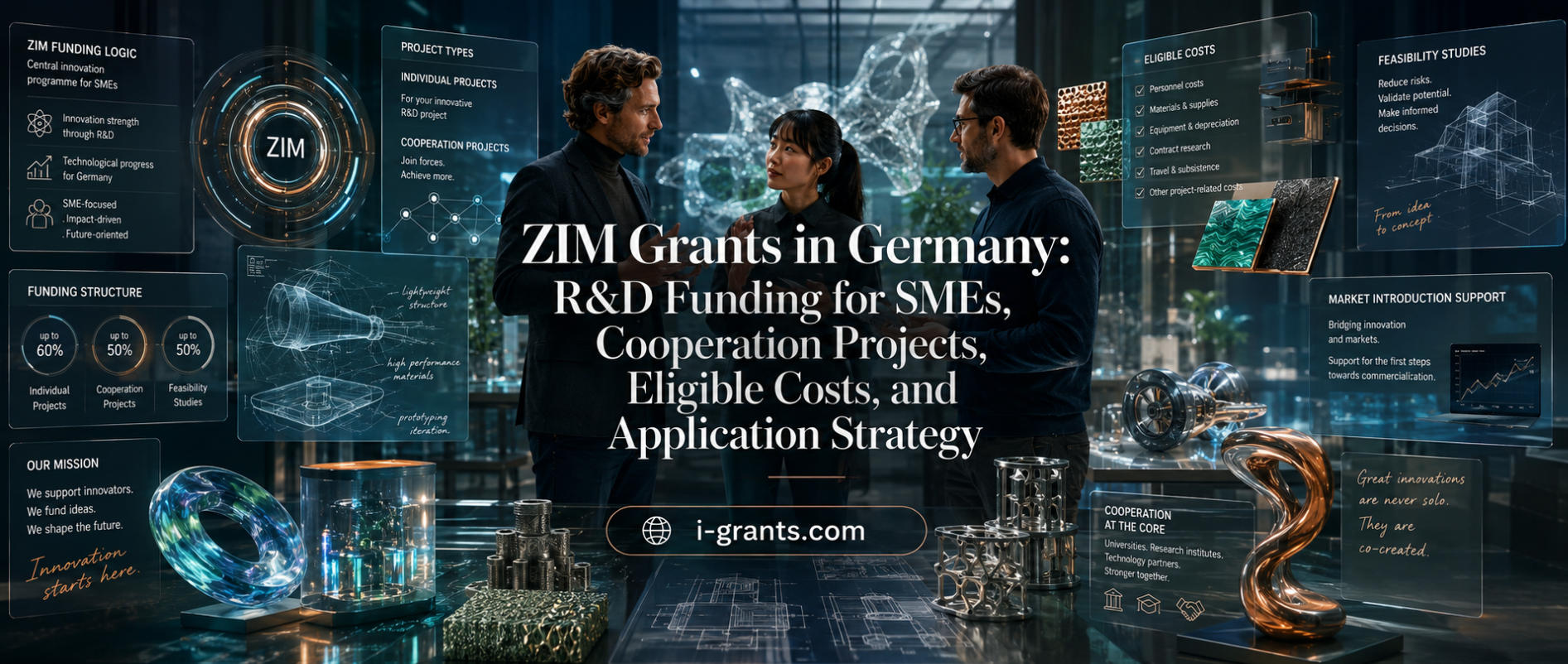
ZIM is one of Germany’s most important funding instruments for innovation in small and medium-sized enterprises. Its full German name is Zentrales Innovationsprogramm Mittelstand, usually translated as the Central Innovation Programme for SMEs. For companies searching for small business grants in Germany, ZIM is often one of the first programmes that appears relevant.
However, ZIM is not a general grant for business growth. It is not designed to finance ordinary expansion, routine digitalisation, general product launch costs, or normal equipment purchases. It is a research and development funding programme for companies that can prove technological innovation, technical uncertainty, market potential, and the capacity to carry out a structured R&D project.
This distinction matters. A company may have a promising product idea and still fail ZIM if the application describes only commercial implementation. A project may be useful for customers and still not be sufficiently innovative. A budget may be realistic for the company and still not match eligible ZIM cost categories. A cooperation may look impressive and still be weak if the partners do not contribute real R&D value.
For SMEs, startups, technical service providers, manufacturers, software-driven firms, and innovation teams in Germany, the practical question is not simply “Can we get ZIM funding?” The better question is: “Can we formulate our project as a credible market-oriented R&D project under the ZIM rules?”
What ZIM actually funds
ZIM supports demanding research and development projects that lead to new products, technical services, or improved production processes. The programme is open across technologies and sectors, which makes it attractive for a wide range of SMEs. A machinery company, sensor developer, medical technology supplier, software-based industrial service provider, climate technology startup, materials company, or production SME may all be potentially relevant.
The programme’s openness should not be misunderstood. ZIM is open by sector, but selective by project quality. The decisive points are technological innovation and good market prospects. The applicant must show that the project goes beyond normal engineering, adaptation, or implementation. It must involve development work with technical uncertainty and a plausible route to commercial use.
A strong ZIM project usually combines four elements: a clear technical problem, a novel solution approach, a structured R&D work plan, and a market reason for developing the result. If one of these elements is missing, the application becomes weaker.
Table 1. What makes a project suitable for ZIM
| Project feature | What ZIM expects | Weak application signal |
|---|---|---|
| Technological novelty | A new or significantly improved product, process, or technical service | The idea is mainly a standard implementation or minor adaptation |
| R&D uncertainty | Technical risks that must be investigated during the project | The result already seems technically solved before the project starts |
| Market orientation | A realistic commercial use after the R&D phase | The application does not explain customers, competition, or market demand |
| Implementation capacity | A team and partners able to carry out the technical work | The applicant lacks technical staff or clear work responsibilities |
| Eligible budget | Costs linked to R&D work packages and programme rules | The budget looks like a general business cost plan |
This is why ZIM applications should not be written like ordinary business plans. A business plan can explain the company and the market, but a ZIM application must also explain the technical development logic.
.jpg)
Who can apply for ZIM
ZIM primarily targets SMEs and other Mittelstand companies with a business presence in Germany. For individual R&D projects, SMEs under the EU definition can apply if they have a permanent establishment or branch in Germany at the relevant time. Certain other medium-sized companies with fewer than 500 employees may also be eligible, depending on the programme rules and the calculation of partner and linked enterprises.
For cooperation projects, the applicant structure can be broader. SMEs and other eligible companies may work with other companies or research institutions. In some cooperation settings, companies with up to 1,000 employees can participate if the project includes at least one funded SME and the cooperation structure meets the programme requirements.
Research institutions can participate as cooperation partners, especially in projects where the research contribution is essential. This is important for technology-heavy SMEs that need laboratory capacity, testing facilities, scientific expertise, or specialised development knowledge.
Table 2. Main applicant types in ZIM
| Applicant type | When it may fit ZIM | Practical implication |
|---|---|---|
| EU-defined SME | The company has a German establishment or branch and prepares an innovative R&D project | This is the core target group for ZIM |
| Other medium-sized company under 500 employees | The company meets the programme conditions and has a German establishment or branch | It may be eligible for individual or cooperation projects |
| Company under 1,000 employees | The company participates in an eligible cooperation project with a funded SME | Eligibility depends on the cooperation structure |
| Research institution | The institution contributes R&D work in a cooperation project | It usually participates as a partner, not as a standard business applicant |
| Freelancer or sole proprietor | The business has an eligible legal and operational form and a credible R&D project | The specific status and project structure must be checked carefully |
The eligibility check should include company size, ownership structure, linked enterprises, location in Germany, financial capacity, and the type of project. A company can be innovative and still not fit the exact applicant rules for a specific ZIM format.
The main ZIM formats
ZIM is not one single grant type. It includes several funding formats, each with its own logic. Choosing the wrong format can weaken the application before the technical content is even assessed.
Individual R&D projects are suitable when one company develops the innovation mainly on its own. Cooperation projects are suitable when several companies or a company and a research institution contribute to the R&D work. Innovation networks support groups of companies that build a shared innovation roadmap. Feasibility studies help certain companies examine whether a later R&D project is technically and economically realistic. Market introduction services can support the exploitation of results after a funded ZIM R&D project.
Table 3. ZIM formats and strategic use
| ZIM format | Best suited for | Strategic question |
|---|---|---|
| Individual R&D project | A company developing a new product, process, or technical service internally | Can the company prove enough technical capacity on its own? |
| Cooperation R&D project | A project involving companies or research partners with complementary roles | Does each partner make a real innovation contribution? |
| Innovation network | A group of companies building a joint technological innovation direction | Is there a shared roadmap and professional network management? |
| Feasibility study | Early testing of whether a future ZIM project is viable | Is the company ready for full R&D, or does it need validation first? |
| Market introduction services | Support after an approved ZIM R&D project | Does the company need external services to bring results closer to the market? |
For many applicants, the choice is between an individual project and a cooperation project. The individual route may be simpler if the company has strong internal R&D capability. A cooperation route may be stronger if the project genuinely requires external technical expertise, a research institution, or a complementary business partner.
However, cooperation should not be added only to make the project look more sophisticated. Evaluators need to see why the partners are necessary and how their tasks fit the R&D objective.
Funding rates and maximum eligible costs
ZIM funding is provided as a non-repayable grant based on eligible costs. The funding rate depends on company size, project type, location, and whether the project includes national or international cooperation.
Under the current 2025-2028 framework, small companies can generally receive higher rates than medium-sized companies. Cooperation projects can receive higher rates than individual projects. International cooperation can increase the rate further, up to the programme’s maximum limits.
Table 4. Indicative ZIM funding rates for companies
| Company category | Individual R&D project | Cooperation R&D project | International cooperation |
|---|---|---|---|
| Small company in a structurally weak region | Up to 45 percent | Up to 55 percent | Up to 60 percent |
| Young small company | Up to 45 percent | Up to 50 percent | Up to 60 percent |
| Small company | Up to 40 percent | Up to 45 percent | Up to 55 percent |
| Medium-sized company | Up to 35 percent | Up to 40 percent | Up to 50 percent |
| Other medium-sized company under 500 employees | Up to 25 percent | Up to 30 percent | Up to 40 percent |
| Company under 1,000 employees in an eligible cooperation | Not usually applicable | Up to 30 percent | Up to 40 percent |
The maximum eligible cost base also depends on the format. For company individual R&D projects, eligible costs may reach up to EUR 690,000. For company partners in cooperation R&D projects, eligible costs may reach up to EUR 560,000 per company. For research institutions, the limit is lower. The total grant amount for a cooperation project is capped, and innovation networks, feasibility studies, and market introduction services have their own limits.
Applicants should not confuse eligible costs with the grant amount. If a company has EUR 500,000 in eligible project costs and a funding rate of 40 percent, the grant is not EUR 500,000. It is calculated as a share of the eligible cost base. Non-eligible costs, internal commercial costs, and costs outside the approved project logic may need to be financed entirely by the company.
Eligible costs in ZIM
A ZIM budget must be built around R&D work, not around the company’s general needs. Eligible costs typically include project-related personnel costs, a surcharge for other costs, costs for external R&D orders, and third-party assignments where allowed by the specific format. For feasibility studies and market introduction support, the cost logic is different and more limited.
The strongest ZIM budgets connect each cost to a work package. If the project includes laboratory testing, prototype development, algorithm development, material trials, technical validation, or pilot production, the budget should show how personnel, external services, and other cost categories support those tasks.
A weak budget often has three problems. It includes costs that belong to sales or ordinary operations. It does not separate R&D tasks from commercial tasks. Or it presents round numbers without explaining how the costs were calculated.
A ZIM budget should therefore answer a technical question, not only a financial one: why is this cost necessary to solve the R&D problem?
What evaluators look for
A ZIM application is assessed through the logic of innovation. The project must not only be desirable for the applicant. It must be technologically meaningful, risky enough to justify public support, and commercially plausible.
The technical part should explain what is new compared with the current state of technology, what technical barriers exist, and how the project will overcome them. The work plan should divide development into credible stages with tasks, milestones, responsibilities, and expected results.
The market part should show that the result has a real use case. This does not require the company to guarantee commercial success, but it should demonstrate market understanding. Who are the likely customers? What problem will the solution solve? What alternatives exist? Why would customers adopt the new product, process, or technical service?
The team part should show that the applicant and partners can carry out the work. This includes technical staff, previous experience, development infrastructure, project management capacity, and, where relevant, research competence.
If the project is a cooperation project, the evaluator will also look at the balance of roles. A partner should not be included only as a supplier or symbolic participant. Each partner should bring a real contribution that strengthens the innovation.
Digital application through Förderzentrale Deutschland
ZIM application procedures are now handled digitally through Förderzentrale Deutschland. This changes the practical preparation process. Applicants must be ready for structured online forms, digital access, document uploads, formal declarations, and communication through the platform.
Digital submission does not make the application less demanding. It means that weak preparation becomes visible earlier. A company that has not clarified its project structure, partner roles, budget categories, work packages, and evidence will struggle to complete a coherent digital application.
The portal should be treated as the final submission environment, not as the beginning of strategy development. Before entering the application, the company should already know the ZIM format, project title, technical objective, applicant data, partner roles, budget structure, state aid information, and expected market result.
For companies working with a grant writer, this is also where coordination matters. The technical team, finance team, management, cooperation partners, and writer need to agree on the same project logic before submission. Otherwise, the digital form can become a patchwork of inconsistent answers.
International cooperation in ZIM
ZIM also supports international cooperation. German companies can cooperate with foreign companies or research institutions, provided the project structure meets the rules and the German participant is eligible for ZIM funding. International cooperation can be attractive because it may increase the funding rate and create access to foreign expertise, markets, testing environments, or technology partners.
However, international cooperation also increases complexity. The application must explain why the foreign partner is needed, how tasks are divided, how intellectual property and results will be handled, and how the cooperation improves the project. The international element should strengthen the R&D case, not only decorate it.
For internationally oriented SMEs, ZIM can be a useful bridge between German public funding and cross-border innovation. But the project must still serve the ZIM purpose: market-oriented technological innovation with strong prospects.
.jpg)
Common reasons ZIM applications fail
Many ZIM applications do not fail because the company is weak. They fail because the project is framed incorrectly. The most common problem is presenting the project as a commercial launch, customer implementation, or standard engineering task rather than as R&D.
Another frequent weakness is vague novelty. Saying that a solution is “innovative”, “digital”, “efficient”, or “AI-based” is not enough. The application must explain what is technically new, what existing solutions cannot do, and what development uncertainty remains.
Market sections can also be too general. A ZIM project needs market prospects, not just enthusiasm. Applicants should show target users, demand drivers, competitive alternatives, pricing or adoption logic, and a realistic route to exploitation.
Cooperation projects often fail when the partnership looks formal. If one partner does all the meaningful work and the others appear peripheral, the cooperation logic is weak. A good cooperation project should show why the partners need each other.
Finally, timing and documentation remain critical. Starting too early, submitting through the wrong route, failing to prepare digital access, or building a budget that does not match eligible costs can damage the application before the innovation is fully assessed.
Readiness check before hiring a grant writer
A grant writer can help a company structure and present a ZIM application, but the company should prepare the core evidence first. The most important preparation is not a polished text. It is a clear technical and strategic foundation.
Before hiring a grant writer or funding consultant, an SME should be able to explain the technical problem, the planned solution, the novelty compared with existing alternatives, the R&D uncertainty, the work packages, the expected result, the target market, the internal team, the partner roles, and the rough budget. If these elements are unclear, the first task is not writing. It is project design.
This is where i-grants.com and Grantologic can create practical value. The right specialist can help an SME choose the correct ZIM format, translate technical development into a fundable work plan, connect costs to eligible categories, and identify weak points before the application is submitted.
Conclusion
ZIM is one of Germany’s strongest innovation funding tools for SMEs, but it is not a simple small business grant. It is a structured R&D programme for companies that can show technological novelty, development risk, market potential, and implementation capacity.
For the right applicant, ZIM can support individual R&D projects, cooperation projects, innovation networks, feasibility studies, and services for market introduction. It can help companies move from technical idea to prototype, from prototype to validated solution, and from validated solution toward market use.
The strongest ZIM applications do not begin with the application form. They begin with a precise innovation logic. The company must know what is new, what is technically uncertain, why the project needs funding, who will do the work, which costs are eligible, and how the result can reach the market.
For SMEs and startups in Germany, ZIM can be a powerful opportunity. But it rewards preparation. A strong project, the right format, a realistic budget, credible partners, and a clear application strategy are what turn an innovative idea into a fundable proposal.