

 Français
  Deutsch
  Українська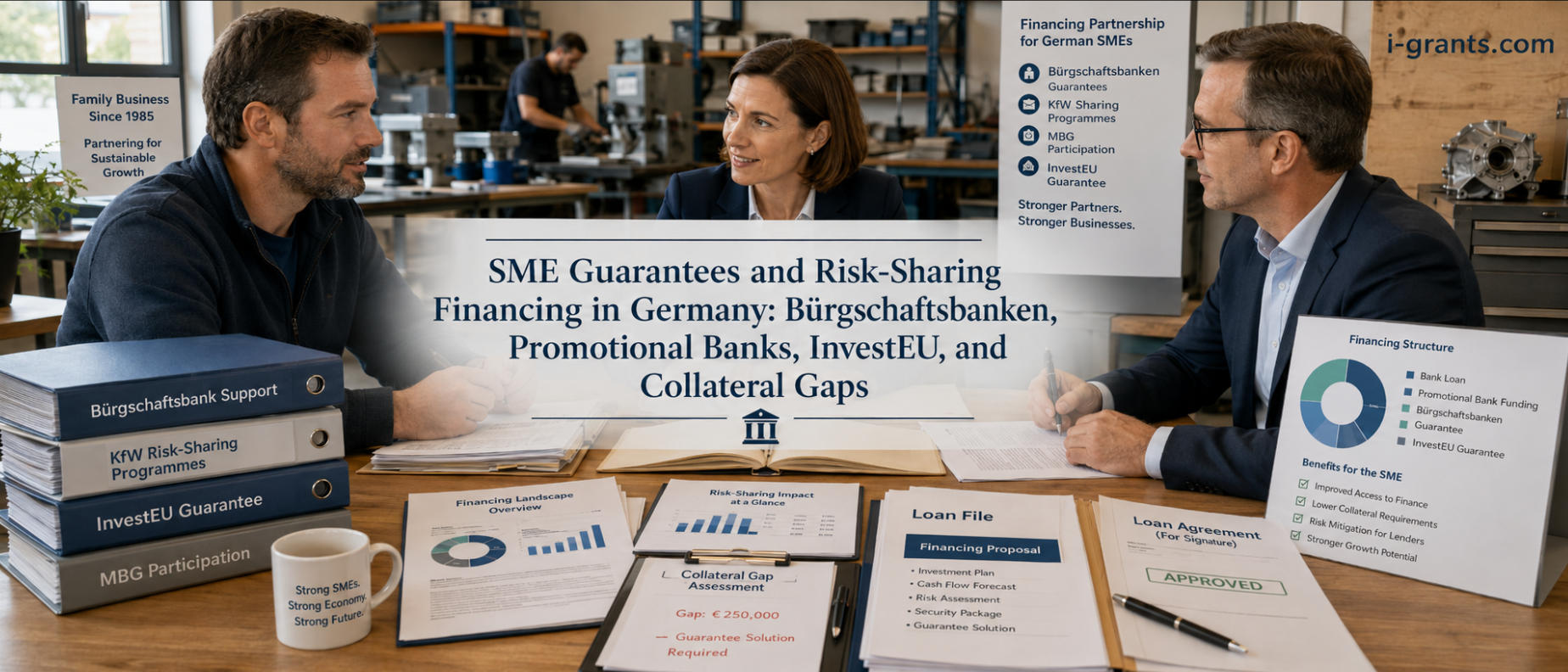
For many German SMEs, the real financing problem is not the absence of funding programmes. It is the gap between a viable business plan and the level of security a bank wants before approving a loan.
This is where guarantees and risk-sharing instruments matter. A business may have a strong order book, a credible investment plan, or a realistic succession project, but still lack sufficient collateral. In Germany, the financing system offers several ways to reduce this gap: Bürgschaftsbanken, guarantees from promotional structures, KfW risk assumption, MBG participation capital, and EU-backed instruments such as InvestEU.
These tools are often less visible than grants, but for many SMEs they are more decisive. A grant may cover a defined eligible cost. A guarantee can make an entire financing package bankable.
Why guarantees matter for German SMEs in 2026
German guarantee banks became more active in 2025. According to preliminary figures from the Verband Deutscher Bürgschaftsbanken, the German Bürgschaftsbanken secured 5,072 project financings with guarantees and participation guarantees in 2025. This was 13.5% more than the previous year. The secured credit and participation volume rose by 8.8% to EUR 1.96 billion.
This growth reflects a practical reality in the SME market. Higher interest rates, weaker macroeconomic conditions, stricter bank risk assessment, and uncertainty around energy, digitalisation, and succession can make banks more cautious. A company may still be economically healthy, but the bank may ask for more collateral, more equity, stronger cash-flow evidence, or a public risk-sharing layer.
A guarantee does not turn a weak project into a strong one. It also does not remove the borrower’s duty to repay the loan. Its value is more specific: it reduces the lender’s loss risk and can help a financing partner approve a project that would otherwise fail because of insufficient collateral.
What is a collateral gap?
A collateral gap appears when the bank sees a project as potentially financeable, but the available security does not fully cover the credit risk. In German financing language, this is often connected to Sicherheiten, rating, debt service capacity, and the bank’s internal risk policy.
The gap can appear in different situations. A startup may have no long track record. A manufacturing SME may need machinery that has limited resale value. A buyer in a business succession may face a high purchase price compared with available private assets. A digitalisation project may create intangible value, such as software, data infrastructure, cybersecurity improvements, or process efficiency, but not much physical collateral. An innovation project may be commercially promising, but uncertain.
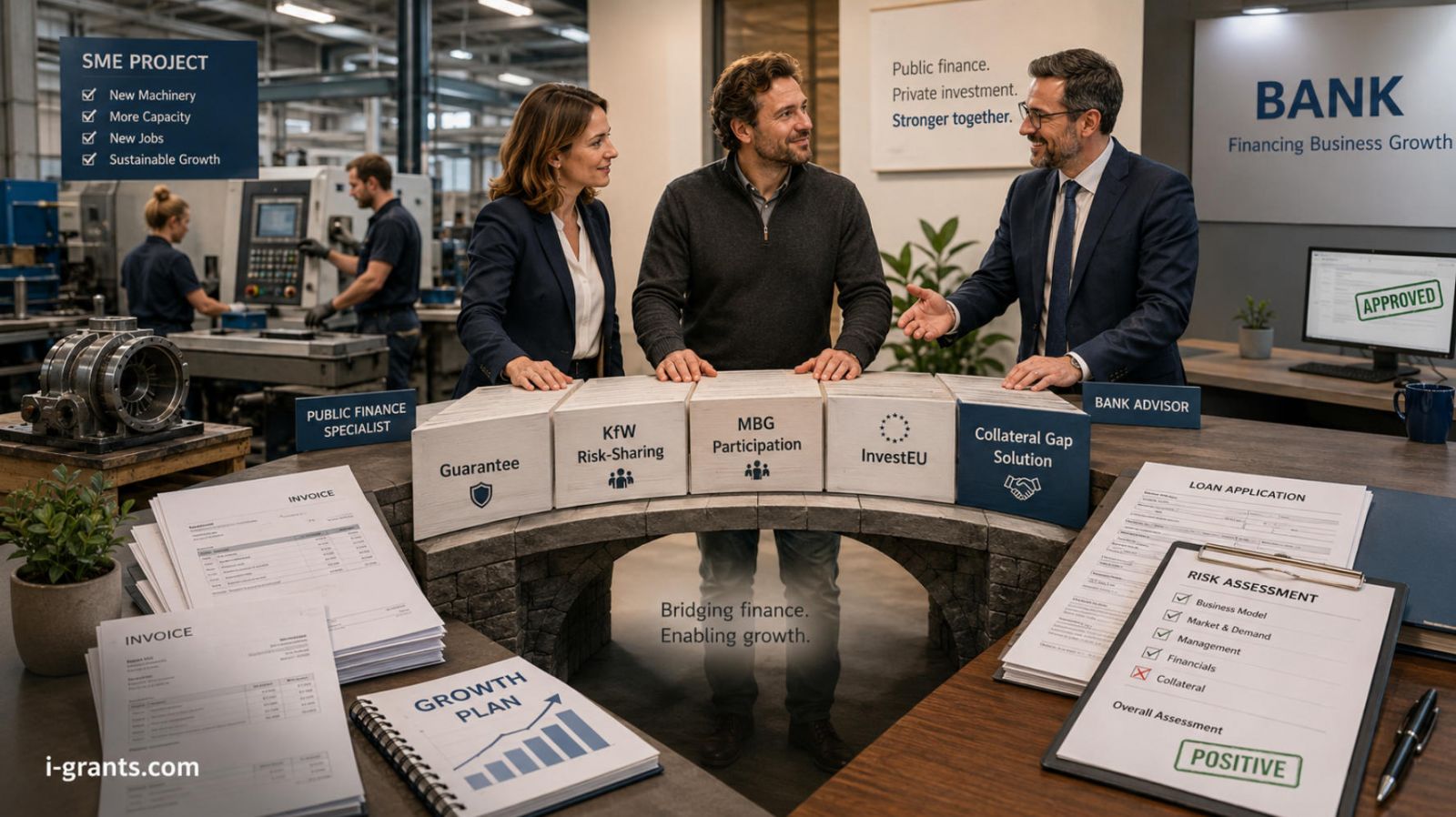
Guarantees and risk-sharing instruments are designed for this type of problem. They are not a substitute for profitability, planning, or compliance. They are a way to align the risk of a viable SME project with the requirements of banks and promotional lenders.
Bürgschaftsbanken: the core German guarantee route
Bürgschaftsbanken are specialised guarantee banks that support SMEs, founders, successors, and professionals when sufficient bank-standard collateral is missing. They work with commercial banks, savings banks, cooperative banks, promotional banks, and other financing partners.
The standard route is usually through the Hausbank. The federal funding database states that applications for Bürgschaftsbank guarantees of up to EUR 2 million are generally submitted via the applicant’s bank, although many Bürgschaftsbanken also allow direct applications below certain limits.
The guarantee bank normally covers only part of the lender’s loss risk. The VDB FAQ explains that a Bürgschaftsbank generally carries up to 80% of the default risk, while the lending institution must accept at least 20% own risk. This point is critical. A guarantee improves bankability, but it does not remove the bank from the decision.
The borrower also remains responsible for repayment. If the loan fails, the guarantee protects the bank, not the entrepreneur from liability. This is why guarantee applications are assessed on commercial viability, repayment capacity, management quality, collateral position, and the purpose of financing.
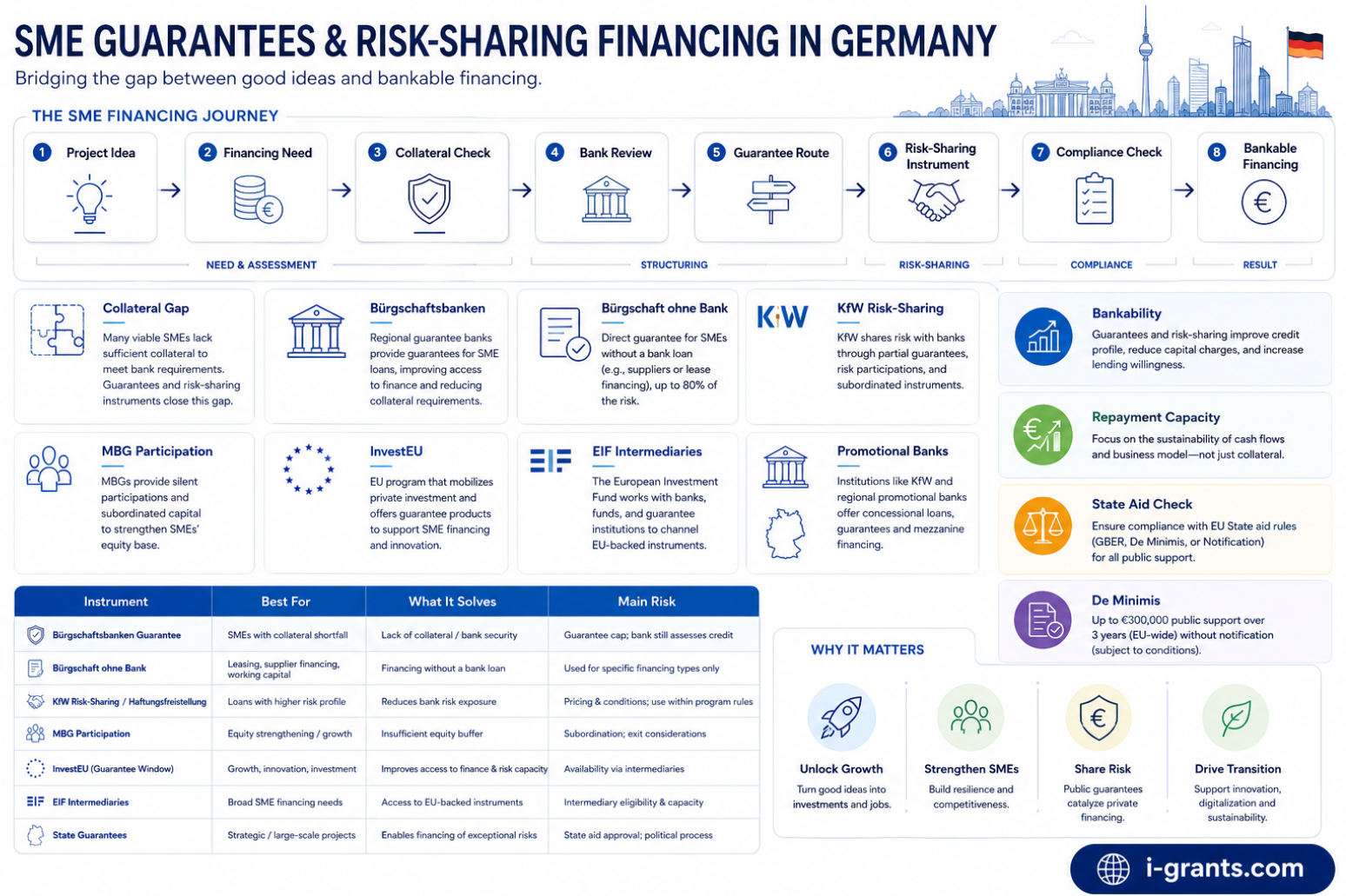
Table 1. Main guarantee and risk-sharing routes for German SMEs
| Route | Best for | What it can solve | Main limitation |
|---|---|---|---|
| Bürgschaftsbank guarantee | SMEs, founders, successors, and professionals with viable projects but insufficient collateral | Reduces the lender’s loss risk and can make a bank loan possible | The bank still keeps own risk and must approve the financing |
| Bürgschaft ohne Bank, BoB | Applicants who want preliminary guarantee support before final bank negotiations | Helps approach banks with a pre-assessed guarantee option | Limits and conditions vary by federal state |
| KfW loan with Haftungsfreistellung | SME investment, startup, succession, working capital, or growth financing through a financing partner | KfW shares part of the credit risk with the financing partner | The borrower remains fully liable for repayment |
| Landesförderinstitut or state guarantee | Larger or state-specific financing needs | Can support financing above standard Bürgschaftsbank limits or within regional schemes | Rules differ significantly by Land |
| MBG silent participation | SMEs with weak equity base or need for mezzanine-like capital | Strengthens economic equity and can improve bankability | It is not a grant and normally involves remuneration and repayment |
| EIF or InvestEU-backed intermediary finance | SMEs needing EU-backed debt, equity, guarantee, innovation, sustainability, or growth finance | Strengthens financial intermediaries’ capacity to take risk | SMEs usually access it through intermediaries, not directly |
 Bürgschaft ohne Bank: useful before the bank discussion
In several federal states, SMEs can use Bürgschaft ohne Bank, often shortened to BoB. The logic is simple: the applicant first approaches the Bürgschaftsbank, receives a preliminary guarantee decision, and then uses that decision in negotiations with a financing bank.
This can be useful when the entrepreneur expects collateral to be the main obstacle. However, it should not be confused with a loan approval. A BoB decision can improve the discussion with banks, but the bank still reviews the project, pricing, repayment capacity, account relationship, and remaining risk.
Conditions differ by Land. For example, some BoB programmes define different maximum financing needs or different guarantee coverage for investment and working capital. This is why applicants should check the Bürgschaftsbank in the federal state where the business or project is located.
KfW Haftungsfreistellung: risk-sharing through the financing partner
KfW programmes often work through the financing partner principle. The SME does not simply receive money directly from KfW. It applies through a bank or another financing partner, which conducts the credit assessment and remains central to the financing decision.
A key term is Haftungsfreistellung. KfW defines it as an agreement on risk distribution between KfW and the on-lending financing partner. The higher the risk assumption, the lower the financing partner’s loss exposure if the borrower defaults. This can help when the applicant has no collateral or only limited collateral.
The ERP-Gründerkredit StartGeld 067 is a clear example. It provides up to EUR 200,000 for setting up and operating a business, including up to EUR 80,000 for working capital, and KfW states that it assumes 80% of the credit risk.
For broader SME financing, the ERP-Förderkredit KMU 365/366 supports investment, working capital, startup, succession, and participation financing. KfW states that the product can finance up to EUR 25 million and that the version with risk assumption can provide up to EUR 25 million for investment, takeover, and participation, plus up to EUR 7.5 million for working capital and inventories. KfW also states that it optionally assumes 50% of the credit risk and that this can make banks more willing to finance projects with limited collateral.
This makes KfW risk-sharing especially relevant for SMEs that need larger financing than a small founder loan, but still face a collateral gap.
Guarantees are not grants
One of the most common misunderstandings is to treat a guarantee like a subsidy. A guarantee is not free money. It is a credit support instrument. It may reduce the bank’s risk, but the SME still signs a loan contract, pays interest, provides available collateral, and repays the debt.
This difference matters for application strategy. A grant application focuses heavily on eligible costs, policy fit, impact, and compliance. A guarantee or risk-sharing application focuses more directly on bankability: repayment capacity, collateral structure, owner contribution, financial statements, cash-flow forecast, and the realism of the investment plan.
For this reason, an SME should not prepare a guarantee case as a simplified grant application. It should prepare it as a professional financing file.
MBGs and silent participation: when the problem is weak equity
Sometimes the financing problem is not only missing collateral. It is also weak equity. If a company has too little own capital, the bank may see the balance sheet as too fragile, even if the project itself is promising.
This is where Mittelständische Beteiligungsgesellschaften, or MBGs, can be relevant. MBGs often provide silent participations or mezzanine-like capital. This can strengthen the economic equity base of an SME and improve its position in bank negotiations.
The federal funding database explains that Bürgschaftsbanken provide guarantees to secure participations by MBGs in medium-sized companies, and that these guarantees are themselves backed by counter-guarantees from the federal government and the relevant Land. It also notes that the aid value of state-backed counter-guarantees must be assessed and communicated to the beneficiary.
This is important for two reasons. First, MBG participation can be part of a wider financing structure, not a standalone solution. Second, it may have state aid implications, so the SME should document cumulation with other support.
InvestEU and EIF-backed finance in Germany
At EU level, InvestEU provides a major risk-sharing framework. The InvestEU Fund is designed to mobilise more than EUR 372 billion of public and private investment through an EU budget guarantee of EUR 26.2 billion. The official InvestEU page also reports EUR 397 billion of investments mobilised as of the end of 2025 and, as of May 2026, EUR 28.1 billion in maximum EU guarantee amount approved by the Investment Committee across 385 approved operations.
For SMEs, the practical point is that InvestEU is usually not a direct application route comparable to a local grant form. It works through implementing partners and financial intermediaries. Banks, funds, guarantee institutions, and other intermediaries use EU-backed risk-sharing to offer finance to final beneficiaries.
The EIF plays a central role in this ecosystem. In Germany, the EIF reported end-2025 figures of EUR 14.3 billion of EIF financing, EUR 58.8 billion made available for SMEs, and 129,488 supported SMEs. The EIF also notes that it works with banks, guarantee institutions, microfinance institutions, and funds that act as financial intermediaries.
For a German SME, this means the relevant question is not only “Can I apply to InvestEU?” but “Which bank, fund, guarantee institution, or promotional intermediary offers an EIF or InvestEU-backed product that fits my project?”
Table 2. Documents needed for a guarantee-ready financing case
| Financing question | Why it matters | Evidence to prepare |
|---|---|---|
| Is the project commercially viable? | Guarantees support viable projects, not weak rescue cases | Business plan, market logic, contracts, sales pipeline, investment plan |
| What exactly is the collateral gap? | The guarantee must solve a specific security problem | Collateral overview, available assets, bank feedback, valuation evidence |
| Can the SME service the debt? | Risk-sharing does not cancel repayment capacity | Liquidity plan, cash-flow forecast, BWA, annual accounts, tax documents |
| Is the owner sharing risk? | Banks often expect meaningful own contribution | Equity contribution, shareholder loans, retained earnings, MBG option |
| Is the project timing compliant? | Many promotional routes require application before project start | Timeline, offers, purchase orders, contract dates, planned start date |
| Are state aid rules respected? | Guarantees, subsidised interest, and grants can all have aid value | De minimis declaration, cumulation statement, prior funding overview |
| Is management credible? | Lenders assess implementation capacity, not only numbers | CVs, sector experience, succession plan, advisory support, references |
State aid and de minimis risks
Guarantees and risk-sharing instruments can involve state aid. This does not mean they are prohibited. It means they must fit the correct legal basis and be documented properly.
Under the current general de minimis rule, Member States cannot grant more than EUR 300,000 of de minimis aid over three years to a single undertaking. For guarantees, the EUR-Lex summary also states that the guarantee must not exceed 80% of the loan at any moment and must remain within defined maximum loan and term parameters for simplified de minimis treatment.
SMEs should be especially careful when combining several instruments. A company may receive a regional grant, a KfW promotional loan with interest advantage, advisory support, a guarantee, and a small digitalisation subsidy. Each instrument may have different state aid treatment. The applicant should not assume that “small” support is irrelevant.
For larger financing packages, professional advice can be useful. The most important practical task is to keep a complete record of previous aid, including de minimis certificates, grant award letters, KfW documents, guarantee approvals, and cumulation declarations.
Application strategy: how to make the case bankable
A strong guarantee application starts before the bank says no. SMEs should approach the financing process with a complete picture of project costs, financing sources, available collateral, expected cash flow, and state aid exposure.
A practical process is to define the financing purpose, calculate the total funding need, separate investment from working capital, identify available collateral, prepare a realistic debt service forecast, speak with the Hausbank, check the relevant Bürgschaftsbank or BoB route, review KfW options with risk assumption, and document state aid cumulation before signing contracts.
This sequence matters because many promotional instruments require the application before the project starts. KfW explicitly tells applicants to apply through the financing partner before beginning the project. Starting too early can make an otherwise suitable project ineligible.
Common mistakes
The first mistake is assuming that a guarantee replaces creditworthiness. It does not. If the business model is weak, if the liquidity plan is unrealistic, or if debt service is not plausible, the guarantee route will not solve the problem.
The second mistake is presenting the collateral gap vaguely. “We do not have enough security” is not enough. The SME should show the investment amount, available collateral, estimated security values, bank requirements, uncovered risk, and proposed guarantee coverage.
The third mistake is confusing the different layers of support. Bürgschaftsbank guarantees, KfW Haftungsfreistellung, MBG participation, state guarantees, and InvestEU-backed intermediary finance all reduce risk in different ways. They are not interchangeable.
The fourth mistake is ignoring the Hausbank relationship. Even where a direct guarantee route exists, the financing partner remains central to many SME financing packages. A prepared bank meeting can be more valuable than sending incomplete documents to multiple institutions.
The fifth mistake is forgetting compliance. De minimis limits, cumulation rules, SME status, sector exclusions, project start rules, and aid value calculations can affect the final structure.
When a guarantee makes sense
A guarantee or risk-sharing route is most suitable when the SME can show a commercially reasonable project, a clear financing need, realistic repayment capacity, and a specific collateral gap. It is less suitable when the business needs emergency rescue, has no viable cash-flow path, or wants to replace equity entirely with debt.
The strongest cases usually combine several elements: a credible owner contribution, a bank that understands the sector, a well-prepared business plan, a transparent collateral overview, and a funding structure that matches the project. For example, a succession financing case may combine buyer equity, ERP-Förderkredit KMU, a Bürgschaftsbank guarantee, advisory support, and documented de minimis compliance. A digitalisation investment may combine own funds, a KfW loan with risk assumption, and a regional subsidy where eligible.
Conclusion
German SME funding is not only about grants. In many cases, the decisive question is whether a bank can finance the project despite limited collateral. Bürgschaftsbanken, KfW risk-sharing, MBG participation, state guarantee structures, EIF intermediaries, and InvestEU-backed finance all help address this problem.
For applicants, the strategic lesson is clear: do not treat guarantees as a last-minute rescue tool. Treat them as part of the financing design. A guarantee-ready SME prepares its numbers, explains the collateral gap, proves repayment capacity, checks state aid exposure, and approaches banks with a structured case.
For grant writers and funding advisors, this is an important advisory opportunity. Many German SMEs ask for grants when they actually need bankable financing. The best solution may be a grant, a promotional loan, a guarantee, or a blended structure. The expert task is to know the difference and build the route that fits the project.