

 Français
  Deutsch
  Українська
Finding business grants in France is not only a matter of searching for the word “grant”. The French public funding system includes grants, repayable advances, subsidised loans, guarantees, tax incentives, diagnostic support, regional aid and European programmes. Many of these instruments are listed in public databases, but the final conditions are usually set by a specific operator, such as Bpifrance, ADEME, a regional authority, a France 2030 programme manager or the European Commission.
This means that an SME should not begin with a generic internet search. It should begin with a clear project, a defined location, a realistic budget and a structured search across official sources.
Aides-entreprises, the public reference database for business aid in France, lists more than 2,000 support and financial aid schemes offered by public authorities for business creation and development. It allows companies to search by project, territory or financing organisation, and it provides information on objectives, beneficiaries, amounts and award conditions.
For SMEs and startups, the key challenge is therefore not the absence of funding opportunities. The challenge is choosing the right funding route and verifying that the opportunity is real, open, relevant and compatible with the company’s project.
Start with the project, not with the grant
A French company looking for public funding should first describe the project it wants to finance. A weak search begins with a vague phrase such as “I need a grant for my business”. A strong search begins with a concrete funding need: a feasibility study, a prototype, a production line, an energy audit, a digital transformation project, export development, a regional investment or a collaborative research project.
This matters because French funding sources are usually organised around project objectives. Bpifrance may be relevant for innovation, growth, guarantees and startup financing. ADEME is more relevant for energy, circular economy and decarbonisation. Regional portals are often more useful for local investment, digitalisation, employment and territorial development. European programmes are usually appropriate when the project has a clear European, research, climate or breakthrough innovation dimension.
The company should define the project before comparing schemes. The most important questions are: what will be done, where it will be done, when the project starts, what it will cost, which costs are eligible, what impact it will create and how the non-funded part will be financed.
Table 1. Official Sources for Finding Business Grants in France
| Source | Best used for | What to check first |
|---|---|---|
| Aides-entreprises | First search across public aid for business creation and development | Project type, territory, financing organisation, beneficiaries and award conditions |
| Bpifrance | Innovation, loans, guarantees, growth financing, startup support and some France 2030 calls | Instrument type, company stage, application route and whether contact with a regional office is required |
| ADEME Agir pour la transition | Energy efficiency, decarbonisation, circular economy, ecodesign and environmental projects | Eligible project type, deadline, territory, eligible expenditure and expected environmental impact |
| Regional authority websites | Local investment, digitalisation, export, job creation, regional innovation and FEDER opportunities | Region, project site, company size, local economic commitments and co-financing |
| France 2030 pages and operators | Strategic innovation, industrial capacity, deeptech, green transition and regionalised calls | Open calls, operator, sector, maturity level, project size and expected strategic impact |
| EU Funding and Tenders Portal | Horizon Europe, EIC Accelerator, LIFE, Digital Europe, Interreg and other EU programmes | Call topic, deadline, consortium rules, European added value and evaluation criteria |
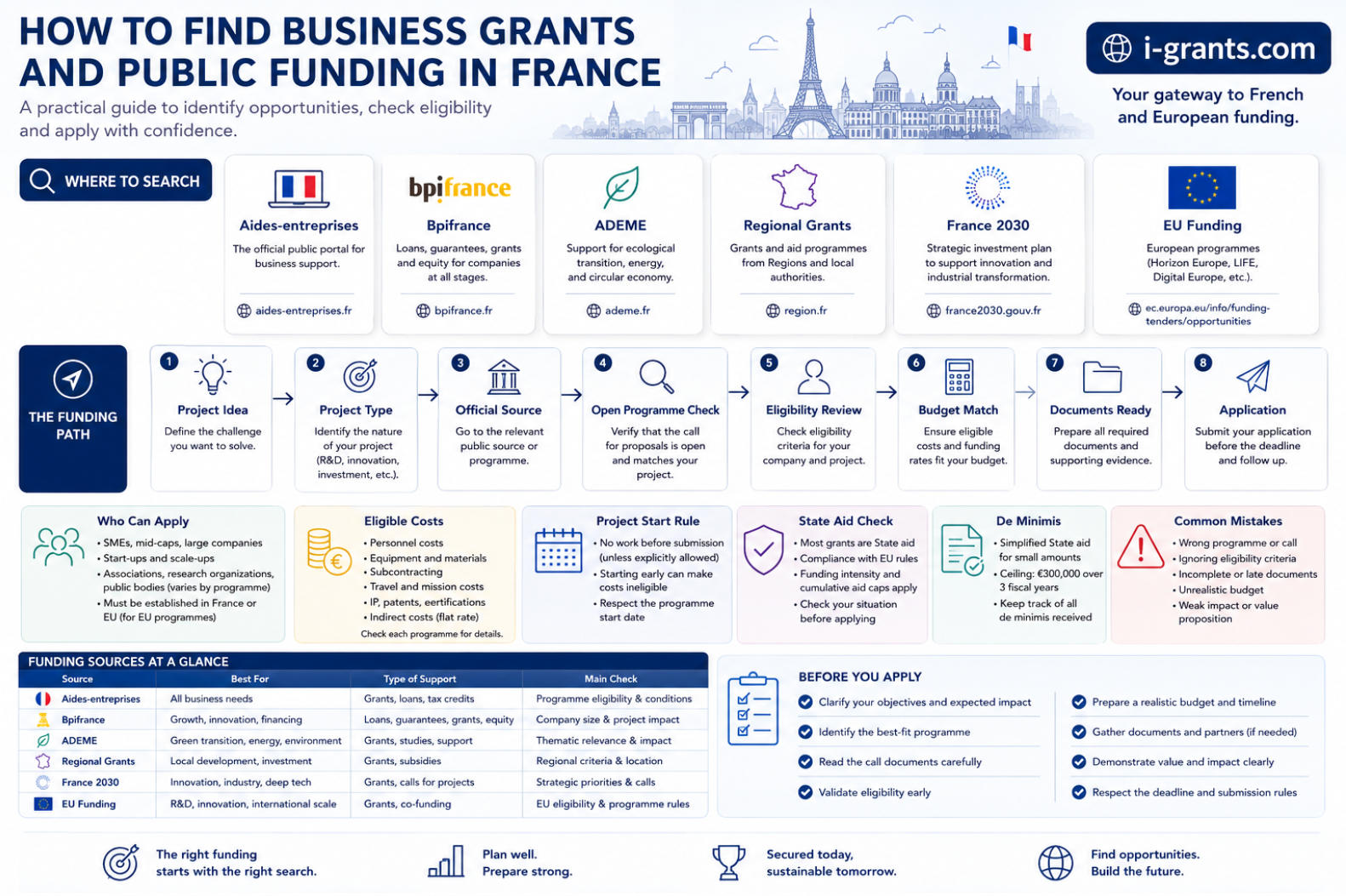
Aides-entreprises: the first official search point
Aides-entreprises should usually be the first search point when a company does not yet know which public body is relevant. It is not a single grant programme. It is a public reference database that helps businesses identify aid schemes for creation or development.
Its main value is breadth. A company can search by project, territory or financing organisation, which is especially useful because many French aid schemes are regional or sector-specific. A search for “innovation”, “energy”, “export”, “digitalisation” or “investment” can produce very different results depending on the region and the type of applicant.
However, Aides-entreprises is not the final application page. It is a navigation tool. Once a company finds a possible scheme, it must verify the official page of the real operator. This may be Bpifrance, ADEME, a region, a chamber of commerce, a local authority or another public body.
A serious applicant should record the official operator, the current status of the scheme, the deadline, the eligible costs, the company profile, the State aid basis and the contact or submission route before investing time in a full application.
Bpifrance: grants, loans, guarantees and innovation finance
Bpifrance is a central institution for French SME and startup finance. Its catalogue covers several types of business needs, including company creation, growth financing, innovation and international expansion.
The most important point is that Bpifrance is not only a grant provider. It can offer or operate innovation grants, repayable advances, innovation loans, bank guarantees, equity investment, export support, diagnostics and calls linked to national priorities. Some instruments are continuous products, while others are competitive calls with deadlines.
For example, Bpifrance’s Subvention Innovation helps finance part of internal and external research and development expenditure linked to an innovation project for SMEs under the European definition. Other Bpifrance instruments may be loans or guarantees rather than grants, which means the company must assess repayment capacity and bankability, not only eligibility.
When using the Bpifrance catalogue, companies should pay attention to the wording of the instrument. A “subvention” may be non-repayable if conditions are met. A “prêt” is debt. A “garantie” helps unlock bank financing but does not provide cash directly. An “avance remboursable” must usually be repaid fully or partly. This distinction affects the company’s budget, cash flow and risk.
ADEME: the main source for green transition funding
ADEME, the French Agency for Ecological Transition, is the key source for companies seeking support for environmental and energy projects. Its business portal helps companies find financial aid such as grants, calls for projects, diagnostics and studies offered by ADEME and other public actors, including regions, chambers of commerce and chambers of trades.
ADEME-related opportunities may support energy efficiency, renewable heat, industrial decarbonisation, circular economy, waste reduction, ecodesign, sustainable mobility, environmental research and changes in production processes.
For these schemes, a company must usually do more than describe an investment. It should quantify the environmental effect. This can include energy savings, reduced greenhouse gas emissions, lower material consumption, waste prevention or improved production efficiency.
ADEME funding should be checked carefully because calls may differ by technology, sector, company size, region, deadline and type of eligible expenditure. Some schemes support studies or diagnostics, while others support major industrial investment. The applicant must verify whether salaries, external services, equipment, construction, audits, prototypes or demonstration activities are eligible.
Regional grants, FEDER and France 2030 régionalisé
Regional funding is essential in France. For many conventional SMEs, a regional grant or regionalised programme may be more realistic than a national innovation competition. Regional authorities and development agencies can support investment, business creation, innovation, digitalisation, export, ecological transition, recruitment and territorial development.
Regional aid is often linked to the place where the project is implemented. A company may need to show that the financed assets will remain in the region, that jobs will be created or maintained, or that the project supports a local economic priority.
The European Regional Development Fund is also important. For 2021 to 2027, the ERDF in France represents more than €9 billion distributed through programmes in mainland France, overseas territories and European territorial cooperation. A French SME may therefore find EU-backed support through a regional programme rather than directly through a European Commission call.
France 2030 régionalisé is another route to watch. Bpifrance describes the regionalised innovation projects action as support for individual R&D projects with strong growth potential, aiming to accelerate the emergence of leading companies in the territory. In practice, this means that some strategic national priorities are implemented with regional authorities and may be more accessible to SMEs than a fully national competition.
EU funding for French SMEs
French SMEs can also search for European funding opportunities. The EU Funding and Tenders Portal is the main entry point for finding EU calls, searching for funding opportunities, finding partners and submitting proposals.
EU funding is not the best route for every company. It is usually appropriate when the project has a European dimension, strong innovation potential, international partners, measurable climate impact or a technology that could scale beyond France.
Horizon Europe can be relevant for collaborative research and innovation. Eurostars supports international R&D projects led by innovative SMEs. LIFE can support environmental and climate projects. Digital Europe focuses on advanced digital deployment, data, artificial intelligence, cybersecurity and digital skills. The EIC Accelerator supports startups and SMEs with game-changing products, services or business models that can create new markets or disrupt existing ones.
The EIC Accelerator can offer substantial support, but it is highly competitive. In 2026, the European Innovation Council stated that the programme supports startups and small businesses with grant funding of up to €2.5 million, complemented by equity investments from the EIC Fund. This route is best suited to companies with breakthrough innovation, strong growth ambition and funding needs that are too risky for private investors alone.
How to verify a French funding opportunity
Finding a programme is only the beginning. Before preparing an application, the company must check whether the opportunity is current, official and suitable.
Table 2. How to Verify a French Funding Opportunity Before Applying
| Check | Question to ask | Why it matters |
|---|---|---|
| Operator | Who actually receives the application? | A catalogue may only redirect to the real funder |
| Status | Is the scheme open, closed, suspended or archived? | Many programmes operate by deadlines or application waves |
| Territory | Is the project located in the eligible region, department or municipality? | Regional aid often applies only to specific areas |
| Applicant profile | Are SMEs, startups, micro-enterprises, mid-caps, associations or consortia eligible? | A wrong applicant profile makes the application invalid or weak |
| Project fit | Does the project match the programme objective? | General business growth is often not specific enough |
| Eligible costs | Are salaries, equipment, services, studies or prototypes covered? | Ineligible costs will not be reimbursed |
| Project start | Can the company begin spending before submission or approval? | Starting too early can make costs ineligible |
| Co-financing | What share must the company finance itself? | Most programmes do not fund the whole project |
| State aid | Can this aid be combined with other public support? | Wrong cumulation can create repayment risk |
| Evidence | What financial, technical and legal documents are required? | Weak documentation can damage a strong project |
State aid must be checked early. Under the current general de minimis rule, Member States cannot grant more than €300,000 over three years to a single undertaking, including relevant linked enterprises. This is not the maximum for all aid, but it is a common limit for small public support schemes and must be monitored by the company group.
Table 3. Best Search Route by Project Type
| Project type | First sources to check | Typical instrument |
|---|---|---|
| Early innovation or feasibility study | Bpifrance, regional innovation schemes, Aides-entreprises | Grant, repayable advance or diagnostic support |
| Industrial investment | Regional portals, Bpifrance, France 2030 régionalisé, FEDER | Investment aid, loan, guarantee or repayable advance |
| Energy efficiency or decarbonisation | ADEME, regional portals, France 2030, Aides-entreprises | Grant, audit support, investment aid or loan |
| Digitalisation or AI adoption | Regional portals, Bpifrance, France Num, Digital Europe where relevant | Diagnostic support, grant or loan |
| Export development | Bpifrance, regional internationalisation schemes, Business France ecosystem | Advisory support, guarantee, insurance or loan |
| Collaborative R&D with partners | Horizon Europe, Eurostars, Bpifrance, regional innovation programmes | EU grant, national co-financing or repayable advance |
| Breakthrough startup innovation | EIC Accelerator, Bpifrance, France 2030, deeptech programmes | Grant, equity, repayable advance or blended finance |
Common mistakes when searching for grants in France
Many SMEs waste time because they search too broadly or trust incomplete information. The first common mistake is looking only for the English word “grant” and ignoring French terms such as subvention, avance remboursable, prêt, garantie, aide fiscale, diagnostic and accompagnement. A company that searches only for grants may miss the instrument that actually fits its project.
The second mistake is treating a private database as final proof. Private tools can help with discovery, but the final rules must always come from the official operator.
The third mistake is ignoring regional programmes. Many SMEs are not suitable for national competitions, but they may be strong candidates for regional investment, digitalisation, export or environmental aid.
The fourth mistake is confusing a funding catalogue with an open call. A catalogue entry may describe a scheme, but the company must still verify whether applications are currently accepted.
The fifth mistake is starting expenses too early. If a programme requires application before project start, signed contracts, supplier orders or construction work may make the expenditure ineligible.
When a grant writer or funding consultant can help
A grant writer becomes useful when the funding landscape is unclear, the application is technical, the budget is large, several instruments are combined or the project involves research and development, environmental impact, State aid rules or a consortium.
A consultant should not simply “write a nice text”. The real value is in matching the project with the right funding source, identifying eligible costs, building the application logic, checking compliance risks and preparing the evidence required by the operator.
For French SME funding, the consultant should also understand the difference between a grant, a repayable advance, a loan, a guarantee, a tax credit and an EU-funded call. Choosing the wrong instrument can create cash-flow problems even when the application is successful.
Final assessment
France offers many real funding opportunities for SMEs and startups, but they are not concentrated in one place and they do not all work like grants. A good search strategy begins with a clear project and then moves through official sources: Aides-entreprises for the broad national overview, Bpifrance for innovation and finance, ADEME for green transition, regional portals for local aid, France 2030 for strategic calls and the EU Funding and Tenders Portal for European programmes.
The strongest applicants do not chase the largest advertised amount. They verify the operator, deadline, territory, applicant profile, eligible costs, co-financing, project start rule and State aid basis before preparing the application.
For companies, this disciplined search can save time and prevent costly mistakes. Through i-grants.com, SMEs and startups can connect with grant writers and funding specialists who understand French, regional and European funding routes and can help turn a business project into a structured application.