

 Français
  Deutsch
  Українська
France has one of Europe’s strongest public funding ecosystems for small businesses, SMEs and startups. A company can find grants, repayable advances, subsidised loans, bank guarantees, tax credits, regional investment aid, environmental support and European programmes. The challenge is that these instruments are spread across many public bodies and are rarely designed as simple “free money” for ordinary business costs.
In 2025, France reached a new record for business creation, with 1,165,800 new businesses registered. This was 5 percent more than in 2024, after growth of 6 percent in 2024. The numbers show a dynamic entrepreneurial market, but they do not mean that every new company can receive a public grant. Many registrations are individual businesses or micro-entrepreneurs, while larger grant and innovation schemes usually require a structured project, eligible costs, co-financing and clear economic impact.
For SMEs and startups, the key lesson is simple: France does not have one universal small business grant. Instead, it has a layered funding system. A company must match its project with the right instrument, the right operator and the right call for proposals.
How the French SME funding system works
French public funding is delivered through several levels. Bpifrance is central for innovation, loans, guarantees, growth financing and some France 2030 calls. ADEME supports environmental transition, energy efficiency, circular economy and decarbonisation projects. Regions provide local aid for investment, innovation, digitalisation, export, job creation and territorial development. The European Union adds further opportunities through Horizon Europe, EIC Accelerator, Eurostars, LIFE, Digital Europe, Interreg and FEDER.
The system is rich, but also complex. Aides-entreprises describes itself as the reference public database for business aid in France and lists more than 2,000 public financial aids. This confirms why companies often struggle to identify the right route without a structured search process.
A French business should not start by asking, “Which grant can I get?” A better question is: “What project am I financing, which costs are eligible, and which public instrument fits the project stage?”
Who qualifies as an SME in France?
Most French and EU programmes use the European Commission SME definition. A company normally qualifies as an SME if it has fewer than 250 employees and meets either the turnover ceiling or the balance sheet ceiling. Partner and linked companies may also need to be included in the calculation, which is especially important for subsidiaries, corporate groups and investor-backed startups.
Table 1. SME Size Thresholds Commonly Used in French Funding Programmes
| Category | Employees | Annual turnover | Annual balance sheet total |
|---|---|---|---|
| Micro-enterprise | Fewer than 10 | Up to €2 million | Up to €2 million |
| Small enterprise | Fewer than 50 | Up to €10 million | Up to €10 million |
| Medium-sized enterprise | Fewer than 250 | Up to €50 million | Up to €43 million |
SME status is only the first filter. A programme may also require a French establishment, a specific region, a defined sector, a minimum level of equity, intellectual property rights, an innovation component, a project site in France or evidence that the project will create jobs or economic value.
Micro-entrepreneurs are not automatically excluded from all aid, but many major innovation and industrial programmes are designed for incorporated companies that can sign contracts, hire staff, finance part of the project and manage reporting obligations.
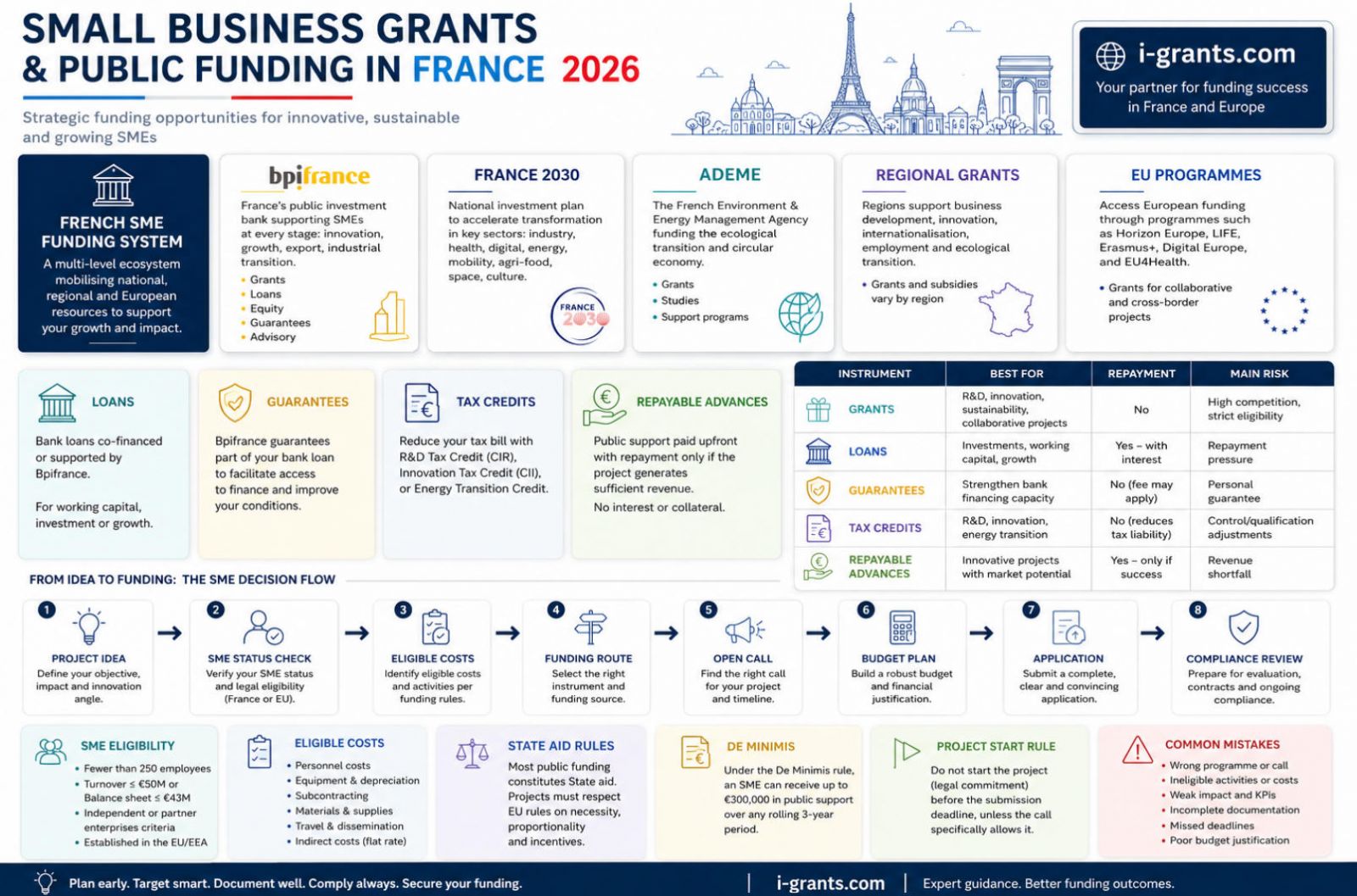
Main types of public funding in France
The word “grant” is often used too broadly. In France, public support can take several financial forms, each with different consequences for the applicant.
Table 2. Main Funding Instruments for French SMEs and Startups
| Instrument | Repayment | Typical use | Main risk or condition |
|---|---|---|---|
| Grant or subvention | Usually no repayment if conditions are met | R&D, innovation, green transition, studies, investment | Strict eligible cost rules |
| Repayable advance | Repaid fully or partly | Innovation projects with commercial potential | Repayment may depend on project results |
| Subsidised loan | Repaid | Equipment, growth, industrialisation, digitalisation | The company must show repayment capacity |
| Bank guarantee | Not a direct payment | Access to bank loans | It reduces lender risk but does not replace financing |
| Equity investment | No scheduled repayment | Startup growth, deeptech, scale-up | Founders give up part of ownership |
| Tax credit | Claimed through tax system | Research, development and innovation | Requires strong technical and financial documentation |
| Diagnostic or advisory aid | Usually partial support | AI, energy, export, cybersecurity, strategy | Often funds a service, not general spending |
| EU grant | Usually no repayment | International R&D, climate, digital, innovation | High competition and complex applications |
The best funding plan often combines several instruments. For example, a deeptech startup may use a grant for feasibility, a repayable advance for development, equity for hiring and a guaranteed loan for equipment. A manufacturing SME may combine regional aid, an ADEME programme, a bank loan and a Bpifrance guarantee.
The main rule is that the same eligible cost cannot be financed twice. Public aid must respect State aid rules, cumulation limits and programme-specific ceilings.
Bpifrance: the central institution for SME finance
Bpifrance is one of the most important financing institutions for French businesses. It provides innovation finance, loans, bank guarantees, equity investment, export support and advisory services. It also operates or co-operates several public programmes, including calls linked to France 2030.
Bpifrance reported record activity in 2025, with €72 billion deployed into the French economy. Its 2025 activity review also reported €3.4 billion deployed to almost 4,900 businesses for innovation financing.
For SMEs, Bpifrance should not be seen only as a grant provider. Its role is broader. It can help a company test an innovation project, finance development, share risk with a commercial bank, support industrialisation, back export activity or participate in growth financing.
Typical Bpifrance-related routes include innovation grants, repayable advances, innovation loans, seed and growth investment, startup support, guarantees for bank loans and programmes connected with regions or national priorities. Some instruments are available through online catalogues, while others require contact with a regional Bpifrance office, a partner bank or a specific call for projects.
France 2030: strategic funding for innovation and industry
France 2030 is a national investment plan with a budget of €54 billion. It is designed to support strategic sectors, ecological transition, competitiveness and future industrial champions.
France 2030 is not one grant programme. It is an umbrella for many calls, competitions and investment schemes. Depending on the topic, programmes can be operated by Bpifrance, ADEME, Banque des Territoires, the French National Research Agency or other public bodies.
For SMEs and startups, France 2030 can be relevant in areas such as low-carbon industry, health innovation, biotechnology, sustainable transport, electronics, robotics, artificial intelligence, cybersecurity, cloud technologies, space, agriculture, food, training and industrial startup production capacity.
The practical question is not whether a company is “eligible for France 2030” in general. The real question is whether it fits a specific open call, with the right sector, maturity level, budget size, project location and expected impact.
ADEME and green transition funding
ADEME, the French Agency for Ecological Transition, is a key source of support for environmental and energy projects. Its business funding portal helps companies find grants, calls for projects, diagnostics and studies offered by ADEME and other public actors, including regions, chambers of commerce and chambers of trades.
ADEME-related opportunities may support energy efficiency, renewable heat, industrial decarbonisation, circular economy, waste reduction, ecodesign, sustainable mobility, environmental research and changes in production processes.
A strong environmental funding application should quantify the expected impact. This can include energy savings, greenhouse gas reduction, lower material use, waste prevention or measurable improvements in production efficiency.
Regional grants and EU funding
French regions are highly important for SME funding. Regional councils and development agencies can support investment, business creation, innovation, digital transformation, export, ecological transition and job creation. In many cases, regional programmes are more accessible for conventional SMEs than national innovation competitions.
Regional funding may also be combined with FEDER, the European Regional Development Fund. This is especially relevant for companies investing in local development, innovation capacity, digitalisation, industrial competitiveness or environmental transition.
French SMEs can also apply for EU programmes. Horizon Europe is relevant for collaborative research and innovation. Eurostars supports international R&D projects led by innovative SMEs. The EIC Accelerator targets high-potential breakthrough companies. LIFE supports environmental and climate projects. Digital Europe focuses on advanced digital deployment, data, AI, cybersecurity and digital skills.
EU funding can be attractive because grant amounts may be high. However, competition is strong and applications usually require a clear European dimension, strong project management and convincing evidence of impact.
How much funding can a company receive?
There is no standard amount. Small diagnostic programmes may cover a few thousand euros. Feasibility and innovation grants may cover a limited early-stage budget. Industrialisation, R&D or decarbonisation projects may reach hundreds of thousands or several million euros through a mix of grants, repayable advances, loans and guarantees.
The final amount depends on eligible costs, company size, project type, location, State aid basis, co-financing, programme budget and maximum aid intensity. A high ceiling does not mean that every applicant should request the maximum amount.
Public funding rarely covers the full project. A company must usually show that it can finance the remaining costs through equity, cash reserves, bank finance, investors or other confirmed resources.
State aid, de minimis and cumulation
Many French business aids are governed by EU State aid rules. Under the current general de minimis rule, one single undertaking can receive up to €300,000 of de minimis aid over a three-year period. The “single undertaking” concept may include linked companies, not just the legal entity applying for funding.
This ceiling is not the maximum for all public funding. Larger aid can be awarded under other legal bases, such as rules for research, innovation, environmental protection, training or regional investment. The applicant must understand which basis applies and whether several sources can be combined for the same project.
Incorrect declarations can lead to a reduction, cancellation or recovery of aid. Companies should keep a clear record of all grants, subsidised loans, guarantees, tax advantages and other public support received by the group.
Project start and eligible costs
One of the most common mistakes is starting too early. Many programmes require the application to be submitted before the project begins or before the company makes an irreversible commitment. Signing an equipment order, starting construction or confirming a supplier contract may make the cost ineligible.
Eligible costs also vary by programme. They may include salaries, external services, research, prototypes, testing, equipment, software, patents, energy studies or consultancy. Routine operating costs, past expenses, unrelated working capital, recoverable VAT, debt refinancing and dividends are usually excluded.
Before applying, the company should build a simple cost eligibility matrix. Each budget line should be connected to the official programme rules.
Where to find real funding opportunities
The best official search channels are Aides-entreprises for public aid, Bpifrance for innovation, loans and guarantees, ADEME for ecological transition, regional authority websites for local programmes, France 2030 pages for strategic calls and the EU Funding and Tenders Portal for European programmes.
A practical search process should follow this order: define the project, identify eligible costs, confirm SME status, check location and sector requirements, choose the funding instrument, verify open calls, review State aid rules, prepare the budget and submit before starting the project.
Private grant databases and consultants can help, but the final conditions must always be checked on the official page of the programme operator.
Common mistakes to avoid
Many rejected applications fail because the funding strategy is weak, not because the project is useless.
The most common mistakes are searching only for non-repayable grants, choosing a famous programme instead of the right programme, confusing a new business with an innovative project, ignoring co-financing needs, forgetting linked companies in SME calculations, starting the project before approval and treating a grant as immediate cash.
A good application must show why public support is justified, how the project will be delivered, what results will be achieved and how the company will finance the part not covered by public aid.
When a grant writer can help
A grant writer or funding consultant is useful when the application is technical, the budget is large, several instruments are combined, State aid rules are unclear, the project involves R&D, or the company lacks internal capacity.
The consultant should not invent innovation or financial strength. Their role is to match the project with the right funding route, structure the evidence, prepare the application logic, align the budget with eligible costs and reduce compliance risks.
Final assessment
France offers real funding opportunities for SMEs and startups, but successful applicants do not search for “free money”. They build a fundable project.
A strong funding strategy starts with a clear business objective, eligible costs, measurable impact, a realistic budget, co-financing and careful review of official rules. Bpifrance, France 2030, ADEME, regions and EU programmes can all be valuable, but each serves a different purpose.
For SMEs, the best result often comes from combining grants, repayable advances, loans, guarantees, tax incentives and private capital. The right mix depends on the company’s size, sector, project stage and financial capacity.
Through i-grants.com, companies can connect with grant writers and funding specialists who understand French, regional and European programmes and can help turn a business project into a structured funding application.