

 Français
  Deutsch
  Українська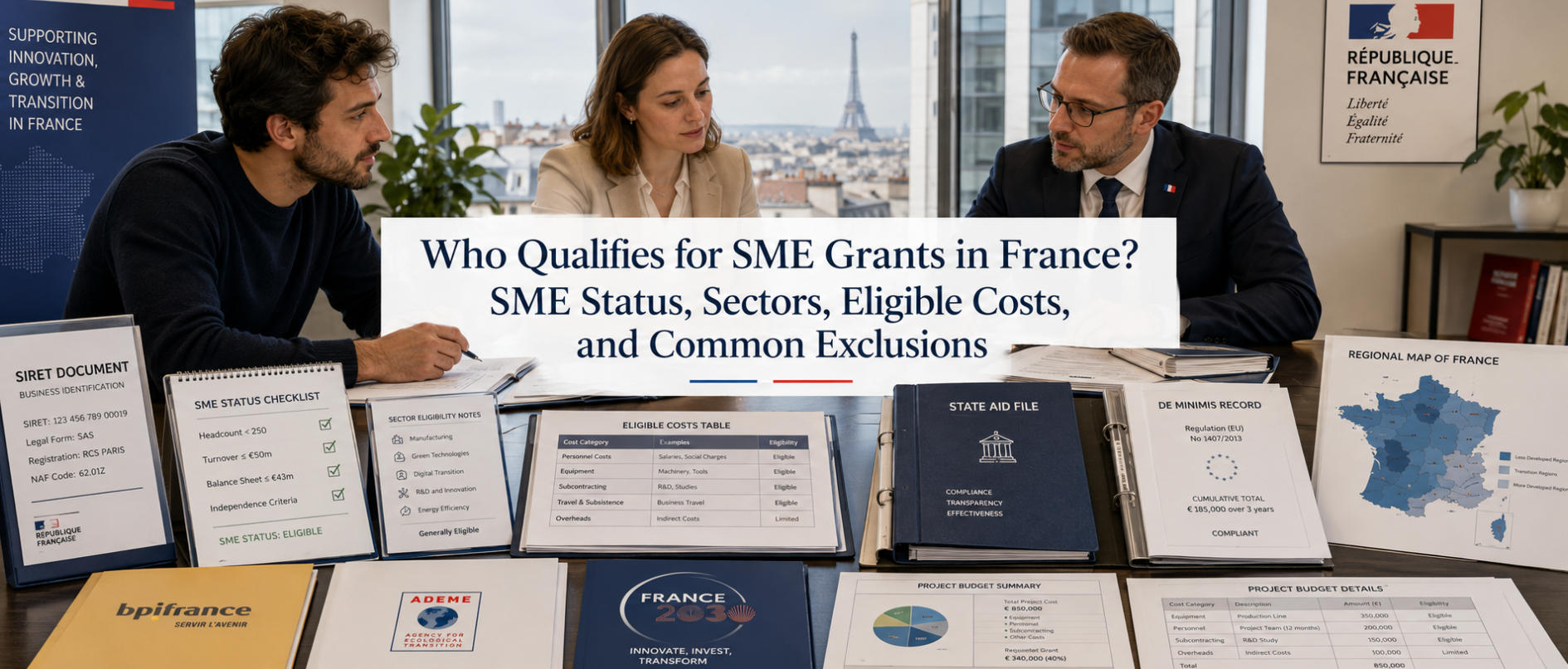
France has one of the most developed public funding ecosystems in Europe, but that does not mean every small company can receive a grant. For many applicants, the first mistake is assuming that “small business” and “grant eligible” mean the same thing. In practice, French funders check several conditions at the same time: company size, legal registration, location, sector, project type, eligible costs, project timing, financial situation and state-aid compliance.
This matters because French business support is fragmented across national schemes, regional programmes, Bpifrance instruments, ADEME ecological transition calls, tax credits, local grants and EU-funded routes. The official French business portal explains that public aid can support creation, development, hiring, competitiveness, digital transformation and sector-specific business needs. The government also directs companies to Aides-entreprises.fr, where applicants can search for support by financing need, location or SIRET number and then refine results by additional criteria.
For SMEs and startups, the practical question is therefore not only “Do we qualify as an SME?” It is “Does this legal entity, in this location, with this project, these costs and this aid history, qualify for this specific programme?” This guide explains how eligibility is usually assessed in France and how applicants can avoid the most common disqualifiers before investing time in a grant application.
The SME definition used in France
Most French SME funding schemes rely directly or indirectly on the European SME definition. Under the European Commission framework, an SME is an enterprise with fewer than 250 staff and either annual turnover not exceeding 50 million euros or an annual balance sheet total not exceeding 43 million euros. Within that category, small enterprises have fewer than 50 staff and turnover or balance sheet total up to 10 million euros, while microenterprises have fewer than 10 staff and turnover or balance sheet total up to 2 million euros.
The key point is that these thresholds do not always apply only to the applicant’s immediate legal entity. If the company is part of a larger group, it may need to include staff, turnover and balance sheet data from partner or linked enterprises. This is one of the most frequent traps for startups, subsidiaries and SMEs owned by larger corporate groups. A company can look small in France but fail the SME test because control, ownership or group data push it above the threshold.
This definition is especially important because SMEs are a large part of the French economy, but the category includes very different businesses. INSEE data for 2023 show that France had more than 4.8 million microenterprises in the non-agricultural and non-financial market sectors, while SMEs excluding microenterprises employed more than 4.59 million full-time equivalent workers. A local café, a ten-person software studio, a manufacturing subcontractor and a deep-tech startup may all fall somewhere in the SME universe, but they will not qualify for the same funding routes.
SME status is only the first eligibility layer
French grant eligibility usually works like a filter. First, the funder checks whether the applicant is the right type of organisation. Then it checks where the activity is located, whether the sector is allowed, whether the project fits the policy objective, whether the planned costs are eligible and whether the aid can be granted under state-aid rules.
A regional innovation grant, for example, may require the company to be a TPE, PME or ETI, have an establishment in a specific region and submit the application before the project starts. Région Île-de-France’s Innov’up scheme states that the aid request must be filed before the project begins and that earlier expenditure cannot be taken into account.
This is why applicants should not start with the amount of funding they want. They should start with the eligibility chain: who is applying, where the project is implemented, what the project does, which costs are included and which state-aid rule will apply.
Table 1. The practical eligibility test for SME grants in France
| Eligibility layer | What funders usually check | Practical risk for applicants |
|---|---|---|
| Company status | SME definition, legal form, registration, SIREN or SIRET, group links, tax and social compliance | The company is small operationally but fails the formal SME or compliance test |
| Location | Region, department, eligible zone, project site, establishment address | The head office is eligible, but the project site or operational establishment is not |
| Sector and activity | Innovation, ecological transition, digitalisation, industry, export, hiring, training, R&D or local development | The company is legitimate, but the programme targets a different policy objective |
| Cost eligibility | Equipment, staff, R&D, studies, advisory services, software, prototypes or investment costs | The applicant includes normal operating costs or already-incurred expenses |
| State-aid position | De minimis ceiling, aid intensity, cumulation, undertaking in difficulty, recovery orders | The project qualifies technically, but the company cannot legally receive the aid |
French registration, SIRET and location rules
For most French SME grants, the applicant must be identifiable as a French business or have a relevant establishment in France. In practice, this usually means a SIREN or SIRET number, a registered establishment and the ability to show where the funded activity will actually take place. Aides-entreprises.fr reflects this logic because its official search process asks companies to enter either a location or SIRET number to identify suitable aid.
Location is especially important for regional aid. A company registered in Paris may not automatically qualify for a grant in Nouvelle-Aquitaine, Hauts-de-France or Provence-Alpes-Côte d’Azur unless it has a project site, establishment or eligible investment in that region. Some programmes are designed for a regional economic strategy: reindustrialisation, rural development, innovation clusters, green transition, tourism, craft businesses or local job creation.
This is also where foreign founders and international startups need to be careful. A company can be internationally owned and still qualify for certain French schemes if it has the right French establishment and meets the programme conditions. But a company with only a commercial interest in France, no local establishment and no French project execution may not pass the first filter.
.jpg)
Which sectors usually qualify?
French SME grants are rarely “general money for business”. They are normally linked to a public policy objective. The Service Public Entreprendre portal groups business aid around creation or takeover, development, hiring, competitiveness, digital transition, innovation and sector-specific support.
Innovation and R&D are among the strongest funding routes. These may include Bpifrance innovation support, France 2030 calls, regional innovation grants and tax-credit-related routes such as the Crédit d’Impôt Innovation. The CII, for example, applies to SMEs and concerns expenses linked to the design of prototypes or pilot installations of a new product until 31 December 2027. Service Public specifies that the product must not yet be available on the market and must differ from existing products through superior technical, eco-design, ergonomic or functional performance.
Ecological transition is another major category. ADEME’s enterprise platform lists financial support for companies in the form of grants, calls for projects, diagnostics and studies, including schemes offered by ADEME and other public actors such as chambers of commerce, chambers of trades and regions.
Industrial and strategic sectors may also qualify, especially under France 2030. The French government describes France 2030 as a 54 billion euro investment plan focused on industrial competitiveness, future technologies, emerging actors and decarbonisation. This does not make France 2030 a simple small-business grant. It is more selective and usually expects strategic value, innovation, scale-up potential, industrial relevance or contribution to transition priorities.
Digitalisation, export, hiring, training and business creation may also be supported, but the exact eligibility rules vary significantly. A restaurant digitising its booking system, a SaaS startup developing a prototype and a factory investing in energy-efficient production equipment are all “SMEs”, but they belong to different funding pathways.
Eligible costs: what funders actually reimburse
The most important distinction for applicants is this: eligible costs are not the same as business needs. A company may need cash flow, salaries, rent, marketing or debt repayment, but a grant programme may only finance equipment, studies, R&D personnel, advisory services, software, prototypes or specific investment costs.
Cost eligibility is usually defined in the call rules. A regional productive investment scheme may fund tangible assets and certain intangible assets directly linked to production. An innovation scheme may support R&D staff, subcontracted research, prototypes and pilot installations. An ecological transition scheme may support diagnostics, feasibility studies, audits or investments that reduce energy use or environmental impact.
The Region Sud productive investment scheme is a useful example because it clearly shows that not all business costs are eligible. Its excluded expenses include HR costs, leasing, loan interest, VAT, financial charges and simple replacement of equipment without proven obsolescence or degradation.
Table 2. Common eligible and excluded costs in French SME grant applications
| Cost category | Often eligible when... | Often excluded when... |
|---|---|---|
| Equipment and machinery | Directly linked to investment, production improvement, decarbonisation or project delivery | It is simple replacement, financed by leasing, not justified by quotes or not linked to the funded project |
| Software and intangible assets | Necessary for digital transformation, innovation, production management or project execution | It is a general subscription, not proportionate or not directly linked to the project objective |
| R&D and technical staff | The programme funds research, development, prototype design or pilot installation | The scheme is investment-only or the staff time is not documented |
| Advisory services and diagnostics | Linked to energy, innovation, export, feasibility, digital or environmental assessment | The service was completed before the application or delivered outside the programme rules |
| VAT and financial charges | Only eligible if the call explicitly allows them and the VAT is non-recoverable | VAT, loan interest, agios, penalties and general financial costs are excluded |
| Operating costs | Eligible only under specific calls, such as certain innovation or experimentation schemes | Rent, routine salaries, utilities, marketing and ordinary working capital are treated as normal business expenses |
Applicants should build the project budget backwards from the rules of the call. A strong grant budget does not simply describe what the company wants to buy. It separates eligible and non-eligible costs, explains why each item is necessary, connects every cost to a work package and uses quotes, supplier offers or calculation notes to support the figures.
The project start rule
One of the most damaging eligibility mistakes is starting too early. Many French and EU-backed programmes apply the incentive effect principle: the public aid should encourage a project that has not already been committed. Under the General Block Exemption Regulation summary, beneficiaries must submit a written aid application before embarking on the project or activity.
In practice, this means that a company should be careful before signing supplier contracts, paying deposits, ordering equipment, starting implementation or making legally binding commitments. Even when preparatory discussions are allowed, funders may exclude any cost incurred before the formal application date or approval date. Région Île-de-France’s Innov’up page states this very clearly: the aid request must be submitted before the project starts, and earlier expenditure cannot be taken into account.
For SMEs, the safest approach is to create a “funding hold” before submission. The company can collect quotes, prepare specifications, build the budget and discuss the project, but should avoid binding commitments unless the call rules explicitly permit them.
State aid, de minimis and cumulation
Most French SME grants are public aid, which means they must comply with EU state-aid rules. For applicants, the most practical concepts are de minimis, aid intensity and cumulation.
The de minimis rule allows small amounts of aid to be granted without prior notification to the European Commission. Since the 2024 framework, Member States cannot give more than 300,000 euros over three years to a single undertaking under the general de minimis rule.
The phrase “single undertaking” is important. Applicants should not only look at aid received by one SIRET or one legal entity in isolation. In many cases, aid history must be checked at the level of linked entities. If an SME belongs to a group, previous de minimis support received by related entities may affect the remaining ceiling.
Aid intensity is a separate concept. Some schemes fund only a percentage of eligible costs, and the percentage may depend on company size, region, project type and state-aid basis. Cumulation rules then determine whether several aids can be combined for the same project or cost base. For example, a company may not be able to stack a regional grant, a national subsidy and a tax credit on the same eligible expenditure without adjustment.
Before applying, SMEs should prepare an aid history table showing the grantor, date of award, legal entity, amount, state-aid basis, de minimis amount where relevant and the costs covered. This is not only a compliance exercise. It helps the grant writer decide whether the project should be framed under de minimis, GBER, a regional aid basis or another permitted route.
Common exclusions and rejection triggers
French SME grant applications are often rejected not because the company is bad, but because one technical condition is missed. The most common exclusion is a project that started before the application. This can make otherwise strong costs non-eligible.
A second major issue is financial difficulty. EU state-aid rules exclude aid to undertakings in difficulty from the scope of the General Block Exemption Regulation, unless a specific rescue or restructuring framework applies. For ordinary SME grants, this means funders may review financial statements, equity position, insolvency indicators and repayment capacity.
A third risk is tax or social non-compliance. While the exact wording changes by programme, French public funding calls often require applicants to be up to date with tax and social obligations. Even where a grant is designed to support growth, the funder will usually want evidence that the company is administratively reliable.
A fourth problem is wrong-sector eligibility. Some schemes exclude financial activities, real estate holding, purely local retail, agriculture, fisheries, transport or regulated sectors, depending on the legal basis of the aid. Other schemes are open only to industrial SMEs, innovative companies, craft businesses, social enterprises, export projects or companies in specific territories.
Documentation can also disqualify an applicant. Légifrance states that organisations applying for certain public subsidies must provide documents such as balance sheets and profit and loss accounts for the last two closed financial years, a forecast budget, an activity report and a forecast document on the planned use of the requested subsidy. Even when a particular business grant has its own application form, the same logic applies: public funders need financial evidence, project evidence and a credible use-of-funds plan.
Pre-application eligibility checklist
Before submitting a French SME grant application, the company should verify the following points:
- The applicant has the required French registration, SIREN or SIRET, legal form and establishment.
- The company qualifies as an SME under the EU definition, including partner or linked enterprises.
- The project is located in the eligible territory and can prove where the funded activity will take place.
- The sector and project objective match the programme, such as innovation, ecological transition, digitalisation, industrial investment or regional development.
- No binding project start, supplier order, deposit or contract has occurred before the permitted date.
- Each cost is eligible under the call rules, supported by evidence and separated from non-eligible expenses.
- The company has enough co-financing capacity for the part not covered by the grant.
- Tax, social and administrative obligations are up to date.
- The company is not an undertaking in difficulty and is not subject to a recovery order for incompatible aid.
- De minimis, aid intensity and cumulation limits have been checked across linked entities.
- Financial statements, forecasts, quotes, budget notes and project documents are ready.
- The application explains why public aid is needed and what measurable result the project will deliver.
When a grant writer can help
Eligibility screening is one of the most valuable tasks a grant writer can perform. Many SMEs contact a consultant only when they want the application written, but the real value often begins earlier: identifying the right programme, checking the SME definition, reviewing state-aid exposure, cleaning the cost base, preparing the budget and deciding whether the project should be submitted now or adapted first.
For i-grants.com, this is also a useful matching point between applicants and grant professionals. A French SME may not need a long theoretical explanation of public funding. It needs someone who can answer practical questions: Is this company eligible? Are these costs eligible? Has the project already started? Is the de minimis ceiling still available? Which evidence will the funder expect? Should the project be submitted to Bpifrance, a regional programme, ADEME, France 2030 or an EU route?
A good grant writer should not promise funding before eligibility is confirmed. Instead, they should create a clear go or no-go assessment, explain the risks and help the applicant avoid submitting a weak or non-compliant file.
Conclusion
Qualifying for SME grants in France is a structured test, not a single label. A company must first meet the relevant SME definition, but that is only the beginning. It must also fit the legal, territorial, sectoral, cost, timing and state-aid rules of the specific programme.
The strongest applicants do not ask “Which grant can we get?” They ask “Which funder is trying to finance this exact type of project, in this territory, for this type of company, with these eligible costs?” That shift makes the search more precise, reduces wasted applications and improves the quality of the final file.
For SMEs, startups and grant writers working in France, the best first step is a disciplined eligibility review. Confirm the SME status, map the project to the right funding route, separate eligible and excluded costs, check de minimis and state-aid limits, and only then prepare the application. In the French funding system, qualification is not a formality. It is the foundation of a credible grant strategy.