

 Français
  Deutsch
  Українська
Many small business grant applications in Poland are not rejected because the company has a weak business idea. They are rejected because the application does not prove what the funding programme needs to see.
A project may be useful, commercially promising and important for the applicant, but still fail if it does not match the call objective, eligibility rules, evaluation criteria, cost categories, public aid limits or documentation requirements. In competitive Polish grant schemes, ambition is not enough. Evidence, structure and consistency decide whether an application survives assessment.
This is especially important in the 2021-2027 funding cycle. By 7 June 2026, Polish national and regional programmes had launched 4,810 calls with a combined budget of PLN 327.0 billion. Applicants had submitted 78,298 applications, and signed agreements covered 28,121 investments with PLN 266.8 billion in eligible expenditure and PLN 206.9 billion in EU funding, equal to 65.2 percent of the available EU allocation.
At the same time, the potential applicant base is very large. PARP’s latest SME sector data shows that Poland had 2.37 million active non-financial enterprises in 2024, with SMEs representing 99.8 percent of all companies. Microenterprises alone accounted for 97.2 percent of enterprises. This creates a competitive environment where evaluators can be strict, especially in calls for innovation, R&D, technology implementation, energy efficiency and regional investment.
For applicants, understanding rejection reasons is a strategic advantage. For grant writers, it is one of the most valuable parts of advisory work. A good application is not only written well. It is designed to answer the criteria before evaluators ask the questions.
Rejection Is Usually About Criteria, Not Ambition
One of the most common misunderstandings among SME applicants is the belief that a strong business need automatically makes a project fundable. It does not.
A grant programme is not a general business development fund. It is a public funding instrument with a defined policy purpose. Some calls support R&D. Others support implementation of research results, energy efficiency, digitalization, internationalization, regional development or specific sectoral transformations. If the project does not fit that purpose, it may be rejected even if the company genuinely needs support.
This is why a negative assessment should not always be interpreted as a judgment that the company is weak. It often means that the application failed to prove the right things. The evaluator may not have seen enough evidence of innovation, market need, implementation capacity, financial viability, environmental impact or alignment with the programme objective.
For grant writers, this distinction is crucial. The task is not to make a project sound attractive in general. The task is to make the project defensible under the exact rules of the selected call.
The Current Funding Environment Rewards Precision
Poland’s grant system is active, but activity does not mean easy access. Thousands of calls and tens of thousands of applications create opportunities, but they also raise the importance of technical quality.
Ścieżka SMART is a useful example because PARP has published detailed guidance on common mistakes. In previous calls, more than 60 percent of applications reportedly failed already at the stage of obligatory criteria. PARP identified frequent problems in the description of R&D work, innovation indicators and proof of financial capacity.
This is a critical lesson for SMEs. Many applications do not fail at the end of the competition. They fail early because they do not satisfy mandatory conditions. Once an obligatory criterion is missed, a strong narrative elsewhere may not help.
In the 2026 Ścieżka SMART B+R call, PARP received 566 applications for more than PLN 3.6 billion. After first-stage assessment, 332 projects worth more than PLN 2.3 billion met the first-stage criteria. Based on these figures, approximately 58.7 percent of submitted projects passed the first stage, while approximately 41.3 percent did not. This does not mean that every unsuccessful project was bad. It means the first stage itself was a real filter.
Table 1. Main Reasons Polish SME Grant Applications Are Rejected
| Rejection reason | What evaluators are likely to see | Why it weakens the application |
|---|---|---|
| Wrong call selection | The project is useful for the company but does not fit the programme objective. | The application cannot meet the core purpose of the funding instrument. |
| Weak innovation evidence | The applicant says the solution is innovative but does not prove what is new, compared with what and at which level. | Innovation becomes a claim instead of an assessed fact. |
| Poor R&D logic | The project describes routine development, adaptation or implementation as research and development. | Evaluators may conclude that the project does not contain genuine R&D uncertainty. |
| Insufficient financial capacity | The applicant cannot prove that it can finance own contribution, VAT, cash-flow gaps or implementation costs. | The project appears risky even if the idea is technically strong. |
| Inconsistent budget | Costs do not match tasks, eligible categories, time schedule or financial model. | The project looks poorly controlled and difficult to audit. |
| Weak indicators | Indicators are vague, unrealistic, not measurable or not connected to project outputs. | Evaluators cannot verify whether public funding will produce the promised result. |
| Missing or weak documentation | Attachments, technical files, declarations, financial data or authorizations are incomplete or inconsistent. | The application loses credibility and may fail formal or substantive checks. |
| Formal and technical errors | The application is late, submitted through the wrong system, incomplete, unsigned or not prepared according to templates. | Even a strong project can be rejected before full assessment. |
The table shows why rejection prevention begins before writing. If the applicant chooses the wrong call or cannot prove the core criterion, editing the text at the end will not solve the problem.
Innovation Mistakes: “New for Us” Is Not Always Enough
Innovation is one of the most frequent weak points in Polish SME applications. Many companies describe a solution as innovative because it is new for their own business. In some calls, this may not be enough.
For example, Ścieżka SMART materials refer to innovation at least at the national level in the context of project readiness questions. That means the applicant must prove more than internal modernization. It must show what is new in relation to existing solutions, products, processes or technologies in the relevant market.
A strong innovation argument usually answers four questions. What exactly is new? Compared with which existing alternatives? Which measurable parameters prove the improvement? Why can the company realistically deliver the result?
Weak applications often use broad language: “modern”, “innovative”, “unique”, “advanced”, “competitive”. These words do not replace evidence. Evaluators need comparison, technical parameters, market references, patents or literature where relevant, test results, customer needs and a clear explanation of how the project changes the product, process or service.
For grant writers, the practical rule is simple: every innovation claim should be supported by a comparison. If the application says the solution is faster, cleaner, cheaper, more precise or more energy-efficient, it must explain faster than what, by how much and how this will be verified.
R&D Mistakes: When Development Is Not Research
R&D projects are often rejected because the applicant confuses normal product development with research and development. This is one of the most damaging mistakes in innovation grants.
A genuine R&D project should contain uncertainty. The company should not already know exactly how the result will be achieved. There should be a technical, technological or scientific challenge that requires investigation, testing, experimentation or validation. If the project is mainly about buying equipment, adapting a known solution or preparing a product for market, it may belong to an implementation or investment scheme instead of an R&D call.
PARP’s analysis of negative assessments in Ścieżka SMART showed that many unsuccessful projects with an R&D module did not meet the relevant module criteria. The problem was not only wording. It was often the absence of a convincing R&D logic leading to product or process innovation.
A strong R&D section should define the uncertainty, explain the research tasks, link staff and subcontracting to those tasks, show how tests will be conducted and describe how success or failure will be measured. It should not read like a procurement plan with a scientific label.
This is where grant writers must challenge clients early. If the client says, “We already know what we will build and just need funding to build it,” the project may not be R&D. It may still be fundable, but probably under a different logic.
Financial Capacity: The Underestimated Rejection Risk
Many applicants focus on the technical idea and underestimate financial capacity. This is a serious mistake.
Grant funding rarely removes the need for company resources. The applicant may need to finance its own contribution, cover non-eligible costs, pre-finance expenditure before reimbursement, pay VAT if it is not eligible and maintain liquidity during implementation. Evaluators therefore need to see whether the company can realistically carry the project.
PARP has pointed to insufficient proof of financial capacity as a recurring weakness in Ścieżka SMART applications. In analysis of earlier assessments, more than 60 percent of applications rejected at the second stage reportedly failed to demonstrate sufficient financial capacity.
This is not a minor accounting issue. If the financial model is optimistic, inconsistent with financial statements or unsupported by credible financing sources, evaluators may doubt the whole project. A technically strong project can still be rejected if the applicant cannot show that it can implement it.
For SMEs, this means the financing plan must be prepared before submission, not after a positive result. For grant writers, it means the budget should be checked against real cash flow, not only against eligible cost rules.
Budget, Indicators and Documentation: Where Inconsistencies Appear
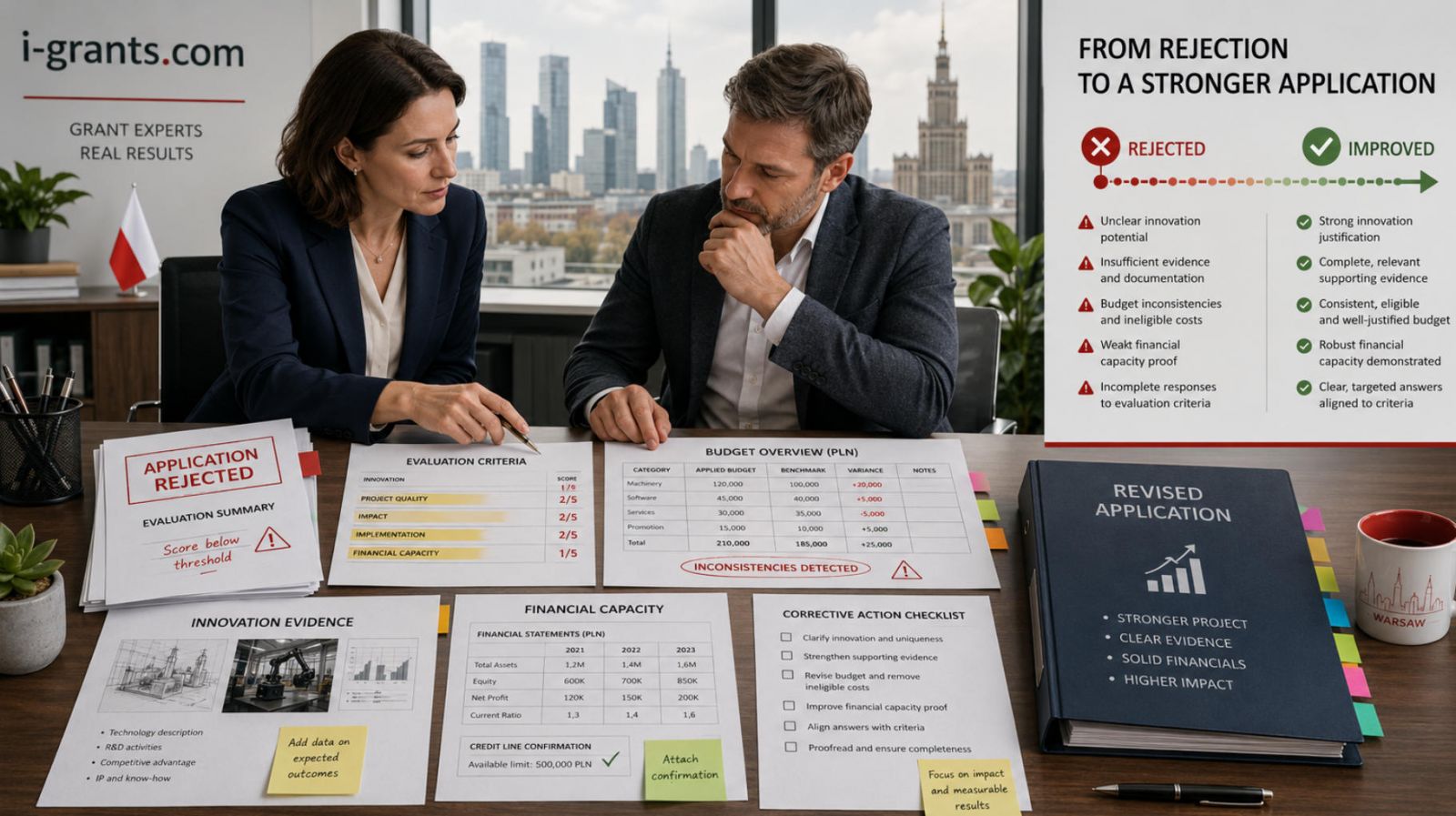
Evaluators do not read the application as a collection of separate documents. They read it as one system. If the project description says one thing, the budget says another and the financial model says a third, the application loses credibility.
Budget inconsistencies often appear in timing, cost categories, task descriptions, supplier assumptions, VAT treatment and own contribution. For example, the project may describe prototype testing, but the budget may include mostly production equipment. The application may promise energy savings, but the technical documentation may not support the calculation. The financial model may show one investment schedule, while the narrative describes another.
Indicators create a similar risk. Applicants sometimes choose indicators because they sound impressive, not because they are realistic or measurable. This can weaken the application and create implementation risk later. If the project is approved, the applicant may be expected to deliver the declared indicators. Inflated indicators can therefore become a problem not only during assessment, but also during project control.
Documentation is the third weak point. Missing attachments are obvious. More subtle problems include documents that contradict each other, technical specifications that do not match the budget, financial data that does not support the declared own contribution or declarations that are not aligned with state aid rules.
Table 2. Evaluation Criteria and Evidence Applicants Should Provide
| Evaluation area | What evaluators may check | Evidence that can strengthen the application |
|---|---|---|
| Applicant eligibility | SME status, ownership links, sector, location, legal form and excluded activities. | SME calculation, ownership structure, company documents, public aid declarations and sector verification. |
| Project fit | Alignment with the call objective, supported activity type and implementation location. | Clear project logic, reference to call objectives and explanation of why this instrument fits. |
| Innovation | Novelty level, measurable improvement, market comparison and technical credibility. | Benchmarking, technical parameters, market analysis, patent or literature review, test assumptions and expert evidence. |
| R&D character | Research uncertainty, planned experiments, development stages and validation method. | Work packages, research tasks, testing plan, risk analysis, staff roles and subcontractor scope. |
| Financial capacity | Own contribution, liquidity, financing sources, VAT and ability to implement. | Financial statements, financial model, financing confirmations, cash-flow assumptions and sensitivity checks. |
| Budget reasonableness | Eligible costs, market prices, cost categories, procurement logic and proportionality. | Supplier quotes, cost justification, technical specifications, procurement files and task-cost mapping. |
| Indicators and impact | Outputs, results, environmental or economic effects and measurability. | Indicator methodology, baseline data, calculation assumptions and verification method. |
| Implementation capacity | Team, experience, timeline, management structure and risk control. | CVs or role descriptions, project schedule, governance plan, risk register and previous implementation evidence. |
The strongest applications do not leave these areas to interpretation. They show evidence directly where the evaluator expects to find it.
Formal and Technical Mistakes Can Still Destroy a Strong Project
Formal mistakes are frustrating because they are preventable. Yet they remain common.
In many Polish SME grant calls, the application must be submitted electronically through the system specified in the documentation. In Ścieżka SMART, PARP materials explain that applications are submitted online through LSI, within the period defined in the call documentation. The application should be prepared in Polish, complete, coherent and based on mandatory templates and instructions. Once the system closes the call, late submission becomes a serious risk.
Technical errors include missing signatures, wrong attachments, incomplete fields, incorrect file formats, inconsistent data, use of outdated templates or submission by a person without proper authorization. These issues may seem administrative, but they can prevent the project from being assessed properly.
Grant writers should therefore treat final submission as a controlled process. The application should have an internal deadline, a document checklist, a signature check, a consistency review and a final technical submission review. No serious application should be uploaded for the first time minutes before the official deadline.
What Applicants Can Learn From Ścieżka SMART 2026
The 2026 changes in Ścieżka SMART are important because they show how Polish institutions are trying to make support clearer for businesses. PARP communicated changes such as separate calls for R&D projects and implementation of R&D results, clearer cost categories, simplified criteria, shorter forms and an improved evaluation process.
This is a positive development. It can reduce confusion and help SMEs choose the right path. However, simplification does not remove the need for evidence. A shorter form may even make precision more important because there is less space for vague explanations.
PARP also published practical guides in 2026, including materials on how to correctly complete applications and how to avoid common mistakes. This sends a clear signal: institutions know where applicants struggle. The same mistakes appear often enough that they can be described, taught and prevented.
For applicants, this means official guidance should be used before writing, not after rejection. For grant writers, it means a professional application should incorporate lessons from previous calls and institutional feedback.
Table 3. How to Fix a Weak Grant Application Before Submission
| Weakness in the application | How to detect it | How to improve it before submission |
|---|---|---|
| The project does not clearly fit the call | The objective sounds useful but not connected to the programme purpose. | Rewrite the project logic around the call objective or choose a different funding instrument. |
| Innovation is only asserted | The text uses words such as “modern” or “unique” without comparison. | Add benchmarks, technical parameters, market alternatives and measurable improvement. |
| R&D uncertainty is missing | The project reads like implementation of a known solution. | Define technical uncertainty, experiments, validation steps and possible failure points. |
| Financial capacity is weak | Own contribution, VAT or cash-flow gaps are not supported. | Strengthen the financial model, add financing evidence and align assumptions with financial statements. |
| Budget lines are disconnected | Costs cannot be traced to tasks, outputs or indicators. | Map every cost to a task, eligible category, period and expected result. |
| Indicators are unrealistic | Targets look attractive but lack methodology or baseline. | Use measurable indicators, explain calculation methods and verify implementation capacity. |
| Documentation is inconsistent | Attachments, budget and narrative contain different numbers or assumptions. | Run a cross-document consistency check before submission. |
| Submission risk is high | Signatures, access, file formats or platform steps are left until the last day. | Set an internal deadline and complete a technical submission rehearsal. |
A weak application should not be “polished” first. It should be diagnosed first. Polishing a structurally weak application only makes the problem harder to see.
What to Do After a Negative Assessment
A rejection is not always the end of the process, but it should be handled professionally.
The first step is to read the justification carefully. Applicants should identify whether the problem was formal, eligibility-related, financial, technical or substantive. In some procedures, the applicant may receive evaluation sheets or detailed comments through the electronic system. These documents are valuable because they show how evaluators interpreted the project.
The second step is to check whether a protest or appeal-like procedure is available under the rules of the call. In the Ścieżka SMART B+R 2026 first-stage results, applicants with a negative assessment had the right to submit a protest within 14 days of receiving the negative result letter. The exact procedure depends on the call, so it must be checked in the documentation.
The third step is to decide whether the rejection should be challenged or learned from. Not every negative result is worth contesting. If the evaluator misunderstood evidence that was actually present, a protest may be reasonable. If the application genuinely failed to prove a core criterion, it may be better to redesign the project and apply again under a better-fitting call.
Grant writers can add real value after rejection by turning the assessment into a diagnostic report. Which criterion failed? Was the problem evidence, structure, eligibility, budget or project concept? Can the weakness be fixed, or does the company need a different programme?
How Grant Writers Improve the Chances of Success
A professional grant writer does not guarantee approval. No one can honestly guarantee that in a competitive public funding process. But a strong grant writer can significantly reduce avoidable risks.
The most valuable work happens before drafting. The grant writer should test the call fit, challenge weak innovation claims, check whether the project is truly R&D where relevant, align the budget with eligible costs, identify missing evidence, review financial capacity and build the narrative around evaluation criteria.
This role is especially important for small companies that do not apply for grants regularly. They may know their business very well, but not know how evaluators read applications. A founder may describe a product from a commercial perspective, while the call requires a technical innovation argument. A finance team may prepare realistic internal numbers, but not in the structure required by the financial model. A technical manager may understand the process, but not explain it in terms of eligible work packages and indicators.
The best grant writers translate between these worlds. They make the project understandable to evaluators without weakening the business logic.
For i-grants.com, this is a central value proposition. Applicants need access to professionals who can diagnose weaknesses early. Grant writers need projects where their expertise can genuinely increase the quality of the application.
Conclusion: The Strongest Applications Are Built Around Evidence
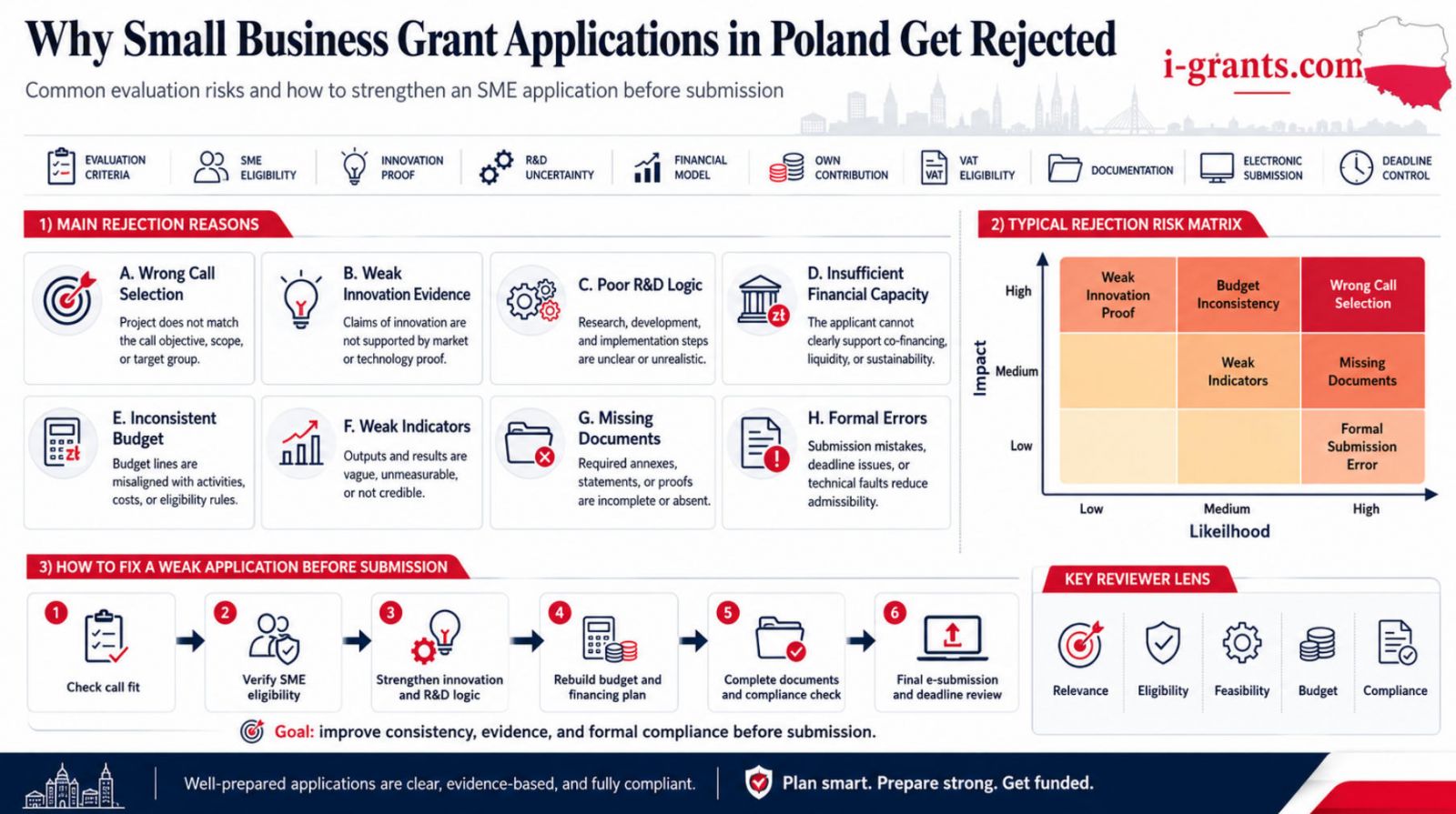
Small business grant applications in Poland get rejected for many reasons: weak innovation evidence, poor R&D logic, insufficient financial capacity, inconsistent budgets, vague indicators, missing documents, formal mistakes or wrong call selection. But most of these risks can be detected before submission.
The strongest applications are not built around optimism. They are built around evidence. They prove that the applicant is eligible, the project fits the programme, the innovation is real, the budget is coherent, the company can finance implementation and the expected results are measurable.
For SMEs, this means grant preparation should begin with diagnosis, not writing. For grant writers, it means the first responsibility is not to make the project sound better. It is to make the project stronger under the criteria.
Poland’s 2021-2027 funding cycle still offers major opportunities for small businesses, especially in innovation, technology, energy efficiency and regional development. But opportunities are not the same as approvals. In a competitive system, the companies that understand rejection reasons before they apply will have a better chance of submitting applications that survive evaluation, contracting and implementation.