

 Français
  Deutsch
  Українська
Small business grants in Germany are not awarded simply because a company is small, ambitious, innovative, or located in Germany. Most public funding programmes apply a strict eligibility logic before they assess the quality of the project itself. A company may have a strong business idea and still be rejected because it does not meet the SME definition, started the project too early, chose ineligible costs, exceeded de minimis limits, or cannot prove financial capacity.
This is especially important in Germany, where the small and medium-sized enterprise sector is large and diverse. According to IfM Bonn, around 3.52 million German enterprises were classified as SMEs in 2024, representing 99.2 percent of enterprises with turnover from goods and services and/or employees. These SMEs employed around 21.8 million people, or 54.4 percent of total employment. In practice, this means that many companies may fall into the SME category, but not all of them qualify for the same grant, loan, subsidy, guarantee, or advisory support.
For applicants, the key question is not only “Can my business get funding?” A better question is: “Does my company, project, location, cost structure, timing, and aid history match the rules of this specific programme?”
This article explains who can realistically qualify for small business grants and public funding in Germany, with a focus on SME status, eligible sectors, eligible costs, state aid, de minimis, financial capacity, and common formal exclusions.
SME status is the starting point, not the whole answer
Many German funding programmes use the European Union SME definition. This definition matters because it determines whether a company is treated as a micro, small, or medium-sized enterprise for access to EU, federal, and state-level support.
Under the EU framework, an SME is an enterprise with fewer than 250 employees and either annual turnover of no more than EUR 50 million or a balance sheet total of no more than EUR 43 million. Within this group, micro and small enterprises have lower thresholds.
Table 1. EU SME size thresholds for funding eligibility
| Company category | Staff headcount | Annual turnover | Or annual balance sheet total |
|---|---|---|---|
| Micro enterprise | Fewer than 10 | Up to EUR 2 million | Up to EUR 2 million |
| Small enterprise | Fewer than 50 | Up to EUR 10 million | Up to EUR 10 million |
| Medium-sized enterprise | Fewer than 250 | Up to EUR 50 million | Up to EUR 43 million |
For grant applicants, the practical implication is simple: do not rely on informal labels such as “startup”, “family business”, “small company”, or “Mittelstand”. The programme text usually defines exactly which category is eligible.
This is particularly important in Germany because the term Mittelstand is often broader than the EU SME definition. Some German statistical or policy contexts may include companies that are larger than EU-defined SMEs. A company may be part of the German Mittelstand in a business culture sense, but still fail the SME test for a funding call that uses EU thresholds.
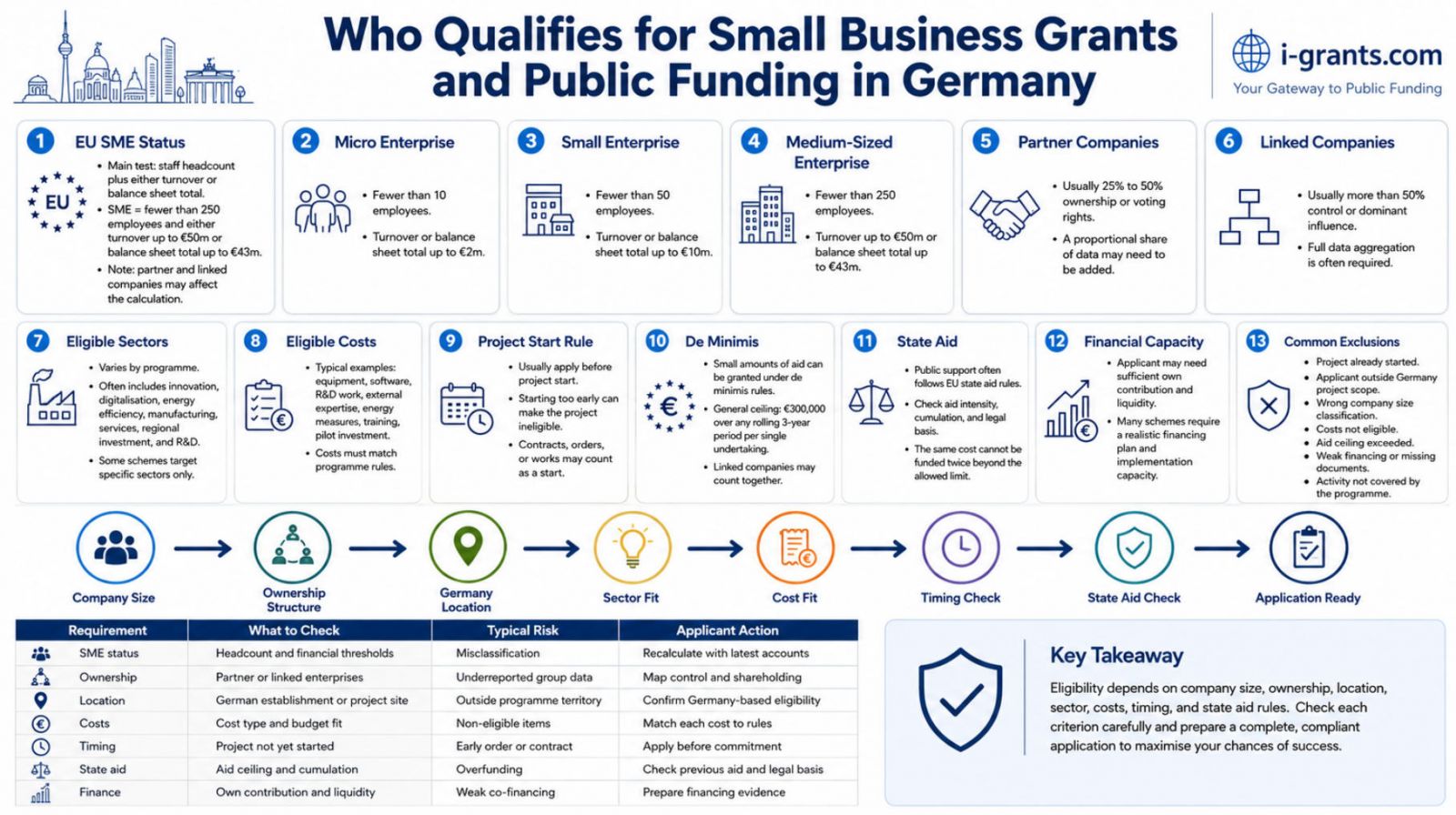
Ownership structure can change your SME category
One of the most common eligibility mistakes is checking only the applicant’s own staff, turnover, and balance sheet. For many programmes, this is not enough. The EU SME definition requires applicants to consider whether they are autonomous, partner, or linked enterprises.
An autonomous enterprise is usually assessed mainly on its own data. A partner enterprise may require part of another company’s data to be added. A linked enterprise may require the full data of related companies to be included. This can change the result dramatically.
For example, a German company with 35 employees and EUR 7 million in turnover may look like a small enterprise. But if it is controlled by a larger group, or if it has linked companies through ownership or voting rights, the group data may push it into the medium-sized category or outside SME status completely.
Table 2. Why company relationships matter for SME eligibility
| Company relationship | Why it matters for funding |
|---|---|
| Autonomous enterprise | The company is usually assessed mainly on its own staff, turnover, and balance sheet data. |
| Partner enterprise | A proportional share of another company’s data may need to be included. This can change the SME category. |
| Linked enterprise | The full data of linked companies may need to be included. This is critical for subsidiaries, holding structures, and controlled companies. |
| Public ownership issue | Certain forms of public control or ownership can affect SME classification, depending on the rules of the programme. |
| Group restructuring | Mergers, acquisitions, and company splits can affect SME status and state aid calculations. |
This is why grant writers and funding advisors usually ask for ownership charts, shareholder information, voting rights, group accounts, and related-company data before confirming eligibility. The question is not only “How large is the applicant?” It is also “Which other enterprises must be counted with the applicant?”
Who can apply: companies, founders, freelancers, and research-based teams
Different German funding instruments target different applicant types. A standard SME investment loan will not have the same eligibility logic as an R&D grant, an energy efficiency subsidy, a startup scholarship, or a regional investment incentive.
KfW programmes often support SMEs, founders, freelancers, and young companies through promotional loans. For example, ERP funding instruments can be used for investment, working capital, business creation, succession, and participation, depending on the programme. These are not always grants in the narrow sense, but they are important public funding tools because they can improve access to finance.
ZIM, the Central Innovation Programme for SMEs, is focused on market-oriented research and development. It is designed to strengthen the innovative capacity of SMEs and supports individual R&D projects, cooperation projects, and innovation networks. Here, eligibility depends not only on company size, but also on whether the project is genuinely innovative and technically credible.
EXIST is different again. It supports startup projects from universities and research institutions. The applicant logic is connected to students, graduates, researchers, and research-based teams, often through a university or research institution. A normal trading company without a research-based startup context would not fit this programme.
Energy and resource efficiency funding, such as BAFA-administered EEW support, focuses on companies investing in eligible measures that reduce energy or resource use. In that case, the decisive question may be less about sector branding and more about whether the measure delivers eligible energy, resource, or emissions savings.
Location rules: the project must usually be anchored in Germany
For German business funding, location is often decisive. A company may have international founders, foreign shareholders, or cross-border operations, but many programmes require a seat, branch, permanent establishment, operating site, or investment location in Germany.
The exact wording differs by programme. Some require that the company be established in Germany. Others require that the funded investment be implemented in Germany. Some regional programmes require the project to take place in a specific federal state or structurally weak region. Startup programmes may require a German university or research institution connection.
This matters for international applicants. A foreign-owned company can sometimes qualify if it has a German legal entity, branch, or eligible operating site. But a company that only sells into Germany from abroad usually will not qualify for funding designed to develop the German business location.
For the article’s target audience, the practical rule is clear: before evaluating the grant amount, check the territorial link. Funding in Germany is usually linked to economic activity, investment, employment, innovation, energy savings, or value creation in Germany.
Eligible sectors: broad access does not mean universal access
Many German SME funding programmes are sector-open, especially innovation, digitalisation, energy efficiency, and general investment instruments. However, sector-open does not mean that every business activity is eligible.
State aid rules and programme guidelines often restrict or exclude certain sectors or activities. Commonly sensitive areas include primary agricultural production, fisheries and aquaculture, certain export-related activities, activities directly linked to import substitution, and some transport-related uses. Specific programmes can also exclude purely financial activities, real estate investment, gambling, tobacco, or projects that conflict with environmental or public policy objectives.
Table 3. Typical sector and project fit by funding type
| Funding type | Applicants that may fit | What usually needs to be proven |
|---|---|---|
| R&D and innovation grants | SMEs, technology companies, cooperation projects, research partners | Technical novelty, market potential, implementation capacity, project risk, and credible R&D work plan |
| Energy and resource efficiency support | Companies investing in eligible efficiency measures | Eligible equipment or process change, measurable savings, technical documentation, and application before project start |
| Startup support | Founders, young companies, research-based teams, freelancers in some programmes | Business model, founder qualification, innovation level, market potential, and financing plan |
| Regional investment incentives | Companies investing in eligible regions | Location fit, job or value creation effect, eligible investment, and compliance with regional aid rules |
| Promotional loans | SMEs, founders, freelancers, business successors | Creditworthiness, viable business plan, investment or working capital need, and bank approval route |
| Advisory support | SMEs needing external business consulting | Eligible consulting topic, qualified advisor, formal approval, and documentation of the advisory service |
A company should therefore avoid asking only: “Is my sector eligible?” The more useful question is: “Is this specific activity, in this specific location, with these costs, eligible under this programme?”
Eligible costs: funding follows the programme logic
Public funding rarely covers general business needs without restrictions. Each programme defines what can and cannot be funded.
An investment programme may support machinery, equipment, buildings, software, vehicles, or production-related assets. A promotional loan may also cover working capital, inventory, rent, personnel costs, or marketing costs, depending on the product. An R&D grant may focus on staff costs, subcontracting, research services, prototypes, materials, and cooperation costs. An energy efficiency subsidy may support cross-cutting technologies, process heat, measurement and control technology, sensors, energy management software, process optimisation, or electrification measures.
This distinction is crucial. A cost can be necessary for the business but still ineligible for a specific funding call. For example, routine operating expenses may not fit an innovation grant. General marketing may not fit an energy efficiency programme. Legal, tax, or grant acquisition advice may be excluded from SME consulting support even if other business consulting topics are eligible.
Applicants should build the budget only after reading the cost rules. The safest approach is to map every planned cost to one eligible cost category in the programme guidelines. If a cost does not clearly fit, it should be treated as risky until confirmed by the funding body or an experienced advisor.
The timing rule: apply before you start
One of the most important rules in German funding is the requirement to apply before the start of the project. In many programmes, applicants must submit the application before they begin the funded measure or make binding financial commitments.
This rule is often misunderstood. “Starting the project” may include more than physical implementation. It can include signing a purchase contract, placing a binding order, signing a construction contract, commissioning a supplier, or otherwise creating a financial obligation. If the applicant starts too early, the entire project or specific costs may become ineligible.
Some programmes allow certain preparatory activities, but this must be checked carefully. A feasibility discussion, internal planning, or non-binding quotation may be acceptable in some cases, while a signed contract may not be.
For SMEs, the practical recommendation is strict: do not sign, order, pay, or begin implementation until the programme rules allow it. If bank financing is involved, such as through KfW promotional loans, the application route through the financing partner must also be respected before project start.
De minimis and state aid: the hidden eligibility filter
Many applicants discover state aid rules only after they have already identified a promising programme. This is risky. Public support to companies can be classified as state aid, and state aid must follow EU rules.
De minimis aid is one of the most common frameworks. Under the current general de minimis regulation, a single undertaking may receive up to EUR 300,000 in de minimis aid over a period of three years. This sounds simple, but it becomes more complex when companies belong to a group.
The limit applies to a “single undertaking”, which can include linked enterprises. Therefore, an applicant must know not only its own aid history, but also relevant aid received by linked companies. Mergers, acquisitions, and splits can also affect the calculation.
State aid rules also matter when combining several funding sources. An SME cannot simply stack grants, loans, guarantees, and subsidies for the same eligible costs without checking cumulation rules and aid intensity limits. A project may be technically eligible but still receive reduced funding, or no funding, if the aid limit is already exhausted.
From 2026, de minimis monitoring becomes even more structured because Member States must use a central register for de minimis aid. This makes accurate aid declarations increasingly important.
Financial capacity: eligibility is also about delivery risk
Grant eligibility is not only a legal or administrative question. Funding bodies and financing partners also assess whether the applicant can realistically implement the project.
For loans, this usually includes creditworthiness, a viable business plan, liquidity planning, profitability forecasts, and the ability to service debt. For grants, it may include own contribution, project management capacity, staff resources, technical competence, market validation, and the ability to pre-finance costs before reimbursement.
Some programmes exclude companies in insolvency proceedings or companies that qualify as undertakings in difficulty under state aid rules. Even where a company is not formally excluded, weak liquidity, unclear ownership, missing annual accounts, tax arrears, or an unrealistic business plan can damage the application.
This is why early eligibility checks should include financial documents. A grant writer can improve the application narrative, but they cannot fix a project that has no financing plan, no own contribution, no credible budget, or no capacity to deliver.
Common exclusions that make companies formally ineligible
Most failed eligibility checks fall into predictable categories. Before preparing a full application, companies should screen for the following risks:
-
The company is not an SME after partner or linked enterprises are included.
-
The project has already started, or binding orders and contracts were signed before application.
-
The investment location, operating site, or implementation place is outside the eligible German territory.
-
The planned costs do not match the programme’s eligible cost categories.
-
The company has already used too much de minimis aid or cannot document its state aid history.
-
The company lacks financial capacity, own contribution, creditworthiness, or a credible implementation plan.
These issues are not minor technicalities. They can make a company formally ineligible even before evaluators review the quality of the business idea.
How applicants should check eligibility before applying
A serious eligibility check should start with the company, not the grant. First, confirm the legal entity, ownership structure, SME category, financial data, aid history, and German location link. Then define the project: what will be done, where it will be implemented, when it will start, which costs are needed, and what outcome the funding should support.
Only after that should the applicant search for the right programme. This order matters. If the company starts with a popular grant name, it may force the project into a programme that does not fit. If it starts with eligibility, it can choose the right funding route: grant, promotional loan, guarantee, advisory support, R&D programme, energy efficiency support, regional incentive, or startup scheme.
For many SMEs and startups, this is also the right moment to involve a grant writer. A good grant writer does more than write persuasive text. They help translate the company’s structure, project, costs, and evidence into the logic of a specific funding call.
Conclusion
Small business grants in Germany are accessible to many SMEs, startups, freelancers, and innovation-driven companies, but eligibility is precise. A company must fit the programme’s definition of applicant, size, ownership structure, sector, location, project type, cost categories, timing rules, state aid limits, and financial capacity.
The most successful applicants do not treat eligibility as a formality. They treat it as the first strategic step. Before writing the application, they verify SME status, check linked enterprises, map eligible costs, confirm the project has not started, review de minimis history, and prepare evidence of financial and operational capacity.
For i-grants.com and Grantologic users, this is where professional support can create real value. The right grant writer can help identify programmes that match the applicant’s actual profile, avoid formal exclusions, and build an application around the rules that funding bodies really use.