

 Français
  Deutsch
  Українська
Business succession in Germany is not only a legal transfer of ownership. For thousands of small and medium-sized enterprises, it is a financing problem, a valuation problem, a management continuity problem, and sometimes a survival problem.
A buyer may see an existing company as a safer route into entrepreneurship than starting from zero. The business may already have customers, employees, revenue, supplier relationships, equipment, permits, and a market reputation. But a bank will still ask a difficult question: can the successor finance the acquisition, service the debt, keep the company stable, and invest enough after the takeover to make the business viable for the next decade?
This is why business succession financing in Germany usually involves more than one instrument. KfW loans, the buyer’s own contribution, a house bank, guarantees from Bürgschaftsbanken, advisory support, regional institutions, and succession platforms such as nexxt-change may all be part of the same transaction.
For German SMEs, succession is becoming urgent. KfW’s Nachfolge-Monitoring Mittelstand 2025 estimates that around 186,000 SME owners plan to withdraw from their business by the end of 2026 and aim for a succession solution. Looking further ahead, KfW estimates that about 545,000 of Germany’s 3.87 million SMEs plan a business transfer by the end of 2029, which equals roughly 109,000 planned successions per year.
At the same time, many companies may not be transferred at all. KfW estimates that around 243,000 active SMEs could leave the market without succession by the end of 2026 if owners implement their closure plans. By the end of 2029, the number of planned or seriously considered closures could reach 569,000. KfW also reports that 57 percent of SME owners were 55 or older in 2025, compared with only 20 percent about two decades earlier.
The financing question is therefore not a technical detail. It can decide whether a viable local business continues, changes hands, modernises, or disappears.
The German Succession Gap in 2026
The German succession problem is visible in several datasets, but the numbers differ because the sources measure different things. KfW looks at SME owners’ plans to transfer or close a business. IfM Bonn estimates companies that are economically suitable for transfer and whose owners are expected to leave management for personal reasons. DIHK reflects the practical advisory experience of local chambers with owners and potential successors.
IfM Bonn estimates that around 186,000 companies in Germany will be ready for transfer in the 2026 to 2030 period. The institute also notes that the number of expected transfers is stagnating despite the ageing of business owners, partly because weaker economic conditions make some companies less attractive to potential successors.
DIHK shows the matching problem from a market perspective. Its 2025 succession reporting indicates that the German chambers saw about 9,600 businesses ready for transfer but only around 4,000 potential successors. DIHK also describes this as an alarm signal for the Mittelstand because the gap between owners and buyers has reached a historically difficult level.
Table 1. German SME Succession Pressure: Key Data for 2026
| Indicator | Current figure | Why it matters for financing |
|---|---|---|
| SME owners planning succession by the end of 2026 | Around 186,000 | Creates short-term pressure on banks, advisors, guarantee institutions, and potential buyers. |
| SMEs planning succession by the end of 2029 | Around 545,000 | Shows that succession financing is a structural need, not a niche issue. |
| Planned successions per year to 2029 | Around 109,000 | Helps explain why repeatable financing and advisory routes are important. |
| Active SMEs that may close by the end of 2026 | Around 243,000 | Shows the risk when no successor or financing solution is found. |
| Planned or seriously considered closures by the end of 2029 | Around 569,000 | Succession failure may remove viable firms from local economies. |
| SME owners aged 55 or older in 2025 | 57 percent | Demographics make early planning essential. |
| IfM Bonn estimate for companies ready for transfer in 2026 to 2030 | Around 186,000 | Uses a different method focused on economically transferable companies. |
| DIHK advisory imbalance | Around 9,600 businesses ready for transfer versus around 4,000 interested successors | Shows the practical matching gap between sellers and buyers. |
Why Takeover Financing Is Different from a Normal Start-up Loan
Buying an existing SME is not the same as financing a new start-up. In a start-up case, the bank mainly evaluates the founder, the business model, the financial plan, collateral, and market assumptions. In a takeover, the bank evaluates two sides at once: the buyer and the company being acquired.
This makes succession financing more complex. The lender must understand the purchase price, past financial statements, hidden liabilities, customer concentration, dependence on the old owner, employee retention, lease agreements, supplier contracts, tax risks, and post-acquisition investment needs. A business may be profitable under the current owner but less stable after transfer if key customers, technical know-how, or personal relationships are not properly handed over.
The purchase price is often the central pressure point. KfW reports that expected sale prices in the Mittelstand have increased by around 34 percent since 2019, or around 9.5 percent after adjusting for inflation. KfW also states that owners planning succession expected an average sale price equivalent to 1.2 times annual turnover in 2025.
This matters because price drives the financing structure. A high valuation can increase the loan amount, reduce the buyer’s liquidity buffer, make debt service harder, and raise the need for collateral or guarantees. DIHK also identifies financing as a frequent obstacle for interested successors and reports a major mismatch between businesses seeking transfer and people prepared to take them over.
A realistic financing plan should therefore answer five questions before the buyer approaches a bank: what is being bought, why the price is defensible, how much own capital is available, which cash flow will repay the debt, and what investments will be needed after the transfer.
KfW Loans for Business Succession
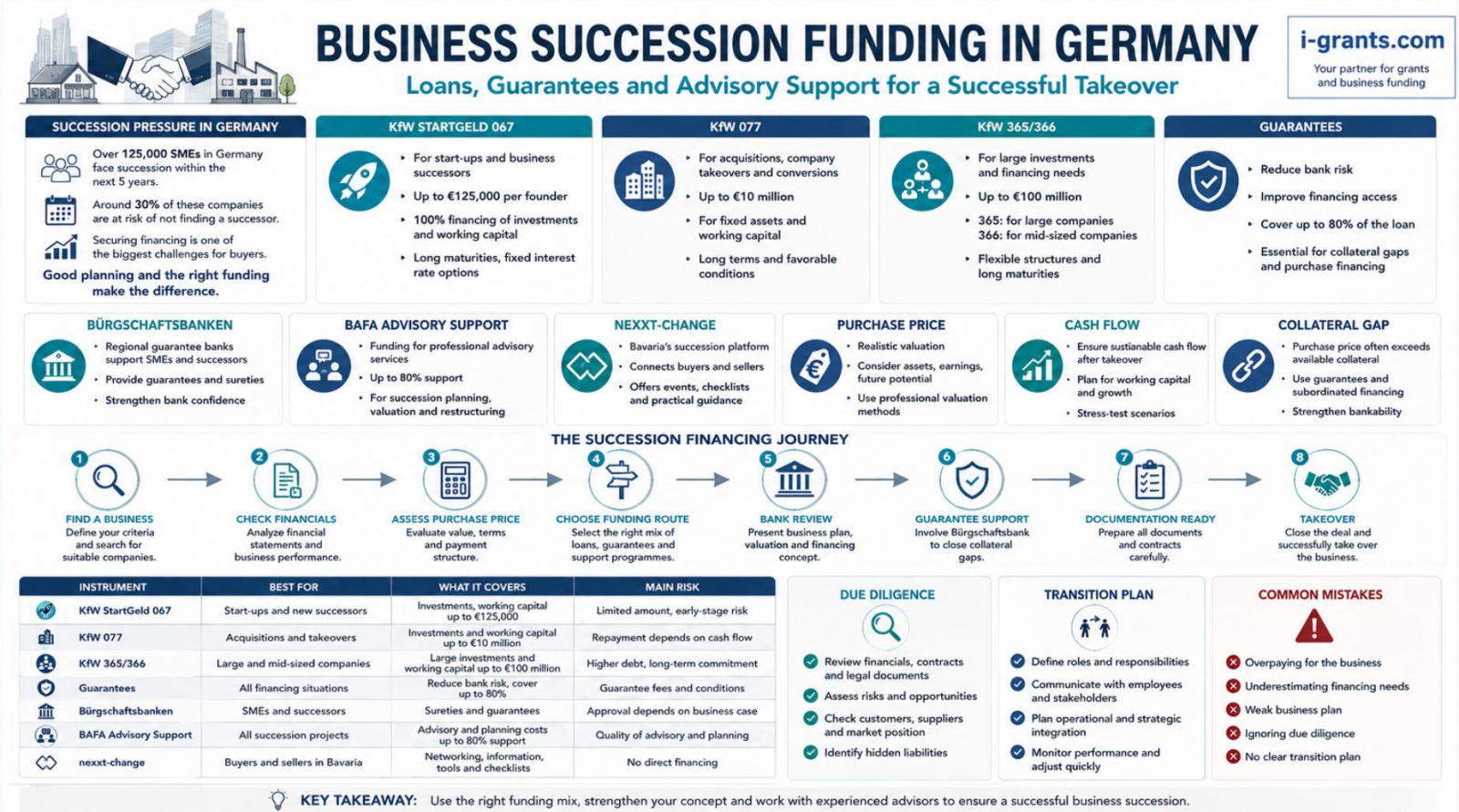
KfW is often the first public financing route that successors investigate. However, it should not be described as a grant route. KfW support for business succession is normally loan-based and works through a financing partner, usually the applicant’s house bank. The bank remains central because it checks the project, the borrower, the collateral situation, and repayment capacity.
KfW explicitly presents business succession as a route into self-employment and states that it can support the takeover of an existing company through different promotional loan products depending on the size and structure of the project.
For smaller takeovers, the ERP Start-up Loan, StartGeld 067, can be relevant. KfW states that the product provides up to 200,000 euros, including up to 80,000 euros for working capital. It can finance the establishment and operation of a business, and KfW’s public information confirms that the programme gives start-ups, self-employed professionals, and young businesses access to easier financing because KfW assumes 80 percent of the default risk for the applicant’s regular bank.
For succession and young companies with a larger but still limited financing need, the ERP Promotional Loan for Start-ups and Succession 077 is more specific. KfW states that this product can provide up to 500,000 euros per applicant, but the loan may not exceed 35 percent of eligible costs. It is designed for business formation, succession, and young companies and is linked to a guarantee from a Bürgschaftsbank.
For larger SME transactions, the ERP Promotional Loan SME 365/366 can be relevant. KfW states that this product serves SMEs and self-employed professionals and can be used for investments, working capital, business formation, succession, and participations. It can provide up to 25 million euros, with repayment terms of up to 20 years, up to three repayment-free years, and, in the risk-sharing variant, a 50 percent KfW risk assumption.
Table 2. KfW and Support Routes for Business Succession Financing
| Instrument | Suitable for | What it can support | Key financing feature | Main applicant risk |
|---|---|---|---|---|
| ERP Start-up Loan, StartGeld 067 | Smaller takeovers, founders, self-employed professionals, young businesses | Investments, running costs, working capital, business establishment and continuation | Up to 200,000 euros, including up to 80,000 euros for working capital, with KfW assuming 80 percent of the default risk for the regular bank | The cap may be too low for larger acquisitions, and the bank still checks repayment capacity. |
| ERP Promotional Loan for Start-ups and Succession 077 | Successors, founders, and young companies with a defined financing need | Formation, business succession, and development of young companies | Up to 500,000 euros per applicant, but not more than 35 percent of eligible costs, linked to Bürgschaftsbank guarantee logic | It does not finance the whole acquisition and requires a convincing financing structure. |
| ERP Promotional Loan SME 365/366 | SMEs financing larger investments, succession, participation, or working capital | Investments, working capital, company formation, succession, and business participation | Up to 25 million euros, repayment term up to 20 years, possible 50 percent risk assumption in variant 366 | The house bank still assesses business quality, collateral, cash flow, and transaction risk. |
| Bürgschaftsbanken | Successors with insufficient collateral but a viable project | Guarantees for bank loans, including succession-related financing | Guarantees may cover up to 80 percent of default risk, while the lending bank must keep at least 20 percent own risk | A guarantee does not replace a viable business case or adequate borrower commitment. |
| BAFA advisory support for SMEs | SMEs needing external management advice before or after succession | Individual consulting on economic, financial, personnel, and organisational management questions | Grant support of up to 80 percent of eligible consulting costs, with eligible consulting costs capped at 2,800 euros under the federal funding database description | It is advisory support, not acquisition financing, and it does not cover mainly legal, tax, insurance, or grant-focused consulting. |
| nexxt-change | Sellers looking for successors and buyers looking for companies | Matching, anonymised listings, information, regional partner support | Germany’s largest business succession exchange, with more than 10,000 current anonymised listings reported by IHK and around 1,000 successful matches per year | Finding a company is only the first step. Due diligence and financing readiness still decide whether the transaction works. |
Guarantees and the Collateral Gap
Many succession transactions fail not because the target company is worthless, but because the buyer cannot provide enough collateral for a bank loan. This is a classic problem in takeover financing. The value of the company often depends on future earnings, customer continuity, employee stability, and successful transfer of knowledge from the previous owner. These factors are real, but they are not always easy to pledge as security.
This is where Bürgschaftsbanken can become decisive. The official German funding database states that federal and state guarantees can cover a maximum of 80 percent of the default risk, while the lending institution must retain at least 20 percent of the risk without preferential satisfaction or special collateral. It also states that investors or shareholders must participate appropriately with their own equity or liable capital.
The role of guarantee banks is not theoretical. The Association of German Guarantee Banks reports that German Bürgschaftsbanken secured 5,077 project financings with guarantees and guarantee instruments in 2025. VDB also explains that guarantee banks can step in for up to 80 percent of an outstanding loan amount if a borrower becomes insolvent, with federal and state counter-guarantees forming a basis for their work.
For a successor, a guarantee can improve the bank’s risk position. But it cannot fix a weak transaction. The buyer still needs a defensible purchase price, a realistic business plan, credible management ability, own capital, liquidity planning, and a convincing answer to what happens after the old owner leaves.
Advisory Support: Preparing the Business Before and After Transfer
Succession financing is not only about money. It is also about readiness. A seller may need to prepare the company for transfer. A buyer may need to assess the business, improve processes, build a post-takeover plan, or stabilise management after acquisition. This is where advisory support can be useful.
BAFA’s programme for SME consulting is not a dedicated succession acquisition grant, but it can support individual consulting on business management issues. BAFA states that the directive applies to applications submitted from 1 January 2023 and, within the validity period ending on 31 December 2026, each eligible company may receive support for a maximum of five separate consultations, but no more than two per year.
The federal funding database describes the support as a grant and states that the subsidy can reach up to 80 percent of eligible costs depending on the region, while the maximum eligible consulting costs are 2,800 euros. The application must be submitted online before the planned consulting begins.
For succession, this kind of support should be used carefully. It is suitable for management, finance, organisational, personnel, or business model questions. It should not be treated as a way to finance the acquisition itself or as a substitute for legal and tax due diligence.
nexxt-change and the Matching Problem
Financing cannot solve succession if buyers and sellers never find each other. Germany’s official succession marketplace, nexxt-change, addresses this matching problem. The platform describes itself as Germany’s largest business succession exchange, bringing together business owners and people seeking to start or continue a business.
IHK information states that users can choose from more than 10,000 current anonymised listings on nexxt-change and that more than 1,000 entrepreneurs find a successor through the platform each year.
For a buyer, however, a marketplace listing is not yet a financeable transaction. It is only the beginning of a process. The buyer still needs financial statements, price logic, debt capacity analysis, customer and employee continuity checks, lease and contract review, investment planning, and a credible integration plan.
For a seller, the same logic applies from the other side. A company that is prepared for transfer will usually be easier to finance. Clean accounts, documented processes, second-level management, transferable customer relationships, and realistic valuation can make the difference between a serious offer and a failed negotiation.

Documents Banks Expect Before Financing a Takeover
A bank financing a business acquisition will usually expect more than a standard business plan. The successor should be ready to provide a structured financing file that explains both the acquisition and the future operating model.
Table 3. Documents Needed Before Financing a Business Takeover in Germany
| Document or analysis | Why it matters | Typical weakness |
|---|---|---|
| Business plan for the successor | Shows how the buyer will run and develop the company after transfer | Too much focus on acquisition, not enough on continuity and post-takeover growth |
| Financial statements of the target company | Allows the bank to assess profitability, debt, margins, and stability | Incomplete, outdated, or not adjusted for owner-specific effects |
| Purchase price rationale | Explains why the valuation is economically defensible | Price based on owner expectations rather than cash flow |
| Liquidity and debt service plan | Shows whether the company can repay the loan after acquisition | No buffer for slower sales, delayed investments, or transition costs |
| Transfer and integration plan | Shows how customers, employees, suppliers, and know-how will be retained | Overdependence on the outgoing owner |
| Collateral and guarantee concept | Helps the bank structure risk, including possible Bürgschaftsbank involvement | Buyer assumes that public guarantee automatically replaces own contribution |
| Advisory and due diligence record | Shows that legal, tax, financial, and operational risks were reviewed | Due diligence starts too late or remains too superficial |
A good financing file is not just a collection of documents. It is a coherent argument that the takeover price, the borrower, the target company, and the repayment plan fit together.
Common Mistakes in German SME Succession Financing
Many succession financing problems are predictable. The buyer accepts an excessive purchase price, underestimates working capital, assumes that past profits will continue automatically, or ignores how dependent the company is on the previous owner. The seller prepares too late, keeps knowledge undocumented, expects a price the market cannot finance, or does not make the business transparent enough for banks and successors.
A particularly serious mistake is starting the project too early. KfW promotional loans generally require application through a financing partner before the project begins. KfW’s product pages for relevant succession and start-up financing routes make clear that the application is handled through the bank and should be made before the start of the project.
Another mistake is treating public finance as a replacement for commercial viability. KfW loans, guarantees, and advisory grants can improve the financing structure, but they do not remove the need for a viable company, a capable successor, a realistic purchase price, and enough cash flow to repay debt.
Where a Grant Writer or Funding Advisor Adds Value
Business succession financing is not a classic grant-writing task, but a funding advisor can still add substantial value. The work is less about writing a persuasive narrative for a grant evaluator and more about making a financing case bankable, coherent, and compliant.
For KfW-backed finance, the advisor helps select the right product, prepare the financing logic, align the business plan with bank expectations, and avoid timing mistakes. For guarantees, the advisor helps explain the collateral gap and the risk structure. For BAFA-supported consulting, the advisor helps separate eligible management consulting from non-eligible legal, tax, or purely subsidy-focused work. For succession platforms, the advisor can help turn an interesting listing into a structured acquisition file.
The best time to involve external support is before price, financing, and timing are fixed. Once a buyer has agreed to an unrealistic price or started the project before applying, the available public finance routes may become narrower.
Strategic Takeaway
Germany’s business succession challenge is not only about finding younger people willing to take over companies. It is also about making takeovers financeable.
KfW loans can support smaller and larger succession projects, but they remain bank-based loans, not grants. Bürgschaftsbanken can help when collateral is insufficient, but they do not replace a viable acquisition case. BAFA consulting support can help companies prepare for management, finance, organisational, and post-transfer challenges, but it does not finance the purchase itself. nexxt-change can help buyers and sellers find each other, but matching is only the first step.
For a German SME succession to work, the transaction needs a realistic price, credible cash flow, own capital, bank confidence, a guarantee strategy where needed, due diligence, and a clear continuity plan. The strongest successors are not simply those who find a company to buy. They are the ones who can show how the company will remain stable, repay the financing, retain people and customers, and invest in its next stage.
In Germany’s ageing Mittelstand, that is the real financing challenge: not only transferring ownership, but financing continuity.