

 Français
  Deutsch
  Українська
Small business grants in Poland rarely fail because the applicant wants to grow. They fail because the budget does not match the rules.
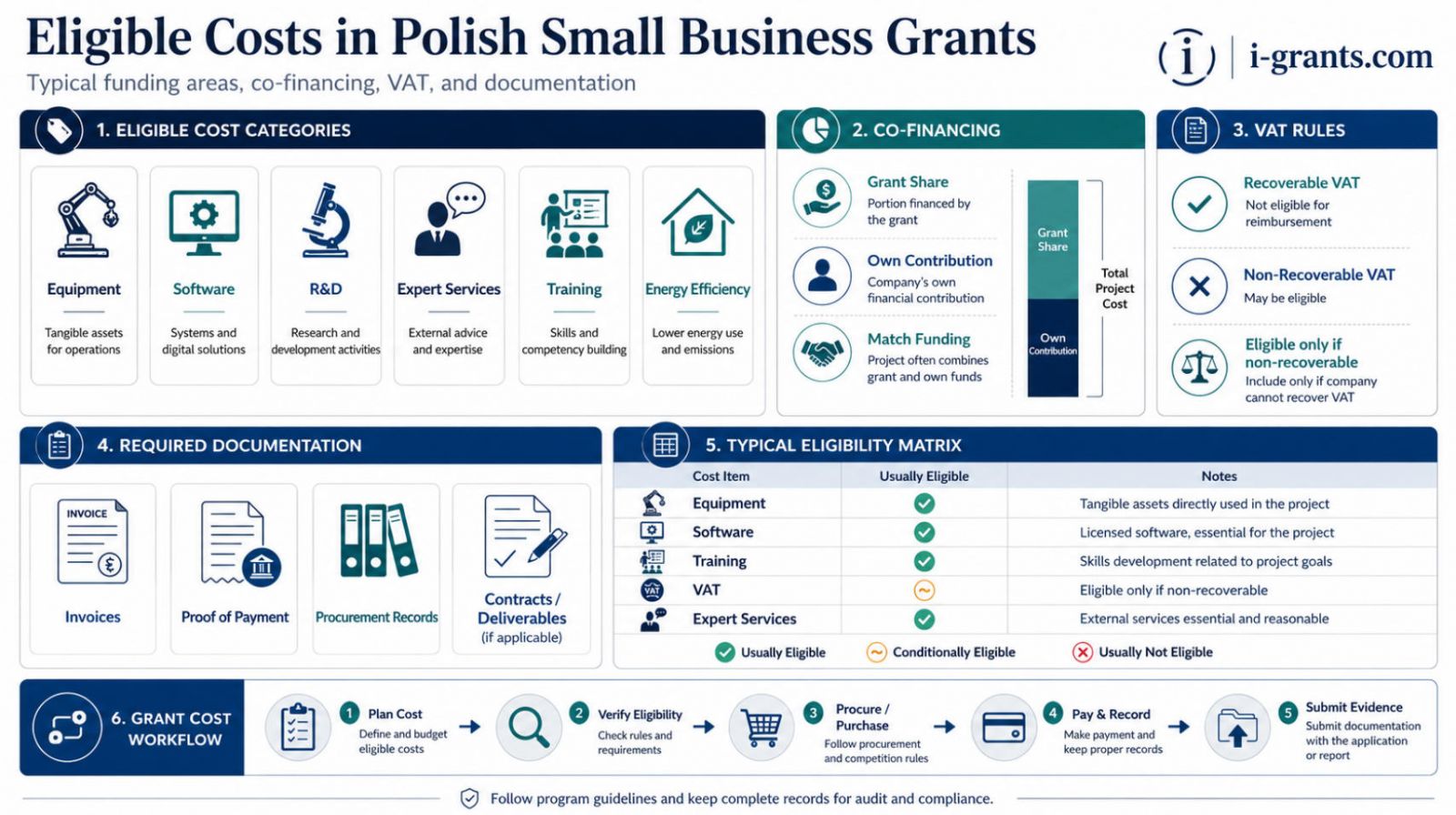
For Polish SMEs, grant funding can cover equipment, R&D, software, patents, expert services, training, green investment, internationalization, energy-efficiency upgrades or selected operating costs. But none of these categories is automatically eligible. Every cost must be linked to the project objective, included in the call documentation, incurred within the allowed period, supported by accounting evidence and compliant with public aid rules.
This distinction matters in 2026. Poland is already deep into the 2021-2027 EU funding cycle. According to the Polish Ministry of Funds and Regional Policy, by 7 June 2026 national and regional programmes had launched 4,810 calls with a combined budget of PLN 327.0 billion. Applicants had submitted 78,298 funding applications, while signed agreements covered PLN 206.9 billion of EU funding, equal to 65.2% of the available EU allocation.
For SMEs, this creates both opportunity and pressure. Poland’s business base is overwhelmingly made up of small firms. PARP’s latest SME sector report indicates that in 2024 Poland had 2.37 million active non-financial enterprises, with SMEs representing 99.8% of all companies. Microenterprises alone accounted for 97.2% of enterprises. That means grant calls attract a very large pool of potential applicants, and a technically weak budget can quickly become a reason for rejection, reduction or later financial correction.
This article explains what costs small business grants in Poland can cover, how co-financing works, when VAT may be eligible, which documents matter and what grant writers should check before a client submits an application.
The Core Rule: Eligible Does Not Mean Useful
A cost is not eligible simply because it is useful for the business. It is eligible only if it satisfies the funding programme’s legal, financial and project logic.
In Polish EU-funded grant schemes, eligibility is shaped by several layers of rules: EU regulations, national eligibility guidelines, programme-specific rules, call regulations, the regional aid map, state aid conditions and the applicant’s own accounting position. For 2021-2027 funds, the central reference point is the Polish eligibility guidance for European Funds, updated in 2026, which sets unified rules and procedures for eligible expenditure under major EU funds such as ERDF, EFS+, the Cohesion Fund and the Just Transition Fund.
For an SME applicant, the practical test is simple:
A cost should be necessary for the project, proportionate to the expected result, allowed by the call, correctly classified, incurred in the eligible period, paid through acceptable channels and documented well enough to survive audit.
This is why the same item can be eligible in one project and ineligible in another. A machine purchased to implement an innovation may be eligible in an investment module. The same machine may be rejected in an R&D module if the rules allow only depreciation during the research period. A marketing campaign may be eligible in an internationalization project but not in a pure technology implementation project. A software licence may be eligible as an intangible asset if it is necessary for the funded activity, but not if it is a general business tool unrelated to the project’s objective.
Table 1. Main Cost Categories That Polish SME Grant Schemes May Cover
| Cost category | When it may be eligible | Typical risk for applicants |
|---|---|---|
| Fixed assets and equipment | When machinery, devices or equipment are necessary for the funded investment, production upgrade, innovation implementation or energy-efficiency project. | Buying equipment before the eligible start date, choosing items not linked to the project objective or treating production equipment as R&D equipment without checking module rules. |
| Intangible assets | When patents, licences, know-how, technical knowledge, software or IP rights are purchased on market terms and used for the project. | Using software for general business operations rather than the funded project, buying from related entities without market justification or failing to keep the asset linked to the project for the required period. |
| R&D staff costs | When employees work directly on industrial research or experimental development tasks and the cost is calculated according to programme rules. | Weak time allocation, unclear job descriptions, bonuses not compliant with internal remuneration rules or staff costs assigned to the wrong module. |
| Subcontracting and external services | When external research, expert work, laboratory services, technical studies, audits or specialized services are necessary and allowed by the call. | Exceeding subcontracting limits, using related suppliers without safeguards, vague deliverables or treating ordinary consulting as technical project work. |
| Materials and consumables | When raw materials, reagents, prototype components or consumables are necessary for R&D or testing and are used for the project. | Purchasing stock for normal production, failing to prove proportional project use or including pilot-line elements in the wrong cost category. |
| Construction works and building materials | When the programme supports investment, modernization, technology implementation or energy-efficiency upgrades. | Exceeding percentage caps, including residential premises, starting works before eligibility begins or failing to connect construction to the funded objective. |
| Training and advisory services | When the programme explicitly supports skills, internationalization, digitalization, innovation management or green transition. | Treating broad business coaching as eligible project support without a direct link to programme indicators. |
| Energy-efficiency documentation | When audits, expert opinions, technical concepts or engineering projects are required for green investment instruments. | Preparing documentation that does not support the required energy-saving calculation or is not aligned with the call methodology. |
This table should not be read as a universal shopping list. It is a map of possible categories. The final answer always depends on the call documentation.
Equipment, Fixed Assets and Production Investments
Equipment is one of the most visible cost categories in Polish SME grant projects, but also one of the most frequently misunderstood.
In investment-oriented programmes, fixed assets may include machinery, technological lines, production equipment, testing devices, infrastructure elements or specialized tools. BGK’s Kredyt technologiczny, for example, includes categories such as the acquisition or production of fixed assets, construction works and materials, leasing instalments, intangible assets, technical studies and expert opinions. Kredyt ekologiczny also focuses on modernization investments designed to reduce primary energy consumption, with a minimum eligible expenditure threshold of PLN 2 million in the official BGK product information.
However, equipment is not eligible merely because it is expensive or useful. The applicant must show why the asset is necessary for the funded project, how it contributes to the expected result and why its price is reasonable. In technology implementation, the equipment must support the implementation of a new or significantly improved product or process. In energy-efficiency projects, it must be connected to measurable energy savings. In R&D projects, the cost may be treated differently, often through depreciation rather than full purchase cost.
Grant writers should therefore avoid generic budget lines such as “production machine” or “IT equipment”. A strong grant budget names the asset, connects it to a task, explains the technical function, justifies the cost level and shows how the asset will remain in the project during the durability period if required.
R&D Costs: Industrial Research, Experimental Development and the Problem of Classification
For innovative SMEs, Ścieżka SMART is one of the most important reference points because it shows how detailed cost classification can become. In the 2026 PARP documentation for the R&D call, support is aimed at developing and strengthening research and innovation capacities and using advanced technologies. The call was open to micro, small and medium-sized enterprises conducting business activity in Poland.
In R&D modules, eligible costs may include staff, subcontracting, depreciation of research equipment, depreciation of buildings used for R&D, certain land-use costs, intangible assets, materials and selected operating services. But the key issue is classification. Industrial research and experimental development are not the same, and they may have different aid intensities.
PARP’s 2026 eligibility guide for Ścieżka SMART indicates that R&D aid intensity may not exceed 50% of eligible costs for industrial research and 25% for experimental development, with possible increases under specific conditions such as SME size, broad dissemination of results or location. This means that a budget is not only a financial document. It is also a technical interpretation of the innovation process.
For applicants, the danger is overclaiming. If a company describes ordinary product adaptation as R&D, evaluators may reject the logic. If the project is genuinely experimental but the budget puts production costs into R&D categories, the cost may be reduced or excluded. If staff, materials and subcontracting are not assigned to specific research tasks, the project may look inflated or insufficiently controlled.
A good R&D budget should answer three questions: what uncertainty is being tested, which cost is needed to resolve that uncertainty and how the result will be verified.
Intangible Assets, Software and Intellectual Property
Software, licences, patents and know-how can be eligible in Polish SME grants, but only under defined conditions. In the Ścieżka SMART R&D eligibility guide, intangible assets may include patents purchased or used under licence, know-how, non-patented technical knowledge, expert opinions, analyses and research reports, provided they are used for industrial research or experimental development. In technology-oriented investment schemes, BGK also lists patents, licences, know-how and other intellectual property rights among possible eligible expenditure categories.
The grant writer’s task is to distinguish between project-critical intangible assets and ordinary operating tools. A CAD licence used to design and test a prototype may be defensible. A general office software subscription for the whole company may not be. A patent licence that enables the implementation of a new technology may fit the project. A brand refresh package may not, unless the specific programme supports market entry, internationalization or promotional activities.
The safest approach is to describe intangible assets through their technical role. What problem do they solve? Which work package needs them? Who will use them? Will they remain in the enterprise as project assets? Were they bought from an unrelated third party on market terms? These questions reduce the risk that software or IP costs are treated as vague overhead.
Marketing, Internationalization and Advisory Costs
Marketing costs are not automatically eligible in small business grants in Poland. They are usually eligible only where the programme’s purpose includes market entry, export development, internationalization, trade fairs, promotional missions, design, branding or commercialization.
This is a common source of budget mistakes. Applicants often assume that every growth project needs marketing, so marketing must be eligible. Evaluators take a narrower view. They ask whether the call supports that type of cost and whether the marketing activity contributes directly to the project indicators.
For example, trade fair participation, foreign market advisory services, promotional materials for export expansion or business missions may be eligible in internationalization-focused schemes. But paid social media ads, broad PR, influencer campaigns or domestic sales campaigns may be ineligible if the programme is focused on R&D, infrastructure, technology implementation or energy efficiency.
Advisory services follow the same logic. Technical studies, expert opinions, energy audits, engineering designs, patent support or market-entry consulting may be eligible if the programme allows them. General business consulting, routine accounting, tax advisory, sales training or investor pitch preparation may be excluded unless the call explicitly includes them.
Co-Financing and Own Contribution
Most small business grants in Poland do not cover 100% of project costs. The applicant must usually provide an own contribution, and the required share depends on the funding instrument, company size, region, cost category and type of public aid.
In practice, co-financing is not one number. It is a structure. A project can include several types of costs, and each type may be subject to a different aid intensity. For example, R&D, investment, advisory services, training and de minimis-funded costs may each follow different rules. A microenterprise in one region may receive a higher aid intensity than a medium-sized enterprise in another region. An industrial research task may have a higher support level than experimental development. A technical study may be subject to a different cap than machinery.
PARP’s Ścieżka SMART guide states that the applicant must provide the declared own contribution to cover part of eligible costs, and that the own contribution may be made only in monetary form during the project. It also indicates that the own contribution cannot come from public sources such as grants or subsidies from the state budget or local government budgets.
For applicants, this has a practical implication: the grant budget must be financially realistic. It is not enough to win the grant. The company must also finance its share, pre-finance costs where reimbursement is used, manage cash flow and keep evidence of payments.
Table 2. How Co-Financing and Cost Rules Differ by Instrument
| Funding instrument or context | What it can show about eligible costs | Practical lesson for SMEs and grant writers |
|---|---|---|
| Ścieżka SMART R&D module | R&D costs may include staff, subcontracting, depreciation, intangibles, materials and selected operating costs. Aid intensity differs between industrial research and experimental development. | The budget must follow the technical R&D logic, not only the company’s purchasing plan. |
| Ścieżka SMART implementation logic | Investment costs can be linked to implementation of innovation, with support levels affected by regional aid rules and company size. | The same project may need separate cost logic for R&D and implementation. |
| BGK Kredyt ekologiczny | Supports modernization investments aimed at reducing primary energy consumption. Official information sets a minimum eligible expenditure threshold of PLN 2 million. | Energy-saving calculations, audit documentation and investment logic are central. |
| BGK Kredyt technologiczny | May include fixed assets, construction works, intangible assets, leasing instalments, technical studies and expert opinions. | Technology implementation must be genuinely linked to the company’s own project, not only the purchase of a ready-made solution. |
| De minimis aid | EU rules set a general ceiling of EUR 300,000 over any period of three years for one undertaking. | The applicant’s previous aid history can limit new funding even if the cost category itself is eligible. |
| Regional aid | Aid intensity depends on the regional aid map, company size and investment location. | The registered office is not always enough. The project location and actual investment site matter. |
VAT: Usually Ineligible, Sometimes Eligible
VAT is one of the most sensitive budget items in Polish grant projects. The safest rule is this: VAT is generally not an eligible cost if the applicant has a legal right to deduct or recover it.
The PARP Ścieżka SMART eligibility guide states that VAT generally constitutes an ineligible project expense. VAT may be eligible only when the applicant, under applicable national law, has no right to reduce output VAT by input VAT or apply for a VAT refund. The guide also makes clear that having the legal possibility to recover VAT excludes eligibility, even if the beneficiary does not actually use that right.
This is important because applicants sometimes believe that a written declaration saying “we will not recover VAT” is enough. It is not. The issue is not only what the company intends to do. The issue is whether the company has a legal right to recover VAT.
For grant writers, VAT should never be treated as a small technical detail at the end of the budget. In larger investment projects, VAT can significantly affect cash flow. If VAT is non-eligible, the company must finance it outside the grant. If the company incorrectly includes recoverable VAT as eligible, the cost can be removed during assessment or challenged later during control.
Timing: When Can Costs Be Incurred?
Many Polish SME grant programmes apply a strict start-date logic. In general, costs incurred before the allowed eligibility date are at risk. In many competitive grant calls, the project cannot start before the application is submitted or before a specific date defined in the call rules. Some de minimis-funded costs or preparatory costs may be treated differently, but this must be checked in the specific documentation.
This rule is especially important for equipment orders, construction works, supplier contracts and advance payments. Signing an unconditional contract before the eligible start date may be treated as starting the project. In some cases, conditional contracts may be acceptable, but the wording and timing matter.
For applicants, the practical advice is clear: do not commit to major project costs before checking the call rules. For grant writers, the safest workflow is to ask the client for all planned contracts, supplier negotiations, pro forma invoices, advance payments and board decisions before finalizing the application. A project can be technically strong and still lose eligibility because the company moved too early.
Documentation: What Auditors and Intermediate Bodies Will Look For
A grant budget is not finished when the application is submitted. It must be capable of being verified during assessment, implementation, payment requests and control. Documentation should therefore be designed before the project starts, not reconstructed after the fact.
Table 3. Key Documents for Proving Eligible Costs in Polish SME Grant Projects
| Document type | Why it matters | What grant writers should check |
|---|---|---|
| Application budget and cost schedule | Shows how each cost is assigned to tasks, modules, indicators and funding categories. | Each cost line should have a clear role, category, timing and calculation method. |
| Invoices and equivalent accounting documents | Prove that the expense exists and corresponds to the approved project. | Invoice descriptions should match the project scope and avoid vague supplier wording. |
| Proof of payment | Confirms that the cost was actually paid through acceptable channels. | Bank transfers, payment dates and payer identity should align with project rules. |
| Procurement or market comparison files | Demonstrate price reasonableness and supplier selection transparency. | Keep offers, evaluation notes, supplier correspondence and conflict-of-interest checks. |
| Contracts and deliverable protocols | Prove the scope, timing and acceptance of external services or works. | Deliverables should be specific enough to prove that the service was real and project-related. |
| Time records and HR documents | Support staff cost eligibility in R&D or project implementation. | Roles, working time, employment rules and remuneration components should be consistent. |
| Depreciation records | Support partial eligibility for equipment or buildings used during the project. | The eligible share should reflect project use, period of use and accounting rules. |
| VAT status evidence | Supports the treatment of VAT as eligible or non-eligible. | Confirm whether the company has the legal right to deduct or recover VAT. |
| Energy audit or technical documentation | Supports green investment, energy-efficiency or modernization projects. | Calculations must support the required energy-saving or environmental indicators. |
Strong documentation does not make an ineligible cost eligible. But weak documentation can make an otherwise eligible cost impossible to defend.
Common Mistakes That Make Costs Ineligible
The most frequent budget problems are predictable. They usually appear when the applicant builds the budget from business needs first and programme rules second.
Common mistakes include:
-
Including costs that are useful for the company but not allowed by the call.
-
Starting the project too early by signing contracts, placing orders or making payments before the eligible date.
-
Treating recoverable VAT as an eligible cost.
-
Using one co-financing percentage across all cost categories when different aid intensities apply.
-
Assigning costs to the wrong module, for example putting implementation costs into R&D.
-
Under-documenting market price, procurement process, staff time or project use.
-
Forgetting previous public aid when de minimis or cumulation rules apply.
These mistakes are especially damaging because they can appear at different stages. Some lead to rejection during assessment. Others reduce the grant amount during contracting. Some create repayment risk after implementation.
What Grant Writers Should Do Before Building the Budget
For grant writers working with Polish SME clients, budget preparation should begin before writing the narrative. A strong cost structure is one of the main signs that the project is mature.
The first step is to map every cost to a project task. If a cost cannot be connected to a task, result or indicator, it probably needs to be removed or redefined. The second step is to classify the cost under the correct category in the call documentation. The third step is to check aid intensity, VAT, timing and documentation. Only after that should the budget be optimized for scoring.
A useful internal review should cover five questions:
-
Is this cost explicitly allowed by the call or clearly justified under an eligible category?
-
Is the cost necessary for the project objective, not only for the company’s general growth?
-
Is the amount reasonable and supported by market evidence?
-
Can the applicant finance the own contribution, VAT and cash-flow gap?
-
Can the company prove the cost during control two or three years later?
This approach protects both the applicant and the grant writer. It reduces the risk of a “beautiful application” with an indefensible budget.
Strategic Advice for SME Applicants
Applicants often try to maximize the grant amount by including every possible cost. This is not always the best strategy. A leaner budget that clearly matches the programme objective can be stronger than a larger budget full of borderline items.
For a Polish SME, the best funding budget usually has four characteristics. It is directly linked to the project result. It uses the correct cost categories. It respects aid intensity and own contribution rules. It is easy to document.
This is particularly important in competitive calls. Evaluators are not only checking whether the company wants funding. They are checking whether the requested public money is necessary, proportionate and compliant. A project with inflated costs may look risky even if the underlying business idea is strong.
For grant writers, the budget should also support the story of the project. If the application says the company will develop a new technology, the cost structure should show research tasks, prototype work, testing, technical expertise and implementation logic. If the project claims energy savings, the budget should show audit-backed modernization costs. If the project aims at internationalization, the costs should support market entry rather than general promotion.
Conclusion: Eligible Costs Are the Architecture of a Fundable Project
Small business grants in Poland can cover a wide range of expenses, from R&D staff and subcontracting to machinery, intangible assets, expert services, construction works, training and green modernization. But eligibility is never automatic.
The strongest Polish SME grant applications treat the budget as the architecture of the project. Every cost has a purpose. Every category matches the rules. Every percentage is checked. VAT is handled correctly. The own contribution is realistic. Documentation is prepared from the beginning.
For applicants, this means that grant funding should not be approached as a reimbursement wish list. For grant writers, it means that budget design is not an administrative appendix. It is one of the central parts of grant strategy.
In the 2021-2027 funding cycle, Poland still offers significant opportunities for SMEs, especially in innovation, technology, energy efficiency and regional development. But as more calls are launched and more funds are contracted, competition and scrutiny increase. Companies that understand eligible costs before submitting the application will have a stronger chance not only to win funding, but also to keep it.