

 Français
  Deutsch
  Українська
Corporate grants from major brands are often presented as simple opportunities: find the application, explain why the business needs money and compete for a check. The reality is considerably more complicated. Two of the most recognizable companies supporting small businesses in the United States, Verizon and American Express, illustrate how different corporate grant models can be even when both are designed to strengthen local businesses and communities.
Verizon's most important 2026 opportunity is the Small Business Digital Ready national grant. Eligible businesses can receive $10,000, but the grant sits inside a broader system of free courses, events, expert resources and business support. The 2026 model is particularly unusual because one application can remain under consideration across multiple monthly selections instead of disappearing after a single unsuccessful round. As of September 2, 2026, this national grant is still active.
American Express has taken a different approach. Its Amex Shop Small Grants Program awarded $20,000 to 505 businesses in 2026, distributing $10.1 million after an initial $5 million commitment was expanded by another $5.1 million. The application window has closed and the recipients have already been announced, but the program is exceptionally useful for understanding what American Express looks for in a small business, how narrowly it defines an eligible physical business and how detailed corporate grant rules can become once an applicant moves beyond the promotional headline.
American Express also has a deeper grantmaking history through its Backing Small Businesses partnership with Main Street America. In February 2026, Main Street America announced 400 recipients from the 2025 main funding round, each receiving $10,000. In July 2026, 25 businesses received another $30,000 each through Enhancement Grants. Since the Backing Small Businesses initiative began in 2021, it has provided more than $15.52 million to 1,755 small-business owners nationwide.
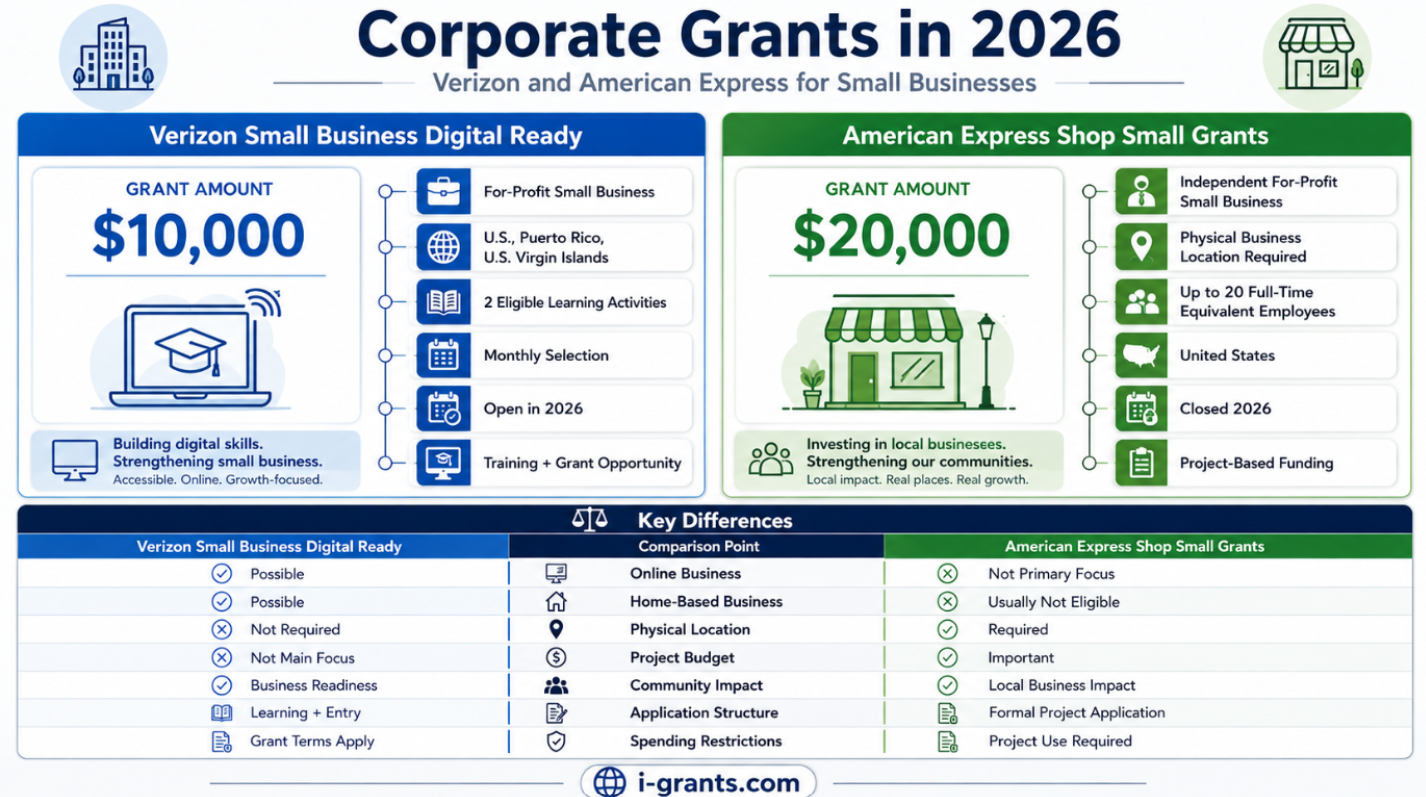
These two companies therefore provide an unusually useful comparison. Verizon currently offers a relatively accessible $10,000 grant connected to learning and rolling selection. American Express has recently completed a much more restrictive $20,000 competition centered on established brick-and-mortar businesses with ready-to-execute projects. Verizon emphasizes repeated access to a development platform, while American Express places much more emphasis on physical location, project readiness, community significance and precise spending rules.
For applicants, the important question is not simply which company offers more money. The better question is which funding model matches the business's legal structure, location, stage of development, investment need and ability to comply with the rules.
This article examines both companies in detail, including eligibility, deadlines, selection procedures, use-of-funds requirements, verification, additional support, historical results and the strategic lessons future applicants can draw from the 2026 funding cycles.
Program information and status were reviewed as of September 2, 2026.
Verizon and American Express: Two Very Different Corporate Grant Models
The headline numbers make the programs look similar. Verizon offers $10,000 grants to small businesses. American Express awarded $20,000 grants. Both programs are associated with large national brands, both use experienced nonprofit organizations to help administer small-business support, and both emphasize the relationship between stronger businesses and stronger local communities.
Once the detailed rules are examined, however, the similarities become much less important than the differences.
Verizon allows a broad range of for-profit small businesses in the United States, Puerto Rico and the U.S. Virgin Islands to participate. The current national grant does not publish a fixed minimum revenue threshold, a maximum revenue threshold, a numerical employee cap or a minimum number of years in business. Instead, the owner completes two qualifying learning activities, submits one application and enters a rolling selection system.
American Express took the opposite approach in the Shop Small Grants Program. The business had to be independently owned, for profit, established by a specific date, located in a permanent brick-and-mortar premises, operating from that premises by another specified date and employing no more than 20 full-time-equivalent employees including the owner. Online-only businesses, home-based businesses and franchises were excluded.
The contrast is central to understanding corporate grants. A higher grant does not necessarily mean a better opportunity, and a famous corporate brand does not tell an applicant whether the program was designed for a company like theirs.
Table 1. Verizon and American Express Small Business Grants in 2026
| Indicator | Verizon Small Business Digital Ready | American Express Shop Small Grants |
|---|---|---|
| Main grant amount | $10,000 | $20,000 |
| 2026 status on September 2 | Open | Closed, recipients announced |
| Applicant type | For-profit small business | Independent for-profit small business |
| Geography | U.S., Puerto Rico, U.S. Virgin Islands | 50 U.S. states and Washington, D.C. |
| Physical storefront required | No published requirement | Yes |
| Online-only business eligible | Not excluded by the current national rule solely for being online | No |
| Home-based business eligible | No specific exclusion published on current national grant page | No |
| Franchise eligible | No specific franchise rule published on current national page | No |
| Published employee maximum | None stated on current national page | 20 FTE including owner |
| Published minimum business age | None stated on current national page | Business start date on or before January 1, 2024 |
| Training required before application | 2 qualifying Digital Ready activities | No equivalent pre-application training |
| Application model | One application, rolling monthly consideration | One fixed application period |
| Main project requirement | Proposed use of funds and community impact considered | Ready-to-execute project with detailed budget |
| AI-generated application | No comparable prohibition published on current national grant page | Explicitly prohibited |
| Grant administrator | LISC | Main Street America |
| Additional ecosystem | Courses, events, expert support, networking | Networking, learning opportunities, Shop Small and Main Street ecosystem |
The table shows why grant seekers should never compare corporate programs only by award size. A business that is completely eligible for Verizon could be automatically excluded from American Express because it operates online, from home or with more than 20 full-time-equivalent employees. Conversely, an established storefront business with a highly specific renovation or equipment project could be exceptionally well aligned with the American Express model.
1. Verizon Small Business Digital Ready: More Than a $10,000 Grant
Verizon Small Business Digital Ready is designed as a business-development platform rather than merely a grant portal. Verizon currently promotes more than 60 free online courses covering subjects such as financial management, social-media marketing and artificial intelligence adoption. The platform also includes networking, expert resources and funding opportunities, and it is available to small businesses regardless of whether they are Verizon customers.
By mid-2026, Verizon reported that Digital Ready had reached more than 600,000 business owners. The company has set a longer-term goal of supporting one million small businesses by 2030. Since 2021, Verizon says it has awarded $15 million in grants through the platform to more than 1,500 small businesses. Its current funding page states that more than 145 grants are expected to be awarded across the wider program during 2026.
Those numbers help explain why the current national grant should not be interpreted as a one-off promotion. Verizon has been building a multi-year small-business support system in which education and grantmaking reinforce each other.
The current $10,000 national grant is the most important opportunity inside that system because it remains open and because the 2026 rules introduced a new rolling application model.
How the Verizon $10,000 National Grant Works
Beginning in 2026, Verizon and LISC changed the process so that applicants would not need to prepare repeated applications for separate national grant cycles. An eligible business now completes two qualifying Digital Ready courses or events, unlocks the grant application and submits it once. That application remains active for subsequent monthly selections during the rest of 2026 if the business is not immediately selected.
Ten businesses are selected each month from June through December. If all seven monthly rounds operate according to the published structure, the national rolling program will produce 70 grants worth a combined $700,000. This $700,000 figure refers specifically to the current national $10,000 stream and should not be confused with Verizon's wider 2026 grant activity.
The rolling model has a significant practical advantage for applicants. In a conventional grant competition, an unsuccessful decision ends the opportunity. With Verizon, a business that is not selected in one monthly round may remain under consideration in later months without preparing another grant application.
That does not mean an early application is guaranteed to receive preference. Verizon does not state that applications are scored more favorably simply because they arrive earlier. However, an application submitted while several monthly rounds remain has more future selection periods available than one submitted near the end of the year. For a prepared business, unnecessarily delaying the application therefore makes little strategic sense.
Table 2. Verizon Small Business Digital Ready $10,000 Grant: 2026 Requirements
| Requirement | Current Rule |
|---|---|
| Grant | $10,000 |
| Business status | For-profit small business |
| Owner age | At least 18 |
| Geography | U.S., Puerto Rico, U.S. Virgin Islands |
| Verizon customer required | No |
| Digital Ready account | Required |
| Learning requirement | Any combination of 2 qualifying courses or events |
| Learning period | January 1 to December 7, 2026 |
| Application frequency | One application |
| Monthly selections | 10 businesses |
| Selection months | June through December 2026 |
| Application remains active after unsuccessful month | Yes |
| Final decision for all applicants | By January 12, 2027 |
| Multiple businesses owned by one person | Only one may be submitted |
| Nonprofit applicant | Not eligible |
| Previous Digital Ready grantee | May apply, but new recipients receive priority |
| Changes after submission | Not accepted |
What Verizon Does Not Require Publicly
Some of the most important information in a grant program concerns requirements that are absent.
The current Verizon national grant page does not state that the business must generate a particular minimum level of annual revenue. It does not publish a maximum revenue ceiling. It does not specify that a business must employ fewer than a certain number of people, and it does not impose a publicly stated rule that the business must have operated for one, two or three years before applying.
This matters because third-party grant databases often add generalized definitions of "small business" to program summaries. A reader may encounter an article claiming that a Verizon applicant needs fewer than 50 employees or annual revenue below a particular number even when that numerical threshold does not appear in the current official national grant rules.
Applicants should not make themselves ineligible based on conditions the funder has not published. They should also avoid the opposite mistake of assuming that the absence of a public numerical threshold means no verification will occur. LISC still verifies finalists and requires appropriate business and financial information.
The correct approach is to separate published eligibility rules from assumptions.
The Two-Activity Requirement Is More Important Than It Looks
To unlock the national grant application, a business owner must complete two qualifying Digital Ready activities between January 1 and December 7, 2026. These can include courses, virtual events, recorded events and eligible in-person activities. For an in-person event to count, it must appear on the Digital Ready in-person event list, and the participant must scan the relevant code onsite so that completion is recorded.
A business owner could treat this as a procedural requirement and select the easiest possible activities simply to reach the application. That may satisfy the rule, but it misses the strategic purpose of the platform.
A better approach is to choose training directly connected to the business problem the grant would address. If the company wants funding for customer acquisition, courses on marketing, sales or customer retention could strengthen the owner's understanding before the application is written. If the proposed investment concerns automation or digital systems, training on technology adoption may make the project more credible and easier to explain.
The ideal sequence is therefore not "complete anything, then ask for money." It is "identify the business constraint, learn more about the area, design the investment and then explain how the grant would convert that learning into measurable improvement."
That sequence aligns much more closely with the logic of Digital Ready.
Verizon's Application Is Short, but That Does Not Make It Easy
Verizon says the national application should take approximately 30 minutes and recommends using Google Chrome, setting aside uninterrupted time and checking every answer before submission. The final instruction is especially important because LISC does not permit applicants to edit the application after it has been submitted.
A short application can actually increase the importance of good writing. In a long public-sector proposal, applicants may have several pages to explain the history of the company, financial need, market conditions and expected results. In a concise corporate form, the business must communicate the essential logic far more efficiently.
A strong application should therefore make the relationship between problem, investment and result immediately understandable. If the company wants equipment, it should explain what limitation the current equipment creates and what new capacity the purchase will unlock. If it wants marketing support, it should identify the customer-acquisition problem and how the proposed spending will address it. If it wants new technology, it should explain what process is currently inefficient and how the new system will improve operations.
The most persuasive answer is rarely the longest answer. It is the answer that makes the business case clear.
How Verizon Actually Chooses Businesses
The selection process is more complex than the word "drawing" might suggest.
LISC begins with an anonymous drawing to narrow the applicant pool and provide applicants an initial opportunity to advance without personal identity determining the first step. If necessary, an algorithm is then used to support a balanced distribution of industries and geographies so that awards are not concentrated too heavily in one location or sector.
Verizon also states that priority is given to businesses located in under-resourced and low-to-moderate-income communities that may have limited access to flexible and affordable capital. A subset of applications then undergoes deeper review based on accuracy, community impact and proposed use of funds. Businesses selected after that review must complete financial and legal verification before funding is released.
This is a critical distinction because some applicants may hear "anonymous drawing" and assume the quality of the application is irrelevant. It is not. Random selection helps narrow the pool, but substantive criteria still influence which businesses ultimately receive money.
Table 3. Verizon's 2026 Selection Process
| Stage | What Happens | Why It Matters |
|---|---|---|
| Eligibility | Basic conditions are confirmed | A strong business cannot overcome a fundamental eligibility failure |
| Anonymous drawing | Pool is narrowed | Provides an initial selection mechanism |
| Geographic and industry balancing | Algorithm may be used if needed | Helps avoid concentration of grants |
| Priority consideration | Under-resourced and LMI communities may receive priority | Eligibility does not mean equal priority |
| Detailed review | Accuracy, community impact and proposed use are evaluated | Application quality becomes important |
| Finalist status | Business is contacted for further information | Finalist is not yet guaranteed funding |
| Verification | Financial and legal standing are checked | Documentation can determine whether the award proceeds |
| Payment | Verified recipient receives $10,000 | Grant follows successful verification |
Eligibility Versus Priority: A Difference Applicants Often Miss
A business can satisfy all basic eligibility requirements without being among Verizon's highest-priority applicants.
This distinction is important. The current national rules do not say that a business must be located in a low-to-moderate-income community to apply. Instead, businesses in under-resourced and LMI communities receive priority during selection.
The same logic applies to previous grant recipients. Verizon does not automatically exclude businesses that received a Digital Ready grant in the past. They may apply again. However, the program gives priority to applicants that have not previously received a grant, and Verizon indicates that repeat awards are unlikely.
The practical lesson is that "eligible" and "competitive" are different concepts. Corporate grant seekers should always identify both the minimum conditions for entering and the characteristics that make a funder more interested in one eligible applicant than another.
What Community Impact Can Mean for a For-Profit Business
For-profit entrepreneurs sometimes assume that community impact is relevant only to nonprofits. Verizon's selection criteria show why that assumption can weaken a corporate grant application.
A small business can create community impact in several ordinary commercial ways. It can employ local residents, provide services that are scarce in the area, purchase from local suppliers, occupy otherwise vacant commercial space, improve accessibility, create safer or more welcoming premises, serve underserved customers or increase economic activity in a neighborhood.
The applicant does not need to invent a charitable mission. Instead, the application should explain the real consequences of business growth.
Suppose a small gym requests equipment. The direct business effect may be greater capacity and more memberships. The community effect could be broader access to physical activity, additional employment or services for older residents. A childcare company expanding its facilities may increase revenue while simultaneously creating more childcare capacity for working families. A local retailer investing in inventory may strengthen its business while keeping more consumer spending within the community.
This relationship between company growth and local impact becomes especially relevant when comparing Verizon with American Express, because community impact is central to both companies' funding models.
Finalist Verification: The Grant Can Still Be Lost
A business that reaches Verizon's finalist stage has not yet secured the $10,000.
LISC may request information such as a W-9, ACH banking details, EIN and other tax or identifying information needed to confirm the applicant and distribute the grant. LISC may also perform a background search. Verizon's FAQ states that this verification does not involve a credit check or credit-score pull.
The program also gives applicants useful fraud-prevention information. LISC says it will not request copies of documents such as a driver's license, passport or green card as part of this process. Finalist communications primarily come from an email address using the @lisc.org domain.
The communication requirement may sound administrative, but it can become decisive. Applicants are expected to respond to finalist requests promptly. A missed message, undeliverable email or failure to provide requested documents can result in the opportunity moving to another business.
That means a strong grant strategy includes basic administrative readiness. The owner should monitor the email address used in the application, check spam folders and organize tax and banking documentation before finalist notification rather than waiting until the last moment.
The Grant Is Not a Loan, but Taxes Still Matter
The Verizon award does not need to be repaid like a loan. However, receiving a grant does not necessarily mean that the full $10,000 can be spent without considering tax consequences.
LISC issues a Form 1099, and the recipient is responsible for applicable taxes. A small business planning to commit the entire grant immediately should therefore understand the financial treatment of the award and consult an appropriate tax professional when necessary.
This is a useful reminder that "non-repayable" and "tax-free" are not interchangeable terms.
Verizon's Grant Model Changed During 2026
Another reason to study Verizon closely is that the program evolved within a single year.
Earlier in 2026, Verizon and LISC operated shorter regional funding rounds. One official California grant provided 25 businesses with $5,000 each, for a total of $125,000. That round required one qualifying Digital Ready resource and used a fixed March 31 deadline rather than the current one-application rolling model.
The later national $10,000 program doubled the individual award, increased the learning requirement from one qualifying resource to two activities and allowed applications to remain under consideration throughout subsequent monthly selections.
This matters for applicants who entered an earlier Digital Ready grant cycle. Verizon explicitly states that applications submitted before April 15, 2026 did not automatically move into the new national grant. Those businesses must submit a new application for the current $10,000 opportunity.
Once the new national application is submitted, however, the business does not need to apply again every month.
Table 4. How Verizon's 2026 Funding Model Evolved
| Feature | Earlier California Round | Current National Round |
|---|---|---|
| Grant amount | $5,000 | $10,000 |
| Number in California round | 25 | 10 national recipients monthly |
| Training requirement | 1 qualifying resource | 2 qualifying activities |
| Geography | California | U.S., Puerto Rico, U.S. Virgin Islands |
| Application model | Fixed cycle | Rolling consideration |
| Reapplication required for later opportunity | Yes | No monthly reapplication after current national submission |
| Main deadline structure | March 31, 2026 | Apply during 2026 after satisfying qualification |
| Current status | Closed | Open |
The change demonstrates why applicants should never rely on last year's Verizon article, or even an article written several months earlier in the same year, without checking the current program page.
Verizon Small Business Super Pitch: A Different Route to Corporate Funding
Verizon also experimented with a very different small-business funding mechanism in 2026 through the Small Business Super Pitch.
The competition did not simply ask owners to submit a grant form. Participants first registered for Digital Ready and completed at least one course or event in the Winning Customers category. They then posted an approximately 60-second video on social media explaining how Digital Ready had helped position their business to succeed and completed the official entry form.
The competition ran from April 27 through May 18, 2026. More than 500 businesses participated. Twenty were selected for regional semifinal events in Kansas City, Houston, Los Angeles and Philadelphia, with five businesses competing in each city. Four regional winners then advanced to the final in Hoboken, New Jersey.
The finalists were The Balm Box, House of Perna, TWB Tours and Renewed Focus. Their sectors ranged from health-related products and fashion to tourism and therapy, demonstrating that Verizon was not limiting the competition to technology startups. All four finalists received tickets to the FIFA World Cup 2026 Final as well as expert mentoring on using artificial intelligence in their businesses.
The important lesson from Super Pitch extends beyond the competition itself. Verizon was testing whether entrepreneurs could explain their business clearly, show how they had used learning resources and communicate a convincing growth story. That skill is equally useful in a conventional grant application.
An entrepreneur should be able to explain what the company does, what is preventing the next stage of growth, what investment is needed and what measurable result will follow. If that explanation cannot be delivered clearly in a short pitch, it may also be too vague for a short grant application.
Verizon's Reported Business Outcomes
Verizon's own program reporting provides additional context for the value of Digital Ready beyond grant funding.
The company currently reports that 90 percent of surveyed participants are likely to recommend Digital Ready, 81 percent increased a specific skill or area of knowledge, 71 percent increased their confidence as entrepreneurs and 99 percent said the program helped their businesses.
Another Verizon Digital Ready program page has reported more outcome-focused measures, including 67 percent of participants saying Digital Ready increased revenue or profit, 55 percent saying it enabled them to increase employment and 66 percent saying it helped increase the number of customers. These are Verizon-reported program measures rather than guarantees of individual business results, but they help explain why the company describes Digital Ready as more than a grant platform.
Recent case studies also show how the resources can be used. Verizon has highlighted businesses that improved pricing, customer acquisition, digital visibility and administrative efficiency after using Digital Ready. The important point is not that every participant will reproduce the same results, but that the platform is intended to improve business capabilities before and after a grant decision.
Table 5. Verizon Digital Ready: Scale and Reported Outcomes
| Indicator | Reported Figure |
|---|---|
| Business owners reached by mid-2026 | More than 600,000 |
| Long-term goal | 1 million businesses by 2030 |
| Grants distributed since 2021 | $15 million |
| Small businesses receiving Digital Ready grants since 2021 | More than 1,500 |
| Free online courses currently promoted | More than 60 |
| Participants likely to recommend Digital Ready | 90 percent |
| Participants reporting increased skills or knowledge | 81 percent |
| Participants reporting greater entrepreneurial confidence | 71 percent |
| Participants saying Digital Ready helped their business | 99 percent |
2. American Express Shop Small Grants: $20,000 With Much Tighter Eligibility
If Verizon illustrates an accessible learning-and-grant ecosystem, American Express illustrates a more tightly engineered project grant.
The Amex Shop Small Grants Program was launched with Main Street America on Small Business Saturday, November 29, 2025. The original commitment was $5 million, enough to fund 250 businesses at $20,000 each. American Express also pledged an additional dollar for each qualifying transaction made with an eligible American Express Card at qualifying U.S. small businesses on Small Business Saturday. The resulting contribution added another $5.1 million.
By May 20, 2026, American Express and Main Street America had announced 505 recipients. At $20,000 each, those awards represent $10.1 million in direct grant funding. The recipients came from industries including retail, food service, health care and professional services.
This scale makes Shop Small one of the most substantial major-brand small-business grant rounds of 2026. At the same time, it was far less broadly accessible than Verizon.
American Express Defined the Eligible Business Very Precisely
The official Shop Small terms required the applicant to be at least 18 years old and to own an eligible small business. The applicant must have owned that business on or before January 1, 2025, and the business itself must have started on or before January 1, 2024.
The company had to be independently owned and for profit, operate from a physical brick-and-mortar location in one of the 50 U.S. states or Washington, D.C., and have operated from that location on or before January 1, 2025. The location had to be a permanent structure used solely by the same business operating within it.
The employee limit was 20 or fewer full-time-equivalent employees, including the owner.
This excluded a wide variety of businesses that might still qualify for other small-business grants.
Nonprofits were excluded. Franchises were excluded. Online-only businesses were excluded. Home-based businesses were excluded. Businesses operating solely from a vehicle, trailer or temporary structure were excluded. Businesses operating in shared spaces such as pop-ups, coworking locations and indoor marketplaces were also excluded.
This is a perfect example of why the phrase "grant for small businesses" is never enough information.
Table 6. American Express Shop Small Grants: 2026 Eligibility
| Requirement | 2026 Rule |
|---|---|
| Grant | $20,000 |
| Applicant age | At least 18 |
| Business structure | Independent, for-profit |
| Business start date | On or before January 1, 2024 |
| Current owner in place | On or before January 1, 2025 |
| Geography | 50 states and Washington, D.C. |
| Physical location | Permanent brick-and-mortar required |
| Business operating at that location by | January 1, 2025 |
| Maximum employees | 20 FTE including owner |
| Nonprofit | Not eligible |
| Franchise | Not eligible |
| Online-only business | Not eligible |
| Home-based business | Not eligible |
| Mobile-only business | Not eligible |
| Pop-up or coworking location | Not eligible |
| Indoor marketplace business | Not eligible |
| One owner with several businesses | Only one application allowed |
The Deadline Changed, and the Final Terms Matter
The American Express cycle also provides an important lesson about source verification.
An earlier program FAQ listed January 16, 2026 as the closing date. The revised formal program terms, however, extended applications through January 23, 2026 at 11:59 p.m. Central Time.
For an applicant, this is more than a historical curiosity. Grant information can change during a live competition. Promotional pages, FAQs and official terms may not always update at exactly the same moment.
When deadlines conflict, the most recent formal terms should normally be treated as the controlling program document unless the administrator states otherwise.
This is one reason applicants should save or review the official rules close to submission rather than relying on an article or screenshot collected weeks earlier.
American Express Wanted a Project, Not Just a Business Need
The strongest difference between Shop Small and Verizon becomes clear in the spending rules.
American Express required applicants to propose a ready-to-execute project. Recipients had a six-month period to complete their projects, with grant funds required to be spent during the April to September 2026 grant period. The application therefore needed more than a general statement that the company wanted to expand. It needed a defined project and a detailed, itemized budget.
If the total project budget exceeded $20,000, the applicant had to explain where the remaining money would come from. That means the funder was assessing not only whether the idea was attractive but whether the financing plan was complete enough to make implementation realistic.
If the main project cost less than $20,000, remaining grant funds could be used for equipment and inventory, marketing expenses or other operational expenses, as long as the spending occurred during the grant period and was identified in the application budget.
This creates a much more project-oriented application than Verizon's national grant.
An American Express applicant needed to know not simply what the business needed, but what project would be implemented, how much each component would cost, when it would be completed and how the entire budget would be financed.
What American Express Would and Would Not Pay For
The program allowed meaningful business investment, but it placed several important boundaries around the $20,000.
Grant funds could support equipment, inventory, marketing and other appropriate operating expenses associated with the project. Contracted labor provided by another business could also be eligible. For example, a recipient could hire an electrician or an outside branding consultant.
The grant could not be used to reimburse invoices or credit-card purchases made before the grant period. Debt and loan repayment were prohibited. Rent and utilities were prohibited. Ordinary payroll, staffing and labor costs were prohibited, except for qualifying contracted work performed by another business. Personal and non-business expenses were also prohibited.
The distinction between payroll and contracted labor is especially useful for applicants.
A business could not simply use the grant to cover several months of an existing employee's salary. It could, however, potentially contract with another company for specialist work required to complete the approved project.
Table 7. American Express Shop Small Grants: Use of Funds
| Expense | Treatment Under 2026 Rules |
|---|---|
| Equipment | Potentially eligible |
| Inventory | Potentially eligible |
| Marketing | Potentially eligible |
| Other approved operational expenses | Potentially eligible |
| Outside branding consultant | Potentially eligible contracted labor |
| Electrician or other outside contractor | Potentially eligible contracted labor |
| Project budget above $20,000 | Allowed if additional funding source is clearly identified |
| Purchases made before grant period | Not eligible |
| Debt repayment | Not eligible |
| Loan repayment | Not eligible |
| Rent | Not eligible |
| Utilities | Not eligible |
| Ordinary payroll | Not eligible |
| Regular staffing costs | Not eligible |
| Personal expenses | Not eligible |
Community Impact Was Not Optional to the Logic of the Program
American Express framed the program around three connected ideas: helping businesses grow, helping them innovate and strengthening local communities.
The official FAQ went further. If a business already had a clear community-support role, its grant could focus on growth and innovation. If it did not already support its local community, part of the grant-funded project needed to include a community-oriented initiative in addition to the business growth or innovation component.
This makes community impact more explicit in the American Express program than many conventional business grants.
The logic is closely connected to American Express's wider Shop Small strategy. According to the company's 2025 Small Business Economic Impact Study, an estimated 68 cents of every dollar spent at a U.S. small business remains in the local community. The estimate includes the direct local activity as well as the effect of small businesses and their employees spending with local suppliers and services.
American Express therefore has a clear strategic reason for connecting grant-funded business growth with local economic effects. The company is not treating community impact as decorative language appended to a commercial project. It is central to the Shop Small argument that healthy independent businesses contribute to healthy local economies.
How American Express Evaluated Applications
Applications were reviewed according to five stated categories: eligibility, feasibility, business impact, community impact and local significance. The program administrator did not publish individual judging scores, either during or after the competition.
These criteria help reconstruct what a strong application needed to accomplish.
Eligibility was binary. If the business was online-only, home-based, too new or too large, a compelling project could not fix the problem.
Feasibility concerned whether the project could realistically be completed during the grant period. That is why ready-to-execute planning, itemized budgets and proof of additional financing for projects above $20,000 mattered.
Business impact concerned what would improve inside the company. This could include increased capacity, modernization, new offerings, customer growth or another measurable commercial improvement.
Community impact and local significance then asked why the business mattered beyond its own balance sheet. A longstanding neighborhood restaurant, a service business filling a local gap or an independent retailer anchoring a commercial district could all demonstrate value that extends beyond direct revenue.
Taken together, these criteria show that American Express wanted a business, a project and a community story to align.
The AI Rule Was Exceptionally Strict
One of the most significant and unusual provisions in the official 2026 terms concerned artificial intelligence.
Applications generated in whole or in part by artificial intelligence, script, macro or other automated means were declared void. Applications also had to be the applicant's original work product.
The phrase "in part" is particularly important.
This was not merely a warning against submitting an entirely machine-generated application without reviewing it. The formal language prohibited AI generation of even part of the application.
For grant seekers, this is an important compliance development.
Artificial intelligence is now widely used for editing, brainstorming, business planning and grant writing, but funders are free to set their own rules. Some programs may allow it, some may impose disclosure requirements and others may prohibit it outright.
American Express demonstrates why every applicant should check the current competition terms before using any automated writing tool.
A technically excellent application can still be invalid if it was produced in a way the program rules prohibit.
Publicity Rights Were Also Broader Than Many Applicants Might Expect
The Shop Small terms also contained extensive provisions covering publicity and use of application materials.
Applicants granted the sponsor and American Express broad rights to use information, documents, photographs, biographical details, logos, social-media identifiers, quotes and other submitted materials for promotional and related purposes. Grant recipients also agreed that the sponsor or American Express could photograph or record them in connection with use of the grant funds.
Recipients could also be restricted from publicly announcing the grant before the official announcement without prior written approval.
This is another feature that distinguishes corporate grantmaking from some public grants.
For a corporate brand, a successful small-business grant can also become a communications asset. Recipient stories demonstrate what the program funded and reinforce the company's broader small-business strategy.
Applicants should therefore read publicity clauses as carefully as financial rules, especially if the business operates in a sector where confidentiality, customer privacy or brand control is particularly important.
Winner Notification Had a Seven-Day Compliance Window
American Express recipients were required to return a grant agreement, valid W-9 and banking-information form within seven days of issuance.
Failure to respond, failure to provide required documents or failure to comply with the terms could result in forfeiture, allowing the sponsor to select another applicant.
This is remarkably similar to the administrative lesson from Verizon.
Winning a competitive review does not end the process.
Both programs require applicants to remain responsive, keep records organized and act quickly when additional documents are requested.
For small-business owners who handle grant applications in addition to daily operations, this can be easy to underestimate. A missing email should not be the reason a business loses $10,000 or $20,000.
The 2026 Shop Small Results
On May 20, 2026, American Express and Main Street America announced 505 recipients of $20,000 grants.
The companies highlighted businesses across retail, food service, health care and professional services. Examples included Bill's Hamburgers in Amory, Mississippi, a nearly century-old restaurant planning to expand gathering space and complete improvements, and Don't Toss the Bouquet in Patchogue, New York, a flower-rescue business expanding a program that repurposes floral arrangements from weddings and funerals.
These examples reveal something important about the meaning of "innovation" in the program.
Innovation did not necessarily mean artificial intelligence, biotechnology or a patentable new product. For a traditional Main Street business, innovation could mean improving a physical space, adding capacity, creating a new service or developing a new way to serve customers and the community.
That makes the program relevant to a much broader range of established businesses than the word "innovation" may initially suggest.
American Express Backing Small Businesses: A Longer Grant Track Record
The Shop Small Grants Program is not American Express's only significant collaboration with Main Street America.
In 2021, American Express and Main Street America created Backing Small Businesses to support economically vulnerable businesses recovering from the pandemic and help them grow.
The program has since evolved through multiple funding rounds.
In 2023, 350 businesses received initial grants, and 25 later received $25,000 Enhancement Grants. In 2024, 500 businesses received $10,000 each, followed by 25 Enhancement Grants of $30,000. The 2025 main round selected 400 businesses for $10,000 awards, with the recipients announced in February 2026. A special disaster-recovery round also provided 100 businesses with $10,000 each.
In July 2026, Main Street America announced that 25 businesses from eligible prior 2025 rounds had received $30,000 Enhancement Grants. The organization reported that Backing Small Businesses had by then distributed more than $15.52 million to 1,755 business owners since launching in 2021.
Table 8. American Express Backing Small Businesses: Selected Historical Results
| Period or Round | Main Result |
|---|---|
| Program launch | 2021 |
| First year | $1.65 million to 330 small businesses |
| 2023 main cohort | 350 businesses received initial funding |
| 2023 Enhancement Grants | 25 businesses received $25,000 |
| 2024 main cohort | 500 businesses received $10,000 each |
| 2024 Enhancement Grants | 25 businesses later received $30,000 |
| 2025 main round | 400 businesses received $10,000 each |
| 2025 disaster-recovery round | 100 businesses received $10,000 each |
| 2026 Enhancement Grant announcement | 25 businesses received $30,000 each |
| Program total reported July 2026 | More than $15.52 million |
| Total business owners supported | 1,755 |
The importance of this history is not that applicants can necessarily apply today. The current Backing Small Businesses application is closed. The value lies in demonstrating that American Express and Main Street America have repeatedly returned to direct small-business grantmaking rather than running only one temporary promotional competition.
For future applicants, recurring history is a useful planning signal, though it is not a guarantee that the next round will use the same amount, eligibility rules or schedule.
The Enhancement Grant Model Rewards Proven Execution
The Enhancement Grants add another layer to the American Express strategy.
An initial grant recipient can potentially become eligible for a substantially larger second-stage award. In the 2025 funding structure, recipients from both the 400-business general round and the 100-business disaster-recovery round could be considered for the Enhancement Grants. Twenty-five businesses eventually received $30,000 each.
This creates a different funding philosophy from a single one-time grant.
The first award gives the business resources to implement a project or stabilize operations. A later enhancement award can then build on the recipient's momentum and community impact.
For applicants, that makes execution after winning particularly important.
A grant recipient should not think only about complying with the minimum spending rules. It should document what changed, what results were achieved, how the community benefited and what a larger second investment could accomplish.
That documentation becomes valuable if the program offers another stage of funding, and it is equally useful when approaching other grantmakers later.
Why American Express Focuses So Heavily on Local Businesses
American Express's grantmaking should be understood within its larger Shop Small strategy.
The company founded Small Business Saturday in 2010 and has spent years encouraging consumers to direct spending toward independent businesses.
American Express reports that its global Shop Small initiatives reached a goal of driving $100 billion in consumer-reported spending at small businesses between 2021 and 2025. On Small Business Saturday 2025 alone, surveyed consumers reported an estimated $18 billion in spending at small businesses.
The company's economic-impact research argues that small-business spending has a strong local multiplier effect. An estimated 68 cents of every dollar spent at a U.S. small business remains in the local community.
Seen in this context, the requirement for local significance in Shop Small Grants is not an arbitrary judging category.
American Express is funding businesses partly because it views them as infrastructure for local economies.
An applicant that can demonstrate local employment, neighborhood identity, supplier relationships, community services or commercial-district impact therefore fits naturally into the broader strategy.
Verizon Versus American Express: Which Model Is Easier?
At first glance, Verizon appears easier.
Its current national application has broader published eligibility, no physical storefront requirement, no publicly stated 20-employee ceiling and a relatively short application process. It also remains active across monthly selection cycles.
American Express required more preparation. The applicant needed the right business age, ownership history, physical premises, employee count and geographic location. It also needed a ready-to-execute project, detailed budget and compliant expenditure plan.
However, "easier to enter" does not mean "easy to win."
Verizon's broad eligibility can produce a large applicant pool, and only 10 national businesses are selected each month. American Express had a much narrower eligible population but ultimately selected 505 businesses.
The better measure is therefore not which application looks easier. It is which competition gives the specific business the strongest alignment.
Table 9. Which Program Better Fits Different Types of Businesses?
| Business Profile | Verizon | American Express Shop Small |
|---|---|---|
| Online-only business | Potentially much stronger fit | Ineligible |
| Home-based business | Potentially stronger based on current published national rules | Ineligible |
| Established independent storefront | Strong potential fit | Strong potential fit |
| Business with more than 20 FTE | No published national employee cap | Ineligible |
| Young business started after January 1, 2024 | No equivalent age cutoff published | Ineligible |
| Business needing flexible $10,000 growth capital | Strong fit | May prefer larger, project-specific funding |
| Business with defined $20,000 renovation or equipment project | Possible | Particularly strong fit if all rules satisfied |
| Business with no clear project budget | Can still develop proposed use | Weak fit for Amex 2026 model |
| Business in Puerto Rico | Eligible for Verizon national grant | Not eligible for Shop Small 2026, though other Amex programs may differ |
| Business owner comfortable with training before applying | Strong fit | No comparable training requirement |
| Business that used AI to draft its application | No equivalent published prohibition identified for current Verizon grant | Application would violate Amex 2026 terms |
Which Program Had the Higher Financial Value?
In pure cash terms, American Express offered twice the amount per primary recipient: $20,000 compared with Verizon's $10,000.
But cash alone is an incomplete comparison.
Verizon gives applicants free access to courses, events, networking and expert support whether or not they receive a grant. Its Digital Ready platform is designed to create ongoing value before and after the funding decision.
American Express's Shop Small program also included non-cash support. During the six-month implementation period, Main Street America planned opportunities for recipients to connect with one another, participate in self-guided learning and prepare to share their business and grant-project stories.
The best financial comparison therefore depends on what the business lacks.
A company with good management systems but a clear $20,000 equipment project may value the larger American Express check most.
A founder who needs help with digital marketing, finance and business systems before deciding exactly how to invest may extract significant value from Verizon's learning ecosystem even before receiving a grant.
The Biggest Difference Is Project Readiness
If one concept separates the two programs more than any other, it is project readiness.
Verizon asks applicants to explain community impact and proposed use of funds, but the current national program does not publish the same detailed six-month project framework used by American Express.
American Express required the project to be ready to execute. The budget needed to work. If costs exceeded the grant, the financing gap needed to be explained. If the project cost less, remaining funds still needed a compliant purpose. The entire project had to become operational by the end of the grant period.
That means an American Express applicant benefited from doing substantial work before the application opened.
Contractor quotes, equipment pricing, project schedules, permit considerations, co-funding and expected operational results could all become relevant before submission.
A Verizon applicant can also benefit from this level of planning, but the Amex structure made it much closer to a formal requirement.
A $10,000 or $20,000 Grant Should Solve a Defined Constraint
Both programs ultimately reward clarity about what money will change.
For a small business, the best use of a corporate grant is often not "growth" in the abstract. It is removal of a specific bottleneck.
A bakery may need equipment that increases daily output. A retailer may need a storefront improvement that allows it to use previously unusable space. A health or wellness business may need equipment that expands the number of customers it can serve. A professional service firm may need systems that reduce administrative work and free staff for revenue-generating activity.
The proposed grant should therefore be translated into a sequence of cause and effect.
A useful model is:
constraint -> investment -> operational change -> measurable business outcome -> local impact
This approach works for both Verizon and American Express because it connects business need to measurable value.
Seven Questions to Answer Before Choosing Between Verizon and American Express
Before investing time in either funding route, an applicant should answer the following:
-
Does the business satisfy every legal, geographic and structural eligibility requirement?
-
Does the business need approximately $10,000 in flexible growth support or a more defined $20,000 project?
-
Is the project already ready to execute, or does the company still need training and planning?
-
Can the business explain exactly what operational constraint the money will remove?
-
Can the applicant demonstrate genuine community or local economic impact?
-
Are tax, banking, ownership and business records organized enough for rapid verification?
-
Has the applicant checked the current rules governing artificial intelligence, publicity and application content before submitting?
These questions can prevent substantial wasted effort. They also force the business to think like a grant reviewer rather than simply like an owner who wants capital.
Table 10. The Most Important Compliance Risks
| Risk | Verizon | American Express |
|---|---|---|
| Wrong legal status | Nonprofits excluded | Nonprofits excluded |
| Wrong geography | Outside U.S., Puerto Rico, U.S. Virgin Islands | Outside 50 states or D.C. |
| Multiple businesses by same owner | Only one may be submitted | Only one application per owner |
| Failure to meet training requirement | Cannot unlock national grant | No equivalent requirement |
| Inaccurate application | Can fail review or verification | Can be disqualified |
| Missing finalist communication | Can lose opportunity | Can forfeit grant |
| Failure to provide tax/bank documents | Funding may not proceed | Grant may be forfeited |
| Using prohibited expenses | Proposed use is reviewed | Detailed prohibited-expense rules apply |
| AI-generated application | No equivalent explicit ban identified in current national rules | Application void if AI-generated in whole or in part |
| Missing project deadline | Rolling application structure | Project had to operate by end of grant period |
| Publicity obligations | Standard program communications | Broad publicity rights in official terms |
What Applicants Can Learn From Both Companies
The most important lesson is that corporate grants are not miniature versions of government grants.
The company behind the funding shapes the entire opportunity.
Verizon is a telecommunications and technology company, and its Digital Ready strategy emphasizes digital skills, business capabilities, access to expertise and an ongoing relationship with entrepreneurs.
American Express is deeply connected to small-business commerce and local spending. Its Shop Small grant strategy focuses much more strongly on independent physical businesses, commercial districts and measurable local significance.
Neither strategy is inherently better.
They simply reward different forms of alignment.
Applicants who recognize this can stop asking generic questions such as "How do I write a winning grant application?" and begin asking more useful questions such as "Why would this specific company want to fund this specific project?"
That change in perspective often produces a much stronger application.
A Practical Preparation Strategy for Future Corporate Grant Rounds
A business that wants to compete for major-brand funding should begin preparing before the next application portal opens.
First, the owner should maintain a current grant-readiness file containing legal registration documents, W-9 information, tax identifiers, banking information, ownership records, employee counts and basic financial statements. Both Verizon and American Express demonstrate how quickly these materials can become necessary after selection.
Second, the company should maintain a list of possible projects with estimated budgets rather than waiting until a grant announcement to invent one. Equipment, physical improvements, technology, inventory expansion, marketing initiatives and community projects can all require different documentation.
Third, the owner should track measurable baseline data. Current revenue, customers, production capacity, website traffic, staff hours, repeat purchases, event attendance or another relevant measure will make it much easier to show later what the grant changed.
Fourth, community impact should be documented rather than improvised. Local hiring, use of local vendors, support for community organizations, neighborhood services and other effects can become important evidence.
Finally, the applicant should review the actual terms shortly before submission. The American Express deadline change and AI prohibition demonstrate why relying on a summary article alone is dangerous.
Should a Business Apply for Verizon Now?
For an eligible for-profit business in the United States, Puerto Rico or the U.S. Virgin Islands, the current Verizon grant is one of the more practical major-brand opportunities still available in 2026.
The platform is free. The owner does not need to be a Verizon customer. The application is designed to be relatively short, and one application can remain under consideration during multiple monthly selections.
The business still needs to complete two qualifying learning activities and should not submit until it has a clear proposed use of funds. Because no changes are accepted after submission, accuracy matters.
For a first-time applicant that has not previously received a Digital Ready grant, the priority structure is also comparatively favorable.
The strongest reason to apply is not that the process is effortless. It is that the administrative burden is relatively modest compared with the size of the award and the applicant can receive useful training even if the grant is not ultimately won.
What Should a Business Do About American Express Now?
The 2026 Shop Small application is closed, so a business cannot apply retroactively for the $20,000 award.
The useful strategy is preparation and monitoring.
The 2026 rules provide an unusually detailed template of what American Express and Main Street America valued: established independent storefront businesses, small teams, executable projects, detailed budgets, local significance and measurable community impact.
American Express's longer history through Backing Small Businesses also shows repeated direct grantmaking rather than a single isolated event. Since 2021, the program has supported 1,755 businesses with more than $15.52 million.
That history does not guarantee that a future round will return with identical terms, but it makes the program worth monitoring.
A business that meets the general profile can prepare now by developing a project budget, gathering contractor or equipment estimates, documenting community impact and keeping financial and legal records current.
If another round opens, that business will be starting from a prepared position rather than from zero.
Why American Express's 2026 AI Rule Deserves Special Attention
The AI provision should not be treated as a minor footnote because it represents a wider change in grant compliance.
Artificial intelligence is rapidly becoming part of ordinary business operations. Owners use it for marketing, customer communication, research, business plans and writing. Yet a tool that is acceptable for one business task may be prohibited in a grant competition.
The American Express 2026 rules show that corporate funders can impose stricter standards than applicants expect. Even partial AI generation was prohibited.
Future applicants should therefore create a compliance habit: before using AI to draft, rewrite or substantially edit any grant response, search the official rules for terms such as "artificial intelligence," "automated means," "original work," "generative AI" and "assistance."
The safest approach is never to assume.
Why Community Impact Appears in Both Programs
Verizon and American Express arrive at community impact from different corporate strategies, but both treat it as important.
Verizon gives priority to under-resourced and LMI communities and reviews community impact as part of its deeper assessment.
American Express explicitly evaluates community impact and local significance, and its wider Shop Small strategy is based on the economic role of independent local businesses.
This reflects a broader shift in corporate funding.
Corporate grantmakers are increasingly looking for a dual return: stronger individual businesses and stronger communities around them.
For an applicant, this means the best proposal does not separate commercial success from local value. It explains how they reinforce each other.
A business that becomes more profitable may retain employees, hire locally, occupy commercial space, purchase from nearby suppliers and continue providing a valued service.
A corporate grant application becomes more persuasive when that full chain is visible.
The Most Important Numbers to Remember
Table 11. Verizon and American Express Funding by the Numbers
| Indicator | Verizon | American Express |
|---|---|---|
| Current main grant amount | $10,000 | $20,000 in completed Shop Small round |
| National Verizon monthly recipients | 10 | |
| Verizon national selection months | 7, June through December | |
| Cash represented by Verizon national structure | $700,000 | |
| Verizon grants since 2021 | $15 million | |
| Digital Ready grant recipients since 2021 | More than 1,500 | |
| Digital Ready users reached by mid-2026 | More than 600,000 | |
| Shop Small recipients in 2026 | 505 | |
| Shop Small direct 2026 funding | $10.1 million | |
| Backing Small Businesses total since 2021 | More than $15.52 million | |
| Backing Small Businesses owners supported | 1,755 | |
| 2025 main Backing Small Businesses recipients | 400 at $10,000 | |
| 2025 disaster-recovery recipients | 100 at $10,000 | |
| 2026 Enhancement Grant recipients | 25 at $30,000 |
The figures also reveal how different the scale of corporate grantmaking can look depending on how it is measured.
Verizon's current national award is smaller, but its Digital Ready platform has reached hundreds of thousands of owners and combines grants with free support.
American Express distributed more than $10 million in one Shop Small round alone and has developed a separate multi-year Backing Small Businesses grant history worth more than $15 million.
Both companies are therefore significant corporate funders, but they use capital differently.
Which Company Offers the Better Opportunity?
There is no universal answer.
For a small online or service business without a storefront, Verizon may be the obvious choice because the 2026 American Express Shop Small rules would have excluded it.
For an established independent retailer or restaurant with fewer than 21 full-time-equivalent employees and a well-designed physical improvement project, the American Express model could be more financially attractive because the award was twice as large.
For a company that still needs to improve its digital marketing, financial systems or technology strategy, Verizon's free learning ecosystem may create value even without an award.
For a business that already knows exactly what it wants to build, buy or renovate, American Express's project model may feel more natural.
For a company that has previously received an American Express-backed grant, the Enhancement Grant history illustrates the possibility of deeper subsequent support, though future funding is never guaranteed.
The correct decision therefore comes from fit, not brand prestige.
Final Takeaway
Verizon and American Express demonstrate two of the most important corporate small-business funding models operating in the United States in 2026.
Verizon has built grantmaking into a year-round business-development platform. Its current $10,000 national grant requires two qualifying Digital Ready activities, accepts one application and keeps unsuccessful applicants under consideration across subsequent monthly selections. Ten businesses are selected each month from June through December, while the wider platform provides courses, events, networking and expert resources regardless of whether the business receives money.
American Express used a more restrictive but larger project-based model through the Amex Shop Small Grants Program. Five hundred and five businesses received $20,000 each, producing $10.1 million in direct 2026 grant funding. Eligible companies had to be established independent brick-and-mortar businesses with 20 or fewer full-time-equivalent employees and projects ready for implementation during a defined six-month grant period.
American Express's longer Backing Small Businesses history adds another dimension. The initiative has provided more than $15.52 million to 1,755 business owners since 2021 and continued producing new results in 2026 through $30,000 Enhancement Grants.
The deeper lesson is that corporate grants should never be evaluated simply by asking, "How much money can I get?"
A serious applicant should ask what type of company the funder wants, what project the money is intended to unlock, how success will be evaluated, what community impact matters, what documentation will be required and what compliance rules could invalidate an otherwise strong application.
For Verizon, the strongest 2026 applicant is an eligible small business that uses Digital Ready strategically, identifies a clear use for $10,000 and can connect the investment to measurable growth and community value.
For a future American Express round, the strongest applicant is likely to be an established independent local business that already understands the project it wants to implement, has a credible budget and can demonstrate why strengthening that business also strengthens its community.
That distinction is what turns corporate grant searching from chasing famous brand names into a real funding strategy.