

 Français
  Deutsch
  Українська
For a small business owner searching for corporate grants in 2026, Intuit IDEAS may initially look like a relatively straightforward $5,000 funding opportunity. In reality, it is a much more complex program. The cash grant is only one component of a 12-month business accelerator that combines financial technology, bookkeeping support, marketing tools, executive coaching, business advising, technology assistance, and a multi-stage screening process.
The distinction matters. Applicants are not simply competing for a check. They are applying to enter an operational business-development program in which Intuit examines the applicant's business, financial setup, compatibility with QuickBooks, willingness to share business data, capacity to participate for a full year, and potential to benefit from the company's products and expert support.
As of September 3, 2026, applications for the main 2026 Intuit IDEAS cycle remain open, with a deadline of September 11, 2026 at 11:59 PM Pacific Time. The opportunity is available to registered small businesses in selected U.S. markets, while military veteran and military-spouse entrepreneurs have access to a separate nationwide virtual cohort.
For applicants who qualify, the program can be more valuable than the $5,000 figure in the headline suggests. Participants receive free access to Intuit products and training valued by the company at more than $10,000, business and executive coaching, expert assistance, networking and marketing opportunities, and potentially an additional $1,000 technology grant. At the same time, the 2026 rules contain unusually specific operational restrictions that could make an otherwise legitimate small business unsuitable for the program.
Understanding those restrictions before applying may be just as important as writing a persuasive application.
What Is Intuit IDEAS?
IDEAS stands for Invest, Develop, Empower, Accelerate, and Scale. Intuit describes it as a program intended to help small businesses improve revenue, operations, efficiency, and capital readiness by combining its technology platform with human expertise, coaching, and business counseling.
The current program provides participants with access to QuickBooks, Mailchimp, TurboTax, Credit Karma, Intuit tax and bookkeeping experts, monthly business coaching, executive coaching, community partners, networking opportunities, marketing exposure, and a personalized IDEAS Growth Plan.
Unlike many corporate grant competitions, the principal $5,000 cash grant is not presented as an award paid immediately after selection. Intuit states that participants receive it after successful completion of the 12-month program. Participating businesses may also receive a separate $1,000 technology grant for eligible business technology needs.
This makes IDEAS better understood as an accelerator with grant funding attached to successful participation rather than as a conventional one-time small business grant.
Table 1. Intuit IDEAS 2026 at a Glance
| Feature | 2026 Program Rule |
|---|---|
| Main cash grant | $5,000 |
| When the main grant is paid | Upon successful completion of the program |
| Additional technology support | Participating businesses may receive a $1,000 technology grant for eligible technology needs |
| Program duration | 12 months |
| Product and training value | More than $10,000 according to Intuit |
| Main application deadline | September 11, 2026 at 11:59 PM PT |
| Eligible applicant type | Registered small businesses |
| Nonprofits | Not eligible |
| C Corporations | Not eligible |
| Ideal business maturity | At least one year in operation |
| Employee requirement | No published minimum or maximum; teams with 1-9 employees have historically performed best |
| Customer requirement | Business should have an active customer base |
| Application language | English |
| Main geographic model | Selected U.S. markets |
| Nationwide exception | Military veteran and military-spouse entrepreneurs |
| Program format | Mainly virtual, with in-person activities in program markets |
Who Can Apply for Intuit IDEAS in 2026?
The current eligibility rules are broader in some respects than the original Intuit IDEAS pilot, but the program is not open to every small business in the United States.
Intuit says eligible applicants should be registered small businesses operating in an eligible program market. Businesses should have an active customer base and a desire to grow. Current Intuit employees, including contractors and experts, cannot participate.
Nonprofit organizations are explicitly excluded. C Corporations are also currently ineligible because Intuit states that its relevant business tax and accounting products are better suited to businesses organized under other structures. The company specifically points to S Corporations, partnerships, and other entities as structures that can make better use of the program.
This C Corporation exclusion is particularly important for startup founders. A company can easily satisfy the ordinary meaning of a small business and still be unsuitable for IDEAS because of its legal structure.
Intuit does not publish a minimum or maximum annual revenue threshold in its current FAQ. Nor does it establish a hard employee ceiling. Instead, it reports that teams with 1-9 employees have performed best and encourages applications from a range of companies. Similarly, at least one year in operation is described as characteristic of an "ideal" applicant rather than as an absolute eligibility threshold.
That distinction is important. Applicants should not convert Intuit's profile of a strong or historically successful participant into requirements that the company itself has not established.
Table 2. Eligibility Rules and What They Actually Mean
| Criterion | Official Position | Practical Interpretation |
|---|---|---|
| Registered business | Required | An informal business idea without an operating business is unlikely to fit the program |
| Active customer base | Expected | Intuit is looking for operating businesses with evidence of market activity |
| One year in operation | Described as ideal | Not published as an absolute minimum |
| Team size | 1-9 employees have performed best | Not a formal employee cap |
| Annual revenue | No public threshold identified | Applicants should not assume a specific revenue minimum or maximum |
| Nonprofit status | Not eligible | The program is designed for small businesses rather than nonprofit organizations |
| C Corporation | Not eligible | Corporate structure should be checked before investing time in the application |
| Existing Intuit customer | Not required | Applicants do not need to use QuickBooks or other Intuit products before applying |
| Multiple applications | One application per entrepreneur per cycle | An entrepreneur should choose the strongest eligible business if they own several |
| Application language | English only | All application content must be submitted in English |
Where Is Intuit IDEAS Available in 2026?
The regular 2026 program operates in Atlanta, Charlotte, Chicago, Dallas/Fort Worth, New York City, Philadelphia, San Diego, and West Virginia.
For the metropolitan cohorts, Intuit advises entrepreneurs to live within approximately 40 miles of the selected metro area because in-person events are part of the program. The program itself remains mainly virtual.
Military veteran and military-spouse entrepreneurs receive a major geographic exception. They may apply nationwide and can select a dedicated virtual military cohort.
A business may serve customers outside the United States, but this does not eliminate the location requirement. For ordinary applicants, the business must still be physically located and operating in an eligible U.S. program market. The nationwide route applies specifically to qualifying military veteran and military-spouse entrepreneurs.
Los Angeles is being handled differently in 2026. Intuit's current FAQ states that the city will have its own dedicated cohort focused on growth opportunities connected with major upcoming events in Los Angeles. The FAQ says that a separate application was expected by the end of August and currently directs interested entrepreneurs to an interest form. Because the main IDEAS application and the Los Angeles process are separate, LA-based entrepreneurs should not assume that the standard application automatically covers their market.
Table 3. Intuit IDEAS Geography in 2026
| Market or Cohort | 2026 Status | Important Detail |
|---|---|---|
| Atlanta, Georgia | Main program market | Approximately 40-mile participation radius recommended |
| Charlotte, North Carolina | Main program market | Approximately 40-mile participation radius recommended |
| Chicago, Illinois | Main program market | Approximately 40-mile participation radius recommended |
| Dallas/Fort Worth, Texas | Main program market | Approximately 40-mile participation radius recommended |
| New York City, New York | Main program market | Approximately 40-mile participation radius recommended |
| Philadelphia, Pennsylvania | Main program market | Approximately 40-mile participation radius recommended |
| San Diego, California | Main program market | Approximately 40-mile participation radius recommended |
| West Virginia | Main program market | Listed statewide rather than as a single metropolitan area |
| Los Angeles, California | Separate dedicated cohort | Separate application process |
| Military veteran and military-spouse entrepreneurs | Nationwide | Dedicated virtual cohort |
The Most Important Rule: Selection Does Not Equal Admission
One of the biggest mistakes an applicant could make is to assume that a strong written application is the final hurdle.
Intuit divides admission into three phases.
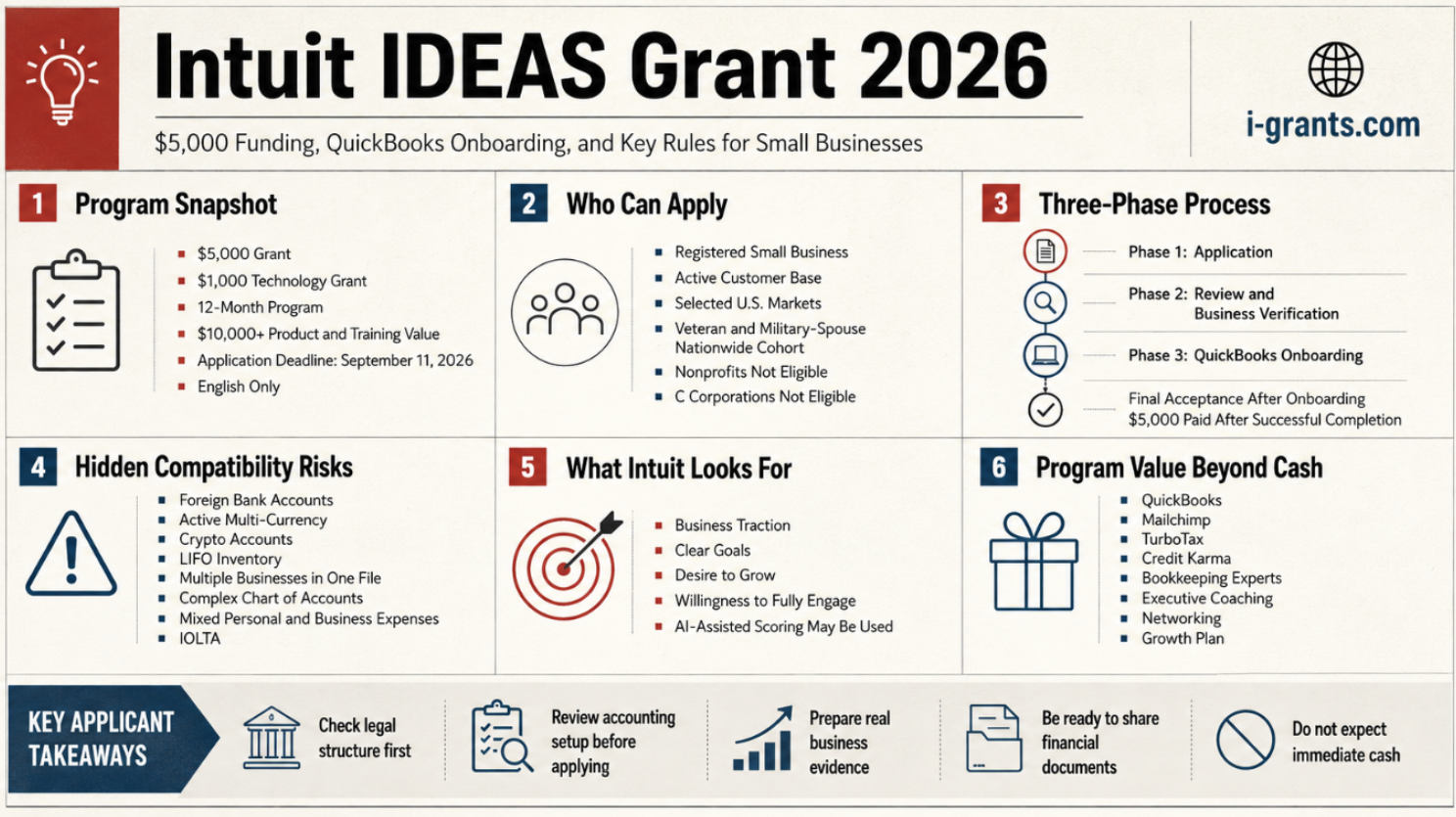
Phase I is the application itself. Applicants must submit a complete application before the deadline.
Phase II is application review and business verification. During this stage, the program team reviews and scores applications, verifies business information, evaluates compatibility with Intuit products and program resources, and decides which applicants may proceed to conditional acceptance.
Phase III is QuickBooks onboarding. Conditionally accepted businesses must complete account setup, upload business data, and meet with a QuickBooks bookkeeper. Final admission depends on successfully completing this onboarding and other required setup steps.
This structure has an important consequence: an applicant can apparently have a compelling business and still fail to enter the final cohort if the business cannot be successfully onboarded into the program's accounting environment.
Table 4. The Three-Phase Intuit IDEAS Selection Process
| Phase | Stage | What Intuit Does | What the Applicant Must Achieve |
|---|---|---|---|
| Phase I | Application | Receives the application | Submit a complete application by the deadline |
| Phase II | Review and verification | Scores the application, verifies business information, evaluates product and program compatibility | Pass review, verification, and compatibility screening |
| Phase III | QuickBooks onboarding | Sets up account access, receives business data, connects the applicant with a QuickBooks bookkeeper | Successfully complete onboarding and required setup steps |
| Final acceptance | Program admission | Confirms participation | Complete all required stages rather than merely being conditionally selected |
Intuit May Use AI-Assisted Scoring
The 2026 FAQ contains an unusually transparent detail about the evaluation process.
Intuit states that Phase II may include AI-assisted scoring, expert human review, business information verification, and product-fit review.
This does not mean that an AI system independently selects participants. Intuit does not publish the relative weighting of automated and human assessment, identify the specific model used, or explain whether every application receives the same form of automated analysis. Applicants should therefore avoid making unsupported assumptions about how the technology operates.
The practical implication is different. Applications need to be clear, internally consistent, specific, and easy to verify. A vague narrative filled with general claims about passion or future potential is unlikely to communicate business traction as effectively as an application that links the company's current position to specific operating challenges and measurable growth objectives.
The FAQ also does not establish a special published prohibition on applicants using generative AI to help prepare their applications. That should not be confused with Intuit's own disclosure that AI-assisted scoring may be used during review. Applicants remain responsible for the accuracy, authenticity, and consistency of everything they submit.
What Does a Strong Application Look Like?
Intuit does not currently publish a numerical scoring matrix showing, for example, how many points are allocated to revenue, community impact, growth potential, financial readiness, or management quality.
Instead, its application guidance identifies four characteristics of a strong application: business traction, clear goals, a desire to grow, and willingness to engage fully in the program.
Those criteria provide useful clues about how an applicant should frame the business.
Traction should demonstrate that the business is already operating. Depending on the company, useful evidence may include an established customer base, repeat customers, orders, contracts, revenue history, expansion of products or services, operational capacity, partnerships, or other verifiable indicators of market activity.
Clear goals should describe what needs to change over the next year. "I want to grow my business" communicates less than explaining that the business needs to improve bookkeeping reliability, understand margins, professionalize customer acquisition, strengthen email marketing, prepare for outside capital, introduce new systems, or expand into a new market.
Willingness to participate is also more important here than in a typical grant. IDEAS requires up to three hours per week during onboarding and approximately 3-5 hours per month during the 12-month program for workshops, coaching, business development, and implementation.
An applicant should therefore make the case not only that the business deserves support, but that it is ready to use a year of structured support.
QuickBooks Compatibility Can Become a Hidden Eligibility Test
The most unusual part of the 2026 program is the detailed list of accounting and operational conditions that may prevent onboarding.
A small business could meet the headline eligibility requirements, operate in the correct city, have customers, submit a convincing application, and still encounter a serious obstacle during Phase III.
Intuit identifies businesses with more than 300 accounts or more than three subaccount levels in their Chart of Accounts as potentially unsuitable. Real estate businesses maintaining more than three properties in one QuickBooks Online file can encounter problems. So can businesses reporting more than one business in a single QuickBooks Online file.
The company also identifies commingling of personal and business expenses, foreign bank accounts, active multi-currency accounting, cryptocurrency accounts, LIFO-tracked inventory, options and futures investments, factoring of accounts receivable, certain government and 401(k) activities, and IOLTA accounts linked to client sub-ledgers among the situations that may prevent onboarding.
Businesses engaged in activities illegal under federal law are also identified as incompatible with onboarding.
This screening can be especially relevant to companies that appear simple from the outside but have complex accounting structures. A law firm handling client trust funds, a real estate operator managing several properties, a company trading internationally, a business receiving or holding cryptocurrency, or an entrepreneur who has historically mixed personal and business transactions could encounter difficulties that have nothing to do with the quality of the business story.
Table 5. QuickBooks Onboarding Issues Applicants Should Check Before Applying
| Issue | Why It Matters for IDEAS |
|---|---|
| More than 300 Chart of Accounts entries | Identified as overly complex for onboarding |
| More than three subaccount levels | May create onboarding incompatibility |
| More than three real estate properties in one QuickBooks Online file | Listed as a potential disqualifying issue |
| Multiple businesses in one QuickBooks Online file | May prevent onboarding |
| Personal and business expenses mixed in one account | Listed as an onboarding concern |
| Foreign bank accounts | Not compatible with the current program rules |
| Active multi-currency accounting | May prevent onboarding |
| Cryptocurrency accounts | Listed as incompatible |
| LIFO-tracked inventory | Listed as incompatible |
| Options or futures investments | Listed among incompatible situations |
| Factored accounts receivable | Listed as an onboarding concern |
| IOLTA accounts linked to client sub-ledgers | Potential incompatibility for legal-services businesses |
| Incomplete QuickBooks Desktop conversion | Can prevent successful onboarding |
| Refusal or inability to provide requested financial documentation | May prevent onboarding |
| Federally illegal business activities | Incompatible with the program |
Applicants should therefore perform a basic accounting compatibility review before investing substantial time in the application. For some businesses, correcting bookkeeping structure before conditional selection may be more important than polishing an additional paragraph in the application.
Applicants May Need to Share Sensitive Business Information
The verification process goes beyond basic company registration details.
Intuit says participating entrepreneurs may be required to confidentially share past tax returns, business financial statements, transaction data, and marketing plans. Providing Intuit experts with access to business financial and marketing information is described as necessary to take full advantage of the program's resources.
The application FAQ also states that information submitted through the application may be used by Intuit to process the application and may be shared with third parties engaged to process applications and provide services.
This does not make the program unusual in requiring verification, but the depth of information is significant enough that applicants should prepare for it in advance.
A founder who is uncomfortable sharing financial statements, transaction data, tax information, or marketing information with program experts should understand that IDEAS is structured around access to exactly that type of operational data.
Businesses also remain subject to review after admission. Intuit says participants may undergo continuing verification of business information and alignment with Intuit values, and the program team can request updated documentation during the program.
What QuickBooks Experts Will and Will Not Do
The scale of Intuit's support can create another misunderstanding. Access to QuickBooks experts does not mean the company will effectively take over every accounting and administrative task.
According to the current FAQ, QuickBooks Experts do not run payroll or submit payroll tax filings, create invoices or pay bills, forecast cash flow or build budgets, file sales tax, complete income tax or business tax returns, recommend loans or complete financing applications, provide formal financial statements or audits, or maintain records outside QuickBooks Online. They also do not provide every form of general business consulting through the bookkeeping service.
The value is therefore better understood as systems support, bookkeeping expertise, product assistance, training, coaching, and improved financial organization rather than outsourced management of the entire business.
This distinction should influence an applicant's expectations. A business with fundamentally weak financial controls can gain significant value from structured expert support, but the owner still has to operate the company and perform tasks that fall outside the experts' scope.
How Much Is Intuit IDEAS Really Worth?
The headline cash award is $5,000 after successful completion.
However, Intuit says participants may also receive a $1,000 technology grant and that free product access and training provided to selected entrepreneurs are valued at more than $10,000.
In addition, the program includes executive coaching and business advising from Zella Life, advising from community partners, hands-on training in Mailchimp, QuickBooks, and TurboTax, networking with Intuit professionals and alumni, marketing exposure, and an individualized growth plan.
The economic value therefore cannot be measured simply by adding the cash grant to the technology grant. Some benefits have a stated company valuation, while others, such as coaching, expert time, introductions, process improvement, and access to networks, do not have a public cash equivalent.
A business should therefore evaluate IDEAS by asking whether its primary constraints are the types of problems that the program is designed to address. For an entrepreneur whose central challenges involve bookkeeping, financial visibility, marketing systems, operational discipline, capital readiness, or management development, the noncash component may be more valuable than the eventual $5,000 payment.
For an applicant interested only in unrestricted cash, a year-long accelerator with operational requirements may be a less attractive fit.
What Can the $5,000 Grant Be Used For?
This is an area where applicants should be careful not to rely on assumptions.
The current Intuit FAQ describes the $5,000 payment as an investment in business growth, but it does not provide a detailed public expense schedule showing every permitted and prohibited use of the main grant.
The separate potential $1,000 grant is described more specifically as support for eligible business technology needs.
Without additional written award terms, applicants should not assume that categories such as payroll, rent, inventory, advertising, debt repayment, equipment, owner compensation, travel, or taxes are automatically permitted or prohibited. The absence of a restriction from a short public FAQ is not the same as an affirmative authorization.
A selected participant should review the final award agreement and program instructions before committing grant funds to a particular expense.
The Cash Grant Comes at the End, Not at the Beginning
This timing is one of the most important financial planning considerations.
The current program page describes IDEAS as a one-year program and states that the grant is provided at the end of the program. The FAQ is more explicit: participants receive the $5,000 grant upon successful completion.
Consequently, an applicant should not plan a September or autumn 2026 purchase on the assumption that $5,000 will become available immediately after selection.
The program sequence is more accurately understood as:
application, review and verification, conditional acceptance, QuickBooks onboarding, final acceptance, participation in the 12-month accelerator, successful completion, and then the main cash grant.
This structure also means that the applicant must value the program itself. Someone who would not want the coaching, systems work, training, financial transparency, and ongoing participation should not view the $5,000 payment in isolation.

What Has Changed Since Intuit IDEAS Launched?
IDEAS has evolved substantially in just a few years.
Intuit launched the program in Los Angeles in 2023 with the Los Angeles Urban League. The original pilot planned to support approximately 25-30 Black and Latino-owned small businesses and included a $10,000 grant for participants at the conclusion of the 12-month program.
The pilot ultimately supported 26 businesses, according to Intuit's FY24 Stakeholder Impact Report. The same report said participating businesses experienced an average revenue increase of 23 percent and saved more than 16.5 hours per month. These are results reported by Intuit rather than findings from an independent randomized evaluation.
In 2024, Intuit expanded IDEAS to Atlanta and Philadelphia and planned to serve a total of approximately 100 small business owners across the three cities.
The next expansion was much larger. In 2025, Intuit announced nine participating cities and a nationwide cohort for military veteran and military-spouse entrepreneurs. Its FY25 impact report states that nearly 100 businesses had been supported in Los Angeles, Atlanta, and Philadelphia and that the company planned to support an additional 250 small business owners as the program expanded.
The 2026 configuration is different again. The current main markets are Atlanta, Charlotte, Chicago, Dallas/Fort Worth, New York City, Philadelphia, San Diego, and West Virginia. Los Angeles is being handled through a separate cohort, while the nationwide military cohort continues.
The cash award has also changed. The original pilot offered $10,000 at completion, while the current 2026 FAQ specifies $5,000, with participating businesses potentially eligible for an additional $1,000 technology grant.
Table 6. How Intuit IDEAS Changed From 2023 to 2026
| Period | Scale and Geography | Funding and Major Development |
|---|---|---|
| 2023 pilot | Approximately 25-30 targeted Los Angeles businesses planned | $10,000 grant at the end of the 12-month pilot |
| 2024 expansion | Los Angeles, Atlanta, and Philadelphia; approximately 100 businesses planned | Expansion following first-year operating results |
| FY25 | Nearly 100 businesses reported as supported across Los Angeles, Atlanta, and Philadelphia | Program received "Highly Commended" recognition at the World 50 Impact Awards |
| 2025 expansion announcement | Nine cities plus nationwide military veteran and military-spouse cohort | Intuit planned substantial national expansion |
| 2026 main cycle | Atlanta, Charlotte, Chicago, Dallas/Fort Worth, New York City, Philadelphia, San Diego, West Virginia; LA separate; nationwide military cohort | $5,000 completion grant plus potential $1,000 technology grant |
The geographic evolution is also worth noting. New Orleans appeared among the nine cities announced for the 2025 expansion but is not listed among the regular 2026 markets in the current FAQ. West Virginia appears in the 2026 list instead. Los Angeles, one of the original program locations, has moved to a separate application structure.
For applicants, this history demonstrates why relying on an older article about IDEAS can lead to incorrect conclusions about the grant amount, eligible markets, or application process.
What Results Has Intuit Reported?
Intuit has repeatedly reported that participating small businesses increased revenue by an average of 23 percent and saved 16.5 hours per month through operational efficiencies associated with its financial technology platform and program support.
Those figures are significant, but they should be interpreted correctly. They are program results reported by Intuit, not evidence that every participating business will increase its revenue by 23 percent or save exactly 16.5 hours per month.
The company has also highlighted individual entrepreneurs whose experiences illustrate how IDEAS operates in practice.
Lynette, founder of Pennsylvania-based Nutz About Popcorn, entered the program with serious bookkeeping challenges. Intuit reports that work with QuickBooks experts helped her bring the books up to date, understand the financial side of the business better, establish processes, and feel more prepared for growth. Her company produces more than 135 popcorn flavors and has expanded into industrial equipment, trailers, and large corporate orders. Her daughter later entered a subsequent IDEAS cohort with her own spa and skincare business.
Jeannette and Ken, the entrepreneurs behind La Bodega Market and Buenos Días Café in Atlanta, used the program while developing a multi-concept food business that combines a community grocery model, prepared food, local products, and support for other food entrepreneurs. Intuit's 2026 profile describes them as exploring opportunities to expand their products and grow beyond Atlanta.
Binta, founder of withBee, has used her Los Angeles-based Afro-Caribbean food business to combine food, culture, education, and community. Her Intuit profile emphasizes that IDEAS helped her develop a stronger understanding of the business side of an enterprise that had previously been driven heavily by creative work.
The first cohort also included Apryl Stewart of Skyview Concessions. Intuit later cited her experience when IDEAS received "Highly Commended" recognition in the Excellence category of the World 50 Impact Awards in 2025.
These cases suggest that IDEAS is not designed exclusively for technology startups or venture-backed companies. Consumer products, food businesses, fitness businesses, service companies, and other operating small enterprises appear throughout Intuit's participant stories.
Tax Treatment: Do Not Assume the Grant Is Tax-Free
Intuit's public IDEAS FAQ does not currently provide a specific federal tax explanation for the $5,000 cash grant.
That absence should not be interpreted as confirmation that the money is tax-free.
The IRS states generally that income is taxable unless it is specifically exempted by law. Its small-business guidance also explains that income connected to a business can constitute business income, while prizes and awards are among the categories of income that may be taxable.
The exact treatment of a private corporate grant can depend on the recipient's legal structure, how the payment is characterized, the documentation issued, applicable federal rules, and state tax rules.
For that reason, an IDEAS participant should retain the program agreement, payment documentation, and any tax forms received from Intuit and confirm the treatment with a qualified tax professional rather than assuming that the word "grant" automatically creates a tax exemption.
A Timing Problem in the Current 2026 FAQ
There is an apparent inconsistency in Intuit's published 2026 timetable that applicants should know about.
The FAQ states that applications close on September 11, 2026 at 11:59 PM PT. The same page says that applicants selected to move forward are expected to receive tentative acceptance notices in "early September 2026." Final acceptance is expected in November after QuickBooks onboarding.
Because early September overlaps with a period in which the application window is still open, applicants should not rely on the tentative-notice wording as a precise selection schedule.
The safest interpretation is that September 11 remains the published application deadline and November remains the stated period for final acceptance, while applicants should monitor communications from the IDEAS team for the actual intermediate review timeline.
There is a similar date issue concerning Los Angeles. The current FAQ says the separate LA application would go out by the end of August, while the official page still directs prospective applicants to an interest form. Applicants in Los Angeles should therefore use the dedicated LA channel rather than assuming they can use the standard 2026 application route.
These inconsistencies are a good reminder to verify the live Intuit application page immediately before submission.
What Should an Applicant Do Before Submitting?
The strongest preparation strategy is to treat the application as both a competitive business case and an operational readiness review.
First, confirm legal and geographic eligibility. A nonprofit or C Corporation should not spend time preparing the main application under the current rules. A nonmilitary applicant should verify that the business is physically located and operating in an eligible market and that participation in local events is realistic.
Second, examine the accounting structure. Review foreign bank accounts, cryptocurrency, multi-currency settings, Chart of Accounts complexity, inventory methods, separate businesses, personal-business expense commingling, real estate properties, receivables factoring, and any other condition identified in the QuickBooks compatibility section.
Third, prepare evidence of traction. The application should demonstrate that the company has customers and an operating history rather than describing only an idea. Revenue trends, customer growth, repeat business, contracts, order volume, product demand, partnerships, operational milestones, or other verifiable metrics can make growth claims more concrete.
Fourth, define a 12-month transformation rather than simply a need for cash. A compelling applicant should be able to explain what better bookkeeping, financial visibility, marketing, coaching, systems, or capital readiness could change in the business.
Fifth, prepare for verification. Bank and credit card statements, financial statements, transaction data, historical tax returns, and marketing information may become relevant during onboarding or participation.
This is one of the rare corporate small-business programs where an applicant can improve their chances not only by strengthening the narrative but also by cleaning up the operational infrastructure behind the narrative.
Who Is Intuit IDEAS Best Suited For?
The strongest fit is likely an established but still relatively small business that already has customers, wants to grow, needs better financial or marketing systems, can work productively with QuickBooks and other Intuit tools, and is willing to participate actively for a year.
A founder with a functioning local business, growing demand, weak financial processes, limited management infrastructure, and clear expansion objectives may derive considerable value from the combination of experts, products, coaching, and eventual grant funding.
By contrast, IDEAS may be less suitable for a founder who needs immediate unrestricted cash, runs a nonprofit, operates through an ineligible C Corporation, has a highly complex accounting system, depends on foreign banking or cryptocurrency accounting, is unwilling to share financial data, or cannot commit to the program's ongoing participation requirements.
The program is also not an ordinary nationwide grant for all U.S. businesses. Geographic eligibility remains important except for the dedicated military cohort.
Final Assessment
Intuit IDEAS is one of the more unusual corporate small-business funding opportunities available in 2026 because the grant is embedded inside a much deeper business intervention.
The $5,000 cash award is meaningful, but it is not the whole offer and it is not paid simply for winning an application. Participants must make it through application review, business verification, product-compatibility assessment, QuickBooks onboarding, final acceptance, and a 12-month development program before receiving the principal cash grant upon successful completion. A potential $1,000 technology grant and more than $10,000 in company-valued product access and training expand the package further.
The program's biggest hidden barrier is therefore not necessarily competition from other applicants. It may be compatibility.
Foreign bank accounts, cryptocurrency, multi-currency accounting, complex Charts of Accounts, mixed personal and business finances, certain inventory methods, multiple businesses in one QuickBooks file, specific real estate structures, IOLTA arrangements, and other accounting characteristics can become material during onboarding.
At the same time, Intuit is unusually explicit that the review process may use AI-assisted scoring alongside expert human review and verification. Strong applicants should respond with clarity, consistency, measurable business traction, specific growth objectives, and information they can substantiate if asked.
The program's evolution also deserves attention. IDEAS began in 2023 as a Los Angeles pilot for 25-30 businesses with a $10,000 completion grant. It subsequently expanded to multiple cities, nearly 100 supported businesses, a nationwide military cohort, and plans to reach hundreds more entrepreneurs. In 2026, the main grant has shifted to $5,000, with a potential technology grant and a broader ecosystem of products, experts, coaching, and operational support.
For the right applicant, this means the most important question is not "How do I win $5,000?"
It is: "Is my business ready to use 12 months of financial, operational, marketing, and coaching support to become stronger?"
If the answer is yes, and the business passes the less visible eligibility and QuickBooks compatibility tests, Intuit IDEAS can offer substantially more than a conventional corporate grant.