

 Français
  Deutsch
  Українська
Community funding from Europe's largest retail chains can look deceptively simple. A company announces several hundred thousand euros for local organisations, publishes photographs of previous recipients, and invites communities to participate. Yet behind the promotional language, the actual funding mechanisms can differ dramatically.
That distinction is particularly important in 2026 when comparing Lidl, dm-drogerie markt, and ALDI.
Lidl Ireland operates a structured environmental and community grant programme with formal eligibility requirements, project budgets, financial due diligence, restricted costs, public voting, and post-award reporting. Germany's dm runs Lust an Zukunft as a nationwide local donation campaign in which individual stores select participating initiatives before customers vote. ALDI's Scottish Sport Fund sits somewhere between the two: organisations submit applications, an internal judging panel creates a shortlist, and public voting helps determine the final awards.
For NGOs, schools, environmental projects, local associations, and sports clubs, these differences affect far more than terminology. They determine when an organisation must prepare, whether an open application even exists, whether salaries can be funded, whether co-financing is required, how much public support matters, and what obligations continue after the money has been transferred.
As of September 2026, the three programmes are also at different stages. Lidl Green Fund applications in Ireland have closed for the year, with public voting scheduled for autumn. dm's Lust an Zukunft voting campaign is active in Germany during September. Several ALDI Scottish Sport Fund regional cycles remain open or are still to come.
How Lidl, dm, and ALDI community funding differs in 2026
The most important mistake applicants can make is treating all three programmes as conventional grants.
Lidl Green Fund is the closest to a traditional project grant. Applicants compete on the strength of a defined project, submit financial information, may have to demonstrate secured co-financing, and can be required to report on expenditure and outcomes.
dm Lust an Zukunft is different. Local store teams select participating initiatives, and both initiatives attached to a store receive financial support. Customer voting determines whether an initiative receives €600 or €400. There is no comparable nationwide open application process in which thousands of organisations submit conventional grant proposals against a central deadline.
ALDI Scottish Sport Fund uses an application-based structure but has increasingly incorporated community mobilisation into the final decision. In 2026, shortlisted organisations move into public voting, making visibility and supporter engagement part of the competition.
Table 1. Lidl, dm, and ALDI Community Funding at a Glance in September 2026
| Programme | Geography | 2026 status | Funding model | Main funding |
|---|---|---|---|---|
| Lidl Green Fund | Republic of Ireland | Applications closed, public voting scheduled for autumn | Competitive project grant with public voting | €25,000 national award and 25 awards of €3,000 |
| dm Lust an Zukunft | Germany | Public voting runs September 1 to September 24, 2026 | Corporate donation campaign with local store selection | €600 for the higher-voted initiative and €400 for the second initiative |
| ALDI Scottish Sport Fund | Scotland | Several regional rounds still active or upcoming in autumn 2026 | Application, judging, shortlist, public vote | £3,000 top award plus runner-up funding |
| Lidl GB Community Fund | Great Britain | Ongoing | Restricted community fund linked to Neighbourly network | Lidl states £500,000 in annual grants |
| ALDI UK Neighbourly | United Kingdom | Ongoing | In-kind food redistribution | Surplus food rather than project grants |
| ALDI SÜD local community support | Germany | Ongoing | Partnerships, donations, local initiatives | Amount varies by programme |
This distinction is especially relevant for grant writers. An organisation cannot simply reuse the same application strategy across the three brands. Lidl requires project readiness. dm requires local relationship-building. ALDI requires both a credible application and, increasingly, a community capable of supporting the organisation publicly.
Lidl Green Fund 2026: €100,000 for sustainability and community projects in Ireland
Lidl Ireland's Green Fund is the strongest conventional grant opportunity among the programmes reviewed here.
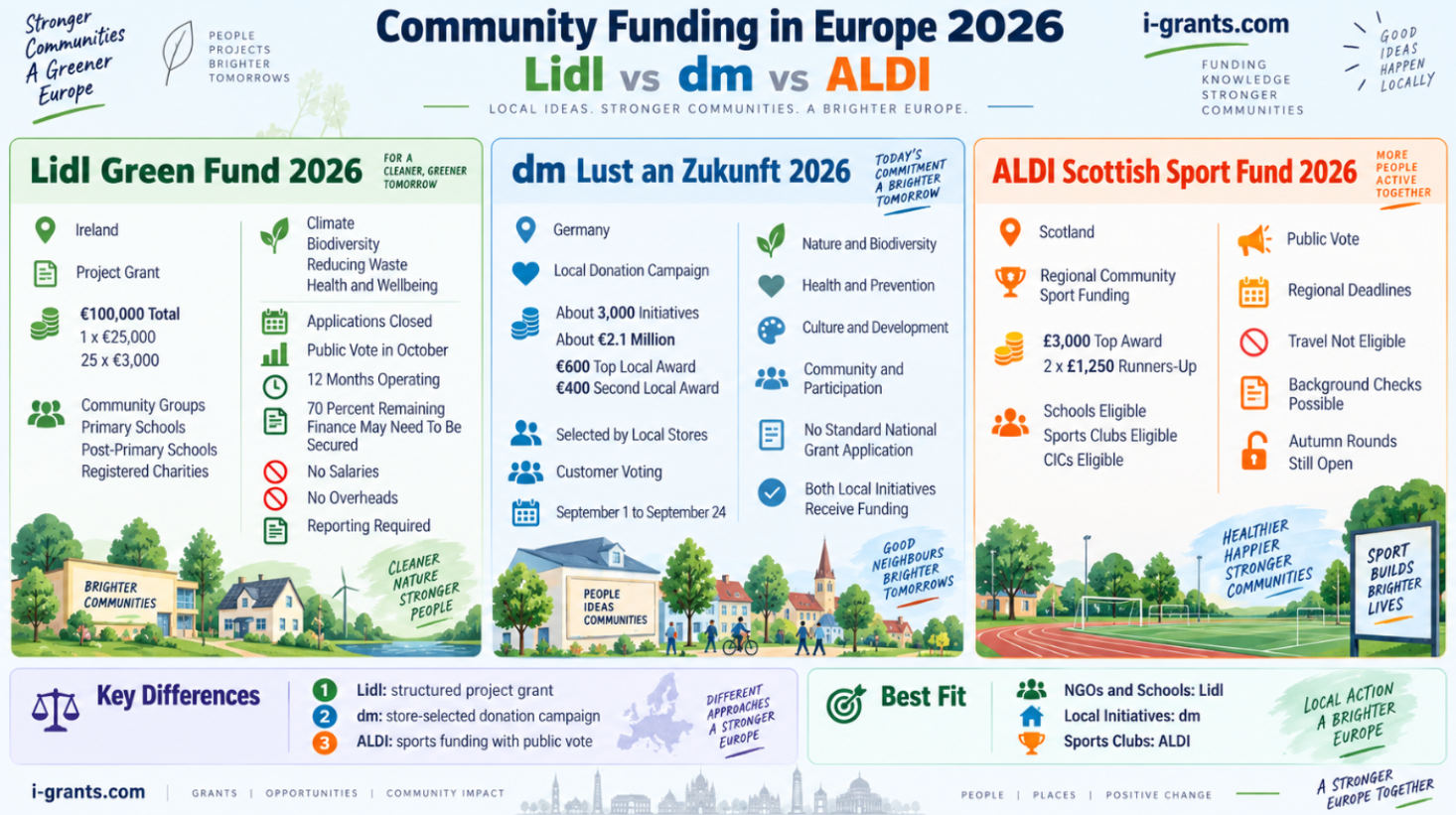
The fund has a total value of €100,000. One national winner receives €25,000, while 25 additional projects receive €3,000 each. The structure is designed to ensure that funded projects are represented across Ireland.
Eligible applicants include community groups, primary schools, post-primary schools, and registered charities operating in the Republic of Ireland. Individuals cannot apply in their personal capacity.
The programme supports four broad themes: climate, biodiversity, reducing waste, and health and wellbeing. These categories give applicants considerably more flexibility than the word "green" might suggest.
A biodiversity project might involve native planting, school gardens, habitats, pollinator areas, nature trails, or marine conservation. A climate proposal could include energy efficiency, LED lighting, or solar installations. Waste-related projects can involve repair cafés, recycling, reuse, and upcycling. Health and wellbeing projects may include community food, cooking, nutrition, and other initiatives linked to sustainable lifestyles.
This broad definition is important because successful projects do not have to be purely environmental. Lidl's previous funding decisions indicate that social inclusion, education, wellbeing, and community participation can strengthen a sustainability proposal when the connection is credible.
Table 2. Lidl Green Fund 2026 Core Rules
| Requirement | 2026 position |
|---|---|
| Country | Republic of Ireland |
| Eligible applicants | Community groups, primary schools, post-primary schools, registered charities |
| Minimum operating history | At least 12 months |
| Total fund | €100,000 |
| National award | €25,000 |
| County awards | 25 awards of €3,000 |
| Number of funded projects | 26 |
| Main themes | Climate, Biodiversity, Reducing Waste, Health and Wellbeing |
| Application opening | April 13, 2026 |
| Closing date in Application Guide | May 18, 2026 |
| Closing date in legal Terms and Conditions | May 11, 2026 |
| Public vote | Scheduled for October 2026 |
| Project start | Normally within six months of receiving funding |
| Project completion | Normally within one year |
The first serious issue appears in Lidl's own official documents.
The 2026 Application Guide gave May 18 as the deadline, while the legal Terms and Conditions defined the competition period as ending on May 11. That seven-day discrepancy matters. An applicant working only from the guide could reasonably have believed applications remained open for another week.
For professional applicants, this is an important due-diligence lesson. Promotional pages, application guides, and legal terms should all be checked before submission. When two official documents conflict and the funder has not issued a written clarification, the safer approach is to work to the earlier date.
Lidl's eligibility rules are stricter than the headline suggests
At first sight, the Green Fund looks like a relatively accessible local community programme. The legal and financial requirements show otherwise.
An organisation must have been operating for at least 12 months. It must have an appropriate governance structure and an organisational bank account. Shortlisted applicants can be required to provide financial accounts, information about board or committee members, confirmation of charitable or tax status where applicable, and written authorisation from the organisation's governing body.
Planning permission, building certification, or other technical documentation may also be required where relevant to the proposed project.
One of the least visible financial conditions concerns projects whose total value exceeds the amount requested from Lidl. The 2026 guidance requires applicants in relevant cases to demonstrate that 70 percent of the remaining finance needed for the project has already been secured.
Consider a community organisation planning a €50,000 project and requesting €25,000 from Lidl. The organisation cannot necessarily present the remaining €25,000 as money it hopes to raise later. Under Lidl's rule, it may need to show that a substantial part of that balance is already committed.
This makes the Green Fund considerably more suitable for projects that are already developed, costed, approved, and partly financed than for early concepts still searching for their first external funder.
Lidl also requires applicants to disclose other sources of project funding. Its terms reserve considerable discretion over projects receiving financial support elsewhere, which makes it important to explain clearly how each source of finance relates to specific project costs.
What Lidl will and will not fund
The difference between an eligible organisation and an eligible expense is crucial.
Schools are eligible, for example, but Lidl does not automatically fund ordinary school costs. The programme is intended for projects that go beyond routine statutory responsibilities.
Similarly, building-related costs are not all treated equally. A general repair to a roof or wall is very different from an energy-efficiency improvement directly connected to the Green Fund's objectives.
Table 3. Lidl Green Fund Eligible and Ineligible Expenditure
| Cost or activity | Likely treatment |
|---|---|
| Solar panels | Potentially eligible |
| LED lighting and energy improvements | Potentially eligible |
| Community gardens | Potentially eligible |
| Biodiversity projects | Potentially eligible |
| Repair cafés and circular-economy projects | Potentially eligible |
| Upcycling and waste reduction | Potentially eligible |
| Sustainable food and nutrition activities | Potentially eligible |
| Salaries | Not funded |
| General overheads | Not funded |
| Ordinary recurring operating costs | Not funded |
| Purchase of land | Not funded |
| Purchase of buildings | Not funded |
| General repairs and maintenance | Normally not funded |
| Retrospective expenditure | Normally not funded |
| General medical costs | Not funded |
| Commercial for-profit activities | Not eligible |
| Political programmes | Not eligible |
| Religious objectives | Not eligible |
| Lobbying intended to influence government policy | Excluded |
This structure makes project framing particularly important.
An organisation asking Lidl to "support our annual community centre costs" is unlikely to fit the programme. The same organisation proposing a clearly defined biodiversity garden with a budget, implementation plan, community users, maintenance arrangements, and measurable environmental outcomes has a much stronger fit.
The programme is also not designed to subsidise permanent staffing. Organisations therefore need to separate project delivery costs from salaries and routine administrative costs before building their budgets.
Due diligence can become a decisive part of the Lidl competition
The Green Fund includes a number of less visible requirements that may affect organisations only after they have passed the first stage.
Shortlisted applicants may need to provide audited accounts and governance documentation. They may also have to demonstrate that the organisation itself controls the bank account into which the grant will be paid.
The 2026 material also requires disclosure of conflicts of interest. If a project intends to pay a supplier, contractor, consultant, or other party connected personally or professionally to someone involved in the organisation, that relationship should be disclosed.
For physical assets, Lidl may require evidence that the project can be maintained beyond the grant period. A community garden, for example, is not simply a one-off installation. Applicants may need to demonstrate who will maintain it, how the work will be financed, and what happens after the initial funding ends.
Lidl also reserves the right to provide only part of the requested amount. Applicants should therefore avoid building a project that becomes impossible to deliver if the funder reduces the award.
Another overlooked condition concerns repeat applicants. Previous recipients face waiting periods before applying again. Smaller awards can trigger a 12-month restriction, while awards above €5,000 can result in a 36-month waiting period.
Table 4. Lidl Green Fund Hidden Requirements Applicants Should Check
| Hidden requirement | Why it matters |
|---|---|
| Organisation must be at least 12 months old | Newly created groups may be excluded |
| Governing-body approval | Project must have formal organisational support |
| Financial accounts may be required | Weak financial records can become a problem after shortlisting |
| Organisational bank account required | Personal accounts cannot be used |
| 70 percent of remaining project finance may need to be secured | Part-funded projects must already be financially advanced |
| Other funders must be disclosed | Overlapping funding can require explanation |
| Conflicts of interest must be declared | Related suppliers or contractors can trigger scrutiny |
| Maintenance arrangements may be required | Particularly relevant for gardens, infrastructure, and physical assets |
| Lidl may offer part-funding only | Project design should tolerate a smaller award |
| Winners must report on outcomes | Funding is not simply transferred without follow-up |
| Expenditure can be checked | Recipients should retain invoices and financial evidence |
| Repeat applicants face waiting periods | Previous winners cannot necessarily apply again immediately |
For an experienced grant writer, these conditions change how the application should be prepared. Governance, bank arrangements, co-financing evidence, supplier relationships, and project approvals should be reviewed before submission rather than after a shortlist announcement.
Lidl uses two different selection systems in one competition
The Lidl Green Fund first operates like a grant competition and later like a community popularity contest.
During the initial stage, applications are assessed on project quality, relevance, feasibility, sustainability, and organisational readiness. The judging process is discretionary, and applicants have limited ability to challenge an unfavourable decision.
Shortlisted projects then move into public voting through Lidl Plus.
The 2026 guidance indicates that three projects from each county are expected to reach this stage. Lidl customers can participate in the vote through the Lidl Plus system after eligible shopping activity.
The practical consequence is that technical quality gets an organisation onto the shortlist, but public mobilisation can decide who receives funding.
A strong application therefore needs two strategies: one for the judging panel and one for the public vote.
A technically excellent organisation with little community visibility may struggle at the second stage. A well-known local organisation may mobilise supporters effectively but never reach the public vote if its project design is weak.
Grant planning should account for both.
What Lidl funded in the first Green Fund cycle
The first Green Fund provides useful evidence of how Lidl interprets its own priorities.
The national €25,000 award went to Clonakilty Kids' Food Revolution in County Cork for the "Grow, Cook, Eat" programme. The initiative combines school gardening, cooking, food education, and sustainable behaviour.
The case is significant because it demonstrates that Lidl does not limit the Green Fund to conventional environmental infrastructure. The project combines environmental awareness with education, nutrition, children's skills, and long-term behaviour change.
Other supported projects have included community gardens, biodiversity initiatives, repair and reuse activities, inclusive environmental spaces, and health-related community programmes.
Table 5. Examples of Projects Supported Through the Lidl Green Fund
| Project or recipient | Funding relevance | Main outcome |
|---|---|---|
| Clonakilty Kids' Food Revolution | €25,000 national winner | Gardening, cooking, food education, and sustainable behaviour among schoolchildren |
| Community biodiversity gardens | Regional funding | Environmental improvement combined with local participation |
| Accessible and sensory gardens | Regional funding | Biodiversity combined with inclusion and wellbeing |
| Repair cafés | Regional funding | Waste prevention, repair, and circular-economy activity |
| School nutrition projects | Regional funding | Health, food education, and community wellbeing |
| Inclusive environmental initiatives | Regional funding | Environmental outcomes combined with social participation |
The strongest lesson from these cases is that a project does not need to deliver only one type of impact.
A biodiversity proposal can also improve mental wellbeing. A sustainable food programme can improve children's nutrition. A repair café can reduce waste while creating volunteering and skills opportunities.
What matters is that the primary Green Fund objective remains clear and measurable.
Publicity and image rights are part of the Lidl deal
Applicants should also read Lidl's publicity provisions before assuming that winning involves only a financial transfer.
Successful participants can be expected to cooperate with interviews, photography, communications activity, and programme promotion. Lidl's legal terms provide broad rights concerning images and other marketing material connected with funded projects.
This matters particularly for schools and organisations working with children, older people, or other vulnerable groups.
A funder's right to publicise a successful project does not remove the recipient organisation's own safeguarding responsibilities. Schools and NGOs should ensure that their internal consent processes, photography policies, and data-protection procedures are consistent with any publicity commitments before agreeing to images or interviews.
These issues are easy to overlook during the excitement of receiving funding but can become important once a communications team begins arranging photographs and case studies.
dm Lust an Zukunft 2026: a donation campaign rather than a traditional grant
Germany's dm-drogerie markt operates one of the largest community-support campaigns in this comparison, but it works very differently from Lidl.
Lust an Zukunft supports around 3,000 local initiatives nationwide, with dm reporting total support of approximately €2.1 million.
During the 2026 campaign, customer voting runs from September 1 to September 24.
Each participating dm store is linked with two local initiatives. The initiative receiving more votes receives €600. The other receives €400.
Both organisations therefore receive funding.
That point matters because Lust an Zukunft is sometimes described online as if organisations compete for a single grant. They do not. At the store level, the public vote determines the division of €1,000 rather than whether one organisation is funded and the other receives nothing.
Table 6. dm Lust an Zukunft 2026
| Feature | 2026 structure |
|---|---|
| Country | Germany |
| Number of initiatives | Around 3,000 |
| Total support | Approximately €2.1 million |
| Public voting | September 1 to September 24, 2026 |
| Higher-voted initiative | €600 |
| Second initiative | €400 |
| Selection into campaign | Local dm store teams choose participating initiatives |
| Voting channels | Online and in participating stores |
| Online voting frequency | One vote per person per day |
| Main themes | Nature and biodiversity, health and prevention, culture and development, community and participation |
| Conventional national application process | Not presented as an open grant call comparable with Lidl |
| Detailed eligible-cost rules | Not published in the same conventional grant format |
| Standard grant reporting | No comparable public project-reporting framework is prominently disclosed |
The real competition therefore takes place before the public voting period even starts.
Local dm teams identify initiatives in their area and decide which organisations will be presented to customers. For a community organisation, the most important step may be establishing a relationship with the local store months before the public campaign begins.
This makes Lust an Zukunft closer to corporate community engagement than to traditional grant writing.
Why the dm model changes applicant strategy
An organisation discovering the programme on September 10 cannot simply open a portal, upload a budget, and submit an application before September 24.
By then, the local initiatives have already been selected.
For future cycles, potential participants should monitor local dm activity earlier in the year and contact nearby stores before final selections are made.
That is particularly relevant to small associations that may not have professional grant-writing capacity. The programme does not appear to reward lengthy technical proposals in the same way as Lidl. Local relevance, visible community activity, a credible relationship with the store, and an understandable public story are likely to matter more.
The financial amounts are modest, but the scale is large. Thousands of initiatives receive support and exposure through one campaign.
The four thematic areas are also broad enough to include a wide range of organisations. Nature and biodiversity covers environmental projects. Health and prevention can include local wellbeing initiatives. Culture and development creates space for education and cultural activities. Community and participation covers social inclusion, volunteering, local cohesion, and civic engagement.
dm's published figures require careful interpretation
The campaign's statistics are impressive, but they should not be used to create an artificial grant success rate.
dm refers to around 3,000 participating initiatives and a network of roughly 2,100 stores. Each participating store presents two initiatives.
Those figures do not translate neatly into a standard application funnel. One initiative may be linked to more than one store, and the published number may represent unique organisations rather than total store-level pairings.
More importantly, the approximately 3,000 initiatives are not necessarily 3,000 organisations that submitted national applications.
They are initiatives already admitted to the campaign.
It would therefore be misleading to claim that dm "received 3,000 applications" or to calculate a percentage of successful applicants from that number.
For grant seekers, the lack of a published application count is itself useful information. The programme should be evaluated as a local corporate partnership opportunity rather than as a central competitive fund with a measurable acceptance rate.
What changed in dm's 2026 campaign
The financial structure remains broadly consistent with previous Lust an Zukunft rounds. The first-ranked initiative linked to a store receives €600 and the second receives €400.
The main visible change is timing.
The 2024 public campaign took place earlier in the year, while the 2026 voting period runs through September.
Previous dm examples show how broad the programme can be. Supported initiatives have included employment and training assistance for migrant women, outdoor educational activities for children with and without disabilities, therapeutic projects involving people with disabilities, and support services for financially vulnerable older residents.
This breadth makes the programme particularly relevant to local NGOs whose work does not fit a conventional environmental or sports grant.
ALDI Scottish Sport Fund 2026: regional funding with national-brand visibility
The ALDI Scottish Sport Fund is the most immediately actionable programme in this article for organisations located in parts of Scotland where 2026 application windows are still open or upcoming.
The programme is divided into regional rounds rather than operating through one national deadline.
In 2026, application periods begin in spring and continue into November. As of September 8, the Fife, Perth and Kinross round is open. Edinburgh and the Lothians and South Scotland still have future windows.
Table 7. ALDI Scottish Sport Fund 2026 Regional Deadlines
| Region | Postcode areas | Application period | Position on September 8, 2026 |
|---|---|---|---|
| Central Scotland | FK, ML | April 13 to May 10 | Closed |
| North East, Highlands and Islands | AB, IV, PH, KW, ZE, HS | May 11 to June 7 | Closed |
| Glasgow | G | June 8 to July 5 | Closed |
| West Scotland | PA, KA | July 6 to August 2 | Closed |
| Dundee and Tayside | DD | August 3 to August 30 | Closed |
| Fife, Perth and Kinross | PH, KY | August 31 to September 27 | Open |
| Edinburgh and the Lothians | EH | September 28 to October 25 | Upcoming |
| South Scotland | DG, TD | October 26 to November 22 | Upcoming |
The regional structure is important for organisations operating in more than one area. ALDI's rules require applicants to pay attention to the earliest relevant deadline rather than simply choosing whichever regional round remains open longest.
Who can apply to the ALDI Scottish Sport Fund
ALDI's formal eligibility is broader than the phrase "sports clubs" suggests.
Eligible organisations can include community sports clubs, registered Community Amateur Sports Clubs, schools and educational organisations, religious organisations, Scout and Guide groups, charitable service funds connected with the Armed Forces, and registered Community Interest Companies.
The organisation must be based in Scotland and provide sporting activity for people in its local community.
This creates opportunities for organisations that may not be registered charities.
A school can qualify. A CIC can qualify. A community organisation running structured sport can potentially qualify.
At the same time, several exclusions are explicit. University sports clubs are not eligible. Individual sponsorship is excluded. Travel and accommodation requests are not supported. Political parties and certain exclusive-membership organisations are also outside the fund's scope.
That makes project design important. A community boxing club requesting new training equipment can fit the programme. The same organisation seeking money primarily for hotel costs and travel to competitions would conflict with the 2026 rules.
ALDI changed the competition substantially in 2026
The most important change is not simply that the top award increased.
In 2025, the regional process included an internal judging stage followed by a random prize draw among qualifying organisations. The largest regional award was £2,500, with additional smaller awards.
In 2026, the top amount rose to £3,000 and the final stage shifted toward public voting through ALDI's social-media channels.
That changes the character of the competition.
A club can no longer think only about submitting a strong application and then relying on chance after shortlisting. Public visibility, community support, and social-media mobilisation can directly influence the final outcome.
The application form itself reflects this shift. It asks for the organisation's social-media details so shortlisted applicants can be tagged during the public campaign.
For volunteer-run clubs, that requirement can be more important than it first appears. An organisation with no functioning social-media presence may still be eligible, but it enters the final stage with a practical disadvantage.
ALDI's official documents contain a funding inconsistency
Applicants should also be aware that ALDI's 2026 official materials do not perfectly align.
The Terms and Conditions describe a £3,000 public-vote winner and two runner-up awards of £1,250 each.
A separate official FAQ also refers to an additional £750 funding package.
That creates uncertainty about the exact total value of one regional round.
Using only the main Terms and Conditions gives £5,500 per region. Including the additional £750 amount produces £6,250.
Until ALDI clarifies how the additional award operates, organisations should avoid presenting an exact overall 2026 programme budget as if it were uncontested.
This also illustrates a broader grant-research problem. Funding databases frequently reproduce numbers from one promotional page without comparing them with the legal conditions. When official documents disagree, the disagreement itself needs to be recorded.
ALDI's hidden due-diligence rules are more serious than the promotional page suggests
The Scottish Sport Fund is marketed as accessible community funding, but the 2026 legal conditions give ALDI significant discretion.
The company may request evidence of the organisation's status, identity, address, and the applicant's relationship with the organisation.
ALDI also reserves the right to conduct background checks on shortlisted applicants and relevant individuals.
The terms go further by referring to disclosure of previous convictions or criminal records for people involved in submitting the application or controlling the requested funds.
For a £3,000 community award, that level of due diligence may surprise applicants.
The fund also gives ALDI the right to examine how an award has been administered and to investigate suspected misuse. The fact that no extensive public final-report template is advertised does not mean recipients can spend the money without accountability.
The award is one-off and non-recurring, and recipients should use it for the purposes described in their application.
ALDI beneficiaries also accept publicity obligations
Successful applicants are expected to cooperate with interviews, photographs, appearances, and other promotional activity connected with the programme.
At the same time, the relationship is not symmetrical.
Recipients cannot freely use ALDI's trademarks, branding, or corporate materials simply because they have received funding. Public communications referring to ALDI or the Scottish Sport Fund may require prior approval.
For clubs accustomed to thanking sponsors by immediately placing logos on posters or social-media graphics, this is an important practical point.
Communications teams should confirm branding permissions before publishing materials.
What previous ALDI beneficiaries used the money for
Historical beneficiary examples help clarify the type of project ALDI values.
Falkirk Lawn Tennis Club used a £2,500 regional award for tennis nets, balls, rackets, and free lessons for local schools.
Springhill Boxing Club received £2,500 for equipment and club development.
Lismore Rugby Football Club used its support to develop walking rugby for people over 50, showing that the programme can support participation and inclusion rather than only conventional competitive sport.
ALDI reports that more than 650 clubs have received support since the Scottish Sport Fund began in 2016, with approximately £500,000 distributed over the programme's lifetime.
That makes the fund considerably more established than a one-off retailer promotion.
Past examples should still be interpreted against current rules. Historical funding decisions do not automatically override 2026 exclusions. Travel-related expenditure appearing in an older case study, for example, should not be treated as evidence that current travel and accommodation costs are eligible.
Other Lidl and ALDI community funding routes in Europe
The three headline programmes are not the only forms of community support operated by these retailers.
Lidl Great Britain works with Neighbourly through a Community Fund that Lidl says makes £500,000 in grants available annually to a network of more than 1,300 good causes.
The important limitation is access. This is not equivalent to the Irish Green Fund's broad public call. Funding is connected to organisations participating in Lidl's local community and surplus-food ecosystem.
Lidl has reported that Community Fund money has helped organisations respond to food poverty, increased demand for food parcels, storage shortages, and the need to refurbish food preparation spaces.
In 2026, Lidl GB also announced additional store-led local donations, demonstrating another important distinction: some corporate community support is allocated by company employees rather than through an application competition.
ALDI operates similar non-grant mechanisms.
In the United Kingdom, its partnership with Neighbourly focuses heavily on surplus-food redistribution. Local charities and community organisations can participate in collections from stores, but the support is primarily in-kind rather than cash project funding.
ALDI SÜD in Germany also supports community organisations through major partnerships and smaller local initiatives. Some involve substantial corporate commitments, but many are selected partnerships rather than open calls available to any NGO.
For grant seekers, that distinction is essential. A programme can represent millions of euros in corporate social investment without offering a public application route.
Tax treatment is not automatically simple
Corporate grants and donations are often described informally as "free money". That language can create accounting problems.
Neither Lidl nor ALDI provides every recipient with a universal tax exemption simply because an award is called a grant.
In Ireland, registered charities may qualify for charitable tax exemptions if they meet Revenue requirements. However, charities do not receive a blanket exemption from every tax, and VAT treatment can be particularly relevant for capital projects and equipment purchases.
A school or charity planning a €25,000 environmental installation should therefore know whether VAT is recoverable, compensable, or an actual project cost before presenting a budget.
The position in Scotland also depends on legal status.
Registered charities and Community Amateur Sports Clubs can have tax advantages that do not necessarily apply in the same way to Community Interest Companies or other entities.
A CIC may be eligible for ALDI funding but should not assume that the payment receives the same tax treatment as income received by a registered charity.
Germany requires similar caution. dm describes its payments as donations, but the recipient's own legal and tax status determines how the money should be recorded and whether any exemption applies.
The safest principle is that corporate terminology does not determine tax treatment. Legal structure, purpose, accounting rules, and national tax law do.
Which programme is the best fit?
For an Irish environmental NGO with a well-developed project, Lidl Green Fund offers the strongest funding opportunity. The €25,000 national award can finance a meaningful intervention, but the organisation should already have governance, finances, co-funding, and project planning under control.
For an Irish school, Lidl is also highly relevant when a project goes beyond normal educational expenditure and creates an additional environmental, wellbeing, or community benefit.
For a small German association, dm Lust an Zukunft is better treated as a local corporate relationship opportunity than a grant-writing exercise. The key task is becoming one of the initiatives selected by a nearby store before customer voting begins.
For a Scottish sports club, school, CASC, or qualifying CIC, the ALDI Scottish Sport Fund remains a practical funding route in several regions during autumn 2026. Applicants should prepare not only a credible project case but also a public communications strategy for the voting stage.
The hidden lesson behind these retailer-funded programmes
The largest difference between successful and unsuccessful applicants may not be the quality of the project itself.
For Lidl, an organisation can have an excellent idea but fail because it lacks financial documentation, secured co-financing, a compliant budget, formal approval, or an eligible cost structure.
For dm, a strong organisation may never reach the public campaign because it approached the programme too late and had no relationship with its local store.
For ALDI, a credible sports project can reach the shortlist but then face competitors with stronger local mobilisation during the public vote.
This is why corporate community funding must be analysed differently from traditional foundation grants.
The applicant is not only competing for money. It is navigating the company's retail network, communications objectives, community-engagement model, legal requirements, and internal corporate processes.
Final assessment
Lidl, dm, and ALDI all provide meaningful support to European communities in 2026, but they do so through three different systems.
Lidl Green Fund is the most conventional project grant. It offers the largest single award in this comparison and can support serious sustainability projects, but it also carries the most detailed financial, governance, expenditure, and reporting conditions.
dm Lust an Zukunft operates primarily as a local donation campaign. Individual payments are smaller, but the programme reaches thousands of initiatives and creates significant local visibility. Its decisive stage happens before the public vote when local dm teams choose participating organisations.
ALDI Scottish Sport Fund combines application-based funding with public competition. Its 2026 model places greater emphasis on community mobilisation than previous cycles and offers accessible funding to a relatively broad range of Scottish community sports organisations.
For applicants, the practical conclusion is straightforward: the headline amount should never be the first or only factor used to judge a corporate funding programme.
Before investing time in an application, organisations should establish whether the opportunity is genuinely open, whether their legal form qualifies, what expenses are permitted, whether additional finance must already be secured, whether public voting affects the outcome, what reporting or publicity obligations follow the award, and whether the promotional page agrees with the legal terms.
In 2026, those less visible details can determine not only who receives funding, but who was realistically in the competition from the beginning.