

 Français
  Deutsch
  Українська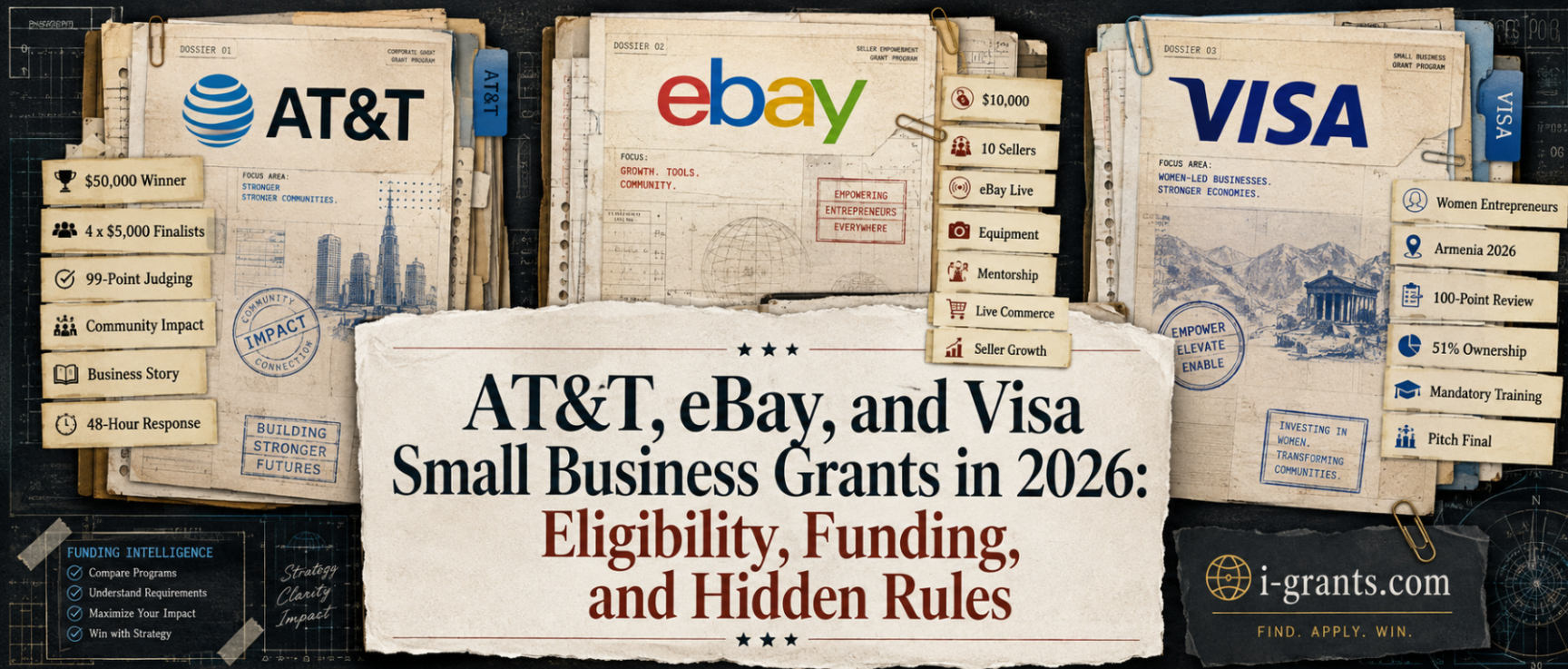
Corporate grants from major international companies are often presented as simple funding opportunities: submit an application, explain why the business deserves support, and compete for a cash award. In practice, the rules behind these programs can differ dramatically.
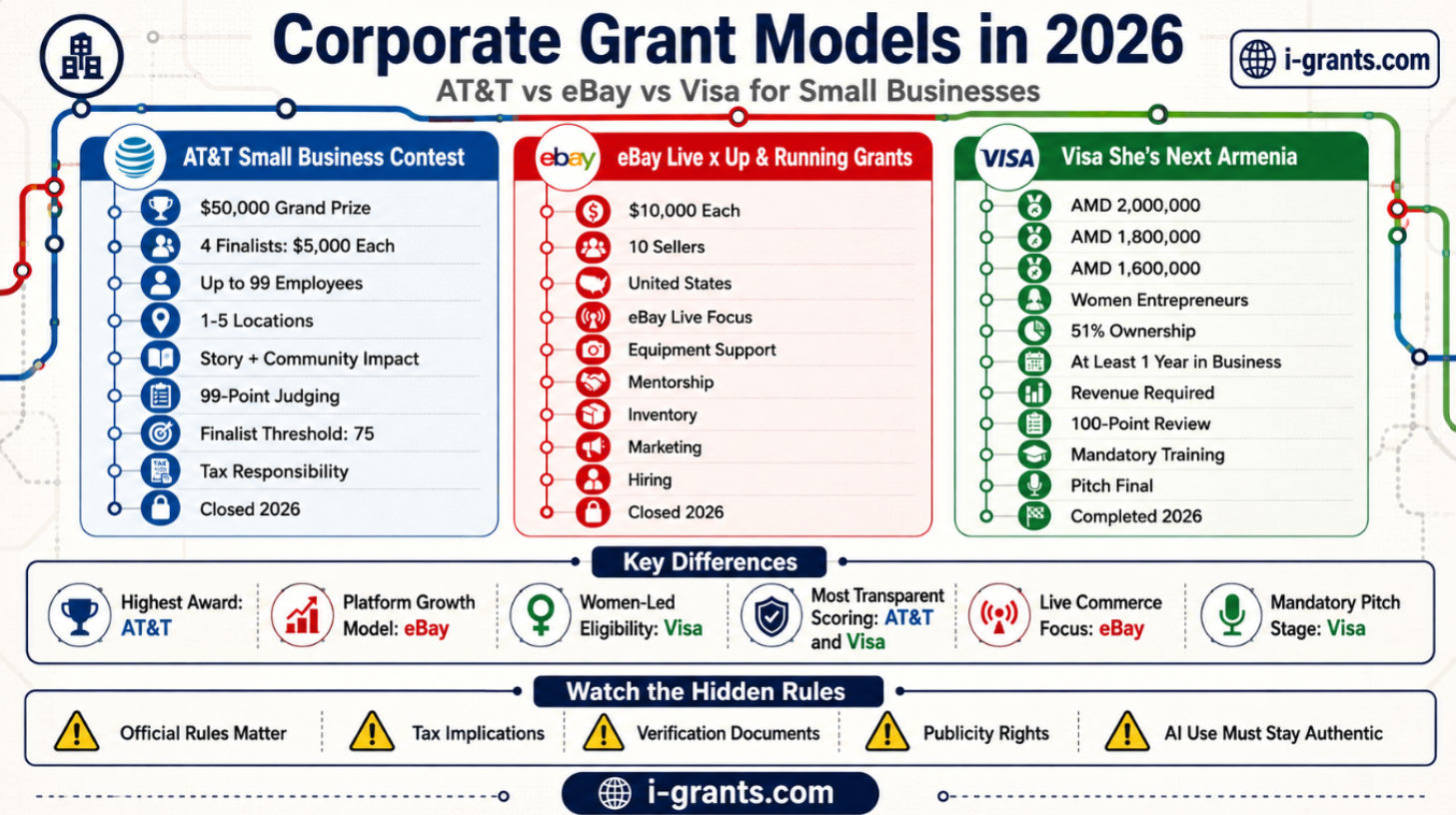
Three corporate funding programs in 2026 illustrate three fundamentally different approaches.
The AT&T Small Business Contest 2026 is built around business storytelling, community impact, and alignment with AT&T's "Connecting Changes Everything" brand purpose. One business will receive $50,000, while four additional finalists will each receive $5,000. AT&T also publishes an unusually detailed 99-point judging framework and extensive legal rules governing finalist verification, taxes, intellectual property, confidentiality, and publicity.
The eBay Live x Up & Running Grants 2026 program follows a very different model. Ten U.S. sellers will each receive $10,000 plus professional live-selling equipment and specialized support from the eBay Live team. The program has changed significantly from previous Up & Running cycles, moving from broad seller support toward the development of businesses capable of growing through live commerce.
The third example, She's Next, Empowered by Visa Armenia 2026, demonstrates another corporate grant strategy. Visa adapts She's Next to local markets rather than operating one universal grant with identical global rules. The 2026 Armenian competition was specifically designed for women entrepreneurs who already owned revenue-generating businesses. It combined a formal 100-point application assessment, individual interviews, mandatory offline training, an Elevator Pitch final, and three cash awards denominated in Armenian drams.
Together, these programs show why applicants should never evaluate a corporate grant only by its headline amount. The stronger question is whether the applicant's legal structure, business model, location, ownership, growth stage, public story, operational systems, and strategic direction match what the corporate funder is actually trying to achieve.
As of September 3, 2026, the application periods for all three specific cycles discussed in this article are closed. AT&T is still approaching its finalist-notification stage, eBay is reviewing its 2026 applications, while Visa has already completed the 2026 Armenia cycle and announced its three winners.
Three Corporate Grant Models, Three Different Goals
The three programs cannot be compared only by asking which one offers the most money.
AT&T is effectively operating a brand-aligned impact competition.
eBay is using grants to accelerate seller growth inside a strategically important marketplace format.
Visa's Armenian She's Next program combines business funding with women-entrepreneur development, financial education, marketing training, digitalization, and pitching skills.
Table 1. AT&T, eBay, and Visa Corporate Grant Programs in 2026
| Feature | AT&T Small Business Contest | eBay Live x Up & Running Grants | Visa She's Next Armenia |
|---|---|---|---|
| Highest cash award | $50,000 | $10,000 | AMD 2,000,000 |
| Number of funded recipients | 5 | 10 | 3 |
| Other cash awards | Four businesses receive $5,000 each | All selected grantees receive the same $10,000 | AMD 1,800,000 and AMD 1,600,000 for second and third place |
| Main geography | 50 U.S. states and District of Columbia under Official Rules | United States | Armenia |
| Main applicant type | Small business owner | eBay seller | Woman entrepreneur |
| Ownership rule | Entrant must be sole or majority owner | Seller requirements apply | Applicant must own at least 51 percent of the business |
| Business maturity requirement | No minimum operating age disclosed in headline rules | Not disclosed on current public summary | At least one year of operation |
| Revenue requirement | No public revenue threshold | No public revenue threshold on current summary | Business must already generate revenue |
| Major strategic focus | Connection, story, community impact | eBay Live growth | Business problem, metrics, digitalization and women-led enterprise growth |
| Public scoring system | Yes, 99 points | Not currently published on public program page | Yes, 100 points at application stage plus pitch assessment |
| Training component | Mentorship for winner | eBay Live support | Mandatory training for top 10 finalists |
| Status on September 3, 2026 | Closed, finalists pending | Closed, applications under review | Completed, winners announced |
The differences are not accidental. Corporate grants normally exist at the intersection of philanthropy, marketing, economic development, customer acquisition, ecosystem building, public relations, and corporate strategy.
An applicant who understands which of those functions matters most to a particular program can write a much more focused application.
AT&T Small Business Contest 2026
What AT&T Is Offering
AT&T opened its fourth annual Small Business Contest on May 1, 2026, with applications accepted through July 31.
One small business will receive a $50,000 grand prize. Four additional finalists will receive $5,000 each, creating $70,000 in direct cash funding across five businesses.
The grand prize package extends beyond cash. According to the Official Rules and contest materials, the winner also receives a new device, a year of eligible AT&T Business Services, access to tools and business resources, mentorship, and participation in branded She's Connected by AT&T content.
AT&T says the contest has already provided grant funding to 11 businesses across the United States during previous cycles.
That history matters because it demonstrates that the program is becoming a recurring part of AT&T's small-business strategy rather than a one-time corporate promotion.
Who Could Apply to AT&T in 2026?
The applicant must be an individual who is the sole or majority owner of the business.
Under the abbreviated and full Official Rules, applicants must be legal residents of one of the 50 U.S. states or the District of Columbia and must have reached the age of majority in their jurisdiction. The business must also be located within the defined eligibility area.
The business can have no more than 99 full- or part-time employees and must operate between one and five locations.
Those conditions represent an important 2026 change. The previous cycle used a lower employee threshold of 50, while 2026 expanded the permitted size to 99 employees and made the one-to-five-location structure explicit.
Table 2. AT&T Small Business Contest 2026 Eligibility
| Criterion | 2026 Requirement | Practical Meaning |
|---|---|---|
| Applicant | Individual business owner | Applicant must be sole or majority owner |
| Residency | 50 U.S. states or District of Columbia | Puerto Rico is excluded by the controlling Official Rules |
| Age | Age of majority | Depends on jurisdiction |
| Employees | 99 or fewer | Both full-time and part-time employees count |
| Locations | 1-5 | Businesses with more locations fall outside the definition used for this contest |
| Revenue | No published minimum or maximum | Revenue size is not a headline eligibility test |
| Gender | No restriction | Men and women can apply |
| Previous applicants | Can reapply | AT&T explicitly encourages previous applicants |
| Entries | One per eligible business | Multiple submissions can create problems |
| Business relationship with AT&T | Not required | The competition is not limited to AT&T customers |
The Puerto Rico Problem
The 2026 contest contains an unusually important contradiction between two official AT&T sources.
The FAQ states that a certified small business in the United States or Puerto Rico may apply.
However, immediately below that information, AT&T's abbreviated legal rules define the eligibility area as the 50 U.S. states and District of Columbia. The full Official Rules use the same definition and exclude Puerto Rico.
The Official Rules also establish that when contest materials conflict, the formal rules govern.
For a serious applicant, this means the safer legal interpretation is clear: Puerto Rico should be treated as ineligible for the 2026 contest despite the conflicting FAQ language.
This is an excellent example of why applicants should always search for documents labeled "Official Rules," "Terms and Conditions," "Contest Rules," or similar wording rather than relying only on promotional summaries.
What About Nonprofits?
The AT&T FAQ creates another distinction that requires careful interpretation.
It says nonprofit organizations can participate if they run a for-profit business that independently satisfies the small-business eligibility requirements.
That does not mean AT&T is offering a normal nonprofit organizational grant.
The actual contest entrant must satisfy the ownership structure established by the Official Rules. A nonprofit that simply wants funding for a charitable program should therefore not interpret this FAQ statement as a general invitation to apply.
The route is relevant where a nonprofit structure is connected to a separately eligible commercial business.
The AT&T Application Was Essentially a Storytelling Competition
The application required more than basic company information.
Business owners had to prepare two original essays, each with a maximum length of 750 words.
The first essay asked applicants to explain their overall business vision or mission, the impact of the business on its community, how receiving $50,000 would affect the business, and how the money would be used.
The second essay focused directly on AT&T's brand purpose and asked applicants to explain how their business embodies the concept "Connecting Changes Everything."
This tells us something important about the nature of the competition.
AT&T is not primarily evaluating a technical project budget. It is looking for a business that can become a compelling public example of entrepreneurship, connection, growth, and community impact.
The $50,000 spending plan matters, but it is part of a broader narrative.
An application that says, "We need $50,000 to purchase equipment" is incomplete from the perspective of the judging model.
The stronger application explains why the equipment will change the company's capacity, who benefits from that change, how growth connects people or opportunities, and why the resulting story naturally fits the purpose AT&T publicly associates with the contest.
AT&T's 99-Point Scoring System
AT&T is much more transparent about scoring than many private grant programs.
Eligible applications are assessed on three criteria, each worth up to 33 points.
The maximum average score is therefore 99 points. An application averaging below 75 points cannot advance to finalist status.
Table 3. AT&T 2026 Judging Criteria
| Criterion | Maximum Points | What the Applicant Must Demonstrate |
|---|---|---|
| Alignment with "Connecting Changes Everything" | 33 | A credible connection between the business and AT&T's stated brand purpose |
| Strength of Story: Business and Purpose | 33 | A clear, distinctive and persuasive explanation of the company |
| Community Impact | 33 | Evidence that the business creates value beyond the owner |
| Maximum | 99 | Strong performance across all areas |
| Minimum finalist threshold | 75 average points | Applications below this average cannot become finalists |
AT&T uses two judging stages.
The first judging panel consists of marketing industry professionals who evaluate eligible submissions and identify five finalists.
A second panel of industry executives then evaluates those finalists to determine the potential grand prize winner. The remaining four finalists become potential recipients of the $5,000 runner-up awards.
The criteria appear equally weighted during normal evaluation, but the tie-breaking rules reveal a hierarchy.
If finalists are tied, alignment with "Connecting Changes Everything" is considered first. Strength of story comes next, followed by community impact.
In a close competition, brand alignment can therefore become the decisive criterion.
What AT&T Means by Community Impact
Community impact does not necessarily mean charity.
A commercial business can create strong community impact through job creation, access to essential services, educational opportunities, improvements in health or food access, support for underserved populations, neighborhood investment, environmental improvement, accessibility, local supplier networks, or economic activity.
What matters is whether the impact is real and logically connected to the business itself.
The 2025 AT&T competition offers useful evidence.
AT&T received more than 11,000 applications and nominations, the highest number the company had reported for the contest at that stage. Five businesses reached the final: Bold Crumb House, Sensori, SOJO Coffee Company, The Blueprint University, and Nourish + Bloom Market.
Nourish + Bloom Market ultimately won the $50,000 award.
Why Nourish + Bloom Market Is an Important Case Study
Nourish + Bloom Market was founded by Jamie and Jilea Hemmings.
AT&T describes the business as the first 24-hour autonomous grocery store with robotic delivery in the United States and the first AI-powered grocery store to accept EBT/SNAP benefits.
The technology is important, but it is not the complete reason the business fits AT&T's judging logic.
The founders built their mission around improving access to healthy food and helping address food deserts. AT&T specifically highlighted the way the company uses innovation to strengthen community and connect people with healthier food options.
There is also another useful detail for future applicants.
Nourish + Bloom did not win on its first attempt. AT&T reports that the founders applied to the program three times before winning.
That makes the contest's explicit permission for previous applicants to reapply much more meaningful.
A rejection does not necessarily indicate that the business is fundamentally unsuitable. The applicant may improve the company, sharpen the story, build stronger evidence of impact, or simply compete against a different field in a future year.
The 48-Hour Finalist Rule
One of AT&T's most important hidden requirements appears after judging.
The five potential winners are expected to be notified by email and/or phone by September 30, 2026 at the latest.
They have only 48 hours after notification to confirm their eligibility and willingness to accept the prize.
That creates an administrative risk.
A founder could write an excellent application, score highly enough to reach the top five, and still lose the opportunity because an email went to spam, the telephone number changed, or the owner simply failed to respond on time.
Potential winners must also complete formal verification documentation. According to the Official Rules, the process includes an Affidavit of Eligibility and Release of Liability, a Publicity Release where permitted, notarization requirements, and submission of IRS Form W-9 containing the relevant Taxpayer Identification Number.
Applicants should therefore continue monitoring the contact channels entered on the application even after several weeks of silence.
AT&T and Taxes
AT&T does not leave the tax issue ambiguous.
Its Official Rules place responsibility for federal, state, and local tax liabilities on prize recipients.
A business receiving $50,000 should therefore not automatically treat the entire nominal prize as available post-tax investment capital.
The required W-9 is another clear indication that the tax implications form part of the formal award administration.
Recipients should retain all contest documentation and work with an appropriate tax professional to determine the actual consequences for their business and personal tax situation.
Confidentiality and Intellectual Property
The legal section of AT&T's rules deserves more attention than it typically receives in simplified grant listings.
The rules warn applicants that submissions may be publicly available and that confidentiality is not guaranteed.
Entrants must also confirm that their materials are original and do not violate third-party copyright, trademark, privacy, publicity, confidential information, or trade-secret rights.
AT&T receives broad rights relating to contest materials and their use for promotional and contest-related purposes.
That may be harmless for an ordinary description of a restaurant, retail business, training company, salon, or other local enterprise.
It can be much more important for technology companies or businesses that rely on confidential formulas, proprietary processes, unpatented inventions, commercially sensitive designs, private client information, or other trade secrets.
Applicants need enough detail to demonstrate why a business is strong without unnecessarily disclosing information that the judges do not need.
Does AT&T Prohibit Generative AI?
The published 2026 rules do not explicitly state that applications created with generative AI tools are prohibited.
They do, however, require the submission to be the entrant's original work and contain restrictions against automated methods used to create or submit entries.
Those clauses should not be rewritten as an explicit ChatGPT ban because the rules do not name ChatGPT or generative AI in that manner.
The safer practical standard is authenticity.
Any assistance used to prepare the essays should preserve the applicant's own facts, reasoning, business experience, voice, and responsibility for every claim submitted.
This is also strategically important. Generic text is poorly suited to a contest in which 66 of the available 99 points depend on business story and alignment with a specific brand purpose.
eBay Live x Up & Running Grants 2026
The eBay Program Has Changed More Than the $10,000 Amount Suggests
eBay's Up & Running Grants program began in 2020 and has developed into a recurring form of support for marketplace entrepreneurs.
By 2026, eBay said it had awarded more than $3 million in grants through the initiative.
The individual 2026 grant remains $10,000, but the structure around it has changed dramatically.
The program is now called eBay Live x Up & Running Grants and focuses on sellers that are already participating in eBay Live or want to begin using the format.
Applications opened May 28 and closed June 25, 2026.
Ten U.S. sellers will be selected, producing a total cash commitment of $100,000.
What the 10 eBay Grantees Receive
Every selected seller receives $10,000.
eBay explicitly says the funding can support areas such as:
-
inventory;
-
equipment;
-
marketing;
-
hiring.
Recipients also receive expert eBay Live mentorship and a complete set of professional live-selling equipment.
That combination makes the program more than a small unrestricted cash award. eBay is helping recipients develop a particular sales capability.
The company says support is intended to help sellers with onboarding, live-business management, marketing, and growth.
What Is eBay Live?
eBay Live combines streaming video with real-time marketplace transactions and audience interaction.
Sellers can present items, explain products, answer questions, engage communities of enthusiasts, and sell during live broadcasts.
eBay identifies categories including sports trading cards, collectible toys, comics, beauty, tools, watches, handbags, jewelry, and other areas where expertise and enthusiast communities can influence purchasing behavior.
This context is essential to understanding the grant.
A traditional eBay seller may have an excellent store, strong feedback, profitable inventory, and years of marketplace history while still being a poor strategic fit for the 2026 grant if live selling adds little to the business model.
By contrast, an energetic specialist seller with a strong category community, compelling inventory, subject-matter expertise, and confidence on camera could fit the program very naturally.
Why eBay Shifted Toward Live Commerce
The grant redesign is closely connected to eBay's wider commercial strategy.
In its second-quarter 2026 results, eBay reported revenue of $3.1 billion and Gross Merchandise Volume of $22.4 billion. More relevant to this grant, eBay reported that eBay Live GMV grew by roughly eight times year over year across seven markets.
Live is therefore not a minor experimental feature.
It is one of the areas where eBay is seeing unusually rapid growth.
Investing $10,000 plus equipment and mentoring in individual small sellers can create benefits on both sides.
The seller receives capital, technology and expertise.
eBay gains experienced and potentially highly visible Live creators who can attract buyers, increase transactions, develop communities, and demonstrate the platform's value to other sellers.
The grant is consequently both entrepreneurship support and ecosystem investment.
eBay Reduced the Number of Winners Substantially
The biggest numerical change is easy to miss if an applicant looks only at the $10,000 grant amount.
In 2024, eBay selected 50 U.S. sellers and gave each a $10,000 grant plus a $500 technology stipend.
The company received more than 18,000 submissions that year.
The 2025 program again committed $500,000 to 50 small businesses.
In 2026, the individual award remained $10,000, but the number of recipients fell from 50 to 10.
That reduced the direct cash pool from $500,000 to $100,000.
Table 4. How eBay Up & Running Grants Changed
| Feature | 2024 | 2025 | 2026 |
|---|---|---|---|
| Grantees | 50 | 50 | 10 |
| Cash per recipient | $10,000 | $10,000 | $10,000 |
| Total direct cash pool | $500,000 | $500,000 | $100,000 |
| Additional technology support | $500 technology stipend | $500 eBay Refurbished support in program materials | Professional live-selling equipment |
| Main focus | Broad seller growth | Broad seller growth | eBay Live |
| Training | Training and mentorship | Coaching and business resources | Specialized eBay Live support |
| 2024 application volume | More than 18,000 | Not directly comparable | 2026 total not yet published |
| Strategic objective | Small seller growth | Seller resilience and growth | Live-commerce adoption and scale |
The 2026 program is therefore smaller in cash distribution but more specialized in its intervention.
The choice resembles a corporate accelerator strategy: support fewer businesses more deeply and align that support with a specific platform priority.
How Competitive Is eBay?
The 2026 applicant total has not yet been officially published in the sources reviewed for this article.
Past years nevertheless demonstrate extremely high demand.
eBay received more than 18,000 submissions for the 2024 cycle and selected 50 recipients.
A simple division produces roughly one grant for every 360 submissions.
That should not be treated as an official acceptance rate because some submissions may have failed eligibility screening and different stages may have used different pools.
Still, the figure shows the scale of competition.
A short commercial grant application can be just as difficult to win as a much more complicated public-sector funding call when thousands of businesses are competing for a small number of awards.
Diversity of Previous eBay Recipients
The 2024 group represented 28 states and 11 product categories.
eBay also reported 19 percent more early-stage entrepreneurs in the applicant pool than in the previous year.
Previous recipients have used grants to improve physical and online storefronts, expand inventory, improve fulfillment, purchase technology, strengthen operations, and hire additional people.
This history is important because it shows how Up & Running originally operated as a broad small-business-capacity program.
The 2026 shift does not abandon those uses of funding. Instead, it puts them into a narrower strategic framework centered on Live.
Inventory is still relevant.
Equipment is still relevant.
Marketing is still relevant.
Hiring is still relevant.
But the strongest application should explain how those investments contribute to success in a live-commerce model.
eBay Does Not Publish an AT&T-Style Scoring Matrix
This is a major difference between the two programs.
AT&T tells applicants exactly how many points are assigned to each judging criterion.
eBay's currently accessible public 2026 materials do not provide a comparable numerical scoring table.
The post-application information says eBay employees are reviewing applicant stories and describes both reading and watching the submissions, indicating that the review incorporates more than basic business data.
However, applicants cannot publicly reverse-engineer the decision using an official point system in the same way they can with AT&T.
That places greater importance on understanding the program's strategic language.
Repeated references to becoming an "eBay Live success story", developing scalable live-driven businesses, and thriving in one of the platform's fastest-growing formats provide the clearest public clues about fit.
Which eBay Sellers Are Likely to Fit Best?
The 2026 program appears particularly well suited to businesses where live demonstration or direct audience interaction can materially increase conversion.
A collectible seller can explain rarity and condition.
A watch seller can demonstrate details and provenance.
A beauty seller can show how a product is used.
A tool seller can demonstrate functionality.
A trading-card specialist can discuss players, sets, grading, scarcity, and collector demand in real time.
The relevant competitive advantage is not simply having an eBay account.
It is having a business that becomes more valuable when the seller can interact with buyers live.
This is a major lesson for platform-based corporate grants.
Eligibility gets an application through the door.
Strategic platform fit determines whether the funder has a reason to care about the applicant's growth.
Visa She's Next, Empowered by Visa Armenia 2026
Why Visa Needs to Be Treated Differently
Visa's She's Next is not one global competition with one application form, one grant amount and one set of rules.
Visa describes She's Next as a global initiative supporting women entrepreneurs, but individual competitions are adapted to regions and countries through local partnerships.
That distinction is essential.
A grant amount advertised for Saudi Arabia, Kuwait, Armenia, Moldova or another She's Next market should never automatically be applied to applicants in another country.
Eligibility can also change.
Ownership rules can change.
Business maturity can change.
Prizes can change.
Partners can change.
Application language and selection methods can change.
For a useful 2026 comparison, the Armenian cycle is especially strong because it has completed the full process and publishes detailed Official Rules.
Visa She's Next Armenia 2026
The third wave of She's Next in Armenia opened on January 12, 2026 and accepted applications through January 31.
The program was organized through the Armenian General Benevolent Union as operational partner, with the European Bank for Reconstruction and Development as a key partner.
For the first time in Armenia, the program used an Elevator Pitch competition model.
This changed the process from a conventional application-based grant into a multi-stage entrepreneurial competition involving written assessment, interviews, business training, and a live final presentation.
Visa Armenia Has Much Stricter Basic Eligibility Than AT&T
Applicants had to be legal female residents of Armenia and at least 18 years old.
The woman applying had to own at least 51 percent of the business and operate it in Armenia.
The business had to have been operating for at least one year.
It also had to already offer a product or service in the market, generate revenue, and be capable of providing business-registration documents.
This is substantially more restrictive than a startup-idea competition.
A woman with an innovative idea but no operating company would not satisfy the 2026 Armenian eligibility rules.
A founder with a company less than one year old would not qualify.
A female executive running a business without at least 51 percent ownership would not qualify.
A business with no revenue would not satisfy the published requirements.
Table 5. Visa She's Next Armenia 2026 Eligibility
| Requirement | Official Rule |
|---|---|
| Gender | Applicant must be a woman |
| Residency | Legal resident of Armenia |
| Minimum age | 18 |
| Ownership | At least 51 percent of the business |
| Operating location | Business must operate in Armenia |
| Business age | At least one year |
| Market status | Product or service must already be offered in the market |
| Revenue | Business must already be generating revenue |
| Registration | Applicant must be able to provide registration documentation |
| Program language | Armenian |
| Participant commitment | Applicant herself must participate in required stages |
| Number of applications | One entry per person |
Another unusual rule is language.
The Official Rules specify that all stages, including the application, training sessions, and pitch day, are conducted in Armenian. Participants therefore need sufficient Armenian proficiency to participate fully.
For an international entrepreneur living in Armenia, this could become a decisive eligibility issue even where the business itself otherwise qualifies.
Visa Armenia Excluded Several Business Sectors
The Official Rules contain a surprisingly extensive list of activities that were not eligible.
Excluded categories included weapons, alcoholic and other specified beverages, food, certain medical supplies, vitamins, specified personal-care and wellness products, dangerous goods, drugs, explosives, high-risk financial services such as pyramid schemes, casinos and betting, unregistered religious organizations, pharmaceuticals, medical devices, traditional or folk medicine, and esoteric services such as tarot, numerology and magic.
Some of these exclusions are broader than an applicant might expect.
For example, a women-owned food business could satisfy the ownership, operating-history, revenue and registration requirements and still be excluded because of sector.
This is exactly why reading only a promotional announcement can be dangerous.
The headline message was support for women entrepreneurs across Armenia.
The legal rules considerably narrowed which women entrepreneurs could actually compete.
Visa Used a 100-Point Application Score
Like AT&T, the Armenian She's Next program publishes a numerical evaluation system.
But the priorities are quite different.
Table 6. Visa She's Next Armenia 2026 Application Scoring
| Criterion | Maximum Points | What Judges Evaluate |
|---|---|---|
| Problem the Business Is Solving | 30 | Importance and clarity of the problem addressed |
| Compelling Story of Entrepreneurship | 20 | Clear vision and business perspective |
| Strength of Business Metrics | 20 | Cost structure, revenue streams, budget, and use of grant money |
| Compelling Digital Presence | 20 | Digitalization component of the business |
| Social Responsibility | 10 | Social component, although the rules describe it as not obligatory |
| Total | 100 | Overall application evaluation |
The contrast with AT&T is revealing.
AT&T gives one third of its entire score to community impact and one third to alignment with its brand purpose.
Visa Armenia gives the largest share, 30 points, to the problem the business is solving.
Business metrics and financial understanding are also explicitly worth 20 points.
Digital presence is another 20 points.
The founder story is important, but it represents 20 points rather than dominating the evaluation.
Social responsibility is worth only 10 points and is specifically described as non-obligatory.
This creates a much more conventional entrepreneurial-investment logic than AT&T's brand-driven competition.
What "Strength of Business Metrics" Actually Means
The Official Rules provide unusual detail here.
Applicants needed to define their budget, cost structure, and revenue streams for at least a one-year period and explain how the grant would be spent, including fixed and variable costs.
This means a persuasive Visa application needed more than an inspiring founder story.
The judges were looking for evidence that the entrepreneur understood the economics of the business.
An applicant should be able to answer questions such as:
How does the company make money?
What are its important fixed expenses?
Which costs grow with sales?
What revenue streams currently exist?
How would the grant alter capacity or growth?
What would the business look like financially over the next year?
That makes the Visa model useful for understanding another major category of corporate grants: programs that combine entrepreneurship development with commercial readiness assessment.
The Top 10 Did Not Win Money Immediately
Application scoring was only the first competitive stage.
The jury selected the top 10 applicants and conducted individual interviews using the email addresses and mobile telephone numbers supplied in the application. Social-media accounts were not accepted as official communication channels.
Those top 10 entrepreneurs then had to attend a mandatory two-day offline training program.
The training covered pitching techniques, marketing and finance.
Only after this training did the finalists participate in the live pitch competition.
This is an important difference from both AT&T and eBay.
Visa was not only selecting businesses based on what they already knew.
The program deliberately trained finalists and then evaluated how effectively they could use that preparation.
The Final Pitch Had Its Own Scoring Logic
The final Elevator Pitch lasted approximately two to three minutes.
Finalists were evaluated on three separate dimensions, each worth five points:
Expertise, meaning knowledge demonstrated by the presenter and the experience developed through the sessions.
Vision, including the ability to communicate key business information within the limited pitch time.
Clear and Coherent Narrative, meaning a structured explanation of the business and its growth trajectory.
This created a second selection environment.
A founder could perform very well in the 100-point written application but still need to demonstrate personal command of the business in front of a jury.
That reinforces another useful grant-writing principle: some corporate competitions evaluate the company, while others evaluate the company and the entrepreneur's ability to represent it publicly.
The 2026 Visa Winners Are Already Known
The final took place before the results were announced on March 16, 2026.
Three women were selected from the top 10 finalists.
Table 7. Visa She's Next Armenia 2026 Winners
| Place | Entrepreneur | Business | Grant |
|---|---|---|---|
| 1st | Sona Qanqanyan | Enkishadow | AMD 2,000,000 |
| 2nd | Armine Qamalyan | MarkPack | AMD 1,800,000 |
| 3rd | Mariam Yeghiazaryan | Paytarar Wooden | AMD 1,600,000 |
Before the pitch contest, all top 10 finalists completed training in brand marketing, finance and pitching delivered with experts and the program's partners.
This gives the 2026 Visa case an advantage for retrospective analysis. Unlike AT&T and eBay, where the current 2026 winners are still pending, the entire Armenian cycle can already be examined from application to award.
Prize Payment and Taxes
The Official Rules state that winners are to be informed about procedures for receiving their monetary prizes within 30 working days following the pitch contest.
Prizes cannot normally be exchanged, assigned, or transferred except at the discretion of the relevant program parties.
The tax provision is also explicit.
The value of a prize may be taxable to the recipient as income, and each winner is responsible for applicable Armenian taxes, including income and withholding taxes, as well as reporting and other liabilities associated with the award.
This creates a useful comparison with AT&T.
Both programs place tax responsibility on the recipient, although they operate under different national tax systems.
Corporate grant recipients should therefore never assume that the number printed in a winner announcement equals the amount ultimately available for business investment after taxation and compliance costs.
Visa's Rules Also Contain Important Intellectual Property Terms
Like AT&T, Visa's Armenian competition contains legal provisions that deserve attention.
Entries must be original work.
They must not violate intellectual-property, privacy, publicity, or other proprietary rights.
Information in the application must be true and accurate.
The rules also prohibit entries created or submitted through scripts, macros or other automatic methods.
The operational partner receives broad permission to use entry materials, images and related content for contest and brand-promotional purposes.
Participants also consent to specified uses of personal information and publicity materials under the rules.
For an applicant, this creates a familiar trade-off.
Corporate grant competitions often provide funding and visibility at the same time.
That visibility can be valuable for a small company.
It also means the founder should understand how application material, photographs, interviews and business stories may later be used publicly.
Does Visa Armenia Have an AI Rule?
The Official Rules do not explicitly name ChatGPT or generative artificial intelligence.
They do require application material to be the entrant's original work and state that entries must not be created or submitted using scripts, macros or another automatic method.
As with AT&T, it would be inaccurate to transform this into a specific statement that every form of AI assistance is prohibited.
However, an applicant should be particularly cautious because Visa's selection process eventually requires personal interviews, mandatory training, and a live two-to-three-minute pitch.
A founder who submits polished application language that she cannot explain convincingly in conversation will expose that inconsistency later in the process.
In programs with live interviews and pitching, authentic understanding becomes an effective verification mechanism even when there is no explicit AI-detection rule.
She's Next Is Much Larger Than the Armenian Competition
The Armenian cycle should not be confused with the scale of the broader She's Next initiative.
Visa launched She's Next in 2019 as an initiative aimed at supporting women entrepreneurs.
In historical reporting on the Central and Eastern Europe, Middle East and Africa region, Visa said She's Next had expanded to 17 CEMEA countries, attracted more than 52,000 applications and supported more than 560 women at that stage. Visa also reported more than $2.87 million invested globally in She's Next in the period covered by that report.
These historical figures should not be treated as a September 2026 total unless Visa publishes an updated cumulative figure.
Their importance is different.
They demonstrate that She's Next is not simply an Armenian grant program.
It is a broader international framework that Visa repeatedly adapts through local financial institutions, development organizations, nongovernmental partners and market-specific competitions.
For grant seekers, that means searching for "She's Next + country + year" is far more useful than searching only for "Visa grant."
Three Programs, Three Different Definitions of a Strong Applicant
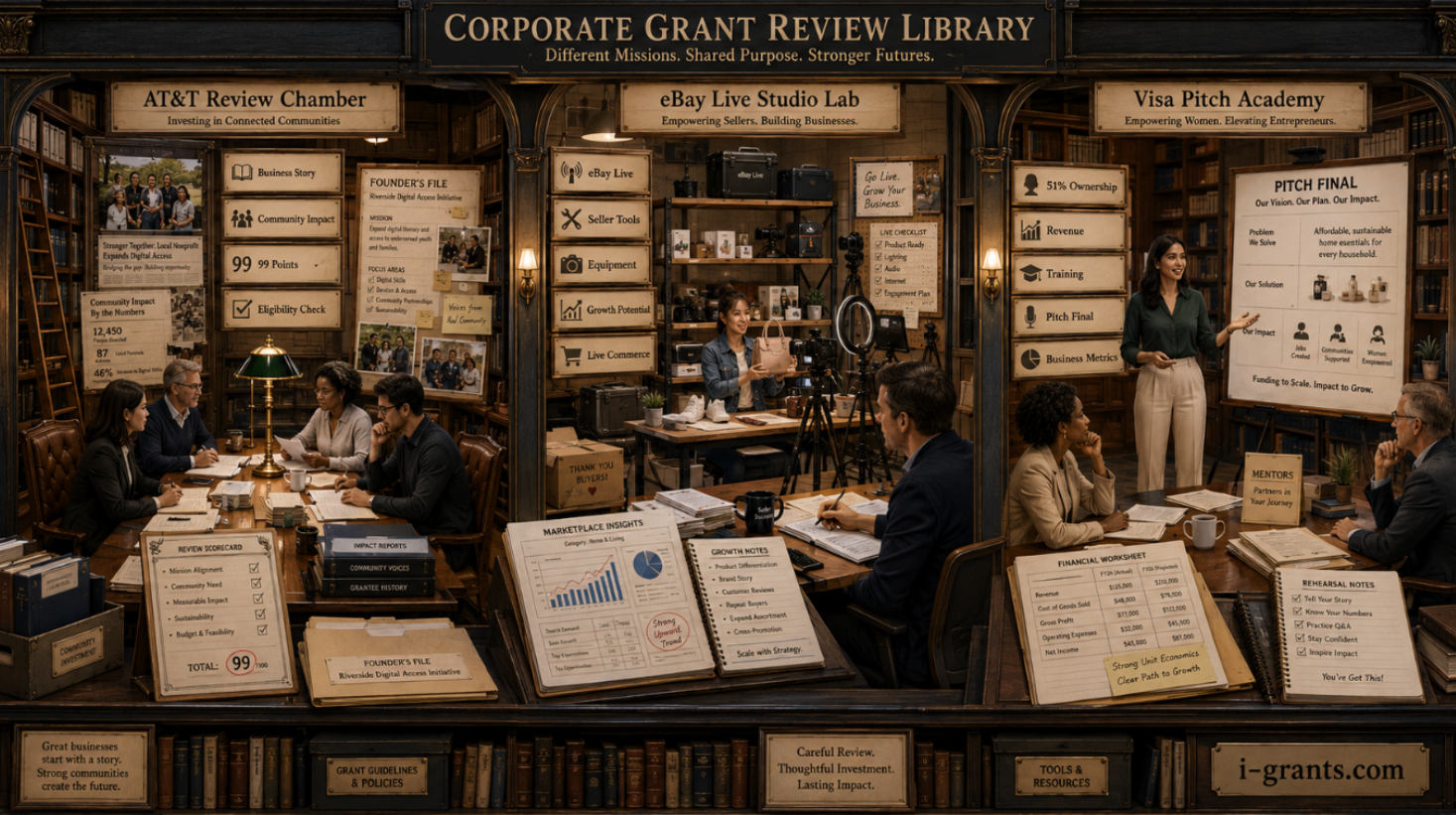
The most important insight from comparing AT&T, eBay, and Visa is that there is no universal "best corporate grant application."
A strong applicant is defined differently by each program.
Table 8. Which Corporate Grant Fits Which Business?
| Business Situation | AT&T | eBay | Visa She's Next Armenia |
|---|---|---|---|
| Needs the largest possible cash award | Strong fit if competitive | Smaller award | Smaller local-currency grants |
| Strong community-impact story | Major advantage | Helpful but not central in public criteria | Worth up to 10 points under social responsibility |
| Strong founder story | Worth major judging weight | Useful for seller storytelling | Worth 20 points |
| Strong financial metrics | Useful | Important for growth credibility | Explicitly worth 20 points |
| Clear digital business model | Useful | Essential to platform growth | Explicit digitalization score worth 20 points |
| Woman owns at least 51 percent | Not required | Not required by headline public page | Required |
| Business less than one year old | Potentially possible | Depends on seller rules | Not eligible in Armenia 2026 |
| Revenue not yet generated | No public revenue test | No public threshold disclosed | Not eligible |
| Large community of online buyers | Helpful | Highly valuable | Useful as digital evidence |
| Live-selling potential | Irrelevant | Central | Not required |
| Strong Armenian-language pitch | Irrelevant | Irrelevant | Necessary |
| Multiple business locations | Maximum five | Current public summary does not specify comparable rule | Not the central restriction |
| Wants funding without public exposure | Poorer fit because branded content and publicity matter | Seller visibility can be valuable | Publicity permissions are part of rules |
| Has commercially sensitive IP | Read contest-use provisions carefully | Review applicable platform and grant terms | Read contest-use provisions carefully |
Which Program Is Most Transparent?
AT&T and Visa Armenia both score well on transparency, but in different ways.
AT&T publishes a precise 99-point judging system and identifies a minimum 75-point finalist threshold.
Visa Armenia publishes a 100-point written-application matrix and a separate pitch-scoring framework.
eBay explains the strategic purpose and prize package clearly, but does not currently provide an equivalent numerical public judging matrix in its accessible 2026 program materials.
This does not necessarily make eBay's process less rigorous.
It simply means applicants have fewer public data points from which to reconstruct exactly how reviewers make comparative decisions.
When scoring weights are unavailable, corporate strategy becomes an important substitute.
The applicant should study repeated phrases on official program pages.
For eBay in 2026, terms such as "eBay Live," "scalable," "success stories," "live-driven businesses," "community," and "one of eBay's fastest-growing formats" reveal the direction of the program.
Which Program Is Most Competitive?
A precise 2026 comparison cannot yet be made.
AT&T has not published the final number of 2026 applications in the materials available as of September 3.
eBay has not published the final 2026 applicant count either.
Visa's official Armenia announcement confirms that ten finalists were shortlisted but does not provide a total application count in the sources reviewed here.
Historical figures nevertheless show that major corporate programs can attract enormous demand.
AT&T received more than 11,000 applications and nominations in 2025 before selecting five finalists.
eBay received more than 18,000 submissions in 2024 before selecting 50 recipients.
Visa has reported more than 52,000 applications across 17 CEMEA countries during an earlier stage of the broader She's Next initiative.
These figures cannot be converted into comparable acceptance rates because the years, geographies, definitions, and selection structures differ.
But they challenge a common assumption: corporate grants are not automatically easier to win than government funding simply because the application is shorter.
A two-page form competing against thousands of credible businesses can be extraordinarily selective.
The Corporate Funder Is Also a Stakeholder
Applicants often write grant applications as if the only relevant question is what the business needs.
Corporate funding requires another question:
Why does the company giving the money want this particular business to succeed?
For AT&T, a strong recipient becomes a public demonstration of the value of connection, entrepreneurship, technology and community.
For eBay, a successful recipient can become evidence that eBay Live creates meaningful economic opportunities for sellers.
For Visa, a successful She's Next entrepreneur demonstrates the value of supporting women-led businesses, digitalization, financial capability and inclusive economic participation.
This does not mean an applicant should artificially change the mission of the business to resemble the sponsor.
It means the applicant should choose competitions where the overlap already exists.
Strategic fit is much harder to manufacture than to recognize.
The Most Important Hidden Rules Across the Three Programs
The headline eligibility page is never enough.
Across these three 2026 programs, some of the most important conditions appear only after deeper reading.
AT&T's FAQ creates a conflict over Puerto Rico that is resolved only by consulting the Official Rules.
AT&T also imposes a 48-hour finalist response requirement and extensive verification and publicity obligations.
eBay's biggest hidden consideration is not a legal technicality but strategic fit: the 2026 program has been rebuilt around Live, even though the $10,000 amount looks familiar from earlier Up & Running rounds.
Visa Armenia requires at least 51 percent female ownership, more than one year of operations, existing revenue, Armenian-language participation, mandatory offline training, and excludes several industries that might otherwise appear to fit a general women-entrepreneur program.
These are not minor details.
Any one of them can determine whether preparing the application is worthwhile.
A Practical Framework for Evaluating the Next Corporate Grant
Before spending hours on the next branded funding opportunity, a business can run a structured pre-application review.
First, verify hard eligibility: country, state or region, ownership, legal structure, employee count, locations, operating history, revenue status, sector restrictions, and required language.
Second, identify the corporate objective behind the program. Ask whether the funder is prioritizing community impact, technology adoption, marketplace activity, women-led entrepreneurship, sustainability, local economic development, or another strategic outcome.
Third, find the actual scoring system. If points are published, build the application around them rather than around assumptions.
Fourth, inspect the post-selection requirements. Verification documents, tax forms, interviews, onboarding, training, publicity, travel, live pitching, or rapid response deadlines can be as important as initial eligibility.
Fifth, read the data, confidentiality, and intellectual-property sections before submitting proprietary information.
Sixth, distinguish between an opportunity that provides only money and one that also requires substantial participation in mentoring, training, platform adoption, marketing, or public content.
This framework eliminates many weak-fit applications before the applicant wastes time preparing them.
Final Assessment
AT&T, eBay and Visa demonstrate how far the modern corporate grant has evolved from a simple charitable check.
The AT&T Small Business Contest 2026 offers the largest individual award of the three examples, with $50,000 for one winner and $5,000 for four additional finalists. But the application is fundamentally a brand-aligned storytelling and community-impact competition. The 99-point scoring framework, 75-point finalist threshold, Puerto Rico discrepancy, 48-hour response rule, tax obligations and intellectual-property provisions make careful reading of the Official Rules essential.
AT&T's 2025 winner also demonstrates that persistence matters. Nourish + Bloom Market competed three times before winning and ultimately presented exactly the type of story AT&T's criteria reward: technology linked to connection, access, and measurable community need.
The eBay Live x Up & Running Grants 2026 program offers a smaller $10,000 award but provides a useful example of how quickly a recurring corporate grant can change. The individual grant amount is unchanged from earlier cycles, yet the number of funded sellers has fallen from 50 to 10 and the program has been repositioned around live commerce. Recipients receive professional equipment and specialized eBay Live support in addition to cash.
That strategic shift looks especially significant in the context of eBay's business results. The company reported roughly eightfold year-over-year growth in eBay Live GMV across seven markets during the second quarter of 2026.
The grant therefore illustrates a common corporate-funding pattern: the business receives resources, but the sponsor also invests in behavior that strengthens its own ecosystem.
She's Next, Empowered by Visa Armenia 2026 shows a third model.
The program combines direct funding with structured entrepreneur development. Applicants needed at least 51 percent ownership, more than one year of business activity, revenue, Armenian residency, business registration, and Armenian-language participation. The 100-point application assessment examined the problem being solved, founder story, business metrics, digitalization and social responsibility. The top ten then passed through interviews, mandatory offline training and a final Elevator Pitch before three winners received AMD 2,000,000, AMD 1,800,000 and AMD 1,600,000.
The three programs ultimately reward different things.
AT&T rewards a compelling business whose purpose and community impact can demonstrate the power of connection.
eBay rewards sellers that can help turn live commerce into a scalable growth channel.
Visa Armenia rewards established women-owned businesses that can demonstrate a real market problem, credible business economics, digital capability, entrepreneurial vision and the ability to present a convincing growth case.
For grant seekers, that leads to one larger lesson.
Do not begin by asking which famous company is giving away the most money.
Begin by asking what that company is trying to build through the grant.
Once that answer is clear, it becomes much easier to decide whether the business belongs in the competition at all.
And in highly competitive corporate funding, choosing the right competition may be just as important as writing the application itself.