

 Français
  Deutsch
  Українська
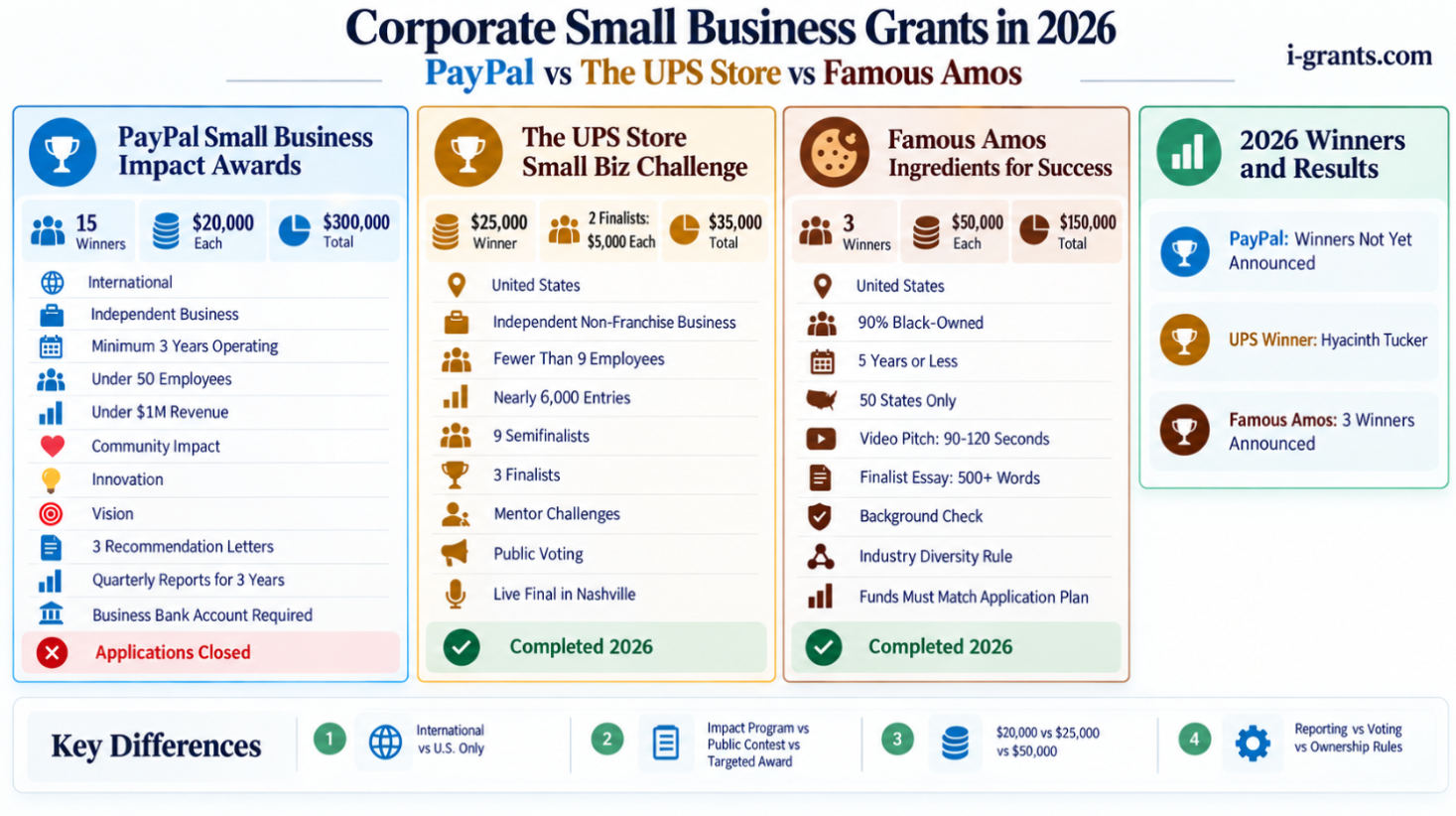
PayPal, The UPS Store, and Famous Amos all supported small businesses with substantial cash awards in 2026, but describing the three opportunities simply as "small business grants" hides important differences.
PayPal and Global Citizen operate an international Small Business Impact Awards program that will distribute $300,000 among 15 businesses in 2026.
The UPS Store runs a U.S. business competition in which applicants progress through mentoring, public voting, business challenges, and a live final before competing for a $25,000 top prize.
Famous Amos, owned by Ferrero North America, operates its Ingredients for Success Entrepreneurs Initiative as a national U.S. award program for early-stage Black-owned businesses. Three 2026 recipients each received $50,000.
For search purposes, all three programs may appear under terms such as "small business grants," "corporate grants," or "business funding." Legally and operationally, however, they are not identical.
PayPal's official rules describe its program as a competition and the funding as a prize. Famous Amos formally calls its $50,000 payments Business Awards. The UPS Store Small Biz Challenge is explicitly a business competition with cash prizes.
That distinction matters because corporate awards can include judging requirements, publicity rights, travel obligations, tax consequences, background checks, long-term reporting, and restrictions that would not be obvious from a headline announcing "$20,000" or "$50,000 for small businesses."
As of September 7, 2026, the PayPal application window has closed and the 2026 winners have not yet been publicly announced. The UPS Store competition is completed, with Hyacinth Tucker of The Laundry Basket LLC taking the $25,000 top award. Famous Amos has also completed its 2026 cycle and announced three $50,000 recipients.
PayPal, The UPS Store, and Famous Amos Funding in 2026
Table 1. Current Status of PayPal, The UPS Store, and Famous Amos Small Business Awards in 2026
| Program | Geography | 2026 cash funding | Number of main recipients | Current status as of September 7, 2026 |
|---|---|---|---|---|
| Global Citizen and PayPal Small Business Impact Awards | International | $20,000 each, $300,000 total | 15 | Applications closed; winners not yet publicly announced |
| The UPS Store Small Biz Challenge | United States | $25,000 winner; two finalists received $5,000 each | 3 cash recipients | Completed |
| Famous Amos Ingredients for Success | 50 U.S. states | $50,000 each, $150,000 total | 3 | Completed; 2026 winners announced |
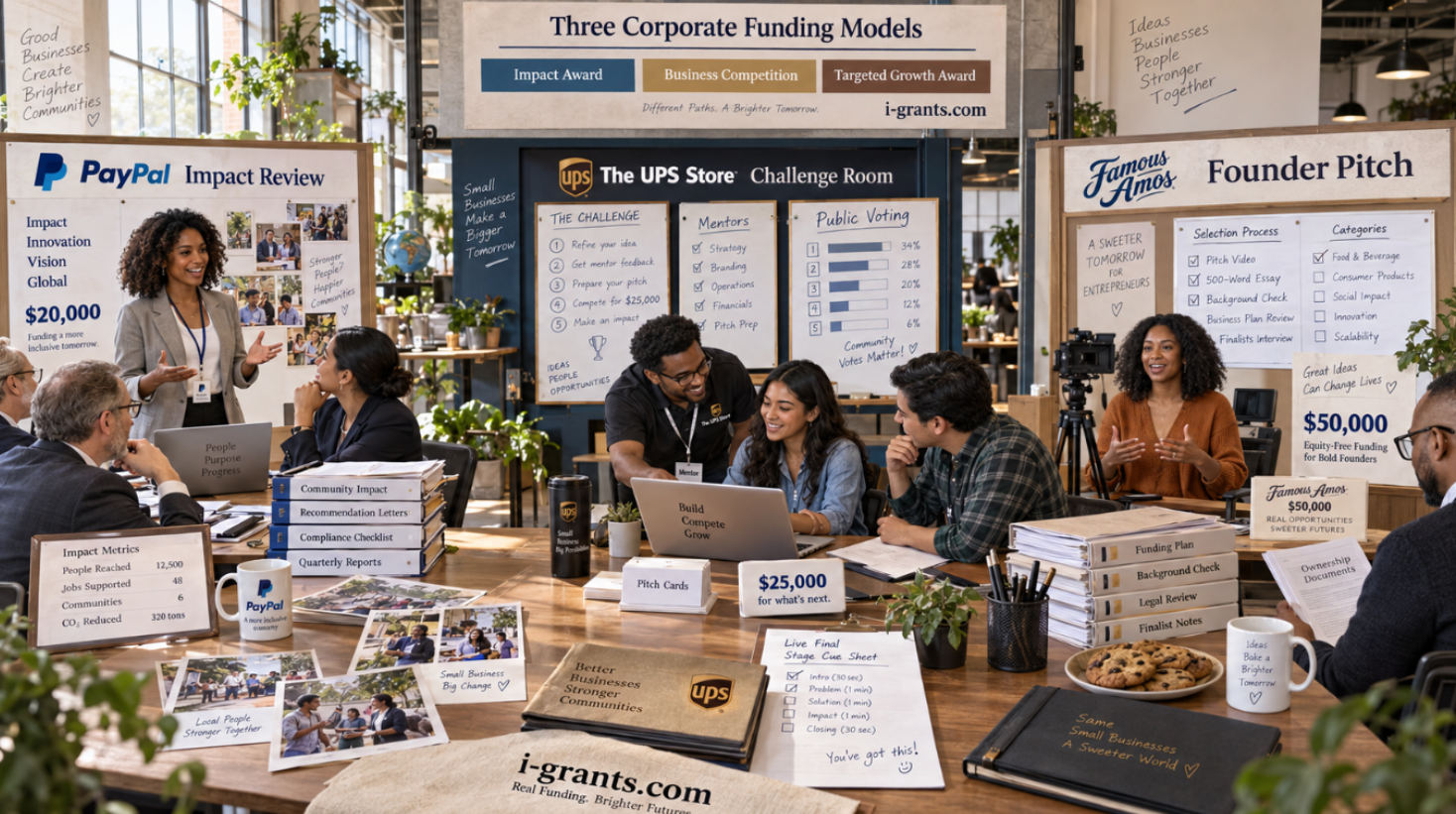
The three programs represent three different corporate funding models.
PayPal targets independently owned businesses that combine commercial activity with measurable social or environmental impact. The UPS Store tests the founder's ability to communicate, adapt, solve business problems, attract public support, and perform under live competition conditions. Famous Amos focuses on early-stage Black-owned businesses and combines substantial capital with mentorship, networking, and educational resources.
PayPal Small Business Impact Awards 2026
A Global Program With $300,000 in Cash Awards
The Global Citizen and PayPal Small Business Impact Awards entered their second year in 2026.
The program increased the number of recipients from five in 2025 to 15 in 2026. Each winner will receive $20,000, bringing the total cash commitment to $300,000.
PayPal and Global Citizen also say recipients will receive technical training and marketing support intended to help them expand their business and community impact.
The 2026 application period has ended. Global Citizen's current program page explicitly states that the application window is closed and that winner updates are still forthcoming. Under the formal terms, winners may be selected between August and December 2026.
That makes this a particularly useful program to watch even after the deadline. The 2026 recipient announcement will provide new examples of the types of companies PayPal and Global Citizen consider strong combinations of innovation, impact, and growth potential.
Who Was Eligible for the PayPal Awards?
The formal 2026 Terms and Conditions provide a much more precise definition of a qualifying business than many promotional summaries.
Table 2. Formal PayPal Small Business Impact Awards Eligibility Requirements for 2026
| Requirement | Formal 2026 rule | Practical meaning |
|---|---|---|
| Applicant | Owner, founder, or CEO aged at least 18 | Applicant must remain actively involved in strategy or operations |
| Independence | Independently owned business | Publicly controlled businesses do not qualify |
| Legal status | Properly licensed and authorized to operate in its home country | Informal ventures without appropriate legal standing may fail eligibility |
| Geographic scope | Businesses may operate anywhere in the world, subject to law and sanctions | International program, not limited to U.S. applicants |
| Local connection | Business must primarily serve its local community | A locally rooted operating model is central to the award |
| Employees | Fewer than 50 full-time employees | Formal rules use a strict employee threshold |
| Revenue | Less than $1 million in total annual revenue | Formal rules require compliance with this threshold as well |
| Operating history | Minimum of 3 years | Very young startups are excluded |
| Community contribution | Tangible local social, environmental, employment, training, or partnership impact | Impact must be demonstrated, not merely promised |
| Franchise status | Franchises and national or international chains excluded | Independent business requirement is substantive |
| Previous PayPal funding | Prior grant or similar funding from PayPal or related entities can make an applicant ineligible | Repeat funding is restricted |
| Sanctions and compliance | Applicants must not fall under applicable sanctions or prohibited categories | International eligibility remains subject to regulatory controls |
A particularly important detail is that the formal rules require a qualifying small business to have both fewer than 50 full-time employees and less than $1 million in annual revenue.
This is stricter than the wording on some of the program's informational pages.
A Real Contradiction Between the PayPal Marketing Page and Legal Rules
Global Citizen's public-facing materials describe a typical small-to-medium business as having "fewer than 50 full-time employees or annual revenue under $1 million."
The legal Terms and Conditions use "and," not "or." They separately require fewer than 50 full-time employees and less than $1 million in annual revenue.
For an applicant, that is not a minor grammatical difference.
Consider a company with 18 employees and $1.4 million in annual revenue. A reader relying only on the shorter promotional description might think the company qualifies because it has fewer than 50 employees. Under the formal terms, it would fail the revenue requirement.
The same issue appears in the application deadline.
Table 3. PayPal 2026 Information Conflicts Applicants Needed to Notice
| Issue | Earlier or promotional information | Final formal position | Best interpretation |
|---|---|---|---|
| Employee and revenue test | "Fewer than 50 employees or annual revenue under $1 million" | Fewer than 50 employees and less than $1 million annual revenue | Follow the formal Terms and Conditions |
| Early deadline | July 19, 2026 at 8:00 p.m. ET | July 31, 2026 at 5:00 p.m. PST | Deadline was effectively extended or superseded |
| Finalist terminology | Public FAQ refers to up to 50 finalists | Formal rules define up to 50 Prize Finalists, with 15 ultimately becoming winners | Legal terms control |
| International availability | Worldwide language | Void where prohibited, with sanctions and regulatory exclusions | "Worldwide" is subject to legal restrictions |
An early Global Citizen article published on June 16 gave a deadline of July 19, 2026 at 8:00 p.m. ET. The formal Terms and Conditions later established an entry period ending July 31, 2026 at 5:00 p.m. PST, and PayPal's July 24 announcement was still promoting the program at that point.
For grant applicants, the lesson is important: when a marketing page and formal rules conflict, the current legal rules should generally be treated as the controlling source unless the organizer says otherwise.
What PayPal Actually Asked Applicants to Submit
The PayPal application was not a simple registration form.
Global Citizen states that the application included information about the founder and business, a pitch, responses explaining alignment with the judging criteria, and supplementary organizational information if requested.
Applicants had to submit a one-to-two-minute video pitch and answer four short questions, each limited to 250 words. Applications were accepted only in English, although applicants could prepare their content in another language and translate it before submission.
This created a dual evaluation problem.
An applicant had to demonstrate business substance while also communicating that substance concisely. A company might have substantial impact data, but if it could not explain its innovation, vision, and results in a few hundred words and a short video, the strength of that data could be lost.
The formal judging criteria are Innovation, Impact, and Vision.
Innovation concerns how the business model, product, or service supports a social or environmental mission. Impact concerns measurable results. Vision concerns the founder's plan for expanding that work over the next three to five years.
The Selection Process Gets Much Harder After the First Application
Up to 50 entrants can be selected for further consideration.
Those businesses must provide three letters of recommendation. The organizers can also request additional information, conduct media assessments, and perform background checks.
Finalists are then reviewed by representatives from Global Citizen and PayPal, along with outside experts and leaders in international development. Fifteen ultimately become prize winners.
This means applicants should not wait until finalist notification to begin gathering evidence of credibility.
A founder whose customers, partners, nonprofit collaborators, suppliers, or community leaders can provide strong recommendation letters is in a better position than an equally promising company that has never documented those relationships.
Winning $20,000 Creates Three Years of Obligations
Perhaps the most important hidden condition in the PayPal competition comes after selection.
A winner may be required to participate in filming at the business, appear in additional promotional content, and attend Global Citizen NOW or Global Citizen Festival events in 2026.
The rules require participants to have a valid passport and make them responsible for obtaining any necessary visa, although certain approved travel expenses and up to $500 in visa processing costs may be covered by the sponsor when travel is required.
More unusually, winners must agree to provide quarterly written progress updates for three years.
They must also agree to media interviews and appearances during that three-year period.
Quarterly reporting for three years means a possible total of 12 formal reporting points after the award.
That is a significant commitment for a $20,000 corporate award and is exactly the type of condition that can disappear from a short grant directory listing.
PayPal Also Requires a Business Bank Account and Compliance Checks
The award cannot be paid to the founder's personal bank account.
The formal rules require payment by wire transfer to an account registered in the name of the qualifying business. The banking details must match the registered business name.
Winners must also satisfy Know Your Customer and Anti-Money Laundering requirements.
Global Citizen can require government identification, proof of legal entity status, recent bank statements showing ownership of the business account, and other documents necessary to confirm identity, registration, and financial standing.
The award can be withheld, delayed, or revoked when required documentation is missing, inaccurate, incomplete, fraudulent, or creates compliance concerns.
Tax responsibility remains with the winner.
For an international program, this is particularly important because tax treatment can vary substantially across jurisdictions. PayPal and Global Citizen explicitly advise recipients that tax implications may arise and do not accept responsibility for those liabilities.
PayPal Expanded the Program Dramatically in Its Second Year
Table 4. Global Citizen and PayPal Small Business Impact Awards, 2025 vs 2026
| Feature | 2025 | 2026 |
|---|---|---|
| Program year | First | Second |
| Number of winners | 5 | 15 |
| Cash per winner | $25,000 | $20,000 |
| Total cash awards | $125,000 | $300,000 |
| Geographic model | International | International |
| Additional support | In-person brand-building masterclass | Technical training and marketing support |
| Winner status by September | Not yet known at the equivalent stage | Not yet publicly announced as of September 7 |
| Formal operating-history requirement | Program-specific | Minimum 3 years in 2026 |
The most striking change is the funding structure.
PayPal reduced the individual award from $25,000 to $20,000, a decrease of 20 percent per recipient, while increasing the number of winners from five to 15.
As a result, total cash awards rose from $125,000 to $300,000, an increase of 140 percent.
The strategy appears to have shifted from supporting a very small cohort with somewhat larger individual awards to supporting a much wider international group with substantial but slightly smaller grants.
What the 2025 PayPal Winners Tell Us About the Program
The inaugural five winners came from Argentina, India, South Africa, Sweden, and the United States.
They were Angirus, Sopköket AB, Sheba Feminine, CLIP, and Satellites on Fire. Each received $25,000.
The cases reveal that "impact" does not mean one single business model.
Angirus develops alternatives to traditional construction materials using waste. Sopköket addresses food waste, hunger, and employment. Sheba Feminine develops sustainable menstrual products. CLIP works on affordable electric mobility. Satellites on Fire uses artificial intelligence and satellite information to detect wildfires.
Some of the reported impact metrics are substantial.
Global Citizen says Satellites on Fire had protected 56 million hectares across 19 countries. CLIP had patented its electric-bike technology in 47 countries. These are not tiny community projects in an early concept stage. They demonstrate that the awards can favor small companies with international technological reach while still requiring a clear local or societal impact story.
The lesson for future applicants is that a purpose statement alone is unlikely to be enough.
A competitive PayPal application needs evidence that the business already converts its mission into measurable results.
The UPS Store Small Biz Challenge 2026
A Business Competition, Not a Traditional Grant Application
The UPS Store Small Biz Challenge is structurally different from PayPal.
The 2026 competition offered a total prize pool of $35,000. The winner received $25,000 and an editorial feature in Inc. magazine, while the two other finalists received $5,000 each.
Applications closed on February 22, 2026.
The competition was open to adult U.S. residents who owned and operated independent, non-franchised small businesses in the United States. The official Inc. rules page also described eligible small businesses as having fewer than nine employees.
This employee threshold is easy to miss because it does not appear in the short headline promoting the $35,000 prize pool.
How the 2026 Competition Worked
Table 5. The UPS Store Small Biz Challenge 2026 Selection Process
| Stage | Participants | What happened | Why it mattered |
|---|---|---|---|
| Initial application | National applicant pool | Short online submission | Basic eligibility and initial business story |
| Semifinal selection | 9 | The UPS Store and Inc. selected semifinalists | Only a very small share of applicants advanced |
| Mentored challenges | 9 | Entrepreneurs completed exercises in business fundamentals | Tested ability to learn and apply feedback |
| Public voting | 9 | Voting ran March 16 to April 5 | Public appeal directly affected advancement |
| Finalist selection | 3 | Highest-performing or advancing participants moved to final | Finalists received a Nashville trip |
| Live final | 3 | Business presentation and judged challenges in Nashville on April 23 | Attendance was mandatory |
| Cash awards | 3 | $25,000 winner, $5,000 each for two other finalists | All three finalists received money |
The semifinalists worked with mentors Isaac Hetzroni, Julissa Prado, and Tori Dunlap on challenges covering areas such as brand strategy, market positioning, and operational execution.
Their work was then shown publicly, and voting from March 16 through April 5 helped determine the three finalists.
The final phase took place in Nashville on April 23.
Attendance was not optional. The abbreviated official rules explicitly state that attendance at the Nashville final was mandatory.
This creates a very different applicant profile from a conventional grant.
A founder may have an excellent company and still be poorly suited to a competition that requires public voting, mentor interaction, video or social content, rapid adaptation, travel, and live presentation.
Almost 6,000 Businesses Entered in 2026
The 2026 Small Biz Challenge attracted nearly 6,000 entries.
Nine semifinalists were selected, meaning roughly one semifinal place existed for every 667 entries if calculated from the headline volume. Only three reached the live final.
Again, these calculations are not official acceptance rates because not every submission may have been valid or equally competitive. They simply demonstrate the scale of the funnel.
Competition volume has remained high for several years.
Table 6. Recent The UPS Store Small Biz Challenge Participation and Winners
| Year | Applications | Semifinalists | Main winner | Top cash prize |
|---|---|---|---|---|
| 2024 | Nearly 6,000 | 9 | Lacey Benard, Bitty Bao | $25,000 |
| 2025 | More than 6,700 | 9 | Sydney Attis, Just Call Me Shirley | $25,000 |
| 2026 | Nearly 6,000 | 9 | Hyacinth Tucker, The Laundry Basket LLC | $25,000 |
In 2024, nearly 6,000 applicants entered before Lacey Benard of Bitty Bao won the top award. In 2025, more than 6,700 applications were submitted, the highest of these three recent cycles, and Sydney Attis of Just Call Me Shirley became the winner.
The 2026 cycle returned to approximately 6,000 entries.
These figures suggest that The UPS Store competition has developed a stable national audience rather than depending on a one-year spike in interest.
The 2026 Winner: The Laundry Basket
Hyacinth Tucker, founder of The Laundry Basket LLC, won the 2026 Challenge.
Her company began from a simple problem. Tucker helped a friend who was overwhelmed by laundry, then discovered broader demand when other people asked for the same service.
She formally launched The Laundry Basket in 2022.
By 2026, the company had evolved into a technology-enabled textile management and logistics service working with residential and commercial clients.
It operates across markets including Atlanta, Cleveland, Houston, Maryland, Northern Virginia, and Washington, D.C. Inc. reported that The Laundry Basket generated nearly $470,000 in annual revenue in 2025.
Tucker said the $25,000 would support operational efficiency, customer service, and infrastructure.
Her case is especially instructive because mentor feedback suggests she was not necessarily the most polished contestant at the beginning. One mentor described her as initially appearing to be an underdog because of weaker social-media experience, but her live pitch substantially changed that perception.
This reveals something important about the competition.
The UPS Store is not only selecting the company that looks strongest on paper on the first day. The format also rewards the founder's capacity to learn quickly, absorb coaching, improve presentation, and perform under pressure.
Public Voting Makes The UPS Store Fundamentally Different
Traditional grant writers often focus on evidence, budgets, eligibility, and narrative.
Those skills remain useful in The UPS Store Challenge, but they are not enough.
Public voting means that a founder's existing audience, social-media communication, customer loyalty, community relationships, and ability to mobilize supporters can influence whether the business reaches the final.
Then the final introduces a completely different skill: live performance.
A strong applicant therefore needs both business credibility and public-facing communication capacity.
That makes The UPS Store closer to an entrepreneurial competition or pitch contest than to a standard corporate grant review.
Famous Amos Ingredients for Success 2026
Three $50,000 Business Awards
Famous Amos launched the sixth annual Ingredients for Success Entrepreneurs Initiative in March 2026 in partnership with U.S. Black Chambers, Inc.
The program distributes $150,000 each year, with three recipients receiving $50,000 each, along with mentorship, networking opportunities, and educational resources.
Ferrero says the initiative was created in 2020 to honor Famous Amos founder Wally Amos and expand access to capital and support for early-stage Black entrepreneurs.
Before the 2026 awards, the program had supported 15 owners with a total of $750,000. After the three 2026 recipients, the total reached 18 businesses and $900,000 in awards.
Famous Amos Eligibility Was Narrower Than the PayPal or UPS Programs
Table 7. Famous Amos Ingredients for Success 2026 Eligibility and Exclusions
| Requirement | 2026 rule | Practical implication |
|---|---|---|
| Ownership | At least 90 percent Black-owned | Ownership threshold is central to eligibility |
| Business age | In business for 5 years or less as of March 31, 2026 | Mature businesses are excluded |
| Headquarters | Within the 50 United States | Puerto Rico, U.S. Virgin Islands, and other territories excluded |
| Owner age | All owners must be at least 21 | Every owner must satisfy the requirement |
| Franchise status | Franchisees not eligible | Independent business structure required |
| Nonprofit status | 501(c)(3) organizations excluded | Program is for commercial enterprises |
| Alcohol sector | Certain licensed alcohol manufacturers, retailers, and distributors excluded | Industry-specific exclusion |
| Application limit | One application per business/applicant group | Duplicate participation restricted |
| Business stability | Insolvency, ownership change, or receivership before award can eliminate eligibility | Eligibility must continue through award stage |
| Industry diversity | Maximum one finalist or winner per industry or business category | Strong applicants can still be blocked by category competition |
The industry-diversity requirement is one of the most unusual rules among major corporate small business awards.
Famous Amos states that no more than one applicant from the same industry or business category may be selected as a finalist or winner. Ferrero itself determines those classifications.
This means applicants are not competing only against the entire applicant pool.
They may also be competing for a single place allocated, in practice, to their business category.
If two outstanding companies operate in the same category, the judges cannot simply advance both because both are excellent.
That creates a structural factor that an applicant cannot fully control.
Famous Amos Required a Video Before the Essay
The first application stage required much more than company contact information.
Applicants had to provide ownership information, business name, legal postal address, official business email, tax identification number, a business overview of no more than 250 words, links to the company website and social-media pages, and a 90-to-120-second elevator-pitch video.
The first-round deadline was June 1, 2026.
The program then expected to select ten finalists, although the rules permitted an eleventh finalist if the judges could not reach consensus and unanimously agreed to expand the group.
Those finalists had to submit an essay of at least 500 words explaining the company's greatest needs and detailing how the $50,000 award would address them. The second-stage deadline was June 30.
This sequence is strategically interesting.
The short video comes before the longer written explanation.
Famous Amos therefore tests persuasion early. A founder who cannot explain the business clearly in roughly two minutes may never reach the stage where a detailed 500-word funding case can be evaluated.
What Did Famous Amos Judge?
The rules are unusually direct.
Applications were evaluated based on the creativity and persuasiveness of the elevator pitch and on the content and business rationale explaining how the award would be used.
This differs from PayPal's explicit Innovation, Impact, and Vision framework.
Famous Amos puts a particularly strong emphasis on the founder's ability to sell the business case and connect $50,000 to identifiable business needs.
The rules also permit disqualification where an application contains unlawful activity, conflicts with the spirit of the initiative, or could expose the sponsor or applicant to ridicule or reputational harm.
Finalists Had to Pass a Background Check
Another condition appears only after an applicant reaches the later stage.
The top ten or eleven finalists must agree to a background check, and final selection is conditional on passing it.
This creates a due-diligence stage that is easy to overlook if an entrepreneur reads only the public program summary.
It also reinforces a broader trend visible across corporate awards: businesses are increasingly evaluated not only on the proposed use of money but also on legal standing, reputation, compliance, media suitability, and the founder's ability to represent the sponsoring brand.
Famous Amos Controls How the $50,000 Is Used
The $50,000 award is not described as unrestricted money that a winner can redirect to any purpose after selection.
The formal rules say the Business Award is to be used in accordance with the application to further the success of the business described in that application.
That makes the use-of-funds section particularly important.
If an applicant wins by saying that the award will finance production equipment, market expansion, hiring, technology, or a new facility, the safest interpretation is that those commitments should remain consistent after the money arrives.
The rules also state that awards are non-assignable and nontransferable.
Federal, state, and local tax reporting and payment remain the responsibility of the winner, and the amount paid can be reduced by legally required withholding.
Publicity Rights Are Extremely Broad
Famous Amos also receives extensive rights to use applicant information.
The official rules grant the sponsor and partner organization rights to use the applicant's name, voice, likeness, application information, and biography for promotional purposes in connection with the program and similar future programs, in all media, in perpetuity, without additional compensation or approval.
This provision matters for founders who prefer strict control over their personal brand or business story.
A $50,000 award can bring significant visibility, but the tradeoff is that the founder may give the corporate sponsor long-term promotional rights.
PayPal contains similarly broad publicity provisions, while The UPS Store's program itself is built around public competition and Inc. media exposure.
Across all three programs, privacy and low visibility are not realistic assumptions.
Famous Amos 2026 Winners
Table 8. Famous Amos Ingredients for Success 2026 Winners
| Business | Founder or founders | Location | Business focus | Award |
|---|---|---|---|---|
| The Brunch Munch | Ashley Reed | St. Petersburg, Florida | Food business using community connection and cultural-place preservation as part of its model | $50,000 |
| Maison Black | Tori Nichel | New York City | Fashion platform expanding visibility and market access for Black designers | $50,000 |
| The Marriage Pinnacle | Dr. Lara and Memi | Maryland | Relationship support platform combining clinical and cultural expertise for Black couples | $50,000 |
The three 2026 recipients demonstrate the industry diversity that Famous Amos intentionally builds into the program.
One is a food business, one operates in fashion, and one provides relationship and family support services.
The variety is not accidental. It directly reflects the rule preventing more than one applicant from the same industry or business category from becoming a finalist or winner.
The 2026 cycle also generated record interest. Reporting based on Ferrero's announcement states that the program received more than 2,800 applications, more than double the previous year's level.
With three awards, that represents approximately 933 applications per funded business if the total applicant volume is divided mechanically by the number of awards.
As with similar comparisons elsewhere in this article, that is not an official acceptance rate because some applicants may have been ineligible or incomplete.
It does, however, illustrate the level of demand for $50,000 early-stage business capital.
Three Programs, Three Very Different Definitions of a Strong Applicant
A strong PayPal applicant is not necessarily a strong Famous Amos or UPS applicant.
PayPal emphasizes measurable community or environmental impact, innovation, and a three-to-five-year vision. It also requires a mature enough organization to have operated for at least three years, while remaining below both the employee and revenue limits.
The UPS Store tests entrepreneurial adaptability and communication. A business needs to survive an initial review, respond to mentors, perform business challenges, attract public votes, and present effectively in a live final.
Famous Amos combines early-stage eligibility with a persuasive founder pitch, specific capital needs, strict ownership requirements, and an industry-diversity rule.
The overlap is that all three programs are looking for more than financial need.
"Business needs money" is not a competitive argument by itself.
The applicant has to show why this particular business, founder, impact model, growth opportunity, or recovery strategy deserves the sponsor's capital and public endorsement.
The Hidden Cost of Corporate Awards: Reporting, Publicity, and Compliance
Corporate small business awards are often described as "free money" because they are not conventional loans.
That description is misleading.
PayPal may require three years of quarterly reporting and media participation. Winners may also need to travel, be filmed, maintain confidentiality before public announcement, provide business banking information, and satisfy KYC and AML checks.
The UPS Store requires finalists to participate publicly in challenges, voting, mentoring, and a mandatory live final. The winner also receives national editorial exposure through Inc.
Famous Amos finalists undergo background checks. Winners must use funds in accordance with the application and accept broad promotional-use provisions.
These obligations do not make the programs unattractive.
They simply mean that applicants should evaluate the full exchange.
The company receives capital, expert support, visibility, or credibility. The sponsor receives stories, public engagement, evidence of corporate impact, brand association, and sometimes years of follow-up information.
Which Program Offered the Best Financial Opportunity in 2026?
Purely by individual award size, Famous Amos offered the largest main payment at $50,000 per winner.
The UPS Store's top prize was $25,000.
PayPal offered $20,000 to each recipient.
But comparing only individual awards gives an incomplete picture.
PayPal had by far the largest total 2026 cash commitment among the three, at $300,000 across 15 businesses. Famous Amos committed $150,000 to three businesses. The UPS Store distributed $35,000 among three finalists.
Eligibility also changes the practical value.
A founder outside the United States cannot apply to The UPS Store or Famous Amos, while PayPal is internationally accessible subject to local law and sanctions.
A business operating for six years would fail Famous Amos's five-year maximum but could potentially qualify for PayPal.
A business with ten employees could potentially qualify for PayPal or Famous Amos but would exceed the fewer-than-nine-employees definition on the UPS competition's official rules page.
A franchise would be excluded from PayPal, The UPS Store Challenge, and Famous Amos under the respective 2026 conditions.
The "best" grant is therefore the one for which the business is legally eligible and strategically competitive.
What Future Applicants Should Prepare Before the Next Cycle
The 2026 programs suggest several documents and capabilities worth preparing before new application periods open:
-
A concise explanation of the business model, customers, revenue, and current stage.
-
A clear use-of-funds plan connecting every major expense to a business result.
-
Measurable evidence of community, environmental, employment, or customer impact where relevant.
-
A short founder video that explains the company persuasively without relying on technical jargon.
-
Current company registration, tax, bank, ownership, and financial records that can survive formal verification.
-
References, customer or partner relationships, and public-facing materials strong enough to support due diligence, voting, interviews, or media review.
The most important preparation is consistency.
The ownership information, website, revenue figures, business registration, bank account, public story, impact claims, and use-of-funds plan should describe the same company.
A corporate award process can move quickly from a simple application to background checks, banking verification, recommendation letters, public voting, or live interviews. Contradictions that seem small at the first stage can become much more serious later.
Frequently Asked Questions
Is the PayPal Small Business Impact Award still open in 2026?
No.
The 2026 application window is closed as of September 7. Global Citizen's current page says winner updates are still forthcoming. Fifteen businesses are expected to receive $20,000 each.
Is PayPal giving small businesses $20,000 or $25,000?
Both figures are real, but they belong to different years.
The five inaugural 2025 winners received $25,000 each.
In 2026, PayPal expanded the program to 15 winners and reduced the individual award to $20,000.
Can a company with more than $1 million in revenue apply for PayPal's 2026 award?
Under the formal 2026 Terms and Conditions, no.
A qualifying business must have fewer than 50 full-time employees and generate less than $1 million in total annual revenue. Applicants should follow the formal terms rather than the less precise "employees or revenue" language on promotional pages.
Does a PayPal winner have to report after receiving the money?
Yes.
The formal rules require winners to provide quarterly written progress updates for three years and agree to media interviews and appearances during the same period.
Can the PayPal award be paid into a personal bank account?
No.
The formal rules require wire transfer to a bank account registered in the name of the qualifying business.
Who won The UPS Store Small Biz Challenge in 2026?
Hyacinth Tucker, founder of The Laundry Basket LLC, won the $25,000 top prize.
Andrew Tyree Clinkscale of Portion LLC and Laura Nolen of High Strung Racquets LLC each received $5,000 as finalists.
How many businesses entered The UPS Store competition?
The 2026 competition received nearly 6,000 entries.
Nine semifinalists were selected, followed by three finalists.
Could a franchise enter The UPS Store Small Biz Challenge?
No.
Despite The UPS Store itself being a franchise system, the 2026 competition was open to owners of independent, non-franchised small businesses.
How much did Famous Amos award in 2026?
Famous Amos awarded three businesses $50,000 each, totaling $150,000.
The program also includes mentorship, networking, and educational resources.
Does a Famous Amos applicant have to be Black-owned?
For the 2026 Ingredients for Success program, the business had to be at least 90 percent Black-owned.
All owners also had to be at least 21, and the business had to be five years old or younger and headquartered within the 50 United States.
Why does the applicant's industry matter in Famous Amos?
The official rules allow no more than one applicant from each industry or business category to be selected as a finalist or winner.
Ferrero decides how those categories are classified.
Can a Famous Amos winner spend the $50,000 on anything?
Not according to the formal rules.
The Business Award is to be used in accordance with the winning application to further the success of the business described there.
Final Assessment
PayPal, The UPS Store, and Famous Amos offered three substantial but fundamentally different routes to corporate small business funding in 2026.
PayPal provided the broadest geographic opportunity and the largest overall cash commitment.
Its partnership with Global Citizen will distribute $300,000 among 15 international small businesses. The program is designed for companies that can demonstrate a combination of innovation, measurable social or environmental impact, and a credible plan for expanding that impact.
But the $20,000 award comes with some of the most demanding post-award obligations among the corporate programs reviewed by i-grants.com.
Three years of quarterly reporting, media participation, potential filming and travel, formal KYC and AML checks, a business-bank-account requirement, and broad publicity rights make this much more than a simple cash transfer.
The program also illustrates why applicants must read formal rules. Promotional language suggested an employee or revenue test, while the legal rules required compliance with both limits. An early July 19 deadline was superseded by July 31 in the final terms.
The UPS Store operated the most competition-driven model.
Nearly 6,000 businesses entered, nine became semifinalists, three reached Nashville, and Hyacinth Tucker won $25,000.
The process tested much more than the quality of a business plan.
Mentoring, brand strategy, operational challenges, public voting, live presentation, and mandatory attendance meant that founder adaptability and communication were part of the competition itself.
Tucker's case is particularly useful because The Laundry Basket had already grown to nearly $470,000 in annual revenue by 2025, yet mentor commentary suggests her greatest competitive improvement occurred during the Challenge. The program rewarded development during the process, not merely polished presentation at the beginning.
Famous Amos offered the largest individual award.
Three early-stage Black-owned businesses received $50,000 each in 2026.
The program combines capital with mentoring and professional networks, but it also has unusually specific structural rules. Businesses must be at least 90 percent Black-owned, five years old or younger, based within the 50 states, and independently operated.
The industry-diversity condition is particularly significant. A founder may have an exceptional application and still face an additional competitive barrier if another exceptional company is placed in the same business category.
Famous Amos also evaluates the persuasiveness of a 90-to-120-second founder pitch before finalists progress to a longer written funding case. Finalists must accept background checks, winners must use the award consistently with their application, and the sponsor receives broad long-term publicity rights.
Together, the three programs demonstrate an increasingly important feature of corporate grants and business awards:
The money is only one part of the opportunity.
Corporate funders are also selecting businesses that can represent their values, demonstrate impact, communicate publicly, withstand legal and financial verification, and participate in a wider brand ecosystem.
For applicants, that changes how a strong submission should be built.
Eligibility comes first. Business evidence comes second. Then comes the question many applicants overlook: Is the founder prepared for everything that happens if the application succeeds?
A $20,000, $25,000, or $50,000 corporate award can accelerate a small business significantly.
But the most competitive applicants understand the full agreement before they apply, not after they win.