

 Français
  Deutsch
  Українська
Corporate grants have become an increasingly visible part of the funding landscape for small businesses, nonprofits, community organizations and entrepreneurs. But the term "corporate grant" now covers programs that differ dramatically in scale, structure and accessibility.
A $10,000 grant from a technology company may be embedded in a business education platform. A $500,000 foundation award may require audited financial statements and a two-year project. A global brand may operate a grant initiative in only a few countries. Another corporation may distribute millions of dollars to charitable organizations while accepting no unsolicited applications at all.
This distinction matters.
For applicants, one of the biggest mistakes is treating corporate funding as a single category. The real questions are more specific: Is the program actually open? Can an external organization apply? What legal entities are eligible? Is the applicant in the right location? Does the business meet employee, revenue or operating-history thresholds? Are there technology, accounting or reporting requirements? And does the program provide only cash, or does it also include mentoring, software, training and access to a corporate network?
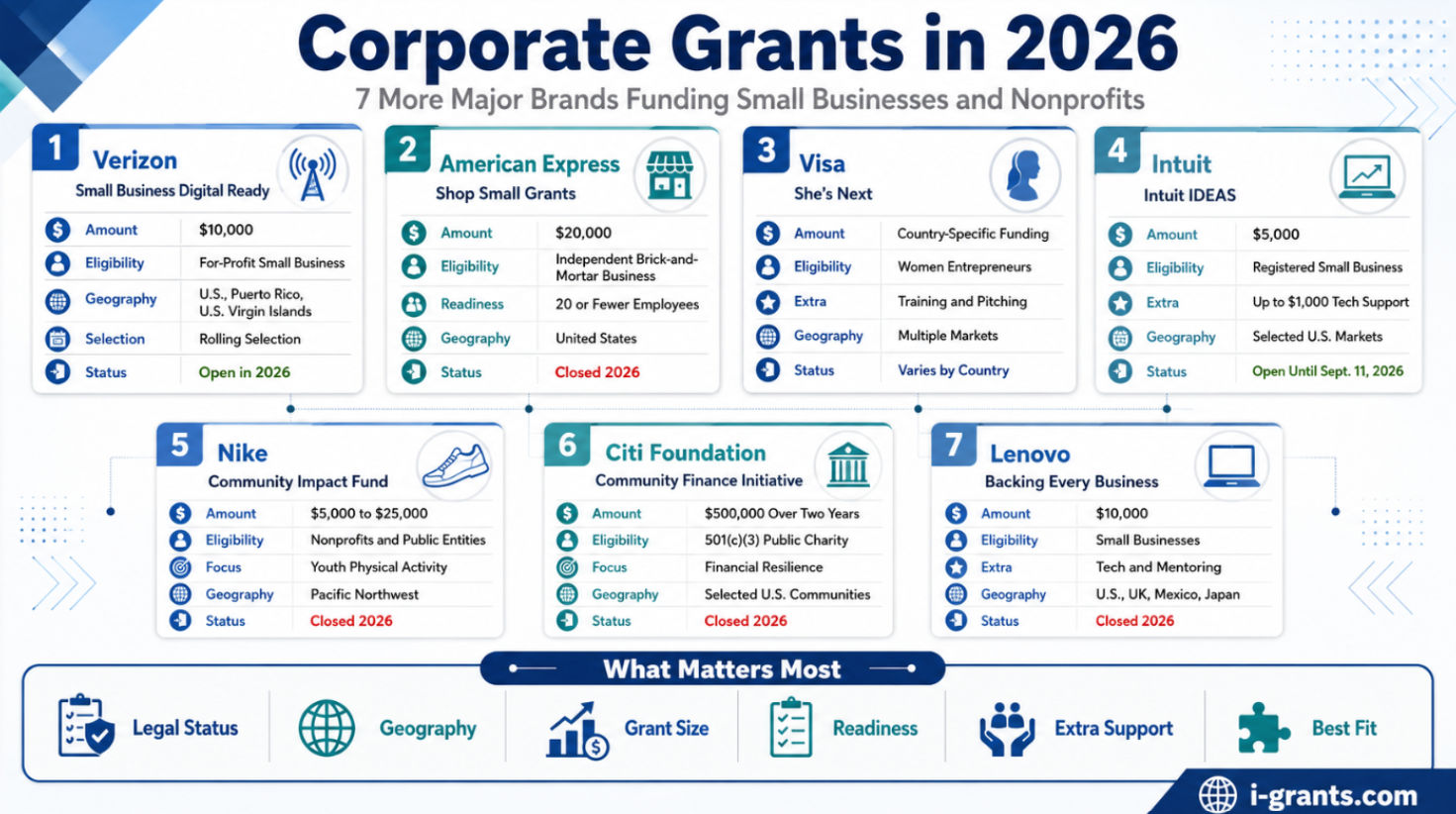
This second part of our 2026 corporate grants analysis examines seven major brands and foundations with documented funding programs: Verizon, American Express, Visa, Intuit, Nike, Citi Foundation and Lenovo.
Together, these programs illustrate several important developments in corporate grantmaking. Companies are increasingly combining grants with business support. Geographic eligibility is becoming more precise. Due diligence is becoming more demanding. Some programs reward operationally mature organizations, while others are designed for very small businesses. And artificial intelligence is beginning to affect both application rules and evaluation processes.
The programs reviewed below were analyzed using official corporate, foundation, program administrator and grant guideline sources. Program status is presented as of September 1, 2026.
Corporate Grants in 2026: The Overall Picture
The seven programs range from $5,000 small-business awards to $500,000 nonprofit grants. However, grant size alone tells applicants very little about how realistic an opportunity is.
A $500,000 grant may be completely inaccessible to a young nonprofit without audited accounts. A $20,000 grant may exclude online businesses altogether. A $10,000 program may be much more realistic if the business can satisfy relatively simple eligibility conditions and remain in a rolling applicant pool for several months.
Table 1. Seven Major Corporate Grant Programs Reviewed for 2026
| Company or Foundation | Program | Typical 2026 Cash Award | Main Applicant Type | Main Geography | 2026 Status as of September 1 |
|---|---|---|---|---|---|
| Verizon | Small Business Digital Ready Grant | $10,000 per business | For-profit small businesses | United States, Puerto Rico, U.S. Virgin Islands | Open |
| American Express | Amex Shop Small Grants Program | $20,000 per business | Independent brick-and-mortar small businesses | 50 U.S. states and Washington, D.C. | Closed, recipients announced |
| Visa | She's Next, Empowered by Visa | Varies by country | Women entrepreneurs and women-led businesses | Country-specific | Selected 2026 cycles closed |
| Intuit | Intuit IDEAS | $5,000 after successful completion, plus possible $1,000 technology grant | Registered small businesses | Selected U.S. markets | Open until September 11, 2026 |
| Nike | Nike Community Impact Fund, Pacific Northwest | $5,000-$25,000 | Nonprofits, eligible tribes and public entities | Selected Oregon counties and Clark County, Washington | Closed, recipients announced |
| Citi Foundation | 2026 Community Finance Initiative | $500,000 over two years | 501(c)(3) public charities | Selected U.S. communities and Puerto Rico | Closed |
| Lenovo | Backing Every Business: Twinning | $10,000 | Small businesses and sole proprietors | United States, United Kingdom, Mexico and parts of Japan | Closed |
The differences are substantial.
Verizon and Intuit are primarily business-oriented programs. Nike and Citi Foundation are nonprofit-focused. Visa targets women entrepreneurs through locally structured competitions. American Express is designed specifically for independent physical businesses. Lenovo combines grant funding with technology and mentoring.
For applicants, these are not interchangeable opportunities.
1. Verizon Small Business Digital Ready: A Rolling $10,000 Grant Model
Verizon Small Business Digital Ready is one of the most practical corporate funding opportunities still relevant in September 2026.
The program combines grant funding with free business education, events and digital resources. In 2026, Verizon and program partner LISC introduced a rolling national grant model that gives qualified businesses repeated chances to be selected.
Eligible businesses can receive $10,000.
Ten recipients are selected each month from June through December 2026. Based on that published structure, the rolling national grant stream is scheduled to generate 70 awards and distribute $700,000 during those seven monthly selections.
The mechanism is important because applicants do not need to submit a new application every month. Once a qualifying business completes the required steps and submits its grant application, that application remains active for later monthly selections during the year.
Who Can Apply
The applicant must own a for-profit small business located in the United States, Puerto Rico or the U.S. Virgin Islands and be at least 18 years old.
Nonprofits are not eligible.
An owner who operates multiple businesses may submit only one business.
Before the application becomes available, the entrepreneur must complete any combination of two qualifying Digital Ready courses or events between January 1 and December 7, 2026.
This requirement means Verizon is not offering a completely standalone grant. The applicant is expected to participate in the Digital Ready ecosystem first.
How the Selection Process Works
The selection mechanism is more sophisticated than a simple random lottery.
LISC first uses an anonymous drawing to reduce the applicant pool. Geographic and sector diversity may then be considered. Verizon and LISC also prioritize businesses in under-resourced and low-to-moderate-income communities, particularly businesses facing limited access to affordable capital.
Applications reaching the substantive review stage are considered on factors that include the accuracy of the information provided, anticipated community impact and proposed use of the funds.
Finalists may have to provide business, tax and banking documentation before funds are released.
A useful feature is that applicants not selected in one month can remain under consideration for later selections.
This makes timing strategically important.
A business that qualifies and applies earlier in the year can potentially participate in more monthly selections than one that waits until the end of the year.
Table 2. Verizon Small Business Digital Ready, Key 2026 Requirements
| Requirement | 2026 Rule |
|---|---|
| Grant amount | $10,000 |
| Legal status | For-profit small business |
| Geography | United States, Puerto Rico, U.S. Virgin Islands |
| Minimum owner age | 18 |
| Training requirement | Complete 2 qualifying courses or events |
| Training eligibility period | January 1-December 7, 2026 |
| Number selected | 10 businesses per month |
| Selection period | June-December 2026 |
| Approximate number of awards under published rolling structure | 70 |
| Approximate cash distributed through this rolling structure | $700,000 |
| Previous winners | Can technically apply again, but new recipients receive priority |
| Credit check | Not presented as part of the published selection process |
| Nonprofits eligible | No |
Verizon reports a broader history of substantial support through Digital Ready. Since 2021, more than 1,500 unique small businesses have received grants, and the company reports $15 million in grants awarded through the initiative.
Who Is Verizon Best For?
This program is particularly suitable for very small businesses that need flexible growth capital but may not have the financial infrastructure required by larger institutional grantmakers.
It is also attractive because the program does not demand the type of extensive audited financial history expected by a foundation such as Citi.
However, applicants should not mistake accessibility for automatic funding. The pool is competitive, and the community-impact component means a business should explain not only what it will buy but why that investment can strengthen the company and its surrounding community.
2. American Express: More Than $10 Million for Independent Physical Businesses
The 2026 Amex Shop Small Grants Program stands out because of both its scale and its narrow definition of an eligible small business.
The initiative, operated with Main Street America, ultimately awarded more than $10 million.
More than 500 businesses received $20,000 each.
The program was initially announced at a smaller scale, with $5 million intended for 250 businesses. Additional funding connected with Small Business Saturday expanded the program, eventually producing more than 500 awards.
That is an unusually large corporate small-business grant round.
However, the eligibility requirements excluded many businesses that might otherwise describe themselves as small businesses.
Physical Location Was Essential
Applicants had to be independent, for-profit businesses with permanent brick-and-mortar premises.
Online-only businesses were not eligible.
Home-based businesses were not eligible.
Franchises were excluded.
Temporary pop-up concepts, businesses operating primarily from vehicles, coworking-space businesses and businesses operating only inside indoor marketplaces were also excluded.
The business could employ no more than 20 full-time-equivalent employees, including the owner.
The business itself had to be established on or before January 1, 2024, while the current owner had to own it on or before January 1, 2025.
The permanent business location also had to be operating by January 1, 2025.
This created a strong bias toward established Main Street businesses such as independent retailers, local restaurants, service businesses and community-oriented commercial establishments.
Deadline and 2026 Cycle
The final published program terms extended applications through January 23, 2026 at 11:59 p.m. Central Time.
This date is worth noting because earlier program materials referenced January 16. For grant research, revised formal terms should take precedence over earlier promotional materials when the two conflict.
What Could the Grant Pay For?
American Express provided more detailed spending guidance than many corporate programs.
Eligible uses could include equipment, inventory, marketing and selected operating costs connected with an approved growth or improvement project.
The project was expected to be ready for implementation.
The grant was not intended to repay debt, cover rent or utilities, pay ordinary payroll or finance personal expenses. Previous expenditures outside the grant period were also ineligible.
External contracted services could be acceptable. For example, a recipient could potentially hire an electrician, designer or branding consultant as part of an approved project even though ordinary employee payroll was not an eligible grant expense.
Table 3. American Express Shop Small Grant, Important Eligibility and Spending Rules
| Category | 2026 Requirement |
|---|---|
| Grant amount | $20,000 |
| Approximate total distributed | More than $10 million |
| Number of recipients | More than 500 |
| Business type | Independent for-profit business |
| Location type | Permanent brick-and-mortar |
| Maximum size | 20 FTE including owner |
| Business established by | January 1, 2024 |
| Current owner in place by | January 1, 2025 |
| Final application deadline | January 23, 2026, 11:59 p.m. CT |
| Online-only businesses | Not eligible |
| Home-based businesses | Not eligible |
| Franchises | Not eligible |
| Equipment | Potentially eligible |
| Inventory | Potentially eligible |
| Marketing | Potentially eligible |
| Debt repayment | Not eligible |
| Rent and utilities | Not eligible |
| Ordinary payroll | Not eligible |
| Personal expenses | Not eligible |
The AI Rule Applicants Should Not Ignore
One of the most unusual conditions in the 2026 program was the rule governing artificial intelligence.
The official terms stated that applications generated in whole or in part by artificial intelligence or other automated means were void.
This makes American Express particularly important from a grant-compliance perspective.
AI tools are increasingly used by businesses to draft marketing materials, financial explanations and grant applications. But applicants cannot assume that using AI is acceptable simply because the program has an online application.
Program-specific rules take precedence.
An applicant who used AI to produce even part of an application risked disqualification under the 2026 Amex terms.
What American Express Was Really Funding
The program was not simply rewarding small companies for existing.
It favored businesses with a specific and executable project capable of producing measurable business and community benefits.
Evaluation included feasibility, business impact, community impact and local significance.
That makes the Amex program especially relevant for businesses that can define exactly how $20,000 would translate into expansion, better operations, new equipment, inventory growth, improved customer experience or other tangible results.
3. Visa She's Next: Why There Is No Single "Visa Grant"
Visa's She's Next initiative illustrates one of the biggest problems with third-party corporate grant lists.
The phrase "Visa She's Next grant" often appears as though Visa offers one universal grant to women entrepreneurs worldwide.
It does not.
She's Next is an international initiative, but its funding competitions are organized through local markets and partners. Grant amounts, eligibility rules, stages and deadlines therefore differ by country.
Armenia 2026
The Armenian 2026 competition opened on January 12 and closed on January 31.
Eligible participants were women entrepreneurs whose businesses had operated for more than one year.
The woman applicant needed to own at least 51 percent of the company.
Applicants went through independent review and one-to-one online interviews.
Ten finalists advanced to offline training in brand marketing, finance and pitching.
The finalists then presented at an Elevator Pitch competition.
Three winners received grants.
First place received AMD 2,000,000.
Second place received AMD 1,800,000.
Third place received AMD 1,600,000.
The announced winners were Sona Qanqanyan of Enkishadow, Armine Qamalyan of MarkPack and Mariam Yeghiazaryan of Paytarar Wooden.
Uzbekistan 2026
Uzbekistan used a different model.
The country's first She's Next wave in 2026 was launched with Ipak Yuli Bank.
The program accepted not only women already operating businesses but also women who were planning to launch one.
Registration remained open until May 24, 2026.
Participants completed four video lessons and accompanying tests before becoming eligible to submit business plans.
Thirty finalists were selected for a Pitch Day in Tashkent.
Seven winners were expected to share a total grant pool of $22,000.
Table 4. Visa She's Next 2026, Armenia and Uzbekistan Compared
| Feature | Armenia | Uzbekistan |
|---|---|---|
| Target group | Women entrepreneurs with operating businesses | Existing and aspiring women entrepreneurs |
| Business age requirement | More than 1 year | Broader entry-stage eligibility |
| Ownership rule | At least 51 percent female ownership | Local competition rules applied |
| Application deadline | January 31, 2026 | May 24, 2026 |
| Finalists | 10 | 30 |
| Final award stage | Elevator Pitch | Pitch Day |
| Number of winners | 3 | 7 |
| Cash awards | AMD 2.0M, AMD 1.8M, AMD 1.6M | $22,000 total pool |
| Training component | Yes | Yes |
| Business plan required | Competition-based application | Yes, after educational stage |
The lesson for grant seekers is straightforward: Visa should be monitored market by market.
A woman entrepreneur in Germany, Armenia, Uzbekistan or another country should search for a current national She's Next round rather than assume that criteria from another market apply to her.
Why Visa's Model Matters
Visa is also demonstrating how corporate grants increasingly combine funding with capability building.
Training, pitching and visibility are central to the program.
For early-stage entrepreneurs, this can be valuable even when the cash award is smaller than an institutional grant.
A competition can improve financial planning, brand positioning and investor communication while also creating access to a professional network.
4. Intuit IDEAS: A Small Cash Grant With a Much Larger Support Package
At first glance, Intuit IDEAS may appear less attractive than a $20,000 or $25,000 grant because the standard cash award is $5,000.
That would be a misleading comparison.
Intuit IDEAS is closer to a business-development accelerator that includes grant funding.
Successful participants can receive $5,000 after completing the program. Participating businesses may also receive a technology grant of up to $1,000.
More importantly, businesses gain access to Intuit products, experts, executive coaching, business advising, QuickBooks support, Mailchimp training, TurboTax resources, networking opportunities and an individualized growth plan.
Intuit estimates that the product and training component alone can exceed $10,000 in value.
2026 Geographic Coverage
The program covers selected U.S. markets, including Atlanta, Charlotte, Chicago, Dallas/Fort Worth, New York City, Philadelphia, San Diego and West Virginia.
Participants generally need to be located within approximately 40 miles of the relevant metropolitan area because parts of the program involve in-person engagement.
There is also a nationwide virtual cohort for military veteran and military-spouse-owned businesses.
Los Angeles operates through a dedicated cohort.
Business Requirements
Applicants must operate registered small businesses.
Nonprofits are not eligible.
C Corporations are also excluded from the 2026 program.
Intuit says ideal participants have been operating for at least one year and have an active customer base.
The company also notes that businesses with one to nine employees have historically performed particularly well in the program, although that is not presented as a strict maximum threshold.
The Hidden Eligibility Layer: Accounting Compatibility
One of the most important aspects of Intuit IDEAS is that business eligibility extends beyond normal grant criteria.
Final acceptance depends partly on successful QuickBooks onboarding.
Businesses with accounting structures that are too complex or incompatible with the program's setup can face problems even if their business story is otherwise compelling.
The official FAQ identifies potential issues including extensive charts of accounts, complicated subaccount structures, foreign bank accounts, multicurrency accounting, cryptocurrency, LIFO inventory, factoring accounts receivable and mixed personal and business expenses.
This makes Intuit an unusual example of a grant program where the sponsor's technology environment directly affects eligibility.
Selection and AI-Assisted Review
The program generally moves through application, review and verification, followed by QuickBooks onboarding for conditionally accepted businesses.
Intuit also states that its review process may include AI-assisted scoring together with expert human review.
This creates one of the most striking contrasts in the entire corporate grant landscape examined here.
American Express prohibited AI-generated applications.
Intuit may use AI as part of its own application evaluation.
There is therefore no common corporate-grant standard on artificial intelligence.
Applicants need to read the rules of each program separately.
Table 5. Intuit IDEAS, Financial Value and Program Structure
| Component | 2026 Value or Requirement |
|---|---|
| Cash grant | $5,000 after successful completion |
| Possible technology grant | Up to $1,000 |
| Product and training value | Intuit states more than $10,000 |
| Program duration | Extended business-development support |
| Legal entity | Registered small business |
| Nonprofits | Not eligible |
| C Corporations | Not eligible |
| Preferred business maturity | Generally 1+ year and active customer base |
| Geographic model | Selected U.S. markets plus special national cohort |
| QuickBooks onboarding | Required for final participation |
| AI in review | AI-assisted scoring may be used with human review |
| 2026 application deadline | September 11, 2026 at 11:59 p.m. PT |
Intuit also reports measurable results from previous participants, including an average 23 percent revenue increase and approximately 16.5 hours saved per month.
Those figures reinforce an important point: the program is designed to improve business performance, not merely distribute cash.
5. Nike Community Impact Fund: Global Brand, Highly Local Grant
Nike's Community Impact Fund shows how misleading corporate scale can be when assessing geographic eligibility.
Nike is a global corporation.
The 2026 Pacific Northwest NCIF opportunity was not a global grant, a national U.S. grant or even a statewide Oregon grant.
It covered ten specific counties.
Eligible Oregon counties included Multnomah, Clackamas, Washington, Yamhill, Columbia, Linn, Benton, Marion and Polk.
Clark County in southwest Washington was also eligible.
The 2026 grant range was $5,000 to $25,000.
The total annual allocation was at least $550,000.
Applications opened January 8 and closed February 17, 2026 at 5 p.m. Pacific Time.
Who Could Apply?
Eligible applicants included 501(c)(3) public charities, federally recognized Indian tribes under the relevant tax-code provisions and government entities.
Organizations without their own qualifying nonprofit status could potentially participate through an eligible fiscal sponsor.
This differs significantly from Citi Foundation, where fiscal sponsorship was not permitted for the Community Finance Initiative.
A Major 2026 Change
Nike made its 2026 funding focus much more specific.
All awards in the cycle were directed toward projects that increase physical activity among children and young people through sport or other forms of physical activity.
That means a youth-development nonprofit could not assume that general educational or community programming would qualify.
The proposed project needed a meaningful physical-activity component.
Priority considerations included quality coaching, increasing girls' participation, reducing barriers to physical activity and improving access for young people who might otherwise be excluded.
Projects that had not received an NCIF award during the previous 24 months were also prioritized.
What Nike Would Not Fund
The exclusion framework was extensive.
Individual scholarships and stipends were excluded.
Travel was generally excluded.
Research was not a primary eligible expense.
Fundraising event sponsorship, elite or private sports teams and camps, endowments, deficit reduction, fundraising activities, lobbying and political activities were not supported.
Most capital projects were also outside the program unless the Nike grant could provide the final funding necessary to complete a project.
Actual 2026 Results
The final award list provides valuable information about what Nike funded in practice.
Twenty-nine grants were awarded.
The grants totaled $550,000.
Recipients included organizations supporting cycling, after-school sports, culturally specific recreation, girls' participation in sport and broader youth physical activity.
Adelante Mujeres received $25,000.
Beaverton Education Foundation received $25,000.
Community Cycling Center received $20,000.
Native American Youth & Family Center received $25,000.
Self Enhancement, Inc. received $25,000.
These results show that Nike's interpretation of physical activity is broader than conventional competitive athletics. Cycling, outdoor recreation, community movement programs and culturally relevant physical-activity initiatives can all fit when the applicant demonstrates strong youth outcomes.
6. Citi Foundation: $500,000 Grants for Organizations Ready for Institutional Due Diligence
Citi Foundation's 2026 Community Finance Initiative operates at an entirely different scale.
The Foundation launched a $35 million Request for Proposals to select 70 nonprofit organizations.
Each selected organization is expected to receive a restricted grant of $500,000.
The funding is designed to be disbursed across two years, with an anticipated $250,000 payment in 2026 and another $250,000 in 2027.
This is not a program for newly established community groups without financial infrastructure.
Legal and Financial Requirements
Applicants had to be 501(c)(3) public charities.
Fiscal sponsorship was not accepted.
Organizations needed externally audited financial statements covering at least part of calendar year 2024 or a later period if invited to the full application stage.
There was no formal minimum or maximum organizational budget.
However, the absence of a formal budget threshold should not be interpreted as low financial capacity requirements.
An organization receiving $500,000 in restricted funding over two years must be able to manage compliance, accounting, reporting and program delivery at an appropriate scale.
Geographic Eligibility
The initiative focused on selected Citi communities in California, Connecticut, Florida, Illinois, Maryland, Nevada, New Jersey, New York, Puerto Rico, South Dakota, Virginia and Washington, D.C.
Organizations did not necessarily need their headquarters inside those locations.
The project itself, however, needed to create impact in an eligible geography.
What Projects Fit?
The Community Finance Initiative was divided into three themes: Stabilize, Strengthen and Safeguard.
Stabilize included services such as financial coaching, budgeting, debt management and navigating public benefits.
Strengthen included credit building, savings, emergency funds and homeownership readiness.
Safeguard included fraud prevention, identity protection and safer use of digital financial products and services.
Eligible budgets could include salaries, technology, training, program materials, research, communications, evaluation, events and overhead.
Regranting could also be permitted subject to additional screening.
Political and lobbying expenditures were prohibited.
Competitive Process
The first stage was a Letter of Inquiry.
The LOI deadline was February 18, 2026 at 12 noon Eastern Time.
Citi assessed strategic alignment, feasibility and potential for impact.
Selected organizations then advanced by invitation to a full application.
Final decisions were expected no later than September 2026.
The previous cycle offers useful context.
In 2025, Citi Foundation awarded $15 million to 60 organizations through its Community Finance Initiative.
The 2026 round increased that commitment to $35 million for 70 organizations.
Table 6. Citi Foundation Community Finance Initiative, 2025 and 2026 Compared
| Indicator | 2025 | 2026 |
|---|---|---|
| Total funding | $15 million | $35 million |
| Number of organizations | 60 | 70 |
| Approximate average award | $250,000 | $500,000 |
| Main focus | Community finance and financial coaching | Financial resilience through Stabilize, Strengthen and Safeguard |
| Funding structure | Foundation grants | Two-year restricted grants |
| Institutional due diligence | Significant | Significant |
| Capacity-building element | Yes | Grantmaking plus broader learning and support framework |
The increase is important.
Citi did not simply add a few more recipients. It substantially increased both the total pool and the amount available per organization.
For nonprofits working in financial resilience, the initiative is therefore significant.
For a newly established nonprofit without audited accounts, however, it is not a realistic first institutional grant.
7. Lenovo Backing Every Business: Grant Funding as a Business Ecosystem
Lenovo's 2026 Backing Every Business initiative developed from its earlier Evolve Small program.
The Twinning competition combined a $10,000 cash grant with technology, AI-related support, mentoring and peer learning.
The program was available in the United States, United Kingdom, Mexico and Japan, although local geographic restrictions applied.
In Japan, qualifying applicants needed to reside or operate businesses in Tokyo and/or Osaka.
Size and Business Requirements
Eligible businesses had to be legally registered companies or sole proprietorships.
The business had to have operated for at least 12 months.
It could employ between 1 and 250 people.
Annual revenue for the preceding 12-month period had to be below $50 million.
The company could not have raised more than $3 million in investment capital.
Franchisees, licensees and independent owner-operators linked to larger companies were excluded from Lenovo's small-business definition.
Businesses also had to be in good standing and free from specified litigation issues.
Technology Requirements
One unusual rule concerned Microsoft 365.
Lenovo's published eligibility language stated that the business had to use Microsoft 365 as its primary computer operating system.
Microsoft 365 is technically a productivity suite rather than an operating system, but applicants still needed to assess eligibility using the wording published in the official rules.
This is an important lesson in grant compliance.
When official terms contain unusual language, applicants should not silently reinterpret the requirement in a way that makes them eligible.
They should seek clarification from the program administrator where possible.
What Winners Received
Selected businesses received $10,000.
They also received Lenovo AI-enabled technology, software and services, AI training and one-to-one mentorship.
The initiative was designed around the idea of connecting entrepreneurs with "business twins" facing similar operational challenges.
Selected companies also needed to be comfortable participating in corporate communications, case studies, photography, filming or other publicity.
This is another distinction between corporate and government grants.
Corporate programs often seek stories, brand visibility and public evidence of impact in addition to conventional reporting.
Lenovo reports that its previous North American small-business initiatives supported more than 5,000 businesses, provided more than $3.6 million in financial and technology assistance and delivered more than 750 hours of mentorship.
How Difficult Are These Programs to Enter?
Grant size and application difficulty are not directly correlated.
Citi offers the largest award, but its institutional eligibility threshold is high.
American Express offered substantially less money, but excluded entire categories of businesses through its location and ownership rules.
Verizon offers a smaller grant but a comparatively accessible qualification path.
Intuit appears accessible at first, but accounting compatibility creates a second layer of screening.
Table 7. Relative Entry Barriers Across the Seven Corporate Grant Programs
| Program | Relative Entry Barrier | Main Reason |
|---|---|---|
| Verizon Digital Ready | Moderate | Training required, competitive selection and final verification |
| American Express Shop Small | Moderate to high | Tight brick-and-mortar, size and business-age requirements |
| Visa She's Next | Varies | Local rules differ significantly by market |
| Intuit IDEAS | Moderate to high | Geographic limits plus accounting and technology compatibility |
| Nike NCIF | High for organizations outside the target | Very narrow geography and specific youth physical-activity focus |
| Citi Foundation CFI | Very high | 501(c)(3), audited accounts, institutional capacity and defined geography |
| Lenovo Twinning | Moderate | Revenue, employee, investment, geography and technology rules |
Applicants should use this type of analysis before spending hours preparing a proposal.
The question is not whether a grant is attractive.
The question is whether the applicant sits inside the funder's intended target group.
What Corporate Grantmakers Are Really Funding
Although corporate foundations and grant programs use philanthropic language, the programs also reflect the strategic priorities of the companies behind them.
Verizon wants to strengthen digital readiness among small businesses.
American Express has a long commercial and philanthropic interest in independent Main Street businesses.
Visa supports women's entrepreneurship and financial inclusion.
Intuit builds deeper relationships with businesses using digital financial and marketing tools.
Nike connects community giving with physical activity, youth participation and sport.
Citi Foundation focuses on financial resilience and economic inclusion.
Lenovo combines entrepreneurship support with technology adoption.
Applicants who understand this alignment can write stronger applications.
Instead of asking only, "Why does our organization deserve money?" they should ask, "Why is our project a strong expression of what this program is designed to accomplish?"
That difference often separates a generic grant application from a strategically aligned one.
Cash Is Only Part of the Award
Corporate grants increasingly provide non-cash benefits that can materially affect the value of the opportunity.
Table 8. What Winners Receive Beyond Cash
| Program | Cash | Additional Value |
|---|---|---|
| Verizon | $10,000 | Digital learning, events, expert resources and networking |
| American Express | $20,000 | Learning resources, networking and storytelling opportunities |
| Visa | Market-specific | Training, business-plan development, pitching and visibility |
| Intuit | $5,000 plus possible technology grant | Products, experts, executive coaching, business advising, training and growth planning |
| Nike | $5,000-$25,000 | Connection to community grantmaking ecosystem and program resources |
| Citi | $500,000 | Capacity-building and learning opportunities associated with Foundation initiatives |
| Lenovo | $10,000 | Technology, AI tools, mentoring, training and peer support |
For some recipients, the non-cash component may be more valuable than the grant itself.
A founder who improves bookkeeping, marketing and business systems through Intuit may create recurring financial value long after spending the $5,000.
A Lenovo participant may receive technology and mentoring that would otherwise require substantial investment.
Visa finalists may improve pitching and business planning even if they do not win the top cash award.
This is why applicants should calculate the total opportunity value rather than ranking programs only by headline grant size.
Eight Eligibility Questions to Answer Before Applying
Before investing substantial time in a corporate grant application, applicants should confirm the following:
-
Is the program genuinely open to external applications?
-
Does the applicant have the correct legal status?
-
Is the business or project located in the exact eligible geography?
-
Does the organization meet age, revenue, employee or operating-history requirements?
-
Are audited accounts, tax documents or other financial records required?
-
Are the proposed expenses eligible?
-
Does the applicant meet technology, accounting or training requirements?
-
Does the program impose special rules on AI, publicity, reporting or participation?
These questions can eliminate unsuitable opportunities before proposal drafting begins.
That is especially important because corporate grant applications can appear deceptively simple until an applicant reaches the full terms and conditions.
Corporate Giving Does Not Always Mean an Open Grant
A separate category of corporate philanthropy deserves attention.
Some companies distribute substantial funding but do not offer a public application route.
PepsiCo Foundation is an example.
The Foundation funds organizations working in areas including food access, agriculture, water and workforce development. PepsiCo has also supported nonprofits through programs including community-impact initiatives.
However, PepsiCo Foundation states that it does not accept unsolicited funding proposals.
This means a nonprofit cannot simply find the Foundation website and submit a conventional grant proposal.
Corporate philanthropy can operate through invitation, employee nomination, strategic partnerships, intermediary organizations or long-term relationships.
For grant seekers, this creates an important research rule:
A company's history of charitable giving is not evidence that an open grant application exists.
Any grant database or article that lists a corporate foundation should be checked against the company's current official application policy.
Open, Closed, Recurring and Invitation-Based Funding
Applicants should also distinguish between four program statuses.
Table 9. How to Interpret Corporate Grant Status
| Status | What It Means | Applicant Strategy |
|---|---|---|
| Open | Applications are currently being accepted | Check eligibility immediately and prepare application |
| Closed but recurring | Current cycle ended, but similar rounds have operated repeatedly | Study current rules and prepare for likely future cycle |
| Closed with uncertain renewal | Program existed in 2026, but no next round is confirmed | Monitor official corporate and foundation channels |
| Invitation-only or nomination-based | External applicants cannot submit directly | Build relationships, identify intermediaries or look for open alternatives |
This distinction is essential when evaluating older grant articles.
A program that distributed awards in 2025 or 2026 may still be useful for planning, but it should not be described as "open now" unless the official application portal confirms it.
Which Program Fits Which Applicant?
The seven programs serve very different applicant profiles.
For a small U.S. business seeking an active opportunity in September 2026, Verizon is one of the most practical choices.
The program has a manageable award size, broad U.S. coverage and a rolling selection model.
For a business that wants deeper operational support and can meet Intuit's technology requirements, Intuit IDEAS may offer more long-term value than its $5,000 headline amount suggests.
Independent physical businesses should monitor future American Express Shop Small or related Main Street America programs. The 2026 cycle demonstrates that American Express is prepared to deploy substantial funding, but the program's eligibility rules strongly favor established physical businesses.
Women entrepreneurs should track Visa She's Next by country. The absence of a currently open competition in one market does not mean the broader initiative has disappeared.
Pacific Northwest nonprofits focused on youth physical activity should watch Nike Community Impact Fund carefully. Because the geographic boundaries and program priorities are narrow, an organization that fits them well may have much better strategic alignment than in a national foundation competition.
Established nonprofits working in financial resilience should monitor Citi Foundation RFPs, particularly if they already have audited accounts and can manage six-figure restricted funding.
Technology-oriented small businesses in Lenovo's eligible markets should watch the evolution of Backing Every Business, particularly if they value technology and mentorship alongside grant funding.
Table 10. Best-Fit Applicant by Program
| Program | Strongest Applicant Profile |
|---|---|
| Verizon | Small U.S. business needing flexible growth capital and willing to complete Digital Ready training |
| American Express | Established independent brick-and-mortar business with a specific investment project |
| Visa | Woman entrepreneur in a market where a local She's Next competition is open |
| Intuit | Small growth-oriented business that wants operational, accounting and marketing support |
| Nike | Eligible Pacific Northwest nonprofit with a strong youth physical-activity program |
| Citi | Established 501(c)(3) with audited accounts, institutional capacity and financial-resilience expertise |
| Lenovo | Established small business seeking technology, AI support, mentoring and growth resources |
The Most Important Corporate Grant Trends in 2026
The seven programs point to a broader transformation in corporate funding.
First, corporate grants are increasingly becoming ecosystems rather than one-time payments.
Verizon connects grant access to learning. Intuit integrates funding with software and coaching. Lenovo combines money with devices, AI and mentorship. Visa combines entrepreneurship education with competition.
Second, geography is becoming highly targeted.
A global company can design a grant around a few counties, one metropolitan area or a selected group of markets. Corporate grants are therefore often more geographically restrictive than their brand names suggest.
Third, operational readiness matters.
Citi wants organizations capable of managing institutional funding. American Express wanted businesses with projects ready for execution. Intuit requires businesses that can fit its technology environment. Verizon conducts verification before final award.
Fourth, grantmakers are looking for strategic fit rather than generic need.
Nike does not simply fund "good youth programs." It funds projects aligned with physical activity.
Citi does not simply fund "financial education." Its 2026 strategy is structured around financial stabilization, strengthening and safeguarding.
Corporate grants are usually tied closely to a company's social-impact priorities.
Fifth, AI is creating a new layer of grant compliance.
American Express prohibited AI-generated applications in its 2026 rules.
Intuit may use AI-assisted scoring in evaluation.
Applicants can no longer assume that every funder takes the same position.
Why Official Sources Matter More Than Grant Lists
Corporate funding is fragmented across corporate newsrooms, foundation pages, external program administrators, downloadable guidelines, local campaign pages and partner organizations.
That makes outdated information particularly common.
A third-party website may list an old deadline.
A previous grant amount may remain in search results after the current program changes.
A global corporate initiative may be described as worldwide even when only a few countries currently have open funding rounds.
American Express provides a useful example. Earlier materials listed an application deadline of January 16, while revised formal terms extended the cycle to January 23.
Visa provides another. The She's Next name is global, but Armenia and Uzbekistan operated different application models, timelines and award structures.
Lenovo shows how local versions of a program can contain additional geographic conditions.
For serious grant research, applicants should use a clear evidence hierarchy:
-
Current official terms and conditions or grant guidelines.
-
Current official application portal.
-
Official foundation or corporate program page.
-
Official press releases and recipient announcements.
-
Third-party grant directories only for discovery, never as the final source of eligibility information.
This approach reduces the risk of building an application around outdated or incomplete information.
Final Takeaway
Corporate grants in 2026 are more sophisticated than the familiar image of a company writing checks to small businesses or nonprofits.
Verizon combines $10,000 grants with business education and a rolling selection process.
American Express distributed more than $10 million through a tightly defined brick-and-mortar grant program.
Visa continues to build country-specific funding competitions for women entrepreneurs.
Intuit combines a relatively modest cash grant with software, coaching, expert support and operational improvement.
Nike uses local grantmaking to advance a precise youth physical-activity strategy.
Citi Foundation is deploying institutional-scale funding through a $35 million nonprofit initiative.
Lenovo is using grants as part of a broader technology, AI, mentoring and entrepreneurship platform.
The central lesson for applicants is that the largest grant is rarely automatically the best opportunity.
The strongest fit exists where five factors align: legal eligibility, geography, organizational capacity, permitted use of funds and the corporate funder's strategic objective.
A $10,000 grant with high eligibility alignment may be a much better opportunity than a $500,000 program for which the applicant is only marginally qualified.
Corporate grant seekers should therefore begin with eligibility analysis, not proposal writing.
They should verify whether an open application route actually exists, study the current official rules, examine previous recipients, understand what the company is trying to achieve and evaluate the entire support package rather than cash alone.
That approach does more than prevent wasted applications.
It turns corporate grant research from a search for famous brand names into a strategic funding process.