

 Français
  Deutsch
  Українська
Corporate grants can be difficult to evaluate because many of the best-known programs are either closed, discontinued, limited to narrow applicant groups, or described online using rules from previous years.
H&R Block and DoorDash are different.
Both companies have genuine small business funding activity in 2026, and both offer opportunities that are relevant in September. But the two programs operate according to completely different funding models.
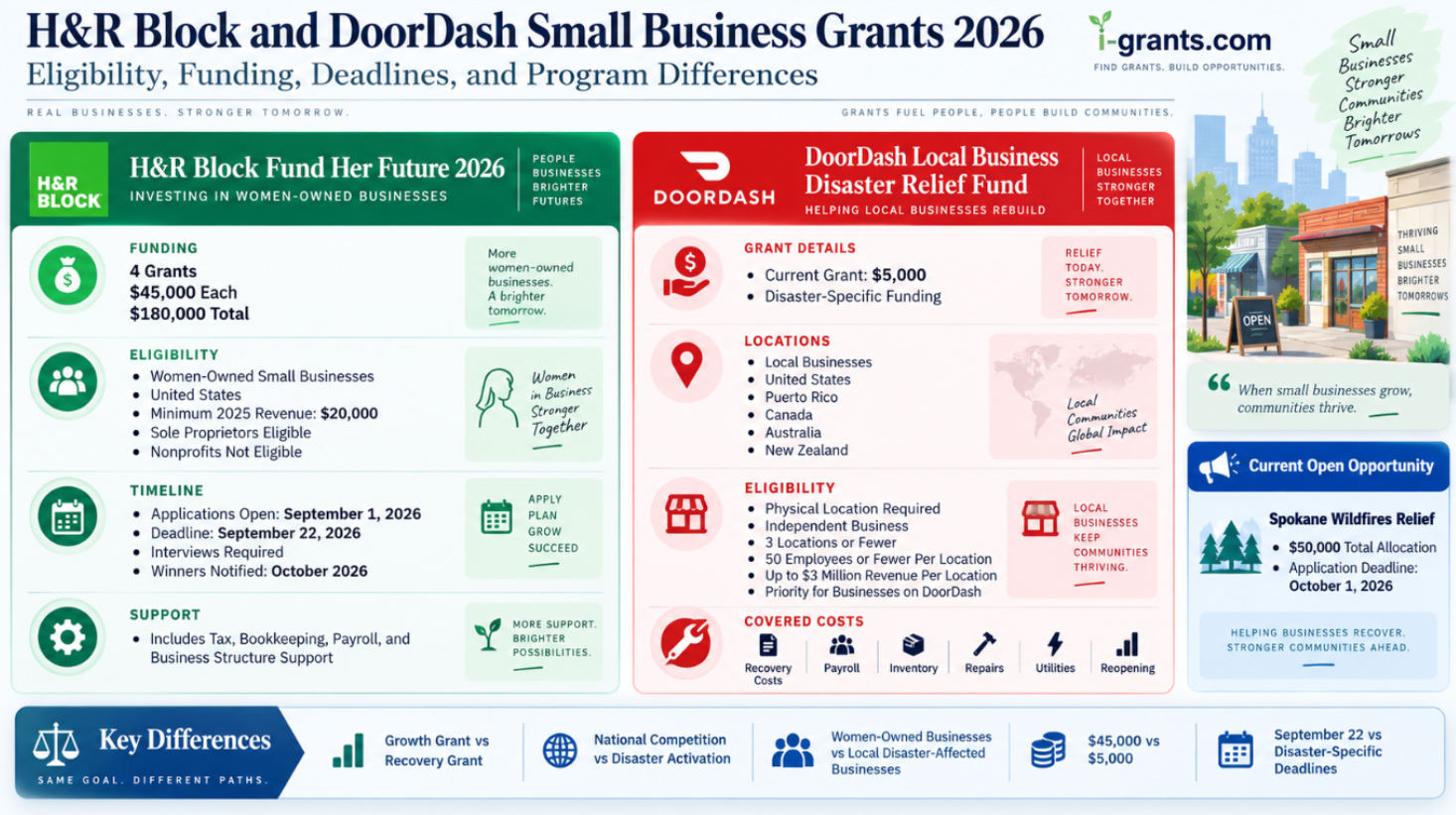
H&R Block's Fund Her Future 2026 is a national U.S. competition for established women-owned small businesses. Four recipients will each receive $45,000, creating a total cash grant pool of $180,000. Applications opened September 1 and close September 22, 2026. Winners also receive one year of tax preparation, bookkeeping, payroll and business structure support.
DoorDash's Local Business Disaster Relief Fund is not a conventional annual business competition. It is activated in response to particular disasters and currently offers $5,000 grants to qualifying local businesses affected by designated natural disasters. DoorDash's current program page says the company has awarded nearly $10 million through the fund to hundreds of business owners.
There is also an active disaster-specific funding window in Washington state. DoorDash has allocated $50,000 through the fund for local businesses affected by the 2026 Spokane County wildfires, with applications open through October 1, 2026.
For applicants, the important question is therefore not simply which company offers more money.
The real questions are: Who can apply? What evidence is required? How competitive is the program? What does the funder appear to value? And does the opportunity actually match the applicant's situation?
H&R Block and DoorDash Grants in September 2026
Table 1. Current H&R Block and DoorDash Small Business Grant Opportunities
| Program | Funding | Geography | Main applicant type | Deadline or application model | Status on September 7, 2026 |
|---|---|---|---|---|---|
| H&R Block Fund Her Future 2026 | $45,000 each for 4 recipients | United States | Women-owned established small businesses | September 22, 2026, 6:00 p.m. ET | Open |
| DoorDash Local Business Disaster Relief Fund | Current standard grant: $5,000 | U.S., Puerto Rico, Canada, Australia, New Zealand | Independent local businesses affected by eligible natural disasters | Disaster-specific application windows | Active |
| DoorDash Spokane Wildfires Relief | $50,000 total allocation, distributed through relief grants | Spokane County, Washington | Eligible local businesses affected by 2026 wildfires | October 1, 2026 | Open |
| DoorDash historical Restaurant Disaster Relief Fund | Historically $10,000 per recipient | Multiple markets | Primarily restaurants | Earlier quarterly or disaster-based rounds | Replaced by expanded Local Business Disaster Relief Fund |
The programs solve very different problems.
H&R Block is financing business growth and strengthening the financial infrastructure of women-owned companies.
DoorDash is financing recovery after external shocks.
That difference affects almost every part of the application.
H&R Block Fund Her Future 2026
A $180,000 Grant Program for Women-Owned Small Businesses
H&R Block launched the third annual Fund Her Future program on September 1, 2026.
The 2026 cycle is the company's largest version of the program so far.
Four businesses will each receive $45,000 in cash funding, producing a total cash pool of $180,000. Each selected recipient will also receive a year of complimentary business services covering tax preparation, bookkeeping, payroll and an analysis of the company's business structure.
Applications opened at 9:00 a.m. Eastern Time on September 1 and close at 6:00 p.m. Eastern Time on September 22, 2026.
H&R Block is also changing the program in another important way.
For the first time, the company says that every applicant, not only grant recipients, will receive access to year-long community-focused programming designed around challenges identified by previous Fund Her Future applicants.
This makes Fund Her Future partly a cash grant and partly a small business support initiative.
Who Can Apply for Fund Her Future 2026?
The current official H&R Block page gives several clear eligibility conditions.
Table 2. Fund Her Future 2026 Eligibility Requirements
| Requirement | 2026 rule | What it means for applicants |
|---|---|---|
| Ownership | Business must be woman-owned | The program specifically targets women business owners |
| Owner involvement | Full-time and part-time owners can apply | A founder does not necessarily need to work full-time in the business |
| Business size/form | Sole proprietors and businesses with employees can apply | Having employees is not required |
| Age | At least 18, or 19 in Alabama and Nebraska | Owner must meet the program's age requirement |
| Residence | Applicant must be a U.S. resident | International founders are not eligible |
| Business status | Existing and established business | Idea-stage ventures are not the target |
| Revenue | At least $20,000 in revenue during 2025 | Pre-revenue startups do not qualify |
| Nonprofit status | Nonprofits are not eligible | Program is aimed at commercial small businesses |
| Deadline | September 22, 2026 at 6:00 p.m. ET | Late applications should not be expected to qualify |
H&R Block's current page does not say that only businesses with employees can participate. It explicitly states that sole proprietors may apply.
The $20,000 revenue floor is especially important.
Many corporate competitions focus on a maximum revenue threshold. H&R Block instead establishes a minimum revenue requirement for 2026, signaling that Fund Her Future is designed for businesses that have already demonstrated some commercial activity.
A founder who has a strong concept but generated only $5,000 in 2025 would therefore fall outside the current published eligibility requirements, even if the business has excellent future potential.
The Application Does Not End With the Form
Fund Her Future is not simply a written application followed by an automatic scoring decision.
H&R Block says it will select a group of applicants for personal interviews. Four winners will then be notified in October.
This gives applicants an important clue about the selection process.
A competitive application has to do more than survive an initial written review. The founder may also need to explain the business, financial needs, growth potential and planned use of support directly to H&R Block.
The interview stage also means founders should make sure the story told in the application matches their actual financial records, operating model and future plans.
What Is H&R Block Looking For?
H&R Block's current FAQ says the company is looking for women business owners who need not only financing, but also expert assistance with areas such as taxes, bookkeeping and payroll.
That language is strategically important.
An applicant may be tempted to present a business as completely self-sufficient and already optimized. But the structure of Fund Her Future suggests that H&R Block is interested in businesses that have real growth potential and identifiable operational problems that H&R Block's services can help solve.
The strongest applicant may therefore be neither a distressed company nor a business that appears to need nothing.
A more convincing profile may be an operating company that has proven demand but is reaching a stage where bookkeeping complexity, payroll, tax planning, entity structure or financial administration is becoming a constraint on growth.
How Fund Her Future Changed From 2024 to 2026
Fund Her Future is only three years old, but the program has already changed substantially.
Table 3. Fund Her Future Grant Evolution, 2024-2026
| Year | Total cash funding | Main award structure | Applicant volume | Additional business support |
|---|---|---|---|---|
| 2024 | $100,000 | 1 x $50,000; 4 x $12,500 | More than 6,000 | One year of Block Advisors services |
| 2025 | $100,000 | 1 x $50,000; 5 x $10,000 | More than 8,000 | One year of business services |
| 2026 | $180,000 | 4 x $45,000 | Not yet known | One year of services for winners plus year-long community programming for applicants |
The inaugural 2024 competition attracted more than 6,000 applications. Twenty finalists were selected before the final five recipients were chosen.
The second competition received more than 8,000 applications, representing a 30 percent increase over the previous year. Six businesses received grants in 2025.
The 2026 design is materially different.
Instead of one $50,000 grand prize and several much smaller awards, H&R Block has created four equal awards of $45,000.
That reduces the difference between first place and other recipients and effectively turns the competition from a winner-plus-runners-up structure into a four-recipient grant cohort.
The total cash commitment also increases by 80 percent, from $100,000 in 2025 to $180,000 in 2026.
How Competitive Is Fund Her Future?
The 2025 numbers provide the clearest available benchmark.
More than 8,000 applications competed for six funded positions. That means fewer than one in 1,300 applicants received a grant, based on the simple ratio of applications to awards.
That calculation should not be interpreted as an official acceptance rate because some submissions may have been incomplete or ineligible. It does, however, demonstrate the level of competition.
The program's growth is also notable.
Application volume rose from more than 6,000 in 2024 to more than 8,000 in 2025.
The amount of money available has now increased sharply, but the number of funded businesses has actually fallen from six in 2025 to four in 2026.
Applicants should therefore expect a highly selective process despite the larger grant pool.
What Previous H&R Block Winners Reveal
Past Fund Her Future recipients provide useful insight into the qualities the program appears to reward.
Table 4. Selected Fund Her Future Winners and Business Cases
| Year | Business | Founder | Award | Business model and impact |
|---|---|---|---|---|
| 2024 | Allégorie | Heather Jiang | $50,000 | Sustainable accessories made using materials derived from food waste and recycled inputs |
| 2025 | Rebel Nell | Amy Peterson | $50,000 | Jewelry and social enterprise model employing and supporting women facing barriers to employment |
| 2025 cohort | Five additional women-owned businesses | Various founders | $10,000 each | Businesses selected for innovation, community contribution and growth potential |
Allégorie, the 2024 grand prize recipient, transforms discarded fruit and recycled materials into accessories such as handbags and wallets.
H&R Block later reported that founder Heather Jiang used the support to expand her team, launch a new product collection and improve the company's marketing strategy. She also cited the benefit of having professional assistance with the company's books.
The 2025 grand prize went to Amy Peterson, founder of Detroit-based Rebel Nell.
Rebel Nell transforms materials such as fallen graffiti into jewelry while employing and supporting women facing barriers including homelessness, disability and displacement. H&R Block reported that the grant and business support contributed to the company's ability to pursue further expansion, including an opportunity to open a fourth location.
The selection process in 2025 was conducted with Hello Alice. H&R Block said finalists went through interviews and assessment before the six recipients were selected based on factors including innovation, impact and growth potential.
These cases suggest that Fund Her Future is not simply a revenue-growth competition.
Commercial viability matters, but so do community value, mission, founder story and a credible plan for how additional capital and professional support can unlock the company's next stage.
Why H&R Block Is Combining Money With Business Services
The design of Fund Her Future becomes easier to understand when viewed alongside H&R Block's research on previous applicants.
The company's 2024 State of Women's Small Business Report drew on more than 6,000 grant applicants.
Table 5. Challenges Reported by Women Small Business Owners in H&R Block Research
| Challenge | Share of respondents |
|---|---|
| Lack of startup capital | 80 percent |
| Need for steady, reliable income | 76 percent |
| Need for a solid business plan | 56 percent |
| Fear of failure | 54 percent |
| Need for help getting started | 50 percent |
| Applicants for bank loans who were never approved | 42 percent |
| Women relying on personal finances or credit cards to fund businesses | Nearly 90 percent |
H&R Block's research found that four of the five most common barriers were related to either financing or support.
The company's September 2026 announcement adds another layer.
Nearly one-third of prior applicants said they needed a mentor, while nearly 60 percent reported needing support with critical business tasks such as tax preparation, bookkeeping, compliance, payroll or incorporation.
This explains why the grant package is not limited to cash.
For many small businesses, $45,000 can fund inventory, marketing, equipment or expansion. But weak bookkeeping, incorrect entity structure, payroll problems or tax compliance issues can undermine the value of that capital.
H&R Block is therefore funding both the growth opportunity and part of the financial infrastructure needed to manage it.
Hidden H&R Block Requirements Applicants Should Notice
The current public application page is relatively straightforward, but several details deserve attention.
First, this is not a startup idea competition. The requirement for at least $20,000 in 2025 revenue establishes a minimum level of commercial validation.
Second, the founder can work either full-time or part-time, which makes the grant more accessible to entrepreneurs who are still transitioning away from salaried employment.
Third, nonprofits are explicitly excluded.
Fourth, selection includes a personal interview, which means communication ability and consistency between the application and the founder's answers can matter.
Fifth, the program explicitly looks for companies that could benefit from professional tax, bookkeeping and payroll assistance. Applicants should therefore think carefully about the operational bottlenecks they would address, not only what they would purchase with $45,000.
Sixth, previous versions of Fund Her Future included formal participation obligations and detailed grant conditions for recipients. Applicants selected in 2026 should read the current participation agreement in full before accepting an award, particularly provisions concerning services, reporting, publicity, tax treatment and recipient responsibilities.
The public 2026 landing page provides the high-level opportunity. It should not replace the legal terms presented during the application and award process.
DoorDash Local Business Disaster Relief Fund 2026
DoorDash operates a fundamentally different grant model.
There is no nationwide competition in which every small business can apply simply because it wants growth capital.
The Local Business Disaster Relief Fund exists to help businesses recover after qualifying disasters.
DoorDash says the current program provides $5,000 grants to selected local businesses affected by severe natural disasters. The fund is activated when major events occur, and each disaster-specific application period generally remains open for four to six weeks.
Applications are reviewed on a rolling basis. DoorDash says applicants should generally receive a status decision within 30 days after the application deadline, and selected recipients receive funds the following month.
Who Can Apply for the DoorDash Fund?
Table 6. Current DoorDash Local Business Disaster Relief Fund Eligibility
| Requirement | Current rule |
|---|---|
| Business type | For-profit local business |
| Physical presence | Must have a brick-and-mortar location |
| Ownership | Must be independently owned |
| Locations | No more than 3 locations |
| Employees | 50 or fewer employees per location |
| Operating history | At least 6 months |
| Revenue | $3 million or less per location in the previous 12 months |
| Geography | U.S., Washington D.C., Puerto Rico, Canada, Australia or New Zealand |
| Disaster impact | Must have suffered revenue loss because of an eligible natural disaster |
| Disaster status | Event must meet the program's designated disaster requirements |
| DoorDash relationship | DoorDash says businesses on its platform receive priority |
The current fund is broader than the original restaurant program.
Eligible business categories now include not only restaurants and bakeries, but also examples such as flower shops, liquor stores, convenience stores, pet stores and local grocery stores.
The phrase independently owned also matters. A small local outlet belonging to a large corporate chain should not assume that its employee count alone makes it eligible.
And there is another important practical point: being a DoorDash merchant is not presented as an absolute universal eligibility requirement on the current page, but DoorDash explicitly says that the fund prioritizes small businesses that are on the DoorDash platform.
For an otherwise similar pair of applicants, that platform relationship may therefore matter.
What Can DoorDash Grant Money Pay For?
Unlike some highly restricted public grants, DoorDash's fund is designed around practical recovery costs.
The current official page gives examples including payroll, inventory, equipment repair or replacement, utility reconnection, cleaning, debris removal, temporary storage and reopening materials.
Table 7. Examples of Eligible DoorDash Disaster Recovery Costs
| Cost | Current DoorDash example | Why it matters after a disaster |
|---|---|---|
| Payroll | One or two weeks of payroll | Helps retain core employees during temporary closure |
| Inventory | Restocking products, food or supplies | Allows the business to resume sales |
| Equipment | Replacement or repair | Can address damage not covered quickly by insurance |
| Utilities | Reconnection of power, water or gas | May be essential before reopening |
| Cleaning | Emergency cleaning, sanitation and debris removal | Helps satisfy reopening and safety requirements |
| Storage | Short-term storage of salvaged equipment or stock | Protects remaining assets |
| Reopening materials | Temporary signs or supplies | Helps communicate that the business is operating again |
The current wording is intentionally practical.
DoorDash's goal is not to finance a long-term expansion project that happened to coincide with a hurricane. The fund is intended to help businesses recover and resume operations.
Applicants should therefore connect requested funding directly to disaster consequences.
DoorDash Changed Its Grant Rules
One of the most interesting findings in the 2026 review is that DoorDash's own official materials document a significant change in the program structure.
The program began as the Restaurant Disaster Relief Fund in 2021.
Historically, it offered $10,000 grants to eligible restaurants affected by disasters.
DoorDash reported that in 2023 alone it awarded $440,000 to 44 restaurants across the United States, Canada and New Zealand. The program had also expanded into Australia.
By May 2025, DoorDash said the Restaurant Disaster Relief Fund had distributed more than $2.5 million to more than 250 restaurants since 2021.
Then came a major redesign.
In August 2025, DoorDash renamed and expanded the initiative into the Local Business Disaster Relief Fund, opening eligibility to more types of local businesses. At that point, DoorDash announced grants ranging from $5,000 to $15,000, awarded four times per year based on need and damage.
The current 2026 program page describes yet another operating model. It now emphasizes disaster-specific activations and identifies the available award as $5,000.
Table 8. How the DoorDash Disaster Relief Fund Evolved
| Period | Program model | Typical or advertised grant | Eligible businesses | Application model |
|---|---|---|---|---|
| 2021 launch | Restaurant Disaster Relief Fund | $10,000 | Restaurants | Disaster relief |
| 2023-2024 | Expanded Restaurant Disaster Relief Fund | $10,000 | Restaurants in multiple countries | Periodic rounds |
| Early 2025 | Restaurant Disaster Relief Fund | $10,000 | Restaurants | Disaster-based relief |
| August 2025 expansion | Local Business Disaster Relief Fund | $5,000 to $15,000 | Restaurants plus grocers, florists, convenience stores, pet stores and others | Four award rounds per year announced |
| Current 2026 page | Local Business Disaster Relief Fund | $5,000 | Broader range of qualifying local businesses | Activated for particular disasters, usually open 4-6 weeks |
This is exactly why applicants should verify current program pages rather than assuming that a grant amount from a previous article remains valid.
A website describing DoorDash grants as universally worth $10,000 may be using the old restaurant rules.
A page saying the program offers $5,000 to $15,000 may accurately describe DoorDash's August 2025 expansion announcement but not the current 2026 landing page.
The most recent official program page should therefore be used when evaluating a new application, while the actual disaster-specific announcement should be checked for the final amount and deadline.
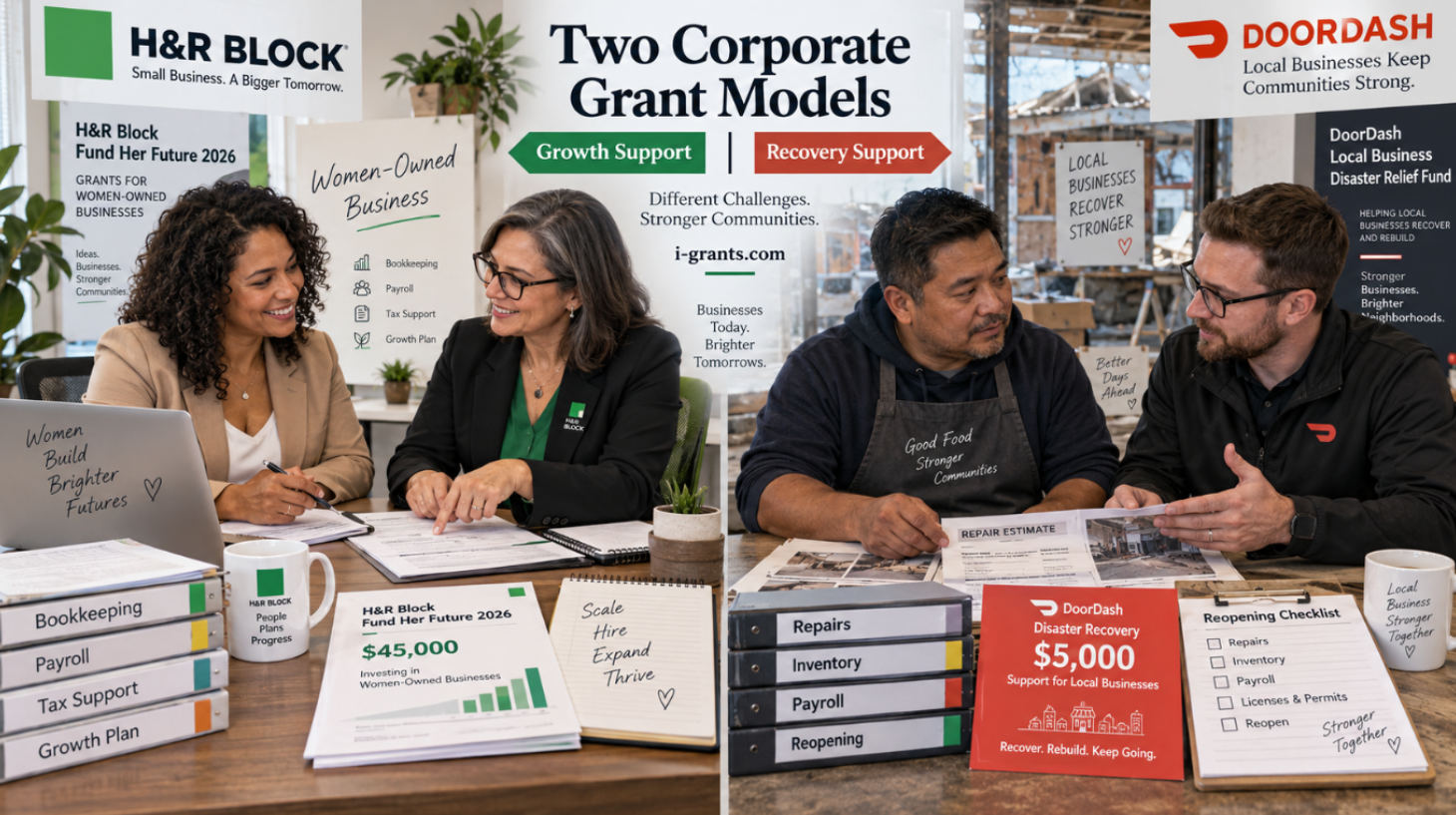
Spokane Wildfires: A DoorDash Grant Open in September 2026
DoorDash's response to the Spokane County wildfires demonstrates how the new system works in practice.
On August 5, 2026, DoorDash announced $50,000 in relief grants through the Local Business Disaster Relief Fund for businesses affected by wildfire damage in the Spokane area.
Eligible business owners can apply through October 1, 2026.
DoorDash says funds may help cover expenses such as rent, repairs, lost inventory and payroll.
This $50,000 figure is the total disaster-specific allocation, not a $50,000 award for each business.
DoorDash representatives have separately described the individual grants in the current fund as $5,000, consistent with the current merchant program page.
This distinction matters because grant headlines often use the total amount committed to a disaster response rather than the amount a single applicant can receive.
Real DoorDash Grant Recipients
DoorDash's 2025 Los Angeles wildfire response provides one of the clearest examples of how its grants are used.
The company awarded 20 grants of $10,000 each, totaling $200,000, to Los Angeles-area restaurants affected by the January wildfires.
Recipients included Amara Kitchen, Cafe de Leche, Go China, Mother Moo Creamery, OLLO, Side Pie, Vienna Pastry and other local businesses.
The money could be used for expenses such as rent, equipment replacement, payroll and inventory.
Amara Kitchen's experience shows the scale of disruption the fund is designed to address. Its location in Altadena was destroyed in the Eaton Fire. DoorDash's grant therefore was not intended to finance ordinary expansion, but to help a local business begin rebuilding after losing a physical operating location.
DoorDash later reported broader recipient feedback.
Among previous Local Business Disaster Relief Fund recipients, 95 percent said the funding had been critical to keeping the business afloat after a disaster, while 58 percent reported that revenue had returned to or exceeded its pre-disaster level.
Those numbers help explain why relatively modest grants can matter.
A $5,000 or $10,000 grant may not rebuild an entire restaurant, but it can bridge a specific cash-flow gap, replace essential inventory, keep employees paid, restore equipment or help a business reopen before customers permanently move elsewhere.
Hidden DoorDash Requirements
DoorDash's fund is relatively simple compared with some corporate competitions, but several requirements can still eliminate applicants who appear eligible at first glance.
A business needs a physical location. A home-based online shop is not the main target of the current program.
The company must be independently owned and have no more than three locations.
The revenue ceiling applies per location, not necessarily to a single consolidated figure in the way applicants may expect.
The business must have operated for at least six months.
There must be an eligible disaster connection, including demonstrable revenue loss.
An ordinary period of weak sales, a local road closure that does not meet the fund's disaster criteria, or a business problem unrelated to the qualifying event does not automatically create eligibility.
And while the fund covers several countries, applicants do not necessarily use the same application route. DoorDash directs businesses in the United States and Puerto Rico through Hello Alice, while applications in Canada, Australia and New Zealand are handled through the Global Entrepreneurship Network.
H&R Block vs DoorDash: Which Grant Is Better?
Neither program is universally "better" because they address different applicant circumstances.
For a U.S. woman who owns an established business, generated at least $20,000 in 2025 and needs growth capital plus stronger financial systems, Fund Her Future can be an unusually valuable opportunity.
The $45,000 cash award is substantial, and the additional tax, bookkeeping, payroll and business structure services can add practical value beyond the cash itself.
For an independent local business recovering from a qualifying natural disaster, DoorDash is more relevant. The grant amount is smaller, but the purpose is immediate recovery rather than general expansion.
The biggest mistake would be trying to reshape an applicant's circumstances to fit the wrong program.
A successful DoorDash applicant should be able to demonstrate disaster impact and immediate recovery needs.
A competitive Fund Her Future applicant should be able to demonstrate an existing business, commercial traction, growth potential and a credible reason why both capital and professional business support will make a measurable difference.
How to Prepare a Strong Fund Her Future Application
Because H&R Block does not publish a simple numerical scoring rubric on the current public page, applicants should avoid pretending that there is a secret formula.
Past selection information does, however, provide useful guidance.
The 2025 recipients were selected through an application review followed by interviews and assessment, with H&R Block highlighting innovation, impact and growth potential.
A strong application should therefore make several things easy to understand:
-
What the business sells, who pays for it, and why customers choose it.
-
What the company achieved in 2025 and 2026 using concrete numbers where possible.
-
Exactly what the $45,000 would fund and why those expenditures unlock the next stage of growth.
-
Which tax, bookkeeping, payroll or business-structure problems currently consume founder time or limit expansion.
-
What measurable result should exist 6 to 12 months after receiving the grant.
-
Why the business produces value beyond the founder herself, whether through jobs, customer outcomes, community impact, environmental benefits or another credible form of contribution.
Generic statements such as "I will use the grant to grow my business" are unlikely to distinguish an application among thousands of competitors.
A stronger explanation might connect $15,000 to production equipment, $10,000 to inventory, $8,000 to a specific marketing channel, $7,000 to hiring and training, and $5,000 to technology or operating improvements, provided those uses accurately reflect the business's real plan.
How to Prepare a DoorDash Disaster Relief Application
DoorDash applicants face a different challenge.
The key issue is documentation.
A business should be prepared to show that it meets the structural requirements and that its revenue loss or operating disruption resulted from the eligible disaster.
Useful evidence may include business registration records, revenue information, photographs of damage, repair estimates, invoices, insurance documentation, utility records, payroll records and explanations of lost operating days.
The use-of-funds narrative should be specific.
"Help us recover" is weaker than explaining that $2,000 will replace spoiled inventory, $1,200 will cover emergency cleaning and sanitation, $1,000 will cover payroll during closure, and $800 will help repair damaged equipment.
The grant is designed for recovery, so the application should show a clear route from the requested funding to reopening or stabilizing the business.
Grant Money Does Not Mean Money Without Conditions
Corporate grants are generally non-repayable, but "non-repayable" should never be interpreted as "free of legal, accounting or tax consequences."
Recipients may be required to sign participation agreements, verify eligibility, provide tax information, cooperate with publicity activities or document how funding was used.
H&R Block's own program history shows that previous Fund Her Future award structures included formal recipient agreements and additional obligations. Applicants should therefore review the 2026 participation documents presented during the selection process rather than relying exclusively on the public marketing page.
Businesses should also plan for possible tax consequences.
The tax treatment of a corporate grant depends on the recipient's circumstances and applicable law. A business should not automatically budget the full nominal award as after-tax cash available for spending.
This is especially relevant for Fund Her Future because the nominal cash award is $45,000 and the recipient also receives professional services with economic value.
Applicants should keep complete award documents and discuss the tax treatment with an appropriate tax professional.
Frequently Asked Questions
Is the H&R Block Fund Her Future grant open now?
Yes.
Applications opened September 1, 2026 and close September 22, 2026 at 6:00 p.m. Eastern Time.
How much is the H&R Block grant in 2026?
Four recipients will each receive $45,000, for a total of $180,000 in cash grants.
Each winner will also receive one year of complimentary tax preparation, bookkeeping, payroll and business structure analysis services.
Do you have to be a full-time entrepreneur?
No.
H&R Block says both full-time and part-time small business owners can apply. Sole proprietors and business owners with employees are eligible, subject to the other requirements.
Is there a minimum revenue requirement?
Yes.
The business must have generated at least $20,000 in revenue during 2025.
Can a nonprofit apply?
No.
H&R Block explicitly states that nonprofits are not eligible for the 2026 Fund Her Future program.
When will H&R Block choose the winners?
H&R Block will select a group of applicants for personal interviews and says all four grant recipients will be notified in October 2026.
Is the DoorDash Disaster Relief Fund open to every small business?
No.
Applicants must satisfy business-size, location, ownership, operating-history and revenue requirements and must have been affected by an eligible designated natural disaster.
Do I need to be a restaurant?
Not anymore.
DoorDash expanded the former Restaurant Disaster Relief Fund to other local businesses, including examples such as local grocers, convenience stores, flower shops, pet stores and liquor stores.
Do I have to be on DoorDash?
The current public eligibility section does not make DoorDash membership an absolute condition for every applicant, but DoorDash explicitly states that the program prioritizes small businesses on the DoorDash platform.
How much does DoorDash provide in 2026?
The current Local Business Disaster Relief Fund page describes $5,000 grants.
Older official DoorDash materials may show $10,000 grants or a $5,000 to $15,000 range because the program structure has changed over time.
Is there an open DoorDash disaster grant right now?
Yes.
DoorDash has allocated $50,000 in relief grants for eligible businesses affected by the Spokane County wildfires, with applications open through October 1, 2026.
Final Assessment
H&R Block and DoorDash provide two of the clearest examples of active corporate small business funding in September 2026, but they should not be treated as interchangeable grant opportunities.
H&R Block Fund Her Future 2026 is a competitive national growth grant.
Four women-owned U.S. businesses will receive $45,000 each, plus a full year of professional business services. The application deadline is September 22, 2026. Applicants must already operate an established business and must have generated at least $20,000 in 2025 revenue.
The program has grown rapidly. More than 6,000 founders applied in 2024, more than 8,000 applied in 2025, and the cash pool has increased from $100,000 to $180,000 in 2026. At the same time, only four companies will receive cash grants this year.
That makes Fund Her Future valuable, but highly competitive.
Its strongest feature may also be what distinguishes it from many corporate grants: H&R Block is not offering money alone. The company is combining capital with bookkeeping, payroll, tax and business-structure support because its own applicant research shows that many women business owners struggle with both access to funding and the financial infrastructure required to manage growth.
DoorDash Local Business Disaster Relief Fund serves a different purpose.
It is an emergency recovery mechanism rather than a general business-growth contest.
The program began with restaurants, expanded into a wider group of local brick-and-mortar businesses, and has changed its grant structure several times. The current 2026 program page lists $5,000 awards and uses disaster-specific activations rather than a simple universal annual competition.
That evolution is important because older online articles may still describe DoorDash grants as $10,000 or $5,000 to $15,000. Those figures correspond to earlier versions of a real program, but they should not automatically be applied to a current 2026 application.
For businesses affected by the Spokane County wildfires, the distinction is immediately relevant. DoorDash currently has $50,000 allocated to local business relief, and applications remain open through October 1.
The broader lesson applies to corporate grants far beyond H&R Block and DoorDash:
The funder's current rules matter more than the grant's historical reputation.
Award amounts change. Eligible business types expand. Application models shift. Revenue requirements appear. Programs move from quarterly rounds to disaster-specific activations. A grant that was worth $10,000 last year may be worth $5,000 now, while a $100,000 national program can grow into a $180,000 program with an entirely different award structure.
For applicants and grant writers, the most valuable habit is therefore simple: verify the exact current cycle before building the application.
In September 2026, H&R Block and DoorDash both offer real opportunities.
But winning starts with understanding that they are funding two completely different business needs.