

 Français
 Deutsch
 Українська
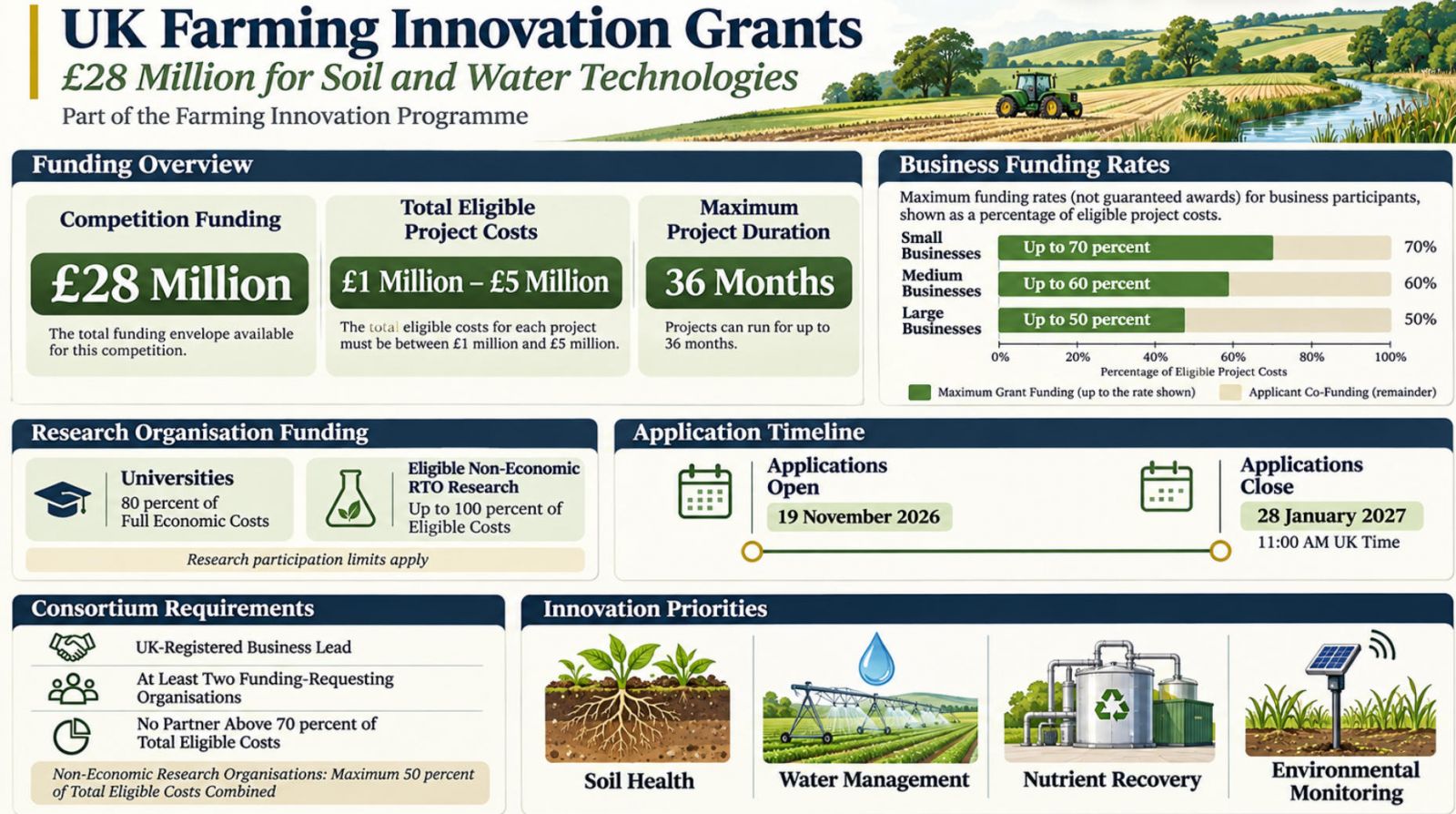
The United Kingdom is preparing a £28 million funding competition to accelerate agricultural technologies that improve soil health, protect water resources, reduce pollution and help farming businesses adapt to a changing climate. Through the Healthy Soils and Water for a Sustainable Environment competition, UK-registered businesses can seek substantial public funding for collaborative research and development projects with total eligible costs between £1 million and £5 million.
The competition forms part of the Farming Futures Research and Development Fund, operating within the Department for Environment, Food and Rural Affairs (Defra) Farming Innovation Programme and delivered in partnership with Innovate UK. Applications are scheduled to open on 19 November 2026 and close on 28 January 2027.
Unlike conventional agricultural investment grants, this opportunity is designed to support ambitious industrial research that can produce commercially deployable technologies, products, practices and services. Potential projects range from intelligent irrigation systems and advanced soil-monitoring equipment to nutrient-recovery technologies, pollution prevention systems and integrated agricultural decision-support platforms.
For agricultural technology companies, engineering businesses, farmers, universities and research institutions, the competition provides an opportunity to develop solutions to problems affecting England's agricultural productivity and environmental resilience. However, the financial structure is more complex than the headline £28 million suggests. Grant funding depends on each partner's eligibility, the nature of its activities, the project's total eligible expenditure and the applicable funding rates.
Understanding these distinctions is essential before assembling a consortium or committing resources to a grant application.
1. Understanding the £28 Million Farming Innovation Competition
The Healthy Soils and Water for a Sustainable Environment competition targets a fundamental challenge facing modern agriculture: increasing or maintaining productive capacity while reducing the environmental pressures associated with farming.
Healthy agricultural soils regulate water movement, support biological activity, store carbon and supply nutrients to crops. When soils become compacted, degraded or vulnerable to erosion, farms may face declining productivity, increased input requirements and greater exposure to droughts and flooding. Poorly managed nutrients and agricultural waste can create additional costs while contributing to pollution of rivers, groundwater and surrounding ecosystems.
Defra's funding approach recognises that these challenges are interconnected. Improving irrigation efficiency without understanding soil structure may produce limited benefits. Similarly, reducing synthetic fertiliser use may not deliver the anticipated environmental improvements if alternative nutrient sources create additional emissions or water-quality problems.
The competition therefore encourages integrated approaches that combine technological innovation with measurable environmental and economic outcomes.
Table 1. Key Funding Conditions and Application Dates
| Competition parameter | Official conditions |
|---|---|
| Programme | Farming Innovation Programme |
| Funding mechanism | Farming Futures R&D Fund |
| Competition | Healthy Soils and Water for a Sustainable Environment |
| Funding organisations | Defra and Innovate UK |
| Announced competition funding | £28 million |
| Eligible total project costs | £1 million to £5 million |
| Research category | Industrial research |
| Maximum project duration | 36 months |
| Competition opening | 19 November 2026, 9:00 a.m. UK time |
| Application deadline | 28 January 2027, 11:00 a.m. UK time |
| Expected funding decisions | 27 May 2027 |
| Latest permitted project start | 1 August 2027 |
| Latest permitted project completion | 31 July 2030 |
| Eligible lead applicant | UK-registered business |
| Collaboration requirement | At least two organisations requesting funding |
| Primary geographical benefit | Farmers, growers or foresters in England |
The £28 million figure represents the announced competition funding envelope, not the maximum grant available to an individual applicant. The official competition overview describes funding of up to £28 million, although another section refers to a minimum allocation of £28 million. Funding remains subject to sufficient high-quality applications and potential government adjustments.
More importantly, the £1 million to £5 million range refers to total eligible project costs, not the amount of grant funding that a consortium will automatically receive.
A £3 million project involving commercial businesses may qualify for significantly less than £3 million in public funding because each participating business must contribute a proportion of its eligible costs. Conversely, a consortium involving eligible research organisations undertaking non-economic research may obtain a higher overall grant-to-cost ratio than a consortium composed exclusively of commercial companies.
Projects must begin on the first day of a calendar month and cannot start before Innovate UK has approved the Grant Offer Letter. Applicants should therefore avoid committing grant-dependent expenditure before formal authorisation.
The programme is competitive, and satisfying the eligibility rules does not guarantee selection. Innovate UK also applies a portfolio approach, which can influence the final distribution of grants across technologies, research maturities and market opportunities.
2. Why England Is Investing in Soil and Water Innovation
The competition responds to substantial environmental and economic pressures documented by the Environment Agency, Defra and other government research organisations.
According to the Environment Agency's Agriculture and the Water Environment report published in June 2026, more than 100,000 farms occupy approximately 68 percent of England's land area. Farming has a major influence on water quality, landscape management and the country's capacity to adapt to extreme weather.
The report cites 2019 evidence indicating that agriculture was the most significant sector adversely affecting approximately 40 percent of water bodies in England. This historical figure should not be interpreted as a new measurement for 2026, but it demonstrates the scale of the longstanding problem.
Agricultural activities are also estimated to contribute approximately 60 percent of nitrogen and 28 percent of phosphorus entering rivers in England and Wales combined. These figures concern the two countries together, rather than England alone.
Nutrient losses represent both an environmental problem and an economic inefficiency. Fertilisers and organic nutrients that are not effectively retained or used by crops may create unnecessary expenditure, while their movement into watercourses can contribute to eutrophication and ecological deterioration.
Regulatory evidence reveals specific technological opportunities
Between April 2021 and March 2026, the Environment Agency conducted 19,018 inspections at 15,006 farms not operating under the environmental permits covered by its separate permitted-site regime. These inspections generated 27,485 required improvement actions, of which 19,841 had been verified as completed.
Approximately 48 percent of inspections identified non-compliance during the five-year period. However, this should not be treated as a representative non-compliance rate for every farm in England. Inspections were targeted towards higher-risk locations, meaning the sample was not randomly selected from the entire agricultural sector.
The types of required improvements are particularly relevant to the new grant competition. The most frequently recorded category was the separation of clean and contaminated water, with 4,086 actions. Other substantial categories included silage storage, slurry storage, nutrient management planning and soil testing.
Table 2. Official Environmental Evidence Relevant to Agricultural Innovation
| Indicator | Reported value | Relevance to innovation |
|---|---|---|
| Agricultural share of England's land area | 68 percent | Large potential application area for sustainable technologies |
| Farm inspections, April 2021 to March 2026 | 19,018 | Evidence of substantial regulatory monitoring |
| Improvement actions issued | 27,485 | Identifies practical environmental management deficiencies |
| Verified completed improvement actions | 19,841 | Shows implementation activity following inspections |
| Clean and contaminated water separation actions | 4,086 | Opportunity for drainage monitoring and water-management systems |
| Silage storage improvement actions | 3,374 | Opportunity for leakage detection and storage monitoring |
| Slurry storage improvement actions | 3,312 | Opportunity for predictive storage and pollution prevention technologies |
| Nutrient management planning actions | 3,227 | Opportunity for digital nutrient planning |
| Soil testing improvement actions | 3,194 | Opportunity for affordable and scalable soil diagnostics |
| Serious or significant water pollution incidents at non-permitted agricultural sites | 263 | Demonstrates the continuing importance of pollution prevention |
Source: Environment Agency, Agriculture and the Water Environment: 2026 Report. Inspection and enforcement figures cover April 2021 to March 2026.
The agency recorded 263 serious or significant agricultural water pollution incidents at non-permitted sites over the same period, including 49 category-one and 214 category-two incidents. Dairy farming accounted for 187 of these incidents, with slurry, contaminated drainage and storage infrastructure among the prominent concerns.
These findings create a clear commercial and environmental rationale for technologies capable of identifying pollution risks before an incident occurs.
For example, an integrated monitoring system could combine slurry storage measurements, precipitation forecasts, drainage conditions and field application records to alert farmers when changing weather creates an elevated pollution risk. Such a system would need to offer genuinely new technical capabilities rather than merely combining standard commercially available devices.
Drought and water availability are becoming critical economic risks
Water scarcity is another important driver of agricultural research.
The Environment Agency's October 2026 assessment of water resources describes sustained pressure following dry weather in 2025 and renewed drought conditions in 2026. Reservoir storage had fallen to approximately 57 percent by the end of August 2025, while the following summer brought further exceptional conditions.
During 2026, temporary water-use restrictions affected more than 30 million people. The agency also reported the driest July on record and five summer heatwaves.
Agricultural abstraction accounts for a relatively small share of total annual licensed water abstraction nationally. Nevertheless, seasonal irrigation demand can become particularly important in water-stressed regions. In parts of south-eastern England, daily agricultural abstraction during summer may be comparable to public water-use demand.
For horticultural businesses and irrigated crop producers, improved water efficiency therefore has implications for both environmental sustainability and production continuity.
Technologies that combine soil moisture measurements, weather forecasting, crop development models and irrigation control could help farmers make better decisions under increasingly variable climatic conditions.
However, an effective innovation project should measure water savings alongside crop yield, product quality, energy consumption and environmental impacts. Reducing irrigation volume is not inherently beneficial if the resulting technology causes unacceptable reductions in marketable production.
England's emerging soil-health evidence
A further development is the publication of new soil-health indicators by the Joint Nature Conservation Committee (JNCC).
Its experimental statistics, published in March 2026 using initial data from 2023 and 2024, assess how soils contribute to ecosystem services.
The modelled indicator for soils' contribution to reducing surface-water runoff was 63.5 percent, while the corresponding optimisation-of-management indicator was 64.0 percent. The reported average carbon stock in the sampled soils was 71 tonnes of carbon per hectare.
These figures do not mean that 63.5 percent of England's soils are healthy or that every agricultural hectare contains 71 tonnes of soil carbon. They represent particular modelled indicators and measurements from an initial sample. JNCC explicitly describes the results as developmental rather than fully representative national statistics.
Nevertheless, the research reveals a significant opportunity: better measurement and verification of soil functions.
Innovation is needed not only to improve agricultural practices but also to determine reliably whether interventions are producing measurable improvements.
That challenge connects directly to Defra's Environmental Improvement Plan 2025, which commits to bringing at least 40 percent of England's agricultural soils into sustainable management by 2028 and 60 percent by 2030.
The plan also seeks a 40 percent reduction by 2038 in agricultural nitrogen, phosphorus and sediment pollution entering water environments, relative to the 2018 baseline. These are government policy objectives, not environmental outcomes already achieved by grant-funded projects.
3. Which Agricultural Technologies Can Receive Funding?
The competition identifies four broad innovation themes. Applicants may address one or several themes, and integrated solutions that connect soil health, water quality, productive efficiency and environmental management are particularly encouraged.
The technologies must demonstrate credible prospects for commercial deployment and practical adoption within agricultural production systems.
Table 3. Eligible Innovation Themes and Potential Commercial Applications
| Official innovation theme | Priority research areas | Illustrative technology opportunity |
|---|---|---|
| Soil, Water and Land Resource Management | Soil structure, organic matter, biodiversity, infiltration, erosion and water retention | Integrated soil-compaction diagnostics and targeted field management |
| Fertilisers, Nutrient Management, Circular Bioeconomy and Pollution Reduction | Nutrient efficiency, manure management, novel fertilisers, nutrient recovery and emerging contaminants | Systems recovering phosphorus from agricultural waste and reducing nutrient losses |
| Climate Resilience and Natural Resource Adaptation | Drought resilience, flood mitigation, water storage and crop adaptation | Predictive irrigation and water-storage systems for climate-sensitive production |
| Crosscutting Decision Support Tools | Affordable sensing, remote monitoring, artificial intelligence and integrated environmental data | Farm decision-support platforms combining sensors, satellite imagery and predictive models |
The themes reflect the official competition scope. Technology opportunities are illustrative concepts, not approved grant awards.
Soil health, erosion prevention and regenerative land management
The first theme covers approaches that improve soil organic matter, biological functioning, nutrient cycling, carbon dynamics, structure and water retention.
Potential developments include technologies for measuring soil compaction more accurately, analysing how field operations affect infiltration, or determining the most effective interventions for reducing erosion under different soil conditions.
A strong proposal could investigate how sensor networks, machinery operating data and soil maps can jointly identify where compaction is reducing productivity and increasing surface runoff.
The research would need to establish whether the solution can distinguish the influence of soil texture, weather, machinery traffic and management practices. It should also demonstrate how recommendations translate into economically realistic decisions for farmers.
The competition is not restricted to software or electronic equipment. Novel biological, mechanical and integrated land-management technologies may also be relevant where they meet the industrial research and innovation requirements.
Nutrient recovery, new fertilisers and agricultural pollution reduction
The second theme includes some of the programme's most technically specialised opportunities.
Defra explicitly identifies technologies that stabilise or retain nitrogen within soils, improve nutrient availability to crops, reduce leaching and emissions, and recover nutrients or water from organic waste streams.
Relevant materials can include slurry, manure, digestate, sludge, biosolids and other agricultural or organic residues.
A consortium might investigate a nutrient-recovery process that converts digestate into a more consistent agricultural input. However, the commercial and environmental case should consider nutrient recovery efficiency, processing costs, energy demand, contamination risks and the agronomic performance of the resulting product.
The competition also covers emerging pollutants such as microplastics and per- and polyfluoroalkyl substances (PFAS).
This creates opportunities for advanced detection, source attribution, remediation and contamination-prevention technologies. The presence of such substances in agricultural systems may depend on specific waste streams and historical management practices, so proposals should avoid making unsupported claims about contamination across the entire farming sector.
Innovations relating to anaerobic digestion and biomethane production may also be eligible when they improve nutrient recovery and environmental performance within the stated scope.
Water security, floods and climate adaptation
The third theme focuses on the ability of farming systems to withstand droughts, flooding and other climatic pressures.
Solutions may involve improved water storage, adaptive irrigation, changes to land management or technologies that help crops use available water and nutrients more effectively.
New crop varieties with improved resilience or nutrient-use efficiency can also fall within the competition, including appropriate precision-breeding approaches.
For water-management technologies, the technical challenge is often to deliver reliable decisions under highly variable conditions. A model trained on one crop, soil type or region may perform poorly elsewhere.
Competitive research could therefore include multi-location field trials, sensor validation, uncertainty analysis and assessment of performance across different seasons.
The commercial case should establish whether the additional value of improved decision-making justifies the cost of installing and operating the technology.
Advanced environmental monitoring and artificial intelligence
The fourth theme covers crosscutting technologies that make environmental information more reliable, affordable and actionable.
These may combine in-field sensors, laboratory measurements, satellite observations, weather data, farm management software and predictive analytics.
Innovations could address near-real-time monitoring of water quality, emissions, nutrient flows and soil conditions.
A particularly important distinction is the difference between collecting environmental data and producing useful management decisions. A technically sophisticated platform may still have limited commercial value if farmers cannot translate its outputs into practical action.
Proposals should explain what is technically new, how data quality will be validated, how false alerts will be managed and how the technology can operate economically in real farming environments.
Where appropriate, projects must conduct life cycle assessments to understand their wider environmental effects. Demonstrating reduced fertiliser losses is insufficient if the solution introduces other substantial environmental burdens that have not been assessed.
The competition also expects wider environmental benefits to be measured and research findings to be disseminated appropriately.
4. Who Can Apply for UK Farming Innovation Grants?
The competition is open to collaborative projects led by established UK-registered businesses.
The lead organisation may be a microenterprise, small or medium-sized business, or large commercial company. Eligible sole traders and partnerships can also lead, provided they meet the relevant requirements for established commercial activity.
A farming business may lead a proposal, but this is not mandatory. A British engineering company, agricultural technology developer or specialist manufacturer can lead a consortium if its project offers demonstrable benefits to farmers, growers or foresters in England.
Universities, research and technology organisations, charities, not-for-profit organisations and public-sector bodies may participate as partners. Academic institutions cannot lead an application or apply alone.
At least two organisations, including the lead, must request funding. A consortium containing one funded company and several entirely self-funded collaborators does not satisfy this particular requirement.
Funding rates vary by organisational category
For participants undertaking commercial or economic activities, the maximum grant contribution depends on the size of the organisation.
Table 4. Maximum Grant Funding Rates by Organisation Type
| Participant category | Maximum funding rate | Required contribution or treatment |
|---|---|---|
| Micro or small business | 70 percent of eligible costs | At least 30 percent funded by the business |
| Medium-sized business | 60 percent of eligible costs | At least 40 percent funded by the business |
| Large business | 50 percent of eligible costs | At least 50 percent funded by the business |
| Eligible RTO undertaking non-economic research | 100 percent of eligible costs | Subject to research participation limits |
| Eligible charity, public-sector or other research organisation undertaking non-economic research | 100 percent of eligible costs | Depends on qualifying activity and costs |
| Academic institution undertaking eligible non-economic research | 80 percent of full economic costs | Special university accounting methodology applies |
| Overseas project partner without grant funding | No direct Innovate UK grant | Funds its own project activities |
Maximum funding rates are subject to the applicable conditions, eligibility checks and subsidy control rules.
The classification of an organisation must reflect its actual activities within the proposed project. A normally not-for-profit organisation conducting commercial or economic activities cannot automatically use the more generous non-economic research funding rates.
Company size also needs to be assessed correctly, including relevant ownership and associated-enterprise relationships. A company that appears small when viewed independently may be treated differently when its wider corporate structure is considered.
The 70 percent consortium cost rule
No individual organisation can claim more than 70 percent of total eligible project costs.
This rule is separate from the 70 percent maximum grant rate available to small businesses.
For example, in a £2 million project, a lead company cannot claim £1.5 million in eligible costs, because this would represent 75 percent of the total project budget. The proposal would need a different distribution of responsibilities and expenditure.
Research organisations undertaking non-economic activity are subject to an additional collective restriction. Their combined share cannot exceed 50 percent of the project's eligible costs.
This limitation applies to all qualifying research organisations together, rather than separately to each university or institute.
The special geographical funding rule for farmers
A particularly important condition concerns farmers, growers and foresters receiving grant funding.
At least 50 percent of the total grant requested by these agricultural participants must be allocated to farmers, growers or foresters geographically based in England.
This does not mean that half of the entire consortium's grant must go to English farmers.
For example, if agricultural businesses across a consortium request £600,000 in grants, at least £300,000 of that agricultural grant amount must be requested by the qualifying participants based in England.
If no farmers, growers or foresters request grant funding, the application must make the appropriate declaration rather than attempting to calculate an inapplicable percentage.
Regardless of the funding distribution, the project must demonstrate a credible benefit to agricultural production in England.
5. Can International Companies and Universities Participate?
International collaboration is permitted, but the conditions differ substantially from those of the UK organisations receiving public funding.
Businesses, universities and research institutions from the European Union and other countries may participate as non-funded project partners. They can contribute their expertise, carry out work in their home countries and potentially exploit project results outside the United Kingdom.
However, these overseas organisations are not eligible to receive direct grant funding as partners under the competition's published rules.
An international agricultural technology company might therefore contribute specialised software, existing research data or technical expertise to a UK-led consortium while financing its own activities.
The contractual arrangements should clearly identify intellectual property ownership, access rights, confidentiality, data management and future commercialisation responsibilities.
Non-funded partners formally included in the Innovation Funding Service application have their own project costs counted towards total eligible project costs. This matters when verifying the £1 million to £5 million threshold and the distribution of costs between consortium members.
The competition also permits overseas subcontractors in limited circumstances. A UK grant recipient must provide evidence explaining why a suitable UK subcontractor could not perform the required work.
A lower overseas price is not, by itself, an acceptable justification. Applicants need to document relevant UK alternatives and explain why those organisations cannot provide the necessary specialist services.
For organisations receiving grant funding, the substantive project work must be carried out in the UK, most of the funding must be spent within the country, and the organisations must intend to exploit project results from or within the UK.
These provisions create opportunities for international knowledge exchange without making the competition a general international research funding programme.
6. How Much Grant Funding Can a Consortium Actually Receive?
The maximum grant cannot be calculated simply by multiplying the total project budget by 70 percent.
Each partner has its own eligible costs, funding rate and financial contribution. The total grant is the sum of the individually calculated awards.
Consider a hypothetical £3.2 million collaborative project developing technology to recover nutrients from agricultural waste, monitor environmental performance and validate commercial applications on English farms.
The consortium consists of a small technology company, a small farming business in England, a medium-sized engineering company, a British university and a research and technology organisation undertaking eligible non-economic activities.
Table 5. Illustrative £3.2 Million Agricultural Innovation Consortium Budget
| Consortium partner | Eligible costs in IFS | Grant requested | Partner contribution |
|---|---|---|---|
| Small UK technology company, project lead | £1,200,000 | £840,000 | £360,000 |
| Small farming business in England | £500,000 | £350,000 | £150,000 |
| Medium-sized engineering company | £700,000 | £420,000 | £280,000 |
| UK university, eligible research costs | £400,000 | £400,000 | £0 |
| UK research and technology organisation | £400,000 | £400,000 | £0 |
| Total | £3,200,000 | £2,410,000 | £790,000 |
Illustrative calculation based on the published maximum funding rates. It is not an actual funded project or an indication of guaranteed award amounts.
The total requested grant is £2.41 million, representing 75.3125 percent of the eligible project budget recorded in IFS. The commercial participants jointly contribute £790,000.
This overall percentage is possible because the consortium includes eligible research organisations undertaking non-economic activities. It does not mean Innovate UK offers a universal grant rate of more than 75 percent to commercial applicants.
The largest partner claims £1.2 million in eligible project costs, representing 37.5 percent of the consortium's budget. The combined £800,000 claimed by the university and RTO represents 25 percent of total eligible costs. Both figures remain within the respective published participation limits.
The university's treatment requires particular attention.
Understanding the university's 80 percent full economic cost rule
Universities use the Transparent Approach to Costing (TRAC) methodology to calculate full economic costs, commonly abbreviated to FEC.
Innovate UK funds 80 percent of eligible university FEC, but the amount entered into the Innovation Funding Service is only the 80 percent being claimed.
Suppose the university's actual calculated full economic cost is £500,000.
The university enters £400,000 into IFS, representing 80 percent of that FEC. Innovate UK can then fund 100 percent of the £400,000 recorded in the application.
The remaining £100,000 is not added to the official eligible project budget as an academic partner contribution. It remains part of the university's wider financial commitment outside the project costs entered into IFS.
In the example above, the university's total FEC is therefore £500,000, while the official consortium budget includes only £400,000 for its activities.
This accounting distinction is essential when calculating the total project value, the research participation limit and the financial obligations of individual partners.
Academic applicants must use the required TRAC documentation rather than the discontinued Je-S process.
Understanding eligible equipment and operating costs
Project expenditure can include qualifying personnel costs, overheads, materials, subcontracted services, travel and specialist research activities. However, all claimed expenditure must be necessary for the project, appropriately justified and calculated under the relevant Innovate UK cost guidance.
Capital equipment is a particularly common source of budgeting errors.
Purchasing an instrument for £120,000 does not automatically make the entire purchase price an eligible project cost. Where depreciation accounting applies, the eligible expenditure may depend on the asset's useful life and the proportion of time it is used for the funded research.
For example, if an instrument costs £120,000, has a 48-month depreciation period, is used for 18 months of the project and is devoted to the project for 60 percent of its operating time, the attributable depreciation would be £27,000 under those assumptions.
This is an illustrative calculation, not confirmation that a particular asset or accounting treatment would be approved.
Similarly, commercial organisations may have different permitted methods of calculating overheads, including a fixed-rate method based on qualifying personnel costs.
Applicants should distinguish ordinary operational expenditure, equipment purchases, capital depreciation and research-specific costs before completing the financial forms.
Subsidy control and agricultural support rules
Funding is provided under the United Kingdom's Subsidy Control Act 2022.
The competition's published rules state that these awards do not count towards an organisation's Minimal Financial Assistance or de minimis allowance. Applicants should therefore not treat the programme as a conventional small-value de minimis grant.
Awards to primary agricultural producers must also satisfy the applicable green box exemption requirements under the World Trade Organization Agreement on Agriculture.
In limited circumstances, European Union State aid rules may remain relevant under the Windsor Framework.
The applicable maximum is consequently determined by the competition conditions, the relevant subsidy rules, the organisation's activities and the eligible budget, rather than by a single universal monetary ceiling.
Organisations experiencing financial difficulties may be excluded following financial viability checks. Applicants must also ensure that the same expenditure is not improperly financed through overlapping public support arrangements.
7. How to Prepare an Innovate UK Application
Applications must be submitted through Innovate UK's Innovation Funding Service.
The lead organisation is responsible for creating the application, inviting consortium participants and checking that all required sections are complete. Individual partners must enter their own project costs and accept the applicable conditions.
The application is divided into project details, application questions and financial information.
The project details include the title, proposed start date, duration, research category, summary, public description and explanation of how the proposal fits the competition scope.
The project summary, public description and scope explanation each have a 400-word limit. The public description may be published if funding is awarded, potentially before project activities begin. Applicants should therefore exclude sensitive proprietary information from that section.
The application contains 18 questions. Questions 1 to 8 are mandatory but are not assigned assessment scores. Questions 9 to 18 are scored and address the substantive research, market, financial and management case.
Each question has a maximum response length of 400 words.
The official application guidance also states that website addresses included in answers will not be opened by assessors. Important evidence should therefore be incorporated directly into the permitted text or supporting documents, rather than relying on external pages.
What the assessors are looking for
The ten scored questions cover the business need, technological innovation, consortium capability, market awareness, commercialisation, wider impacts, project management, risks, additionality of public funding, and value for money.
For a soil-monitoring innovation, a strong explanation of the business need might quantify the financial effect of inconsistent nutrient application, describe the limitations of existing sampling methods and identify the types of farms that would benefit from improved measurements.
The innovation response should establish what existing technology cannot accomplish, what research is needed to overcome that limitation and how the proposed work differs from standard commercial development.
Evidence of early feasibility work, laboratory validation, engineering prototypes or preliminary field measurements can strengthen the case, but applicants should accurately state the maturity of the technology.
The competition does not prescribe a universal numerical Technology Readiness Level range. Instead, applicants must explain their current technological position and how the proposed industrial research will advance it.
Market awareness is equally important. A technically promising product may have limited prospects if its operating costs exceed the economic value delivered to farmers.
Applicants should identify the likely customer segments, adoption barriers, procurement models and distribution channels. Where possible, market estimates should distinguish between the total potential market and the smaller segment that the consortium could realistically serve.
For example, a sensor system might target irrigated horticultural businesses initially before expanding into other types of farming. Its commercial strategy should explain why the first group has a sufficient need and willingness to pay.
Mandatory project management documents
The application requires a project plan or Gantt chart supporting the project management response, together with a risk register supporting the risks response.
Each mandatory document must be submitted as a PDF of no more than two A4 pages and 10 MB, with content legible at 100 percent zoom.
Optional technical diagrams and additional team information may be submitted where permitted by the relevant questions.
A convincing project plan should connect work packages with milestones, partner responsibilities, technical dependencies and decision points.
The risk register should address more than ordinary scheduling difficulties. Relevant risks may include inaccurate measurements, failed field trials, unexpected regulatory requirements, delays in manufacturing, seasonal weather variability, inadequate data quality and a slower-than-expected route to commercialisation.
Projects requiring regulatory permits or licences must have the necessary authorisations by the project start date. International collaboration, potential export controls, animal-related research and relevant national security considerations must also be declared in the appropriate application fields.
Assessment and interview stage
Applications are initially reviewed by three independent assessors.
The published assessor guidance assigns scores from one to ten to each of the ten scored questions. Each score reflects the quality of the evidence provided, including how convincingly the consortium explains the technical opportunity, proposed approach and likely outcomes.
Projects that progress through the initial assessment may be invited to an interview in May 2027.
Up to five project representatives may attend. The presentation must be prepared in Microsoft PowerPoint, contain no more than 20 slides and last no longer than 15 minutes. Applicants should also be prepared for approximately 30 minutes of questions.
An optional written response to assessor feedback may be submitted before the interview, subject to the specified page limit.
The published competition calendar lists applicant notifications for 27 May 2027, although successful applicants will still need to complete the relevant grant setup procedures.
A high technical score does not create an entitlement to funding. Innovate UK considers the available budget, application quality and overall balance of the funded project portfolio.
8. How to Design a Strong Soil and Water Innovation Consortium
The strongest proposals are likely to connect a specific agricultural problem with technically credible research, access to real farm environments and a realistic route to commercial deployment.
A consortium should not be assembled solely to satisfy the minimum number of partners.
Each organisation should bring a clearly identifiable capability that contributes to overcoming a defined technical or commercial barrier.
A technology developer may be responsible for product design and systems integration. An engineering company could develop specialist manufacturing processes or field equipment. A university might investigate soil-water interactions, validate experimental methods or assess environmental outcomes. A farming business could define operational requirements and host real-world trials.
Responsibilities should be reflected in the project budget and work-package structure.
Build the research around a measurable baseline
A useful agricultural research project requires a reliable baseline against which results can be compared.
For nutrient-management technologies, relevant measures may include fertiliser application per hectare, crop nutrient uptake, nutrient concentrations in drainage water, pollutant loads and associated operational expenditure.
For irrigation technologies, measurements could include total water abstraction, water applied per unit of marketable crop, soil moisture conditions, energy use and yield quality.
For pollution-prevention systems, a consortium might measure detection accuracy, the timeliness of warnings, the frequency of potentially harmful events and the number of management actions taken in response.
The distinction between pollutant concentration and pollutant load can be crucial. A reduction in concentration does not necessarily mean that the total quantity of pollution entering a watercourse has fallen, particularly if water volumes have changed.
Research should therefore account for flow, weather, seasonal variation and relevant differences between experimental and control conditions.
Select demonstration locations using environmental evidence
Field trials should take place where the target problem exists and where the resulting evidence can be generalised appropriately.
The Environment Agency's inspection data suggest several areas of opportunity.
For example, serious agricultural water pollution incidents have been particularly concentrated in parts of south-western England. Over the five financial years from April 2021 to March 2026, Devon, Cornwall and the Isles of Scilly recorded 91 serious or significant agricultural water pollution incidents, while Wessex recorded 49.
These figures may support the rationale for investigating slurry storage, drainage and nutrient management technologies in relevant agricultural systems.
However, absolute incident counts do not establish the relative risk per farm. Location selection should also consider farm density, production type, catchment characteristics and the availability of suitable experimental sites.
A consortium studying irrigation efficiency may select a different geographical focus, particularly where water availability, horticultural production and seasonal abstraction create a stronger practical need.
Demonstrate environmental benefits without overstating them
Environmental modelling and experimental validation should be proportionate to the claims made by the project.
If a new fertiliser is expected to reduce nitrogen losses, the project should assess crop performance, emissions, leaching and potential secondary effects. If a new monitoring system is expected to improve water management, its effectiveness should be evaluated under realistic field conditions.
Life cycle assessment may be necessary to determine whether improvements in one environmental indicator create problems elsewhere.
For example, a nutrient-recovery process could reduce waste disposal requirements while increasing electricity consumption. Whether the overall environmental effect is positive will depend on the performance of the technology, its energy sources and the avoided impacts of conventional practices.
It is also important to distinguish project-level results from national policy ambitions. A technology may contribute towards the government's pollution reduction targets without being capable of demonstrating a nationwide reduction during a three-year research project.
Explain the value of public funding
The application's added-value question asks what government funding will change.
A convincing response should identify research activities that would be delayed, reduced or abandoned without support. It should also explain how the grant enables additional experimentation, collaboration or environmental validation that would otherwise be difficult to finance.
Applicants should describe existing financing arrangements transparently. Private investment, commercial revenue and partner contributions may support the project, but their role should be clearly distinguished from the requested public grant.
The public value case should connect technological uncertainty, wider environmental benefits and the potential for commercial adoption.
Strong proposals may also quantify potential benefits under carefully defined adoption scenarios, but these calculations must remain separate from experimentally confirmed results.
9. What Previous Farming Innovation Grants Reveal About Successful Projects
Earlier Farming Innovation Programme competitions provide useful evidence of the types of partnerships and technologies that Defra and Innovate UK have supported.
The programme has already funded projects involving nutrient management, biological fertilisers, environmental monitoring, agricultural waste processing and precision agricultural systems.
A particularly relevant comparison is the £15 million nutrient-management competition launched in May 2024.
According to Defra's Farming and Countryside Programme annual report, that competition attracted 84 applications and funded 29 projects involving 98 organisations. The supported projects began in January 2025 and could run for up to three years.
The historical ratio of funded projects to submitted applications was approximately 34.5 percent. This should not be interpreted as an expected success rate for the new Healthy Soils and Water competition, which has its own applicant pool, budget and evaluation process.
In January 2026, Defra also announced at least £21.5 million for 15 innovation projects selected through earlier precision-breeding and low-emissions farming competitions.
These awards demonstrate continued public investment in research-intensive agricultural technologies, but funding decisions should not be confused with verified completion or proof of commercial success.
Table 6. Previously Funded Agricultural Innovation Projects
| Project | Lead organisation | Confirmed grant across partners | Technology focus |
|---|---|---|---|
| Restoring the River Wye Through ChickenChar | Black Bull Biochar Ltd | £762,221 | Biochar-based nutrient management in poultry production |
| Sensor-based Precision Fertigation of Stone Fruit | Norton Folgate Marketing Ltd | £746,534 | Sensor-supported nutrient delivery in fruit production |
| BIO-PHAGE-UK | Terrafarmer Agriculture Ltd | £966,228 | Biological alternatives to synthetic nitrogen fertilisers |
| BioBLEND | Cefetra Ltd | £1,340,082 | Biochar-based fertilisers for cereal production |
| RePeat | Pollybell Farms Ltd | £1,571,734 | Agricultural innovation involving peatland and land management |
These are grants awarded through previous agricultural innovation competitions, not projects funded under the upcoming Healthy Soils and Water competition. The recorded grants are not evidence that every anticipated environmental result has already been achieved.
ChickenChar: biochar and poultry nutrient management
The ChickenChar project, led by Black Bull Biochar Ltd, investigates the use of specialised biochar products in poultry production.
The research explores whether the properties of biochar can help manage nutrients in poultry litter and reduce environmental pressures associated with agricultural waste.
The consortium includes commercial and research partners with expertise in agricultural production, environmental science and biochar technology.
UKRI records a total project grant of £762,221 for work scheduled between January 2025 and June 2027.
The structure illustrates how a commercially led consortium can distribute research activities between companies and scientific organisations, with different funding rules applying to their respective contributions.
However, the environmental benefits described in the research proposal are intended outcomes. They should not be presented as independently established reductions in River Wye pollution before suitable completed evaluations are available.
Precision fertigation: measuring nutrient requirements in fruit production
Another relevant project, led by Norton Folgate Marketing Ltd, focuses on sensor-based precision fertigation in stone-fruit production.
The research aims to improve the delivery of nutrients to crops such as plums and cherries by developing more responsive monitoring and nutrient-management systems.
The consortium's project description identifies substantial uncertainty about the timing and efficiency of nutrient uptake. It explores the potential for improved measurements to reduce unnecessary fertiliser applications while maintaining crop performance.
The award recorded by UKRI is £746,534, with project work scheduled from February 2025 to January 2028.
The relevance to the new competition is clear. Both funding opportunities recognise the importance of connecting field-level measurements with practical management decisions.
Nevertheless, the project remains in its implementation period. Expected reductions in fertiliser consumption or environmental losses should not be treated as completed, verified outcomes.
BIO-PHAGE-UK and BioBLEND: alternatives to conventional fertilisers
The January 2026 funding announcement includes BIO-PHAGE-UK, led by Terrafarmer Agriculture Ltd, with a grant of £966,228 across its partners.
The project investigates biological alternatives to synthetic nitrogen fertilisers in dairy farming. Its stated ambition includes replacing 50 percent of conventional synthetic nitrogen fertiliser use in the relevant experimental context, while improving soil and nutrient management.
This percentage describes a research ambition, not a confirmed sector-wide reduction.
Another project, BioBLEND, led by Cefetra Ltd, received £1,340,082 to develop biochar-based fertilisers for cereal production.
The research includes field comparisons with conventional fertilisers and aims to reduce the carbon footprint of agricultural production without compromising yields.
These examples show that public funding is being directed towards the complete agronomic and environmental performance of innovations, not merely towards their technical feasibility.
The difference between planned and demonstrated outcomes
Grant award databases confirm funding decisions and project characteristics, but their descriptions often present expected benefits rather than final achievements.
That distinction is important when assessing the maturity of the sector.
An innovation may have received more than £1 million in public funding while still requiring field validation, regulatory approvals, manufacturing development or further investment before commercial deployment.
A separate example of published environmental performance evidence comes from the Catchment Sensitive Farming initiative. Historical evaluation for 2006 to 2018 estimated reductions in losses of approximately 4 percent for nitrates, 8 percent for phosphorus and 12 percent for sediment in relevant supported areas.
These are outcomes associated with a different agricultural environmental programme, not proven results of the new Farming Futures competition.
They nevertheless illustrate why measurable environmental evidence is valuable when designing research projects.
10. What Can Make an Application Ineligible or Uncompetitive?
Eligibility and project quality are separate considerations.
A technically ambitious proposal may be excluded before assessment if it does not meet the competition's structural requirements.
Examples include an ineligible lead organisation, an insufficient number of funding-requesting partners, incorrect project costs, an unsuitable research category or failure to complete the application correctly.
The programme also excludes proposals that fall outside the specified soil, water and environmental monitoring scope.
Specific exclusions include equine-only projects, forestry-only projects, wild-caught fisheries, designated aquaculture activities, medicinal or pharmaceutical cannabis production and specified cellular or acellular production systems.
The fact that a technology operates in agriculture does not automatically make it eligible.
Routine installation of commercially established equipment, without meaningful industrial research, would also struggle to demonstrate the required technological innovation.
A proposal may be eligible but still receive a weak assessment if its research plan lacks a convincing technical challenge, its market opportunity is poorly defined or its consortium lacks the capabilities required to deliver the work.
For example, a project proposing a new soil sensor should address calibration, data reliability, operational durability, measurement uncertainty and comparison with available alternatives. A general assertion that farmers need more environmental data would provide a much weaker technical rationale.
Poorly justified budgets are another substantial risk.
Assessors expect applicants to explain the cost of work packages, the responsibilities of different partners, the importance of subcontractors and the financing of each organisation's own contribution.
An application that requests the maximum possible funding without demonstrating value for money may be less competitive than a carefully costed project with a coherent research plan.
Applicants must also consider financial viability, prior compliance with grant conditions and any outstanding obligations to Innovate UK or UKRI.
If a proposed budget, grant request or duration falls outside the published eligibility criteria, applicants must seek approval of their justification at least ten working days before the competition closes. Such approval is discretionary and should not be assumed.
11. How This Grant Differs from Other UK Agricultural Funding
The Healthy Soils and Water competition is a research and development grant, not a general farm investment subsidy.
This distinction matters because agricultural businesses may encounter several programmes with superficially similar environmental objectives but very different funding mechanisms.
The Farming Investment Fund supports defined categories of investment in agricultural equipment, infrastructure and productivity improvements. Its purpose differs from financing the development and experimental validation of new industrial technologies.
The Sustainable Farming Incentive operates through payments for eligible land-management practices and environmental actions. It is not equivalent to a collaborative research grant for commercial technology development.
The Accelerating Development of Practices and Technologies Fund, known as ADOPT, focuses more directly on farmer-led trials and demonstrations of innovative practices and technologies. Its eligibility requirements and project scale differ from those of the Healthy Soils and Water competition.
For example, the Full ADOPT Grant Round 10, open in autumn 2026, targets collaborative farm-based trial and demonstration projects and requires an eligible farming, growing or forestry business in England to lead.
By contrast, the £28 million Healthy Soils and Water competition allows a wider range of UK commercial businesses to lead large industrial research projects.
Innovate UK also operates investor-related funding mechanisms in other competitions, but this particular programme does not impose a general requirement to secure venture capital investment as a condition of participation.
A conventional bank loan is different again because borrowed capital ordinarily creates repayment and interest obligations. Equity investment can supply growth capital but may involve ownership dilution or other investor rights.
The new competition provides grant support for approved research expenditure, subject to its rules and project obligations.
Applicants should therefore choose a funding mechanism according to the stage of technological development, the nature of expenditure and the evidence required to justify public support.
12. Practical Application Strategy Before the January Deadline
The period between the announced opening on 19 November 2026 and closing on 28 January 2027 is relatively short for a multi-million-pound collaborative research application.
Successful preparation will depend on how quickly a consortium can move from an attractive technological concept to a coordinated, evidence-based project.
The most effective starting point is to identify a specific agricultural problem for which the proposed solution would provide measurable value.
That problem should then be translated into research objectives, experiments, work packages, budgets and commercial milestones.
Before submission, applicants should be able to demonstrate:
-
A documented need: evidence from farmers, growers, environmental measurements or agricultural production data that establishes the importance of the problem.
-
A genuine technological advance: a clear explanation of existing alternatives, technical uncertainty and the innovation required to overcome identified limitations.
-
A capable consortium: defined responsibilities, suitable partners, realistic access to farms and compliance with all funding participation limits.
-
A credible financial plan: correctly calculated eligible costs, justified grant requests and evidence that partners can finance their contributions.
-
Measurable outcomes: practical methods for assessing productivity, environmental effects, technical performance and research uncertainty.
-
A commercialisation pathway: realistic adoption scenarios, market demand, intellectual property arrangements and a strategy for exploitation after the project concludes.
These elements should form a coherent argument rather than six disconnected statements.
The economic case should reinforce the technical case, while environmental benefits should be supported by an appropriate research methodology.
A particularly strong proposal might demonstrate that a new technology addresses a documented regional problem, that its key technical components have already undergone preliminary validation, and that the consortium has the facilities and expertise required to test it under commercially meaningful conditions.
Where evidence remains uncertain, the project should explain how that uncertainty will be resolved rather than conceal it.
Applicants should also plan for knowledge exchange and dissemination. The competition expects research results to contribute to wider agricultural innovation, even where commercial intellectual property must be protected.
Grant consultants can add substantial value by examining the precise assessment criteria, checking the consortium's financial structure, strengthening the evidence base and ensuring that technical, environmental and commercial narratives remain consistent across the application.
For organisations without established relationships in the British agricultural research sector, specialist collaboration with experienced grant writers and research partners can help identify relevant capabilities and avoid preventable eligibility or budgeting errors.
13. Frequently Asked Questions About UK Farming Innovation Grants
Is the £28 million available to a single agricultural business?
No. The £28 million represents the announced competition funding envelope. Individual projects must have total eligible costs between £1 million and £5 million, and the actual grant depends on the eligibility and funding rate of each consortium partner.
Can a small agricultural technology company receive 70 percent of its costs?
Potentially, yes. Eligible micro and small businesses undertaking commercial or economic activities may request up to 70 percent of their eligible project costs. The remaining expenditure must be financed by the participating organisation.
Can a university lead the project?
No. The lead applicant must be an established UK-registered business. Universities can participate as partners and may receive research funding under the relevant non-economic activity rules.
Must every consortium include a farmer?
The published eligibility rules require a qualifying UK business lead and at least one additional funding-requesting organisation. They do not impose a universal requirement that a farmer must be a funded consortium member. However, all projects must provide convincing evidence that their proposed solutions will benefit farmers, growers or foresters in England. Meaningful farm participation is often important for validation and credibility.
Can a company from Germany, France or the Netherlands participate?
Yes, as a non-funded international partner under the published rules. Overseas organisations cannot automatically receive direct Innovate UK grants, although appropriate specialist subcontracting arrangements may be possible where the restrictions are satisfied.
Are projects with artificial intelligence eligible?
They may be eligible if they provide genuine technological innovation within the competition's scope and demonstrate practical agricultural benefits. Simply incorporating artificial intelligence into an existing monitoring product is not sufficient evidence of innovative industrial research.
Is there a minimum Technology Readiness Level?
The competition does not publish a universal mandatory numerical TRL range. Applicants should explain the maturity of their technology, the research challenges that remain and the development expected during the project.
Can grant money be used to purchase farm machinery?
Eligible equipment expenditure may be included where justified for the research project, subject to the relevant cost rules. However, the competition is not a general machinery replacement subsidy. Equipment costs may also need to be calculated through depreciation and project-use allocation rather than the full purchase price.
When will applicants know the outcome?
The published competition timetable identifies 27 May 2027 for applicant notifications. Successful projects must subsequently satisfy the relevant grant setup requirements before starting funded work.
Does meeting all eligibility conditions guarantee funding?
No. Applications are competitively assessed, and the programme has a limited funding allocation. Even technically strong proposals may remain unfunded because of competition quality, available resources or portfolio considerations.
Conclusion: Turning Environmental Challenges into Commercial Agricultural Innovation
The Healthy Soils and Water for a Sustainable Environment competition represents a substantial opportunity for organisations capable of developing agricultural technologies with measurable environmental and economic value.
Its £28 million announced funding envelope, project cost range of £1 million to £5 million and support for collaborative industrial research create opportunities for technology companies, farming businesses and research institutions to address problems that are difficult to solve through routine commercial investment alone.
The environmental evidence explains why these technologies matter. England's agricultural sector faces persistent nutrient losses, water-quality pressures, soil-management challenges and increasing climatic uncertainty. Official inspections continue to identify deficiencies in drainage, slurry storage, nutrient planning and soil testing, while emerging research demonstrates the importance of more reliable environmental measurement.
The programme's emphasis on commercially deployable solutions means that technological novelty must be connected to the needs of real agricultural users. Proposals should demonstrate not only that a technology can function but also that it can improve decisions, reduce resource use, support productivity or deliver environmental benefits under realistic conditions.
The financial rules require equal attention. A £5 million project is not a £5 million grant, university research costs are treated differently from commercial expenditure, and international partners have specific participation restrictions.
For prospective applicants, the central challenge is to create an integrated proposal in which the problem, technology, consortium, research methodology, budget and commercial strategy reinforce one another.
Organisations preparing a collaborative agricultural innovation project can use i-grants.com to explore specialist grant-writing expertise and identify professional support for funding research, proposal development and consortium preparation.
With applications scheduled to close on 28 January 2027 at 11:00 a.m. UK time, prospective consortia should give priority to validating eligibility, agreeing partner responsibilities, documenting technical evidence and preparing realistic financing arrangements.
Ultimately, this funding competition is designed to support more than new agricultural equipment or environmental monitoring systems. Its wider objective is to accelerate innovations that enable productive farming and healthier natural resources to develop together.