

 Français
 Deutsch
 Українська
The European Innovation Council (EIC) Accelerator is offering €578 million in funding opportunities for 2027, supporting European startups and small businesses developing breakthrough technologies with the potential to transform international markets. Through the Horizon Europe programme, eligible companies can access grants of up to approximately €2.5 million and investment financing ranging from €1 million to €10 million. The programme combines non-repayable research and innovation support with investment capital intended to help promising technologies reach commercial maturity and achieve international growth.
The EIC Accelerator is particularly relevant to deep-tech companies operating in advanced materials, biotechnology, artificial intelligence, clean energy, robotics, industrial technologies and other research-intensive sectors. Unlike conventional business subsidies, its financial support targets innovations that involve substantial technological, commercial and investment risks. Applicants must demonstrate that their technology has progressed beyond initial laboratory validation, offers a significant competitive advantage and addresses a market opportunity large enough to justify ambitious international expansion.
The European Commission adopted the EIC Work Programme 2027 on 5 November 2026, establishing the programme's financial conditions, evaluation procedures and application deadlines. Four full-proposal submission dates are scheduled for 2027, beginning on 20 January and continuing in March, September and November. Short applications can be submitted throughout the year, although applicants must pass the initial evaluation before progressing to the full-proposal stage.
The competition is substantial. In the latest selection results published on 16 November 2026, only 35 companies were selected from 453 full applications. These figures underline the importance of preparing a technically rigorous, commercially credible and financially realistic proposal. Understanding the difference between grants, investment financing, technology readiness and the EIC Fund's separate investment decisions is essential before committing resources to an application.
What Is the EIC Accelerator Programme?
The EIC Accelerator is a funding instrument within Horizon Europe, the European Union's principal research and innovation framework programme for 2021–2027. It is administered through the European Innovation Council and the European Innovation Council and SMEs Executive Agency (EISMEA), with investment activities managed through the EIC Fund. Its central objective is to identify and support companies developing technologies capable of creating new markets or fundamentally transforming existing industries.
The programme addresses a financing challenge particularly common among deep-tech businesses. Technologies originating from scientific research frequently require extensive experimentation, specialised equipment, regulatory validation and substantial investment before generating meaningful commercial revenue. Traditional private investors may be reluctant to finance these activities because development periods are long, technical uncertainties are significant and the eventual market may not yet be established.
EIC Accelerator funding is intended to bridge this gap by helping innovative companies advance their technology while attracting additional private capital. Its grant component supports innovation activities, typically covering technology readiness levels (TRL) 6 to 8. The investment component can support further development, market deployment and commercial expansion, including activities associated with TRL 9.
The programme is designed primarily for individual startups and small and medium-sized enterprises rather than traditional research consortia. Companies must demonstrate a credible opportunity to become major international competitors, not merely develop a technically interesting product. The EIC also evaluates whether the proposed innovation requires European public support because the associated risks cannot reasonably be financed by private investors alone at the relevant development stage.
Table 1. Main Funding Conditions for EIC Accelerator 2027
| Funding condition | Official programme requirements |
|---|---|
| Funding organisation | European Innovation Council |
| EU framework | Horizon Europe |
| Total EIC Accelerator budget | €578 million |
| EIC Accelerator Open budget | €428 million |
| EIC Accelerator Challenges budget | €150 million |
| Indicative investment component allocation | €347 million within the programme's overall financial structure |
| Standard grant ceiling | Below €2.5 million, generally up to €2,499,999 |
| Investment component | €1 million to €10 million |
| Grant funding rate | Up to 70 percent of eligible innovation costs |
| Beneficiary co-financing | 30 percent of the eligible grant-component work packages |
| Grant funding model | Lump-sum financing |
| Technology readiness | TRL 5 completed before application; grant activities generally cover TRL 6–8 |
| Typical grant project duration | Up to 24 months, with justified exceptions |
| Principal applicants | Individual startups and SMEs |
| Other eligible applicants | Certain small mid-caps, individuals intending to establish companies and specified investors acting on behalf of companies |
| Application process | Short proposal, full proposal and EIC Jury interview |
| Full-proposal dates | 20 January, 17 March, 1 September and 4 November 2027 |
The €578 million allocation includes funding for both EIC Accelerator Open and the four thematic Challenges. The indicative €347 million investment allocation is part of the programme's financial structure and should not be added again to the overall budget. Actual allocations may also be affected by available resources, transfers and unused funding from earlier work programmes.
An equally important distinction concerns the financial instruments. Grants and investments are not interchangeable, and a recommendation for EIC Accelerator support does not automatically guarantee the conclusion of an EIC Fund investment agreement. The amount, timing and conditions of investment are determined through a separate assessment and negotiation process.
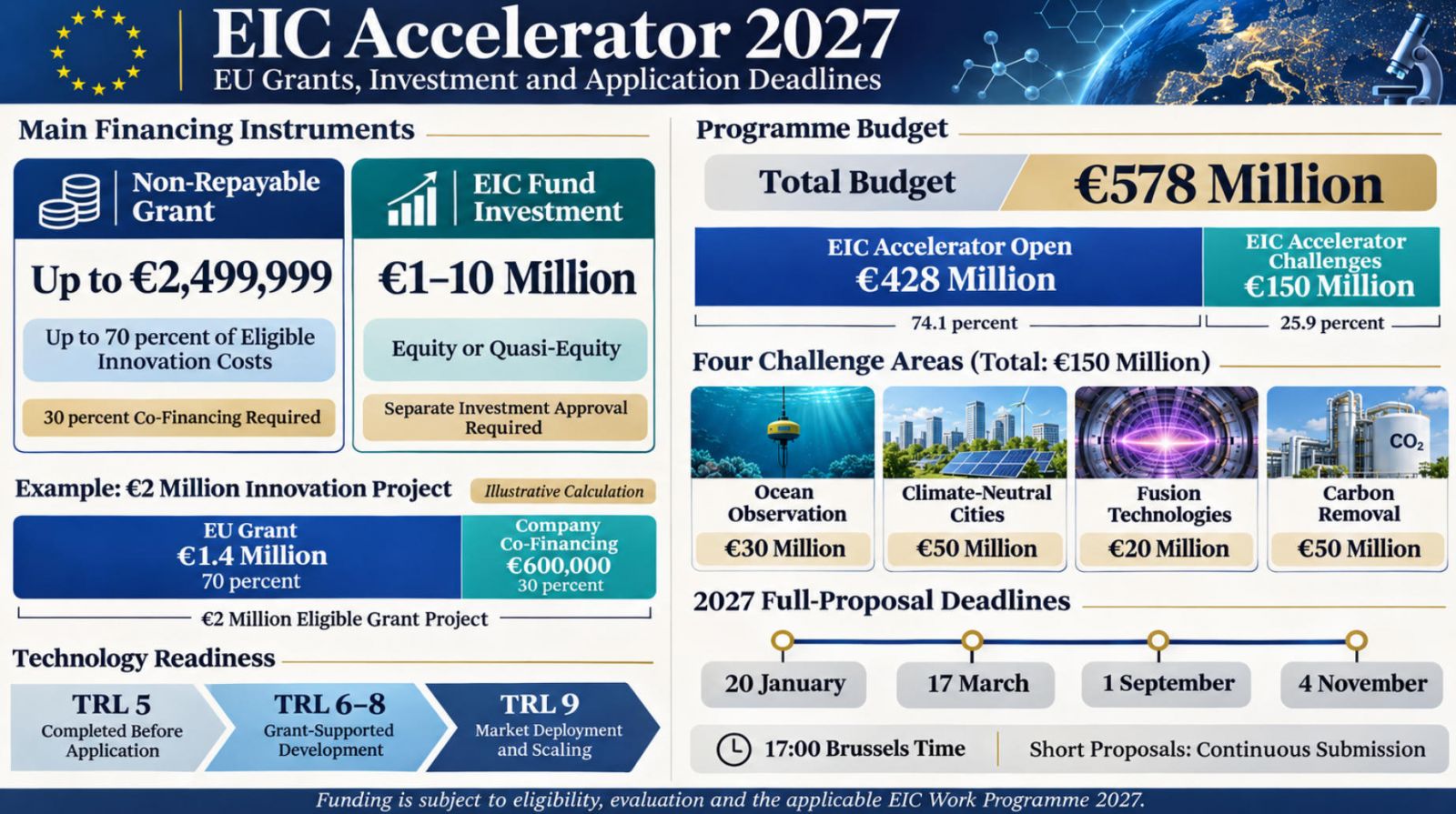
EIC Accelerator Open vs Challenges: How the €578 Million Budget Is Allocated
The EIC Accelerator offers two principal routes to funding in 2027. EIC Accelerator Open accepts proposals across technological sectors without restricting applicants to a predefined research theme. EIC Accelerator Challenges, by contrast, focuses on selected strategic priorities identified by the European Commission.
The Open programme has an indicative budget of €428 million and is particularly relevant to companies whose technologies address substantial commercial opportunities outside the designated Challenges. An innovative medical technology, advanced semiconductor component or industrial automation system, for example, may qualify under Open if it meets the programme's requirements for technological maturity, breakthrough innovation and international growth potential.
The Challenges programme has a total indicative budget of €150 million distributed across four themes. These priorities reflect European objectives in marine monitoring, climate-neutral cities, fusion energy and carbon removal technologies. A company should apply under a Challenge only when its innovation genuinely addresses the defined objectives and expected impacts of that specific call.
Table 2. EIC Accelerator Challenges 2027 and Their Indicative Budgets
| Official Challenge title | Budget | Relevant innovation areas |
|---|---|---|
| Advanced in-situ Ocean Observation Technologies for Scalable, High-Resolution Marine Monitoring | €30 million | Autonomous underwater systems, ocean sensors, marine mapping, biodiversity monitoring and environmental data |
| Climate-Neutral and Smart Cities | €50 million | Urban energy efficiency, sustainable mobility, smart infrastructure and climate-resilient resource management |
| Alternative Concepts and Key Enabling Technologies for Fusion Power Plants | €20 million | Fusion reactor components, plasma technologies, alternative reactor concepts and enabling industrial systems |
| Carbon Removal and Utilisation for Climate Change Mitigation and EU Industrial Resilience | €50 million | Carbon removal, carbon conversion, industrial carbon utilisation and permanent removal technologies |
| Total EIC Accelerator Challenges | €150 million | Four strategic technology priorities |
Advanced Ocean Observation Technologies
The marine observation Challenge supports technologies capable of substantially improving the scale, accuracy, affordability and continuity of ocean monitoring. Relevant innovations may include autonomous underwater vehicles, advanced sensor networks, intelligent observation systems and interoperable environmental datasets. Companies developing technologies for monitoring biodiversity, pollution, seabed conditions or underwater infrastructure may find opportunities within this Challenge.
An important evaluation requirement is the ability to quantify expected technological improvements. Applicants should identify existing performance benchmarks, explain the limitations of current monitoring methods and demonstrate how their innovation will produce measurable benefits. For instance, a new autonomous sensor platform might aim to reduce observation costs, increase measurement frequency or extend operational endurance compared with existing systems.
The Challenge also emphasises the environmental impact and full life cycle of deployed technologies. Applicants should consider maintenance requirements, equipment recovery, end-of-life treatment and the potential reuse of instruments operating at sea. These factors are relevant both to technological competitiveness and to the programme's broader environmental objectives.
Climate-Neutral and Smart Cities
With a budget of €50 million, this Challenge supports technologies that can accelerate the transition toward climate-neutral and resource-efficient European cities. Potential applications include intelligent energy systems, low-emission transport, efficient building technologies, urban water management and integrated digital infrastructure.
The Challenge is connected to European climate and urban innovation priorities, including the EU Mission for Climate-Neutral and Smart Cities. Projects should demonstrate how their technologies can produce measurable improvements in urban sustainability while remaining commercially viable. A solution designed for a single municipality may be less compelling than one capable of serving multiple cities with similar infrastructure requirements.
Applicants should also investigate opportunities for collaboration with municipalities, public utilities and other potential institutional customers. EIC business development services may help companies establish connections with relevant public and private buyers. Such relationships can provide evidence of demand, although they do not replace the need for a commercially credible business model.
Fusion Energy Technologies
The fusion energy Challenge allocates €20 million to innovative technologies relevant to future fusion power plants. Its scope includes alternative technical concepts, critical subsystems and technologies capable of overcoming major engineering challenges in fusion energy development. Potential beneficiaries may include companies working on advanced materials, plasma-related systems, high-performance components or other enabling technologies.
The Challenge has a specific geographical funding consideration because part of its budget originates from the Euratom Research and Training Programme. At least half of its indicative budget is expected to support eligible legal entities established in countries participating in both the relevant Euratom and Horizon Europe arrangements.
This condition makes legal establishment and programme association particularly important for cross-border applicants. A company developing an eligible fusion technology should examine both the scientific requirements and the applicable country-specific conditions before selecting its application route.
Carbon Removal and Utilisation
The carbon removal Challenge has a €50 million indicative budget and supports technologies contributing to climate mitigation and European industrial resilience. Eligible areas can include direct carbon dioxide removal from the atmosphere, certain biogenic carbon sources and technologies converting captured carbon into commercially useful materials or other products.
The programme distinguishes between technologies that genuinely address its specified carbon removal and utilisation objectives and activities outside the Challenge's scope. For example, conventional carbon storage approaches involving captured fossil carbon dioxide without the required transformation are not automatically eligible. Hydrogen production technologies are also outside the defined scope of this particular Challenge.
Applicants must demonstrate credible technical performance, environmental benefits and a realistic pathway to industrial deployment. Claims concerning carbon removal should be supported by a transparent methodology for measuring and verifying their impact. This is especially important where the proposed technology involves complex energy inputs, industrial processes or long-term carbon storage assumptions.
The four Challenges compete within their respective indicative financial allocations. If part of a Challenge budget remains unused, the EIC may redirect resources according to the work programme's rules, including to suitable proposals under Open. Therefore, thematic alignment is important, but the existence of a dedicated budget does not guarantee funding for a project that fails the quality criteria.
Who Is Eligible for EIC Accelerator 2027?
The primary applicants are individual startups and SMEs established in an EU Member State or a country associated with the relevant part of Horizon Europe. In most cases, the applicant must meet the European definition of a small or medium-sized enterprise, which generally means employing fewer than 250 people and remaining within the applicable turnover or balance sheet thresholds.
The assessment may include associated and linked enterprises, not just the applicant's standalone figures. A company with relatively few employees can therefore fail the SME test if it belongs to a substantially larger corporate group. Applicants should examine shareholder relationships, voting rights and other forms of control before assuming they qualify.
The programme also provides limited opportunities for small mid-cap companies employing up to 499 people. These enterprises can normally seek investment-only support and may qualify for blended finance in exceptional circumstances involving rapid business expansion. Standard grant-only funding is not available to small mid-caps under the same conditions as for startups and SMEs.
Can Individual Entrepreneurs Apply Before Establishing a Company?
The EIC Accelerator allows certain natural persons and legal entities to submit proposals with the intention of establishing an eligible company. This provides a route for researchers, technology founders and entrepreneurial teams that have developed a promising innovation but have not yet completed the necessary incorporation process.
For applicants originating from an EU Member State or an eligible associated country, the relevant company must generally be established before the grant agreement is signed or, for investment-only support, before the investment agreement is concluded. The application should therefore include a credible and sufficiently advanced incorporation plan.
Different timing applies to applicants from countries that are not associated with the relevant Horizon Europe component. Such entrepreneurs may pursue an eligible establishment or relocation route, but they must demonstrate the effective establishment of the company in an eligible jurisdiction by the time the full proposal is submitted.
This distinction is especially important for international entrepreneurs considering the creation of an EU-based technology business. Simply declaring an intention to relocate does not guarantee eligibility, and the location of the legal entity must correspond to the requirements applicable at the relevant application stage.
Can Ukrainian and Other Non-EU Companies Apply?
The EIC Accelerator is not limited exclusively to companies from EU Member States. Countries associated with the relevant Horizon Europe programme component may also participate, subject to the conditions of their association agreements and the specific funding instrument.
Ukraine is included among the associated countries identified in the EIC Work Programme 2027. Ukrainian technology companies can therefore examine eligibility for EIC Accelerator funding, provided they satisfy the relevant requirements concerning their legal entity, ownership, technology, financial capacity and proposed activities.
Other associated countries include Norway, Iceland, Switzerland, Türkiye, Moldova and several additional European and neighbouring states. The United Kingdom also participates in Horizon Europe, although its access to the EIC Fund investment component is subject to specific provisions and should not be assumed to be identical to grant eligibility.
International company structures require additional attention. The EIC Fund may evaluate beneficial ownership, shareholder control, intellectual property location and potential economic security risks. These considerations are particularly relevant to sensitive technologies, including advanced semiconductors, quantum systems, artificial intelligence and other strategically important sectors.
Foreign ownership does not automatically prevent a company from participating in the EIC Accelerator. Nevertheless, applicants should verify the precise requirements applicable to their jurisdiction, ownership structure and requested funding component before committing resources to a full proposal.
EIC Accelerator Funding: Grant Only, Blended Finance and Equity Only
The EIC Accelerator provides three principal funding arrangements designed for different stages of technological and commercial development. Understanding their financial and legal differences is essential because a non-repayable grant and an investment in company equity produce different consequences for the beneficiary.
Table 3. Comparison of EIC Accelerator 2027 Funding Models
| Funding feature | Grant Only | Blended Finance | Equity Only |
|---|---|---|---|
| Non-repayable grant | Yes | Yes | No |
| EIC Fund investment | No | Yes | Yes |
| Standard grant ceiling | €2,499,999 | €2,499,999, with justified exceptions | Not applicable |
| Standard investment range | Not applicable | €1 million to €10 million | €1 million to €10 million |
| Grant funding rate | Up to 70 percent | Up to 70 percent for eligible grant activities | Not applicable |
| Company co-financing | 30 percent of grant-component work packages | 30 percent of grant-component work packages | Depends on the investment and financing arrangement |
| Typical purpose | Technology development and validation | Technology development combined with market deployment and expansion | Market deployment, further development and business expansion |
| Potential ownership dilution | Not through the grant | Yes, depending on investment terms | Yes, depending on investment terms |
| Separate EIC Fund assessment | No EIC Fund investment process | Required | Required |
| Important restriction | Grant-only support can be awarded only once to the same beneficiary during Horizon Europe | Grant and investment are linked components of one support arrangement | Investment is negotiated and not automatically paid |
Grant Only: Non-Repayable Funding for Innovation Activities
Grant-only funding supports companies that require financial assistance to complete eligible technological development but can demonstrate sufficient resources and commitment to undertake subsequent commercial expansion. The standard grant ceiling is below €2.5 million, generally €2,499,999. EIC grant-only support can be awarded only once to the same legal entity during the 2021–2027 Horizon Europe programme.
The grant typically covers up to 70 percent of eligible innovation costs. The remaining 30 percent must be financed through the beneficiary's resources. Applicants should demonstrate that these resources are credible, available at the necessary stages and consistent with the company's wider financing strategy.
Grant-only financing does not require transferring company shares to the EIC Fund. However, this does not make it an unrestricted subsidy. Funding remains connected to the approved innovation activities, milestones, work packages and obligations established in the grant agreement.
Blended Finance: Combining a Grant with Investment Capital
Blended finance is intended for companies that need both non-repayable innovation funding and substantial investment to advance their technology and scale their business. The grant component supports eligible innovation activities, while the investment component can provide capital for market deployment, subsequent development and commercial expansion.
The standard investment range for 2027 is €1 million to €10 million. The investment may take the form of direct equity or quasi-equity, including convertible instruments, depending on the negotiated transaction. In exceptional, sufficiently justified cases, the grant component of blended finance may exceed the ordinary ceiling.
An important financial distinction is that the investment component may also be used to support co-financing of innovation activities when permitted under the applicable arrangements. Nevertheless, companies must present a credible financing plan and should not assume that an anticipated investment automatically replaces the need to demonstrate financial capacity.
The two components are closely linked. A serious issue affecting the investment process, including rejection of the proposed transaction or refusal to accept the EIC Fund's offer, may affect the overall blended-finance arrangement. Applicants should therefore assess the implications for ownership, governance and future financing before choosing this format.
Equity Only: Investment Without a Grant
Equity-only support is intended for companies that do not require the standard grant component but need substantial capital to develop, deploy or expand their innovation. It can be relevant to businesses that have already completed the necessary technological validation and are approaching commercial deployment.
The investment component is managed by the EIC Fund, which evaluates the company's financing needs, valuation, business prospects and investment risks. The final transaction may involve direct equity or an appropriate quasi-equity instrument. Funding remains subject to negotiation, investment approval and compliance requirements.
Equity-only financing must not be described as a non-repayable grant. In an equity investment, existing shareholders may experience dilution, and the EIC Fund becomes an investor with rights established through the relevant agreement. The financial outcome therefore differs fundamentally from receiving a grant.
EIC Accelerator Financial Examples: How Much Must a Company Contribute?
The distinction between project costs and requested EU support is central to preparing a financially credible proposal. A grant covering 70 percent of eligible expenditure does not eliminate the beneficiary's co-financing obligation. Similarly, investment financing is not simply an additional grant that can be added to the project budget without considering its legal and commercial consequences.
Table 4. Illustrative EIC Accelerator 2027 Financing Scenarios
| Financial indicator | Scenario A: Grant Only | Scenario B: Blended Finance | Scenario C: Equity Only |
|---|---|---|---|
| Eligible grant-project budget | €2,000,000 | €3,500,000 | Not applicable |
| Requested grant | €1,400,000 | €2,450,000 | €0 |
| Grant funding rate | 70 percent | 70 percent | Not applicable |
| Funding required beyond the grant for innovation work packages | €600,000 | €1,050,000 | Not applicable |
| Separately requested EIC Fund investment | €0 | €5,000,000 | €5,000,000 |
| Potential combined EIC grant and investment support | €1,400,000 | €7,450,000 | €5,000,000 |
| Possible change in company ownership | No, through grant funding | Yes | Yes |
These scenarios are illustrative calculations, not actual EIC funding decisions. Investment amounts are subject to separate assessment and agreement. The financing of grant work packages must comply with the applicable co-financing conditions.
Scenario A: An Industrial Technology Startup Seeking a €1.4 Million Grant
Consider a European startup developing an advanced optical inspection system for semiconductor manufacturing facilities. Its technology has already been validated in a relevant industrial environment, but further work is required to demonstrate reliable performance at operational scale. The company proposes a €2 million innovation project covering prototype refinement, testing, system integration and validation with industrial partners.
At a 70 percent grant funding rate, the company could request €1.4 million from the EIC Accelerator. The remaining €600,000 must be financed through available resources. The applicant must therefore demonstrate a credible source of funding, which could include existing capital, qualifying new investment or other resources permitted under the programme's financial rules.
The company's subsequent commercial expansion would not automatically be covered by this grant. Management should explain how it intends to finance manufacturing preparation, customer acquisition and international growth after completing the grant-supported technology development.
Scenario B: A Biotechnology Company Applying for Blended Finance
Imagine a biotechnology startup that has completed the relevant early validation of an innovative therapeutic delivery platform. The company proposes €3.5 million in eligible innovation activities covering advanced testing, regulatory development and technical validation. It requests a grant of €2.45 million, representing 70 percent of the proposed eligible costs.
The remaining €1.05 million must be financed in accordance with the programme's co-financing requirements. In addition, the company requests €5 million in EIC Fund investment to support the broader development and commercialisation strategy. The potential combined EIC support would therefore equal €7.45 million, consisting of a non-repayable grant and a separate investment transaction.
However, the investment cannot be regarded as guaranteed income. The EIC Fund must assess the company's valuation, ownership, investment readiness and financing strategy before agreeing on an amount and transaction structure. Its eventual investment terms may differ from the applicant's original expectations.
Scenario C: A Growth-Stage Technology Company Requesting Equity Only
A company developing advanced industrial batteries may already have completed the main technological validation activities but still require considerable capital to establish production capacity and enter international markets. In this situation, it could consider applying for €5 million in equity-only EIC Accelerator financing.
The company would not receive a grant under this arrangement. Instead, it would negotiate an investment with the EIC Fund, potentially alongside other private investors. The financial benefits could include additional capital and access to investment networks, but existing shareholders would need to consider ownership dilution and governance implications.
The suitability of this structure depends on the company's valuation, financing requirements, strategic objectives and readiness for an institutional investment process.
How Much Equity Does the EIC Fund Normally Take?
The EIC Fund Investment Guidelines updated in August 2026 indicate that the Fund generally seeks minority ownership stakes, commonly targeting approximately 10 to 20 percent. This is a negotiating objective rather than a universal fixed requirement. Actual ownership depends on the amount invested, company valuation, financing round structure and other transaction-specific considerations.
For example, an illustrative €5 million equity investment at a €25 million pre-money valuation would represent approximately 16.7 percent of the post-investment company, assuming a straightforward equity transaction without other simultaneous changes. The post-money valuation would be €30 million, and the investment would account for one-sixth of the resulting equity value.
The example does not predict the valuation or ownership percentage that the EIC Fund would accept. Convertible instruments, different share classes, additional investors and transaction terms can significantly change the outcome. In strategically sensitive cases, the Fund may also negotiate safeguards intended to protect European interests.
Technology Readiness Levels: Why TRL 5 Is Essential
EIC Accelerator funding is intended for technologies that have progressed beyond early scientific exploration. The 2027 work programme requires applicants to demonstrate completion of all relevant aspects of TRL 5, including validation in a relevant environment. Grant-supported innovation activities normally focus on further development through TRL 6, TRL 7 and TRL 8.
TRL 5 represents a significant threshold because it requires more than a laboratory concept or untested technical hypothesis. A technology must have demonstrated meaningful functionality under conditions relevant to its intended application. The evidence required will vary by industry, but applicants should be prepared to provide experimental results, test documentation and technical performance data.
TRL 6 generally involves demonstrating a technology in a relevant environment, while TRL 7 concerns demonstration of a system prototype in an operational environment. TRL 8 indicates that the system is complete and qualified for its intended use. TRL 9 relates to proven operation in a real application and is more closely connected to full deployment and commercial activities.
For a medical technology company, relevant evidence may involve prototype performance, laboratory and preclinical findings, and the appropriate validation environment for the specific innovation. An industrial robotics company may demonstrate testing in a representative production facility. A clean-energy company might provide experimental operating data from a relevant pilot installation.
The purpose is not merely to assign a high technology readiness number. Applicants must demonstrate that the claimed readiness level is supported by evidence and that the proposed development pathway is technically realistic. Overstating technological maturity can undermine confidence in the entire proposal, particularly because full applications undergo an independent technical assessment.
Grant-supported innovation activities normally include demonstration, prototyping, system-level testing and research necessary to satisfy regulatory or standardisation requirements. These activities are generally expected to be completed within 24 months, although a longer period can be considered when properly justified.
EIC Accelerator 2027 Deadlines and Application Schedule
The EIC Accelerator uses different submission arrangements for short and full proposals. Short applications can be submitted throughout the year via the EU Funding & Tenders Portal. They are grouped for evaluation on the first Tuesday of each month at 17:00 Brussels time.
Applicants normally receive short-proposal results approximately four to six weeks after the relevant monthly evaluation grouping. Therefore, submitting a short proposal immediately before a full-proposal deadline does not create an automatic opportunity to participate in that round. Companies should plan sufficient time for evaluation feedback and preparation of the more demanding full application.
Four full-proposal submission dates are scheduled for 2027. These dates apply to both EIC Accelerator Open and the relevant Challenges.
Table 5. Official EIC Accelerator 2027 Full-Proposal Deadlines
| Application deadline | Submission time | Applicable funding routes | Evaluation arrangements |
|---|---|---|---|
| 20 January 2027 | 17:00 Brussels time | Open and Challenges | Full-proposal assessment, followed by the first planned interview session after the March batch |
| 17 March 2027 | 17:00 Brussels time | Open and Challenges | Full-proposal assessment and first planned interview session |
| 1 September 2027 | 17:00 Brussels time | Open and Challenges | Full-proposal assessment, followed by the second planned interview session after the November batch |
| 4 November 2027 | 17:00 Brussels time | Open and Challenges | Full-proposal assessment and second planned interview session |
The dates follow the EIC Work Programme 2027. The European Commission may adjust deadlines under the applicable rules. Applicants should consult the Funding & Tenders Portal before submitting.
The 2027 evaluation calendar provides for two EIC Jury interview sessions, each following two full-proposal evaluation batches. This means the programme has four major full-proposal dates but not necessarily four separate interview periods.
Full-proposal evaluation results are generally expected approximately eight to nine weeks after the corresponding deadline. Following interviews, applicants normally receive the outcome within approximately two to three weeks after the interview session has concluded.
These evaluation periods are not equivalent to the time required to receive funding. Grant agreement preparation and EIC Fund investment negotiations are separate processes. Investment decisions may normally require several additional months, and complex transactions can take longer.
How the EIC Accelerator 2027 Evaluation Process Works
The EIC Accelerator follows three main competitive selection stages: the short proposal, the full proposal and the final interview. Successful applicants requesting an investment component then undergo an additional investment assessment. Each stage examines the company's technology and business from a different perspective.
Stage 1: Short Proposal
The first stage requires a concise application explaining the innovation, its market potential and the team responsible for commercial development. Applicants submit a form of up to 12 pages, a presentation of up to ten slides and a video lasting no more than three minutes. The video should feature up to three core team members explaining the motivation behind the project.
Four independent EIC experts evaluate each short proposal. To progress to the next stage, at least three of the four evaluators must issue a positive GO assessment. If two or more give a NO GO, the application is unsuccessful.
The short proposal should demonstrate a genuinely breakthrough technology rather than simply describe a useful product. It must also establish a credible market opportunity and explain why the team possesses the capabilities to deliver the proposed innovation. Successful applicants can receive optional EIC business coaching before preparing their full proposal.
Stage 2: Full Proposal and Technical Assessment
Successful applicants are invited to prepare a more detailed application of up to 20 pages. The full proposal includes the company's development strategy, technology, target market, implementation approach and financial requirements. Additional documents provide evidence concerning corporate ownership, intellectual property and the proposed funding structure.
The full proposal also includes a presentation and video, which may be updated from the short-proposal stage. Companies requesting a grant component must provide an implementation plan with proposed milestones and a detailed lump-sum budget. Financial information and the company's ownership structure must also be documented.
A specialist technology evaluator conducts a detailed assessment, including an online meeting with the applicants to clarify technical and commercial claims. An evaluation panel of independent experts then examines the proposal, considers the technical assessment and determines a score and ranking.
The minimum overall score is 13 out of 15. Applicants must also achieve at least 4 out of 5 under each of the three main evaluation criteria: Excellence, Impact, and Level of Risk, Implementation and Need for Union Support.
However, reaching the minimum score does not automatically secure an invitation to the final interview. The number of shortlisted companies is constrained by the available funding and their relative ranking. The programme normally aims to invite proposals requesting grant amounts totalling approximately 2.5 times the available grant budget for the relevant selection process.
Stage 3: EIC Jury Interview
Companies shortlisted after the full-proposal assessment are invited to present their innovation to an EIC Jury. The interview evaluates the technological breakthrough, commercial strategy, financial readiness and team's ability to implement the proposed development plan. Applicants must demonstrate that they understand the main risks and can defend the assumptions behind their proposed growth.
The presentation is normally limited to ten minutes, followed by questions from the jury under the applicable interview arrangements. Founders should therefore be able to explain complex scientific and technical concepts clearly while also demonstrating credible financial and commercial management.
The jury may recommend the proposal for funding, reject it or, under the relevant provisions, place it on a reserve list. The jury can also recommend a lower grant amount where some proposed activities fall outside the eligible grant scope. It does not simply replace the applicant's requested investment amount with a different figure, although the EIC Fund may later negotiate the actual investment terms.
Stage 4: Grant Agreement and EIC Fund Due Diligence
After a positive selection outcome, grant applicants proceed to agreement preparation with the responsible European agency. The applicant's eligibility, financial conditions, technical requirements and compliance obligations may be checked further before signature. The first grant pre-financing payment follows the terms of the signed agreement.
For blended-finance and investment-only applicants, relevant information is transmitted to the EIC Fund and its investment advisers. The investment process examines financial statements, shareholder structure, ownership of intellectual property, valuation, regulatory compliance and potential co-investors. The EIC Fund may negotiate investment in one or more instalments linked to milestones or financing events.
An investment may be postponed if the company is not yet ready for the proposed transaction. In some cases, a company receiving blended finance may begin its grant-supported activities before the investment component is finalised. However, the relationship between the two funding components means that serious difficulties in the investment process can still affect the overall support arrangement.
EIC Accelerator Evaluation Criteria and the Seal of Excellence
The full-proposal evaluation combines three principal criteria, each scored out of five. The first, Excellence, examines the breakthrough nature of the technology, the credibility of its technological readiness and the company's intellectual property strategy. A strong proposal must show a meaningful technological advantage over existing alternatives and explain how that advantage can be maintained.
The second criterion, Impact, considers market opportunity, competitive positioning, scalability and potential economic or societal benefits. Evaluators examine whether the company has a credible pathway toward international growth, not merely an ambitious market-size estimate. Evidence from prospective customers, industrial partners and early commercial validation can substantially strengthen this assessment.
The third criterion, Level of Risk, Implementation and Need for Union Support, evaluates the company's capabilities, financing needs, development plan and execution risks. Applicants must demonstrate that the requested European support addresses a genuine financing gap and that their team can manage the proposed project. Realistic milestones and financial forecasts are therefore as important as scientific ambition.
The Seal of Excellence recognises applications that meet the relevant quality thresholds but do not receive funding through the main selection process. Such recognition can help companies pursue alternative European, national or regional funding opportunities. It is not itself a grant and does not guarantee that another institution will finance the project.
Applicants under the relevant EIC Accelerator Challenges may also qualify for the Sovereignty (STEP) Seal. This recognition connects suitable proposals with the Strategic Technologies for Europe Platform objectives and can facilitate access to complementary financing. Again, a Seal does not replace a funding agreement.
A further consideration is the possibility of a GO Reserve recommendation. Under the applicable 2027 rules, eligible projects may be placed on a reserve list and subsequently financed if additional resources become available. Reserve status should therefore be distinguished from a confirmed funding award.
How Many Times Can a Company Apply?
The EIC Accelerator limits unsuccessful submissions by the same legal entity. Under rules applying from 1 January 2024, after three unsuccessful submissions across the relevant Open or Challenges application stages, a company cannot submit another EIC Accelerator proposal under the current Horizon Europe framework.
This restriction covers unsuccessful short and full applications and applies across the different funding formats. A successful short proposal does not count as an unsuccessful submission, but a later rejection can affect the company's remaining opportunities.
The rule makes application readiness especially important. Submitting a weak proposal merely to obtain general feedback can consume one of the company's limited attempts. Applicants should therefore address technological maturity, market evidence, company eligibility and financing strategy before making a formal submission.
What Has Changed in EIC Accelerator 2027?
The 2027 programme continues a series of changes introduced during 2026 to improve evaluation efficiency and strengthen the assessment of breakthrough technologies. Some features that applicants may encounter in 2027, including the shorter full-proposal format and more extensive technical evaluation, originated in the previous work programme rather than being entirely new.
The 2027 EIC Accelerator budget is €578 million, compared with approximately €634 million in the 2026 programme. This represents a reduction of €56 million, or around 8.8 percent. However, the overall EIC Work Programme 2027 provides more than €1.8 billion across several funding instruments, so a lower Accelerator allocation should not be interpreted as an equivalent reduction in all EIC activity.
The 2027 application structure includes four full-proposal deadlines and two planned jury interview sessions. The programme also continues the use of specialist technical assessments, structured scoring and mechanisms for recognising high-quality applications that cannot be financed through the main budget.
The strategic thematic priorities have also changed. The four Challenges in 2027 focus on ocean observation, climate-neutral cities, fusion technologies and carbon removal. These themes reflect current European priorities concerning industrial competitiveness, climate resilience and technological autonomy.
Another development is the continued opening of EIC support to qualifying dual-use technologies, meaning innovations with potential civilian and defence applications. Such proposals are evaluated against the same core criteria as civilian innovations and do not receive automatic preferential treatment. Applicants must still demonstrate a qualifying technological breakthrough, credible commercial potential and compliance with relevant security requirements.
How Competitive Is EIC Accelerator? Latest Official Selection Results
EIC Accelerator is among the most selective European innovation funding programmes. Official results from 16 November 2026 provide recent evidence of the competition companies face when progressing beyond the short-proposal stage.
In that selection round, 453 companies submitted full applications, and 88 advanced to the final interview stage. The EIC ultimately selected 35 startups and SMEs representing 17 EU and associated countries. The selected companies were recommended for a total of €84 million in grant support, while 32 were to undergo a separate assessment for potential EIC Fund investments.
The proportion selected from full applications was approximately 7.7 percent. Among companies reaching the interview stage, approximately 39.8 percent were selected. These figures illustrate the competitiveness of that specific selection round, but they do not represent the probability that any individual company will obtain funding.
The calculations also exclude applicants rejected during the earlier short-proposal stage. Consequently, the overall proportion selected from all initial applicants cannot be determined from the 453 full applications alone. Comparing success rates across different years or rounds requires consistent definitions of the applicant population.
The November 2026 results also showed that 31 percent of selected companies had women in key leadership positions, including chief executive, chief technology or chief scientific roles. The highest numbers of selected companies came from France, Switzerland and Germany. These figures describe the composition of the selected group, not a funding preference automatically applied to individual applicants.
A further 74 applications met the relevant quality thresholds but could not receive funding because available resources were insufficient. These companies were designated to receive a Seal of Excellence. Another 13 companies meeting the relevant criteria under the thematic Challenges were expected to receive a STEP Seal.
These results should be distinguished from completed funding agreements. Grant negotiations and investment assessments follow the selection announcement, and the final financial terms may change during implementation.
EIC Impact Report 2026: What Has the Programme Achieved?
The EIC Impact Report 2026 provides broader evidence of the European Innovation Council's activities across previous years. According to the report, the EIC has supported more than 800 startups and SMEs, with approximately €6.5 billion allocated to ambitious European innovators through its relevant instruments.
The EIC Fund has undertaken approximately 350 investments and helped mobilise around €5 billion in additional private investment. The report indicates that every euro invested by the EIC Fund was associated with approximately €3.5 in additional investment. This measures the Fund's reported ability to attract other capital rather than a guaranteed financial return for individual beneficiaries.
The report also identifies 12 investment rounds exceeding €100 million, three companies with valuations exceeding one billion dollars and 12 successful exits within the relevant portfolio. These historical outcomes illustrate the potential scale of EIC-supported businesses but should not be interpreted as results already achieved by the 2027 programme.
Importantly, impact indicators may cover different periods and funding instruments, including support beyond EIC Accelerator itself. They should therefore be presented as evidence of the wider EIC ecosystem, not as proof that every Accelerator beneficiary experiences similar growth.
Real EIC Accelerator Success Stories: Verified Companies and Funding
Official EIC company profiles provide useful examples of the technologies that have received support and the development results reported by beneficiaries. They also demonstrate why a strong application requires both technological originality and a credible route toward market adoption.
Table 6. Verified EIC Accelerator Beneficiaries and Published Financial Support
| Company | Country | Officially reported EU contribution | Technology and documented development |
|---|---|---|---|
| KORIAL | Germany | €2,499,999 | AI-driven autonomous industrial inspection and robotic operations |
| Inobiostar | Lithuania | €2,294,720 | InnoAerogel materials for environmental protection and industrial applications |
| Apisense | Poland | €2,487,827 | Intelligent monitoring of bee colony health using artificial intelligence |
| NanoPhoria | Italy | €2,499,999 grant contribution, with separately reported historical equity support | Advanced inhalable therapies for cardiovascular diseases |
Figures are taken from official EIC company profiles and relate to earlier funding decisions. They do not represent awards under EIC Accelerator 2027. NanoPhoria's historical investment support is discussed separately below.
KORIAL: Autonomous Industrial Inspection
Germany-based KORIAL develops an artificial intelligence platform designed to enable autonomous inspection of industrial facilities and critical infrastructure. Its technology integrates robotic control, navigation and data analysis to help operators detect potential faults and improve industrial safety. The official EIC profile records an EU contribution of €2,499,999.
The company reports that EIC support accelerated the development of its autonomous inspection platform and strengthened its ability to expand industrial applications. Its work focuses on reducing the need for people to perform dangerous, repetitive inspection tasks while improving the quality of operational information available to facility managers.
KORIAL illustrates how EIC Accelerator funding can support a sophisticated industrial technology that combines advanced software with practical robotic applications. The company's development also demonstrates the importance of translating technical capabilities into measurable advantages for customers, including improved safety, reduced operational risk and more efficient maintenance.
Inobiostar: Advanced Materials for Environmental Protection
Lithuanian company Inobiostar develops InnoAerogel, an advanced material designed for environmental applications. Its official EIC profile reports €2,294,720 in EU contribution associated with its 2024–2026 Accelerator project. The company has investigated applications involving the collection and treatment of petroleum pollutants.
A particularly relevant aspect of the project is its cooperation with the Port of Klaipėda. This collaboration provided opportunities to test the material under real environmental and operational conditions, helping bridge the gap between laboratory development and practical deployment.
According to its published EIC profile, Inobiostar has completed product development and is preparing for industrialisation and market entry. These statements describe the company's reported progress and plans; they should not be converted into invented revenue, export or market-share figures.
The case illustrates how technical validation in a real operating environment can strengthen an innovation's commercial credibility. Such evidence is particularly relevant to Accelerator applicants seeking to demonstrate the transition from TRL 5 toward higher technological maturity.
Apisense: Artificial Intelligence for Bee Colony Monitoring
Polish company Apisense develops technology that analyses biological signals from bee colonies to identify potential health problems without disturbing the hive. The system combines specialised sensors, data processing and artificial intelligence to support beekeeping and environmental monitoring. Its official EIC profile records an EU contribution of €2,487,827.
By the first quarter of 2026, the company reported manufacturing more than 2,000 devices for large-scale validation and signing more than 200 cooperation agreements involving research, veterinary and industrial partners. These figures describe the company's reported development and cooperation activities, not necessarily completed commercial sales.
Apisense subsequently reported extended field validation and the collection of real-world biological data to improve its analytical systems. Its project demonstrates how technological development can combine environmental benefits with a potentially scalable commercial application.
For prospective EIC applicants, the important lesson is the connection between product validation, data quality and practical customer needs. A compelling technology proposition should explain why its measured performance creates a meaningful advantage for users and how that advantage can support sustainable revenue.
NanoPhoria: Combining EIC Grants with Investment Capital
Italian biotechnology company NanoPhoria develops inhalable therapies for cardiovascular diseases using an advanced nanoparticle-based delivery platform. Its technology seeks to deliver therapeutic compounds through the lungs toward targeted cardiovascular applications. The company originated from research linked to Italy's National Research Council.
NanoPhoria's official EIC profile identifies a grant contribution of €2,499,999. The company also reports €15 million in equity support under an earlier EIC Accelerator financing arrangement, bringing its historical EIC support package to approximately €17.5 million.
In October 2025, NanoPhoria announced a Series A financing round of €83.5 million. The company is using its broader financing resources to advance pharmaceutical development and prepare for clinical evaluation. These achievements demonstrate the potential interaction between European public support and subsequent private fundraising, although they do not prove that the entire investment round resulted directly from the EIC award.
The distinction between historical and current rules is critical. NanoPhoria's earlier equity support exceeded the standard €10 million investment ceiling established for EIC Accelerator 2027. Its case should therefore illustrate an actual previous financing outcome rather than suggest that every 2027 applicant can request €15 million through the ordinary Accelerator investment component.
The Latest Selected Companies: Emerging Technologies in November 2026
The November 2026 selection announcement provides additional examples of technologies currently attracting EIC support. Among the selected companies was DEESS from France, developing autonomous underwater robots for seabed mapping and marine infrastructure applications. Its technology reflects growing European interest in advanced ocean observation and environmental monitoring.
Poland's Ecobean was also selected for technology intended to transform industrial coffee waste into higher-value materials and ingredients. The company's innovation relates to circular production and the recovery of resources from existing industrial waste streams. Its selection illustrates that EIC support can extend to technologies integrating advanced processing with new commercial value chains.
Another selected company, Switzerland-based Oxyle, develops technologies that use light to destroy persistent PFAS pollutants. These substances present significant environmental challenges because of their persistence and widespread presence in industrial and water systems. The technology addresses a complex environmental problem with potentially substantial international demand.
The selection announcement also identified Seamoretech from Portugal, developing technologies to increase freshwater production from desalination while recovering valuable minerals, and Sia Cellboxlab from Latvia, working on advanced organ-on-chip research technology.
These companies were selected for support in November 2026, but their future grant agreements and potential EIC Fund investments were still subject to subsequent procedures. They therefore provide evidence of the programme's recent technology priorities rather than completed economic results from the 2027 funding cycle.
How to Prepare a Competitive EIC Accelerator Application
A successful EIC Accelerator proposal requires more than an attractive scientific concept or a professionally designed presentation. The company must build a consistent argument connecting technological superiority, market opportunity, financial requirements and the need for European support. The strongest applications present evidence that allows independent experts to challenge and verify the company's main claims.
Demonstrating Genuine Technological Breakthrough
The first priority is establishing the innovation's technical originality and advantage over existing alternatives. Applicants should identify the technologies currently used by customers, quantify their limitations and explain how the proposed solution performs differently. Evidence may include experimental data, performance comparisons, independent testing, technical publications and prototype demonstrations.
Intellectual property protection is another important component. Companies should explain which inventions they own or control, how these rights support their commercial strategy and whether third-party patents could restrict market entry. A freedom-to-operate analysis can be particularly valuable for technologies involving complex patent landscapes.
The application should also acknowledge technical uncertainty. EIC Accelerator is designed to support ambitious innovations that involve substantial risk, so pretending that all development challenges have already been solved may weaken the credibility of the proposal. What matters is a rigorous plan for resolving remaining problems through measurable activities and milestones.
Validating the Market and Business Model
The EIC evaluates whether an innovation can generate significant commercial value, not merely whether the technology functions. Applicants should identify the initial customer segment, the purchasing problem being addressed and the practical conditions required for adoption. This includes understanding procurement cycles, regulatory approval, manufacturing costs and competitive alternatives.
A broad claim that a global market is worth several billion euros provides limited evidence of the company's actual commercial opportunity. A stronger analysis explains the realistic addressable segment, expected market entry sequence, pricing assumptions and evidence that customers will pay for the proposed solution.
Financial projections must be consistent with the company's technology development and commercial timeline. A biotechnology company awaiting regulatory approval, for instance, should not forecast large-scale commercial revenue before the relevant authorisations can realistically be obtained. Similarly, an industrial hardware company must account for certification, manufacturing preparation and customer integration requirements.
Explaining the Need for EIC Support
The application must demonstrate why the requested funding is necessary and why ordinary market financing cannot adequately address the technology's risk at the current stage. This is not equivalent to claiming that no private investor would ever be interested in the company. The EIC aims to help promising innovations reach a stage at which additional private investment becomes more feasible.
Companies should explain the specific financing gap and the consequences of not receiving support. These may include delayed technology validation, inability to undertake expensive testing or difficulty attracting sufficient investment before critical regulatory or technical milestones.
For blended-finance applicants, the financial case should distinguish the grant-supported innovation programme from the broader investment requirements. Expected funding rounds, investment timing and potential co-investors should be explained realistically rather than presented as guaranteed future commitments.
Essential EIC Accelerator Application Checklist
-
Confirm eligibility and legal structure. Verify the company's SME classification, country of establishment, shareholder relationships and eligibility for the requested financial component.
-
Establish technological readiness. Demonstrate completion of TRL 5 using technical reports, experimental results, testing documentation and credible evidence of performance in a relevant environment.
-
Prepare the intellectual property strategy. Identify ownership of core inventions, patent protection, licensing arrangements and potential freedom-to-operate obstacles.
-
Build the market and financial case. Provide realistic customer evidence, competitive comparisons, revenue assumptions, development costs and financial projections.
-
Structure the requested financing. Distinguish eligible grant activities from investment requirements, demonstrate the necessary co-financing and prepare a credible plan for later commercial expansion.
-
Prepare the application materials and interview. Develop the short and full proposals, presentation, video, financial annexes and evidence-based responses to likely technical and investment questions.
Applicants should also consider whether they qualify for accelerated submission routes. The EIC Fast Track scheme can allow certain projects originating from previous EU-funded activities to proceed directly to the full-proposal stage, subject to the applicable review. The Plug-In scheme provides a comparable route for projects emerging from eligible certified national or regional innovation programmes.
These mechanisms do not remove the requirement to satisfy the EIC Accelerator's substantive evaluation standards. They change the route to the full application rather than guaranteeing financial support.
Lump-Sum Funding, Reporting and Compliance Obligations
An important feature of EIC Accelerator 2027 is the use of lump-sum financing for grant components. This model differs from traditional reimbursement arrangements in which the beneficiary requests payment solely by presenting each individual cost invoice. Instead, the project budget is structured around approved activities and work packages with defined results.
However, lump-sum funding does not mean that the company can spend grant resources without accountability. Applicants must provide a detailed and credible budget during the application process, and implementation remains subject to the approved work plan and grant agreement. Project progress, completion of activities and delivery of expected outcomes can be examined through reporting and monitoring procedures.
Financial planning remains essential because the timing of grant pre-financing and subsequent payments depends on the agreement. A company should not assume that the entire grant amount will be transferred immediately after receiving a positive selection decision. The applicant must be capable of financing its own contribution and covering operating needs during implementation.
Changes affecting project activities, intellectual property, company control or the location of strategically important assets may also require attention under the applicable conditions. The EIC Fund places particular importance on maintaining substantial economic value, including relevant intellectual property, within the EU or eligible associated countries.
For companies anticipating acquisitions, major financing rounds or cross-border restructurings, these provisions should be considered early. A transaction that appears commercially attractive may have implications for existing grant or investment obligations. Professional legal and financial review can be particularly important in such circumstances.
Common Reasons EIC Accelerator Applications Are Rejected
A frequent weakness is insufficient evidence of a genuine technological breakthrough. A company may develop a useful or commercially promising product without demonstrating the substantial scientific or technical advance expected by the EIC. Incremental software improvements, routine industrial upgrades or services based mainly on existing technologies may struggle to meet the programme's innovation criteria.
Another risk is overstating technology readiness. If a company claims to have reached TRL 5 but cannot provide convincing validation in a relevant environment, its proposal may fail a fundamental technical requirement. The independent technology assessment can examine whether experimental results genuinely support the proposed development pathway.
Weak commercial evidence is equally problematic. Applicants sometimes describe a large market opportunity without identifying actual purchasing customers, competitive alternatives or realistic adoption barriers. An impressive market-size estimate does not demonstrate that the company can capture a meaningful share of that market.
Financial inconsistency can also undermine an application. The company may request a large grant without explaining its own co-financing resources, present unrealistic revenue growth or seek investment without a credible financing strategy. Such weaknesses become particularly visible during the full-proposal review and jury interview.
Finally, an insufficiently prepared team can reduce confidence in implementation. The EIC expects applicants to demonstrate not only scientific expertise but also commercial, managerial and financial capabilities. A credible development programme should explain how the necessary expertise will be secured and how the principal risks will be managed.
Frequently Asked Questions About EIC Accelerator 2027
Is EIC Accelerator 2027 open for applications?
The EIC Work Programme 2027 was adopted on 5 November 2026 and establishes four full-proposal deadlines for the following year. Short proposals can be submitted on a continuous basis, with the first full-proposal deadline scheduled for 20 January 2027. Applicants should consult the Funding & Tenders Portal for the current submission conditions and any changes to the published schedule.
What is the maximum EIC Accelerator grant in 2027?
The standard grant component is below €2.5 million, generally capped at €2,499,999. It can cover up to 70 percent of eligible innovation costs. Exceptionally justified blended-finance projects may qualify for a higher grant amount under the relevant programme provisions.
Can a startup receive both a grant and an investment?
Yes. Blended finance combines grant funding with an investment component managed by the EIC Fund. The standard investment range is €1 million to €10 million, but the final amount and conditions are determined through a separate investment process. A positive grant decision does not guarantee completion of an equity transaction.
Does the EIC Accelerator require company shares?
Grant-only funding does not involve an EIC Fund equity investment. Blended-finance and equity-only arrangements may involve direct equity or quasi-equity instruments, which can affect company ownership. The EIC Fund generally seeks minority positions, but the actual conditions depend on negotiation.
What technology readiness level is required?
Applicants must demonstrate that their technology has completed all relevant aspects of TRL 5, including validation in a relevant environment. Grant-supported activities normally cover further development through TRL 6 to TRL 8. Technologies still at an early conceptual or exploratory research stage are generally better suited to other research funding instruments.
Can Ukrainian startups apply?
Ukraine is included among the countries associated with the relevant part of Horizon Europe under the 2027 work programme. Ukrainian companies may therefore explore EIC Accelerator eligibility, subject to the applicable country conditions, company structure, technology readiness and funding requirements. Access to specific investment arrangements should be examined separately.
What is the EIC Accelerator success rate?
In the selection results published on 16 November 2026, 35 companies were selected from 453 full applications, representing approximately 7.7 percent. This calculation excludes unsuccessful short-proposal applicants and should not be presented as the overall probability of receiving EIC Accelerator funding. Selection rates vary across rounds and applicant groups.
How many times can a company apply?
Under the current Horizon Europe rules, three unsuccessful submissions by the same legal entity, counted from 1 January 2024 under the applicable conditions, can prevent further EIC Accelerator applications during the programme period. Applicants should use evaluation feedback to make substantial improvements before resubmitting.
Can a company apply without private investors?
The absence of private investors at the initial stage does not automatically prevent an EIC Accelerator application. However, the company must demonstrate its financing needs, ability to implement the proposed activities and credible potential to attract investment or finance commercial expansion. The EIC Fund may support the search for co-investors during its investment process.
Is EIC Accelerator suitable for ordinary business expansion?
Generally, no. The programme targets breakthrough technological innovation involving significant development and commercial risk. Routine business expansion, standard equipment replacement or the ordinary marketing of established products will not normally satisfy its central objectives. Applicants must demonstrate a credible technological advance and substantial international growth potential.
Final Assessment: Is EIC Accelerator 2027 Right for Your Company?
EIC Accelerator 2027 provides a significant opportunity for European startups and SMEs developing technologies with the potential to create new markets or transform existing industries. Its €578 million budget combines non-repayable innovation grants with investment opportunities designed to address financing gaps in ambitious deep-tech development. The programme is especially relevant to companies that have already validated their technology but still require substantial resources for advanced testing, demonstration and international commercial expansion.
However, the financial opportunity comes with demanding eligibility and evaluation requirements. Applicants must demonstrate a genuine technological breakthrough, completion of TRL 5, a credible intellectual property strategy, realistic commercial potential and sufficient financial capacity. Companies requesting a grant must account for the 30 percent co-financing requirement, while those seeking investment must also consider valuation, ownership dilution and the EIC Fund's separate approval process.
The latest official selection results demonstrate how competitive the programme has become. Only 35 companies were selected from 453 full applications in the round announced in November 2026. This makes careful preparation particularly important, especially because unsuccessful submissions are subject to limits under the current Horizon Europe framework.
For prospective applicants, the most effective starting point is a combined assessment of technological readiness, legal eligibility, intellectual property, market evidence and financing needs. A strong EIC Accelerator proposal should explain not merely why an innovation is impressive, but why it can create significant international economic value and why European funding is necessary to overcome the remaining technological and commercial risks.
Through i-grants.com, innovative businesses can connect with professional grant writers and funding consultants who assist with programme research, proposal development, financial modelling and preparation for competitive grant applications. Specialist support can help companies present their evidence more clearly and identify weaknesses before submission, but EIC funding decisions remain entirely with the responsible European institutions.
The central opportunity of EIC Accelerator 2027 is not simply access to substantial European funding. It is the possibility of transforming a validated technological breakthrough into an internationally competitive business capable of attracting investment, entering new markets and creating long-term economic value.