

 Français
 Deutsch
 Українська
Switzerland offers one of Europe's most distinctive public funding models for business innovation. Through Innosuisse, the Swiss Innovation Agency, companies can collaborate with universities and research institutions to develop new technologies, products, services and industrial processes while receiving indirect financial support for scientific research. Unlike conventional innovation grants that transfer public money directly to businesses, Innosuisse Innovation Projects with Implementation Partners generally fund the research institution participating in a collaborative project. The company contributes its own development resources and a mandatory financial payment to the research partner, while Innosuisse covers the remaining eligible research costs. This structure encourages businesses to undertake scientifically ambitious projects without having to finance every aspect of the research independently.
For Swiss startups, small and medium-sized enterprises (SMEs), established manufacturers and international companies operating in Switzerland, this arrangement can significantly reduce the financial burden of research-intensive innovation. It also creates structured opportunities to access advanced scientific knowledge, specialised equipment and academic expertise that businesses might otherwise struggle to obtain. The programme supports innovations across numerous sectors, including artificial intelligence, medical technology, engineering, energy, environmental technologies, advanced manufacturing, biotechnology and digital services. Applications can be submitted throughout the year, with funding decisions made according to the Innovation Council's scheduled meetings. However, continuous application submission should not be confused with automatic access to public funding, as each proposal must satisfy scientific, economic and financial requirements.
The financing mechanism requires careful preparation because companies normally contribute between 40 and 60 percent of total direct project costs, including a mandatory cash contribution of at least 5 percent. Research partners must meet specific Swiss eligibility requirements, while commercial and scientific organisations must demonstrate appropriate independence. Intellectual property arrangements, market opportunities and the creation of added value in Switzerland also play important roles in the assessment. These requirements become particularly significant when the implementation partner is a startup with limited financial resources or a Swiss subsidiary of an international company. Understanding the programme is equally important because Innosuisse operates several other funding instruments, including direct startup innovation grants and international cooperation schemes, with substantially different conditions.
This guide examines the national collaborative innovation funding model, explains how companies and universities share project costs, analyses the latest available funding statistics and explores real examples of Swiss businesses that have developed new technologies through Innosuisse-supported research partnerships. It also identifies the financial calculations, eligibility questions and intellectual property considerations that applicants should resolve before preparing a proposal.
1. What Are Innosuisse Innovation Projects with Implementation Partners?
Innosuisse is Switzerland's national innovation promotion agency, responsible for strengthening science-based innovation and encouraging the transfer of knowledge between research institutions, businesses and society. Its Innovation Projects with Implementation Partners scheme supports collaborative research and development activities intended to transform scientific knowledge into commercially or socially valuable applications. The programme is not limited to technology companies or industrial manufacturers, as organisations from healthcare, agriculture, education, public administration, environmental services and other sectors may participate when their projects demonstrate sufficient innovation and potential value creation in Switzerland. What matters is whether the proposed work addresses a meaningful scientific or technological challenge and has credible prospects for implementation. Routine commercial development without substantial scientific innovation is therefore unlikely to provide a convincing basis for funding.
The central feature of the scheme is cooperation between an implementation partner and an eligible Swiss research partner. The implementation partner is normally the organisation intending to apply the results and is responsible for identifying the commercial or societal need, contributing technical resources and creating value through eventual implementation. The research partner provides scientific expertise to address technological uncertainties and develop the proposed solution through activities such as laboratory experiments, computational modelling, materials research, engineering development or clinical investigation. Innosuisse provides financial support directly to the eligible research institution instead of reimbursing the company for its own development expenditure. Both partners therefore participate in the innovation, but their financial responsibilities differ substantially.
Table 1. Key Conditions of Innosuisse Innovation Projects with Implementation Partners
| Programme feature | Official conditions |
|---|---|
| Funding organisation | Innosuisse, Swiss Innovation Agency |
| Country | Switzerland |
| Main funding instrument | Innovation Projects with Implementation Partners |
| Funding purpose | Collaborative science-based innovation and research and development |
| Implementation partners | SMEs, startups, large companies and eligible private or public organisations |
| Research partners | Eligible Swiss research institutions |
| Direct grant recipient | Research partner |
| Implementation partner contribution | Normally 40 to 60 percent of total direct project costs |
| Mandatory cash contribution | At least 5 percent of total direct project costs |
| Research funding | Innosuisse covers the remaining eligible direct research costs |
| Eligible sectors | All scientific and innovation fields, including interdisciplinary projects |
| Typical project duration | 6 to 36 months |
| Maximum project duration | No universal fixed limit |
| Maximum project budget | No universal financial ceiling |
| Application period | Applications accepted throughout the year |
| Indicative decision period | Approximately 6 to 8 weeks, depending on the evaluation process |
| Main economic requirement | Creation of added value in Switzerland |
One particularly valuable characteristic of this instrument is the absence of a universal financial ceiling for standard collaborative innovation projects. This does not mean that Innosuisse provides unlimited funding, because the requested contribution must be justified by the research activities, expected outcomes, project complexity and overall relationship between costs and benefits. The absence of a fixed maximum project duration is another important distinction: although projects typically last between 6 and 36 months, Innosuisse does not impose a universal 36-month maximum for this instrument. The appropriate duration depends on the nature of the research, the maturity of the technology and the time required to generate meaningful experimental results. Applicants should therefore build their project budgets and schedules around genuine research needs instead of assuming that an unusually large or lengthy proposal will automatically receive support.
Why this funding model differs from conventional innovation grants
In many European innovation programmes, businesses receive grants covering a specified proportion of their own research expenditure. A company may therefore obtain public funding for eligible employee salaries, prototype development, materials or equipment, with the remaining costs covered through its own resources. The standard Innosuisse collaborative model operates differently because the company finances its own development activities and contributes towards the research institution's expenditure, while Innosuisse pays the eligible portion of the research institution's budget that remains after the company's contribution. The business benefits from participating in a larger research project without directly receiving the public grant. Describing this arrangement simply as a government subsidy covering half of a company's expenses would therefore be misleading.
For example, a manufacturer developing an advanced production control system may need expertise in mathematical modelling, materials behaviour or industrial automation that it does not possess internally. Instead of building a permanent and potentially expensive research department, the company can collaborate with a Swiss university of applied sciences and share the project costs according to Innosuisse rules. The university contributes scientific capabilities, while the manufacturer provides practical production knowledge, access to equipment and a potential route to commercial deployment. The collaboration can help overcome technical uncertainties that would otherwise make private investment difficult to justify. This relationship between scientific research and practical implementation is central to the programme's purpose.
2. Which Companies and Research Institutions Are Eligible?
The programme accommodates different categories of implementation partners, provided they can demonstrate the required connection to Swiss economic or societal value creation. Small businesses are particularly relevant because specialised research expenditure can be substantial compared with their available financial and personnel resources, but large companies, startups and eligible non-commercial organisations can also participate. There is no general requirement for the implementation partner to be newly established or to operate within a particular industry. Nevertheless, the project must involve genuine scientific innovation and an appropriately qualified research institution rather than merely bringing together organisations for a routine commercial activity. Eligibility therefore depends on the participating organisations, their relationships and the nature of the proposed research.
Table 2. Eligibility of Businesses, Universities and International Organisations
| Organisation type | Role in the project | Direct Innosuisse funding under this scheme |
|---|---|---|
| Swiss SME | Implementation partner | No |
| Swiss large enterprise | Implementation partner | No |
| Swiss startup | Implementation partner | No |
| Eligible Swiss university | Research partner | Yes |
| Swiss university of applied sciences | Research partner | Yes |
| Eligible federal research institution | Research partner | Yes |
| Qualifying non-commercial research institution | Research partner | Yes |
| Swiss public or non-profit organisation | Potential implementation partner | Normally no in this role |
| Swiss branch of an overseas company | Potential implementation partner if Swiss added value is demonstrated | No |
| Foreign university without eligible Swiss research status | Not a standard direct research grant recipient | No |
The research partner must belong to an eligible category under Switzerland's Research and Innovation Promotion Act. These categories include universities and recognised higher education research institutions, qualifying non-commercial research centres outside the university sector, certain public research institutions and eligible federal research organisations. A research centre that has not previously received Innosuisse funding may need to complete administrative procedures before submitting its first application, including confirmation of institutional eligibility and establishment of approved personnel cost rates. Consequently, identifying a scientifically suitable university laboratory is only the beginning of the eligibility process. Applicants must also ensure that the institution can formally participate and account for the proposed research expenditure according to the agency's rules.
Independence between research and implementation partners
Innosuisse requires research and implementation partners to remain appropriately independent in financial and personnel matters. This condition helps ensure that public funding supports genuine cooperation between scientific and implementing organisations rather than subsidising activities that a company already controls internally. A business cannot assume that an affiliated research company qualifies as an independent research partner simply because it operates under a separate legal name. Ownership relationships, overlapping personnel, financial dependencies and organisational control may all require examination. These questions can be especially important for university spin-offs, companies established by academic researchers and corporate groups with affiliated research entities, where the distinction between independent collaboration and internal development may be less obvious.
Can a foreign-owned company participate?
Foreign ownership does not automatically exclude participation because Innosuisse recognises that a Swiss branch of a company headquartered abroad may act as an implementation partner when relevant economic value is created in Switzerland. The decisive question is whether the Swiss operation genuinely performs the work, possesses the necessary expertise and contributes to value creation within the country. Consider a German engineering company with an established Swiss subsidiary employing researchers and engineers in Zurich: if that subsidiary carries out meaningful development activities and intends to exploit the innovation through operations that create value in Switzerland, it may qualify as an implementation partner. By contrast, establishing a nominal Swiss office without substantive activities would not necessarily satisfy the requirements. Companies headquartered abroad should therefore examine their actual Swiss operations, personnel, technical resources and intended commercial activities before relying on the national collaborative funding scheme.
International businesses seeking to cooperate more directly with foreign research institutions may find separate Innosuisse international programmes more appropriate. These can include bilateral innovation projects and multilateral initiatives such as Eurostars, depending on the participating countries and current calls. The applicable eligibility conditions, financing arrangements and national funding rates differ from those of standard domestic Innovation Projects with Implementation Partners. A foreign company should not assume that participation in one Innosuisse instrument establishes eligibility under another. Selecting the correct route at the beginning can prevent substantial expenditure on an application that does not fit the intended partnership structure.
3. How Innosuisse Funding and Company Co-Financing Work
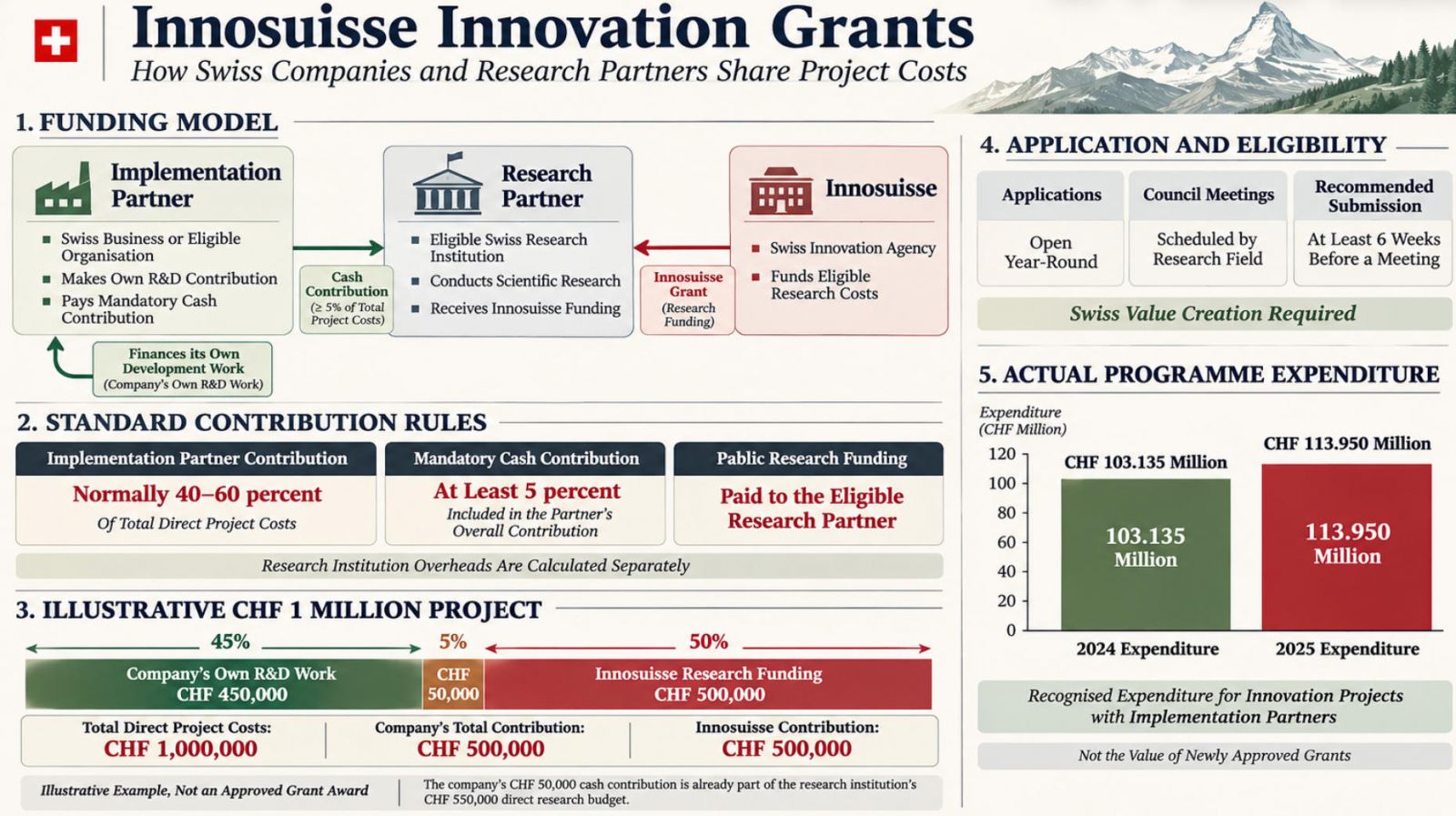
The financial structure is one of the most important aspects of an Innosuisse application because the programme depends on the relationship between company expenditure, research institution expenditure and the public contribution. Under the standard rules, implementation partners collectively cover between 40 and 60 percent of the project's total direct costs, excluding the separately calculated overhead contribution. The implementation partners' share includes both their own eligible project activities and a mandatory cash payment towards the research partner's costs. That cash contribution must normally represent at least 5 percent of total direct project costs and is included within the company's overall required contribution. It is not an additional percentage imposed on top of the usual 40 to 60 percent range, and misunderstanding this point can lead to a materially incorrect project budget.
A realistic CHF 1 million collaborative innovation project
Consider a hypothetical Swiss industrial company developing an advanced production monitoring system together with a university of applied sciences. Total direct research and development costs amount to CHF 1,000,000, of which the company performs CHF 450,000 in engineering and development activities while the university performs scientific research worth CHF 550,000. The company contributes CHF 50,000 in cash towards the university's research expenditure, leaving CHF 500,000 of eligible university costs to be financed directly by Innosuisse. As a result, the company's total contribution consists of CHF 450,000 in its own work and CHF 50,000 transferred to the university, while the agency provides the remaining CHF 500,000. The arrangement therefore creates a project with equal financing shares from the implementation partner and Innosuisse, although the public contribution is paid to the research institution rather than to the company.
Table 3. Illustrative CHF 1 Million Innosuisse Collaborative Project Budget
| Budget component | Amount, CHF | Financing source |
|---|---|---|
| Company's own research and engineering activities | 450,000 | Implementation partner |
| Research institution costs covered by the company's cash contribution | 50,000 | Implementation partner |
| Remaining eligible research institution costs | 500,000 | Innosuisse |
| Total direct project costs | 1,000,000 | |
| Total implementation partner contribution | 500,000 | 50 percent |
| Total Innosuisse direct contribution | 500,000 | 50 percent |
Illustrative financial model based on standard Innosuisse co-financing principles. It is not an actual approved project. Research institution overhead contributions are excluded.
The university performs work worth CHF 550,000, but only CHF 500,000 of that amount is financed by Innosuisse, with the remaining CHF 50,000 coming from the implementation partner. The business contributes CHF 500,000 overall and participates in a collaborative research project with total direct costs of CHF 1 million. It would be incorrect to add the CHF 50,000 cash payment to the CHF 1 million total again because the transfer finances part of the university's existing research expenditure rather than creating an additional research activity. It would also be misleading to claim that the company has received a CHF 500,000 government grant, as those funds are paid directly to the research partner. The company's potential advantage lies in access to scientific expertise, project results and capabilities that may reduce the cost and technical risk of developing a commercially valuable innovation.
A smaller innovation project for a Swiss startup
The same principles can apply to a younger technology company with more limited financial resources. Suppose a Swiss startup is developing a medical measurement device with a university and plans a project costing CHF 600,000 in total direct expenditure, comprising CHF 250,000 in its own development work and CHF 350,000 in university research. The startup contributes CHF 30,000 in cash to the university, exactly 5 percent of the total direct costs, while Innosuisse finances the remaining CHF 320,000 in university expenditure. The startup's combined contribution is therefore CHF 280,000, or approximately 46.67 percent of the project, and the Innosuisse direct contribution is approximately 53.33 percent. The calculation can be expressed as CHF 250,000 in startup development activities plus CHF 30,000 in cash paid to the university plus CHF 320,000 in Innosuisse funding, equalling CHF 600,000 in total direct costs.
This example also demonstrates why the amount of public funding and the actual cash requirement of the implementation partner must be analysed separately. The startup does not receive CHF 320,000 into its own account, and its CHF 250,000 contribution in development work is not necessarily a cash transfer to the university. The company must nevertheless possess enough personnel, materials, technical capabilities and financial resources to perform the activities it commits to delivering. Its mandatory cash payment creates an additional liquidity requirement that must be planned before the project begins. A correct financing model should therefore distinguish the value of internal work from money transferred between partners, while ensuring that each expense is counted only once.
Can the company contribute less than 40 percent?
The ordinary co-financing range of 40 to 60 percent is not entirely inflexible because Swiss innovation legislation allows Innosuisse to approve departures from the standard requirements in specified circumstances. A lower implementation partner contribution may be considered when unusually high project risks, particularly substantial potential economic or societal benefits, benefits extending to a wide group of users, or special implementation circumstances justify different treatment. Conversely, Innosuisse may require a higher contribution in certain situations, depending on factors such as the level of risk and the implementation partner's financial capacity. Such exceptions need an appropriate legal basis and must be assessed individually rather than assumed by the applicant. A startup should therefore not expect a lower contribution simply because it has limited financial reserves, and the normal funding rules remain the starting point unless the agency approves a different arrangement.
4. Eligible Project Costs and Research Institution Overheads
Correctly calculating eligible expenditure is essential because an Innosuisse project normally includes two different forms of activity: scientific research carried out by an eligible research institution and implementation-oriented development work performed by the commercial partner. Research institution budgets may include qualifying personnel costs and necessary material expenditure, provided the costs are directly connected to the proposed project. Personnel expenditure is determined using the approved notional hourly rates applicable to the institution, and researchers must document the time devoted to the funded activities. The institution must also be able to substantiate the expenses during financial reporting, while ensuring that personnel costs already fully covered by another public or external funding source are not claimed again. This restriction may be particularly relevant to professors and other academic staff whose regular salaries are supported through existing institutional financing arrangements.
Equipment, materials and specialist services
Research-related material costs can include consumables, project-specific software, specialised technical equipment and certain external services when these are necessary for the scientific work. However, ordinary equipment forming part of a research institution's standard infrastructure is generally not eligible for new funding through the project. Basic office computers, standard software and routine institutional facilities should therefore not automatically be charged to Innosuisse, whereas specialised equipment required for particular experiments may qualify under the relevant conditions. Where depreciation rules apply, the attributable cost must reflect the approved accounting treatment and the proportion of use devoted to the funded research. Applicants should also distinguish genuinely necessary research equipment from general capital investments that would remain useful to the institution independently of the project.
External services must be appropriate to the research activities and sufficiently justified within the budget. In limited situations, a Swiss research institution may engage a foreign research organisation for specialised tasks when the work requires expertise that is not otherwise available through the project partners. Necessary international travel can also qualify, including activities such as overseas sample collection or experimental work that cannot reasonably be performed in Switzerland, while ordinary domestic travel costs are generally not reimbursed under the standard rules. Expenses relating to marketing the research results, registering intellectual property or publishing research findings are not automatically eligible research costs. Each category should therefore be examined against the current financial guidance instead of being included simply because it may contribute indirectly to the project's commercial development.
How company personnel costs are calculated
Implementation partners can count necessary personnel and material expenditure towards their own contributions, subject to the applicable accounting rules. Personnel expenditure is generally based on the relevant hourly rate methodology established by Innosuisse, with adjustments possible in specified circumstances, and the standard calculation also includes an additional allowance of 20 percent for employer contributions to qualifying personnel costs. These expenses must correspond to genuine project work, such as prototype testing, technical development, engineering validation or integration of research findings. Ordinary sales activities, unrelated production expenditure and general commercial administration should not be relabelled as innovation work merely to increase the company's contribution. A credible budget must therefore connect each major cost item to a defined research or development responsibility.
Research institution overhead funding
In addition to its direct research contribution, Innosuisse may provide eligible research partners with separate funding for indirect institutional costs. These overhead contributions help compensate research organisations for expenses associated with infrastructure, administration and other supporting activities that are not fully represented in their direct research budgets. The applicable rates depend on the rules in force when an application is submitted, and historical rates published for earlier funding periods should not automatically be applied to projects submitted in 2026 or 2027. A financial model should distinguish total direct project costs, the company's direct contribution, Innosuisse's direct research funding and any separately calculated overhead contribution. Keeping these components separate prevents overhead funding from being incorrectly included in the base used to calculate the implementation partner's ordinary contribution.
Innosuisse subsidies themselves are not treated as remuneration for services subject to Swiss value-added tax. Nevertheless, payments between research and implementation partners, institutional expenditure and particular transactions within the project may still have VAT implications under the applicable rules. Applicants should therefore verify the tax treatment of their actual financial arrangements rather than assume that the grant's status removes VAT considerations from every project activity. Particular attention may be necessary when companies operate across borders or when research institutions provide services under agreements containing additional commercial provisions. These questions should be resolved early enough to avoid errors in the budget or subsequent financial reporting.
5. When to Apply: Innosuisse Funding Schedule for 2027
One advantage of the standard collaborative innovation scheme is that companies do not need to wait for a single annual application window, as Innovation Projects with Implementation Partners accept submissions throughout the year. However, the Innovation Council meets according to a defined schedule covering five thematic areas, and the timing of a submission can affect when a proposal is considered. Innosuisse advises applicants to submit at least six weeks before the relevant decision meeting if they want their application to be considered at that meeting, assuming the formal review and expert assessment proceed without delays. This is a planning recommendation rather than a separate legally binding application deadline. The distinction is especially important for applicants preparing financial commitments, university staffing arrangements or experiments that must take place during a particular season.
Table 4. First Scheduled Innosuisse Innovation Council Meetings in 2027
| Thematic area | First scheduled meeting in 2027 | Six-week planning reference |
|---|---|---|
| Energy & Environment | 22 January 2027 | 11 December 2026 |
| Engineering | 27 January 2027 | 16 December 2026 |
| Information & Communications Technologies | 3 February 2027 | 23 December 2026 |
| Life Sciences | 27 January 2027 | 16 December 2026 |
| Social Sciences & Business Management | 4 February 2027 | 24 December 2026 |
Meeting dates are published by Innosuisse. The six-week planning references are calculated guidance dates, not separate legally binding application deadlines. Innosuisse may change meeting dates.
Continuous submission does not mean that an application received shortly before a scheduled meeting will necessarily be assessed during that session. The agency must first verify the completeness and formal eligibility of the application, after which the scientific and commercial evaluation needs to be completed before a funding decision can be made. Innosuisse indicates a typical decision period of approximately six to eight weeks for standard projects when the process proceeds smoothly, but actual timing can depend on the meeting calendar and any requests for clarification. An incomplete research plan, uncertain financial contribution or unresolved partner eligibility issue may delay assessment. Companies should therefore coordinate the proposed project start date with the university and allow sufficient time for the funding agreement to be finalised.
Choosing the appropriate thematic evaluation group
The Innovation Council operates through five thematic groups: Information and Communications Technologies, Energy and Environment, Engineering, Life Sciences, and Social Sciences and Business Management. Engineering projects may involve advanced manufacturing, mechanical systems, materials science, electronics, robotics, measurement technology and photonics, while Life Sciences includes medical devices, biotechnology, pharmaceuticals, agricultural technologies and diagnostics. Energy and Environment covers renewable energy, efficiency improvements, energy storage, environmental protection, recycling and sustainable resource management. Information and Communications Technologies includes artificial intelligence, cybersecurity, data science, communication systems and digital automation, whereas Social Sciences and Business Management encompasses innovation in education, public administration, finance, business organisation and related areas. Interdisciplinary projects may combine several of these fields, so applicants should explain the scientific disciplines involved and identify the most appropriate route through the application system.
6. What Innosuisse Evaluators Expect from an Application
Innosuisse evaluates applications by considering scientific quality, technical novelty, economic potential, implementation feasibility and broader societal value. The first stage is a formal eligibility review conducted by the agency's secretariat, followed by substantive assessment from two independent experts. The Innovation Council uses the evaluation findings when deciding whether a project should receive funding. The published criteria include the degree of innovation, value creation in Switzerland, methodological quality, partner expertise and contributions to sustainable development. Rather than relying on a single attractive feature, applicants must explain why these different elements collectively justify public support.
Demonstrating genuine technological novelty
A proposal should identify the limitations of existing scientific knowledge, technologies or commercial solutions and explain why the proposed work represents a meaningful advance. The research must address uncertainties that cannot be resolved through ordinary product adaptation or routine engineering alone, which is particularly important when the implementation partner already has an established technical department. For example, a company developing a medical diagnostic sensor should describe the scientific limitations of existing measurement methods, its proposed technological approach and the experiments necessary to validate its performance. Evidence from scientific literature, preliminary testing, patent analysis and competitor research can help demonstrate where existing solutions fall short. However, these preparatory activities should support the planned research rather than constitute its main funded content.
The updated Innosuisse Practical Guide, published on 10 November 2026, reinforces the expectation that substantial preliminary preparation should be completed before the application is submitted. Literature reviews, patent searches, basic market assessments and initial clarification of existing technologies are normally treated as preparatory activities rather than the central research work for which funding is sought. Applicants should therefore avoid presenting ordinary background research as if it were the technological innovation itself. Instead, the proposal should show precisely which scientific uncertainties remain and how the planned experiments will resolve them. This approach helps evaluators distinguish a genuinely research-intensive project from a commercial product concept that has not yet been sufficiently developed.
Creating measurable value in Switzerland
Potential value creation is a central evaluation criterion because Innosuisse wants to understand what will happen after the research results become available and why their implementation matters to the Swiss economy or society. For commercial projects, the analysis should address target customers, the relevant market, competitors, the business model and the financial benefits expected from the innovation. The updated practical guidance encourages applicants to consider realistic selling prices, production costs, gross margins, recurring expenses and potential break-even scenarios over a period of three to five years. Depending on the project, net present value calculations may also help illustrate the difference between developing the technology with and without public support. These estimates should be based on transparent assumptions rather than unexplained market projections or claims of guaranteed commercial success.
A manufacturing company developing a technology to reduce material waste could, for example, estimate the potential economic benefit using its current material expenditure, historical waste levels, expected implementation costs and realistic adoption assumptions. If the technology is intended for sale to other companies, the proposal should also explain the customer problem, likely purchasing decisions and the competitive alternatives available in the market. For social or environmental innovations, value creation may be broader than direct commercial revenue because benefits can include lower healthcare costs, reduced environmental damage or improved public services. Nevertheless, applicants must explain how these benefits will be achieved, measured and maintained after the research funding ends. A technically promising solution without a credible implementation mechanism may struggle to demonstrate the expected Swiss added value.
Technical feasibility, project management and sustainability
A convincing research plan connects scientific objectives with work packages, measurable milestones, clearly assigned responsibilities and suitable experimental methods. Evaluators consider whether the proposed approach can produce meaningful results and whether the requested resources are proportionate to the scientific challenges involved. Strong applications acknowledge that technological uncertainty is inherent in industrial research, but they also explain how unexpected results will be assessed, how experimental methods may be revised and which decisions will be taken if initial assumptions prove incorrect. This is especially important for projects involving biological systems, new materials, complex engineering or artificial intelligence, where laboratory performance may differ considerably from real operating conditions. A project plan that combines scientific ambition with realistic risk management is generally more convincing than one that assumes every development stage will succeed without difficulty.
Artificial intelligence projects may require additional attention to model reliability, data protection, explainability, bias, information security and human oversight. An AI-based medical technology, for example, should consider false-positive and false-negative results, changes in the data environment and the consequences of inaccurate automated recommendations rather than relying solely on a general claim of improved efficiency. Environmental projects face comparable evidence requirements because reducing one type of pollution or resource consumption may create additional effects elsewhere. Sustainability should therefore be supported by indicators, measurement methods and an analysis of possible negative consequences. The strongest proposals integrate scientific credibility, technical innovation, economic value and environmental or societal responsibility within one coherent research strategy.
7. Intellectual Property: Who Owns the Results?
Intellectual property arrangements are among the most commercially important aspects of an Innosuisse-funded collaboration because the participating organisations often contribute different forms of knowledge and resources. A company may provide specialised engineering expertise, market access and technical equipment, while the university develops patentable inventions, scientific methods, algorithms or new materials. The partners therefore need to establish how pre-existing intellectual property, newly created results and future improvements will be treated. Uncertainty in these arrangements can affect not only the project itself but also later investment decisions, commercial licences and international expansion. Intellectual property negotiations should consequently begin before the application is submitted rather than being left until commercialisation becomes imminent.
Article 41 of the Swiss Research and Innovation Promotion Ordinance establishes minimum requirements governing the use of intellectual property arising from funded collaboration. Under these rules, implementation partners are entitled to at least free, non-exclusive use and commercial exploitation of the supported project's results in the area of their products and services. This provides a valuable minimum entitlement, but it does not automatically make the company the exclusive owner of every patent, invention or research result. A business seeking exclusive rights, control over particular patents or restrictions on access by competitors may need additional agreements with the research institution. The distinction between ownership, exclusive licensing and non-exclusive use can have major financial implications when the innovation becomes commercially valuable.
Partners should discuss existing patents, background technology, future inventions, software ownership, access to research datasets, confidentiality, publication rights and licensing arrangements before committing to the project. Innosuisse requires intellectual property and usage rights to be regulated no later than three months after the project begins, and the required confirmation must be provided under the relevant funding arrangements. The agency may request the actual agreement in particular circumstances, while additional obligations in the grant agreement may need to be satisfied before research financing can continue normally. For startups intending to raise capital, unresolved intellectual property rights can complicate investment negotiations even when the underlying technology is technically promising. A clear agreement protects the interests of both the commercial and scientific partners and makes future exploitation of the research results more predictable.
8. Innosuisse Funding Statistics: What the Latest Annual Report Shows
Switzerland's public innovation system operates at a substantial financial scale, and Innosuisse's Annual Report 2025, published in April 2026, provides the latest complete annual financial picture available for this analysis. The report documents strong demand for innovation funding in an environment characterised by geopolitical uncertainty, rapid technological change and increasing competitive pressure on businesses. Innosuisse received an ordinary federal contribution of CHF 305.1 million in 2025, supplemented by CHF 28.7 million in transitional funding associated with Horizon Europe. These figures describe broader financing of the agency rather than the budget of the standard collaborative innovation scheme alone. The financial statements provide a more appropriate breakdown of expenditure recognised under different programmes, allowing the scale of implementation-partner projects to be examined separately.
Table 5. Innosuisse Innovation Funding Expenditure in 2024 and 2025
| Funding category | 2024, CHF million | 2025, CHF million |
|---|---|---|
| Innovation projects with implementation partners | 103.135 | 113.950 |
| Innovation projects without implementation partners | 25.019 | 27.699 |
| Startup innovation projects | 31.445 | 33.526 |
| International innovation projects | 26.411 | 20.008 |
| Flagship innovation projects | 9.610 | 16.053 |
| Innovation Cheques | 9.396 | 7.503 |
| Research institution overhead contributions | 24.262 | 29.163 |
| Total innovation promotion expenditure across all instruments | 345.972 | 316.776 |
Source: Innosuisse Annual Report 2025, financial statements. The total includes additional funding categories not individually displayed in this table. Figures represent amounts recognised in the annual accounts, not exclusively new grants approved during each year.
Expenditure recorded for Innovation Projects with Implementation Partners increased from CHF 103.135 million in 2024 to CHF 113.950 million in 2025, representing growth of approximately 10.5 percent. This increase is notable because total innovation promotion expenditure across all Innosuisse instruments decreased over the same period. The different trends reflect changes in the financial development of individual programmes rather than a uniform expansion of the entire innovation funding system. The figures also show why funding statistics must be interpreted carefully: expenditure recognised in a particular year can relate to previously approved projects that continue over several financial periods. It should not be described automatically as the value of entirely new grants awarded during that year.
Application demand reached a new high
The annual management report records 832 applications in the national innovation project category discussed in connection with regular implementation-partner projects and a targeted SME funding initiative, representing approximately 38 percent growth compared with the preceding year. The annual report's shorter public summary also refers to around 1,100 national innovation project applications, approximately 35 percent above the previous year. These statistics reflect different reporting scopes and should not be treated as interchangeable figures for the ordinary implementation-partner scheme. The 832-application figure provides valuable context for the demand facing collaborative innovation funding, but it should not be presented as exclusively standard applications without acknowledging the targeted initiative. Similarly, calculating a programme success rate by combining one of these application figures with unrelated approval statistics would produce a misleading result.
The available evidence nevertheless indicates strong demand for public innovation support in Switzerland. Innosuisse has acknowledged that rising application volumes create pressure on funding resources and may require more selective prioritisation. Businesses should therefore not interpret the year-round application process as evidence that competition for grants is weak. Strong applications still need to demonstrate research quality, credible implementation plans and reasonable financial requirements. These pressures also make early preparation and appropriate programme selection increasingly important.
What Swiss SMEs say about the application process
In January 2026, Innosuisse published a qualitative study based on interviews with 46 representatives of small and medium-sized enterprises. The research included businesses that had received innovation funding, companies whose applications had been rejected and organisations that had never applied. The study found that Innosuisse remained insufficiently known among some Swiss SMEs, although organisations familiar with the agency generally viewed its professional capabilities positively. Significant preparation requirements, limited internal personnel capacity and financial constraints were among the obstacles affecting participation. These findings suggest that the difficulty of obtaining innovation funding is not limited to the quality of a technical idea, as companies may also lack the resources necessary to develop a complete research, financial and commercial proposal.
For smaller businesses, external expertise can therefore be particularly valuable during the initial stages of a funding project. A company may understand its technical problem and possess strong market knowledge while lacking experience in identifying suitable research institutions, calculating the mandatory financial contribution or preparing scientific evidence for independent evaluation. Assistance with programme selection, budget structure and collaboration agreements can reduce these administrative obstacles, although it cannot guarantee that the proposed research will be approved. The study also indicates that improving access to information about available instruments could help more Swiss SMEs explore public innovation financing. This creates a clear rationale for specialist grant advisory services focused on the practical requirements of research-intensive business development.
9. Does Innosuisse Funding Improve Business Performance?
Beyond the amount of public expenditure, a central question is whether supported research collaborations produce measurable economic results. An academic study conducted by the KOF Swiss Economic Institute at ETH Zurich provides important evidence about the effects of Innosuisse-supported cooperation between businesses and public research institutions. Using company-level data and a difference-in-differences methodology, researchers compared supported enterprises with otherwise similar firms that had not received the funding. The analysis considered characteristics such as research expenditure, workforce qualifications and competitive conditions to strengthen the comparison. Its objective was not merely to record whether companies were satisfied with the programme but to estimate how their performance differed from what might have occurred without the support.
Over a five-year observation period, the researchers estimated that Innosuisse funding increased participating companies' sales by approximately 21 percent and employment by approximately 18 percent, on average, relative to comparable unsupported businesses. The estimated effects also tended to increase over time, suggesting that some benefits of scientific collaboration emerge gradually rather than immediately after a project concludes. The findings were particularly relevant to smaller companies and certain forms of university-industry cooperation, including collaborations with institutions in the ETH domain and universities of applied sciences. However, these figures are average estimated effects within the research population, not guaranteed outcomes for an individual applicant. A business preparing a grant proposal should not treat the estimated 21 percent increase in sales as a reliable forecast of its own future revenue.
What the Innosuisse impact monitor reveals
Innosuisse's own impact monitoring offers another perspective by following the implementation of innovations after funding has ended. At project completion, approximately 45 percent of supported innovations had already been implemented or were planned for implementation within the following year. Three years after completion, 57 percent had been implemented or were expected to be implemented within the subsequent two years. These combined measures include both actual implementation and stated plans, so they should not be represented as the proportion of projects that had already achieved successful commercialisation. The monitoring also found that approximately 19 percent of higher-risk projects were no longer being implemented or continued three years after their completion, illustrating that technological uncertainty can persist even when public research support has been provided.
Other monitoring findings indicate that approximately one-third of participating SMEs reported employment growth, around three in ten reported increased sales and 12 percent reported cost savings. Nearly half of the companies also continued working with their research partners three years after the original projects had ended, suggesting that the programme can create relationships extending beyond the period of financial support. This is particularly relevant to the Innosuisse model because the intended benefit includes sustained knowledge transfer between science and industry, not simply completion of an isolated development task. Continued collaboration may enable additional research, improvements to existing products or the development of entirely new applications. Nevertheless, these reported outcomes describe observed patterns among monitored participants and should not be treated as promises of commercial success.
Innosuisse's impact analysis also estimates that one Swiss franc of project funding generates approximately four francs of direct economic value creation over the specified measurement horizon, with a higher multiplier when estimated indirect effects are included. Such figures depend on the assumptions and methods used in the evaluation and do not represent money paid to the companies receiving support. They are better understood as estimates of broader economic effects associated with the programme. Together with the KOF research, they provide evidence that collaborative innovation funding can produce meaningful results while also demonstrating the importance of careful interpretation. The effects of any individual research project will still depend on its scientific success, commercial implementation and market conditions.
10. Real Innosuisse Projects: Technologies, Partners and Confirmed Outcomes
The value of the Swiss collaborative model becomes more tangible when examining individual funded projects. Official Innosuisse case studies describe how businesses combine practical production knowledge with specialised academic expertise to address technical challenges that would be difficult to solve independently. The examples cover different industries and demonstrate that successful research collaboration does not always lead immediately to commercial deployment. Some projects produce working prototypes while identifying additional scientific questions, whereas others achieve measurable improvements during trial operations or prepare innovations for future market entry. Understanding these distinctions is essential when evaluating the actual achievements of publicly supported research.
TerraRad Tech: Advanced moisture sensing for agriculture
In August 2026, Innosuisse presented a collaboration involving TerraRad Tech, ETH Zurich, the Swiss Federal Institute for Forest, Snow and Landscape Research (WSL) and Agroscope. The project focused on developing and testing a miniaturised microwave sensor designed to measure moisture-related properties of soils and vegetation, with potential applications in agricultural irrigation and harvest planning. Accurate moisture information can help farmers determine when water is required and may support more efficient management of crops under changing weather conditions. The consortium mounted the sensor on a drone to collect high-resolution observations across agricultural fields, exploring an approach different from relying exclusively on conventional ground-level measurements. The technology sought to provide useful information while making advanced sensing equipment smaller and more suitable for practical field deployment.
Each participating research organisation contributed distinct capabilities. ETH Zurich worked on hardware development and testing, WSL investigated the modelling of microwave emissions from vegetation, and Agroscope contributed agricultural expertise, experimental design and field measurement capabilities. The collaboration produced and tested a sensor prototype, and initial hardware results were presented at an international remote-sensing conference in 2023. However, the research also revealed technical challenges because soil and crop temperatures, the orientation of cereal spikes and changes in surface conditions following rainfall affected measurement accuracy more strongly than expected. These findings demonstrate that a promising prototype may still require substantial scientific work before its performance is reliable across different operating environments.
Further algorithm development remains necessary to achieve consistently accurate measurements under varying agricultural conditions, while the company has also identified potential applications in turfgrass management and autonomous mowing equipment. Innosuisse's case study discusses the possibility of reducing agricultural water consumption by up to 30 percent when appropriate moisture information is combined with suitable irrigation technology. That figure should be interpreted as a potential application benefit rather than a universally verified result achieved by the TerraRad sensor on Swiss farms. The project is especially informative because it documents experimental progress and remaining technical uncertainties instead of presenting research funding as proof of a completed commercial product. It illustrates why public support may be valuable precisely when promising technology still faces unresolved scientific challenges.
Hoffmann Neopac: Reducing material waste in industrial manufacturing
Another relevant case involves Hoffmann Neopac AG, a Swiss manufacturer of multilayer packaging tubes used in pharmaceuticals, cosmetics and consumer products. The company collaborated with the Institute of Automation at the University of Applied Sciences and Arts Northwestern Switzerland (FHNW) to address a specific production challenge. Different laminate materials require adjustments to the machinery used to unwind, form and weld packaging tubes, and material can be wasted while the equipment is being configured to achieve the correct operating conditions. Reducing the time and waste associated with these adjustments could create both economic and environmental benefits for the manufacturer. The research therefore concentrated on improving the underlying control process rather than merely replacing existing machinery with commercially available equipment.
The consortium developed a system combining physical simulation models with advanced control methods to automate machine setup more effectively. The university contributed expertise in mathematical modelling and industrial automation, while Hoffmann Neopac provided detailed knowledge of production processes and access to practical testing conditions. According to the company, trial operations produced a 3 percent reduction in scrap and reduced machine changeover times by approximately half. These are reported results from trial operations rather than theoretical projections, making the case particularly useful for understanding how innovation benefits can be measured. However, the technology was still undergoing trial implementation when Innosuisse published the case in September 2026, and broader deployment had not yet been completed.
The company expects more extensive material savings and reduced carbon dioxide emissions if the technology is implemented across its production facilities. Those broader benefits remain projections until wider implementation and subsequent measurement demonstrate the outcomes. A grant application should make the same distinction between improvements established through experiments and benefits anticipated after commercial expansion. The Hoffmann Neopac project illustrates how relatively specialised industrial research can affect operational performance without necessarily producing an entirely new consumer product. It also shows how academic expertise can help manufacturers solve technically complex problems that have direct implications for production costs and resource efficiency.
Wenger Fenster: Energy-efficient ventilation integrated into windows
A third example comes from Wenger Fenster, a Swiss family-owned manufacturer of timber and timber-metal windows based in the canton of Bern. The company collaborated with Bern University of Applied Sciences to develop an active ventilation system integrated into a window structure, combining ventilation components, filters and heat exchange to improve indoor air circulation while limiting heat losses. The project required knowledge of airflow behaviour, ventilation engineering and system integration that extended beyond the company's established manufacturing specialisation. By cooperating with university researchers, the company could investigate a new technology area while retaining its practical expertise in window design and production. The arrangement demonstrates how scientific partnerships can help traditional SMEs expand their technological capabilities without abandoning their existing business activities.
The research institution contributed modelling and engineering expertise that supported the development of the new ventilation solution. By September 2025, the technology had been developed, but further pilot testing and preparations for commercial market entry were still planned. Wenger Fenster estimated that products incorporating the new system could eventually account for several percent of its revenue over a period of five to ten years. This was a forward-looking business expectation rather than a confirmed economic outcome, and the distinction matters when assessing the maturity of the innovation. The case illustrates a practical route through which established manufacturers can diversify their products by combining internal production capabilities with university research.
What these three cases demonstrate
The three projects share a common structure in which an implementation partner identifies a commercial problem, a research institution contributes specialised scientific knowledge and Innosuisse helps make the collaboration financially accessible. Their outcomes nevertheless represent different stages of innovation, ranging from prototype development and unresolved measurement challenges to confirmed improvements in trial operations and preparation for market introduction. TerraRad Tech demonstrates the importance of continued validation, Hoffmann Neopac provides an example of measurable manufacturing benefits, and Wenger Fenster illustrates technology development that had not yet reached full commercial deployment. The exact grant amounts for these projects were not established in the reviewed official case-study publications and should therefore not be estimated from average programme spending. They are most useful as verified examples of collaboration, technological development and reported achievements, with confirmed results kept separate from expectations about future commercial performance.
11. Innosuisse Startup Grants, Innovation Cheques and Other Funding Schemes
Businesses researching Innosuisse funding encounter several programmes with similar names but substantially different eligibility and financial conditions. This can create confusion, especially for startups looking for direct financial support and SMEs seeking a research partnership. The ordinary Innovation Projects with Implementation Partners scheme does not provide the company with a direct grant, while other instruments may finance business expenditure more directly or support preliminary studies with much smaller budgets. International cooperation schemes introduce additional differences related to participating countries and national funding arrangements. Choosing the correct programme therefore requires an understanding of the company's development stage, the intended partners and the type of expenditure for which public support is needed.
Table 6. Comparison of Major Innosuisse Innovation Funding Instruments
| Funding instrument | Main target group | Key funding characteristics |
|---|---|---|
| Innovation Projects with Implementation Partners | Businesses collaborating with eligible Swiss research institutions | Funding goes to the research partner; implementation partners normally contribute 40 to 60 percent of direct project costs |
| Start-up Innovation Projects | Eligible Swiss startups before market entry | Direct startup funding covering up to 70 percent of eligible direct project costs |
| Innovation Cheque | Swiss SMEs and other eligible organisations with fewer than 250 full-time equivalent employees | Up to CHF 15,000 for a preliminary study conducted by a Swiss research partner |
| Innovation Projects without Implementation Partners | Eligible Swiss research institutions | Research funding without an implementation partner; normally limited to 18 months |
| Swiss Accelerator | Eligible Swiss startups and SMEs already established on the market | Separate direct funding instrument, with its own calls and limits |
| International Innovation Projects | Qualifying international research and business consortia | Country-specific rules; direct company contributions may be available under the relevant international scheme |
Funding instruments have separate conditions, application procedures and availability. The financial rules of one scheme must not be applied automatically to another.
Direct Innosuisse funding for startups
Start-up Innovation Projects are designed for eligible Swiss startups preparing to enter the market with innovative products or services. Unlike standard collaborative projects, this instrument provides funding directly to the startup and can cover up to 70 percent of eligible direct project costs under the published rules, with the company contributing at least 30 percent. The startup must have its headquarters in Switzerland, be registered in the Swiss commercial register and demonstrate a scalable business model. The instrument primarily targets companies before market entry, although certain limited preliminary activities or prototype testing may be compatible with the requirements. An independent research institution is not mandatory for this scheme, making it fundamentally different from the ordinary implementation-partner model.
Eligibility also depends on the company's age, development stage and other specific requirements established for startup funding. The usual company age limit is five years, although certain circumstances can justify exceptions extending to ten years. Applicants should evaluate the programme's definitions of market entry and company status carefully rather than assume that every recently established business qualifies. It would be incorrect to claim that all Innosuisse startup grants require university collaboration or that every startup can obtain direct financing through the standard collaborative scheme. The two instruments serve different purposes and should be considered separately according to the startup's actual research and financing needs.
Innovation Cheque: Testing an idea before a larger project
The Innovation Cheque can be particularly useful for SMEs that have an innovative concept but lack sufficient evidence to justify a substantial collaborative research project. It provides up to CHF 15,000 to finance a preliminary study conducted by an eligible Swiss research partner, with Innosuisse covering up to 100 percent of qualifying research institution costs within the voucher limit. Eligible implementation partners generally have fewer than 250 full-time equivalent employees and must satisfy the applicable Swiss establishment requirements. The company must already have identified a suitable research institution, while the preliminary study must be completed within the permitted six-month period. The standard rules also restrict repeated participation by organisations that received an Innovation Cheque within the preceding two years.
A preliminary study can investigate technological feasibility, innovation potential or early commercial opportunities before the company commits to a larger research programme. For example, a small engineering firm could work with a university to test whether a proposed measurement technology is scientifically feasible, establish preliminary performance data and identify the remaining technical uncertainties. Those results could later strengthen an application for an Innovation Project with Implementation Partners, provided the proposed follow-up work meets the relevant research and eligibility requirements. However, successful completion of an Innovation Cheque project does not create an entitlement to subsequent funding. The instrument should be treated as a possible preparation stage rather than an automatic first step in a guaranteed sequence of grants.
International innovation funding
Companies seeking direct cross-border research cooperation should examine Innosuisse's separate bilateral and multilateral funding mechanisms. Depending on the programme and participating countries, Swiss businesses may qualify for direct financial contributions that are not available to implementation partners under the ordinary national collaboration model. Relevant international schemes may support consortia involving Swiss SMEs, universities and foreign enterprises, but the applicable funding rates, eligible costs, partner requirements and submission deadlines can differ considerably. International applicants must therefore evaluate the specific programme rather than transfer assumptions from domestic Innosuisse rules. This is particularly important where the research work is divided between different countries or where a foreign company wants to receive public funding for its own activities.
12. Common Reasons for Weak or Unsuccessful Applications
An Innosuisse proposal may be formally eligible but still fail to convince evaluators if it does not demonstrate sufficient technological novelty, scientific uncertainty or commercial potential. One common weakness is an inadequate distinction between genuine research and ordinary product development, particularly when a company proposes improving an existing commercial process without explaining the scientific questions that remain unresolved. Another frequent problem is an insufficient market case, with applicants describing a large potential market while providing little evidence of customer demand, realistic pricing or the competitive advantages of the proposed solution. Current practical guidance indicates that preliminary commercial analysis is expected before submission rather than being deferred entirely until the funded project. A strong application should therefore explain both why the research is scientifically necessary and why its successful completion could create meaningful value.
Consortium design can also undermine a proposal when the research institution's contribution is poorly defined or does not require the specialised capabilities for which public support is being sought. If the scientific partner performs work that could be completed internally by the company through routine engineering, the rationale for research funding becomes more difficult to defend. Financial inaccuracies present another serious risk, particularly where the company's mandatory cash contribution is counted twice, the research partner's overhead contribution is included incorrectly or ordinary business expenditure is treated as eligible project work. Applicants should also resolve intellectual property expectations early enough to avoid disputes over patents, licensing or commercial rights after the research begins. Even a technically strong proposal can be weakened by uncertainty about whether the company has the personnel and resources required to fulfil its contribution.
A further weakness arises when scientific objectives are disconnected from a realistic implementation strategy. Innosuisse is interested in research capable of generating economic or societal value, so the application needs to explain how the results could progress beyond laboratory experiments and become useful in practice. This does not require applicants to guarantee commercial success, but it does require credible assumptions, relevant partners and a coherent development pathway. If an application is rejected, Innosuisse provides reasons for its decision, and applicants may prepare a revised proposal for submission as a new application. The published procedures also provide for legal appeal against formal decisions within the applicable period, although an appeal is distinct from improving the substance of a new funding proposal.
13. What Happens After an Innosuisse Grant Is Approved?
A positive decision by the Innovation Council does not mean that project participants can immediately begin spending public funds. The relevant funding agreement must first be concluded, and the funded project must then start within three months after that agreement takes effect. Innosuisse must be informed of the actual start date, while the partners need to complete the required intellectual property and usage rights arrangements within the applicable period after commencement. These obligations should be reflected in the consortium's internal planning because delays in contractual arrangements or partner commitments can affect the research schedule. Companies should also ensure that the researchers, equipment and other resources promised in the application will be available when the project begins.
During implementation, the consortium must perform the approved research, maintain suitable financial documentation and submit the required scientific and administrative reports. Major changes to the project, including adjustments to the partner structure, research objectives, timetable or financing arrangements, may require notification or formal approval from Innosuisse. Project partners should therefore establish a clear internal procedure for assessing important changes before committing to activities that differ from the approved proposal. The agency may also request interim financial information or additional documentation where necessary. Careful recordkeeping is particularly important because the implementation partner's contribution and the research institution's eligible expenditure both affect the final funding calculation.
At completion, the scientific and financial reports must demonstrate how the research was conducted and how the available resources were used. Final financial checks can affect the amount ultimately payable, especially if expenses are insufficiently justified or the implementation partner's contribution differs from the approved requirements. Innosuisse also monitors projects after completion to assess whether innovations have been implemented and whether they have generated economic or societal benefits. This longer-term evaluation reflects the agency's objective of supporting practical knowledge transfer rather than financing isolated research activities without subsequent use. Applicants should therefore consider commercialisation, implementation and continued collaboration from the beginning rather than treating them as tasks to address only after the grant ends.
14. Practical Strategy for Startups, SMEs and Grant Consultants
For organisations considering Innosuisse support, preparation should begin with choosing the appropriate funding instrument rather than immediately drafting a proposal. A startup seeking direct financing has different needs from a manufacturer seeking university research expertise, while an international company operating through a Swiss subsidiary may face additional eligibility questions. Once the correct instrument has been identified, the applicant should assess whether the proposed work involves genuine scientific innovation, whether an eligible research partner can contribute the necessary expertise and whether the expected benefits justify the project costs. The financial structure must then be developed in parallel with the research plan because the company's required contribution can influence the feasibility of the entire proposal. A well-designed application should connect technical objectives, financial capacity, intellectual property rights and market implementation within a coherent strategy.
A structured preparation process can focus on six priorities:
-
Select the correct funding scheme. Determine whether the project requires direct startup financing, a preliminary feasibility study, national research collaboration or an international consortium.
-
Identify a suitable research partner. Confirm the institution's eligibility, scientific expertise, independence, facilities and ability to address the specific technological challenge.
-
Demonstrate value creation in Switzerland. Explain where the innovation will be developed, how its results will be implemented and which economic or societal benefits are expected.
-
Prepare an accurate financial model. Separate company expenditure, mandatory cash contributions, research institution costs, public funding and any additional overhead contribution.
-
Clarify intellectual property arrangements early. Establish a shared understanding of existing technology, future inventions, licensing rights, commercial exploitation and research publications.
-
Develop a credible market and research case. Support the proposal with evidence of customer needs, competitors, technological limitations, experimental feasibility and realistic commercial assumptions.
These priorities should reinforce one another rather than become independent administrative exercises. A medical technology startup, for example, may identify an excellent university research partner but still need to address regulatory requirements, measurement reliability and the economic viability of its proposed product. An industrial manufacturer may have strong commercial knowledge and access to production facilities while requiring academic expertise to develop a new physical model or control method. An environmental technology company may demonstrate substantial ecological potential but still need a viable mechanism for financing deployment once public research support ends. The strongest applications explain how each partner contributes to overcoming these specific obstacles and how the intended innovation can move towards practical use.
Professional grant consultants can assist with eligibility assessment, funding instrument selection, research budget calculations, consortium coordination, market evidence and the preparation of clear technical narratives. Their contribution can be particularly valuable to smaller businesses that lack dedicated personnel for funding applications or to international companies unfamiliar with Swiss research and innovation rules. Nevertheless, grant-writing expertise cannot substitute for scientific novelty, a suitable research partner or the financial resources required by the implementation organisation. Companies and research institutions seeking experienced grant-writing specialists can explore professional collaboration opportunities through i-grants.com, an international platform connecting funding applicants with grant professionals. Effective external support should help applicants present a stronger and more coherent project rather than make unrealistic promises about approval or financial results.
15. Frequently Asked Questions About Innosuisse Innovation Grants
Can a Swiss company receive money directly through Innovation Projects with Implementation Partners?
Under the standard national collaborative model, the Innosuisse grant is paid directly to the eligible research partner rather than to the company. The implementation partner finances its own project activities and provides the mandatory cash contribution to the research institution, while benefiting from the scientific collaboration and the agreed rights to use its results. Companies seeking direct funding should examine other Innosuisse instruments, including the separate Start-up Innovation Projects scheme where appropriate. The financial conditions of those instruments differ from the ordinary collaboration model.
Does Innosuisse cover 50 percent of every innovation project?
No. Implementation partners normally finance between 40 and 60 percent of total direct project costs, including the mandatory cash contribution, while the remainder of the eligible research expenditure is covered through the public funding arrangement. The precise distribution depends on the approved budget and applicable rules, and certain exceptions may be possible under specified conditions. Separate overhead contributions can also apply to eligible research institutions. The programme should therefore not be described as a universal grant covering exactly half of every company's expenditure.
Is the 5 percent cash contribution additional to the company's ordinary co-financing?
No. The cash contribution forms part of the implementation partner's total required contribution and is normally at least 5 percent of total direct project costs. It is paid to the research institution to finance part of the eligible scientific activities rather than creating a new cost category outside the project budget. The same research expenditure must not be counted twice when calculating total costs. This distinction is essential for preparing a correct financial model.
Is there a maximum Innosuisse grant amount?
There is no universal fixed financial ceiling for standard Innovation Projects with Implementation Partners. However, the requested amount must be justified by the proposed research, the expected results, the project's complexity and a reasonable relationship between costs and benefits. The absence of a fixed ceiling does not guarantee approval of an unusually large budget. Other Innosuisse instruments may also have their own financial limits.
Can a startup apply without a university?
A startup applying under the standard Innovation Projects with Implementation Partners scheme needs an eligible Swiss research partner. Other funding instruments, particularly Start-up Innovation Projects, operate under different rules and may offer direct funding without requiring an independent university partner. Eligibility depends on factors such as the company's establishment, development stage, business model and the nature of its innovation. Startups should therefore identify the correct programme before deciding how to structure their research activities.
Can a foreign company participate?
A Swiss branch of a foreign company may participate as an implementation partner when it performs substantial activities and creates relevant added value in Switzerland. Foreign ownership alone does not necessarily exclude the company, but a nominal Swiss presence without meaningful operations may be insufficient. Businesses without qualifying Swiss activities should investigate the international innovation funding instruments available through Innosuisse and the relevant partner countries. These programmes have separate funding rates, deadlines and eligibility conditions.
Are social innovation and environmental projects eligible?
Yes. Innosuisse supports science-based innovation across a wide range of disciplines, including projects offering economic, societal and environmental benefits. Applicants must demonstrate appropriate scientific novelty, a credible research methodology and realistic opportunities for implementation, regardless of whether the intended value takes the form of commercial revenue or broader public benefits. Environmental and social objectives should also be connected to measurable indicators rather than presented only as general aspirations. The importance of Swiss value creation remains relevant across different project types.
When is the application deadline?
Standard Innovation Projects with Implementation Partners accept applications throughout the year, so there is no universal annual submission deadline for the ordinary scheme. Applicants are advised to submit at least six weeks before the relevant Innovation Council meeting if they want to target that meeting, subject to the normal assessment process. The meeting schedule can change, and submitting six weeks beforehand does not guarantee a decision at the selected session. Companies should therefore verify current dates and allow sufficient time for evaluation and contractual preparation.
Who owns the intellectual property created during the project?
The applicable legal rules provide implementation partners with minimum rights to use and commercially exploit supported project results on a free, non-exclusive basis within their fields of products and services. These rights do not automatically make the company the exclusive owner of all patents, inventions, research data or other intellectual property. Additional ownership and licensing arrangements must be clarified between the partners, with the required agreements concluded within the applicable project period. Businesses planning investment rounds or international commercialisation should examine these arrangements especially carefully.
Does Innosuisse funding guarantee higher revenue or business growth?
No. Independent economic research has identified positive average effects on supported companies' sales and employment, while Innosuisse's impact monitoring reports implementation activity and other benefits among participating organisations. However, these findings are statistical observations rather than guaranteed results for individual grant recipients. Technical development may fail, market conditions may change or commercial implementation may require additional resources after the funded research ends. Public funding can reduce certain barriers to innovation, but it does not eliminate the uncertainty associated with developing new technologies.
Conclusion: Switzerland's Collaborative Approach to Innovation Funding
Innosuisse offers a distinctive opportunity for companies seeking to develop scientifically advanced technologies through cooperation with eligible Swiss research institutions. Its Innovation Projects with Implementation Partners scheme does not operate like a conventional grant paid directly to a startup or SME, because the agency finances the research partner while requiring the implementation organisation to contribute its own resources and a defined cash payment. For businesses with limited internal research capacity, this arrangement can provide access to scientific expertise, specialised facilities and technical capabilities that would otherwise be difficult or expensive to obtain. The programme is especially relevant to organisations developing complex industrial processes, medical devices, environmental technologies, digital systems and other innovations that require more than routine engineering or commercial development. Its value lies not simply in the amount of public funding available but also in the structured cooperation it creates between research and industry.
The latest available evidence indicates that this model can produce meaningful economic and technological benefits. Innosuisse's annual financial statements show substantial expenditure on collaborative innovation, while independent KOF research identifies positive average effects on sales and employment among supported businesses. Official case studies involving TerraRad Tech, Hoffmann Neopac and Wenger Fenster demonstrate how cooperation with universities can produce new scientific knowledge, practical prototypes and measurable industrial improvements. Nevertheless, these projects also illustrate the uncertainty of innovation, as successful research does not always result immediately in a commercial product or verified environmental benefit. Funding decisions, experimental achievements and projected long-term outcomes must therefore be considered separately.
The programme's financial and legal conditions demand careful attention from applicants. A company must calculate its contribution correctly, distinguish internal development expenditure from mandatory cash payments and understand that the grant itself is normally paid to the research institution. The consortium must also demonstrate appropriate independence, agree on intellectual property rights and present a credible plan for creating added value in Switzerland. International organisations face additional questions about the substance of their Swiss operations and the suitability of national rather than international funding instruments. These requirements make early preparation particularly important for startups and SMEs with limited administrative or financial resources.
For prospective applicants, the strongest strategy is to begin with a well-defined technological or societal problem, select a research partner with relevant scientific capabilities and develop a rigorous plan connecting experiments, finances and implementation. A competitive proposal should demonstrate not only that a technology is scientifically interesting, but also that the planned research can overcome genuine uncertainties and create measurable economic or societal value. With applications accepted throughout the year and Innovation Council meetings scheduled by thematic area, organisations can plan their research partnerships around technological readiness and business needs rather than one annual deadline. For startups, SMEs and research institutions, Innosuisse represents an opportunity to transform scientific collaboration into practical innovation, provided the partnership is appropriately structured and supported by credible technical, financial and commercial evidence.