

 Français
 Deutsch
 Українська
Germany has developed one of Europe's most extensive systems of public support for research-based entrepreneurship, helping students, university graduates and scientists transform innovative ideas into commercially viable businesses. Among the country's most established funding instruments is the EXIST Business Start-up Grant, officially known as EXIST-Gründungsstipendium. Unlike conventional startup financing programmes that provide capital to already established businesses, EXIST supports aspiring founders during the critical period before their companies are formally created, when they must develop their technologies, assess market opportunities and prepare for independent commercial activity.
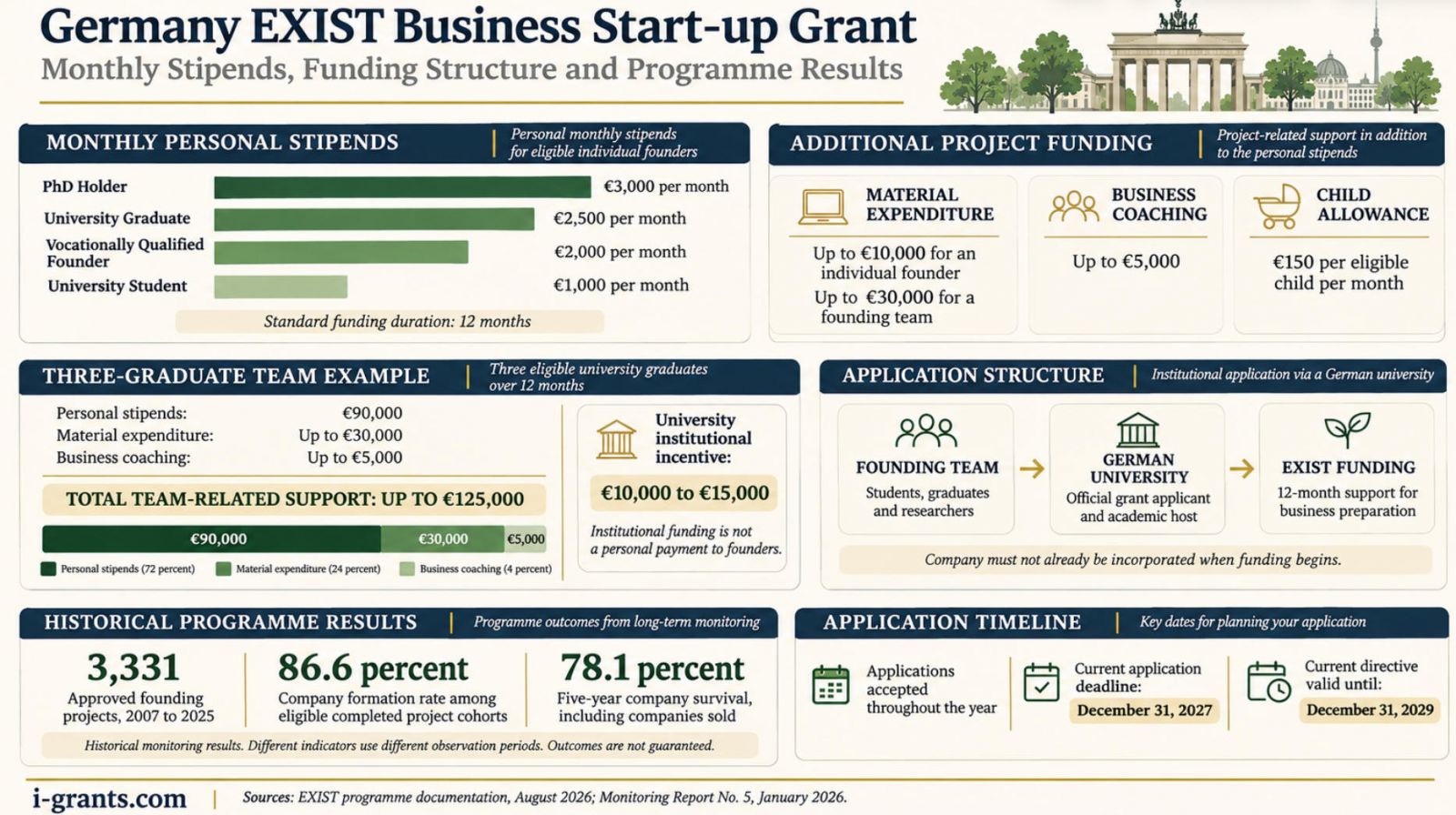
Under the current funding framework, eligible doctoral degree holders can receive a personal stipend of €3,000 per month, university graduates can obtain €2,500, founders with recognised vocational qualifications can receive €2,000, and students can qualify for €1,000. These payments normally continue for 12 months and are designed to allow participants to concentrate on preparing their businesses without immediately depending on commercial revenue. In addition to personal financial assistance, the programme provides up to €30,000 for material expenditure for founding teams, up to €5,000 for specialised business coaching and access to the facilities, scientific expertise and entrepreneurial networks of participating German universities and research institutions.
The overall financial value can be considerably higher than the advertised monthly stipend suggests. For example, a team of three eligible university graduates may receive a combined €90,000 in personal stipends over one year, together with up to €35,000 in project-related support. A separate institutional incentive may further increase the total public resources committed to the project. However, these amounts have different purposes and recipients, and it would be misleading to present the entire funding package as unrestricted capital transferred directly to a newly established company.
EXIST is particularly attractive to founders developing advanced software, biotechnology, artificial intelligence, medical devices, engineering solutions and other innovative products or knowledge-based services. Nevertheless, the programme is not restricted exclusively to conventional technology sectors. Its central requirement is a credible innovative business idea with identifiable competitive advantages, realistic commercial prospects and a founding team capable of implementing the proposed development plan.
Current programme status: As of November 13, 2026, EXIST-Gründungsstipendium remained open for applications throughout the year. Under the published funding directive, applications can be submitted until December 31, 2027, while the directive itself remains valid until December 31, 2029. These dates describe the current regulatory framework and should not be interpreted as confirmation that identical funding conditions will automatically continue beyond the stated periods.
For international founders, understanding the programme's institutional structure is especially important. The official applicant is a German university or eligible research institution, not the individual founder or the future company. The institution administers public funding, provides academic supervision and helps participants prepare for business formation. This article examines how the programme works, who qualifies, how much support is available, what happens to intellectual property and how thousands of previous participants have progressed from research-based ideas to independent enterprises.
What Is the EXIST Business Start-up Grant and Why Does Germany Fund It?
EXIST-Gründungsstipendium is a federal entrepreneurship support programme designed to encourage the commercial application of scientific knowledge and innovative ideas originating from universities and research institutions. It is financed by Germany's Federal Ministry for Economic Affairs and Energy (BMWE), with co-financing from the European Social Fund Plus (ESF Plus), and administered through Projektträger Jülich. The programme belongs to the wider EXIST initiative, which Germany introduced in 1998 to strengthen entrepreneurship education, improve university startup infrastructure and increase the economic use of publicly supported research.
The Business Start-up Grant has supported innovative founding projects since 2007. Its purpose is not simply to provide income replacement for researchers who wish to become entrepreneurs, but to create a structured transition between academic development and commercial independence. During the funding period, participants are expected to improve their technological concepts, investigate customer demand, develop business models, establish appropriate intellectual property arrangements and prepare a company capable of continuing after public assistance ends.
This approach addresses a persistent weakness in research-intensive entrepreneurship. Universities regularly produce scientific findings, experimental technologies and highly qualified graduates, yet relatively few academic discoveries become sustainable commercial ventures without additional support. Researchers may have extensive experience developing technologies but limited knowledge of customer acquisition, market entry, pricing or investment negotiations. Students may possess promising technical ideas but lack sufficient personal income, laboratory access or professional networks to devote a year to developing them into businesses.
Private investment does not always resolve these problems. Venture capital firms often prefer businesses that have already demonstrated commercial demand, secured intellectual property rights or achieved important development milestones. By contrast, university-based entrepreneurs may still be investigating whether their inventions can operate reliably outside laboratory conditions or whether prospective customers will pay for the proposed solution. EXIST helps bridge this early financing gap by providing personal stipends and institutional resources while the commercial foundations of the business are being established.
The programme also reinforces the role of universities as active participants in economic development. Rather than allowing researchers to work independently without structured entrepreneurial support, EXIST requires a host institution to provide scientific supervision, appropriate facilities and access to professional guidance. This institutional involvement can improve the quality of project preparation and help identify legal, technical or financial problems before a company becomes dependent on commercial investors.
Although EXIST is often associated with high-technology entrepreneurship, its scope is broader than laboratory inventions alone. An innovative knowledge-based service, new method of applying research or original digital business concept may also qualify if it demonstrates sufficient novelty and commercial potential. Ordinary retail operations, routine consulting services and businesses based primarily on existing technologies without meaningful innovation are less likely to satisfy the programme's objectives.
How EXIST-Gründungsstipendium Differs From Other Startup Grants
The most important distinction is that EXIST primarily supports people preparing to establish a business, not an existing company seeking expansion capital. Many European grant programmes require applicants to be incorporated enterprises with financial statements, registered capital and a defined operational history. EXIST takes a different approach: the planned company must not already have been formally established when the funding period begins, although incorporation is permitted later during the supported year.
The financial structure reflects this purpose. Monthly stipends provide eligible founders with personal support, while material expenditure and coaching funds help them carry out approved development activities. The university receives and administers the public funding, ensuring that the project remains connected to the required academic and entrepreneurial support environment. Consequently, applicants should evaluate EXIST as a business preparation programme rather than a direct investment grant for an existing enterprise.
Table 1. Main Conditions of Germany's EXIST Business Start-up Grant
| Programme feature | Confirmed conditions |
|---|---|
| Official programme name | EXIST-Gründungsstipendium |
| Country | Germany |
| Responsible federal ministry | Federal Ministry for Economic Affairs and Energy (BMWE) |
| European co-financing | European Social Fund Plus (ESF Plus) |
| Programme administrator | Projektträger Jülich (PtJ) |
| Main participants | Students, university graduates and researchers |
| Official applicant | German university or eligible research institution |
| Personal monthly stipend | €1,000 to €3,000 depending on qualification |
| Maximum funded team size | Three founders |
| Standard funding duration | 12 months |
| Material expenditure funding | Up to €10,000 for an individual or €30,000 for a team |
| Specialised business coaching | Up to €5,000 |
| Additional child allowance | €150 per eligible child per month |
| Company formation | Company must not already exist at the beginning of funding |
| Application availability | Generally throughout the year |
| Application deadline under current directive | December 31, 2027 |
| Current directive valid until | December 31, 2029 |
The financial amounts are maximum programme allowances rather than guaranteed payments. Actual support depends on the founding team's recognised qualifications, the composition of the group, eligible project expenditure and compliance with the applicable rules.
Who Is Eligible for EXIST Funding?
EXIST is primarily designed for people who have a meaningful connection to academic research or higher education and intend to establish an innovative business. Eligible participants may include students who have completed a substantial part of their degree programme, recent university graduates, researchers employed by scientific institutions and certain professionally qualified individuals who contribute complementary skills to a founding team. Applications may concern individual founders or teams of up to three people, although team composition is subject to specific academic and professional requirements.
The academic connection is important because EXIST is intended to commercialise knowledge and innovation emerging from educational and research environments. Nevertheless, participation is not limited to people who have already completed doctoral studies or who intend to establish technically complex businesses. The programme recognises several qualification categories and adjusts personal financial support accordingly, while also requiring founding teams to possess sufficient expertise to implement the proposed venture.
Students, Graduates and Researchers
Students can participate if they have completed at least half of the credits required for their degree programme before funding begins. For example, a student enrolled in a bachelor's programme requiring 180 ECTS credits would generally need at least 90 completed credits. Master's students may satisfy the relevant academic qualification conditions through an already completed first university degree, although their stipend category must still be determined according to their formal status under the programme rules.
The eligibility of university graduates and researchers is also connected to the timing of their qualifications and academic involvement. Graduates generally need to have completed their studies, or ended their relevant scientific activity, within the preceding five years. This requirement helps direct funding towards people making the transition from education or research into entrepreneurship rather than towards established business owners seeking a new source of personal income.
EXIST nevertheless allows limited flexibility within founding teams. One participant may be admitted with a recognised vocational qualification, while another permitted exception concerns a person whose academic qualification or relevant scientific activity falls outside the usual five-year period. These exceptions are intended to help teams combine complementary skills, but they do not remove the programme's central requirement for a genuine connection to university-based entrepreneurship.
A team consisting of a software engineering graduate, a doctoral researcher and a professionally qualified electronics technician could, for example, combine theoretical expertise, advanced research experience and practical development capabilities. Such a combination may be particularly useful when the proposed company needs to build and test physical equipment. By contrast, a team consisting entirely of vocationally qualified founders without the required university connection would not ordinarily satisfy the programme's conditions.
Teams in which students constitute the majority require particular care. Although students may individually meet the academic progress requirement, the current programme guidance treats student-majority teams as exceptional cases requiring specific justification. Three students who have each completed half their degree programme therefore do not automatically qualify as a founding team simply because they meet the individual credit threshold.
Table 2. EXIST Eligibility and Personal Stipends by Founder Qualification
| Founder category | Main eligibility considerations | Standard monthly stipend |
|---|---|---|
| Bachelor's student | Completion of at least half the degree programme | €1,000 |
| Master's student | Relevant academic qualification and recognised participation status | Usually €1,000 with student status |
| University graduate | Recognised university degree and compliance with the usual five-year rule | €2,500 |
| Doctoral degree holder | Recognised doctoral qualification and other programme requirements | €3,000 |
| Founder with vocational qualification | Recognised professional training and permitted team composition | €2,000 |
| Graduate outside the usual qualification period | Possible under the limited exception for team composition | Based on recognised eligible status |
| International founder | Appropriate qualification, institutional support and legal residence status | Based on qualification |
The qualification category must be confirmed by the responsible institution. Having previously completed a university degree does not automatically establish entitlement to a particular stipend if the participant's recognised status under the grant differs.
Can Founders Participate Without Leaving Their Academic Environment?
EXIST is designed to facilitate a transition towards entrepreneurship, not necessarily to require an abrupt separation from a university. Participants can continue using approved institutional facilities and receiving scientific support while preparing their future companies. In some circumstances, existing employment relationships may be suspended for the duration of the founding project, allowing researchers or other participants to concentrate on business development without permanently abandoning their institutional connection.
However, the personal stipend comes with restrictions intended to ensure sufficient commitment to the project. Additional paid employment exceeding 20 hours per month is not permitted under the applicable rules, and participants cannot freely combine EXIST with other scholarships financing the same living expenses. Founders who already receive academic stipends, student maintenance assistance or support from other public programmes should have their individual circumstances reviewed before applying.
These restrictions matter because the purpose of the stipend is to create time for entrepreneurial development. A founder who spends most of the week working for another employer may be unable to demonstrate the commitment required by EXIST, even if the business idea itself is innovative. The university must therefore verify not only the qualifications of participants but also their ability to undertake the funded activities throughout the approved period.
Can International Students and Foreign Entrepreneurs Apply?
EXIST has an important international dimension. The official programme handbook updated in August 2026 confirms that participants may come from any country, irrespective of their nationality or the state in which they obtained their academic qualifications. Foreign university graduates and researchers can therefore potentially benefit from the programme if they satisfy its eligibility criteria and work through a qualifying German university or research institution.
However, the openness of the programme to foreign nationals should not be confused with automatic immigration rights. Citizens of countries outside the European Union must possess an appropriate German residence permit covering the entire funding period before support begins. The grant itself does not replace the legal procedures required to reside in Germany, and it does not guarantee that a participant can obtain a particular immigration status.
For example, a Ukrainian graduate with an engineering degree or an Indian researcher with a doctoral qualification may be able to participate through a German institution. The person's nationality is not the decisive obstacle, but their academic qualifications, residence situation, project eligibility and institutional arrangements must all be assessed. A founder living abroad cannot simply submit a personal request to the German government and expect the programme to finance relocation or company creation without an eligible German host organisation.
Foreign academic qualifications may also require formal recognition or verification. Germany maintains resources, including the anabin database, that help determine how foreign educational institutions and degrees are classified. Nevertheless, the assessment required for a particular EXIST application depends on the programme's rules and the responsible university's procedures. Founders should clarify these questions early because problems concerning qualifications or residence permits can delay the proposed start of funding.
Language is another practical consideration. German proficiency can be extremely useful for dealing with public authorities, negotiating with suppliers, managing employees and approaching domestic customers, but the programme does not impose a universal requirement that every founding team contain a German-speaking participant. According to the August 2026 handbook, the business idea concept paper may be prepared in English when no member of the team speaks German. Other administrative documents and later company operations may still require German-language assistance.
For international applicants, the strongest starting point is therefore to identify a university or research institution whose scientific expertise matches the proposed venture and whose entrepreneurship support office has experience working with foreign founders. Such an institution can help assess whether the team qualifies, which documents are needed and whether the planned business can be developed within the programme's legal and operational framework.
How Much Financial Support Can an EXIST Founding Team Receive?
The advertised stipend of up to €3,000 per month is an important benefit, but it represents only one part of the funding structure. EXIST combines personal living support with project expenditure, business coaching and institutional assistance. Because these components serve different purposes, a financial plan should show them separately rather than treating the full amount as cash available for unrestricted business operations.
Personal stipends depend on qualifications. A doctoral degree holder can receive €36,000 over a standard 12-month period, while a university graduate may receive €30,000, a participant with recognised vocational training €24,000 and a student €12,000. An additional allowance of €150 per eligible child per month may also apply. These payments are intended to support founders personally while they develop their business, rather than to finance equipment purchases or compensate employees of an established company.
The stipend is not the same as a conventional employment salary. Recipients remain responsible for the tax treatment applicable to their individual circumstances, health insurance and other personal obligations. Consequently, founders should not assume that the full amount of the monthly payment will be available for discretionary spending or treat it as equivalent to net employment income.
Material Expenditure and Professional Coaching
In addition to personal payments, the programme can provide up to €10,000 in material expenditure support for an individual founder or up to €30,000 for a founding team. These resources help finance authorised activities necessary for developing and testing the business concept. Depending on the approved project and applicable expenditure rules, they may contribute to obtaining specialised materials, supporting prototype development, conducting relevant tests and carrying out other justified preparations.
Another allowance of up to €5,000 is available for professional business coaching. This support can be valuable for researchers with limited commercial experience who need assistance with market analysis, pricing, financial forecasting or the preparation of an investment strategy. It is administered within the institutional funding arrangement and should not be treated as an unrestricted personal bonus for team members.
The 2026 programme guidance introduced simplified procedures for certain expenditure categories, including lump-sum arrangements. However, simplified administration does not remove the obligation to use public resources for their intended purposes. The university remains responsible for compliance, supporting documentation and the relevant reporting requirements.
Realistic Budget Examples
Consider a three-person team consisting of recent university graduates. If each founder qualifies for €2,500 per month, their combined personal stipends amount to €90,000 over one year. With the maximum €30,000 team material allowance and €5,000 coaching allowance, the total theoretical support connected to the team reaches €125,000. The university may also qualify for a separate institutional incentive, but that additional amount does not become personal income for the founders.
The composition of the team can change the calculation considerably. A project led by one doctoral researcher, one university graduate and one student would generate €78,000 in combined personal stipends during the standard funding period. A three-person team consisting entirely of eligible doctoral degree holders could theoretically receive €108,000 in stipends before material and coaching support is added. These calculations are useful for financial planning, although every proposed team must independently satisfy all qualification and composition requirements.
Table 3. Illustrative EXIST Funding Budgets for Different Founding Teams
| Founding team | Personal stipends over 12 months | Maximum material and coaching support | Maximum team-related total |
|---|---|---|---|
| One university graduate | €30,000 | €15,000 | €45,000 |
| Two university graduates | €60,000 | €35,000 | €95,000 |
| Three university graduates | €90,000 | €35,000 | €125,000 |
| One doctoral researcher, one graduate and one student | €78,000 | €35,000 | €113,000 |
| Three doctoral degree holders | €108,000 | €35,000 | €143,000 |
These examples assume 12 months of funding, full use of the relevant expenditure allowances and no additional child allowance. They do not guarantee that a particular team structure or budget will be accepted, and they exclude the separate institutional incentive for the host organisation.
Additional Incentive Funding for Universities
The institutional element is one of EXIST's less widely understood features. Under the updated 2026 handbook, the participating university or research institution can receive a basic incentive allowance of €10,000 for supporting an approved founding project. The allowance may be increased by €2,500 when the team satisfies particular gender or nationality diversity conditions and by another €2,500 when a female academic mentor provides the required scientific supervision.
The maximum institutional incentive can therefore reach €15,000. These funds are intended to strengthen the university's entrepreneurial support services, professional guidance, networks and organisational resources. Their payment is also linked to relevant project milestones and programme requirements.
In the example involving three university graduates, the €125,000 team-related funding package combined with an institutional allowance of €10,000 to €15,000 would produce a theoretical overall public funding framework of €135,000 to €140,000. However, it would be incorrect to advertise this entire amount as a grant paid directly to the founders. Distinguishing between personal scholarships, project expenditure and institutional resources is essential for an accurate comparison with conventional company grants.
When Can Founders Establish Their Company?
The timing of incorporation is a central legal issue under EXIST-Gründungsstipendium. The programme is designed to support business preparation before the company has been formally established, so an existing legal entity can create an eligibility problem if it was incorporated before the funding period began. Founders are nevertheless permitted to establish the company during the supported period, provided they comply with the programme's conditions.
This creates an important distinction between preparing a business and legally forming one. A university team may already have developed software, conducted scientific experiments, built a prototype or discussed potential applications with industrial partners without having registered a company. These activities can form part of the preparation for an EXIST application. However, creating a commercial legal entity too early may undermine eligibility even when the underlying innovation is otherwise attractive.
For example, researchers who have developed a new environmental monitoring sensor may wish to register a company immediately to demonstrate their commitment to commercialisation. Before doing so, they should consult the university entrepreneurship office and clarify whether incorporation should instead take place after the official funding period begins. The consequences can be particularly significant when the proposed enterprise will hold patents, enter licensing agreements or accept private investment.
Founders must also consider what happens once commercial operations begin. The programme allows company formation during the funded period, but publicly supported university activities must remain properly separated from the commercial obligations of the new business. Research resources paid for through the grant should not be used improperly to finance ordinary customer contracts or development services for third parties.
The precise structure should be planned with the host institution. This includes determining which activities belong to the publicly financed project, which belong to the newly created company and how assets or intellectual property will be treated after incorporation. A clear distinction helps protect both the founders and the university from financial reporting problems or potential violations of state-aid rules.
Intellectual Property and University Research: Who Owns the Results?
For research-based ventures, intellectual property can be more important than the immediate value of the stipend. A company developing a patented medical technology, specialised software or an industrial manufacturing process needs to know whether it has the legal right to use, improve and commercialise the underlying invention. This question is particularly complicated when the technology was originally developed by university employees, created using public research infrastructure or financed through earlier scientific projects.
EXIST does not automatically transfer all relevant intellectual property to the founding team without conditions. Rights may already belong to a university, individual inventors or another organisation under employment agreements, research contracts or licensing arrangements. The programme requires participating institutions to support the commercial application of project results, but the actual treatment of specific rights must comply with the applicable legal framework and institutional rules.
Patents, Software and Research Agreements
Consider a doctoral researcher whose university laboratory has developed a patented sensing technology. The researcher and two colleagues may want to establish a company to manufacture and commercialise products based on that invention. Even if the founding team qualifies for EXIST, the proposed business could require a licence from the university or a separate agreement transferring relevant intellectual property rights. Without an appropriate legal arrangement, the company might be unable to sell products, negotiate manufacturing contracts or attract investors who require evidence of secure technology ownership.
Similar issues arise with software developed through collaborative research, databases assembled using public research resources or technologies involving more than one institution. Founders should determine which rights are necessary for the proposed commercial activity and whether the future company can obtain them on legally and economically workable terms. Such agreements may involve licensing fees, royalties, assignment payments or other conditions that must be reflected in the company's financial planning.
It is therefore advisable to examine intellectual property ownership before submitting the application rather than leaving the issue until the business is ready to attract investment. An otherwise promising company can face serious commercial difficulties if it is unable to demonstrate control over the technology that constitutes its main competitive advantage.
Equipment and Prototypes After Funding
The treatment of equipment and prototypes also requires attention. The 2026 EXIST handbook recommends, where appropriate, that assets and necessary rights associated with the supported project be made available to the newly established enterprise in accordance with the applicable state-aid framework. This may involve transferring equipment, licensing technology or establishing another arrangement allowing the business to continue development after the university funding period ends.
Transfers on favourable financial terms can create a state-aid benefit. The European de minimis framework may therefore become relevant, including the general ceiling of €300,000 over the applicable three-year period for a single undertaking and the corresponding aggregation requirements. From January 2026, relevant de minimis assistance is also subject to the applicable central registration arrangements.
These considerations show why the transition from a university project to an independent company should be planned as a legal and financial process, not merely as the act of registering a business name. Founders need a commercially viable way to access the technology, equipment and research results on which their future company will depend.
How to Prepare and Submit an EXIST Application
The application process begins at the university rather than with a direct personal submission to the federal government. Aspiring founders should contact the entrepreneurship centre, technology transfer office or startup support network of an eligible German university or research institution. The host organisation evaluates the proposed venture's suitability, provides guidance on the programme's requirements and helps identify the academic mentor who will supervise the project.
This preliminary institutional assessment can be particularly valuable because it may reveal problems that would otherwise delay or prevent funding. The team may need to clarify eligibility, adjust its composition, secure permission to use research facilities or resolve questions concerning intellectual property. International participants may also need additional time to verify their qualifications and residence status.
Once the institution agrees to support the project, the founding team develops its business idea concept paper, known as the Ideenpapier. According to the August 2026 programme handbook, the document should follow the prescribed structure and contain no more than 15 pages under the applicable formatting requirements. It must explain the innovation, the people developing it, the proposed commercial application and the plan for using the funding period.
What Should the Business Idea Concept Explain?
A compelling concept paper should demonstrate that the founders understand both the technological or knowledge-based innovation and the economic problem it addresses. It should describe the limitations of existing solutions, explain what makes the proposed approach distinctive and identify the customers who could benefit from it. The application should also establish why the founding team is capable of implementing the project and how the proposed activities will lead towards business formation.
For a medical technology project, this may require describing technical validation, the intended clinical application, competing solutions and the expected regulatory pathway. For an innovative software product, it may involve demonstrating the originality of the technical approach, the target customer group and evidence of unmet demand. A knowledge-based service business may need to explain how its proprietary methods or research-based content differ substantially from conventional services already available on the market.
Financial planning should be realistic rather than excessively optimistic. The application should establish what can be achieved during 12 months, how personal stipends and project expenditure will support that work and what financing will be needed afterwards. A large theoretical market is not sufficient evidence that customers will buy a proposed product, just as an impressive laboratory result does not necessarily establish commercial feasibility.
Supporting material may include prototype illustrations, research results, letters from prospective customers or partners and other evidence of technological development or market interest. The objective is not to eliminate every uncertainty before funding begins, but to show that the team has identified the most important questions and developed a credible plan for addressing them.
Evaluation Criteria and Selection Process
The programme evaluates innovation, economic potential, entrepreneurial capabilities and the feasibility of the proposed development plan. The official guidance does not establish a single general public scoring formula with fixed numerical weights for every criterion comparable to certain other European grant schemes. Applicants should therefore avoid relying on invented scoring systems or assuming that a particular numerical result guarantees selection.
Evaluators consider whether the business idea represents a meaningful innovation, whether the target market is credible, whether the team has appropriate qualifications and whether the activities planned for the funding period are realistic. Proposals may receive a positive assessment, be rejected or require further clarification and revision. In practice, this means that technological novelty cannot compensate entirely for an incoherent business model, while strong commercial ambitions cannot substitute for the innovation required by the programme.
The official application is submitted by the host institution using the relevant electronic federal procedures, including easy-Online and the required supporting documents. According to programme guidance, a decision may take approximately one to two months after the complete application package has been received. This is an indicative administrative period, not a guaranteed processing deadline, and preparation within the university may require additional time.
Founders should therefore work backwards from their desired funding start date and allow time for academic supervision arrangements, documentation, internal approval and formal submission. This is especially important for international teams whose applications depend on immigration documents, foreign qualification recognition or agreements involving more than one research institution.
What Happens During the 12-Month EXIST Funding Period?
EXIST is structured as a period of intensive business preparation with defined development and reporting expectations. Founders are not simply paid to remain associated with a university while considering possible business ideas. They are expected to advance the proposed product or service, investigate customer needs, strengthen their business model and prepare for the transition to an independent enterprise.
Scientific supervision and entrepreneurial guidance serve different but complementary purposes throughout this process. The academic mentor helps the team address technical questions, evaluate research developments and use the relevant scientific environment. The university's entrepreneurship network supports business planning, organisational matters, market development and access to potential partners or investors. These resources can be especially valuable when the founding team has strong scientific qualifications but limited experience managing a commercial organisation.
The programme also includes activities intended to strengthen teamwork and entrepreneurial skills. Founders may receive training in communication, allocation of responsibilities, conflict management and business development. A progress presentation is normally conducted around the fifth month, allowing the university's support network to assess the project's development and identify areas requiring additional attention.
By approximately the tenth month, the team is expected to have developed a comprehensive business plan. This document should explain the proposed commercial activities, customer groups, expected revenue sources, organisational structure and financing needs. It should also reflect what the team has learned from technical work, discussions with customers and the evaluation of competing solutions.
Reporting and Financial Documentation
The participating university or research institution remains responsible for administering the public funds and preparing the required financial documentation. Participants also contribute information to programme monitoring, including questionnaires associated with ESF Plus reporting. These requirements allow the authorities to examine not only how funds are used but also how supported projects develop over time.
Although the current handbook provides simplified lump-sum arrangements for certain material, coaching and institutional expenditure categories, documentation remains essential. Institutions must retain relevant records of payments, authorised expenditure and project implementation for potential audits. The final statement of expenditure generally needs to be submitted within three months after completion of the funding period, while relevant supporting records must be retained for the applicable minimum period, generally at least five years unless longer legal requirements apply.
Failure to respect the funding conditions can lead to payment suspension, cancellation of assistance or recovery of funds in appropriate circumstances. Founders should therefore regard administrative compliance as an integral part of project management. Developing sound financial and organisational practices during the stipend period can also help prepare the future company for later investment, public grants and commercial contracts.
How Successful Has EXIST Been? Results From 2007 to 2025
One of the strongest reasons to examine EXIST in detail is the availability of extensive long-term monitoring data. In January 2026, Projektträger Jülich published the fifth monitoring report on EXIST-Gründungsstipendium, covering programme activity from 2007 through 2025. The report combines administrative records, monitoring information and participant surveys to assess the creation, survival and development of companies supported by the programme.
Over the reporting period, 6,051 applications were submitted and 3,331 projects were approved, corresponding to a historical approval rate of approximately 55 percent. Almost €368 million in funding was allocated, and the monitoring system recorded 2,695 newly created companies associated with supported projects. These figures demonstrate the scale of university-based entrepreneurship support in Germany, although they must be interpreted according to the different observation periods used for individual indicators.
The programme's reported company formation rate is particularly notable. Among projects that completed funding by 2023 and could therefore be followed over a sufficient period, 86.6 percent resulted in the creation of a company. This is not a claim that exactly the same proportion of every recent cohort will establish a business. Newer projects may still be developing their ideas, and the monitoring information for the most recent years can remain incomplete.
Table 4. Historical Results of EXIST-Gründungsstipendium
| Indicator | Reported result | Important clarification |
|---|---|---|
| Applications submitted | 6,051 | Programme period 2007–2025 |
| Approved projects | 3,331 | Programme period 2007–2025 |
| Historical approval rate | Approximately 55 percent | Approved projects divided by applications |
| Total allocated funding | Approximately €368 million | Cumulative programme funding |
| Recorded companies established | 2,695 | Monitoring data available in early 2026 |
| Company formation rate | 86.6 percent | Projects completing funding by 2023 |
| Five-year survival, including sold companies | 78.1 percent | Relevant monitored company cohort |
| Five-year survival, excluding sold companies | 73.6 percent | Relevant monitored company cohort |
| Average employees after one year | 2.2 | Relevant observed companies |
| Average employees after three years | 5.7 | Relevant observed companies |
| Average employees after five years | 13.1 | Relevant observed companies |
| Estimated total employment created | 32,679 | Econometric estimate, not a direct headcount |
| Companies with annual revenue above €500,000 after five years | 38.5 percent | Relevant monitoring sample |
| Companies with financing above €500,000 after five years | 42.3 percent | Relevant monitoring sample |
Source: Projektträger Jülich, EXIST-Gründungsstipendium Monitoring Report No. 5, published January 31, 2026. The indicators use different observation periods and samples. Historical results do not represent guaranteed outcomes for individual founders.
Business Survival and Employment Growth
The monitoring report found that 78.1 percent of the relevant companies remained represented in the market five years after funding when businesses that had been sold were included. When sold companies were excluded, the corresponding figure was 73.6 percent. The difference matters because an acquisition may be a positive commercial outcome rather than an indication that a business failed. Equally, company survival should not automatically be interpreted as substantial profitability, international expansion or exceptional technological success.
Employment outcomes provide another useful measure of development. The reported average increased from 2.2 employees one year after support to 5.7 after three years and 13.1 after five years. The monitoring report also presents an estimate of 32,679 jobs created over the relevant programme history. However, these figures should not be interpreted as guaranteed employment creation by every funded project or as a simple count of positions recorded directly by the funding authority.
The data nevertheless suggest that some companies originally supported during the pre-incorporation stage later become employers with meaningful operational capacity. This is an important economic contribution because innovative university-based ventures can generate demand for specialised researchers, engineers, commercial professionals and other qualified workers. The significance of these outcomes extends beyond the personal stipends initially paid to founders.
Revenue, Investment and Long-Term Commercialisation
The report also provides information about the financial development of companies after their original EXIST funding. Five years after support, 38.5 percent of the relevant monitored businesses reported annual revenue exceeding €500,000, while 42.3 percent had secured more than €500,000 in financing. These indicators show that a substantial group of former participants succeeded in generating commercial activity or attracting additional financial resources, although their paths to market varied widely.
The distinction between revenue and investment is important. A company that has raised €1 million in venture capital has demonstrated an ability to attract investors, but it may still have limited commercial sales. Conversely, a business with steady revenue may finance its development through customers rather than relying on repeated external investment rounds. Neither approach is inherently superior; the appropriate model depends on the technology, development timetable and business strategy.
Research-intensive sectors may require considerably longer periods before substantial revenue appears. A biotechnology company may need to complete complex scientific testing and regulatory procedures, while a digital service provider could potentially begin selling soon after its product is developed. Consequently, EXIST's aggregate results should be used to understand historical programme outcomes, not to promise that every participating founder will establish a company, attract investment or reach a particular level of revenue.
Women in Entrepreneurship and the Role of EXIST-Women
Female participation has increased significantly within EXIST-Gründungsstipendium, although the historical figures continue to show considerable differences in representation. According to the fifth monitoring report, women accounted for 17.1 percent of all supported founders across the programme's history. In 2025, however, their annual share reached 31.3 percent, the highest level recorded in the monitoring period. This development indicates an important change in participation, but the recent annual figure should not be confused with the historical average.
Germany also operates a separate programme called EXIST-Women, designed to encourage women to explore entrepreneurship and develop their business ideas. Its purpose is distinct from that of the standard 12-month Business Start-up Grant. EXIST-Women offers structured training, mentoring, access to entrepreneurial networks and financial support for early business preparation, including up to €2,000 for relevant material expenditure. Some participants may also receive a personal stipend for up to three months, depending on their qualifications and the applicable conditions.
The two programmes can be understood as addressing different stages of entrepreneurial development. EXIST-Women may help a participant assess whether an idea could become a business, identify potential collaborators and develop the knowledge required for a more advanced proposal. EXIST-Gründungsstipendium, by contrast, supports a defined innovative founding project with a more developed team, a structured implementation plan and a standard 12-month funding period.
Participation in EXIST-Women does not automatically guarantee approval under EXIST-Gründungsstipendium, and the funding mechanisms should not be presented as interchangeable. However, the official handbook recognises that earlier participation in EXIST-Women may be relevant to certain qualification-related exceptions in a subsequent Business Start-up Grant application. For universities seeking to support a broader range of entrepreneurs, both programmes can contribute to building a more inclusive environment for business formation.
Real Examples of Companies Supported by EXIST-Gründungsstipendium
The long-term success of an entrepreneurship programme is easier to understand when official statistics are combined with examples of actual companies. However, it is important to identify the specific funding instrument involved. The wider EXIST initiative includes EXIST-Gründungsstipendium, EXIST-Forschungstransfer and other support mechanisms, so a company that received funding under one programme should not automatically be presented as a beneficiary of another.
Two useful examples directly associated with EXIST-Gründungsstipendium are Noxon, a medical technology venture, and KATAPULT, a company built around the innovative communication of scientific knowledge. Their different business models illustrate why the programme's relevance extends beyond a single technological sector.
Noxon: Developing Wearable Technology for Muscle Monitoring
Noxon is a Munich-based medical technology company developing wearable systems intended to measure muscle activity and provide targeted stimulation. Its technology explores applications in personalised muscle monitoring and related therapeutic approaches, combining specialised scientific knowledge with the engineering challenges of creating compact, wearable medical systems.
According to the official EXIST success story, the Business Start-up Grant played an important role during the company's early development. It provided the founding team with financial support while members worked on the technology and the practical tasks associated with establishing an enterprise. University resources and scientific collaboration also contributed to the development process, illustrating how an academic environment can provide capabilities that would be difficult for a newly formed company to finance independently.
Noxon was founded in 2022 and subsequently secured a multimillion-euro seed financing round, according to the official programme profile. This is an example of public entrepreneurship support being followed by private investment, although the two forms of financing serve different purposes. EXIST helped support the preparation of the business, while later investors provided capital for subsequent development.
It would nevertheless be incorrect to treat the company's fundraising or technology demonstrations as proof that all intended medical applications have received regulatory approval. Clinical validation, product authorisation and commercial adoption are separate stages that require their own evidence. The confirmed story demonstrates entrepreneurial development and investment progress, not guaranteed medical or commercial outcomes.
KATAPULT: Turning Scientific Knowledge Into a Commercial Media Business
KATAPULT provides a different perspective on innovation. Founded in Greifswald in 2015 with support from EXIST-Gründungsstipendium, the company developed a distinctive approach to communicating science, statistics and social research through accessible journalism, maps and explanatory visualisations. Its business is based on applying knowledge and communication methods in a way that differentiates its publications from conventional information products.
The company's development illustrates that innovation does not always require advanced laboratory equipment or an entirely new engineering process. A research-based commercial model can also emerge from original methods of presenting, distributing or applying knowledge. What matters is whether the proposed business offers a credible innovation and a demonstrable advantage rather than simply reproducing existing services.
KATAPULT subsequently expanded into publishing and other media activities. According to its official EXIST success story, it reported approximately €4.3 million in revenue for 2024. By May 2026, the company had 40 permanent employees and worked with 15 freelance contributors. These are reported business outcomes from a company that received early entrepreneurship support, not a calculation of revenue directly attributable to the original scholarship.
Together, Noxon and KATAPULT show the diversity of businesses that can emerge through university-based entrepreneurship programmes. One relies on medical engineering and scientific development, while the other applies knowledge and communication innovation in the media sector. In both cases, EXIST supported the founders during an early phase when establishing the commercial foundations of the business was essential.
Germany's Innovation Economy and the Importance of University Support
EXIST operates within an economy that invests heavily in research and development. According to Germany's Federal Statistical Office, Destatis, national research and development expenditure reached approximately €137.1 billion in 2024, representing 3.17 percent of gross domestic product. This substantial investment reflects the country's scientific and industrial capabilities, but research expenditure alone does not guarantee that discoveries will lead to commercially successful enterprises.
The process of transferring knowledge from universities into business involves several challenges. Researchers may lack experience negotiating licensing agreements, identifying customer needs or developing financial strategies. Scientific institutions may have valuable technologies but limited resources for supporting every entrepreneurial initiative. New companies may also struggle to obtain external investment before they have validated their products or established secure intellectual property arrangements.
University-based entrepreneurship funding addresses some of these barriers by creating a bridge between academic research and commercial activity. EXIST provides a structured opportunity for promising teams to investigate their business ideas before they face the full financial responsibilities of an independent enterprise. The value of this support becomes especially clear when it is considered alongside broader trends in German entrepreneurship.
According to the KfW Start-up Monitor 2026, approximately 690,000 people started businesses in Germany during 2025, compared with about 585,000 in 2024. However, much of this increase came from part-time entrepreneurship, with approximately 483,000 founders establishing businesses as a secondary occupation. These figures describe entrepreneurship across the wider economy and should not be interpreted as the number of innovative technology companies or potential EXIST applicants.
More specific evidence comes from the German Startup Monitor 2026. Among surveyed founders, 50.5 percent reported having received support from universities or research institutions, while nearly 70 percent considered that support important to their companies. These findings illustrate how academic institutions contribute through entrepreneurial guidance, access to talent, technological resources and professional networks.
Venture capital activity adds another dimension. The same research reported approximately €8 billion in investment in German startups during the first nine months of 2026, with large transactions in research-intensive and defence-related technologies contributing substantially to the total. However, increasing overall investment does not necessarily mean that early-stage entrepreneurs can easily secure capital. Founders developing an initial prototype or exploring a scientific application may still struggle to obtain financing before demonstrating technical feasibility and commercial demand.
Which German Regions Have Received the Most EXIST Funding?
The programme's monitoring data show that EXIST-Gründungsstipendium has been used across Germany, although cumulative funding is concentrated in several major research and university regions. Bavaria has received the largest historical amount, followed by North Rhine-Westphalia, Baden-Württemberg and Berlin. Saxony and Lower Saxony also account for substantial cumulative funding, reflecting the participation of universities and research institutions beyond Germany's largest economic centres.
Table 5. German Federal States With the Largest Historical EXIST-Gründungsstipendium Funding
| Federal state | Cumulative funding |
|---|---|
| Bavaria | €77.7 million |
| North Rhine-Westphalia | €54.4 million |
| Baden-Württemberg | €52.3 million |
| Berlin | €51.0 million |
| Saxony | €22.7 million |
| Lower Saxony | €19.9 million |
Source: EXIST-Gründungsstipendium Monitoring Report No. 5, historical programme data through 2025. The amounts indicate cumulative funding and do not represent current regional application quotas or approval probabilities.
Major institutions with substantial historical participation include the Technical University of Munich, RWTH Aachen University, the Technical University of Berlin, Humboldt University of Berlin and Freie Universität Berlin. Their experience can make them attractive environments for certain types of innovative founding projects, but historical funding volume does not necessarily determine the quality of support available to an individual entrepreneur.
A smaller institution may offer more relevant laboratory facilities, specialised scientific expertise or closer personal guidance for a particular venture. International teams should therefore evaluate potential universities according to the scientific field of the project, access to technical resources, the experience of their entrepreneurship offices and the legal arrangements concerning intellectual property. Choosing a host institution solely because it has historically received substantial EXIST funding would overlook these important practical factors.
EXIST-Gründungsstipendium Compared With Other Funding Programmes
Germany's EXIST system includes several instruments that support different stages of research-based entrepreneurship. The Business Start-up Grant focuses on preparing an innovative company, while EXIST-Forschungstransfer is designed for more technically demanding research projects requiring substantial development before commercialisation. EXIST-Women, meanwhile, supports women who are exploring entrepreneurship and strengthening their preparation for future business formation.
These programmes differ not only in their objectives but also in the structure of their financial support. EXIST-Gründungsstipendium primarily provides personal scholarships, material expenditure funding and coaching through a university. EXIST-Forschungstransfer can support more extensive research development activities, including funded positions and larger expenditure budgets, while its later phase addresses the needs of an established company. EXIST-Women offers a different combination of mentoring, training and smaller-scale financial assistance.
Table 6. Comparison of EXIST-Gründungsstipendium, EXIST-Forschungstransfer and EXIST-Women
| Programme | Main objective | Funding structure | Typical participants |
|---|---|---|---|
| EXIST-Gründungsstipendium | Preparing an innovative business before incorporation | Personal stipends for 12 months, material expenditure and coaching | Students, graduates and researchers |
| EXIST-Forschungstransfer, Phase I | Developing technically demanding research-based innovations | Funding for research and business-related positions plus substantial eligible development expenditure | Research teams with significant technological development needs |
| EXIST-Forschungstransfer, Phase II | Commercial development after company formation | Separate assistance for eligible business development expenditure, generally up to €180,000 under the relevant framework | Eligible established technology ventures |
| EXIST-Women | Encouraging women to explore and prepare for entrepreneurship | Mentoring, training, up to €2,000 in material support and, for selected participants, a personal stipend for up to three months | Women interested in starting a business |
The financial mechanisms are not interchangeable. Personal stipends, university research personnel budgets, company grants, loans and equity investments serve different purposes and may involve different eligibility rules and legal obligations.
Choosing Between the EXIST Instruments
EXIST-Gründungsstipendium is generally most appropriate when the founders already have a sufficiently innovative concept and need time, personal financial support and entrepreneurial guidance to prepare a company. EXIST-Forschungstransfer may be more suitable when significant scientific uncertainties or expensive technical development remain unresolved and the project requires a larger research budget before commercialisation becomes realistic.
For example, a university team preparing an innovative software product with an initial technical demonstration may fit the Business Start-up Grant, provided it meets all programme conditions. A research group developing a complex industrial material that requires extensive laboratory validation and specialised equipment may need the more research-intensive support available through EXIST-Forschungstransfer.
The August 2026 handbook also describes a limited pilot possibility for certain particularly innovative artificial intelligence projects supported through EXIST-Gründungsstipendium to seek access to Phase II of EXIST-Forschungstransfer. This opportunity is intended for ventures with substantial technological development requirements in which artificial intelligence is genuinely central to the innovation. Simply using an existing external AI system through a standard interface does not automatically establish the technological depth required.
The pilot mechanism has separate conditions and must not be portrayed as guaranteed follow-on funding. More generally, founders should not assume that receiving one EXIST award automatically entitles them to another. Each instrument has its own purpose, application procedure and eligibility framework.
After incorporation, other forms of financing may also become relevant, including public innovation grants, subsidised business loans, private investment and commercial revenue. These instruments should be distinguished carefully. A loan creates repayment obligations, while equity financing may transfer ownership rights to investors. A personal founding stipend, by contrast, supports an eligible person during the preparation of a business and is not equivalent to either company debt or an investment in its capital.
How to Build a Competitive EXIST Application
A strong EXIST application begins with a genuine innovation and a realistic explanation of why it could become a viable business. Founders should clearly identify the problem they intend to solve, explain the shortcomings of existing solutions and demonstrate the distinctive value of their approach. The application should connect technical development with a credible understanding of potential customers and show how the supported year will reduce the uncertainties preventing commercial launch.
Evidence is particularly valuable. Where appropriate, the founding team can use laboratory findings, research publications, prototype demonstrations, patent analysis, software tests or interviews with prospective customers to substantiate its claims. The goal is not to present a fully completed product before funding begins, but to demonstrate that the founders have already investigated the innovation seriously and can identify the next steps required.
The business model deserves equally careful attention. Some applications are technologically ambitious but offer little explanation of who would pay for the resulting product or service. Others present attractive revenue projections without accounting for development costs, regulatory requirements or the time needed to reach customers. A convincing concept should acknowledge these constraints and explain how the project will progress towards commercial viability within and beyond the funding period.
Team composition can be another decisive factor. A technically skilled group may need additional commercial expertise, while an entrepreneur with strong marketing skills may require more extensive scientific support. EXIST's university framework can help address some of these gaps through mentoring and coaching, but the founders themselves must possess a credible combination of qualifications, commitment and practical capabilities.
For international teams, legal preparation should begin early. Residence permits, academic qualification recognition, university sponsorship and intellectual property ownership can all affect the application timetable. Teams planning to incorporate during the funding period should also clarify how their future corporate structure will interact with the university's rights and the conditions of public funding.
What Can Cause an Application to Fail?
Applications may be weakened by insufficient innovation, poorly supported market assumptions, unrealistic work plans or a founding team that does not meet the required academic criteria. A proposal relying mainly on ordinary use of existing technologies may fail to demonstrate the distinctive technological or knowledge-based contribution expected by the programme. Similarly, a technically advanced idea may remain unconvincing if the founders cannot explain who will use it, how it will generate revenue or what practical steps are required for commercialisation.
Formal problems can also be serious. An unsuitable team structure, missing documentation, incompatible employment commitments or premature company incorporation may create obstacles that cannot be resolved through stronger writing alone. This is why an early eligibility assessment by the university entrepreneurship office is so important.
Professional grant writers and funding advisors can contribute by helping founders structure a persuasive concept paper, prepare financial calculations, document technological advantages and identify weaknesses before submission. However, they cannot replace the mandatory role of the host institution, and they should not promise that a carefully written application will be approved. The quality of the innovation, eligibility of the participants and feasibility of the business remain essential.
For international platforms such as i-grants.com, the programme illustrates the value of specialised advisors who understand university entrepreneurship, technology transfer, intellectual property and the legal requirements of public innovation funding. An effective advisory relationship should help founders make informed decisions about whether they are ready to apply, which institution is appropriate and how to prepare for the responsibilities that follow approval.
Preparing for Life After the EXIST Stipend
The most important financial planning question may not be how much founders can receive during the supported year, but how their business will continue when those payments end. EXIST provides a temporary opportunity to develop an idea into a viable enterprise. It does not guarantee continued personal income, automatic access to another grant or sufficient investment to finance every later stage of development.
Founders should therefore begin planning their post-EXIST financing strategy well before the final months of support. This requires understanding which technical milestones must be achieved, when customers may begin paying and what additional resources will be needed for product development, manufacturing, certification or commercial expansion. The most appropriate financing model depends on the type of business and its development stage.
A software company with an operational product and early customers may be able to finance part of its expansion through revenue. A biotechnology business may require years of additional research, regulatory testing and specialist investment before meaningful sales become possible. An industrial technology company may need substantial capital for pilot production or manufacturing equipment even after successfully demonstrating its initial prototype.
These differences explain why venture capital, public research funding, company loans and commercial income should be considered as separate options rather than interchangeable sources of money. Each has its own costs, conditions and strategic implications. A business that depends on patented university technology must also ensure that it has appropriate rights to use those assets after leaving the academic environment.
The historical EXIST monitoring results show that many supported projects do progress beyond the stipend period, establishing companies, generating revenue, attracting capital and creating employment. Yet the same data should encourage realistic expectations rather than complacency. Not every supported project develops into a successful enterprise, and even promising research-based companies may need to change their original business plans as they learn more about customers and technology.
The best use of the EXIST year is therefore to establish a clear foundation for independent operations. Founders should aim to leave the programme with a legally and commercially coherent business, a tested understanding of their market, appropriate intellectual property arrangements and a financing strategy suited to their next development stage.
Frequently Asked Questions About EXIST-Gründungsstipendium
Can I Receive €3,000 per Month Through EXIST?
Yes, provided you qualify for the doctoral degree holder category and meet the other programme requirements. Under the standard funding framework, university graduates receive €2,500 per month, founders with recognised vocational qualifications €2,000 and students €1,000. The applicable amount depends on formal eligibility, not simply the salary or stipend the applicant would prefer to receive.
Can Foreign Students and Graduates Apply?
Yes, foreign nationality is not an automatic barrier. International founders must satisfy the academic and professional requirements, secure appropriate support from a German university or research institution and comply with applicable residence rules. Citizens outside the European Union need an appropriate German residence permit covering the funding period.
Is a Registered Company Required Before Applying?
No. EXIST-Gründungsstipendium is designed to support the preparation of a company before its establishment. Under the standard rules, the company must not already be formally incorporated when funding begins, although incorporation can take place during the supported period in accordance with programme requirements.
Can I Work While Receiving the Stipend?
Limited secondary employment is permitted, but paid work exceeding 20 hours per month is excluded under the programme's rules. Recipients must also consider restrictions on simultaneously receiving other scholarships or financial assistance intended to cover the same living expenses. Individual circumstances should be reviewed with the host institution before funding begins.
Is EXIST Available for Non-Technical Businesses?
Potentially, if the proposed business is sufficiently innovative and knowledge-based, has a credible competitive advantage and meets the other programme requirements. Ordinary businesses without meaningful innovation are unlikely to qualify. The success of ventures such as KATAPULT demonstrates that innovation can extend beyond laboratory technology and conventional engineering.
Can I Submit an Application Directly to Projektträger Jülich?
No. The official applicant is an eligible German university or research institution. Founders should first approach the relevant university entrepreneurship centre or technology transfer office, which can assess the proposal, arrange scientific supervision and coordinate the formal submission.
Do EXIST Scholarships Have to Be Repaid?
The personal stipend is not an ordinary loan requiring scheduled repayment. However, funding conditions must be fulfilled, and serious breaches may result in payment suspension, cancellation or recovery of assistance. Other financial instruments obtained after company formation, such as loans or equity investments, have separate contractual and financial consequences.
When Is the Next EXIST Application Deadline?
Applications are generally accepted throughout the year under the current programme framework. The published directive provides for applications until December 31, 2027, and remains valid until December 31, 2029. Applicants should verify the latest official documentation before relying on these dates or assuming that the same rules will continue under any future framework.
Conclusion: Is Germany's EXIST Business Start-up Grant Right for Your Venture?
The EXIST Business Start-up Grant is one of Germany's most valuable public support instruments for students, graduates and researchers who want to transform innovative ideas into commercially viable enterprises. By combining monthly personal stipends, project expenditure, professional coaching and university infrastructure, it offers founders an opportunity to devote sustained attention to business preparation during a period when obtaining private finance can be particularly difficult.
The possibility of receiving up to €3,000 per month makes the programme attractive to eligible doctoral degree holders, while substantial support is also available to university graduates, students and qualified founding teams. When material expenditure, coaching and institutional assistance are considered alongside personal stipends, the overall value of the programme becomes considerably greater than its headline monthly payment suggests.
Nevertheless, EXIST should not be confused with a direct grant to an established business. Its eligibility requirements, university-based application structure, employment restrictions and intellectual property considerations reflect a specific objective: enabling promising founders to prepare a company before it begins operating independently. International applicants can participate, but they must pay particular attention to residence status, academic qualification recognition and their relationship with an appropriate German host institution.
The programme's monitoring history provides evidence of meaningful long-term outcomes. Thousands of projects have received support, many have resulted in new businesses, and a substantial proportion of former participants have continued operating, employed additional staff or attracted further financing. At the same time, these figures are historical observations rather than promises that every supported idea will become a profitable company.
For founders considering an application, the most effective preparation starts with identifying a genuine innovation, establishing a relationship with an appropriate university and evaluating whether the team possesses the qualifications and capabilities needed to develop the proposed business. A credible commercial strategy, sound financial planning and clear intellectual property arrangements can substantially improve the quality of the founding project and reduce problems after incorporation.
The greatest value of EXIST lies not simply in financing one year of entrepreneurial activity, but in helping founders use that year to establish a business capable of continuing without the stipend. For ambitious students, university graduates and researchers with innovative ideas and a realistic path to market, the programme can provide an important connection between academic knowledge, commercial independence and long-term economic opportunity.