

 Français
 Deutsch
 Українська

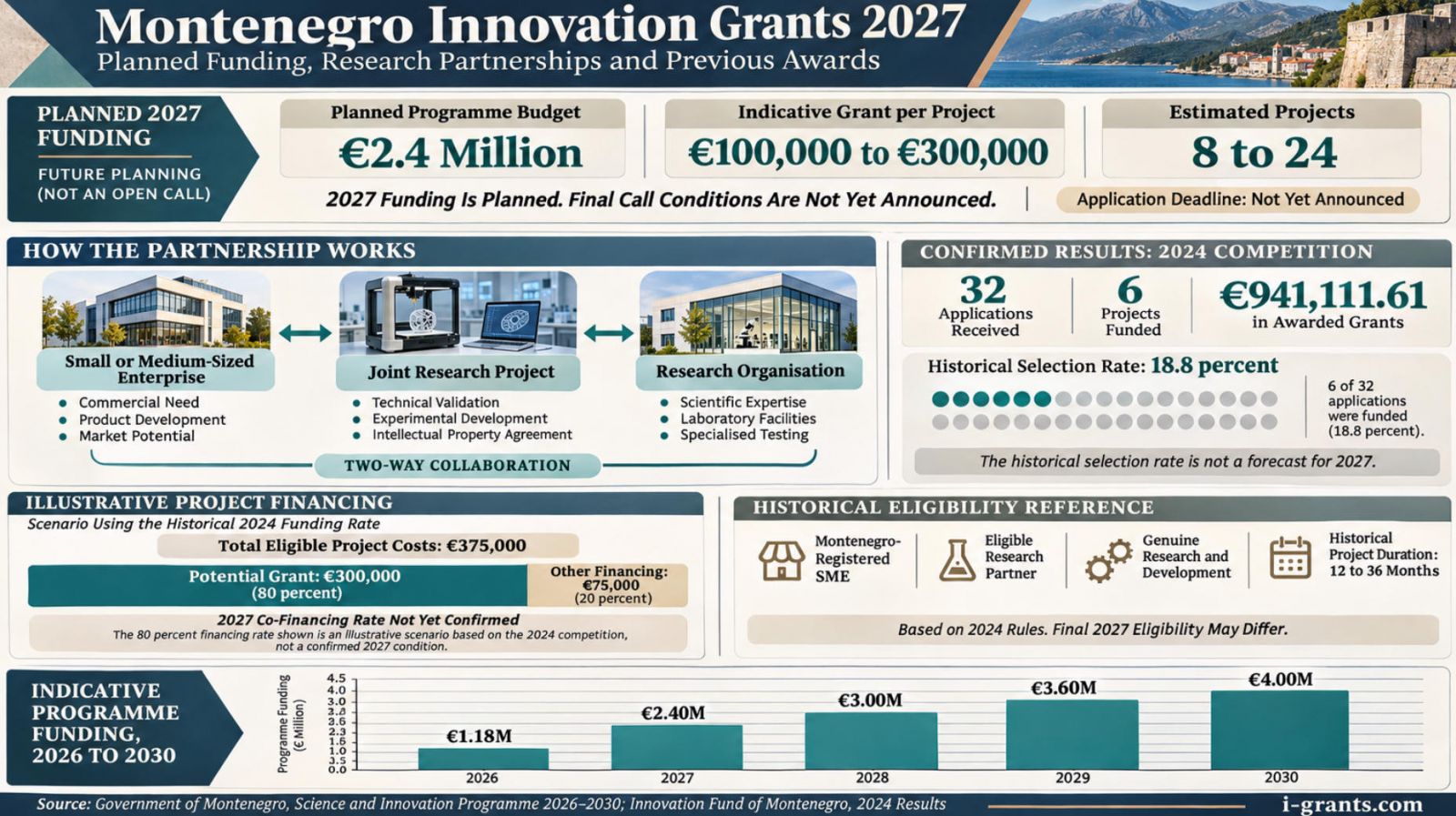
Montenegro is preparing to expand grant funding for collaborative research and innovation, with €2.4 million earmarked for a programme supporting partnerships between small and medium-sized enterprises and research organisations in 2027. Under the government's Science and Innovation Programme 2026–2030, individual collaborative innovation grants are expected to range from €100,000 to €300,000.
The planned funding represents an opportunity for technology companies seeking to develop new products, improve industrial processes, validate emerging technologies and bring research-based innovations closer to commercial application. Unlike conventional business development subsidies, the Collaborative Innovation Grants Programme is designed to encourage meaningful cooperation between enterprises and scientific institutions.
The programme already has a documented funding history. In its 2024 competition, the Innovation Fund of Montenegro supported six collaborative projects with approximately €941,112 in grants. The selected initiatives included artificial intelligence for medical analysis, sustainable construction materials, industrial energy efficiency and technological applications in agriculture.
These results provide valuable evidence of the types of research partnerships the Fund has previously supported, although they do not establish the eligibility conditions for the next competition.
As of November 2026, the €2.4 million allocation and the €300,000 maximum grant are indicative figures in Montenegro's official government programme. A separate public call confirming the final conditions, application dates and funding rates for 2027 has not yet been identified.
For potential applicants, preparation should therefore begin with an assessment of technological readiness, research partnerships, intellectual property arrangements and financial capacity rather than assumptions about an already open application process.
What Is Montenegro's Collaborative Innovation Grants Programme?
The Collaborative Innovation Grants Programme, officially known as Program kolaborativnih grantova za inovacije, is administered by the Innovation Fund of Montenegro, or Fond za inovacije Crne Gore.
Its primary objective is to strengthen cooperation between businesses and research organisations through joint research, development and innovation projects.
The programme focuses on the development of new or improved products, services, technologies and processes with credible commercial potential. It seeks to encourage enterprises to use scientific knowledge, specialised research infrastructure and experimental development capabilities that may otherwise remain disconnected from commercial activity.
The programme is part of Montenegro's wider strategy to develop a knowledge-based economy, strengthen domestic innovation capabilities and improve the competitiveness of its businesses.
The country's Science and Innovation Programme 2026–2030 establishes an indicative financial framework for the collaborative grant instrument, including a substantial increase in planned support from 2027.
Table 1. Montenegro Collaborative Innovation Grants: Planned Funding for 2026–2030
| Year | Indicative programme budget | Planned grant per project | Estimated number of projects |
|---|---|---|---|
| 2026 | €1,180,000 | €100,000–€200,000 | 5–11 |
| 2027 | €2,400,000 | €100,000–€300,000 | 8–24 |
| 2028 | €3,000,000 | €150,000–€300,000 | 10–20 |
| 2029 | €3,600,000 | €150,000–€300,000 | 12–24 |
| 2030 | €4,000,000 | €150,000–€300,000 | 13–26 |
| Total | €14,180,000 | 48–105 |
Source: Government of Montenegro, Science and Innovation Programme 2026–2030. All amounts are indicative planning figures.
The government's framework anticipates one collaborative innovation grant competition in 2027, with potential support for between eight and 24 projects.
The programme is expected to prioritise cooperation between micro, small and medium-sized enterprises and research organisations. Its stated purpose is to finance research-based innovations with commercial potential while encouraging knowledge transfer between academic institutions and industry.
The planned increase in the maximum grant from €200,000 under the 2024 competition to €300,000 in the 2027 financial framework is particularly noteworthy. However, the higher amount should not be interpreted as an already available award.
The implementing agency must publish the specific call and its supporting documentation before applicants can determine the final grant limits, funding intensity, eligibility conditions and submission deadline.
Unlike equity investment, collaborative innovation grants provide non-repayable funding subject to compliance with programme requirements. They do not automatically involve transferring company ownership to investors.
Nevertheless, beneficiaries remain responsible for project execution, financial reporting, eligible expenditure and the achievement of contractual objectives.
A Proven Funding Programme: Results from Previous Competitions
One of the strongest reasons to examine Montenegro's collaborative innovation funding is that the programme already has documented results.
In 2024, the Innovation Fund opened a competition with a total budget of €1 million. Applications were accepted between 29 May and 2 September 2024, with individual grant amounts ranging from €50,000 to €200,000.
The Fund received 32 applications, of which 28 passed the initial administrative assessment and proceeded to international expert evaluation.
After the first evaluation stage, 21 proposals qualified for the second stage. Six projects were ultimately recommended and approved for funding.
According to the Fund's official reporting, the six approved projects received grants totalling €941,111.61.
Table 2. Collaborative Innovation Grants: Historical Competition Results
| Indicator | 2022 competition | 2024 competition |
|---|---|---|
| Applications received | 36 | 32 |
| Applications admitted to expert evaluation | 34 | 28 |
| Proposals progressing beyond the first evaluation stage | 21 | 21 |
| Projects selected for funding | 7 | 6 |
| Funding success rate among all applications | 19.4 percent | 18.8 percent |
| Total grants awarded | Approximately €628,760 | €941,111.61 |
Sources: Innovation Fund of Montenegro, published competition results for 2022 and 2024. Success rates are editorial calculations based on the number of submitted and funded applications.
In both competitions, approximately one in five applicants received funding.
This historical observation is useful for understanding the programme's competitiveness, but it should not be used as a forecast for 2027.
A larger budget could support more projects, while changes to eligibility rules, applicant demand or evaluation procedures could substantially affect the outcome.
The 2024 results also show that the application process involved more than a basic administrative eligibility check. Independent international experts assessed the technical and commercial quality of proposals before the final funding decisions were made.
For applicants, this demonstrates the importance of preparing a convincing research and business case rather than relying primarily on the availability of grant funding.
Six Real Innovation Projects Supported in Montenegro
The Innovation Fund's 2024 annual report provides detailed information about the six collaborative innovation grants awarded during that competition.
The beneficiaries represent several fields, including industrial engineering, agricultural technology, medical artificial intelligence, digital infrastructure and advanced materials.
Their projects also illustrate the central role of research partnerships.
Table 3. Confirmed Collaborative Innovation Grant Recipients in 2024
| Company | Project and research partner | Awarded grant |
|---|---|---|
| Elkon | Intelligent optimisation of ventilation and air-conditioning systems, with Mediterranean University's Faculty of Information Technology | €129,732.02 |
| Paten Studio | Tunnel 3D, with the Faculty of Civil Engineering at the University of Montenegro | €153,271.55 |
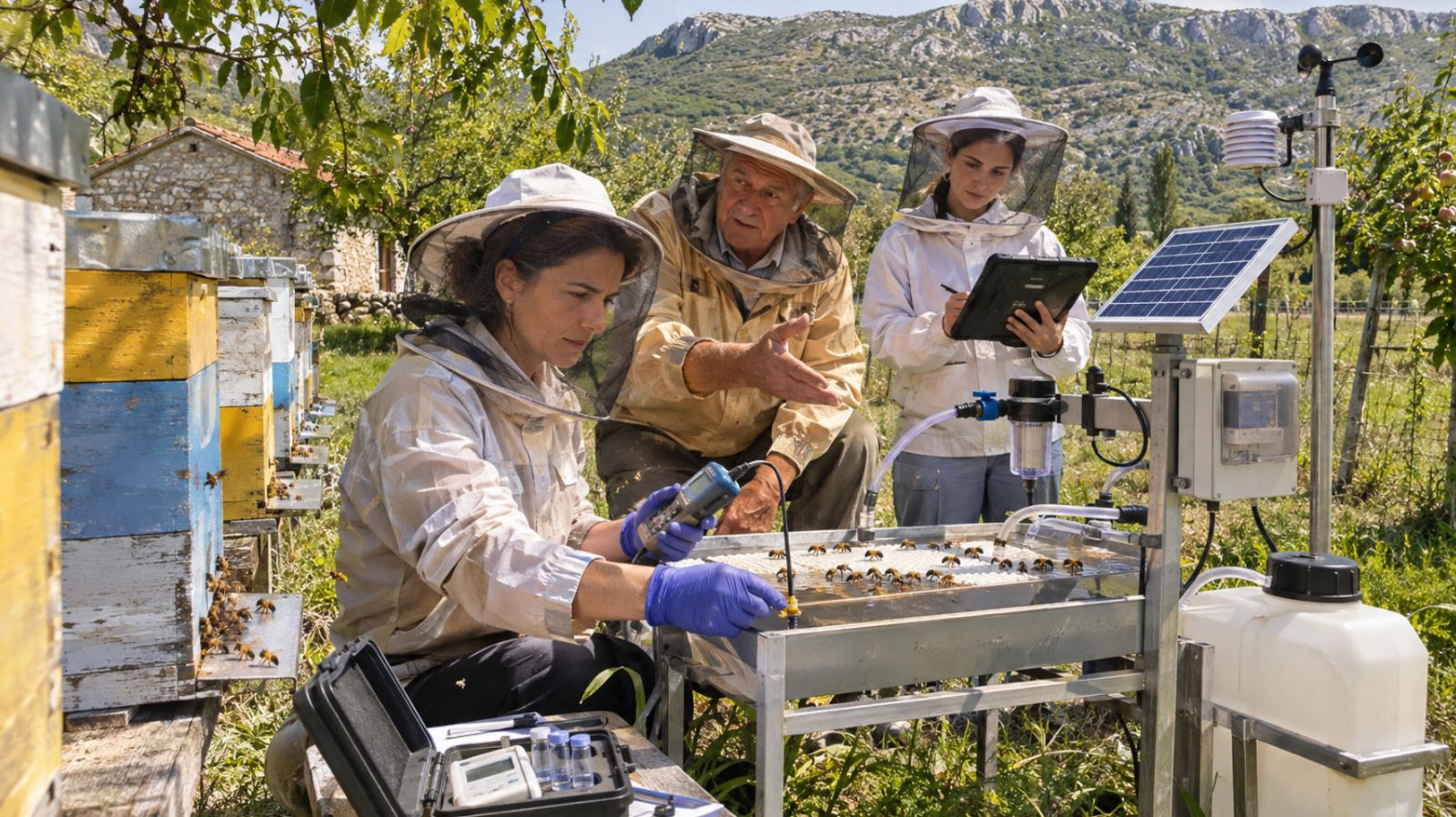
| E&T Healthy Bee | Automated hygienic drinking system for bees, with the Faculty of Mechanical Engineering at the University of Montenegro | €195,994.73 |
| IT Advanced Services | Artificial intelligence for pathological analysis of adenocarcinoma, with the Clinical Centre of Montenegro | €193,400.76 |
| Solutaria | Speech and music technology for speech therapy, with the Institute for Advanced Studies at the University of Montenegro | €121,802.90 |
| Mont Way | Environmentally friendly thermal insulation materials based on ash and waste plastics, with the Faculty of Metallurgy and Technology at the University of Montenegro | €146,909.65 |
| Total | Six supported projects | €941,111.61 |
Source: Innovation Fund of Montenegro, Annual Report 2024. Amounts refer to approved grant agreements rather than confirmed commercial revenues or completed technological outcomes.
The combined budgets of these six projects amounted to approximately €1.179 million, including €238,032.06 in beneficiary co-financing.
This provides a concrete example of how grant funding and financial contributions from participating organisations can be combined within a collaborative innovation programme.
E&T Healthy Bee: Technology Development in Agriculture
E&T Healthy Bee received approximately €196,000, the largest individual collaborative innovation grant awarded in the 2024 competition.
Its project concerned an automated hygienic drinking system for bees, developed in partnership with the Faculty of Mechanical Engineering at the University of Montenegro.
The example is significant because it demonstrates that innovation funding is not restricted to software companies or highly specialised electronics businesses.
Agricultural technologies can also qualify where they involve genuine research, technical development and the creation of commercially relevant solutions.
The project should nevertheless be described as a funded development initiative, not as evidence that a finished product has already achieved commercial success.
IT Advanced Services: Artificial Intelligence for Medical Analysis
IT Advanced Services received approximately €193,401 for a project involving artificial intelligence in pathological analysis of adenocarcinoma.
The research partner was the Clinical Centre of Montenegro.
This example illustrates a possible model of cooperation between a technology enterprise and a healthcare research institution, where technical development requires access to specialised scientific expertise and clinical knowledge.
Projects in medical artificial intelligence may also require careful consideration of data protection, validation procedures, intellectual property and the regulatory requirements applicable to medical technologies.
Such considerations can affect the project's technical feasibility and eventual commercialisation, even when they are not all explicitly listed as independent grant selection criteria.
Mont Way: New Materials from Industrial Waste
Mont Way received approximately €146,910 for the development of environmentally friendly thermal insulation materials using ash and waste plastics.
The project involved the Faculty of Metallurgy and Technology at the University of Montenegro.
This initiative is especially relevant to the country's priorities in sustainable construction, resource efficiency and circular economic activities.
Developing a marketable insulation material from industrial waste requires more than identifying a potential raw material. Researchers may need to investigate mechanical properties, thermal performance, durability, manufacturing consistency and compliance with applicable construction standards.
The published grant record confirms funding for the research partnership. It does not independently establish that all technical objectives have already been achieved.
What These Projects Reveal About the Programme
The six awards demonstrate that the Innovation Fund has supported a relatively broad spectrum of applied research.
The successful applicants were not exclusively early-stage software businesses. They included companies working on physical products, industrial systems, healthcare technologies and new materials.
The central common feature was the involvement of an enterprise and a relevant research institution in a project intended to produce an innovative commercial outcome.
That distinction provides a useful foundation for companies considering the planned 2027 competition.
Who Can Apply for Collaborative Innovation Grants?
The government's planning framework for 2027 identifies micro, small and medium-sized enterprises working with research organisations as the intended beneficiaries.
However, the final legal and administrative conditions for the 2027 competition have not yet been published.
The 2024 programme provides a useful historical reference.
Under those rules, the principal applicant had to be a micro, small or medium-sized enterprise registered and operating in Montenegro.
An eligible research organisation established in Montenegro was required to participate as a co-applicant.
The research partner could include a qualifying university, research institute or another organisation recognised under the applicable national scientific research framework.
Table 4. Applicant Eligibility: Confirmed 2024 Rules and 2027 Planning Status
| Requirement | Historical 2024 conditions | Status for 2027 |
|---|---|---|
| Lead applicant | Micro, small or medium-sized enterprise | SMEs identified as intended beneficiaries |
| Company registration | Registered in Montenegro | Final requirements not published |
| Research partner | Eligible Montenegrin research organisation | Partnership is part of the planned programme model |
| Financial condition | Positive equity at the relevant reporting date | To be confirmed |
| Tax compliance | Required | To be confirmed |
| Insolvency restrictions | Applied | To be confirmed |
| Registration in the Innovation Activity Register | Required within the specified period after grant agreement | To be confirmed |
| Project duration | 12–36 months | To be confirmed |
| Initial technology readiness | Generally TRL 2 or TRL 3 | To be confirmed |
| Maximum development stage | Support could extend to TRL 8 | To be confirmed |
Source: Collaborative Innovation Grants Programme documentation, 2024, and the government planning framework for 2026–2030.
These distinctions matter because businesses should not assume that an earlier call's requirements automatically remain unchanged.
Company Size and Financial Eligibility
For the 2024 competition, the Fund used enterprise-size categories based on employee numbers and financial thresholds.
Microenterprises generally employed fewer than ten people and had annual turnover or balance-sheet totals not exceeding €2 million.
Small enterprises generally employed fewer than 50 people, with turnover or assets not exceeding €10 million.
Medium-sized enterprises generally employed fewer than 250 people, with annual turnover not exceeding €50 million or total assets not exceeding €43 million.
Companies also needed to comply with financial and legal conditions concerning their operations, reporting, tax obligations and solvency.
Applicants should examine relationships with associated and partner enterprises when determining their size, since a company does not necessarily qualify as an independent SME simply because its own financial statements fall below the relevant thresholds.
The precise treatment of linked enterprises must be checked against the applicable rules of the new competition.
Can Foreign-Owned Companies Participate?
The programme's international relevance raises an important question for entrepreneurs who are not citizens of Montenegro.
The historical 2024 call required the principal applicant to be an enterprise established in Montenegro.
It did not establish a general right for a company registered exclusively abroad to apply without a qualifying local legal entity.
Nevertheless, foreign ownership and foreign company registration are different legal issues.
A business incorporated in Montenegro but owned by foreign nationals may potentially satisfy the basic registration condition, provided it also meets the relevant requirements concerning enterprise size, financial stability, ownership and state aid.
For entrepreneurs from European Union countries, Ukraine, the United Kingdom or other jurisdictions, the appropriate approach is to assess the actual legal entity applying for funding rather than relying on the nationality of its shareholders.
A newly established local company should not assume automatic eligibility. Its financial history, corporate structure and status under the future rules may be decisive.
Research Partnerships: More Than a Formal Requirement
Collaborative Innovation Grants are designed to address a practical problem within innovation systems: businesses may possess market knowledge and commercial opportunities, while universities and research institutions hold scientific expertise, specialist equipment and technical capabilities.
A collaborative project should bring these complementary resources together.
The enterprise typically provides the commercial problem, knowledge of customers, potential routes to market and the ability to develop the resulting innovation into a viable business activity.
The research organisation contributes scientific knowledge, experimentation, laboratory infrastructure, technical analysis or other specialised expertise required to overcome the project's technological challenges.
This relationship should be reflected in the project's activities, budget, responsibilities and expected results.
A research partner included only to satisfy a formal application requirement would contribute little to the underlying purpose of the programme.
Choosing the Appropriate Research Institution
A company planning a new industrial material might benefit from working with a faculty specialising in chemistry, metallurgy or materials engineering.
A business developing advanced agricultural equipment could seek expertise in mechanical engineering, environmental measurement or agricultural science.
A company working on a medical technology may require a research partner capable of supporting appropriate scientific evaluation and validation.
However, proximity to a university or the reputation of a research institution should not be the only selection criteria.
Applicants need to determine whether the partner possesses the necessary equipment, personnel, technical experience and capacity to undertake the proposed work within the intended budget and timeframe.
The 2024 programme results show that funded projects involved several different kinds of research institutions, including university faculties and the Clinical Centre of Montenegro.
This provides evidence that collaboration was not confined to a single institution or academic discipline.
Intellectual Property Ownership Must Be Addressed Early
One of the most important lessons from the historical programme documentation concerns intellectual property.
The 2024 guidance required partners to agree on principles governing ownership and use of intellectual property before submitting an application.
This is particularly significant where a research institution develops a technical solution that a company subsequently intends to manufacture or commercialise.
A partnership may involve knowledge and technology that existed before the project, newly created inventions, technical documentation, research data, software, patents and confidential manufacturing processes.
The parties should establish how existing intellectual property will be used, who will own new results, whether licences will be required and how future commercial rights will be allocated.
Publication rights and confidentiality may also require careful consideration.
A company may have a commercially promising product but face difficulties bringing it to market if the contractual arrangements do not give it sufficient rights to use the research results.
The final 2027 grant agreement may establish additional requirements, making early legal review especially valuable.
How Much Co-Financing Could Be Required?
Historical financial rules are important for preparing a preliminary budget, but they must not be mistaken for confirmed 2027 conditions.
In the 2024 competition, the Innovation Fund could finance up to 80 percent of eligible project expenditure.
Applicants and their partners were required to provide at least 20 percent through permitted financial contributions.
The contribution generally had to be provided in cash rather than solely through non-financial contributions such as equipment, premises or unpaid labour.
If a similar funding intensity were retained in 2027, a grant of €300,000 could correspond to a project with total eligible expenditure of €375,000.
However, the 2027 call could establish a different co-financing rate, additional aid restrictions or revised eligible expenditure rules.
Table 5. Illustrative Project Budgets Using the Historical 80 Percent Funding Rate
| Illustrative grant | Total eligible project expenditure | Grant contribution | Other financing required |
|---|---|---|---|
| €100,000 | €125,000 | 80 percent | €25,000 |
| €150,000 | €187,500 | 80 percent | €37,500 |
| €200,000 | €250,000 | 80 percent | €50,000 |
| €250,000 | €312,500 | 80 percent | €62,500 |
| €300,000 | €375,000 | 80 percent | €75,000 |
These figures are hypothetical calculations based on the historical 2024 funding intensity and the planned 2027 grant range. They are not approved budgets or confirmed financial conditions for the 2027 competition.
The financing requirement can be especially important for small technology companies.
A business requesting €300,000 may need to demonstrate that it can provide its own contribution while covering operating costs and managing project expenditure before receiving grant payments.
Applicants should also distinguish between eligible project costs and additional business expenses that the programme may not reimburse.
A commercially viable budget must therefore account for the full cost of developing the proposed technology, not merely the amount expected from the Innovation Fund.
Why Previous State Aid Can Matter
Another important issue is the state-aid mechanism used by the programme.
The 2024 competition applied rules concerning de minimis aid.
Under the relevant European de minimis framework, the general threshold is €300,000 for a single undertaking over any period of three years.
Because Montenegro is not an EU member state, applicants should assess the national state-aid rules and their relationship with the relevant European framework rather than automatically treating EU regulations as directly applicable in every respect.
The distinction is especially important when a company has already received public financial assistance.
If the 2027 competition applies a similar de minimis mechanism, previous qualifying aid could affect the amount of new support available to the applicant.
Companies with related entities may also need to assess how the applicable rules define a single undertaking.
However, the use of de minimis aid in the 2027 competition has not yet been confirmed. Applicants should not assume that the future programme will necessarily retain the same state-aid framework.
Eligible Costs and Financial Restrictions
The detailed 2024 programme guidelines provide insight into the types of expenditure that the Innovation Fund has historically supported.
They also reveal several restrictions that may materially affect a research project's budget.
Table 6. Historical Eligible Cost Categories and Limits in the 2024 Competition
| Cost category | Historical conditions |
|---|---|
| Personnel costs | Up to 70 percent of the awarded grant |
| Equipment and instruments | Up to 50 percent of the awarded grant |
| Materials and small equipment | Up to 10 percent of the awarded grant |
| External services | Up to 20 percent of the awarded grant |
| Training and dissemination activities | Up to 10 percent of the awarded grant |
| Indirect costs | Flat rate of up to 7 percent of eligible direct costs |
| Value-added tax | Eligible only where it could not be recovered |
| Land and building purchases | Not eligible |
| Vehicle purchases and leasing | Not eligible |
| Ordinary advertising, sales and distribution | Not eligible |
Source: Collaborative Grants for Innovation, 2024 programme guidelines. The cost-category limits refer to the applicable historical rules and should not be treated as confirmed 2027 conditions.
The programme distinguished between expenditure required to develop an innovation and ordinary commercial expenses.
For example, the costs of testing a prototype or obtaining technical research services could be relevant to an innovation project.
By contrast, advertising an already completed product or financing routine distribution activities was not the programme's intended purpose.
The treatment of equipment was particularly important. Applicants had to demonstrate that the proposed purchases were necessary for research and development rather than ordinary business expansion.
The historical programme also allowed certain unrecoverable VAT expenses, an issue that can materially affect the budget of a company purchasing specialised laboratory equipment.
Personnel costs required appropriate documentation of employees' actual work on the project. The guidelines described calculations based on employer labour costs and standard annual working-time assumptions.
These provisions demonstrate why a grant budget should be developed alongside the research plan rather than added as a final administrative exercise.
The specific ceilings, accounting methods and VAT rules for 2027 must be verified against the new competition documents once they become available.
Technology Readiness: From Scientific Concept to Practical Application
The Collaborative Innovation Grants Programme has historically supported projects that still require significant research and technical development.
The 2024 guidelines referred to starting points around Technology Readiness Level 2 or Technology Readiness Level 3, with supported development potentially progressing towards Level 8.
Technology Readiness Levels, commonly abbreviated as TRL, provide a framework for describing how far a technology has advanced from its scientific foundations towards practical application.
A project at TRL 2 may have a formulated technological concept but limited experimental validation.
At TRL 3, the fundamental concept has generally undergone an initial experimental demonstration.
Later stages involve increasingly comprehensive validation, prototype development and testing in environments relevant to eventual practical use.
This distinction is critical when deciding whether a proposed activity constitutes research and development.
Consider a company developing a new biodegradable industrial packaging material. The business may have demonstrated that a particular formulation can be produced in a laboratory, but its mechanical strength, manufacturing consistency and behaviour under different environmental conditions remain uncertain.
A collaborative research project could investigate these uncertainties and develop a more advanced prototype.
By contrast, a company purchasing standard machinery to manufacture an already fully developed product may have limited justification for support under a research-oriented programme.
Research Risks Should Be Identified Explicitly
A convincing proposal should explain the technological uncertainty that requires research.
The project should identify the technical problem, describe existing approaches, explain why available solutions are insufficient and set out the experimental work needed to produce new knowledge.
It should also establish measurable objectives.
These might concern material durability, energy consumption, processing speed, measurement accuracy, manufacturing consistency or another characteristic directly related to the proposed innovation.
The research partner's contribution should be clearly connected to these objectives.
For projects involving advanced software, the evidence should go beyond describing ordinary implementation of established technologies.
For physical technologies, applicants should explain the testing methodology, equipment requirements and expected technical progression.
The final 2027 call will determine which technology readiness levels and development activities are formally admissible.
How Applications Were Evaluated
The 2024 competition used a multi-stage evaluation procedure involving independent international experts.
After administrative and eligibility checks, proposals underwent technical assessment before selected applicants presented their projects to an expert committee.
The first evaluation stage examined the feasibility and quality of the project, its innovativeness and practical application potential, and the capabilities of the team.
The evaluation framework allocated 35 percent of the first-stage assessment to project quality and feasibility, another 35 percent to innovation and application potential, and 30 percent to team capacity.
Projects generally needed an assessment above 3.00 on a five-point scale to proceed.
At the second stage, applicants presented their proposals to a three-member international expert committee and answered questions about the project.
Final funding decisions followed the assessment process, ranking and budget negotiations.
Although these procedures are useful indicators of the Fund's historical approach, their precise application in 2027 remains subject to the new call.
What a Competitive Application Should Demonstrate
The programme's historical results suggest that a strong application requires an integrated argument connecting research, technical execution and future commercial value.
The applicant must explain why the technology is innovative, why the research is necessary and what the partnership can achieve that the enterprise could not reasonably accomplish through routine commercial activities.
The implementation plan should provide realistic milestones, appropriate expertise and a credible allocation of responsibilities.
The commercial case should address the potential market, customer needs, competing technologies and the intended use of the research results.
A project may be scientifically interesting without having a convincing route to commercial application. Conversely, a strong business opportunity may not justify an innovation grant if the proposed activities contain little genuine technological development.
Applications need to satisfy both dimensions.
Montenegro's New Smart Specialisation Strategy for 2026–2031
The country's innovation priorities have evolved since the 2024 competition.
In June 2026, the Innovation Fund announced the government's adoption of Montenegro's Smart Specialisation Strategy for 2026–2031, accompanied by an Action Plan for 2026–2027.
The strategy identifies five areas of particular development potential.
Table 7. Montenegro's Smart Specialisation Priorities and Potential Innovation Projects
| National priority | Illustrative research and innovation opportunity |
|---|---|
| Construction tailored to nature and people | Advanced building materials, energy-efficient construction systems and new material processing technologies |
| Energy and sustainable environment | Industrial energy optimisation, environmental monitoring and resource recovery technologies |
| Sustainable agriculture and food value chains | Precision agriculture, agricultural sensors and innovative food processing methods |
| Innovative, regenerative and sustainable tourism | Resource-efficient tourism infrastructure and advanced environmental management technologies |
| Information and communication technologies and digital innovation | Applied artificial intelligence, cybersecurity and industrial digital systems |
The national priorities are drawn from Montenegro's Smart Specialisation Strategy 2026–2031. The project examples are editorial illustrations rather than a formally approved list of eligible activities.
The accompanying Action Plan for 2026–2027 includes 100 activities with a total indicative value of €94.7 million.
This amount concerns the wider national innovation strategy and must not be confused with the €2.4 million specifically planned for collaborative innovation grants in 2027.
The distinction is significant because strategic priorities may influence how funding is directed without establishing that every activity within those sectors qualifies for an individual grant.
The 2024 collaborative grant competition reserved at least 70 percent of its available funding for projects aligned with the relevant smart-specialisation priorities, subject to the availability of sufficiently strong proposals.
However, the earlier competition operated under a previous strategy.
The exact treatment of the five new priorities in the 2027 competition must therefore be confirmed when the relevant call is published.
For applicants, the practical recommendation is to examine whether their technology addresses an identifiable need within one of the national priority areas while also demonstrating genuine research content and commercial potential.
Montenegro's Innovation Economy: The Wider Context
Montenegro has a relatively small domestic market and an economy strongly influenced by services, particularly tourism.
Its innovation policy increasingly seeks to strengthen scientific capabilities, support technology-based enterprises and encourage activities capable of creating greater economic value.
The European Innovation Scoreboard 2026 reported Montenegro's innovation performance at approximately 44.7 percent of the European Union average.
Although this reflects progress in the country's innovation system, the level remains substantially below the EU benchmark.
Research and development expenditure also remains relatively limited, with recent internationally reported figures indicating spending of approximately 0.3 percent of GDP.
The two indicators measure different aspects of the economy and should not be treated as interchangeable. The innovation index combines multiple performance dimensions, while R&D expenditure measures financial resources devoted to research and development relative to economic output.
A limited domestic research base creates challenges for companies seeking access to specialised scientific knowledge, technical staff and advanced infrastructure.
Collaborative innovation grants attempt to address part of this problem by encouraging enterprises to work directly with research organisations.
The Innovation Fund's Growing Role
The Innovation Fund has gradually expanded its activities since its establishment.
According to its published review of 2025, the Fund supported more than 100 projects during that year and awarded over €4 million across its different programmes.
The review also reported substantial interest from the innovation community, with hundreds of applications seeking significantly more funding than was available.
These figures refer to the Fund's broader portfolio, not exclusively to Collaborative Innovation Grants.
The distinction becomes particularly relevant when examining the results of another programme introduced in 2025.
Under the Programme for Strengthening the Innovativeness of Micro, Small and Medium-Sized Enterprises, the Fund reported support for 14 projects with a combined value of approximately €2.44 million.
Examples included an autonomous wildfire detection system using drones and artificial intelligence, a system for forecasting solar power generation, and technologies for optimising industrial processes.
These are confirmed examples of support awarded under a related programme, not proof that the planned 2027 Collaborative Innovation Grants competition has already opened.
They nevertheless demonstrate that Montenegro's public innovation financing is increasingly supporting technologically diverse projects.
Participation in Horizon Europe
Montenegro has been associated with Horizon Europe since January 2021, allowing eligible organisations to participate in the EU research and innovation framework programme under the applicable conditions.
According to the European Commission's Montenegro Report 2026, the country had signed 39 Horizon Europe grant agreements worth approximately €19.1 million since the beginning of the programme.
During the reporting period covered by the Commission, ten additional agreements worth €14.5 million were signed.
The country also secured support under the Teaming for Excellence initiative to establish CENNA, a centre of excellence focused on advanced environmental monitoring and nature-based solutions in protected areas.
These developments illustrate Montenegro's increasing participation in international research networks.
However, the announced establishment of a centre should not be interpreted as proof that all planned facilities are already operating or that all research objectives have been completed.
International research participation can provide companies with access to scientific partners, networks and expertise that may complement domestic grant funding.
A Strategic Connection: EIC Accelerator Plug-In
An especially important feature of Montenegro's Collaborative Innovation Grants Programme is its recognition within the European Innovation Council's Plug-In mechanism.
The European Commission's official list of certified national and regional programmes includes Collaborative Grants for Innovation, managed by the Innovation Fund of Montenegro.
The Plug-In mechanism is designed to connect selected national innovation funding programmes with the EIC Accelerator application process.
Under the relevant rules, authorised national funding bodies may recommend eligible companies from certified programmes for direct access to the full application stage of the EIC Accelerator.
This can reduce duplication between national and European assessment procedures and create a potential route towards larger-scale European innovation financing.
However, the existence of this connection should not be overstated.
Receiving a collaborative innovation grant in Montenegro does not automatically provide an EIC Accelerator grant, investment or guaranteed admission to the full application stage.
The company must satisfy the applicable eligibility requirements, undergo the necessary national assessment and receive the relevant recommendation through an operational Plug-In process.
The European Commission also distinguishes between programmes certified with and without additional conditions. Applicants should confirm how the mechanism is being implemented by the Innovation Fund rather than assuming that all grant recipients can use it immediately.
Companies referred through the mechanism remain subject to the subsequent EIC evaluation process.
The strategic benefit is therefore a potential funding pathway, not an entitlement to additional money.
For businesses developing technologies with international growth potential, this relationship may nevertheless be important.
A successful domestic research partnership could help generate technical evidence, strengthen intellectual property and prepare a company for more demanding European innovation funding opportunities.
Comparing Montenegro's Innovation Funding Options
Collaborative Innovation Grants are not the only national instrument available to Montenegrin technology enterprises.
The Innovation Fund operates different programmes for companies at different stages of development.
For instance, its 2026 Programme for Strengthening the Innovativeness of Micro, Small and Medium-Sized Enterprises was announced with a €1.3 million budget and individual grants of €50,000 to €200,000.
The Fund also announced an early-stage startup support programme in 2026 with grants of up to €35,000 and a total budget of €400,000.
The government's financial framework additionally anticipates separate proof-of-concept funding for research organisations in 2027, with planned grants of €20,000 to €40,000.
The suitability of these programmes depends on whether an applicant needs to validate an early concept, develop a research-based technology, strengthen an existing innovation or finance later-stage commercial expansion.
A recently established company with a preliminary product idea may be better suited to an early-stage support instrument.
A business with an established technical concept and a genuine need for scientific collaboration may find the Collaborative Innovation Grants Programme more relevant.
A company that has completed substantial technological validation and is seeking larger-scale international funding may consider the EIC Accelerator or another appropriate European instrument.
These options should not be presented as interchangeable. They differ in applicant eligibility, funding size, development stage, financial structure and application procedure.
Nor should historical competitions whose deadlines have passed be described as currently open funding opportunities.
How to Prepare for Montenegro Innovation Grants in 2027
The strongest preparation strategy is to begin before the call opens, while avoiding assumptions about requirements that have not yet been confirmed.
The enterprise should first examine its legal and financial position.
For companies already established in Montenegro, this means reviewing registration documents, corporate ownership, financial statements, tax compliance and relevant company-size classifications.
For international entrepreneurs considering a Montenegrin business structure, the assessment should include local incorporation requirements, potential restrictions concerning newly established businesses and the relationship between the applicant and any foreign parent companies.
The next priority is finding a research partner whose expertise directly addresses the proposed technological problem.
An appropriate partner should possess relevant scientific capabilities, suitable infrastructure and sufficient personnel to perform the planned work.
The project team should agree on research objectives, responsibilities and intellectual property arrangements before developing the final budget.
Establishing a Credible Development Plan
A strong research proposal should describe the technological starting point and identify the specific uncertainties that the project will resolve.
This includes explaining what has already been demonstrated, which technical questions remain unanswered and what experimental activities will produce the required evidence.
For example, a business developing advanced thermal insulation from recycled materials might need to establish its mechanical properties, resistance to moisture, long-term durability and consistency under industrial manufacturing conditions.
The research partner could design and conduct appropriate experiments while the company works on processing methods, prototype manufacturing and potential commercial applications.
The project should be structured around measurable results rather than broad promises to create an innovative product.
Financial planning should also begin early.
Applicants should estimate the required personnel, equipment, materials, external services and other project expenses. They should then identify which costs might qualify under the relevant programme rules and which must be covered separately.
Historical funding percentages can support preliminary scenarios, but the final budget must follow the conditions published for 2027.
Planning Beyond the Grant
The purpose of a collaborative innovation project is not merely to complete a research activity. It is to help create commercially relevant innovation.
Applicants should therefore consider how the resulting technology could be further developed, protected, manufactured and introduced to the market.
Potential customers, competing solutions, regulatory obligations, manufacturing requirements and the financing needed after the grant should be part of the broader business analysis.
A company might need another funding round, a commercial partnership or access to specialised industrial infrastructure before the innovation becomes market-ready.
This does not necessarily weaken the original grant proposal, provided the project has realistic objectives and clearly explains its contribution to the longer development process.
Professional assistance with grant applications, research budgeting, partnership agreements and innovation financing can help applicants coordinate these requirements. However, the responsibility for accurate information and programme compliance remains with the participating organisations.
When Will the 2027 Application Deadline Be Announced?
The government's Science and Innovation Programme 2026–2030 anticipates one Collaborative Innovation Grants competition in 2027.
It identifies an indicative budget of €2.4 million, an expected grant range of €100,000 to €300,000 per project and support for approximately eight to 24 projects.
The official opening date and application deadline for the 2027 competition have not yet been confirmed.
The precise funding intensity, project duration, eligible costs, research partner requirements and state-aid arrangements must also be established by the new public call.
Applicants should therefore monitor announcements by the Innovation Fund of Montenegro and review the full competition documentation once it becomes available.
The historical 2024 competition, which closed on 2 September 2024, should be used only as a reference for understanding previous procedures.
Companies should pay particular attention to the final eligibility rules, application forms, financial documentation, research partnership requirements and possible changes in evaluation criteria.
Until those documents are published, it would be misleading to describe the planned 2027 funding as an application opportunity with a confirmed submission deadline.
Are Montenegro's Collaborative Innovation Grants Right for Your Company?
Montenegro's planned Collaborative Innovation Grants Programme offers a potentially valuable opportunity for small and medium-sized technology enterprises seeking to develop commercially relevant innovations through scientific cooperation.
The expected increase in maximum individual funding to €300,000 could make the programme particularly relevant to companies whose projects require substantial experimental work, specialised research expertise or advanced prototype development.
The country's previous competitions demonstrate that public support has already reached companies working in agriculture, healthcare, industrial engineering, sustainable construction and digital technologies.
At the same time, the programme should not be mistaken for an unrestricted business expansion subsidy.
Its central purpose is to encourage genuine research collaboration capable of producing new knowledge, technological improvements and commercially useful innovations.
For established companies with a well-defined technical challenge, an appropriate research partner and sufficient financial resources, the planned 2027 competition may deserve serious consideration.
For very early-stage businesses without a developed concept or the ability to finance research activities, smaller innovation grants or early-stage support programmes may be a better starting point.
Foreign entrepreneurs should evaluate the feasibility of participating through an eligible Montenegrin enterprise and avoid assuming that foreign ownership or the creation of a new company automatically establishes grant eligibility.
The programme's connection with the EIC Accelerator Plug-In mechanism also introduces a potential international dimension, although any later European funding remains subject to separate eligibility and evaluation requirements.
Ultimately, the strongest collaborative innovation proposals are likely to combine a clearly defined technological problem, genuine research expertise, a credible development plan and evidence of future market potential.
For companies capable of bringing these elements together, Montenegro's planned innovation grants could become an important source of support for turning scientific knowledge into competitive technologies, products and services.