

 Français
 Deutsch
 Українська

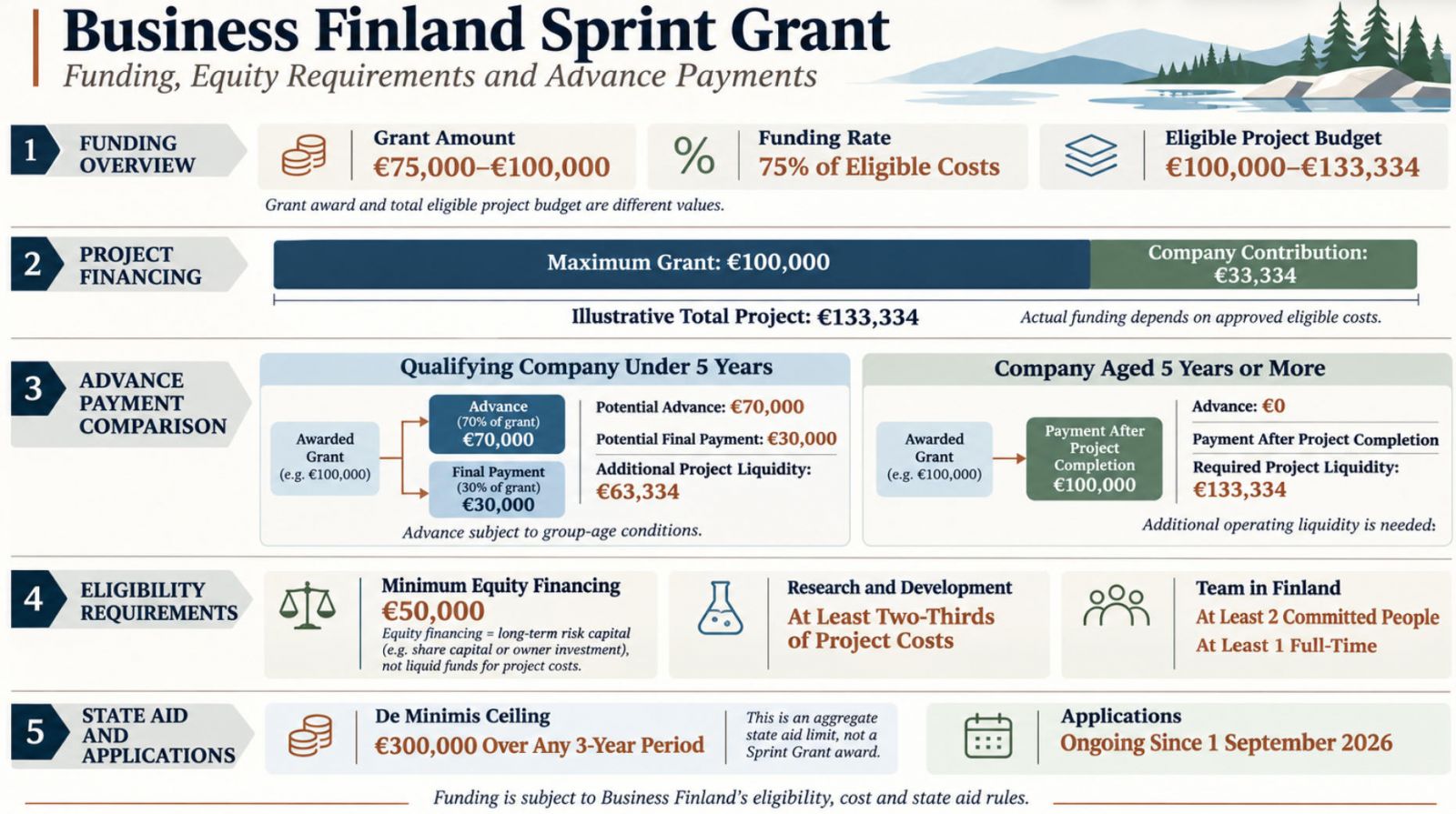
Finland's Business Finland Sprint Grant offers innovative small businesses between €75,000 and €100,000 in non-repayable funding to develop new solutions with significant international growth potential. The grant covers 75 percent of eligible project costs and supports early-stage research, product development, technical validation and market feasibility studies. Unlike conventional business development subsidies, Sprint is designed for companies that need to resolve substantial technological and commercial uncertainties before committing to larger research and development investments.
The programme is particularly relevant to Finnish startups developing original technologies, but it also welcomes established small enterprises seeking a significant transformation of their business through innovation. Eligible companies must demonstrate sufficient financial resources, at least €50,000 in qualifying equity financing, a committed team working in Finland and a credible strategy for entering international markets. Younger companies may qualify for an advance payment of 70 percent of the awarded grant, while companies aged five years or older generally receive their funding only after completing the project.
Sprint opened as a pilot programme on 2 March 2026 and moved to continuous applications on 1 September 2026. As of November 2026, Business Finland continues to accept applications and make funding decisions on a rolling basis. However, the programme is competitive and discretionary, and applicants must satisfy requirements extending well beyond the innovation itself. Understanding the distinction between the grant amount, total project expenditure, equity financing and available working capital is essential before preparing an application.
What Is the Business Finland Sprint Grant?
The Sprint Grant is a public innovation funding instrument administered by Business Finland, Finland's national organisation supporting business innovation and international growth. Its purpose is to encourage smaller companies to undertake ambitious research and development projects that could eventually generate scalable international business. The programme focuses on the period when a company has identified a promising innovation but still needs to demonstrate its technical feasibility, confirm customer demand and establish whether the proposed solution can become commercially competitive.
Sprint does not finance ordinary business expansion or the routine commercialisation of an existing product. A successful project should generate information that materially reduces uncertainty about a new technology, product or business opportunity. The results should help the company determine whether to pursue more extensive R&D investments, seek private investors or develop the solution toward international market entry.
The programme also reflects a change in Finland's public innovation funding priorities. Following reductions in certain non-R&D funding instruments during 2025, Business Finland increasingly concentrated support on research-intensive business development. Sprint emerged as an early-stage instrument within this changing funding environment, combining technological development with a limited amount of customer and market validation.
The original pilot accepted applications from 2 March to 31 August 2026. Business Finland reported more than 200 applications by 15 June 2026, indicating substantial demand during the programme's first months. Continuous applications began on 1 September 2026, without a published universal closing date. The total annual funding allocation is not fixed in the ongoing call announcement and depends on available government funding authorisations and competing funding instruments.
Table 1. Main Funding Conditions for Business Finland Sprint Grant
| Funding condition | Official programme requirements |
|---|---|
| Funding organisation | Business Finland |
| Country | Finland |
| Funding instrument | Sprint Grant |
| Grant amount | €75,000 to €100,000 |
| Funding intensity | 75 percent of approved eligible costs |
| Eligible project budget | €100,000 to approximately €133,334 |
| Company's final contribution | At least approximately 25 percent of eligible costs |
| Advance payment | 70 percent of the grant for qualifying companies younger than five years |
| Payment for older companies | After project completion and approval of reported costs |
| Minimum qualifying equity financing | €50,000 |
| Minimum team | Two committed people working in Finland, including one full-time member |
| Minimum R&D expenditure | Two-thirds of project costs |
| State aid framework | EU de minimis Regulation 2023/2831 |
| Application period | Continuous from 1 September 2026 |
| Application assessment | Rolling, competitive and discretionary |
| Programme budget | Subject to annual funding authorisations |
| Project duration | Determined through the approved project plan and funding decision |
The funding is a grant rather than a loan, so approved amounts do not normally require repayment when the beneficiary complies with the funding decision and applicable conditions. Nevertheless, Business Finland may reduce payments or recover funding if costs are ineligible, reporting obligations are breached or the project significantly deviates from its approved purpose. The maximum €100,000 should therefore be treated as the upper limit of a potential award, not as a guaranteed payment.
Who Can Apply for the Sprint Grant?
Company Registration, Size and Legal Structure
The Sprint Grant is available to small Finnish limited liability companies that operate in Finland and develop innovative solutions for international markets. Applicants must have a Finnish Business ID and meet the European Union definition of a small or micro-enterprise. Generally, this means employing fewer than 50 people and having annual turnover or an annual balance sheet total not exceeding €10 million.
The size assessment is not necessarily limited to the applicant's standalone financial statements. Business Finland considers ownership relationships and affiliations when determining whether a company is genuinely small. Consequently, a Finnish subsidiary with ten employees may fail the size requirement if it belongs to a larger corporate group whose consolidated characteristics exceed the relevant SME thresholds.
The programme excludes several legal forms, including sole proprietorships, general partnerships, limited partnerships, cooperatives, associations and foundations. Public and non-profit organisations are also outside its intended applicant group. Companies established in the Åland Islands without permanent operations in mainland Finland face an additional eligibility restriction.
Applicants must also satisfy Business Finland's general financial and regulatory requirements. Companies classified as undertakings in difficulty under the applicable EU rules, or those affected by other general funding obstacles, may be ineligible. Eligibility is assessed according to the circumstances when the application formally becomes pending.
Can Companies Older Than Five Years Apply?
One of Sprint's distinctive features is that the programme does not impose a universal maximum company age. Businesses registered five or more years before submitting their application can qualify if they intend to make a substantial change in their commercial direction based on a new innovation. This creates opportunities for established Finnish SMEs whose existing experience and capabilities could support a move into a new technological or international market.
However, Business Finland applies additional evaluation criteria to these applicants. An older company must show that its proposed project involves substantial changes in important elements of its activities, such as technology, target customers, products, revenue generation or business model. Ordinary product improvements, expansion of existing operations or the introduction of a slightly modified service are unlikely to satisfy this requirement without genuinely significant innovative content.
The financial treatment also differs. Companies aged five years or older receive no advance payment, and neither do younger companies belonging to a group containing a company at least five years old. These applicants must therefore demonstrate sufficient resources to finance the project before receiving reimbursement.
Table 2. Eligibility Differences Between Young Startups and Established Small Businesses
| Requirement | Company younger than five years | Company aged five years or older |
|---|---|---|
| Eligible company type | Finnish small limited liability company | Finnish small limited liability company |
| Innovation requirement | New solution with international growth potential | New solution enabling significant business transformation |
| Previous Business Finland funding | Specified previous instruments can prevent eligibility | Previous funding may be acceptable if unrelated to the same solution |
| Minimum qualifying equity financing | €50,000 | €50,000 |
| Retained earnings toward equity requirement | Not generally included under the special older-company rule | May qualify based on approved financial statements |
| Advance payment | 70 percent if the group-age condition is also met | Not available |
| Financial resources for a €133,334 project | Approximately €63,334, plus operating liquidity | Approximately €133,334, plus operating liquidity |
| Team requirement | At least two committed people working in Finland | Same requirement |
| International growth potential | Required | Required, supported by a substantial change in business direction |
| Additional business transformation test | Not applicable in the same form | Required |
The company's age is calculated from its registration in Finland's Trade Register when the application becomes pending. The age of related companies is particularly important when evaluating advance-payment eligibility. A newly incorporated subsidiary of a mature group should not assume that it qualifies for startup-style advance financing simply because its own registration date is recent.
Team Requirements and Management Commitment
Sprint applicants must have a committed team representing at least two people working in Finland. At least one person must work full-time for the applicant company, while the remaining required contribution may be assembled from more than one part-time individual. For example, two additional people each contributing half their working time can collectively satisfy the second position.
Business Finland also examines whether team members are genuinely committed to the company's development. A person working full-time elsewhere cannot ordinarily be treated as the applicant's full-time team member. Founders who work actively in the company without receiving salaries can contribute to the assessment of human resources, although unpaid work cannot automatically be included as an eligible salary expense.
Meeting the numerical minimum does not establish that a team is sufficiently qualified. Evaluators also consider technical expertise, industry knowledge, international business experience and the distribution of responsibilities. A small engineering team developing medical technology, for example, may need to demonstrate credible access to regulatory and clinical expertise, even when these specialists are not permanent employees.
Previous Business Finland Funding Can Prevent Eligibility
For companies younger than five years, previous awards under specified Business Finland instruments can create an obstacle to Sprint funding. These include Sprint itself, Tempo, certain equivalent incubator-related funding, R&D funding, Young Innovative Companies and Deep Tech Accelerator. This is especially important for startups that have previously received public support and assume that Sprint can automatically finance their next development phase.
The programme also restricts repeat public financing of the same solution. If the applicant, another group company or another company has already received relevant funding to research, develop or commercialise the same innovation, eligibility may be affected regardless of the applicant's age. Business Finland provides a specific exception for certain spin-offs separated from large or midcap companies where the former parent retains less than 25 percent ownership and no controlling influence.
Applicants should review their entire funding history, the origin of their intellectual property and any restructuring involving related companies before applying. A change in company name or legal entity does not necessarily make previously financed development eligible for another grant.
The €50,000 Equity Financing Requirement Explained
The Sprint Grant's minimum equity financing requirement is one of its most important and frequently misunderstood conditions. Business Finland requires at least €50,000 in qualifying equity financing, but this is not identical to requiring a current bank balance of €50,000. The rule concerns the company's qualifying capital financing, while the separate financial-resource assessment examines its ability to meet actual project expenditure and maintain operations.
Qualifying financing may include paid investments in share capital, contributions to the invested unrestricted equity fund, known in Finland as SVOP, and qualifying capital loans under Chapter 12 of the Finnish Limited Liability Companies Act. For companies aged five years or older, retained earnings reported in approved financial statements for the latest completed financial year may also count toward the requirement.
Business Finland can consider previously received qualifying financing even when the company has already spent those funds. Certain agreed investments may also be taken into account if supported by a signed investment commitment or term sheet. However, an investment agreement does not automatically establish that the company has enough cash available to implement the project.
Consider a startup that previously raised €80,000 from shareholders but has only €35,000 remaining in its bank account. It may satisfy the historical qualifying equity financing requirement while failing the separate liquidity assessment for a large Sprint project. Conversely, a company with substantial available cash must still demonstrate that it meets the specified equity financing requirement, rather than assuming that all forms of cash or ordinary borrowing qualify.
How Business Finland Assesses Liquidity
Business Finland considers several financial indicators, including net financial assets. Its published calculation can be expressed as follows:
Net financial assets = Cash and cash equivalents + Short-term receivables − Short-term liabilities
Suppose a company reports €90,000 in cash, €15,000 in short-term receivables and €48,000 in short-term liabilities. Its net financial assets equal €57,000. Although this may appear to be a strong cash position for a small startup, it can still be insufficient for a maximum-sized Sprint project if the company must supply €63,334 outside the advance payment and support other business expenses.
The assessment is broader than a single formula. Business Finland may examine the quality and timing of expected receivables, signed investment commitments, current liabilities, financing plans and ordinary operating expenditure. Applicants should therefore prepare a realistic cash-flow forecast rather than relying solely on the amount of capital previously raised.
How Sprint Grant Financing Works
The programme finances 75 percent of approved eligible expenditure within the awarded grant limit. A project with €100,000 in accepted costs can therefore receive €75,000, while a project costing approximately €133,334 can potentially qualify for the maximum €100,000 award. Any amount exceeding the approved grant ceiling remains the company's responsibility, even when the calculated percentage would otherwise produce a slightly higher result.
The company's ultimate financial contribution is normally at least 25 percent of eligible costs. However, its temporary funding requirements may be substantially higher because part or all of the grant is paid after project completion. This distinction can determine whether a technically promising application is financially viable.
Financial Example 1: A Two-Year-Old Technology Startup
Imagine a Finnish startup established two years ago that is developing an innovative energy-monitoring system for industrial facilities. Its project will involve building a functioning prototype, testing measurement accuracy and validating customer requirements in selected European markets. The planned eligible budget is €133,334, and the company applies for the maximum Sprint Grant of €100,000.
If the applicant is independent, satisfies the group-age rule and receives approval, it can obtain a €70,000 advance. The remaining €30,000 becomes payable following successful completion and approval of actual eligible expenditure. The company must therefore secure at least €63,334 in additional resources to cover the full project budget before receiving the final instalment, together with sufficient money for its normal operations.
Its final contribution to eligible project costs is €33,334. Nevertheless, the larger temporary cash requirement makes the funding arrangement more demanding than the headline 25 percent co-financing share suggests. The startup must independently demonstrate its €50,000 qualifying equity financing requirement.
Financial Example 2: A Seven-Year-Old Manufacturing Company
Consider a Finnish manufacturing SME that has operated for seven years and intends to develop an original industrial inspection technology using optical sensors and machine learning. Instead of merely improving its existing product range, the company plans to establish a new scalable technology-based business serving international manufacturers. Its eligible project budget is €100,000, with a requested Sprint Grant of €75,000.
Because the company is older than five years, it cannot receive an advance payment. It must therefore have the resources to cover the entire €100,000 project budget, plus its ordinary business expenditure, until the final grant instalment is paid. Once Business Finland accepts the completed project and eligible expenditure, the company can receive €75,000, leaving €25,000 as its final contribution.
The application must also explain why the initiative constitutes a significant change in business direction. A new sales channel for existing components would not be equivalent to establishing an innovative product platform built on substantial new research.
Table 3. Sprint Grant Funding Scenarios and Liquidity Requirements
| Financial indicator | Young startup | Established SME | Larger established SME project |
|---|---|---|---|
| Company age | 2 years | 7 years | 7 years |
| Eligible project budget | €133,334 | €100,000 | €133,334 |
| Potential Sprint Grant | €100,000 | €75,000 | €100,000 |
| Funding intensity | Up to 75 percent | 75 percent | Up to 75 percent |
| Advance payment | €70,000 | €0 | €0 |
| Potential final payment | €30,000 | €75,000 | €100,000 |
| Final company contribution | €33,334 | €25,000 | €33,334 |
| Minimum project funding needed outside advance | €63,334 | €100,000 | €133,334 |
| Minimum R&D allocation | €88,890 | €66,667 | €88,890 |
All figures are illustrative, assume full acceptance of project costs and exclude ordinary operating expenses. The maximum grant is capped at €100,000. Actual payments depend on the funding decision and approved expenditure.
What Happens if Eligible Costs Are Reduced?
A funding decision for €100,000 does not entitle the company to receive the full amount regardless of actual expenditure. Suppose the young startup in the first example receives its €70,000 advance but Business Finland ultimately approves only €120,000 in eligible costs. At a 75 percent funding rate, the final grant entitlement becomes €90,000, leaving only €20,000 available as the final payment.
If eligible expenditure falls further, the consequences can be more significant. For instance, approved costs of €80,000 would produce a maximum grant entitlement of €60,000. Because the company already received €70,000, it would need to return the €10,000 excess under the applicable repayment rules.
Companies should therefore avoid treating advance payments as unrestricted working capital. Funds must remain connected to the approved project, and a realistic contingency reserve is essential.
Which Project Activities and Costs Are Eligible?
Sprint Grant funding is intended primarily for research and development. At least two-thirds of the proposed project costs must relate to R&D activities, while the remaining share can include approved customer research, market validation and preparation for subsequent investment or development. The precise classification should be justified through the project plan, rather than determined simply by assigning broad labels to expenses.
Eligible technical activities may include developing a prototype, testing an experimental algorithm, validating an innovative manufacturing process or establishing whether a new scientific approach can function outside laboratory conditions. Customer pilots can also be relevant when they provide information needed to improve the solution. Market research must contribute directly to the innovation's commercial feasibility instead of functioning as ordinary advertising or sales expenditure.
Business Finland's detailed funding terms distinguish direct costs from standardised indirect cost categories. This matters particularly for salaries, equipment and subcontracting, where assumptions based on conventional commercial accounting can lead to incorrectly prepared budgets.
Table 4. Eligible Costs and Important Accounting Restrictions
| Cost category | Funding treatment |
|---|---|
| Direct R&D salaries | Eligible for actual paid working time allocated to the project and properly recorded |
| Salaries of significant shareholders | For owners holding at least 10 percent, the accepted monthly salary base is capped at €4,000, with project allocation applied |
| Indirect personnel costs | Generally calculated at 30 percent of accepted direct salaries, subject to special conditions |
| External R&D and specialist services | Eligible when necessary, properly procured and used for the approved project |
| Materials and prototype components | Eligible according to the approved plan, actual costs and supporting documentation |
| Equipment rental | Eligible for the justified project-use portion |
| Software and cloud services | Relevant project-period costs can be treated under the equipment-rental rules |
| Initial intellectual property work | Certain novelty searches, patentability assessments, freedom-to-operate studies and initial applications may qualify |
| Other costs | A calculated allowance of up to 10 percent of the specified salary, purchase and rental cost base |
| Equipment purchases and depreciation | Addressed through the calculated other-cost category rather than automatically accepted as separate direct purchases |
| Mandatory final audit | Reasonable independent auditor costs may qualify |
| General marketing and sales | Not eligible as ordinary commercial operations |
| Trade fairs and export distribution | Not eligible |
| Production investment | Not eligible as a normal Sprint investment expense |
| Financing costs and unrelated administration | Excluded or restricted under the funding terms |
The Two-Thirds R&D Rule in Practice
For an illustrative €120,000 Sprint project, at least €80,000 must be devoted to qualifying research and development. The remaining €40,000 can cover appropriate non-R&D activities that support the proposed innovation's market and investment potential, provided that the expenditure also satisfies the detailed cost rules. A grant of €90,000 would leave a final company contribution of €30,000.
This does not mean that any combination of €80,000 in product development and €40,000 in general business expenses would qualify. Every project activity must contribute to the approved purpose, and ordinary sales operations are not made eligible simply because a company also conducts research. Similarly, a customer pilot should be designed around measurable technical or commercial questions rather than used to subsidise routine delivery of an already established product.
For example, a startup developing a novel AI-based quality inspection system might allocate R&D resources to testing detection accuracy under different manufacturing conditions. Its complementary market activities could involve structured interviews with potential industrial customers and analysis of international purchasing requirements. Both components would serve the same development decision, but they would be classified according to their actual research or non-research nature.
Salary Caps, Working Time and Overheads
Sprint's salary rules require particular attention from founder-led startups. For anyone owning at least 10 percent of the applicant company, Business Finland generally accepts a maximum monthly salary base of €4,000, with only the portion attributable to actual project work being reportable. The company cannot include a larger founder salary merely because it has chosen to pay one.
Employees must record project working time on an hourly basis throughout implementation. Records must be completed regularly and approved at least monthly by the responsible manager or supervisor. A managing director or accountable project leader cannot approve their own hours.
Eligible direct salaries normally relate to effective working time for up to 11 months per year. Indirect personnel costs are generally calculated as 30 percent of approved salary costs, although Business Finland can examine circumstances where conventional employment-related overheads do not arise. The separate allowance for other costs should not be confused with this personnel-related calculation.
Equipment, Procurement and Intellectual Property
Equipment rental and the purchase of equipment are not treated identically. Renting equipment mainly used in the project can qualify as a direct cost to the extent justified by actual project use. Purchases of equipment and depreciation, by contrast, are covered by the calculated other-cost mechanism rather than automatically becoming separate direct eligible expenses.
Applicants must also pay close attention to public procurement requirements. Because Sprint normally finances more than half the project's eligible costs, relevant purchases can fall within Finnish public procurement rules. Procurements worth at least €60,000 excluding VAT must be competitively tendered according to the applicable provisions.
The timing of contracts is equally important. As a general rule, only work and purchases agreed in writing after submitting the funding application can be accepted. Exceptional pre-application agreements must meet the programme's specific conditional-contract requirements, and no project cost can become eligible before the application is formally pending.
Intellectual property expenditure can include initial patentability and freedom-to-operate investigations, along with certain initial applications. However, maintaining existing patents, expanding earlier protection into additional territories or pursuing infringement disputes does not automatically qualify. The company must also demonstrate sufficient rights to use the knowledge and technology underlying the proposed project.
EU De Minimis Rules: The €300,000 Aid Ceiling
Sprint funding is awarded under Commission Regulation (EU) 2023/2831, which establishes the general de minimis aid framework. Under this regulation, a single undertaking may receive no more than €300,000 in qualifying de minimis support from a Member State during any rolling three-year period. The relevant calculation includes applicable grants from different public authorities, not only Business Finland.
The concept of a single undertaking is especially important for corporate groups. Certain companies under common ownership or control must be considered together for the purposes of calculating accumulated aid. A startup's remaining capacity can therefore be smaller than its own grant history initially suggests.
Consider a Finnish company whose relevant single undertaking has already received €210,000 in qualifying de minimis support during the applicable period. Its remaining capacity is €90,000. Subject to the other Sprint conditions, that amount could support an eligible €120,000 project at the 75 percent funding rate.
A company with €230,000 in accumulated qualifying aid would have only €70,000 remaining. Because Sprint's advertised minimum award is €75,000, this would ordinarily leave insufficient de minimis capacity for a grant within the programme's stated range. The company would need to reassess the timing and classification of previous aid before applying.
Private shareholder investments are not automatically de minimis aid. Nevertheless, applicants should distinguish between private capital, public innovation grants, subsidised financing and other forms of state support when preparing the required declarations.
Can Foreign Entrepreneurs and Internationally Owned Companies Apply?
The Sprint Grant is not advertised exclusively for companies whose shareholders are Finnish citizens. The central applicant requirement is the existence of an eligible Finnish limited liability company operating in Finland, with the necessary business registration, financial capacity and local team. Consequently, a Finnish company founded or owned by foreign entrepreneurs may potentially qualify.
However, foreign ownership alone does not establish eligibility. An overseas business without an eligible Finnish applicant company cannot simply apply through its foreign legal identity. Likewise, a Finnish subsidiary must satisfy the SME criteria after considering the relevant ownership and group relationships.
For a foreign-owned Finnish startup, several practical considerations deserve early attention. Its ownership structure must not cause it to exceed the permitted enterprise size. A mature company elsewhere in the group can prevent the subsidiary from receiving an advance payment, even when the Finnish company itself is younger than five years.
The applicant must also show genuine business and team activity in Finland. Remote founders with no credible committed team working in Finland cannot assume that registration alone satisfies the programme's requirements. Business Finland evaluates the actual capabilities and commitment of the individuals responsible for delivering the project.
Cross-border intellectual property ownership and intercompany procurement introduce further complexity. A Finnish subsidiary developing technology legally owned by a foreign parent must demonstrate that it has sufficient rights to undertake the research and pursue the intended business. Purchases from foreign companies within the same group require particular treatment under the funding decision.
Foreign entrepreneurs should therefore examine both the Finnish applicant's standalone position and its relationships with overseas entities. Where a corporate structure is complicated, direct clarification from Business Finland before submission is preferable to assuming that all foreign-controlled Finnish companies are treated identically.
Finland's Innovation Funding Environment
Sprint was introduced against the background of substantial national investment in research and development. Statistics Finland reported that total R&D expenditure reached approximately €8.9 billion in 2024, representing about 3.2 percent of GDP. Enterprises accounted for approximately €6.04 billion, or nearly 68 percent of the country's total R&D expenditure.
The Finnish government's 2026 budget included €3.12 billion in appropriations for research and development, approximately €263.7 million more than the corresponding 2025 budget figure. These are nationwide public R&D allocations, not the budget of the Sprint Grant. They nevertheless illustrate the broader policy environment in which Business Finland's innovation instruments operate.
Business Finland's own activities also extend far beyond Sprint. Its official 2025 reporting identified approximately €1.097 billion in total funding granted to companies and research organisations across the agency's activities. That historical figure includes other instruments and must not be confused with awards under the new Sprint programme.
Table 5. Finland's Innovation Ecosystem and Business Finland Funding Indicators
| Indicator | Reported figure | Reference period |
|---|---|---|
| Total R&D expenditure in Finland | €8.89 billion | 2024 |
| R&D expenditure as a share of GDP | 3.22 percent | 2024 |
| Enterprise-sector R&D expenditure | €6.04 billion | 2024 |
| Government R&D budget appropriations | €3.12 billion | 2026 budget |
| Increase in government R&D appropriations | €263.7 million | 2026 compared with 2025 |
| Business Finland total funding granted | Approximately €1.097 billion | 2025 |
| Identified Finnish startups established in 2023 | 258 | Retrospective analysis |
| Identified Finnish startups established in 2024 | 331 | Retrospective analysis |
| Increase in identified startup formation | Approximately 28 percent | 2024 compared with 2023 |
| Startup projects funded by Business Finland | Nearly 700 | 2025 and part of 2026, multiple instruments |
| Sprint applications received | More than 200 | By 15 June 2026 |
Sources: Statistics Finland, Business Finland's official reporting and the November 2026 startup ecosystem analysis. Figures represent different reporting periods and should not be interpreted as Sprint-specific awards.
Finnish Startup Formation Returned to Growth
A Business Finland release published on 13 November 2026 reported that 331 new startups had been identified among companies established in 2024, compared with 258 established in 2023. This represents growth of approximately 28 percent after several years of decline. The finding provides evidence of renewed startup formation, although the report also identifies a substantially higher figure of 587 startups in 2016.
The methodology requires careful interpretation. Researchers identified startups retrospectively through information including Business Finland funding, FiBAN angel investments and participation in Slush. Because the analysis does not represent a complete registry of every innovative new company, the totals should not be treated as a universal count of all Finnish startups.
Business Finland also reported that nearly 700 startup projects had received funding during 2025 and part of 2026. Approximately two-thirds had a strong focus on digital solutions, artificial intelligence or data analytics. These observations describe broader agency activity rather than projects funded exclusively through Sprint.
The wider significance for applicants is that new technologies must still compete for attention and resources within an active innovation ecosystem. Strong technological expertise matters, but the ability to demonstrate customer demand, financial readiness and international scalability is equally important when seeking public support and private investment.
Real Company Example: VAELLA Receives Sprint Funding
VAELLA provides a documented example of how Sprint can support a new Finnish innovation business originating from an established industrial company. Business Finland published the company's Sprint funding case on 22 October 2026, describing its development from an innovation project at KONE into an independent growth venture.
VAELLA develops technology using vision sensors and artificial intelligence to analyse how people move through buildings and transport environments. Its solution aims to provide operators with real-time information about the use of spaces, potentially supporting improved management of metro stations, airports, shopping centres and other complex facilities.
KONE acts as VAELLA's strategic seed investor. According to the published case, Sprint funding supports the development of a hardware package designed to be easier to install, reducing practical barriers to deployment. The company is also investigating international opportunities in selected market segments and engaging with potential customers and partners.
The case illustrates a particularly relevant form of early-stage innovation funding. Instead of financing general international sales activity, Sprint helps the company address a product-development challenge that could affect its ability to scale. Improving the deployability of the underlying technology may create the foundation for later commercial expansion.
However, Business Finland's public account does not identify VAELLA's exact Sprint award amount or provide completed export results attributable to the grant. It should therefore be presented as a confirmed beneficiary with a documented development objective, not as evidence that every Sprint project receives €100,000 or rapidly generates measurable international revenue.
Historical Comparison: Polar Night Energy's Development Journey
A separate Business Finland case provides useful context for the longer-term development pathway of Finnish innovation companies. Polar Night Energy, founded in 2018, develops thermal energy storage systems using sand as a medium for storing heat. The technology can support renewable energy integration by storing thermal energy for later use.
Business Finland reported that the company received Tempo funding during its early development, enabling the founders to investigate market demand and focus on their business idea. The agency subsequently supported the company's more advanced research and development work, including €2.1 million associated with its Sand to Power project. That project investigates technology for converting stored thermal energy back into electricity.
The case demonstrates how initial feasibility and market work can precede substantially larger technology development investments. Nevertheless, Polar Night Energy's early support came from Tempo, and its later €2.1 million award belongs to another R&D funding arrangement. Neither amount should be described as a Sprint Grant award.
The distinction is essential when evaluating the performance of a new programme. Sprint's long-term impacts cannot yet be established by reclassifying results achieved under earlier Business Finland instruments.
Sprint Grant vs Tempo, Young Innovative Companies and Deep Tech Accelerator
Business Finland has operated several instruments supporting innovative companies at different development stages. Their objectives, funding structures and availability have changed, particularly during 2025 and 2026. Applicants should avoid assuming that a historic funding programme remains open simply because its information page is still accessible.
Table 6. Comparison of Business Finland Innovation Funding Instruments
| Programme | Funding model | Primary purpose | Availability in November 2026 |
|---|---|---|---|
| Sprint Grant | €75,000–€100,000 grant, covering 75 percent of eligible costs | Early-stage R&D, feasibility and international market potential | Open continuously |
| Tempo | Historically up to €60,000, covering up to 75 percent | Initial validation of international business opportunities | New applications closed |
| Young Innovative Companies | Historic staged growth funding, potentially reaching approximately €1 million under applicable arrangements | International scaling of promising young innovative firms | New intake closed |
| Deep Tech Accelerator | Up to three €400,000 stages, comprising two grant stages and a loan stage | Accelerating market entry for research-based deep-tech companies | 2026 application round ended 16 August |
| Research, Development and Piloting | Project-dependent grants or loans | Broader R&D, development and piloting activities | Relevant services available subject to current conditions |
Sprint vs Tempo
Tempo previously offered young Finnish businesses a mechanism for assessing international growth opportunities, with grants historically reaching €60,000. Sprint provides a higher maximum award and places a stronger emphasis on systematic research and development. Its requirement to allocate at least two-thirds of project expenditure to R&D differentiates it from the broader early business validation focus associated with Tempo.
Business Finland closed new Tempo applications in October 2025. Companies that previously received Tempo funding must also consider Sprint's restrictions on earlier Business Finland support, particularly when the applicant is younger than five years.
Sprint vs Young Innovative Companies
Young Innovative Companies, also known as YIC or NIY, historically supported selected startups pursuing ambitious international growth through staged funding arrangements. Its focus was more closely connected to scaling promising businesses than to the initial technological feasibility stage emphasised by Sprint. The programme's historical funding ceilings should not be presented as currently available grants without qualification.
New YIC applications closed in October 2025, although existing funding arrangements may continue under their original conditions. Sprint should not be described as an automatic entry point to a future YIC award.
Sprint vs Deep Tech Accelerator
Deep Tech Accelerator targets research-based startups with advanced scientific or technological foundations. The 2026 call described a three-stage potential funding package comprising two €400,000 grant stages followed by a €400,000 loan stage. Progression between stages depends on fulfilling the relevant conditions, so the combined amount is not an automatic entitlement.
An important substantive distinction is that DTA focuses strongly on accelerating market entry and commercial readiness for research-based technology companies. Its 2026 funding call was not primarily intended to finance conventional product development, whereas Sprint explicitly requires a predominantly R&D-based project. The DTA 2026 application period ended on 16 August 2026.
For applicants choosing between funding instruments, the relevant question is therefore not merely which programme offers the largest amount. It is whether the company needs to resolve technical feasibility questions, undertake larger experimental development, or prepare an already advanced technology for market entry.
How to Apply for the Sprint Grant
Business Finland requires prospective applicants to begin through My Business Finland rather than proceeding immediately to a completed funding application. Companies first register and provide basic information about their business. If the initial eligibility criteria appear to be satisfied, they arrange a discussion with a Business Finland expert before submitting the formal application through the agency's online funding service.
This preliminary discussion helps clarify whether the proposed innovation, financial situation and development stage fit Sprint's objectives. It is also an opportunity to identify weaknesses before investing substantial resources in preparing the application. Nevertheless, constructive initial feedback should not be interpreted as a promise that funding will be awarded.
The formal application requires a project plan using Business Finland's prescribed Sprint template. Applicants must also provide a list of shareholders, including relevant parent-company shareholder information for subsidiaries. Detailed account-level income statements and balance sheets generated from the accounting system are mandatory and must be no older than two months; the income statement must cover the period from the start of the current financial year.
An additional pitch deck can be submitted, but it does not replace the required project plan. Business Finland also specifies authorisation arrangements for the person creating the application through its electronic service.
Preparing a Strong Technical and Commercial Project Plan
A compelling Sprint application should explain exactly which technological or business assumptions remain uncertain and why the project is necessary to resolve them. Broad claims that a solution uses artificial intelligence, improves sustainability or disrupts an industry are not sufficient without concrete evidence. The applicant needs to demonstrate what is genuinely innovative relative to existing alternatives.
The research plan should describe the technical approach, proposed experiments, performance indicators, responsible personnel and expected outputs. An industrial sensor project, for instance, could establish target accuracy thresholds, environmental testing conditions and specific criteria for determining whether the prototype is technically viable.
Commercial validation should be equally specific. Instead of claiming that the global market is worth billions of euros, the company should identify the customer segment it intends to serve, the purchasing problem it addresses and the realistic initial geographic market. It should explain why customers might select the proposed solution rather than an established competing technology.
The plan should also demonstrate what happens after the Sprint project. Business Finland expects successful projects to create the basis for more substantial R&D investments, not simply conclude development with a commercially finished product. An application is stronger when it establishes a credible subsequent development programme and explains how further financing might be obtained.
Essential Application Preparation Checklist
-
Verify company eligibility. Confirm the Finnish legal entity, Business ID, SME classification, company age, ownership structure and previous Business Finland funding history.
-
Document financial readiness. Prepare evidence of at least €50,000 in qualifying equity financing, current financial statements and a realistic project cash-flow forecast.
-
Confirm team capacity. Identify the committed team working in Finland, the full-time member and the technical and commercial expertise available for implementation.
-
Define the innovation. Describe technical uncertainties, intellectual property rights, competitive advantages and measurable development objectives.
-
Build the eligible budget. Allocate at least two-thirds of costs to R&D, apply salary and overhead rules correctly and examine procurement requirements before signing commitments.
-
Prepare the international growth case. Identify target customers, priority markets, revenue assumptions, scalability requirements and the next R&D investment stage.
An experienced grant writer can help translate the company's technical and financial information into a coherent funding application. However, grant-writing expertise cannot replace missing eligibility conditions, insufficient liquidity or the absence of genuine technological novelty.
Reporting, Compliance and Grant Repayment Risks
Receiving a favourable Sprint funding decision creates ongoing reporting responsibilities. The beneficiary must maintain project accounting that enables Business Finland to identify costs separately and verify their connection to the approved project. Supporting documents include salary records, invoices, procurement information and evidence of payments.
Every person working on the project must maintain appropriate hourly time records. The company must also submit the required financial and technical reports, including the final independent auditor's report prescribed by the funding terms. Project accounting records and related supporting documentation must generally be retained for at least ten years after the last project payment.
Significant changes to the project plan, timetable, cost categories or responsible project leadership require appropriate notification or prior approval. The company must also maintain sufficient rights to the intellectual property used and generated during development. Certain transfers of business activities, rights or ownership structures may require notification or approval during the specified monitoring period.
The funding terms contain obligations concerning developments after project completion. Changes involving the transfer of project-related business or intellectual property, relocation of activities abroad or significant corporate restructuring can create additional compliance considerations. These restrictions are particularly important for startups anticipating international acquisitions, group reorganisations or technology licensing arrangements.
Business Finland may recover grants where funding is used for materially different purposes, essential information is misleading, obligations are seriously breached or excessive payments have been made. A company should therefore assess compliance before making major project or corporate changes, rather than treating the reporting process as a formality.
Common Reasons Sprint Applications May Fail
The most immediate obstacle is failure to satisfy a mandatory eligibility requirement. An applicant may have a promising product but lack qualifying equity financing, sufficient liquidity or the required team presence in Finland. Previous funding of the same innovation may also create an exclusion that cannot be resolved through stronger presentation.
Projects can fail the substantive assessment when the innovation is insufficiently differentiated from existing products. Routine software development, standard manufacturing improvements or a straightforward expansion into another country may not demonstrate the technological uncertainty and originality expected from Sprint. The problem is especially relevant for older companies, which must show a significant transformation of their business.
Another weakness is an international growth plan based solely on large market estimates. Business Finland examines whether the target customers, competitive advantage and scalability assumptions are credible. A technically attractive solution may not provide a convincing basis for international growth if the applicant has not investigated purchasing requirements, competitors or realistic market entry barriers.
Poorly constructed project budgets can also undermine otherwise promising proposals. A project may allocate too little expenditure to R&D, include ineligible commercial activity or underestimate the financial resources needed before grant reimbursement. These weaknesses are frequently connected: a company attempting to solve an immediate sales or cash-flow problem may propose activities that do not match Sprint's research-focused purpose.
The strongest applications address these issues before formal submission. They establish an eligible applicant, a viable financial model and a clearly defined innovation project supported by measurable development objectives and credible market evidence.
Frequently Asked Questions About Business Finland Sprint Grant
Is the Sprint Grant still open?
As of November 2026, Business Finland lists the Sprint Grant as an ongoing funding call. Continuous applications began on 1 September 2026, after the original pilot concluded on 31 August. Applications are assessed on a rolling basis, with awards subject to the available funding authorisations and the programme's competitive evaluation.
How much money can a startup receive?
An eligible company can apply for a grant of €75,000 to €100,000, covering 75 percent of approved eligible project costs. The corresponding project budget generally ranges from €100,000 to approximately €133,334. Business Finland does not guarantee the maximum award to applicants meeting the basic eligibility requirements.
Does a startup need €50,000 in its bank account?
The programme requires at least €50,000 in qualifying equity financing, which is not identical to a current bank balance. Previously received eligible financing may count even when spent, and certain investor commitments may also be considered. The company must separately demonstrate enough available financial resources to implement the project and maintain ordinary operations.
Can a company older than five years receive Sprint funding?
Yes. Small companies aged five years or older can qualify if the proposed innovation will create a significant change in their business direction and improve their potential for scalable international growth. They are not eligible for the advance payment and must be able to finance project expenditure before reimbursement.
Can a foreign-owned Finnish startup apply?
Potentially, yes. The published rules do not establish a general Finnish-citizenship requirement for all shareholders. The applicant must nevertheless be an eligible Finnish limited liability company, and ownership links, group size, local team capacity, financial resources and intellectual property arrangements all remain relevant.
Can Sprint funding be used for marketing or international sales?
Ordinary marketing, sales operations, trade fairs and export distribution expenses are not eligible. Appropriate customer research and market validation directly connected to the developing innovation can form part of a Sprint project. At least two-thirds of its total costs must relate to qualifying R&D activities.
Is the 70 percent advance available to every startup?
No. The advance applies to qualifying beneficiaries younger than five years where no company in the same group is aged five years or older. Companies failing this age or group condition do not receive an advance and are reimbursed after project completion, subject to approval of eligible costs.
Can the same company receive Sprint after Tempo?
For applicants younger than five years, a previous Tempo award is among the specified funding obstacles. Older companies may be treated differently, but previously financed research, development or commercialisation of the same solution can still create a restriction. Applicants should examine the precise history of the innovation and seek clarification before preparing a new application.
How long can a Sprint project last?
The ongoing call does not establish one universal project duration applicable to every applicant. The schedule must be appropriate to the proposed development activities and approved through the project plan and funding decision. Companies should avoid assuming that an informal standard duration automatically applies to their particular project.
Final Assessment: Is the Business Finland Sprint Grant Right for Your Company?
The Business Finland Sprint Grant offers an important early-stage funding opportunity for Finnish companies developing original solutions with credible international market potential. Its maximum €100,000 non-repayable award can help finance experimental development, prototype validation and the research necessary to support future investment decisions. The programme is particularly valuable when a company needs evidence about technological performance and customer demand before committing substantially more capital.
Nevertheless, Sprint is not an unrestricted startup subsidy. Applicants must demonstrate at least €50,000 in qualifying equity financing, sufficient project liquidity, a committed team working in Finland and an R&D-intensive plan. The distinction between advance payments, final reimbursement and permanent company co-financing can be decisive, especially for young businesses with limited working capital.
Established companies have another opportunity through Sprint, provided they are pursuing meaningful innovation-driven business transformation rather than routine expansion. Foreign-owned Finnish companies may also qualify, but their ownership structures, local capabilities and group relationships require careful assessment.
For prospective applicants, the most productive starting point is a combined eligibility, innovation and financial-readiness review. A compelling technical concept should be supported by realistic development milestones, documented resources and a credible path toward international business. Companies that approach Sprint as the first stage of a larger R&D and investment strategy are more closely aligned with the programme's objectives than those seeking short-term financing for ordinary commercial activity.
For organisations seeking specialist support, i-grants.com connects grant applicants with professional grant writers and consultants who can assist with funding research, project design, budgeting and application preparation. Expert assistance can improve the clarity and structure of an application, but funding decisions remain entirely at Business Finland's discretion.
Sprint's central opportunity is not simply access to €100,000. It is the possibility of turning an uncertain innovation into a technically validated, investment-ready foundation for international growth.