

 Français
 Deutsch
 Українська
Slovenia has launched a €30 million grant programme to support the development, testing and manufacturing of strategic technologies in the western part of the country. Under the STEP Zahod initiative, eligible companies can apply for grants ranging from €1 million to €10 million per project, with applications accepted until 1 April 2027.
The programme offers more than conventional research funding. It can support industrial research, experimental development, specialised testing infrastructure and investments in advanced manufacturing. This combination creates opportunities for technology companies seeking to move from technical validation towards commercial production within European supply chains.
However, access to funding is subject to demanding eligibility conditions. Applicants must demonstrate financial capacity, meet requirements concerning their operating history and workforce, establish an eligible presence in Western Slovenia and prove that their technologies contribute to the strategic objectives of the European Union.
Grant intensity also varies considerably. Depending on the applicant's size, project activities, collaboration arrangements and investment location, the maximum contribution can range from 10 percent to 60 percent of eligible expenditure.
For established technology companies, STEP Zahod may provide substantial non-repayable financing. For early-stage startups, foreign investors and research organisations, understanding its limitations is equally important.
What Is Slovenia's STEP Zahod Grant Programme?
The programme's official Slovenian name is STEP Zahod: Spodbude za razvoj in proizvodnjo strateških tehnologij za Evropo, meaning Incentives for the Development and Production of Strategic Technologies for Europe.
The call was published on 13 November 2026 by Slovenia's Ministry of Economy, Labour and Sport through the Slovenian Research and Innovation Agency, ARIS.
Funding comes from the European Regional Development Fund under Slovenia's European Cohesion Policy Programme 2021–2027. The initiative contributes to the objectives of the Strategic Technologies for Europe Platform, established through Regulation (EU) 2024/795.
STEP is intended to strengthen the European Union's industrial and technological capabilities, reduce strategic dependencies and improve economic resilience. Rather than financing innovation indiscriminately, it concentrates resources on technologies with significant economic potential or a demonstrable role in reducing critical dependencies.
Table 1. Slovenia STEP Zahod: Key Funding Conditions
| Programme parameter | Official conditions |
|---|---|
| Programme | STEP Zahod |
| Country | Slovenia |
| Eligible territory | Western Slovenia Cohesion Region |
| Funding authority | Ministry of Economy, Labour and Sport |
| Implementing agency | ARIS |
| Total allocation | €30 million |
| Minimum grant per project | €1 million |
| Maximum grant per project | €10 million |
| Supported activities | R&D, testing infrastructure, strategic manufacturing |
| Eligible applicants | Companies of different sizes; eligible public research organisations as consortium partners |
| Maximum consortium size | Five partners |
| Application deadline | 1 April 2027, 14:00 Slovenian local time |
| Maximum project duration | 36 months |
| Latest project completion | 31 May 2030 |
| Submission | ARIS Digital Forms or paper application |
The €30 million represents the overall call allocation, not a guaranteed amount for any technology sector or applicant category. Individual grant awards depend on project eligibility, applicable state-aid ceilings, assessment results and available funding.
The distinction between grant funding and total project expenditure is fundamental. A company awarded €2 million may need to finance several million euros in additional eligible expenditure, depending on the applicable aid intensity.
Unlike an investment fund, STEP Zahod provides non-repayable grants rather than equity financing. Beneficiaries do not automatically surrender ownership in exchange for support, although they must comply with contractual obligations concerning project execution, reporting, commercialisation and the durability of supported investments.
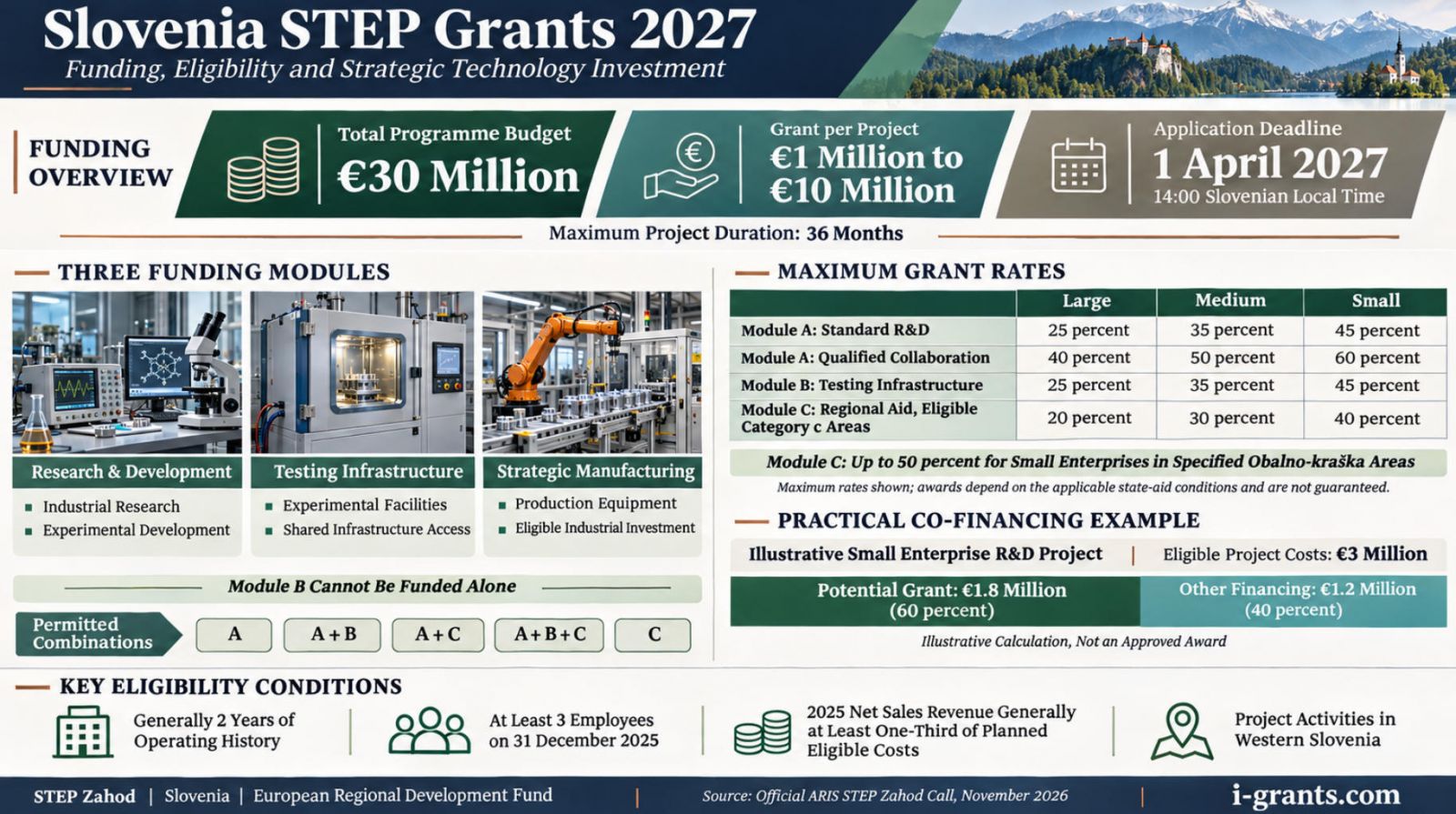
Three Funding Modules: From Research to Industrial Production
One of the programme's most important characteristics is its division into three financing modules.
Module A covers research and development. Module B supports specialised testing and experimental infrastructure. Module C finances the establishment or expansion of manufacturing activities involving critical strategic technologies.
Projects may combine these modules, but only within five configurations established by the call.
Table 2. STEP Zahod Funding Modules and Permitted Project Configurations
| Project configuration | Supported modules | Typical project structure |
|---|---|---|
| Configuration 1 | A | Industrial research and experimental development |
| Configuration 2 | A + B + C | R&D, testing infrastructure and production investment |
| Configuration 3 | A + B | Technology development and specialised testing facilities |
| Configuration 4 | A + C | Research and development combined with manufacturing investment |
| Configuration 5 | C | Establishment or expansion of strategic technology production |
A standalone Module B project is not an eligible configuration. Testing infrastructure must form part of a project that also includes R&D, with or without manufacturing investment.
Where several modules are combined, their activities must be technically connected and contribute to common project objectives. Combining unrelated investments into one application does not satisfy this requirement.
Module A: Industrial Research and Experimental Development
Module A supports activities aimed at developing new or substantially improved products, processes or services within strategic technology fields.
Potential projects include new semiconductor components, advanced industrial sensors, biotechnology production methods, high-performance materials or original technologies for improving industrial energy efficiency.
Funding may cover eligible personnel costs, research services, equipment depreciation, specific intellectual property expenditure and eligible indirect costs.
The programme excludes routine production of previously developed products and the ordinary introduction of existing processes or services under this module. Applicants must demonstrate genuine research or technological development rather than ordinary commercial implementation.
An important feature is that the call applies the same basic aid-intensity rates to industrial research and experimental development. Companies should therefore use the specific STEP Zahod rates rather than automatically applying the different research-category rates found in other European grant programmes.
Module B: Testing and Experimental Infrastructure
Module B addresses a financing gap that frequently arises between laboratory research and industrial application.
A company developing an advanced battery material, for example, may need specialised equipment to test thermal stability, production consistency, degradation characteristics and performance under industrial conditions. Such facilities can be expensive and may not yet generate sufficient commercial revenue to justify their costs independently.
STEP Zahod permits investment in testing and experimental infrastructure that is specifically relevant to critical technologies and their value chains.
Eligible expenditure can include qualifying equipment and intangible assets. However, purchasing buildings or land and undertaking construction work are not eligible under Module B.
The infrastructure must also be accessible to other interested users under the applicable rules. Applicants are required to define its availability beyond their own organisation, including planned access during the period following project completion.
Consequently, Module B should not be treated as unrestricted funding for a company's private laboratory.
Module C: Strategic Manufacturing Investments
Module C is particularly relevant to industrial enterprises preparing to establish or expand production facilities.
Possible activities include investment in machinery, manufacturing equipment, qualifying intangible assets and, subject to the applicable aid scheme, eligible buildings and construction.
However, machinery and equipment must represent at least 50 percent of the eligible expenditure planned and realised under Module C.
The programme does not support the ordinary replacement of existing machinery without the qualifying investment characteristics required by the relevant state-aid scheme.
Large enterprises face additional restrictions under regional investment aid. In eligible regional-aid areas, their supported investment must create a new economic activity, rather than merely expand an existing operation without satisfying the applicable definition.
Public research organisations cannot receive Module C funding.
For companies considering new production facilities, the most important preliminary question is whether the proposed investment qualifies as strategic technology manufacturing under both STEP rules and the relevant state-aid framework.
Who Can Apply for STEP Zahod Funding?
The programme accepts enterprises of different sizes, including micro, small, medium-sized and large companies.
Applicants may participate individually or through consortia comprising no more than five partners. Eligible Slovenian public research organisations, including qualifying universities and research institutes, may join consortia but cannot act as the lead applicant or apply independently.
Unlike many startup-oriented grant schemes, STEP Zahod establishes significant requirements concerning business maturity and financial performance.
As a general rule, an enterprise must have existed for at least two years before submitting its application. It must also have employed at least three people on 31 December 2025.
Another particularly important condition concerns historical revenue. Each enterprise must generally have recorded net sales revenue in 2025 equivalent to at least one-third of the eligible expenditure it plans to undertake.
Consider a medium-sized company proposing €9 million in eligible project expenditure. Under this rule, its net sales revenue for 2025 would generally need to reach at least €3 million.
The condition applies to individual consortium partners based on their respective planned expenditure. A financially strong lead company cannot automatically compensate for another partner's failure to meet the revenue requirement.
One exception allows a consortium to include a single non-leading enterprise established at least one year but less than two years before submission. That partner may benefit from an exemption from the historical revenue threshold. Certain requirements also differ for eligible public research organisations.
Financial Stability and the AJPES Credit Rating
Applicants established under the relevant Slovenian company law must generally provide an AJPES creditworthiness rating of SB6 or better. The permitted younger consortium partner may qualify with SB7 or better.
The supporting rating document must satisfy the specific validity period established by the call.
Applicants must also comply with requirements relating to tax liabilities, insolvency, outstanding recovery obligations, prohibited state aid and the European definition of an undertaking in difficulty.
These conditions make STEP Zahod more suitable for financially established technology enterprises than for newly incorporated startups with limited personnel, no meaningful sales history or insufficient creditworthiness evidence.
A strong technical idea cannot compensate for failure to satisfy mandatory eligibility requirements.
Consortium Independence and Liability
Consortium formation introduces additional restrictions that are easy to overlook.
Within the specified assessment period, partners must not have direct ownership links exceeding 25 percent between them. The same individual also cannot serve as the legal representative of more than one consortium partner.
The consortium agreement must establish each partner's activities, responsibilities, timetable and budget. It must also designate a lead partner and provide for unlimited joint and several liability concerning proper project implementation.
The lead partner receives the grant payments and distributes the appropriate amounts to participating organisations.
For corporate groups, this means that several subsidiaries cannot necessarily form an eligible consortium simply because they possess separate legal identities.
Companies should review beneficial ownership, governance and contractual exposure before committing to a partnership.
Can Foreign Companies Participate?
STEP Zahod has an important cross-border dimension.
Companies established in another European Union member state may apply even if they have not yet registered a Slovenian branch, provided they formally undertake to establish the required presence in Western Slovenia before project activities begin and before the first payment claim.
The company must satisfy the substantive eligibility conditions and provide documentary evidence where requested. ARIS may require appropriate certificates, extracts from foreign registers and certified Slovenian translations.
This creates a potential opportunity for established technology businesses from countries such as Austria, Germany, Italy, France or other EU member states to develop a genuine industrial or research operation in Slovenia.
However, establishing a branch does not exempt the parent company from the minimum operating-history requirement. The foreign enterprise's financial history, workforce and other relevant characteristics remain important.
Companies incorporated outside the EU should not assume that the same branch-registration provision applies automatically to them. The call expressly addresses companies headquartered in other EU member states. A non-EU-owned enterprise established within an eligible EU jurisdiction may need a separate assessment of its legal structure, ownership relationships and financial eligibility.
The nationality of a company's founders is not the same question as the jurisdiction in which the applicant is incorporated.
Most importantly, the supported activities must actually take place within Western Slovenia. Establishing a nominal administrative address while performing the funded work elsewhere would not meet the programme's territorial requirements.
Grant Amounts and Co-Financing Rates
STEP Zahod does not establish one uniform grant percentage for every project.
Instead, maximum aid intensity depends on the module, company size, collaboration structure and, for certain manufacturing investments, geographic location.
The applicable provisions draw on the General Block Exemption Regulation, Regulation (EU) No 651/2014, as amended, and the relevant Slovenian research, regional investment and SME state-aid schemes.
Table 3. Maximum STEP Zahod Grant Rates by Company Size and Activity
| Funded activity | Large enterprise | Medium enterprise | Micro or small enterprise |
|---|---|---|---|
| Module A: Standard R&D | 25 percent | 35 percent | 45 percent |
| Module A: Qualifying collaborative R&D | 40 percent | 50 percent | 60 percent |
| Module B: Testing infrastructure | 25 percent | 35 percent | 45 percent |
| Module C: Regional aid in eligible category "c" areas | 20 percent | 30 percent | 40 percent |
| Module C: Regional aid in specified Obalno-kraška areas | 30 percent | 40 percent | 50 percent |
| Module C: SME investment aid | Not available | 10 percent | 20 percent |
These rates represent upper limits rather than guaranteed funding levels. Additional restrictions may apply to individual projects, investment categories and state-aid calculations.
How Collaboration Can Increase R&D Funding
Module A offers a potentially significant advantage for qualifying consortia.
The basic rates can increase by 15 percentage points where the collaboration meets the call's specific conditions.
At least two unrelated partners must perform Module A activities, at least one must qualify as an SME, and no single unrelated partner may account for more than 70 percent of eligible Module A expenditure.
For a small enterprise, the maximum research funding intensity can consequently increase from 45 percent to 60 percent.
This incentive makes partnership design a financial decision as well as a technical one. Companies should assess whether the additional grant intensity justifies the complexity of consortium management, shared responsibilities and contractual liabilities.
The higher rate is not available simply because a project includes several organisations. The precise collaboration conditions must be satisfied.
Why Manufacturing Location Can Change the Grant Amount
For Module C, the choice between regional investment aid and SME investment aid can substantially affect the financial structure.
Regional investment aid is available only in the designated category "c" areas of Slovenia's regional-aid map.
Although STEP Zahod requires project implementation in Western Slovenia, not every municipality within that wider region qualifies for regional investment aid.
The call identifies six municipalities within the Obalno-kraška statistical region where enhanced regional-aid rates apply: Divača, Hrpelje-Kozina, Izola/Isola, Komen, Piran/Pirano and Sežana.
In these specified areas, a small enterprise may qualify for regional investment aid covering up to 50 percent of eligible expenditure, compared with up to 40 percent in other qualifying category "c" areas.
Elsewhere within Western Slovenia, an SME may be able to use the separate SME investment aid scheme, subject to its requirements. That scheme provides lower maximum rates and is not available to large enterprises.
An SME cannot simply combine both investment aid schemes for the same Module C activity to increase its funding percentage.
The choice of location can therefore affect both whether a manufacturing investment qualifies and how much grant funding is potentially available.
How Much Funding Could a Company Actually Receive?
The following examples illustrate the financial implications of different aid intensities.
They are hypothetical calculations, not approved STEP Zahod projects. They assume that all stated expenditure is eligible, the relevant maximum intensity applies and the company's investment satisfies the applicable state-aid conditions.
Table 4. Illustrative STEP Zahod Project Budgets and Co-Financing
| Applicant and activity | Eligible expenditure | Applicable rate | Potential grant | Other financing required |
|---|---|---|---|---|
| Small enterprise, standard Module A R&D | €3 million | 45 percent | €1.35 million | €1.65 million |
| Small enterprise, qualifying collaborative Module A R&D | €3 million | 60 percent | €1.80 million | €1.20 million |
| Medium enterprise, Module B infrastructure component | €4 million | 35 percent | €1.40 million | €2.60 million |
| Large enterprise, Module A R&D | €6 million | 25 percent | €1.50 million | €4.50 million |
| Small enterprise, Module C investment in an eligible category "c" area | €5 million | 40 percent | €2 million | €3 million |
| Small enterprise, Module C investment in a specified Obalno-kraška area | €5 million | 50 percent | €2.50 million | €2.50 million |
The Module B calculation represents one component of a larger eligible project. Module B cannot be submitted independently and must be combined with the required Module A activities.
The collaborative R&D example assumes the wider consortium satisfies all conditions for the enhanced rate.
These calculations demonstrate why companies should distinguish between the grant amount, total eligible expenditure and the funding required from other sources.
For example, a manufacturer planning €5 million of eligible investment with a maximum grant intensity of 40 percent would still need to secure €3 million beyond the grant.
The remaining contribution may need to cover both eligible expenditure not reimbursed by the programme and additional non-eligible expenditure, such as VAT.
A commercially viable project therefore requires more than an attractive grant percentage. Applicants must demonstrate that they can finance implementation and manage expenditure before receiving the relevant reimbursement.
The Revenue Requirement and Project Size
There is another financial relationship that companies should examine before preparing an ambitious proposal.
Suppose a business recorded €1.2 million in net sales revenue in 2025. Based on the programme's general one-third revenue rule, its planned eligible expenditure would ordinarily be limited to €3.6 million, assuming no exception applies.
The maximum grant would then depend on the relevant aid intensity.
For a small company receiving a maximum research rate of 45 percent, €3.6 million in eligible expenditure would produce a theoretical grant of €1.62 million.
This calculation demonstrates how historical business performance may constrain the amount of funding a company can realistically request even before the formal maximum grant ceiling becomes relevant.
Eligible Costs, Personnel Rates and Budget Restrictions
The programme's eligible expenditure categories differ between the three modules.
For Module A, relevant costs include researchers and technical personnel, qualifying external research services, equipment depreciation and certain intellectual property or intangible asset expenses.
Module B supports eligible investments in testing infrastructure equipment and intangible assets, but excludes construction and the purchase of buildings or land.
Module C may cover machinery, manufacturing equipment, qualifying intangible assets and eligible building-related investments under the relevant investment aid scheme.
VAT is excluded from eligible expenditure across the programme.
The cost-accounting arrangements are also important. STEP Zahod uses both simplified cost methodologies and reimbursement based on evidence of actual expenditure.
Fixed Hourly Rates for Researchers
For eligible Module A personnel, the programme establishes standard hourly cost rates.
Table 5. Personnel Cost Calculation Under Module A
| Personnel category | Eligible unit cost |
|---|---|
| Researcher | €33.90 per hour |
| Professional or technical employee | €22.60 per hour |
| Maximum eligible project hours | 1,700 hours per person per calendar year |
| Indirect costs | Up to 15 percent of eligible direct personnel costs |
The hourly values are accounting rates for eligible project costs. They should not be interpreted as mandatory employee salaries.
An employee must meet the minimum monthly working-time conditions established by the call, and the maximum annual hours apply to the time claimed under the project.
For example, 1,000 eligible researcher hours would generate €33,900 in standard personnel costs. Applying the maximum indirect-cost rate would add €5,085, producing a combined eligible cost base of €38,985 before the relevant grant intensity is applied.
The methodology provides budgeting predictability, but it also requires reliable documentation of the work performed.
Additional financial restrictions include a ceiling of €1 million in requested personnel-cost co-financing for each individual applicant or consortium partner.
Public research organisation partners are collectively limited to 30 percent of the project's planned total grant funding.
Applicants must also identify the sources they will use to finance expenditure before grant payments are received. The call expressly prohibits closing the project's financing structure through leasing.
External contractors and suppliers must comply with ownership and independence requirements. Consortium partners cannot simply invoice each other as external project suppliers.
These rules matter particularly for businesses that normally acquire production equipment through leasing or use affiliated companies for engineering, construction or research services.
Which Technologies Qualify Under STEP?
STEP Zahod focuses on three strategic sectors: digital technologies and deep-tech innovation, clean and resource-efficient technologies, and biotechnology.
However, belonging to one of these industries does not automatically make a project eligible.
Under the relevant STEP framework, the proposed technology must satisfy at least one of two criticality conditions: it must introduce an innovative, emerging and cutting-edge element with substantial economic potential for the EU internal market, or it must contribute to reducing or preventing strategic dependencies within the European Union.
This creates an important distinction between operating in a strategic industry and developing a genuinely critical technology.
A company using commercially available artificial intelligence software to automate ordinary administrative tasks would not necessarily satisfy the programme's technological requirements.
By contrast, a company developing an original, high-reliability AI architecture for industrial infrastructure, supported by evidence of technical novelty and substantial economic potential, might have a stronger basis for demonstrating STEP criticality.
Similarly, an investment in conventional renewable energy equipment is not automatically eligible simply because it contributes to decarbonisation. The proposal must demonstrate the relevant strategic technological contribution and comply with any sector-specific restrictions under the applicable state-aid scheme.
Digital Technologies and Deep-Tech Innovation
Potentially relevant technologies include advanced semiconductors, microelectronics, photonics, quantum technologies, cybersecurity components, industrial computing systems and original AI technologies.
A realistic project might involve developing a new generation of energy-efficient industrial microcontrollers capable of operating reliably in demanding environments.
Its strategic contribution could be demonstrated through technological performance, intellectual property, potential applications in European industrial supply chains and evidence of market demand.
For manufacturing projects, applicants would also need to show that the proposed investment qualifies under the relevant Module C rules.
Clean and Resource-Efficient Technologies
The clean-technology sector includes potentially relevant innovations in advanced energy systems, industrial decarbonisation, resource efficiency, energy storage, materials recovery and technologies that strengthen energy security.
A company developing a new catalyst for electrolysis equipment, for example, could investigate whether its technology reduces reliance on critical imported materials while improving industrial performance.
Another potential project might involve advanced industrial materials that reduce energy consumption or enable more efficient manufacturing processes.
However, eligibility must be established for the precise technology, activity, investment type and state-aid scheme. Energy-related projects require especially careful assessment because certain investment categories are excluded from regional investment aid.
Biotechnology and Advanced Materials
Biotechnology opportunities may include innovative bioprocesses, pharmaceutical technologies, advanced diagnostics, industrial biotechnology and other relevant technological value chains.
A company developing a new biomanufacturing process for a strategically important pharmaceutical ingredient might be able to demonstrate both technological novelty and an industrial supply-chain contribution.
Advanced materials can also be relevant where the proposed innovation meets the critical-technology criteria and aligns with the programme's supported sectors.
Applications should provide measurable technical evidence and explain the economic significance of the innovation rather than relying on broad claims about sustainability or scientific excellence.
The Additional Requirement: Slovenia's Smart Specialisation Strategy
STEP Zahod also requires projects to correspond to the focus areas or product directions of Slovenia's Smart Specialisation Strategy, known as S5.
The strategy includes priority areas such as factories of the future, mobility, health and medicine, advanced materials, circular economy networks, information and communication technologies, smart buildings and other technology-related fields.
Applicants must establish alignment with the specific focus areas or product directions contained in the programme's official S5 annex.
This is a separate eligibility test. A technology may satisfy the broader European STEP definition but still fail to match the relevant Slovenian smart-specialisation priorities.
A convincing application should therefore establish both European strategic relevance and national programme alignment.
How STEP Zahod Applications Are Evaluated
The assessment framework places substantial emphasis on economic and societal impact.
Research excellence remains important, but a technologically ambitious concept without a convincing market opportunity, appropriate implementation capacity or credible financial plan may struggle to compete.
Table 6. Official STEP Zahod Evaluation Criteria
| Evaluation criterion | Maximum points |
|---|---|
| Project excellence and technological concept | 25 |
| Socio-economic impact, market potential and strategic contribution | 50 |
| Applicant and consortium capabilities | 10 |
| Project planning, budget and risk management | 15 |
| Subtotal: Main evaluation criteria | 100 |
| Additional criterion: Project location | 5 |
| Maximum total score | 105 |
Applications must obtain at least 50 points under the main evaluation criteria before the additional location score can be considered.
A proposal receiving zero points for a main criterion or subcriterion is generally excluded, subject to the specific exceptions established for subcriterion 1.2 and the additional location criterion.
The scoring structure makes it difficult to compensate for a fundamental weakness in one area through exceptional performance elsewhere.
Economic Impact Carries Half of the Main Score
The socio-economic impact criterion accounts for 50 of the 100 main points.
It examines market potential, participation in international value chains, broader economic and social effects, environmental impact and the quality of the project's intended objectives.
Applicants should therefore explain who will purchase or use the resulting technology, how the project will contribute to industrial competitiveness and what measurable value it can create.
Relevant evidence may include substantiated market assessments, technical validation results, customer interest, production forecasts, competitive benchmarking and a credible commercialisation strategy.
These documents are examples of useful supporting evidence, not a substitute for the mandatory application forms.
How Funding Decisions Are Made
The programme includes a sector-balancing mechanism.
Among proposals that meet the minimum assessment threshold, the selection process first identifies the highest-ranked eligible project in each of the three technology sectors.
Remaining funding is then allocated to other qualifying applications according to their scores, regardless of sector.
When projects receive equal final scores and available funding is insufficient, preference is determined through a defined sequence of evaluation criteria, beginning with socio-economic impact.
This structure provides a measure of sector representation while preserving competition across the broader funding pool.
Meeting the minimum threshold does not guarantee a grant award. The total allocation is limited, and high-quality proposals may remain unfunded if they rank below other eligible applications.
Commercialisation Obligations Continue After Project Completion
Some of the programme's most consequential conditions concern what beneficiaries must achieve after the funded activities end.
For Module A, the applicant must develop a completed product, process or service with at least three improved characteristics by the end of the project. The resulting innovation must then be placed on the market within 24 months after project completion.
Module B requires the establishment of the proposed testing or experimental infrastructure. The applicant must also specify how the facility will be made available to other interested users during the following 24 months.
Module C requires the establishment or expansion of the relevant strategic manufacturing activity, followed by the placement on the market of products manufactured through the new or expanded production within 24 months after project completion.
These obligations create significant commercial and technical responsibilities.
For a new industrial sensor, the three improved characteristics might involve measurement accuracy, energy efficiency and environmental durability. Applicants would need to define credible indicators and establish how the improvements could be demonstrated.
For a manufacturing investment, the commercialisation timetable should reflect equipment procurement, commissioning, technical validation, regulatory requirements and the development of customer relationships.
Where objectives are not achieved, ARIS may seek repayment of all or a proportionate share of the grant, together with applicable interest.
Supported investments are also subject to durability requirements. Depending on the enterprise category and applicable provisions, relevant obligations may continue for three or five years after the final payment.
Moving production away from the eligible area or making substantial changes that undermine the approved project's objectives may therefore have serious financial consequences.
Slovenia's Innovation Economy: Why the Programme Matters
STEP Zahod arrives at a time when Slovenia combines a substantial industrial research base with continuing challenges in innovation financing and commercial scale-up.
According to preliminary data published by the Statistical Office of the Republic of Slovenia in November 2026, the country spent approximately €1.688 billion on research and development in 2025.
This represented 2.4 percent of GDP, compared with 2.1 percent in 2024. Total R&D expenditure increased by 17.3 percent year on year.
Businesses performed 69.7 percent of Slovenia's R&D expenditure, highlighting the importance of industrial and commercial organisations in the national research system.
Foreign sources financed approximately €489 million of Slovenian R&D expenditure in 2025, equivalent to 29 percent of the national total. This category includes different foreign funding sources and should not be interpreted exclusively as EU grants.
The research workforce comprised 26,711 people, including 17,807 researchers.
Slovenia also has a substantial population of innovation-active businesses. Final statistical data covering 2022–2024 identified 2,411 innovation-active enterprises in manufacturing and selected services, representing approximately 47 percent of enterprises within the survey scope.
Medium-sized and large enterprises displayed higher innovation participation rates than smaller businesses.
Nevertheless, innovation activity does not automatically translate into internationally competitive technology companies.
The European Innovation Scoreboard 2026 classified Slovenia as a Moderate Innovator, with an innovation performance score equivalent to 87.2 percent of the EU average and a ranking of seventeenth among the 27 member states.
The country performs relatively strongly in medium- and high-technology exports and business R&D, while venture capital financing remains a comparatively weak area.
This combination helps explain the relevance of industrial grant instruments that support technological development, testing infrastructure and production capacity.
STEP Zahod cannot replace private investment or solve every financing constraint, but it can complement commercial capital where projects satisfy the strategic and financial requirements.
Real Slovenian Technology Projects: Evidence Beyond STEP Zahod
Because STEP Zahod was launched in November 2026, it does not yet have a documented history of approved beneficiaries under this specific call.
However, several Slovenian technology initiatives illustrate the country's capabilities in sectors related to the programme.
ReCatalyst: Advanced Hydrogen Catalysts
Slovenian company ReCatalyst develops advanced catalysts for hydrogen fuel cells and electrolysers, with a focus on reducing dependence on costly precious metals.
According to investment information published through SPIRIT Slovenia, the company secured a €992,500 EIC Transition grant for its ENABLER project in February 2023.
The same source records a separate €1.7 million seed investment in July 2023.
These financing instruments should not be confused. The first was grant funding, while the second involved private investment capital.
ReCatalyst provides an example of Slovenian expertise in advanced materials and hydrogen-related technologies, but it is not a confirmed STEP Zahod beneficiary.
Skylabs: Low-Power Microelectronics for Space Applications
In April 2026, the European Innovation Council announced the selection of 70 companies under its EIC Pre-Accelerator initiative.
The selected companies included Slovenia's Skylabs, whose project concerns a fault-tolerant, low-power microcontroller for smart sensing and control in space applications.
The initiative illustrates the presence of Slovenian deep-tech activity in strategically important microelectronics.
However, selection under the EIC Pre-Accelerator should not be described as proof of a completed grant payment or as an award under STEP Zahod.
North Adriatic Hydrogen Valley: Industrial Collaboration
The North Adriatic Hydrogen Valley is a cross-border initiative involving Slovenia, Croatia and Italy.
In 2023, a consortium led by Holding Slovenske Elektrarne signed an agreement involving €25 million in grant co-financing through the Clean Hydrogen Partnership.
The project was designed to include 17 pilot initiatives across the participating territories, with the aim of developing integrated hydrogen production and utilisation capabilities.
Its planned industrial activities illustrate how European innovation funding can support partnerships connecting technology, infrastructure and end users.
Nevertheless, the project's funding belongs to a different European initiative, and its planned outputs should not be presented as already achieved commercial results.
Taken together, these examples demonstrate the relevance of Slovenian capabilities in microelectronics, advanced materials and clean technologies. They do not constitute a track record of STEP Zahod awards.
STEP Zahod Compared with EIC Accelerator and Other EU Funding
Technology companies should select funding programmes according to their development stage, financing needs and intended investment location.
STEP Zahod is particularly distinctive because it can support qualifying manufacturing investments alongside R&D and specialised testing.
The European Innovation Council provides complementary instruments, but their financing structures differ.
Under the EIC Accelerator 2027 programme, eligible innovative companies may seek a grant component below €2.5 million, while the investment component can range from €500,000 to €10 million under the applicable conditions.
EIC STEP Scale Up 2027 provides equity investment opportunities ranging from €10 million to €30 million for eligible companies seeking major investment rounds.
These investment components are not equivalent to non-repayable grants. Equity financing involves a different relationship between the company and its investors.
EIC Transition, meanwhile, provides grants of up to €2.5 million to advance technologies emerging from specified earlier research activities towards innovation and market readiness.
For a technology company with an eligible research result but no significant commercial history, an appropriate research-oriented European programme may be more realistic than STEP Zahod.
Conversely, an established manufacturer planning a qualifying production facility in Western Slovenia could find STEP Zahod more closely aligned with its investment objectives.
The appropriate choice depends on the company's maturity, strategic technology, location, funding structure, ownership considerations and capacity to finance the non-grant portion of its project.
How to Prepare a Competitive STEP Zahod Application
The first priority is to establish eligibility before investing heavily in technical writing.
A company should confirm that its proposed technology meets the relevant STEP criticality conditions and can be mapped to a specific S5 focus area or product direction.
It should then evaluate the appropriate project configuration. A research project, a combined R&D and testing initiative, and a manufacturing investment may require different budget structures and supporting evidence.
For Module C, the proposed municipality and investment aid scheme should be assessed early. A location decision may affect the maximum grant intensity or determine whether a particular investment can receive regional aid.
The next stage is a financial and legal assessment.
Applicants should review their 2025 net sales revenue, employment figures, operating history, AJPES rating where applicable, tax compliance and ownership arrangements.
For consortia, the analysis must cover each participating organisation rather than only the lead applicant.
Budget preparation should distinguish eligible from non-eligible costs, document the relevant aid intensity for each module and partner, and explain how the remaining expenditure will be funded.
Cash-flow planning is particularly important for equipment-intensive investments. Applicants should not assume that grant payments will automatically arrive before major supplier invoices become payable.
The technical proposal should explain the current state of technology, the specific advance being proposed, the supporting evidence and the project's relevance to European strategic objectives.
An investment in new equipment is more convincing when connected to a demonstrable technological capability, a credible production plan and a realistic commercial outcome.
Finally, the implementation plan should remain credible beyond the formal project period.
The programme's post-completion obligations mean that market introduction, infrastructure access and production continuity are not merely optional aspirations. They are relevant to the beneficiary's continuing contractual responsibilities.
Professional grant-writing and technical support may be useful when coordinating state-aid calculations, consortium agreements, financial projections and evidence of technology criticality. However, external assistance does not replace the applicant's responsibility for the accuracy of submitted information.
Application Deadline and Submission Procedure
The deadline for STEP Zahod applications is 1 April 2027 at 14:00 Slovenian local time.
Applications may be submitted electronically through ARIS Digital Forms or in paper form, in accordance with the official instructions.
The application package includes technical and financial forms, eligibility declarations, information on company size and beneficial ownership, and additional documentation relevant to the applicant's legal structure and project activities.
Consortium applications must include the required partnership arrangements and authorisations.
Foreign applicants may need to provide supporting documentation from their home jurisdiction, together with certified Slovenian translations when requested.
The selection process evaluates both formal compliance and substantive project quality. Applicants should not assume that missing information concerning fundamental project characteristics can be corrected after the deadline.
If both electronic and paper versions are submitted and contain inconsistent information, the official rules give precedence to the paper submission.
ARIS accepts written questions concerning the competition, subject to the specified deadlines for requesting clarification. Published answers form part of the competition documentation.
Before submission, applicants should check the current official call, all mandatory annexes, published clarifications and any amendments.
The current call requires projects to last no more than 36 months and to conclude no later than 31 May 2030.
Is STEP Zahod the Right Funding Opportunity for Your Company?
STEP Zahod provides a significant opportunity for companies developing technologies that can strengthen European industrial capabilities.
Its principal advantage is the possibility of financing different stages of the innovation process, including research, experimental infrastructure and strategic manufacturing.
Yet the €30 million programme is not a general-purpose innovation subsidy.
Its requirements concerning company maturity, financial strength, strategic technology relevance, territorial presence and post-project commercialisation create a clearly defined applicant profile.
An established technology company with verified research results, a credible route to market and sufficient capital to co-finance its investment may be well positioned to explore the programme.
A newly established startup without a qualifying operating history or meaningful financial capacity may need to consider other funding instruments before pursuing a project of this scale.
Foreign enterprises can also explore participation, particularly where they intend to establish substantive research or industrial operations in Western Slovenia. Cross-border involvement, however, requires careful attention to registration, ownership, eligibility and the actual location of project expenditure.
The most important preparation principle is to treat STEP Zahod as a strategic industrial investment programme rather than simply a source of grants.
A competitive proposal must explain not only what technology will be developed, but also why it matters to Europe, how it will be financed, who will use or purchase the resulting innovation and whether the applicant can fulfil its obligations over the full project lifecycle.
For businesses capable of meeting these conditions, Slovenia's STEP Zahod grants represent a potentially valuable instrument for turning strategic technology development into commercially relevant European industrial capacity.