

 Français
 Deutsch
 Українська

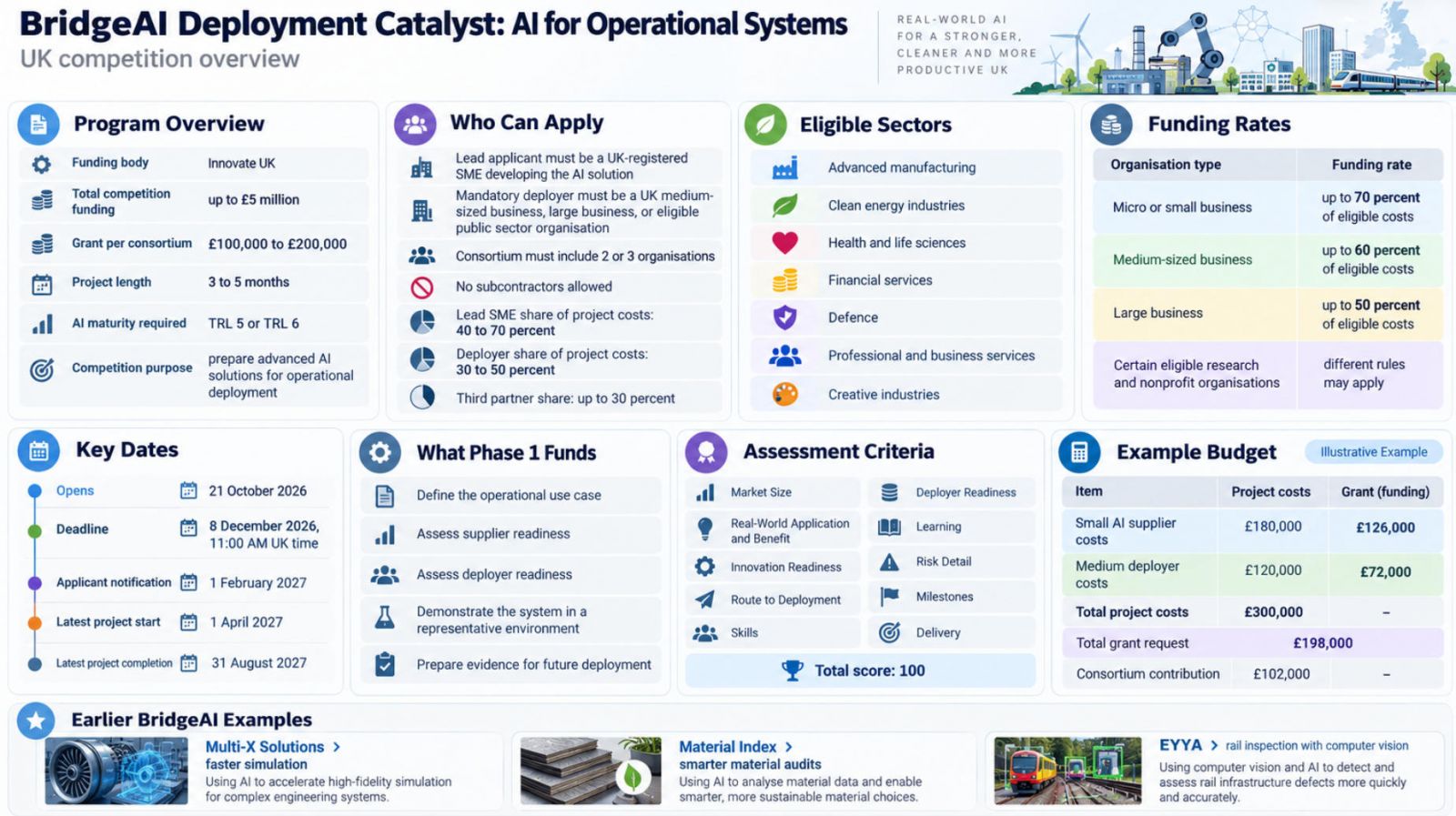
British artificial intelligence companies have a new opportunity to secure substantial public funding for bringing advanced AI technologies closer to real-world deployment. The BridgeAI Deployment Catalyst: AI for Operational Systems competition, delivered by Innovate UK, provides up to £5 million in grant funding for collaborative projects involving UK technology developers and organisations preparing to adopt their solutions.
Eligible project consortia can request between £100,000 and £200,000 in grant funding for feasibility projects lasting three to five months. Applications opened on October 21, 2026, and close on December 8, 2026, at 11:00 a.m. UK time. Successful projects must start no later than April 1, 2027, and finish by August 31, 2027.
Unlike general business digitalisation grants, this competition does not support companies that simply want to purchase existing AI software or automate routine administrative activities. It targets UK-registered small and medium-sized enterprises (SMEs) that have already developed an advanced artificial intelligence or machine learning solution and can demonstrate its readiness for further deployment.
The programme requires a partnership between an AI developer and an eligible organisation that intends to use the technology in a real operational environment. The proposed solution must have reached Technology Readiness Level (TRL) 5 or 6 and address significant unresolved challenges associated with integrating artificial intelligence into practical business operations.
The £200,000 maximum represents the total grant requested by the participating organisations, not necessarily the complete project budget. Different funding rates apply to individual partners, meaning that the actual value of a collaborative project can be considerably higher.
For innovative SMEs, the opportunity goes beyond short-term research funding. BridgeAI Deployment Catalyst is structured as a potential three-phase programme, with later stages expected to support preparation for deployment, operational implementation, and replication across additional organisations. However, progression is competitive, and funding for subsequent phases is not guaranteed.
Understanding the distinction between developing AI technology and preparing it for dependable operational use is therefore essential for applicants seeking to benefit from this programme.
What Is the BridgeAI Deployment Catalyst Programme?
BridgeAI is a wider Innovate UK initiative designed to accelerate the adoption and commercial development of artificial intelligence across the British economy. Previous activities have supported research collaborations, technical advice, innovation funding, knowledge exchange, and the development of advanced AI solutions for practical industrial challenges.
The new Deployment Catalyst programme addresses a particularly important problem: the difficulty of moving promising artificial intelligence technologies beyond demonstrations and limited trials into reliable, commercially valuable operational environments.
Developing a functioning AI model does not automatically mean that an organisation can deploy it successfully. An industrial system may need access to operational data, integration with existing equipment, security controls, technical validation, staff training, and clear arrangements for handling incorrect outputs or system failures.
These challenges become more demanding when artificial intelligence performs activities directly affecting production, financial operations, infrastructure, or other business-critical processes.
BridgeAI Deployment Catalyst has been designed to help developers and potential customers identify and address these barriers together.
The programme operates through three separate competition strands. AI for Decision Critical Systems supports technologies primarily intended to assist people with consequential judgements, recommendations, or decisions. AI for Assurance and Compliance Systems focuses on monitoring, testing, verification, validation, and demonstrating compliance with defined requirements.
The third strand, AI for Operational Systems, supports technologies that directly perform, control, or coordinate operational activity within business processes, software environments, machinery, or infrastructure.
This distinction is particularly important because applicants must select the strand that corresponds to the primary purpose of their technology. Innovate UK will not automatically transfer a proposal between competitions if the applicant chooses incorrectly.
For example, an AI tool that recommends machinery adjustments for a human engineer may belong to a different strand from a system that directly coordinates those adjustments within a production process. Similarly, software designed primarily to verify regulatory compliance would generally be considered under the assurance and compliance strand rather than the operational systems competition.
The three strands share the same principal funding arrangements, but their technical objectives differ.
How Much Funding Is Available?
Innovate UK has allocated up to £5 million to the AI for Operational Systems competition within Phase 1 of BridgeAI Deployment Catalyst. Individual project consortia may request grants between £100,000 and £200,000.
The competition funds feasibility studies rather than full industrial deployment. Projects must be sufficiently advanced to produce meaningful evidence of deployment readiness within three to five months.
Table 1. BridgeAI Deployment Catalyst: AI for Operational Systems Funding Conditions
| Programme condition | Official requirement |
|---|---|
| Funding organisation | Innovate UK, part of UK Research and Innovation |
| Competition strand | AI for Operational Systems |
| Total competition funding | Up to £5 million |
| Minimum consortium grant request | £100,000 |
| Maximum consortium grant request | £200,000 |
| Project duration | Three to five months |
| Applications opened | October 21, 2026 |
| Application deadline | December 8, 2026, 11:00 a.m. UK time |
| Expected applicant notification | February 1, 2027 |
| Latest permitted project start | April 1, 2027 |
| Latest permitted project completion | August 31, 2027 |
| Required consortium | Two or three organisations |
| Required AI maturity | Technology Readiness Level 5 or 6 |
| Subcontractors | Not permitted |
Project work receiving Innovate UK funding must be carried out in the United Kingdom, with most funding spent domestically and the intention to exploit the results in or from the UK. Projects must also start on the first day of a month and cannot begin before Innovate UK has approved the Grant Offer Letter.
The programme is competitive. A technically eligible application is not guaranteed funding simply because sufficient resources appear to be available. Innovate UK may consider the quality of proposals, the balance between sectors and technologies, the types of organisations involved, and the overall composition of its supported project portfolio.
The £5 million allocation relates specifically to the current competition strand. It should not be confused with the wider programme's indicative future funding ambitions or with the amount available to a single applicant.
Which UK Businesses Can Apply for BridgeAI Grants?
The programme has unusually specific partnership requirements. A company cannot submit a standalone application, regardless of how advanced its technology may be.
Every consortium must include an eligible British SME acting as the AI supplier and an eligible organisation that intends to deploy the technology. A third project partner may also participate where its involvement adds identifiable expertise or delivery capacity.
The AI Supplier Must Lead the Project
The lead applicant must be a micro, small, or medium-sized enterprise registered in the United Kingdom.
It must have developed an existing AI or machine learning solution with a functioning minimum viable product. The technology must demonstrate substantive advanced capabilities and have reached TRL 5 or 6.
The lead organisation must also possess the technical capability and intellectual property rights necessary to develop, integrate, support, and eventually commercialise the solution.
A company whose principal business consists of reselling another supplier's ready-made AI service would therefore need to demonstrate that it genuinely meets the programme's requirements for an innovative AI supplier.
The lead SME must account for between 40 and 70 percent of the total eligible project costs.
This requirement prevents an AI developer from participating merely as a nominal technology provider while the majority of the work is undertaken elsewhere.
The Deployer Must Be a Genuine Operational Partner
The second mandatory participant is the deployer, meaning the organisation that intends to use the proposed AI technology.
The deployer must be a UK-registered medium-sized or large business, or an eligible UK public sector organisation. It must operate within one of the specified industrial strategy sectors and provide a meaningful environment in which deployment readiness can be assessed.
The deployer's role extends beyond providing a letter of support. It is expected to contribute operational knowledge, staff involvement, access to relevant data, technical systems, existing workflows, and practical information about the organisation's requirements.
The deployer must account for between 30 and 50 percent of total eligible project costs.
For example, a manufacturing business participating in a machine learning project might provide engineers, production information, process documentation, access to equipment, and internal specialists responsible for operational safety.
The project must explain how these resources will be made available and how their use will contribute to evaluating the technology.
When a Third Partner Can Participate
Consortia may include one additional UK-registered organisation, such as another business, university, research organisation, research and technology organisation, charity, nonprofit organisation, or eligible public body.
The additional partner must not account for more than 30 percent of the project's total eligible costs.
A research institute might contribute specialised testing knowledge, while a smaller technology company could assist with an essential integration component. Its participation must have a clear project purpose.
The competition does not permit subcontractors. Applicants should therefore ensure that all essential work can be delivered by the eligible consortium members rather than relying on external subcontracted development.
Table 2. BridgeAI Consortium Requirements and Funding Rates
| Consortium role | Eligible organisation | Required share of total project costs | Maximum funding rate for commercial activity |
|---|---|---|---|
| Lead AI supplier | UK micro or small enterprise | 40 to 70 percent | 70 percent |
| Lead AI supplier | UK medium-sized enterprise | 40 to 70 percent | 60 percent |
| Mandatory deployer | UK medium-sized enterprise | 30 to 50 percent | 60 percent |
| Mandatory deployer | UK large enterprise | 30 to 50 percent | 50 percent |
| Additional partner | Eligible UK organisation | No more than 30 percent | Depends on organisation type and activity |
Certain research organisations undertaking eligible non-economic activity may qualify for different funding arrangements. For example, eligible research and technology organisations, charities, nonprofits, public bodies, and research organisations may receive funding covering up to 100 percent of their eligible non-economic project costs, subject to the research participation limits. Academic institutions generally follow a different calculation based on 80 percent of full economic costs.
These exceptions do not mean that all nonprofit expenditure automatically qualifies for full reimbursement. The nature of the activity, applicable funding rules, and the consortium structure must be considered.
A further restriction applies to the number of applications. A lead SME may lead only one application and cannot participate as another consortium partner across the three competition strands. An eligible deployer may participate in up to three applications where each concerns a materially different deployment use case.
These conditions make partner selection a strategic decision rather than a formality.
Which Industries and AI Applications Are Eligible?
BridgeAI Deployment Catalyst focuses on industries identified in the United Kingdom's 2025 Industrial Strategy.
The eligible deployer must operate in one of seven sectors: advanced manufacturing, clean energy industries, health and life sciences, financial services, defence, professional and business services, or creative industries.
The relevant factor is the context in which the AI solution will be deployed. A technology supplier may serve customers in multiple sectors, but its proposed use case must align with an eligible sector and the selected competition strand.
Within those boundaries, the programme permits a broad range of advanced artificial intelligence approaches.
Potential technologies include autonomous and semi-autonomous systems, intelligent robotics, advanced computer vision, agent-based AI, multimodal models, reinforcement learning, specialised foundation models, graph-based machine learning, and intelligent optimisation and control.
The programme does not require applicants to use a particular fashionable technology. Instead, they must demonstrate that the AI capability is advanced, innovative, central to the proposed deployment, and necessary to address a significant operational challenge.
In advanced manufacturing, a suitable project might involve machine learning software that coordinates production equipment settings using real-time sensor information. The challenge could involve integrating the system into existing machinery while demonstrating that its outputs remain reliable across changing production conditions.
In clean energy industries, an applicant might propose AI that manages the operation of complex energy systems or coordinates different assets to improve efficiency. The project would need to establish how the system interacts with existing controls and what operational safeguards are necessary.
Within health and life sciences, advanced AI might help coordinate specialised laboratory or manufacturing processes. Such projects would need to address the relevant safety, reliability, governance, and regulatory requirements.
Professional and business services may also provide eligible operational environments, provided the technology performs a substantive operational function rather than simply automating ordinary office tasks.
The distinction becomes clearer when considering projects unlikely to qualify. A business seeking funding to purchase a general-purpose AI writing assistant, introduce a standard customer service chatbot, or automate basic administrative reporting would not normally satisfy the programme's technical objectives.
Similarly, early research into a new AI algorithm without a working minimum viable product falls outside the competition.
A proposal centred on routine installation, configuration, or delivery of an existing commercial AI system is also insufficient. Applicants must identify genuine unresolved deployment challenges requiring meaningful technical and organisational investigation.
Technology Readiness Levels 5 and 6: What Applicants Must Demonstrate
The competition's TRL requirement is one of its most important eligibility conditions.
Technology Readiness Levels provide a structured way to describe how far a technology has progressed from an initial scientific idea towards practical operation.
At TRL 5, a technology has generally been validated in a relevant environment. Its important functions have been tested under conditions that represent the intended application sufficiently well to provide meaningful technical evidence.
At TRL 6, the technology has progressed to a demonstration of a representative system or prototype in a relevant environment.
For BridgeAI, both levels indicate that substantial development has already occurred. The applicant should have a functioning minimum viable product, technical evidence, and a credible explanation of what has been demonstrated.
A concept presentation, research hypothesis, or early experimental algorithm is not enough.
Equally, an established product that is already widely deployed for precisely the proposed purpose may not be suitable, because the programme is intended to address unresolved challenges rather than subsidise routine customer delivery.
The same AI technology may be mature for one application but still require significant preparation for another.
Consider a computer vision system that has successfully identified defects in a controlled industrial demonstration. It may operate reliably using carefully selected images, yet encounter different lighting conditions, product variations, network limitations, or integration requirements on an actual production line.
A BridgeAI project could investigate these barriers, assess the operational environment, demonstrate the model using representative data, and prepare a credible plan for future deployment.
The applicant would need to explain not just what the AI model can do, but how its performance has been verified, what remains uncertain, and why addressing those uncertainties is necessary.
Intellectual property is another essential element. The lead company must show that it holds or controls the rights needed to develop, integrate, deploy, and commercialise the proposed technology.
A strong application therefore combines technical maturity evidence with a clear explanation of ownership, licensing arrangements, system architecture, and the planned route towards commercial use.
What Does Phase 1 Actually Fund?
The first stage of BridgeAI Deployment Catalyst is known as Define.
Its purpose is to establish a credible, evidence-based deployment use case and determine whether the supplier, technology, and adopting organisation are sufficiently prepared to progress towards implementation.
It is not intended to deliver full industrial-scale deployment within a few months.
A successful Phase 1 project should create a clear understanding of the operational problem being addressed, the expected commercial benefits, and the reasons the proposed AI system is an appropriate solution.
The consortium must assess the readiness of the AI supplier, including its technical capabilities, delivery capacity, intellectual property position, standards, and regulatory considerations.
The deployer must undergo a corresponding assessment of operational readiness. This includes examining relevant data, existing systems, governance arrangements, staff capabilities, assurance requirements, and potential integration barriers.
The partners are also expected to obtain letters of support from other potential deployers outside the initial consortium. These organisations may become relevant to later programme phases and the wider commercial application of the technology.
By the end of Phase 1, the consortium must organise a demonstration using representative deployer data and systems within a representative operational environment.
This final demonstration is particularly significant. It provides evidence that the proposed use case is grounded in the needs and technical realities of an actual organisation rather than relying solely on the supplier's own demonstration.
The project should also establish the work required for a potential second phase, including further testing, validation, assurance, integration planning, and organisational preparation.
The relatively short three-to-five-month timetable requires a tightly defined project.
An application promising to develop an entirely new AI platform, integrate it across a large industrial network, obtain every necessary regulatory approval, and achieve full commercial deployment within Phase 1 would be difficult to reconcile with the competition's stated purpose.
A more credible proposal identifies a limited number of decisive uncertainties and explains how the consortium will investigate them within the available period.
Eligible Costs and the Real Meaning of a £200,000 Grant
The maximum grant request applies to the entire consortium. It does not mean that Innovate UK will finance 100 percent of the project's expenditure or transfer £200,000 to the lead company.
For commercial feasibility activities, the maximum funding rates are 70 percent of eligible costs for micro and small organisations, 60 percent for medium-sized organisations, and 50 percent for large organisations.
Each partner calculates its own eligible costs and corresponding grant request.
Consequently, a project involving a small AI developer and a medium-sized industrial company may have a total budget substantially above £200,000 while remaining within the funding limit.
Eligible costs are governed by Innovate UK's project expenditure rules and must be directly attributable to the proposed activities.
These may include personnel working on the project, appropriately calculated overheads, materials and software directly required for the work, eligible equipment usage or depreciation, and necessary project-related travel.
Personnel costs should reflect actual employment expenditure and time devoted to the project. Equipment costs require particular attention because purchasing an asset does not automatically make its entire acquisition price eligible for grant reimbursement.
Organisations must also distinguish project-specific development expenditure from normal business operating costs, commercial marketing, ordinary sales activities, and expenditure that cannot be attributed to the proposed feasibility work.
Although Innovate UK's general cost guidance discusses subcontracting, the special competition conditions explicitly prohibit subcontractors. The specific restriction therefore governs this opportunity.
Applicants should also consider financial viability. Innovate UK conducts post-application checks and cannot award funding to organisations considered to be in financial difficulty under the applicable rules.
The competition operates under the Research, Development and Innovation Streamlined Subsidy Scheme, with corresponding subsidy-control requirements. Organisations should avoid treating the grant as an unrestricted source of business capital.
Illustrative Budget for a Two-Organisation Consortium
Consider a hypothetical project involving a UK small enterprise developing an AI production control solution and a medium-sized manufacturing company preparing to use that technology.
The AI supplier plans £180,000 in eligible project expenditure, while the manufacturer allocates £120,000 to personnel, operational testing, data preparation, and related activities.
At the applicable maximum funding rates, the AI supplier could request £126,000 and the medium-sized deployer £72,000.
The consortium's total eligible expenditure would be £300,000, but its combined grant request would be £198,000.
The remaining £102,000 would need to be provided by the participating organisations.
The AI supplier would account for 60 percent of the total eligible project costs, while the deployer would be responsible for 40 percent. Both shares would satisfy the programme's required allocation ranges.
Illustrative Budget for a Three-Organisation Consortium
A second hypothetical consortium might combine a small AI developer, a large industrial deployer, and an additional small technology company contributing specialised technical capabilities.
The AI developer could account for £150,000 in eligible expenditure, the deployer for £105,000, and the additional partner for £45,000.
The combined grant request would be £189,000, assuming the maximum applicable commercial funding rates. The consortium would contribute the remaining £111,000.
Table 3. Illustrative BridgeAI Consortium Budgets and Grant Calculations
| Hypothetical project participant | Eligible project costs | Funding rate | Grant request | Participant contribution |
|---|---|---|---|---|
| Scenario A: Two organisations | ||||
| Small AI supplier | £180,000 | 70 percent | £126,000 | £54,000 |
| Medium-sized deployer | £120,000 | 60 percent | £72,000 | £48,000 |
| Scenario A total | £300,000 | £198,000 | £102,000 | |
| Scenario B: Three organisations | ||||
| Small AI supplier | £150,000 | 70 percent | £105,000 | £45,000 |
| Large deployer | £105,000 | 50 percent | £52,500 | £52,500 |
| Additional small technology partner | £45,000 | 70 percent | £31,500 | £13,500 |
| Scenario B total | £300,000 | £189,000 | £111,000 |
Both scenarios are hypothetical calculations created to explain the programme's funding rules. They are not budgets from actual BridgeAI award recipients. The examples assume that all stated expenditure is eligible and that each commercial participant qualifies for the indicated maximum funding rate.
These calculations illustrate a common misunderstanding about innovation grants. The funding ceiling restricts the public contribution, while the full project value depends on the participation shares, eligible costs, organisation sizes, and applicable subsidy rates.
Applicants should therefore begin with a realistic work plan and allocate costs to the organisations performing the activities. The resulting grant request should emerge from the budget rather than being set arbitrarily at £200,000.
How Innovate UK Will Evaluate BridgeAI Applications
BridgeAI Deployment Catalyst has a detailed evaluation framework designed to assess both the commercial potential of the AI technology and the consortium's ability to prepare it for deployment.
Each application is assessed by three independent experts with relevant knowledge of the proposal's subject matter.
Ten application questions are scored on a scale from 1 to 10, producing a maximum of 100 points per assessment.
Unlike certain other public grant schemes, the published competition guidance does not specify a universal fixed pass mark of 85 points. Applicants should not assume that a particular score guarantees an award.
The assessment framework rewards evidence-based answers, realistic financial estimates, and detailed understanding of the operational environment.
Table 4. BridgeAI Deployment Catalyst Official Assessment Criteria
| Question | Assessment area | Maximum points | Main evidence expected |
|---|---|---|---|
| 10 | Market Size | 10 | Total addressable market, realistically obtainable market, credible commercial assumptions |
| 11 | Real-World Application and Benefit | 10 | Operational use case, quantified advantages, annual savings per site |
| 12 | Innovation Readiness | 10 | Technical maturity, system architecture, development evidence, intellectual property |
| 13 | Route to Deployment | 10 | Credible pathway from current technology to practical deployment |
| 14 | Skills | 10 | Relevant technical, commercial, and operational expertise |
| 15 | Deployer Readiness | 10 | Organisational capacity, data, infrastructure, systems, operational participation |
| 16 | Learning | 10 | Knowledge and evidence to be generated by the project |
| 17 | Risk Detail | 10 | Identification and management of deployment risks |
| 18 | Milestones | 10 | Meaningful project stages, deliverables, and measurable results |
| 19 | Delivery | 10 | Ability to complete the proposed activities within time and budget |
| Total | 100 |
The assessor guidance identifies scores of 9 or 10 as reflecting exceptional responses supported by robust evidence. Merely describing a plausible AI product is unlikely to justify the highest marks.
Several criteria deserve particular attention.
A Realistic Market Opportunity Matters More Than an Impressive Market Headline
The Market Size question requires applicants to estimate both their Total Addressable Market (TAM) and Serviceable Obtainable Market (SOM).
TAM represents the total potential market for a product or service. SOM is the realistically obtainable portion, accounting for constraints such as geography, competition, customer requirements, pricing, and the company's ability to reach buyers.
A startup cannot adequately establish its opportunity by claiming that the global AI market is worth billions of pounds. It should identify the specific organisations that could purchase its solution, the number of suitable operational sites, likely customer expenditure, and barriers to adoption.
For example, a company specialising in AI control of industrial production equipment should estimate the relevant market for its particular application rather than treating every business that uses artificial intelligence as a potential customer.
Evidence might include industry statistics, the number of relevant facilities, existing customer discussions, verified purchasing requirements, and credible pricing assumptions.
The strongest answers also explain why the company can realistically secure part of the identified market.
Financial Benefits Must Be Quantified
The Real-World Application and Benefit question is one of the most revealing aspects of the assessment framework.
Applicants must estimate the expected advantages of the proposed deployment, including a clear and justified calculation of annual savings from using the AI solution at a single operational site.
The anticipated benefits may involve financial savings, productivity, quality, safety, sustainability, or business resilience. However, a general claim that AI will improve efficiency is insufficient.
A useful model begins with a measurable operational problem.
Consider a hypothetical manufacturing company that experiences 120 hours of equipment downtime annually because of a particular recurring fault. If one hour of downtime costs the company £1,500, the estimated annual financial impact is £180,000.
Suppose the proposed AI system could reduce this category of downtime by 30 percent.
The estimated gross annual saving would be:
£180,000 × 30 percent = £54,000
If the technology subsequently requires £14,000 annually for software, maintenance, and operational support, the estimated net annual saving would be £40,000 before considering any additional implementation costs or indirect effects.
These are hypothetical figures, not results achieved by a funded BridgeAI project.
In a genuine application, the existing downtime, cost per hour, achievable improvement, and expected operating costs should be supported by data from the deployer or other defensible evidence.
The applicant should also explain how the project's activities will test the assumptions. A forecast is more credible when it includes a baseline, a method for measuring improvements, and recognition of operational uncertainties.
Technical Architecture and Intellectual Property Are Scored
The Innovation Readiness question requires a detailed explanation of how the AI solution works, what has already been developed, and why it is sufficiently advanced for the proposed project.
Applicants must provide a technical architecture diagram as a PDF of up to two A4 pages and no larger than 10 MB.
The diagram should help evaluators understand the major system components, data flows, interfaces, and relationships between the AI model and the deployment environment.
It should also be accompanied by an explanation of intellectual property ownership and the rights required for development, deployment, and future commercialisation.
This technical evidence matters because a functioning demonstration is not necessarily proof that a technology can operate reliably within a customer's existing systems.
Deployer Readiness and Project Delivery Are Essential
A technically sophisticated system can still fail to reach deployment if its intended customer lacks usable data, internal expertise, necessary infrastructure, regulatory approvals, or organisational commitment.
For this reason, the assessment examines the deployer's readiness separately from the AI supplier's capabilities.
The application should explain which operational personnel will participate, which systems are available, how representative data will be accessed, and what controls are required for testing.
Risk management should address issues specific to the proposed application rather than relying on a generic statement that technology projects involve uncertainty.
Depending on the project, relevant concerns may include model errors, data quality, cybersecurity, integration failures, operational disruption, intellectual property restrictions, safety implications, regulatory compliance, and the difficulty of reproducing results in other environments.
The project plan should translate these concerns into specific milestones and evidence. The assessors need to understand what will be delivered within three to five months and why the proposed team can achieve it.
Why the UK Is Investing in Operational AI
Artificial intelligence adoption has increased considerably among British businesses, but widespread use of AI tools does not necessarily mean deep integration into business operations.
The Office for National Statistics published an analysis in July 2026 covering the use of AI in UK businesses between 2023 and 2026.
According to its Business Insights and Conditions Survey, the proportion of UK businesses with at least ten employees reporting the use of one or more AI technologies increased from approximately 12 percent in late 2023 to approximately 35 percent in June 2026.
The research also identified substantial differences between industries. AI use was reported by 58 percent of businesses in information and communication, compared with 13 percent in construction.
Importantly, the average number of different AI technologies used by adopting businesses increased only modestly, from around 1.4 to 1.6 during the period.
This suggests that although more companies are introducing AI, the breadth of technologies used within individual businesses remains comparatively limited.
A separate government study, AI Adoption Research, based on a survey of 3,500 UK businesses conducted in 2025, found that 16 percent of respondents were using at least one AI technology. Another 5 percent planned to adopt AI in the future, while approximately 80 percent reported neither current use nor plans to adopt it.
Among businesses already using AI in that study, 85 percent employed natural language processing or text generation, while only 7 percent used agentic AI.
These findings should not be combined into a single statistical time series. The ONS analysis and the separate government study use different samples, periods, and measurement approaches.
Taken together, however, they help explain the challenge BridgeAI seeks to address.
Many businesses are familiar with accessible AI tools that assist with writing, searching, summarising, or analysing information. Far fewer have experience integrating advanced AI directly into operational systems where performance, reliability, and technical control are critical.
This distinction creates opportunities for specialised British technology companies, particularly those developing solutions adapted to specific industrial environments.
A successful operational AI product may offer greater business value than a general-purpose productivity tool, but it usually requires more demanding validation and integration work before customers can use it confidently.
BridgeAI Deployment Catalyst is intended to help close that gap.

Real Results from Earlier BridgeAI Projects
The new Deployment Catalyst competition opened in October 2026, so it does not yet have an official list of award recipients or completed projects.
However, the wider BridgeAI initiative already provides useful examples of artificial intelligence technologies developed or improved with public support.
In August 2024, UK Research and Innovation announced £32 million in funding for 98 projects involving more than 200 businesses and research organisations. These projects addressed applications including manufacturing, infrastructure, railway maintenance, and other productivity challenges.
The results of individual BridgeAI-supported companies illustrate what practical AI development can achieve.
They should nevertheless be distinguished from the new Deployment Catalyst programme. Previous BridgeAI support was delivered through different funding and advisory mechanisms, and the examples below do not represent awards under the competition currently accepting applications.
Table 5. Verified Examples of Earlier BridgeAI-Supported Projects
| Company | AI application | Reported result or progress | Context |
|---|---|---|---|
| Multi-X Solutions | AI-assisted engineering simulation and design validation | 80 percent reduction in simulation time and 30 percent reduction in simulation expenditure | Feasibility work with PAB Coventry |
| Material Index | AI-assisted identification and classification of reusable building materials | 40 percent faster audits, 6 percent improvement in accuracy, and two new licences worth £100,000 | Support through BridgeAI and Digital Catapult |
| EYYA | Computer vision for railway vehicle inspection | Pilot collecting more than 4,000 videos per month | Testing at a major London rail depot with expert support |
These results are drawn from individual case studies published by Innovate UK Business Connect. They are not programme-wide averages, guaranteed outcomes, or performance targets imposed on new applicants.
Multi-X Solutions: Faster Industrial Engineering Simulation
Multi-X Solutions developed Multi-X AI to support the validation of engineering designs and improve assessments of manufacturability.
Traditional computer-aided engineering simulations can require significant computing resources and specialist expertise. They may also take considerable time, creating delays during industrial product development.
Working with PAB Coventry and supported by BridgeAI, Multi-X Solutions refined and validated its AI-driven system using industrially relevant engineering information.
According to the published case study from July 2026, PAB Coventry reported an 80 percent reduction in simulation time and a 30 percent reduction in simulation expenditure compared with conventional methods.
The system achieved accuracy comparable to established physics-based simulations, while the industrial partner committed to adopting the technology within its operations.
The case is particularly relevant to Deployment Catalyst because it demonstrates how a specialised AI developer can work with a real industrial user to validate commercial benefits.
However, the results arose from earlier BridgeAI support and should not be presented as evidence that a newly opened competition has already achieved comparable outcomes.
Material Index: Improving the Assessment of Reusable Construction Materials
Material Index operates in the construction materials reuse sector, helping organisations identify valuable resources before building demolition or refurbishment.
Its AI-enabled technology improves the identification and classification of materials during building audits.
With support associated with BridgeAI and Digital Catapult, the company accelerated the development of its AI capabilities.
The July 2026 case study reported that the technology improved audit speed by 40 percent and accuracy by 6 percent. Following the development work, the company also secured two new licences worth £100,000.
This example illustrates both operational and commercial benefits. Improved data collection and classification can make a specialised service faster and more scalable, while licensing agreements provide evidence of customer demand.
However, the construction sector was part of the broader historical BridgeAI programme. A new applicant cannot assume that a construction-related deployer is automatically eligible for Deployment Catalyst, which applies its own seven-sector requirements.
EYYA: AI-Based Railway Condition Monitoring
The British technology company EYYA has developed TRACK, a system using computer vision to identify dirt, scratches, and graffiti on trains.
The technology captures images and video as rail vehicles pass through inspection points, allowing operators to assess their condition more systematically.
An Innovate UK Business Connect case study published in April 2026 reported that TRACK was being piloted at a major London railway depot, where it captured more than 4,000 videos each month.
The company also received expert advice through The Alan Turing Institute, helping improve its approach to machine learning model performance and technical validation.
The case is valuable because it demonstrates that practical AI deployment involves more than producing a model with promising early results.
Different categories of damage may require different training data, evaluation methods, and quality controls. A system that detects one type of problem accurately may perform less effectively on another.
The 4,000 monthly videos represent the scale of data collection during the pilot, not a verified number of defects detected or a completed nationwide deployment.
EYYA's experience nevertheless provides an example of how independent expertise and testing in a genuine operational environment can help prepare a technology for wider commercial use.
The Three-Phase Funding Pathway: Beyond the Initial £200,000
BridgeAI Deployment Catalyst has been designed as a potential progression from feasibility and preparation towards live deployment and replication.
Across the three phases of the wider programme, Innovate UK has indicated an expectation of making up to £52 million available, subject to the necessary approvals and sufficient high-quality applications.
The current first phase is focused on defining the deployment case and demonstrating readiness. The grant request for the AI for Operational Systems competition must remain between £100,000 and £200,000.
Phase 2 is expected to concentrate on preparing the technology and the adopting organisation for deployment. Its anticipated activities include refining the solution, planning integration, strengthening operational readiness, and developing evidence related to testing, assurance, and regulatory requirements.
Innovate UK has indicated an approximate six-month duration and an indicative maximum grant request of £1 million per consortium for this stage.
Phase 3 is expected to support live deployment with the initial organisation and replication across two additional organisations. Its indicative duration is approximately 22 months, with potential grant funding of up to £2 million per consortium.
These later phases may require additional contributions from consortium members, while Phase 3 is expected to involve committed investment from UK-based investors.
The figures are indicative and do not represent guaranteed future grants.
At the end of Phase 1, Innovate UK will review project delivery, achieved milestones, expenditure, partner engagement, and compliance with programme monitoring requirements before deciding whether a consortium may be invited to apply for Phase 2.
Successful completion of the initial feasibility study therefore improves the evidence available for a future application, but it does not automatically secure continued funding.
For SMEs, this creates an important planning consideration. An applicant should develop a realistic Phase 1 budget while also understanding the resources, partnerships, and commercial commitments that may eventually be required for deployment and scaling.
Preparing the Application Through the Innovation Funding Service
Applications are submitted electronically through Innovate UK's Innovation Funding Service (IFS).
The lead SME is responsible for creating the application, inviting the participating organisations, and ensuring that every required section is completed before submission.
The application is divided into project details, application questions, finances, and project impact information.
Most application questions have a 400-word limit, while the explanation of why the project fits the competition's scope can contain up to 800 words.
The scored questions require detailed but concise responses, making effective use of available space particularly important.
Applicants should prepare their supporting evidence before entering the information into the system. The financial information must be completed separately by each partner, and all participating organisations must accept the relevant terms and conditions.
The lead should also ensure that the project description accurately identifies the primary purpose of the AI system and explains its alignment with the selected competition strand.
A practical preparation process should address several connected questions. Is the technology genuinely at TRL 5 or 6? Does the AI supplier possess the rights necessary for deployment? Is the proposed deployer eligible under the industrial strategy sector rules? Are the partners' budget shares within the permitted ranges? Can they demonstrate access to operational data and systems? Are the planned activities achievable within five months?
These questions are more consequential than the wording of the project title because they determine whether the proposal can satisfy the competition's eligibility and technical requirements.
Applicants should also pay attention to the instructions concerning external references. The competition guidance explicitly states that website addresses and links included in the application answers will not be opened by assessors.
Consequently, essential supporting information should be presented within the answers or through the attachments permitted by the application system.
The technical architecture diagram required for the Innovation Readiness question should be prepared in advance, checked for legibility, and consistent with the written description.
The public project description requires particular care because Innovate UK may publish it if the project receives funding. Commercially sensitive technical information should not be placed in material intended for public disclosure.
The competition also requests information relevant to permits, licensing, international collaboration, export controls, and trusted research and innovation. Where an AI system has potential defence or dual-use applications, these requirements may be especially important.
A project that is technically attractive but lacks necessary approvals or presents unresolved legal restrictions may face difficulties during assessment or project setup.
The Most Common Strategic Mistakes
One of the most serious mistakes is selecting the wrong competition strand. The primary operational purpose of the AI system must correspond to the funding route chosen by the applicant.
Another is presenting a routine software implementation as an innovation project. Deployment Catalyst expects substantive unresolved challenges, not merely standard configuration or the installation of existing software.
Weak evidence of TRL 5 or 6 can also undermine a proposal. Applicants should not rely solely on descriptions of their development ambitions when they can provide previous testing results, demonstration evidence, architecture documentation, or relevant technical assessments.
An unsuitable partner structure creates a separate problem. A small company wishing to adopt AI but lacking a qualifying medium-sized or large deployer cannot simply substitute a letter of interest for the mandatory consortium arrangement.
Unrealistic budgets and unsupported commercial benefits may reduce the score even when eligibility requirements are met.
Finally, organisations should not treat future programme phases as guaranteed revenue or funding. The initial project must be justified by its own achievable deliverables and available financial resources.
Practical Recommendations for UK AI Developers
For a technology developer, the most valuable preparation often begins with understanding the deployer's operational problem in precise terms.
A manufacturing client may not primarily want artificial intelligence. It may want fewer production stoppages, faster quality checks, lower energy consumption, or more consistent equipment performance.
The proposed AI technology becomes commercially meaningful when its functions can be linked to those outcomes.
Rather than claiming that a model will transform industrial productivity, the applicant should explain what particular operational activity will change, which baseline measures will be used, what improvement is anticipated, and how that improvement could be verified.
The consortium should also determine which deployment challenges are genuinely unresolved.
For example, an AI control system may have demonstrated good results in a simulated environment but lack verified performance when processing incomplete sensor information. A Phase 1 project could establish test requirements, assess available data, evaluate integration constraints, and demonstrate the model in a representative environment.
That constitutes a more focused feasibility objective than promising full deployment without sufficient supporting evidence.
Financial planning should develop alongside technical planning. Each partner must understand its share of expenditure, the maximum applicable grant rate, and the contribution it must provide.
For a £300,000 project requesting £198,000 in funding, the consortium must still provide £102,000 from other sources. Failure to account for this contribution can create problems even where the requested grant is within the competition's limits.
The relationship between the supplier and deployer should also be structured with future commercialisation in mind. The partners need to understand how intellectual property will be handled, who controls relevant operational data, what will happen to the technology after the feasibility work, and what rights may be required for further testing or adoption.
Grant-writing specialists can help translate this combination of technical, commercial, and financial evidence into a coherent application.
An experienced adviser should not simply produce a persuasive description of AI. The more valuable contribution is ensuring that the project matches the correct funding strand, complies with consortium rules, presents defensible cost calculations, and addresses the exact evidence requested by the assessors.
Through i-grants.com, innovative businesses can connect with grant-writing professionals and funding specialists who support the preparation of competitive applications for research, development, and technology commercialisation programmes. Such collaboration can be particularly useful when a specialist AI company has strong technical expertise but limited internal capacity to coordinate several organisations and prepare a detailed funding proposal.
The final responsibility for technological claims, financial information, legal compliance, and delivery remains with the participating organisations.
Conclusion: A Targeted Opportunity to Move Advanced AI Towards Real Deployment
BridgeAI Deployment Catalyst: AI for Operational Systems provides a timely funding opportunity for British SMEs developing advanced artificial intelligence technologies with practical industrial applications.
The current competition offers grants of £100,000 to £200,000 per consortium, backed by an overall funding allocation of up to £5 million. It is open until December 8, 2026, and focuses on collaborative feasibility projects that can establish a credible pathway towards real-world operational deployment.
Its requirements are demanding. The lead applicant must be a UK-registered SME with an existing AI solution at TRL 5 or 6, supported by an eligible medium-sized or large deployer or public sector organisation. The project must fall within an eligible industrial strategy sector, comply with the prescribed cost-sharing structure, and address substantive deployment challenges rather than routine software implementation.
The programme's assessment framework also requires more than technical enthusiasm. Applicants need convincing market estimates, defensible calculations of operational benefits, evidence of intellectual property rights, realistic project milestones, and a clear understanding of the intended deployment environment.
Earlier BridgeAI projects demonstrate the potential value of this approach. Reported results such as faster engineering simulations, improved material assessments, and large-scale collection of operational inspection data illustrate how specialised artificial intelligence can address measurable industrial needs. These are historical examples from the wider BridgeAI initiative, not outcomes of the new competition.
For companies preparing an application, the central question is not simply whether their technology uses artificial intelligence. It is whether they can demonstrate that an existing, sufficiently mature AI solution addresses an important operational problem and that both the supplier and intended user are prepared to take the next credible step towards deployment.
With the right partner, clearly defined milestones, reliable financial calculations, and strong technical evidence, BridgeAI Deployment Catalyst can provide an important foundation for moving a promising British AI innovation closer to sustainable commercial use.