
 Français
  Deutsch
  Українська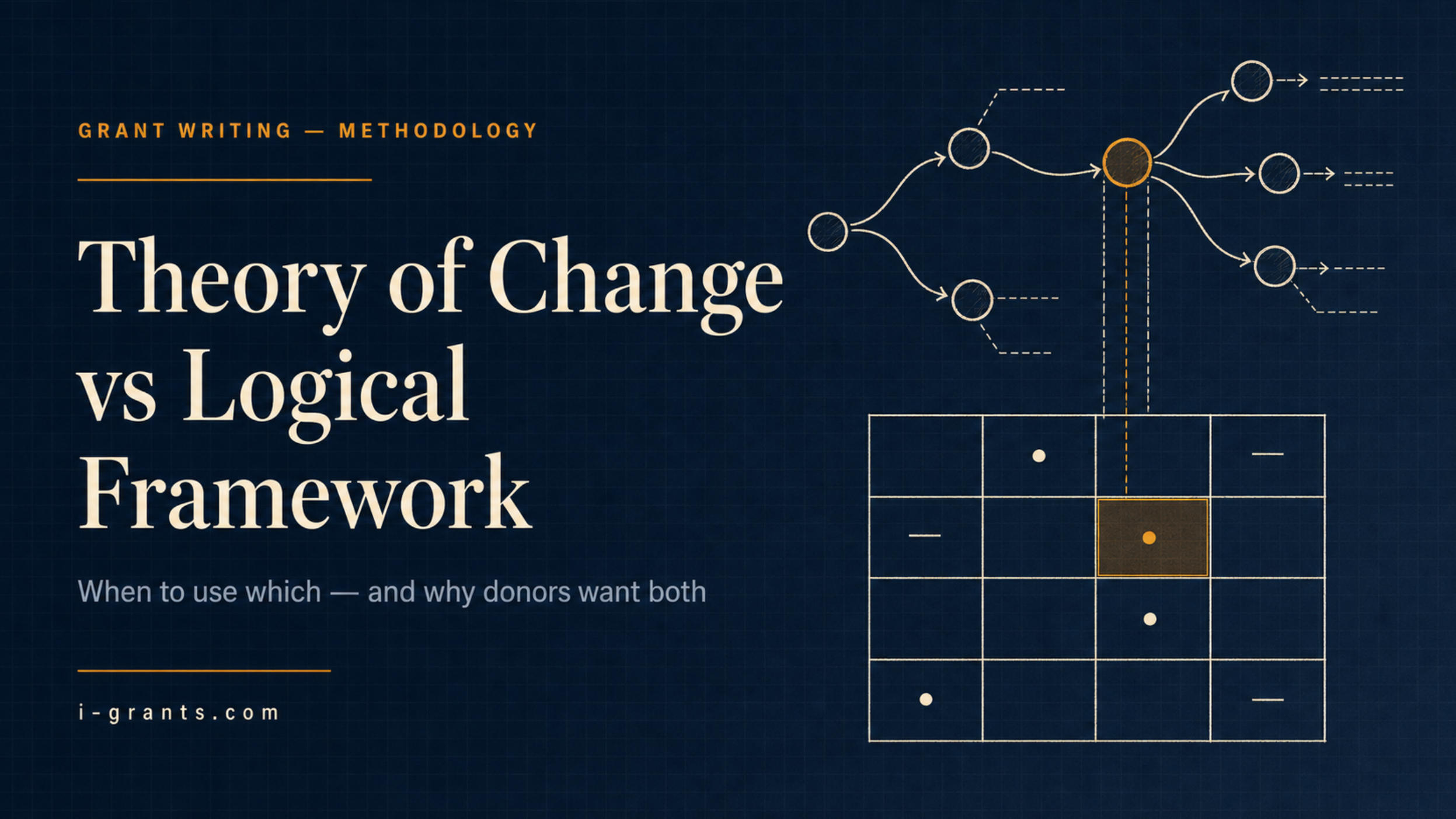
Two tools, one question: how does this project actually create change? Most grant writers know they need one of them — fewer know which, when, or why. And in the past five years, more major funders have started asking for both, leaving applicants to figure out the difference under proposal-deadline pressure.
The short answer: a Theory of Change is a diagnostic; the Logical Framework is an operational summary. They are not interchangeable. They do not compete. They sit at different stages of the same intellectual process.
The fundamental difference
A Theory of Change (ToC) explains why and how change happens. It maps the full causal pathway from activities to long-term impact, surfaces the assumptions behind each link, identifies what else would need to be true (preconditions, enabling factors, complementary actors), and tests for unintended consequences. It is non-linear by design — usually rendered as a flowchart, a narrative, or both.
A Logical Framework compresses the most relevant parts of that thinking into a 4×4 matrix optimised for accountability and monitoring. It tells the funder, on a single page: here are the result levels, here is how each will be measured, here is what we assume.
A useful metaphor: the ToC is the architectural blueprint, complete with structural calculations and site analysis. The LogFrame is the contractor's punch list. You cannot build from the punch list alone — but you cannot manage construction from the blueprint either.
When each is the right tool
Use a Theory of Change when:
- You are designing a new intervention and the causal logic is genuinely uncertain.
- The funder asks for one explicitly. Most large foundations now do — Ford, Gates, MacArthur, Rockefeller — and so do many FCDO and EU INTPA programmes.
- The project addresses a complex social problem with multiple actors and competing pathways.
- You need to convince a skeptical reviewer that the intervention is plausible before the conversation moves to measurement.
Use a Logical Framework when:
- The funder requires it as a standard annex. This covers most EU programmes, USAID via the Results Framework variant, UN agencies, GIZ, KfW, and the World Bank.
- The intervention model is well-tested and the task is to communicate it concisely.
- The reviewer is checking coherence between activities, indicators, and budget.
- You are reporting against a defined set of results during implementation.
Why funders increasingly want both
A decade ago, asking for one or the other was the norm. Today, calls from FCDO, the European Commission's INTPA programmes, USAID's BHA bureau, and most large private foundations frequently ask for both — typically a ToC narrative or diagram in the concept note, followed by a full LogFrame in the proposal stage.
The reason is institutional. Funders have spent years absorbing the critique that LogFrames create false certainty: clean tables can make weak interventions look rigorous. A ToC forces the applicant to justify the causal logic before reducing it to a matrix. The matrix then serves as the monitoring contract; the ToC remains the reference document when implementation drifts from the plan.
A practical workflow for grant writers
Build the Theory of Change first, even when the call only requires a LogFrame. The exercise of mapping the full causal chain — including the parts you ultimately will not fund — exposes weak links that would otherwise hide inside vague indicator wording. When you collapse the ToC into the matrix, you keep the strongest causal chain and treat the rest as assumptions.
If the call requires both, treat them as one document in two formats. Every Outcome in the LogFrame should correspond to a node in the ToC. Every assumption in the LogFrame should correspond to an arrow or precondition in the ToC. Inconsistency between the two is the single most common reason proposals lose points at the methodology stage of evaluation.
Build the Theory of Change for yourself. Build the LogFrame for the funder. Then make sure they tell the same story.