
 Français
  Deutsch
  Українська
Erasmus+ 2026 is not just a mobility programme, and it is not only for universities sending students abroad. For NGOs, universities, schools, vocational education providers, municipalities, youth organizations, cultural institutions, and social enterprises, Erasmus+ 2026 is one of the most practical European funding instruments for building international cooperation, testing new learning models, strengthening civic participation, and turning local educational or youth work into a structured cross-border project.
The 2026 Erasmus+ Programme Guide was published on 12 November 2025, and the European Commission presents it as the central technical document for organizations seeking Erasmus+ funding. It explains the priorities, supported actions, funding available for different actions, and participation rules. The English version also prevails if there are conflicting meanings between language versions.
For 2026, Erasmus+ has a budget of around 5.2 billion EUR and continues to support mobility and cooperation projects across Europe and beyond, with emphasis on future skills, digital skills, green skills, civic skills, and soft skills. That scale matters. Erasmus+ 2026 is large enough to fund thousands of projects, but competitive enough that weak proposals will not survive on good intentions alone.
A winning Erasmus+ 2026 project is not built around the question, “What activities do we want to organize?” It is built around a stronger question: what European problem can our partnership solve better together than separately?
“A strong Erasmus+ project does not start with a trip, a workshop, or a training course. It starts with a shared problem that needs a European learning response.”
That distinction is crucial. Erasmus+ 2026 rewards projects that are relevant, well-designed, inclusive, credible, measurable, and aligned with the priorities of the programme. The difference between a promising idea and a fundable Erasmus+ application is the quality of the logic connecting need, partnership, activities, results, impact, and sustainability.
What Erasmus+ 2026 Really Funds
Erasmus+ 2026 covers education, training, youth, and sport. The programme is structured around several major action families, but most NGOs, universities, and youth organizations will usually encounter Erasmus+ through mobility actions, cooperation partnerships, small-scale partnerships, capacity building, Erasmus Mundus, Jean Monnet, or innovation-oriented actions.
Erasmus+ Key Action 2 is especially important for organizations that want to build joint projects. According to the Erasmus+ Programme Guide, Key Action 2 supports Cooperation Partnerships, Small-scale Partnerships, Partnerships for Excellence, Partnerships for Innovation, Capacity Building projects in higher education, vocational education and training, youth and sport, and not-for-profit European sport events.
The real purpose of Erasmus+ Key Action 2 is not just “international cooperation.” The programme expects projects to create positive and long-lasting effects on participating organizations, policy systems, and people involved directly or indirectly in the activities. It also expects the development, transfer, or implementation of innovative practices at organizational, local, regional, national, or European levels.
That means a competitive Erasmus+ 2026 proposal should show more than enthusiasm for cooperation. It should explain what changes inside organizations, what changes for learners or young people, and what can be reused after the project ends.
Table 1. Which Erasmus+ 2026 Path Fits Your Organization?
| Applicant type | Best Erasmus+ 2026 direction | What the project should prove |
|---|---|---|
| NGO working with youth, inclusion, migration, civic education, or community development | Youth cooperation, Small-scale Partnerships, Cooperation Partnerships, Capacity Building in youth | Clear target group needs, strong non-formal learning methods, inclusion logic, realistic outreach |
| University or research-linked institution | Higher education cooperation, Erasmus Mundus, Jean Monnet, Capacity Building in Higher Education | Academic relevance, institutional capacity, curriculum or teaching innovation, international added value |
| School, VET provider, adult education provider | Mobility, Small-scale Partnerships, Cooperation Partnerships | Practical learning need, staff or learner development, transferable educational method |
| Youth organization | Youth participation, youth worker mobility, cooperation projects, capacity building | Youth voice, participation methods, European dimension, safeguards and inclusion |
| Municipality or public body | Local education, youth, sport, inclusion or skills partnership | Policy relevance, local implementation capacity, stakeholder engagement |
| Cultural or creative organization | Youth, adult education, inclusion, digital or cultural learning projects | Learning value, audience development, skills development, social relevance |
Erasmus+ 2026 can be highly accessible for smaller organizations, but accessibility does not mean simplicity. Even a Small-scale Partnership needs coherent objectives, a realistic activity structure, a credible budget, and a clear explanation of why each partner is necessary.
The Four Erasmus+ Priorities Applicants Cannot Ignore
The current Erasmus+ programme has four horizontal priorities for 2021-2027: inclusion and diversity, digital transformation, environment and fight against climate change, and participation in democratic life, common values and civic engagement. The European Commission states that these priorities apply across the programme and should be considered when writing proposals or planning funded activities.
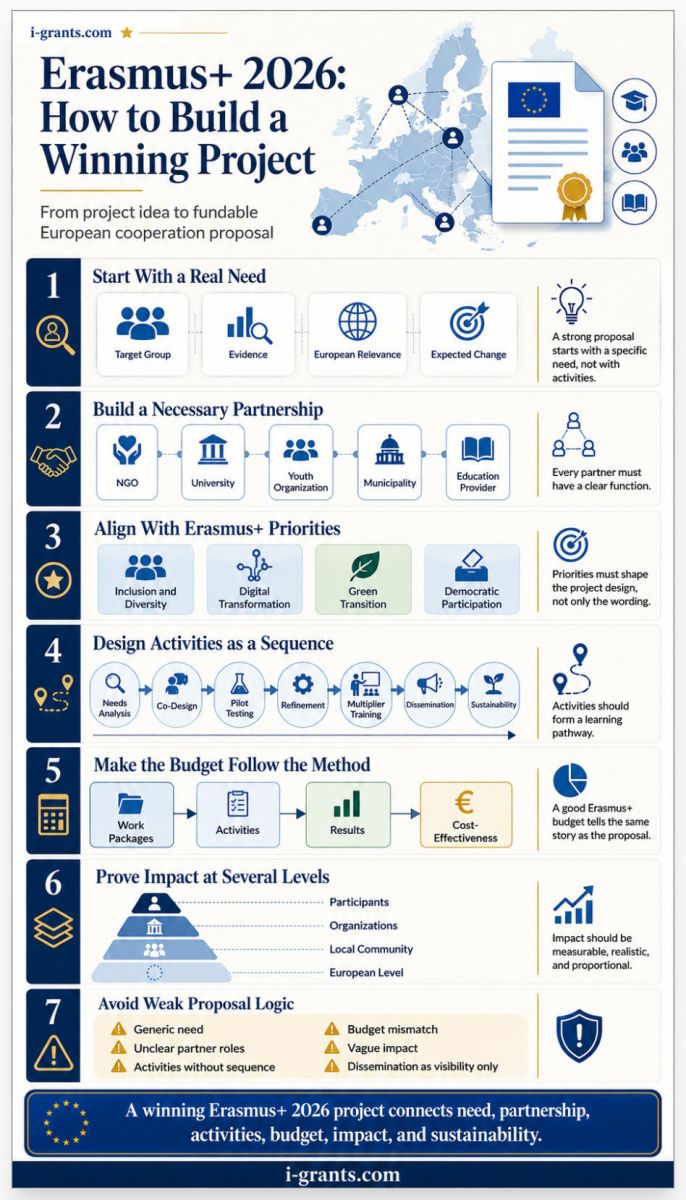
For Erasmus+ 2026, these priorities should not be decorative. A common weakness in Erasmus+ applications is adding the priorities as generic language near the end of the proposal. Evaluators can see when “green,” “digital,” or “inclusive” is used as a label rather than as a design principle.
If your Erasmus+ 2026 project claims inclusion, the application should show who faces barriers, how they will be reached, what support measures will be used, and how participation will be meaningful rather than symbolic. If the Erasmus+ project claims digital transformation, it should explain how digital tools improve learning, cooperation, accessibility, assessment, or dissemination. If the Erasmus+ 2026 proposal mentions sustainability, it should connect environmental thinking to mobility choices, learning content, institutional practices, or project outputs. If the Erasmus+ idea focuses on democratic participation, it should show how participants gain agency, civic skills, or opportunities to influence decisions.
This is where many proposals become too thin. They name a priority, but they do not operationalize it. In Erasmus+ 2026, a priority should affect the project design, not only the vocabulary.
Start With Need, Not With Activities
Many Erasmus+ 2026 applicants begin with an activity plan: a training in Spain, a youth exchange in Italy, a toolkit, a conference, a study visit, a curriculum, a digital platform. These may be useful, but they are not the foundation of a winning proposal.
The foundation is a well-defined need.
For Erasmus+ 2026, a strong needs analysis should answer five questions:
-
Who exactly has the problem?
-
What evidence shows that the problem is real?
-
Why is this problem relevant beyond one organization?
-
Why can transnational cooperation solve it better?
-
What will change if the project succeeds?
This is one of the few places where applicants can significantly outperform competitors. A generic proposal says, “Young people need digital skills.” A stronger Erasmus+ 2026 proposal says, “Youth workers in rural communities lack practical methods to teach digital civic participation to young people with fewer opportunities, and existing training materials are not adapted to low-resource local settings.” The second version is more fundable because it is sharper, more measurable, and more connected to real implementation.
Erasmus+ 2026 evaluators are not looking for abstract European values only. They are looking for a credible pathway from need to action to result.
Build a Partnership That Looks Necessary
A weak Erasmus+ partnership looks like a list of friends. A strong Erasmus+ partnership looks like a system of complementary capabilities.
For Erasmus+ 2026, every partner should have a clear function. One organization may bring access to youth with fewer opportunities. Another may bring curriculum design expertise. A university may contribute evaluation methodology. A municipality may connect the project to local policy. A youth organization may lead participatory methods. A digital education provider may design blended learning tools.
The application should make the partnership feel inevitable. If an evaluator can remove one partner from the Erasmus+ 2026 proposal without damaging the logic, that partner probably does not have a strong enough role.
This is especially important in Cooperation Partnerships. The Erasmus+ Programme Guide explains that projects under Key Action 2 are expected to bring lasting effects on participating organizations and wider systems. A partnership that only divides travel opportunities will look weak. A partnership that combines knowledge, access, methodology, piloting, dissemination, and institutional adoption will look much stronger.
Table 2. From Weak Erasmus+ Logic to Winning Erasmus+ Logic
| Proposal element | Weak Erasmus+ 2026 approach | Strong Erasmus+ 2026 approach |
|---|---|---|
| Need | Broad social issue with little evidence | Specific target group need supported by data, experience, or policy context |
| Partnership | Organizations included because they know each other | Partners selected because each has a necessary function |
| Objectives | Large, abstract, difficult to measure | Concrete, realistic, linked to activities and results |
| Activities | Trainings, meetings, exchanges listed as events | Activities sequenced as a learning and implementation pathway |
| Outputs | Toolkit, website, conference | Outputs connected to actual use, adoption, and target group benefit |
| Inclusion | Mentioned as a value | Built into recruitment, support, accessibility, and participation design |
| Impact | General promises about awareness | Clear organizational, participant, local, and European-level changes |
| Sustainability | “The website will remain online” | Methods, materials, partnerships, or practices continue after funding |
This table reflects the core discipline of Erasmus+ 2026 writing: the proposal must not read like an activity calendar. It must read like a controlled intervention with a European cooperation logic.
Design Activities as a Sequence, Not as a Collection
A common mistake in Erasmus+ 2026 proposals is treating activities as separate events. A training happens, then a meeting happens, then a conference happens, then a toolkit appears. The evaluator sees movement, but not development.
A stronger Erasmus+ project uses sequencing. First, partners diagnose needs and compare practices. Then they co-design a method. Then they test it with target groups. Then they refine it. Then they train multipliers. Then they disseminate and embed it.
This creates a narrative of learning. It also makes the budget more credible because every activity has a reason.
For universities, this may mean moving from curriculum gap analysis to module development, pilot teaching, student feedback, academic validation, and open educational resources. For NGOs, this may mean moving from community mapping to youth worker training, local pilots, peer learning, policy dialogue, and replication. For youth organizations, this may mean moving from youth consultation to co-creation workshops, mobility, local campaigns, evaluation, and youth-led dissemination.
Erasmus+ 2026 is especially strong when activities produce capacity, not only participation. A participant who attends a workshop is a short-term output. A youth worker who can reuse a method with hundreds of young people is a sustainability mechanism.
Budget Logic: Make the Money Follow the Method
Erasmus+ 2026 applicants should avoid treating the budget as an administrative afterthought. In many Erasmus+ actions, lump sums or fixed grant amounts require applicants to justify why the requested amount is appropriate for the planned activities. Even where the budget structure seems simplified, evaluators still expect proportionality.
For example, the official 2026 Cooperation Partnerships application template for higher education asks applicants to explain tasks and responsibilities in work packages, describe activities, identify expected results, allocate amounts, and explain how the amount allocated to a work package was determined and verified as cost-effective.
That tells applicants something important: Erasmus+ 2026 budgets must be logical, not just eligible. A large allocation to project management without complex coordination may look inflated. A large dissemination budget without a defined audience may look weak. A digital output without testing or maintenance logic may look unrealistic.
A good Erasmus+ 2026 budget tells the same story as the narrative. If the proposal says inclusion is central, the budget should make room for accessibility, support, facilitation, translation, or targeted outreach. If the proposal promises a high-quality educational product, the budget should reflect design, piloting, revision, and dissemination. If the Erasmus+ project depends on coordination, the management budget should correspond to real coordination tasks.
Deadlines Matter, But Preparation Matters More
The Erasmus+ 2026 call opened in November 2025, and the first opportunities were made available through the EU Funding & Tenders Portal. The Commission advised applicants to check the portal regularly for calls, criteria, and deadlines.
Some Erasmus+ 2026 deadlines are early in the year. For example, the 2026 Cooperation Partnerships in higher education application form shows a deadline of 5 March 2026 at 12:00 Brussels time. The official Erasmus+ Small-scale Partnerships page also states that, in school education, vocational education and training, adult education and youth, applicants submit by 5 March at 12:00 midday Brussels time for projects starting between 1 September and 31 December, with a possible additional round by 1 October if organized.
But the practical lesson is larger than the calendar. A winning Erasmus+ 2026 proposal is rarely written in the final two weeks. It needs partner alignment, evidence, work package design, budget logic, internal approvals, documentation, and review. The earlier the team clarifies roles and decision-making, the better the proposal will be.
“The best Erasmus+ partnerships are not assembled for the application form. They are designed around the work that must happen after the grant agreement is signed.”
For NGOs and youth organizations, preparation should include target group consultation. For universities, it should include faculty commitment and administrative feasibility. For municipalities, it should include political and operational buy-in. For all Erasmus+ 2026 applicants, preparation should include one uncomfortable question: can we actually implement what we are promising?
How to Write the Impact Section
The impact section is where many Erasmus+ 2026 proposals become too vague. Applicants often write that the project will “raise awareness,” “improve skills,” “strengthen cooperation,” or “promote European values.” These phrases are not wrong, but they are incomplete.
A stronger Erasmus+ 2026 impact section separates impact levels. At participant level, what will learners, students, youth workers, teachers, or young people know or do differently? At organizational level, what new method, course, service, process, partnership, or capacity will remain? At local or regional level, which stakeholders will use the results? At European level, how can the outputs travel beyond the original partnership?
This does not mean exaggerating. Erasmus+ 2026 proposals often become weaker when they promise to transform Europe with a small pilot. A credible impact section is proportional. It explains meaningful change at the right scale.
For example, a youth organization may not transform youth unemployment across Europe, but it can create and test a practical employability method for young people with fewer opportunities, train youth workers in three countries, publish an adaptable toolkit, and build a follow-up network. A university may not reform higher education across the EU, but it can develop a module, pilot it with students, train lecturers, publish open resources, and integrate the module into partner institutions.
This is the type of impact Erasmus+ 2026 can believe.
Dissemination Is Not Promotion
In Erasmus+ 2026, dissemination is not the same as posting on social media. Dissemination means getting the right result to the right audience in a format they can use.
A strong dissemination strategy defines audiences: teachers, youth workers, university departments, municipal officers, NGOs, students, young people, policymakers, sector networks, or community organizations. It then explains what each audience needs and how the project will reach them.
A toolkit may need webinars and training sessions. A curriculum may need academic validation and faculty adoption. A youth participation method may need peer ambassadors and local pilots. A policy brief may need direct meetings with institutions. A digital resource may need onboarding materials and multilingual access.
Erasmus+ 2026 applicants should avoid counting dissemination only by numbers. “Ten posts, five newsletters, one conference” is not a strategy. A better approach explains why a specific channel can change practice.
Common Mistakes That Make Erasmus+ 2026 Applications Weaker
Some mistakes appear again and again across Erasmus+ applications:
-
The proposal describes activities before proving the need.
-
Partners are included without clear operational roles.
-
Objectives are too broad to measure.
-
Inclusion, digital, green, or civic priorities are mentioned but not embedded.
-
The budget does not match the work plan.
-
Dissemination is reduced to visibility.
-
Impact is described as hope rather than evidence.
-
The project depends too much on one organization.
-
Work packages are administrative rather than methodological.
-
Sustainability is limited to “we will keep the website online.”
This is the article’s main practical checklist, but it is also the central diagnosis. Most weak Erasmus+ 2026 proposals do not fail because the idea is bad. They fail because the logic is underdeveloped.
When to Involve a Grant Writer or Erasmus+ Consultant
Many organizations can draft parts of an Erasmus+ 2026 proposal internally. They know their communities, learners, staff, institutions, and local realities better than any external consultant. But an experienced Erasmus+ grant writer or consultant can help translate that reality into the language of the programme.
This is especially useful when the project involves multiple countries, complex work packages, a lump-sum budget, a new consortium, or a deadline with limited room for error. A good Erasmus+ consultant should not replace the partnership’s thinking. Instead, they should structure it, challenge weak assumptions, sharpen the narrative, and make the proposal easier to evaluate.
For i-grants.com, this is exactly where the marketplace model becomes relevant. Erasmus+ 2026 applicants need more than a general copywriter. They need someone who understands EU funding logic, education and youth terminology, partnership design, budget coherence, and evaluator expectations. A university may need one type of expert; a youth NGO may need another. A small organization applying for its first Erasmus+ project may need a different level of support than a consortium preparing a complex cooperation proposal.
The best grant writer for Erasmus+ 2026 is not simply the person who writes fluent English. It is the person who can connect funder priorities, applicant capacity, partner roles, activity design, and measurable impact.
Final Thoughts: What Makes a Winning Erasmus+ 2026 Project
A winning Erasmus+ 2026 project is not necessarily the largest, the most fashionable, or the most ambitious. It is the project that makes evaluators believe three things: the need is real, the partnership can deliver, and the results will matter beyond the application.
For NGOs, that may mean showing deep access to communities and a method that can travel across borders. For universities, it may mean proving academic quality and institutional uptake. For youth organizations, it may mean demonstrating youth participation, inclusion, and practical learning outcomes. For municipalities and public bodies, it may mean linking local implementation with European cooperation.
Erasmus+ 2026 is a powerful opportunity because it rewards cooperation, not isolation. But cooperation must be designed. A strong proposal shows why each partner is there, why each activity exists, why each euro is needed, and why the final result will be used.
The organizations that win Erasmus+ 2026 funding will not be those that simply describe a good idea. They will be those that build a convincing European project architecture around that idea: a clear need, a necessary partnership, a realistic work plan, a coherent budget, measurable impact, and a strategy for making results live after the funding ends.
For NGOs, universities, and youth organizations, that is the real promise of Erasmus+ 2026. It is not only a grant opportunity. It is a framework for turning local knowledge into European cooperation, and European cooperation into lasting educational and social change.