

 Français
  Deutsch
  Українська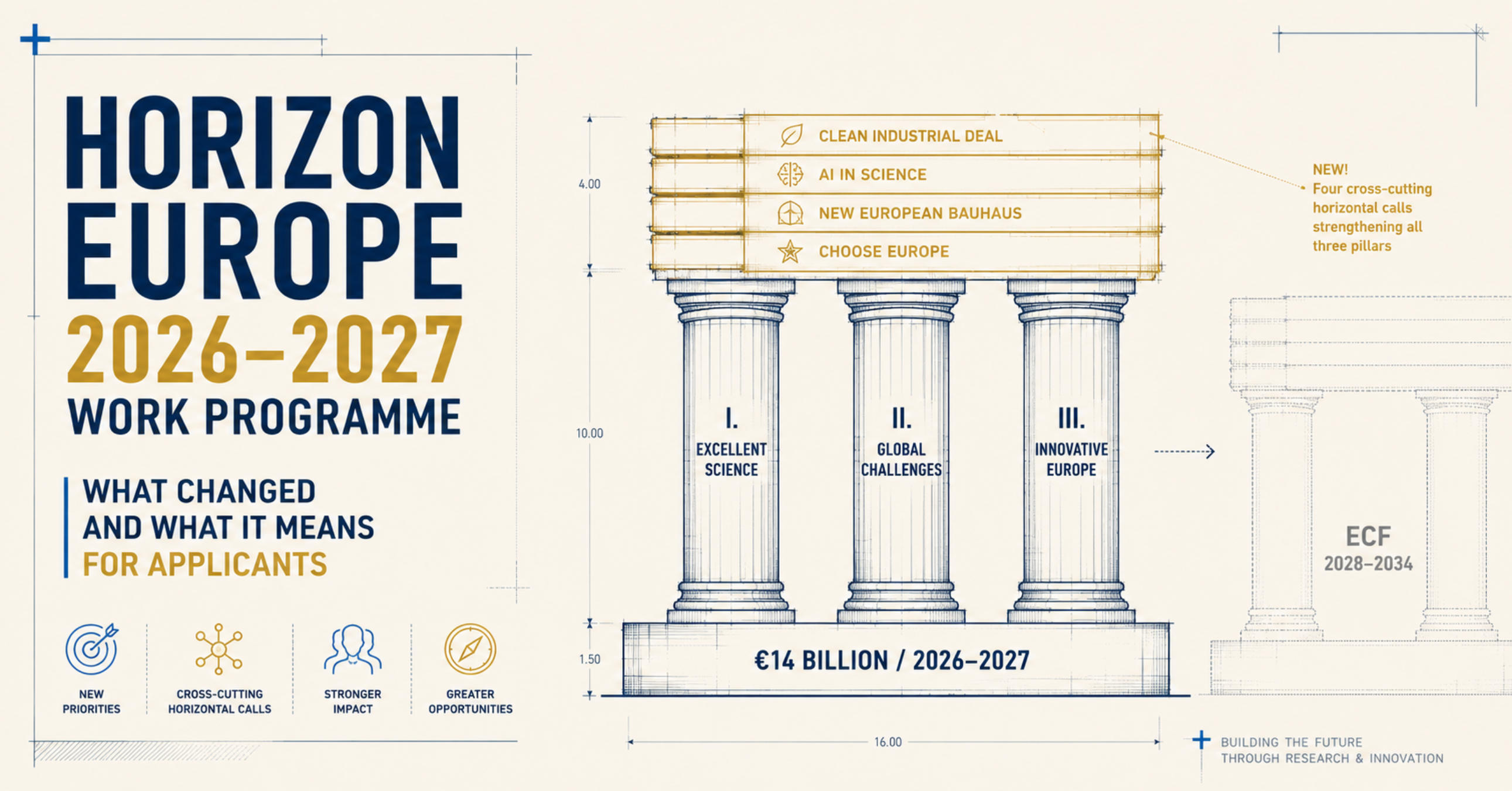
The European Commission adopted the main Horizon Europe Work Programme for 2026-2027 on 11 December 2025, allocating €14 billion across the final two years of the current funding cycle. Most coverage of the announcement focused on the budget headline. The more important story is structural: this Work Programme is a deliberate course correction in how the programme operates, with implications for how applicants should plan their submissions, structure their consortia, and time their funding strategy through the cycle's end and into the successor programme.
This guide treats the changes that actually affect application work, organized in the order applicants need to think about them. The argument throughout is that 2026-2027 is not a continuation of the 2023-2024 Work Programme with new calls. It is a different operating environment, and applicants who treat it as the same programme they navigated last year will lose to those who recalibrate.
The bigger picture: final Work Programme of the current cycle
Horizon Europe runs from 2021 to 2027. The 2026-2027 Work Programme is therefore the last major Work Programme of the cycle, and submissions made under it will produce projects that run well into the next cycle's territory, including the transition to the proposed successor programme. In July 2025, the Commission published its proposal for that successor: the European Competitiveness Fund (ECF), with an indicative budget of €175 billion for 2028-2034. Negotiations on the next Multi-Annual Financial Framework will shape the final form of the ECF, but the strategic orientation is already visible. It is more concentrated on competitiveness, defence, and dual-use technologies than the current programme, and it integrates research and innovation more tightly with industrial policy.
This matters for applicants because the projects funded under 2026-2027 calls will be implemented and evaluated in a policy environment that is already shifting. Consortia thinking strategically beyond a single submission should consider how their work positions them for the successor programme as well. Organizations that establish strong consortium track records in 2026-2027 will have a significant advantage when ECF calls open in 2028, because the consortium-building work that takes years to mature compounds across cycles.
The €14 billion total for 2026-2027 sits within the broader Horizon Europe envelope of approximately €93.5 billion for the full 2021-2027 period. Of the 2026-2027 budget, at least 35 percent (approximately €4.9 billion) is dedicated to climate action, making it the most climate-aligned Work Programme in the programme's history.
What changed structurally: simplification has real consequences
The Commission has framed the most visible change as simplification. The 2026-2027 Work Programme is approximately 33 percent shorter than the 2023-2024 edition. The number of topics has been reduced by around 35 percent. Half of the call budget is now allocated under lump-sum funding rather than actual cost reporting. Forty-one topics use a two-stage evaluation process with a blind first-stage review. Standard proposal templates have been streamlined, with most converging on a 40-page Part B format. These are not cosmetic adjustments; each one changes how applicants need to prepare.
Lump-sum funding deserves particular attention because it inverts the financial logic of the proposal. Under traditional actual-cost reporting, the financial section justifies budget lines and the project tracks costs against them. Under lump sum, the budget is fixed at the proposal stage and payments are tied to deliverables and milestones, not to costs incurred. The financial-control burden during implementation shrinks dramatically, but the upfront discipline of getting the budget right at proposal stage matters more, because adjustments are very limited later. Applicants who treat lump-sum proposals with the same approach as actual-cost proposals will overestimate their flexibility and underestimate the precision required upfront.
The two-stage evaluation process with blind first-stage review is the second structural change with strategic implications. In traditional one-stage calls, evaluators see the full proposal including consortium composition, organizational track records, and detailed work plans. In the new blind first-stage format used on 41 topics, evaluators read only the scientific and technical content of the project, without knowing which organizations are involved. This rewards intellectual quality and originality over consortium prestige, at least at the first stage. For smaller institutions and less-known applicants, this is a meaningful equalizer. For established consortia that have historically benefited from name recognition, it shifts more weight onto the actual idea than they may be used to.
The reduction in topic count, with topics that survive being broader and less prescriptive than before, has the opposite effect on competition dynamics. Fewer, broader topics mean more applicants per topic and more diverse projects competing under the same evaluation rubric. Differentiation becomes harder because the same broad topic now attracts proposals from across multiple sub-fields that would previously have been separated. Applicants need to spend more upfront effort on positioning their proposal within the topic's space and against likely competitor approaches, not just on demonstrating technical merit.
The 40-page Part B template is tighter than what many applicants used in earlier Work Programmes. Long-form, detail-heavy proposals that worked in 2023-2024 will read as bloated and unfocused in 2026-2027. The discipline now is compression: every page must earn its space, and sections that previously had room to elaborate must now make their case in fewer paragraphs.
The new horizontal calls
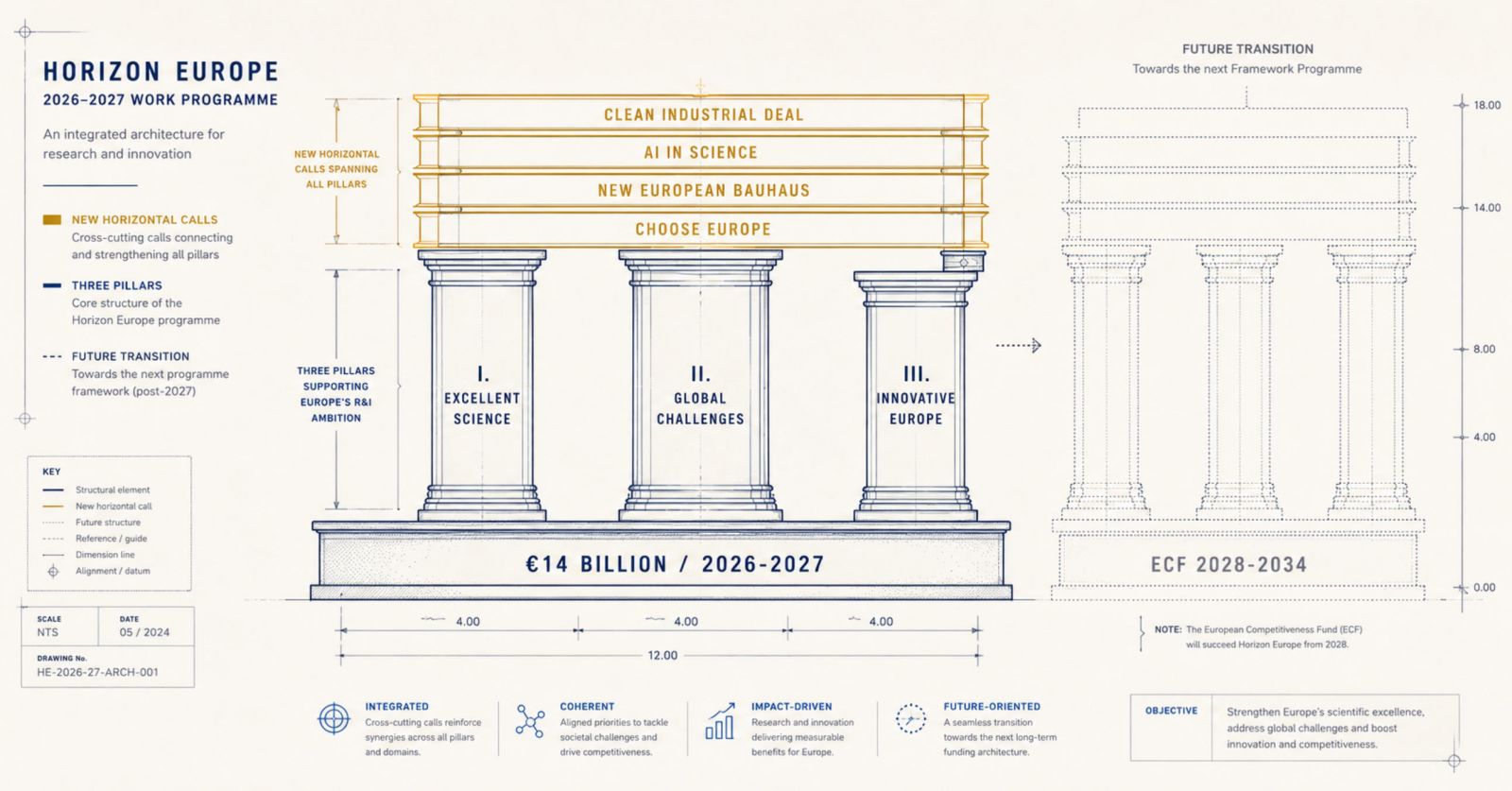
The single most strategically important addition to 2026-2027 is the introduction of horizontal calls, which cut across multiple clusters and pillars rather than fitting within the traditional cluster structure. Four major horizontal calls have been launched, each addressing cross-cutting EU priorities that the previous structure could not capture cleanly.
The Clean Industrial Deal call carries an indicative budget of €540 million, the largest individual call in the new horizontal architecture. It focuses on two interlocking areas: clean technologies for climate action, and the decarbonisation of energy-intensive industries. Its design is bottom-up and industry-led, supporting "fit-for-deployment" projects that demonstrate competitive advantage for European industrial sectors. This is meaningful because it represents a shift away from the more research-focused logic of traditional Pillar II clusters toward a market-deployment orientation closer to the EIC. Applicants in clean-tech, hard-to-abate sectors, and energy-intensive manufacturing now have a major call that is structured around industrial deployment rather than incremental technological advance.
The AI in Science call has an indicative budget of €90 million and supports trustworthy AI applications across scientific domains, including advanced materials, agriculture, healthcare, environment, and food systems. It contributes to the Resource for AI Science in Europe (RAISE) initiative and is designed to build Europe-wide networks of leading research labs working on AI-driven scientific research. This is the natural home for projects that combine AI methodology with substantive scientific application, particularly those that would have struggled to fit cleanly into either Cluster 4 (Digital, Industry, Space) or a domain-specific cluster.
The New European Bauhaus Facility expands the cross-cutting NEB initiative into a more structured funding stream addressing the intersection of sustainability, aesthetics, and inclusion in the built environment, urban systems, and creative economies. It pulls together themes that previously fragmented across multiple clusters and standalone initiatives.
The Choose Europe for Science initiative, while not a single horizontal call in the same sense, runs across MSCA and other Pillar I instruments to attract and retain global research talent. It dedicates approximately €50 million within MSCA specifically for postdoctoral fellowship support. The political backdrop matters here: the initiative is partly a response to changes in the US research funding environment in 2025, and the explicit pitch is that Europe is now a more attractive long-term home for international researchers than it has been recently.
The strategic implication of horizontal calls for applicants is that proposal positioning is no longer a question only of which cluster to target. Many projects can plausibly fit either a horizontal call or a traditional cluster topic. The decision about where to apply now requires explicit comparison of evaluation criteria, expected impact framing, consortium expectations, and competitive landscape between the two. Horizontal calls tend to attract larger, more cross-disciplinary consortia and reward bolder integrative claims. Cluster topics tend to reward depth within a domain. Treating these as equivalent venues will lead some applicants into the wrong call.
Pillar I: Excellent Science
The European Research Council budget for 2026 is approximately €2.7 billion across five grant types: Starting Grants, Consolidator Grants, Advanced Grants, Synergy Grants, and Proof of Concept Grants. Standard ERC grant ceilings remain at €1.5 million for Starting, €2 million for Consolidator, and €2.5 million for Advanced.
The most consequential change for ERC applicants in 2026 is the expansion of relocation funding for researchers based outside Europe. The maximum has been raised from €1.5 million to €2 million, and for the first time the additional funds are eligible to cover personnel costs. Researchers already based in an EU member state or associated country remain eligible for up to €1 million in relocation support. This is a substantive policy shift designed to attract international talent to European host institutions, and it complements the broader Choose Europe for Science framing. ERC applicants currently based outside Europe should treat this as a structural change in what their proposal can credibly include, not just a marginal increase.
ERC deadlines for 2026 include Advanced Grants on 27 August 2026 and Proof of Concept cut-offs on 17 March and 17 September 2026. Starting Grants for the 2027 cycle will open later in 2026, with the exact opening date published on the ERC Apply page closer to the time. Consolidator Grants closed in January 2026.
Marie Skłodowska-Curie Actions allocate approximately €1.196 billion in 2026 and €1.181 billion in 2027 across Doctoral Networks, Postdoctoral Fellowships, Staff Exchanges, and Co-funding schemes. The Choose Europe for Science initiative is most concentrated within MSCA, with approximately €50 million in dedicated funding. A particularly large MSCA call worth €298.5 million launches on 12 May 2026 covering three destinations.
Key MSCA 2026 deadlines include Staff Exchanges on 16 April, COFUND on 8 April, Postdoctoral Fellowships on 9 September, and Doctoral Networks on 24 November. All deadlines are at 17:00 Brussels time, which is the standard convention but worth flagging for applicants who have been caught out by it before.
Research Infrastructures receive a dedicated €50 million in 2026 to improve transnational access and training, expanding the share of the programme that supports the underlying infrastructure on which much European research depends.
Pillar II: Global Challenges and the cluster structure
Pillar II remains the largest pillar of Horizon Europe by budget, organized into six thematic clusters covering Health, Culture and Inclusive Society, Civil Security, Digital and Industry, Climate and Energy, and Food and Bioeconomy. Within Pillar II, the EU Missions are cross-cutting initiatives addressing specific large-scale challenges with quantified targets.
Cluster 4 (Digital, Industry and Space) has an indicative digital-focused budget of €678.3 million in 2026-2027, with 20 calls scheduled for 2026 and 13 for 2027. This makes Cluster 4 one of the most active clusters by call count. Its info days were held online on 29 and 30 January 2026.
The EU Missions deserve specific attention because their budgets and call structures have been clarified in the new Work Programme. The EU Mission on Adaptation has a budget of €226 million in 2026-2027, including two joint Mission calls, focused on accelerating climate adaptation, strengthening multi-level cooperation, and supporting concrete adaptation deployment. The EU Soil Mission has a budget of €246 million across the period (including one joint call), focused on soil health monitoring, sustainable land management including carbon farming, and living labs that restore ecosystems.
The other Missions on Cancer, Climate-Neutral and Smart Cities, and Restore our Ocean and Waters continue with their own call structures. Mission calls tend to attract larger, more applied consortia than standard cluster calls, and they reward proposals that demonstrate clear pathways to measurable Mission targets rather than just thematic relevance.
Pillar III: Innovative Europe and the EIC
The European Innovation Council's 2026 Work Programme allocates over €2.024 billion to support breakthrough innovation through grants, equity investment, and blended finance. The EIC continues to operate three core instruments: the Pathfinder for early-stage research with breakthrough potential, the Transition for technology validation and market preparation, and the Accelerator for startups and SMEs scaling toward market deployment.
The EIC Accelerator's 2026 budget splits across two streams. The EIC Accelerator Challenges, which fund pre-defined topic areas, has a 2026 budget of €220 million. The EIC Accelerator Open, which accepts proposals in any field of technology, has a 2026 budget of €414 million. Companies can request grant-only funding up to €2.5 million, blended finance combining grants with direct equity investment, or investment-only support for companies that do not need a grant component. Equity investment can reach €10 million per company, with higher amounts available through STEP ScaleUP for projects aligned with strategic technology priorities.
The Accelerator's eligibility rules deserve specific attention. Each company can submit only one application at a time, with additional applications possible after receiving results. Applicants from third countries can relocate their company to become eligible, which must be done before submitting the full Step 2 application. UK-based applicants can apply only for the grant-only scheme, not for blended finance.
For the EIC Pathfinder and Transition, deadlines and call topics are published in the EIC's separate work programme. The Pathfinder Challenges focus on specific breakthrough research areas defined by the EIC Board, while the Pathfinder Open accepts proposals across any technology area at low TRLs.
What the simplification means in practice for proposal preparation
The simplification changes are easy to describe and harder to internalize in actual proposal work. Three practical implications matter most.
First, lump-sum funding requires that applicants get the budget right at proposal stage. Under actual-cost rules, a budget could be revised through approved amendments based on real implementation. Under lump sum, the budget is essentially fixed once the grant agreement is signed, with payments triggered by completing pre-defined deliverables and milestones. This means that the work plan and budget must be tightly integrated and realistic at the moment of submission. Underestimating effort or over-promising deliverables creates a much harder operational problem than under the previous system. Experienced applicants are now spending more time on bottom-up work plan and budget integration before drafting the narrative, not less.
Second, the blind first-stage evaluation in two-stage calls means that the first-stage proposal needs to win on the strength of the idea alone. References to organizational track record, prestigious consortium members, or previous funded projects do not help at this stage and may even hurt if they distract from the core scientific argument. Applicants who have historically built first-stage proposals around their consortium credentials are over-investing in elements that evaluators will not see. The discipline is to lead with the strongest possible articulation of the scientific or innovation question, the proposed approach, and the expected outcomes, with credentials saved for the second stage.
Third, the broader and fewer topics mean that the topic analysis stage of proposal preparation matters more than before. Previously, an applicant might have searched for the most precise topic match and shaped the proposal to fit. Now, multiple plausible topics may exist for the same project idea, each with different evaluator pools, different competitive dynamics, and different impact framings. Choosing which topic and which call (cluster versus horizontal) is now a strategic decision that should be made deliberately, ideally with input from National Contact Points or consultants who know the call landscape, rather than defaulting to whatever topic has the most apparent keyword overlap.
Strategic implications for different applicant types
For Pillar II coordinators, the structural shifts argue for tighter consortia (avoiding the consortium bloat that worked under the older system), sharper differentiation through topic positioning, and explicit consideration of whether a horizontal call might be a better venue than a cluster topic.
For ERC and MSCA candidates, the Choose Europe for Science framing and expanded relocation funding for non-European researchers is an opportunity that did not exist at this scale before. Researchers based outside Europe should treat this as a structural change in their viability as ERC applicants, not just a procedural update.
For EIC-eligible startups and SMEs, the size of the Accelerator budget (over €630 million across Open and Challenges in 2026 alone) makes the EIC the largest single instrument for European innovation funding by some margin. The blended finance mechanism remains complex but is the only funding venue at this scale that offers grants and equity in a coordinated package.
For non-European partners, particularly from associated countries and increasingly from third countries that relocate to become eligible, the 2026-2027 Work Programme is more accessible than its predecessors thanks to the Choose Europe framing and the broader policy push to internationalize the talent base. Non-European applications to Horizon Europe have grown sharply in recent years, with US-based applications reportedly up substantially as researchers seek alternative funding environments.

Looking ahead: the European Competitiveness Fund
The Commission's proposal for the European Competitiveness Fund, published in July 2025, sets the indicative envelope for 2028-2034 at €175 billion. The proposal still requires negotiation through the Multi-Annual Financial Framework process, which extends into 2026 and 2027, but the strategic orientation is already shaping how the Commission frames Horizon Europe's final two years. Topics in 2026-2027 increasingly anticipate the priorities expected to dominate the ECF: industrial competitiveness, dual-use and defence technologies, AI and quantum, green transition deployment, and strategic autonomy in critical technologies.
Applicants who win projects in 2026-2027 will implement them while the ECF is being designed and through its early years. Strategic positioning now, including consortium relationships, demonstrated delivery capacity, and visible alignment with the priorities the ECF will likely sharpen, is part of preparing for the next cycle, not just executing on the current one.
The 2026-2027 Work Programme is more than a routine update. It introduces structural changes in evaluation, funding mechanisms, and topic architecture that reward applicants who recalibrate their approach and disadvantage those who treat it as continuity. Lump-sum funding, blind two-stage evaluation, broader topics, and the new horizontal call architecture each shift what makes a strong proposal in ways that are subtle individually and significant cumulatively. The applicants who treat the new Work Programme as a new programme, not a new edition of the old one, will adapt fastest and submit better proposals.
For grant writers and consortium coordinators, the practical message is to read the new general annexes carefully, study the specific topics that fit the project rather than relying on template knowledge from previous cycles, and rebuild internal proposal preparation processes around the new evaluation and funding logic. For applicants new to Horizon Europe, the simplification of the Work Programme makes 2026-2027 a more accessible entry point than the cycle has offered before. The Programme is more navigable, the templates are tighter, and the funding architecture rewards intellectual quality more visibly than it did even two years ago. The opportunity is real for those who treat the changes seriously.