

 Français
  Deutsch
  Українська
The grant funding landscape of 2026 is not the same market it was three years ago. Federal discretionary spending in the United States has undergone one of the most significant restructurings in recent memory, with multi-month pauses hitting programs like SBIR/STTR and AmeriCorps and termination-for-convenience clauses appearing in grant agreements that were once considered secure. In Europe, the Horizon Europe 2026-2027 Work Programme released EUR 14 billion across its final two-year cycle, but competition for those funds has intensified sharply as organizations displaced from US federal pipelines pivot toward multilateral and European funding. Private foundations responded to the surge in demand by increasing payouts, with 30 percent raising disbursements beyond planned levels and 64 percent now offering emergency funding mechanisms, yet their total giving capacity still cannot absorb what federal withdrawal has removed from the sector.
The organizations that are navigating this pressure with the least disruption share one distinguishing feature: they treated their funding sources as a portfolio before the crisis forced them to. This is not a new concept in investment management, but it remains underused in grant strategy. A funder portfolio applies the same logic that a diversified financial portfolio does. No single position should represent an existential concentration of risk. Different assets serve different purposes. The portfolio must be actively managed, not assembled once and forgotten. This article walks through the steps of building one in the conditions that define 2026.
Why Volume Without Strategy Fails
Before addressing the method, it is worth confronting the instinct that many organizations follow when funding feels uncertain: submit more applications. The data from Instrumentl's 2025 sector survey shows that two-thirds of nonprofits increased their application volume after experiencing federal funding disruptions, and 27 percent of those who lost federal funding pushed their submission load beyond original plans. This response is understandable. It is also expensive and frequently counterproductive.
Losing a single two million dollar federal grant and replacing it with private foundation awards means pursuing between ten and twenty smaller grants to fill the same revenue gap. Each of those applications requires research, relationship development, proposal writing, and reporting capacity. Organizations that pursue volume without strategic targeting burn through staff bandwidth, produce weaker proposals because the same team is producing more of them, and damage relationships with funders by submitting generic applications that demonstrate no genuine alignment with that funder's priorities.
The alternative is a portfolio approach: a smaller, deliberate set of funder relationships that are managed across different time horizons and serve different functions within your overall revenue architecture. High-quality, funder-aligned proposals consistently outperform high-volume, generic ones. The portfolio method forces you to make that choice structurally rather than hoping it happens by default.
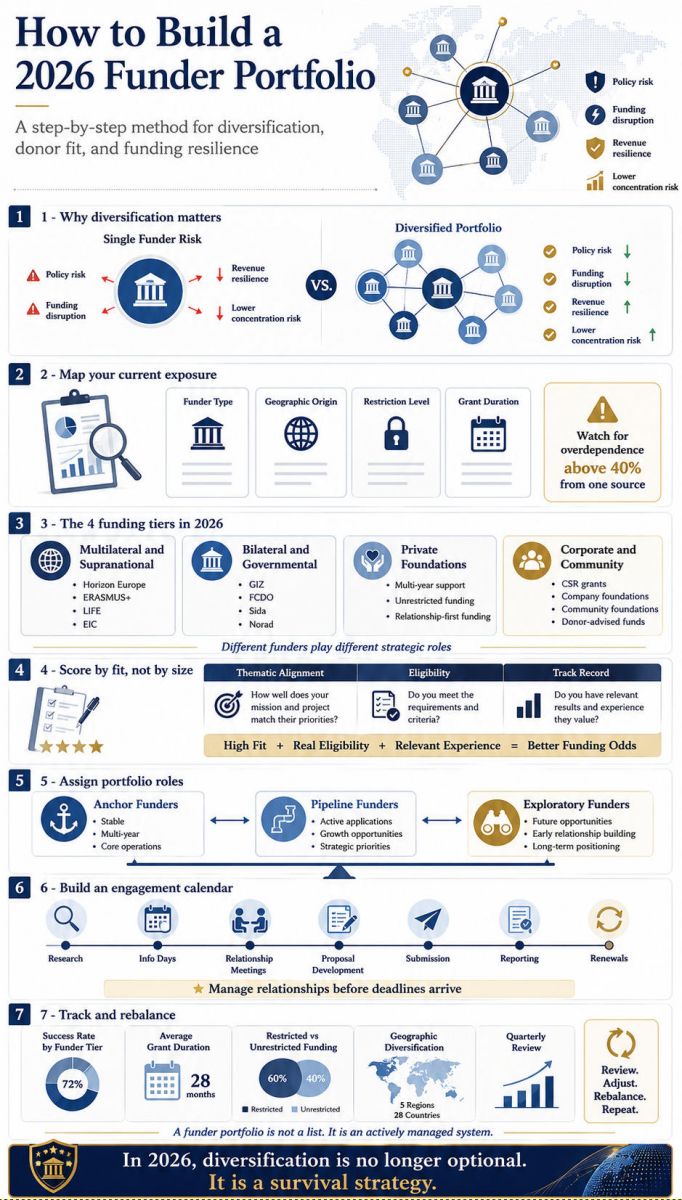
Step 1: Map Your Current Exposure
Portfolio construction begins with an honest audit of where your funding currently comes from. For most organizations, this means pulling together two to three years of revenue data and categorizing each source by funder type, geographic origin, restriction level, and grant duration. The patterns that emerge from this exercise usually reveal concentration risks that are not visible when you look at individual grants in isolation.
The most dangerous concentration in 2026 is dependence on a single funding type or a single funder. Organizations with more than 40 percent of their revenue coming from one US federal agency or one EU program are exposed to the same policy risk that has disrupted thousands of nonprofits this year. Regional concentration carries similar risk. An organization that raises most of its funding from one national government or one bilateral donor inherits that government's budget cycle, political priorities, and appetite for the specific sectors it funds.
Beyond type and geography, examine restriction levels. Restricted project grants are the most common form of institutional funding, but they are also the most fragile because they cannot be reallocated when circumstances change. Building a portfolio means deliberately pursuing a proportion of unrestricted or general operating support alongside project-specific funding. Private foundations responding to the trust-based philanthropy movement are increasingly receptive to this conversation: 42 percent of foundations surveyed in 2025 reported increasing their share of unrestricted grants, a structural shift that creates a genuine opportunity for organizations willing to cultivate those relationships.
What you produce at the end of Step 1 is a funding map with a clear picture of concentration risks, gaps, and the proportion of funding that is flexible versus locked to a specific deliverable set.
Step 2: Understand the Four Tiers of the 2026 Funding Landscape
Effective portfolio construction requires knowing what assets are available before deciding how to allocate between them. The 2026 funding environment consists of four distinct tiers, each with different characteristics, timelines, and strategic roles in a portfolio.
The first tier is multilateral and supranational funding. This includes Horizon Europe, ERASMUS+, the LIFE Programme, the European Innovation Council, and multilateral development finance from institutions like the EBRD and the EIB. These are large-volume, competitive, and process-intensive. The Horizon Europe 2026-2027 Work Programme allocates EUR 14 billion across two years, with at least EUR 4.9 billion dedicated to climate action. The MSCA Postdoctoral Fellowships and Doctoral Networks allocate approximately EUR 1.196 billion in 2026 alone. The EIC Accelerator Open carries a budget of EUR 414 million for 2026, with the EIC Accelerator Challenges adding EUR 220 million more. These programs offer transformative funding at scale, but they require consortium-building, multi-month preparation windows, and specialist compliance capacity including Open Science data plans and Gender Equality Plans for many call types. They are high-effort, high-reward positions in a portfolio. Most organizations should hold one or two active targets in this tier, not ten.
The second tier is bilateral and governmental funding. This covers national development agencies (Germany's GIZ, the UK's FCDO, the Netherlands' Ministry of Foreign Affairs, Norway's Norad, Sweden's Sida), country-specific grant programs, and, where available, US government mechanisms through agencies that remain active. Bilateral funders in 2026 are increasingly focused on thematic priorities: climate adaptation, gender equality, digital transformation, and reconstruction in conflict-affected regions. The Netherlands' Ukraine Partnership Facility and GIZ's women's economic empowerment programs in Kosovo are current examples of bilateral calls open in 2026. These programs typically require demonstrable field presence and implementation capacity rather than pure research credentials. Their competitive intensity has increased in 2026 as organizations previously funded by USAID sought alternative bilateral pipelines, but their regional specificity means that organizations with genuine presence in a priority geography still have a real advantage.
The third tier is private foundations and philanthropic institutions. This is the tier that has absorbed the most new entrants in 2026. Private foundation giving was projected to grow by 5 to 7 percent this year, which sounds positive until you account for the scale of organizations that simultaneously moved into this space. Foundation assets grew from approximately 4.3 billion to 4.8 billion across a tracked cohort between 2023 and 2024, and foundations increased their payout rates to an average of 7.1 percent, well above the 5 percent statutory minimum. That reflects genuine philanthropic commitment, but the competition for those dollars is now intense. Importantly, more than 40 percent of total foundation grant activity occurs in the final quarter of the calendar year, which means building foundation relationships must begin early in the year rather than at the Q4 scramble. Ford Foundation's BUILD Initiative, MacKenzie Scott's Yield Giving, the W.K. Kellogg Foundation, and similar trust-based funders continue to offer multi-year, unrestricted support to mission-aligned organizations they know well. Access to these relationships is earned through relationship-first engagement, not through cold proposal submissions.
The fourth tier is corporate and community funding. Corporate social responsibility grants, company foundations, community foundations, and donor-advised funds represent a fragmented but accessible set of funding sources that can fill specific project-level gaps and, more importantly, provide unrestricted operating support. Salesforce Philanthropy and Google.org have both moved toward multi-year commitments with simplified reporting. Community foundations are particularly useful for geographically anchored organizations because they operate with shorter decision timelines and lower competition density than national foundations. This tier is rarely the largest revenue source, but it provides useful portfolio balance because it operates on different decision cycles than institutional funders.
Step 3: Score and Prioritize by Fit, Not by Size
The instinct when scanning funding opportunities is to prioritize by award size. A EUR 2 million Horizon Europe grant looks more attractive than a USD 50,000 foundation grant. But portfolio construction should be driven by fit first and size second, because a high-fit small grant that you can win has more value than a large grant you cannot credibly compete for.
Funder fit is a composite of three dimensions. The first is thematic alignment: does this funder's stated priority match what your organization actually does at a programmatic level, not just at a broad category level? A funder that describes its priority as "climate" may be focused specifically on nature-based solutions, or specifically on clean industrial transition, or specifically on climate finance. The Horizon Europe Cluster 5 for Climate and Energy, for instance, funds very different work from what the EU Soil Mission funds, even though both sit under the climate umbrella.
The second dimension is organizational eligibility. EU programs frequently require consortium participation, legal establishment in eligible countries, specific organizational size categories, or research institution status. The EIC Accelerator is designed for startups and SMEs, not for established research institutes. MSCA Staff Exchanges require at least three partners from at least three countries. Bilateral programs often require registered presence or a local partner relationship in the target country. These eligibility constraints are non-negotiable, and applying without meeting them wastes everyone's time.
The third dimension is track record alignment. Many institutional funders, particularly in the bilateral and EU space, use past grant performance as a proxy for delivery credibility. An organization applying for its first Horizon Europe project should realistically target a partner role rather than a coordinator role. An organization with no established reporting relationship with a given foundation should expect a longer cultivation period before receiving a first grant.
Score each funder you are considering on these three dimensions and use that score to build a short priority list rather than a broad prospect list. The result should be a manageable set of funders where your time investment has a realistic chance of generating a return.
Step 4: Assign Portfolio Roles
Not every funder in your portfolio serves the same purpose, and confusing these purposes leads to poor resource allocation. A well-constructed portfolio includes funders in at least three distinct roles.
Anchor funders are the grants that provide revenue stability and operational continuity. These are typically multi-year commitments, and they should represent a reliable base of income that covers core costs. Anchor funders are often bilateral donors with established relationships, foundations that have renewed grants multiple times, or government contracts with multi-year terms. The goal is to have enough anchor funding to cover your operational baseline so that the failure of a single new application does not threaten organizational continuity.
Pipeline funders are the grants you are actively cultivating or competing for. These are the programs where you are in active relationship-building with a program officer, preparing a proposal, or waiting for a funding decision. Pipeline funders should represent your growth trajectory and your priority strategic bets for the year. This is where most of your proposal-writing capacity is invested.
Exploratory funders are the relationships you are building for future cycles. These are programs you have identified as strong fit but where you are not yet ready to apply, either because you do not meet eligibility criteria, because you need to develop the relationship first, or because you are building a consortium. Exploratory positions require light-touch engagement: attending their information days, following their calls, connecting with their staff at conferences, and noting their funding cycles for future planning.
The ratio between these roles will vary by organizational size and maturity. A small organization might maintain two anchor positions, three pipeline positions, and four or five exploratory relationships. A larger organization with a dedicated development team might manage more in each category, but the structural principle is the same: different funders serve different functions, and they require different levels of active engagement.
Step 5: Build an Engagement Calendar, Not a Deadline Tracker
Most organizations manage their grant activity through a deadline tracker: a spreadsheet that lists submission dates and works backward from them. This is a reactive system. A funder portfolio is managed through a proactive engagement calendar that maps out the full annual cycle of relationship touchpoints, not just application windows.
Effective engagement calendars do several things that deadline trackers do not. They account for the fact that funder priorities are signaled months before calls are published. Horizon Europe InfoDays, for instance, are held well in advance of call opening dates and provide the earliest public intelligence about what evaluators will prioritize. Attending an InfoDay or bilateral brokerage event for a program you are targeting is not optional preparation; it is the first step in building the kind of understanding that separates competitive proposals from generic ones. The Horizon Europe Missions Brokerage Event held in January 2026 for the Ocean and Waters Mission, for example, included bilateral meetings specifically designed for organizations to test their concepts against expert feedback before committing to a full application.
Engagement calendars also account for the foundation calendar reality that more than 40 percent of grant activity happens in Q4. If you want to receive a foundation grant in the October-December window, you need to begin relationship outreach no later than the spring of that same year. An introductory meeting in September with a foundation whose deadline is November is not early enough to produce a competitive first application.
The calendar should map, on a month-by-month basis: which programs are publishing calls and when, which funders you plan to contact for relationship meetings and in which quarter, which reports and renewals are due to existing funders, and which sector events or conferences give you access to funder staff. This turns funding development from a deadline-driven scramble into a managed, annual workflow.
Step 6: Cultivate Relationships Before You Apply
This step is where portfolio strategy most clearly diverges from volume-based grant seeking. In a volume model, applications are the primary activity and relationships are incidental. In a portfolio model, relationships are the primary activity and applications are the output of relationships.
The trust-based philanthropy movement has formalized what experienced grant writers have always known: funders give to organizations they understand, trust, and feel confident will deliver on what a proposal promises. The Whitman Institute, which coined the trust-based philanthropy term in 2014, built its entire model on moving from transaction-based to relationship-based grantmaking. Many of the foundations now explicitly practicing trust-based principles, including the Ford Foundation's BUILD Initiative, Blue Meridian Partners, and the W.K. Kellogg Foundation, describe their grantmaking as relationship-first by design.
This does not mean that cold applications never succeed. It does mean that in a competition where dozens of technically qualified organizations are applying for the same funds, the organization with an established program officer relationship holds a structural advantage. Program officers can signal when a concept fits or does not fit before you invest forty hours in writing a full proposal. They can sometimes advise on how to frame your work to align with the current cycle's priorities. They are also more likely to remember an organization they have met in person when evaluating a stack of applications from organizations they know only on paper.
For bilateral and governmental funders, relationship cultivation takes a different form. It means being visible in the policy conversations that shape those programs. GIZ, Sida, FCDO, and similar agencies publish thematic strategies and host stakeholder consultations. Engaging with those processes before you apply positions your organization as a sector actor rather than a generic applicant.
Step 7: Track Performance and Rebalance
A portfolio that is built once and not reviewed is not a portfolio; it is a list. Active portfolio management requires a regular review process, typically quarterly, that assesses whether the current allocation is still serving your strategic goals and where adjustments are needed.
The metrics that matter for a funder portfolio are different from standard grant tracking metrics. Success rate by funder tier tells you where your proposals are competitive and where they are not, which guides where to invest preparation time. Average grant duration tells you how much of your revenue is locked into multi-year agreements versus requiring annual renewal, which determines how much development capacity you need to maintain each year. Restriction level distribution tracks whether you are building a base of flexible funding or remaining locked in project-specific grants. Geographic diversification shows whether you are reducing your exposure to any single country's funding decisions.
Review your portfolio allocation against these metrics every quarter and adjust your pipeline accordingly. If your success rate in one funder tier is consistently low, the resource is better allocated to a tier where you have demonstrated competitive strength. If your anchor funding base is thin, pipeline priorities should shift toward multi-year opportunities even if individual award sizes are smaller. If a funder changes its thematic priorities in a new strategy document, reassess your fit score and decide whether to continue investing in that relationship.
The organizations that navigated 2025's federal funding disruption most successfully were those that had spent the prior years building exactly this kind of portfolio structure. The Coastal Family Health Center's decade-long strategy of diversifying revenue across federal grants, patient fees, and its 340B pharmacy program meant that when federal health policy shifted in 2025, it faced the disruption with significantly more resilience than organizations that had not made equivalent investments. That resilience was not accidental. It was the product of a deliberate allocation strategy executed consistently over time.
The 2026 Imperative
The defining characteristic of the 2026 funding environment is that diversification is no longer a strategic option. It is a survival requirement. More than 85 percent of nonprofits report feeling the impact of federal funding changes. Private foundation demand has surged to the point where 87 percent of foundations report receiving more applications than in prior years. The competition for every category of grant funding is higher than it has been at any previous point in this decade.
The organizations that will continue to grow their programs in this environment are not the ones submitting the most applications. They are the ones that have built funder portfolios with genuine relationship depth, deliberate tier diversification, and active management discipline. That work starts with the audit in Step 1, and it compounds with every year of consistent, strategic engagement across your portfolio. The time to build that structure was three years ago. The next best time is now.