
 Français
  Deutsch
  Українська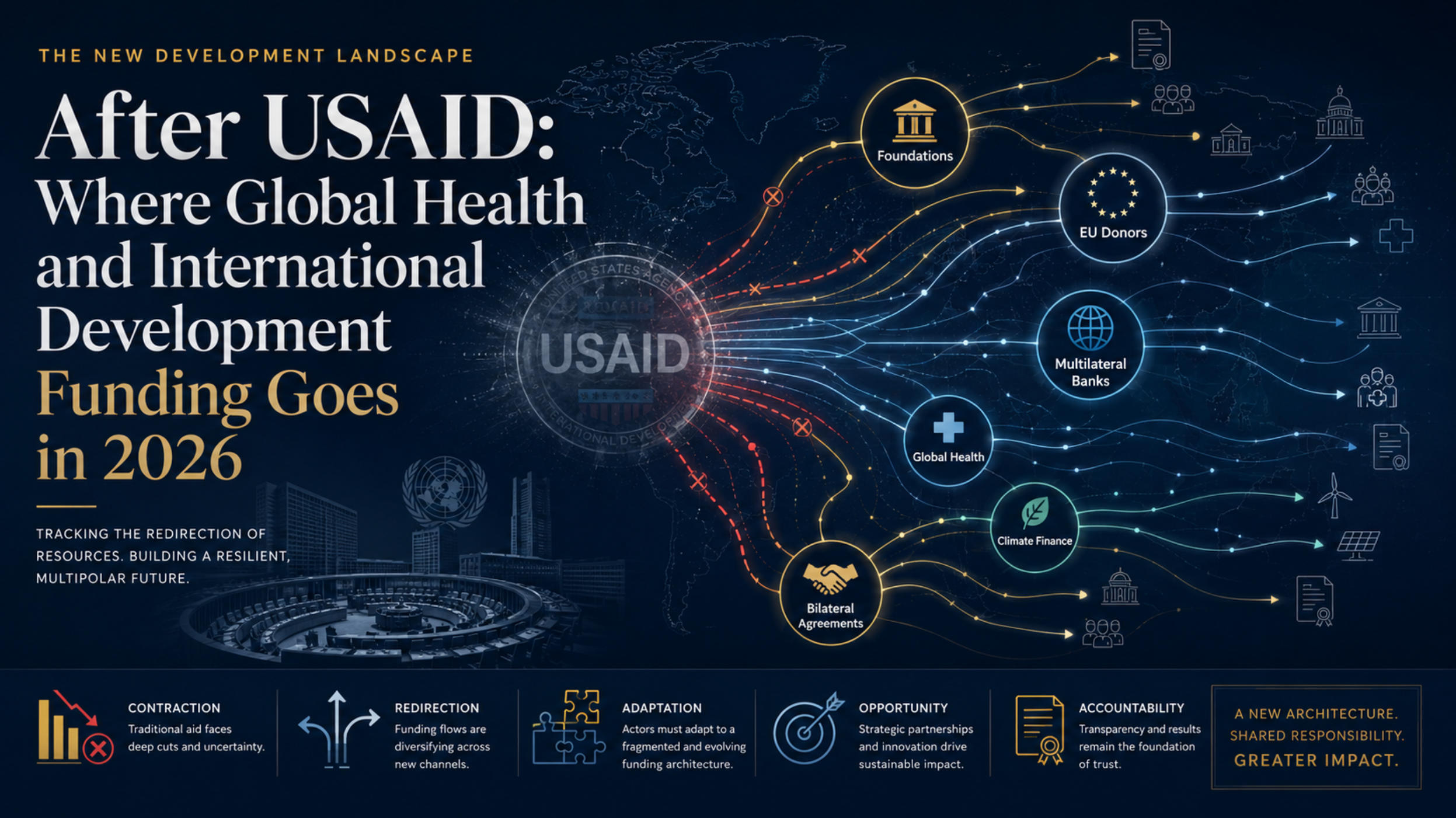
The simplest way to misunderstand the global health and development funding landscape in 2026 is to treat the dismantling of USAID as a single event whose aftermath needs to be navigated. It is not a single event. It is the most visible part of a broader contraction in international development funding that includes substantial bilateral cuts from the United Kingdom, Germany, and France, sharp reductions in the budgets of major UN agencies, and the beginning of a structural reorganization of the multilateral system itself. Organizations that previously relied on USAID and are now searching for a one-to-one replacement are mostly going to be disappointed. The system that exists in 2026 is smaller, more fragmented, and aligned around different priorities than the system that existed in 2024.
This guide describes what actually happened, where the money goes now, and what it means for organizations and grant writers who built their work around the previous architecture. The argument is that successful adaptation requires understanding not just which donors have shrunk, but how the entire logic of international assistance is being rebuilt under emergency conditions with no agreed-upon design.
What actually happened to USAID
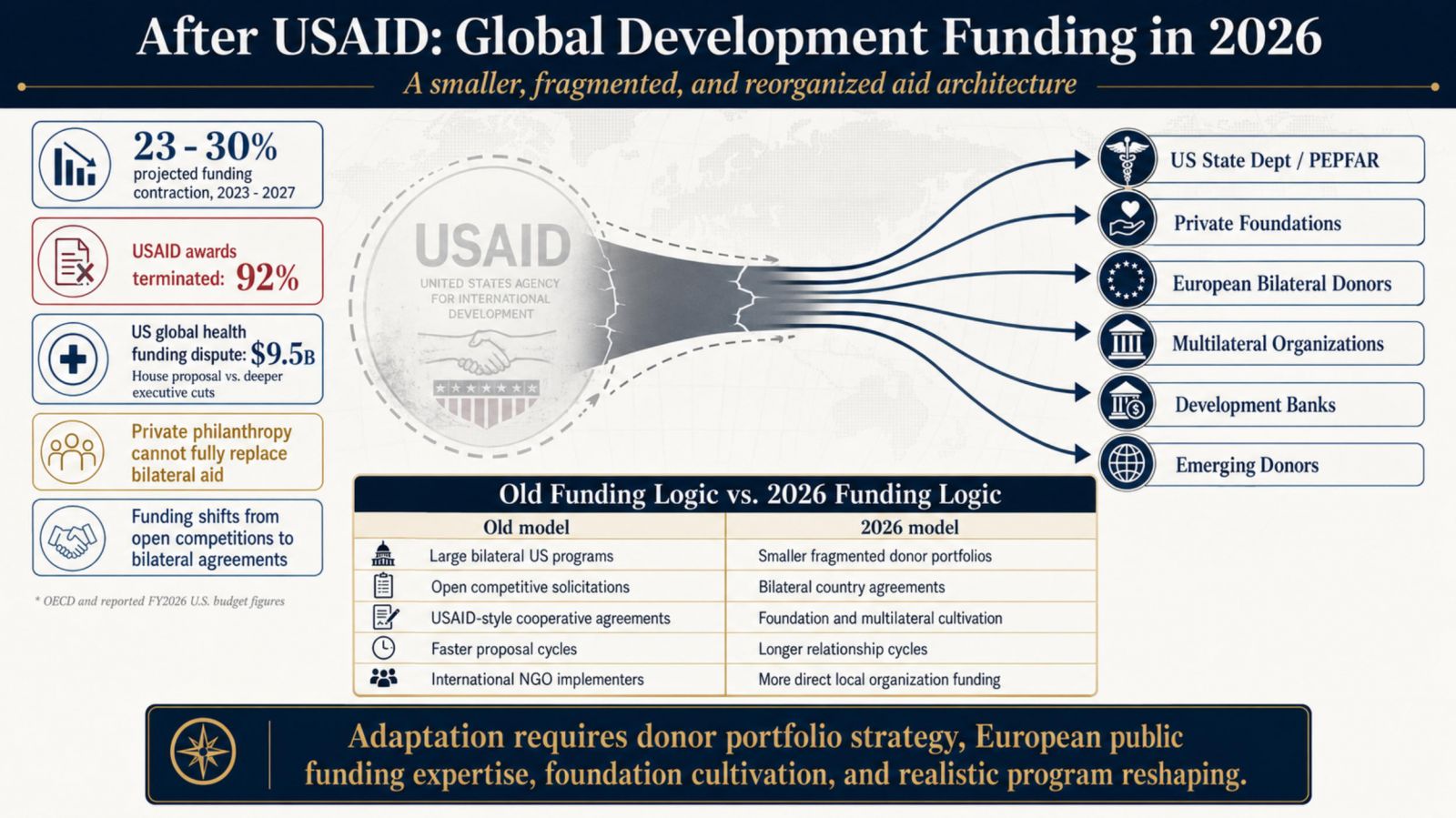
The Trump administration began dismantling USAID in January 2025 through a series of executive actions, beginning with Executive Order 14169 on the foreign aid freeze. By February 2025, mass program terminations had been announced, including 92 percent of USAID's awards. The agency officially shut down on 1 July 2025, with remaining functions absorbed into the State Department under the new Bureau of Global Health Security and Diplomacy. The administration's stated timeline calls for full closure of USAID's physical operations by September 2026, although the agency legally still exists because abolishing it requires an act of Congress, which has not been passed.
The America First Global Health Strategy, released in September 2025, narrowed the surviving US global health architecture to five priority areas: HIV/AIDS, tuberculosis, malaria, polio, and global health security. The new model replaces competitive open solicitations with bilateral country agreements, with implementation and monitoring plans required to be in place by 31 March 2026. This is a significant procurement shift. Where previously NGOs, contractors, and research institutions competed for awards through Notices of Funding Opportunity, the new system funnels resources through negotiated agreements between the US and recipient governments, with much less open competition for implementing organizations.
The administration's FY2026 budget request proposed a 41 percent reduction in State Department, Foreign Operations, and Related Programs (SFOPS) appropriations, including a $6.2 billion reduction in global health funding through foreign assistance. Congress has pushed back. In July 2025, House appropriators advanced a fiscal year 2026 funding bill that codifies USAID's closure but provides $9.5 billion for global health activities at the State Department, nearly $6 billion more than the White House requested. The House bill preserves funding for family planning, neglected tropical diseases, vulnerable children, nutrition, maternal and child health, and HIV/AIDS activities that the administration proposed eliminating. PEPFAR funding was exempted from rescission, although $500 million in family planning and related programs was rescinded.
The current resource picture became more complicated in April 2026. According to a notification sent to Congress on 20 April 2026, the administration plans to redirect $2 billion in funding originally appropriated for global health programs to cover USAID closeout costs, including legal costs, pending invoices, and asset sales. Roughly $1.2 billion originally intended for foreign development assistance would also be redirected. The total reserved for closeout exceeds $19.1 billion. Seventeen Senate Democrats have demanded reversal of the notification. As of May 2026, the dispute is unresolved.
The implementation consequences are concrete. The Center for Global Development estimated that the decline in current US spending led to between 500,000 and 1,000,000 deaths in 2025 compared with previous years. A study published in The Lancet in February 2026 projected that global aid cuts, of which the USAID dismantling is the largest component, could lead to 9.4 million additional deaths by 2030. The Gates Foundation, in its February 2026 annual letter, stated that for the first time this century it is almost certain that more children died in 2025 than in the previous year.
The scale of the gap is bigger than the United States
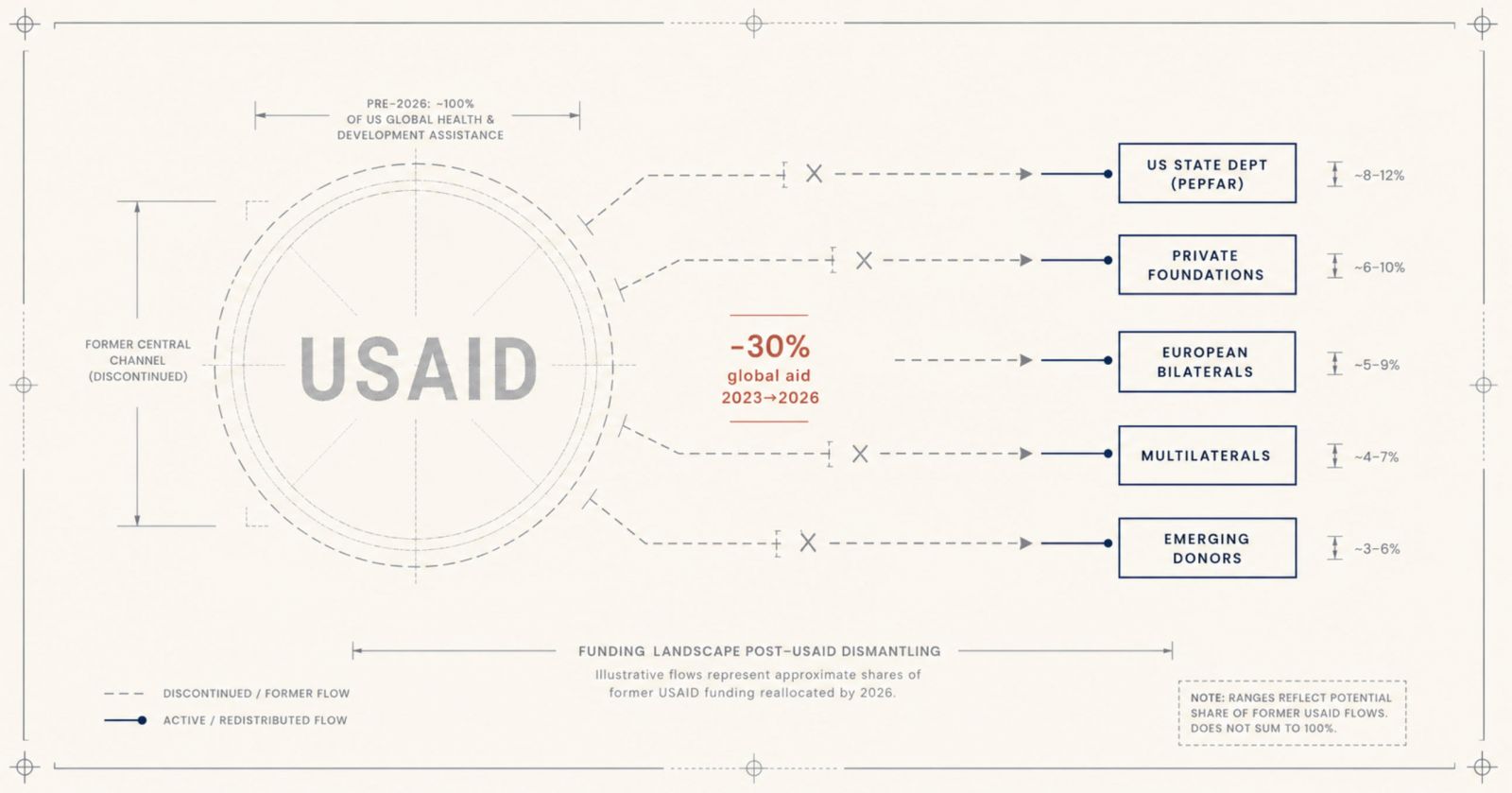
Most coverage of the funding contraction in 2026 focuses on USAID, but the scale is broader. The Organisation for Economic Cooperation and Development estimates that global aid spending fell by 9 percent in 2024 and is projected to fall by another 9 to 17 percent in 2025. By 2026, global aid is expected to have declined by approximately 30 percent compared to its 2023 level. The combined loss across all major donors leaves a vacuum estimated at $10 billion or more in global health funding alone.
The United Kingdom has cut its aid budget twice in successive years. UK aid spending will fall to 0.48 percent of Gross National Income in 2025/26, 0.37 percent in 2026/27, and 0.30 percent in 2027/28. By 2027, UK aid will total approximately £9.2 billion, the lowest figure in cash terms since 2012 and the lowest measured as a proportion of GNI since 1999. Health spending specifically has been hit harder than the average. According to the Foreign, Commonwealth and Development Office's annual report, UK aid classified as covering health fell from £1.77 billion in 2023/24 to £975 million in 2024/25, and is projected to fall further to £527 million in 2025/26. That is approximately a 70 percent reduction in two years. The UK has reduced its pledge to the 2026 to 2030 funding cycle for Gavi, the Vaccine Alliance, by £400 million, and has announced the closure of the Fleming Fund, which has supported 25 countries on antimicrobial resistance.
Germany, which by some measures became the world's largest aid donor in 2026 after the US contraction, has nonetheless cut its own development budget significantly. The Federal Ministry for Economic Cooperation and Development (BMZ) budget fell from €13.8 billion in 2023 to €11.2 billion in 2024 to €10.3 billion in 2025, and the government proposed further reductions in 2026. Humanitarian funding through the Foreign Office is projected to fall to €5.9 billion for 2026 through 2028. France has also reduced its aid envelope, although the cuts have been less publicized than those of the UK and Germany.
The multilateral system, which has historically absorbed cuts more smoothly than bilateral programs, is now experiencing severe stress. UNICEF projects a 20 percent drop in its income in 2026 compared with 2024 levels, from $8.2 billion. The agency has warned that up to 15 million children and mothers may lose access to support as a result. The United Nations Population Fund reduced its funding appeal by $200 million in 2025, with the appeal only 30 percent funded by September. The International Organization for Migration projected a 30 percent drop in donor funding in 2025 with even larger cuts expected in 2026. The UN Refugee Agency reported a shortfall of $8.1 billion against a budget of $10.6 billion, with 185 of 550 operational locations affected. The UN Secretary General announced in 2025 that UNAIDS will close by the end of 2026 and merge into other bodies; UN Population Fund will merge with UN Women; UN Development Programme will merge with UN Office for Project Services. The World Health Organization had to raise membership fees, and its 2026 budget dropped by 10 percent to around $6.2 billion.
The cumulative effect is that the recipient organizations facing USAID's closure are not simply seeing one funder disappear. They are seeing the system within which they operated contract on multiple fronts simultaneously. The pool of money available for international development work in 2026 is substantially smaller than it was in 2023, and the rearrangement of what remains is far from complete.
Where the money actually goes now
Five distinct channels are now visible in the contracted landscape, each with different logic, different access routes, and different implications for organizations that previously relied on USAID-style competitive solicitations.
The first is what remains of US government funding. The Bureau of Global Health Security and Diplomacy at the State Department now houses PEPFAR, global health security funding, and the global health programs absorbed from USAID. The total funding pool at State for global health in FY2026, according to the House appropriations bill, would be approximately $9.5 billion if enacted. PEPFAR's specific allocation has been preserved by Congress despite administration efforts to rescind funds, and country-level bilateral agreements are being negotiated under the America First Global Health Strategy framework. Organizations that historically received USAID funding for non-priority areas, including democracy and governance, agricultural development outside global health security, climate adaptation, and women's economic empowerment, are largely without a US channel. Organizations working on the five priority areas can still access US funding, but through narrower bilateral agreements rather than competitive solicitations open to international NGOs and contractors.
The second is private philanthropy, and the most important fact about it is that even at maximum capacity it cannot substitute for what was lost. The Gates Foundation has committed to increasing its annual spending to $9 billion by 2026, and Bill Gates has pledged to raise the foundation's total assets to support disbursement of $200 billion by 2045. This is the largest single philanthropic commitment in history, and yet, as Gates Foundation CEO Mark Suzman acknowledged directly in his February 2026 annual letter, the foundation cannot fill the void. Two structural reasons make this clear. First, the absolute scale of bilateral US funding far exceeded foundation capacity, and any expansion of foundation budgets covers a small fraction of the gap. Second, foundation funding works differently from bilateral aid. Foundations typically fund specific projects through relationship-driven invitations rather than open solicitations, they earmark money for specific priorities rather than providing flexible budget support, and they operate on longer cultivation cycles than competitive RFP processes.
Within those constraints, the foundations stepping up most visibly in 2026 are the Gates Foundation in health and agriculture, the Rockefeller Foundation in climate and health intersection work, Wellcome in research and infectious disease, the Chan Zuckerberg Initiative in biomedical research, the Novo Nordisk Foundation in health and bioscience, and the Ford and MacArthur Foundations in democracy, human rights, and journalism. New collaborative arrangements between foundations have also emerged, including the Rockefeller-Wellcome partnership on climate-informed health action announced in May 2025. The Center for Global Development hosts Project Resource Optimization (PRO), an initiative connecting former USAID program implementers with donors interested in continuing specific cut programs, which the Gates Foundation supports. The scale of PRO is small relative to the gap, but it represents the kind of bridging infrastructure that did not exist before.
The third channel is European bilateral assistance, which is mixed in direction. Germany, despite its budget reductions, remains the largest bilateral donor in 2026 by some measures and continues to operate substantial programs through BMZ, GIZ, KfW, and DAAD. The UK, while cutting overall, is increasing some specific allocations including climate finance (up 59 percent in fiscal year 2025/26), international finance through development banks (up 52 percent), and bilateral support to strategic partners including Indonesia, Turkey, Nigeria, Pakistan, Ukraine, and the Democratic Republic of Congo. The Nordic countries (Sweden, Norway, Denmark, Finland) have held relatively steadier in their aid budgets than the larger European donors, although Sweden has reduced spending and Norway has shifted priorities. Switzerland through SDC and Canada through Global Affairs Canada continue to operate substantial programs. The Netherlands has reduced aid spending but maintains a stable channel. France's Agence Française de Développement (AFD) continues to operate but with a tighter overall envelope.
The fourth channel is multilateral organizations, where the picture is one of preservation under stress rather than expansion. The Global Fund to Fight AIDS, Tuberculosis and Malaria received $1.25 billion from the US in FY2026, down from a peak of $2 billion in FY2023 and $400 million below FY2025. The administration pledged $4.6 billion to the Global Fund's eighth replenishment, although the actual annual appropriation determines what flows. Gavi continues to operate but with the UK pledge reduced by £400 million. The World Bank's International Development Association remains a major channel for low-income countries, although total contributions reflect the overall donor contraction. The European Union itself continues to disburse through DG INTPA, DG ECHO, and country-specific instruments including the Ukraine Facility, which is operating on a different curve from broader development funding given Ukraine's geopolitical priority. Multilateral channels remain the most accessible route for organizations that can partner with country governments and implement at scale, but the resources they distribute are smaller than they were two years ago.
The fifth channel is the set of newer or growing sources that have absorbed some of the strategic space vacated by traditional Western donors. Gulf states have grown their development funding, with the Saudi Fund for Development, the Kuwait Fund for Arab Economic Development, the Abu Dhabi Fund for Development, and the Islamic Development Bank operating substantial programs. China's Belt and Road Initiative continues to fund infrastructure projects in over 150 countries, although the channel works differently from traditional grant aid and has its own political conditions. Japan through JICA and Korea through KOICA continue to operate bilateral programs with steady or slightly growing envelopes. South-South cooperation, including India's development partnership programs and various regional initiatives, represents a growing but still relatively small share of global development funding. Multilateral development banks (the World Bank, African Development Bank, Asian Development Bank, Inter-American Development Bank, Asian Infrastructure Investment Bank, and the European Investment Bank) have been positioned by donor governments as a preferred channel because they leverage donor contributions against borrowed capital. The UK government has explicitly stated that future development cooperation will work more through multilateral development banks and through mobilizing private finance, including through the City of London.
Strategic implications for organizations that relied on USAID
Organizations that built their funding around USAID are facing an adjustment that is more than a search for replacement funders. It is a transition to a fundamentally different funding logic, and the organizations that adapt most successfully are those that recognize this.
The first practical implication is that one-to-one replacement is rarely possible. A $5 million USAID cooperative agreement for a multi-year health program in sub-Saharan Africa cannot be replaced by a $5 million foundation grant, because foundation grants of that size to single organizations are rare and typically come with different conditions, deliverables, and cultivation timelines. Organizations seeking equivalent funding from any single alternative source will mostly be disappointed. The realistic alternative is a mosaic of smaller grants from multiple sources, often requiring substantial reshaping of the program to fit different donor priorities.
The second is that the cultivation cycles for the alternative sources are longer. USAID solicitations, like most public donor competitive processes, operated on calendar timelines: a Notice of Funding Opportunity would be released, organizations would have weeks to respond, decisions would be made within months, awards would flow. Foundations typically work on relationship cycles that take years to mature. The program officer who funds a project today often first heard about the applicant organization two or three years earlier through conferences, networks, or shared work. Organizations that have not been building those relationships for years before USAID's dismantling face a long ramp to access this funding.
The third is that European bilateral donors operate with different application logic, different evaluation criteria, and different priorities than USAID did. A proposal to BMZ or AFD that reads like a USAID proposal will not score well. The expected structure is different, the gender and climate cross-cutting expectations are heavier, the consortium and country-partner composition matters more, and the language and framing of impact are calibrated differently. Organizations new to European bilateral funding need to invest in understanding these conventions, not just translate USAID-style proposals.
The fourth is that organizations working in areas now deprioritized by the surviving US channel (democracy, governance, agricultural development outside health security, climate adaptation, women's economic empowerment, non-priority health areas) need to fundamentally re-orient their funding strategy, not just substitute donors. Some programs will simply not be funded by anyone at the previous scale.
The fifth is that some organizations will not survive the transition, particularly smaller US-based NGOs that operated primarily on USAID contracts and have neither the foundation relationships nor the European partner networks to pivot quickly. The Center for Global Development has documented the closure of US-based implementing organizations through 2025, and the attrition is expected to continue through 2026.
What this means for grant writers
The grant writing skill set built around USAID solicitations is not directly transferable to the alternative channels. The technical structure of a USAID Notice of Funding Opportunity, with its M&E plan requirements, branding requirements, and detailed budget narrative conventions, is specific to the agency and overlaps only partially with what other donors expect. Grant writers who built their practices around USAID-style work need to retool for European Commission application logic, foundation prose-driven proposals, and multilateral submission requirements, each of which has its own conventions.
The market for grant writers with European public funding expertise, particularly Horizon Europe and ERASMUS+ specialists, has tightened significantly. The market for grant writers who can credibly bridge between US foundation cultivation and European public funding has also tightened. Generalist grant writers without specific donor specialization are facing a more competitive environment than they did two years ago, because the surviving funding pool is smaller and the writers competing for it are more skilled and more specialized.
For grant writers working with organizations adapting to the new landscape, the most useful service is often not proposal writing itself but funder portfolio strategy: helping organizations map which of their programs can be funded by which alternative channels, where the realistic application volume and success rates are likely to be, and how to allocate proposal development effort across the resulting target list. The mosaic strategy that organizations need requires a level of strategic donor mapping that many in-house grants teams have not historically done.
The structural rebuild underneath
The deeper change in 2026 is not just smaller budgets but a different conception of what international development funding is for. Several of the surviving major donors have publicly framed their new approach as moving from "donor" to "investor," from grant-making to partnership, from project funding to systems support. The UK has called this its "modernised approach to international development" and announced an international conference on the future of aid for May 2026. The Trump administration's framing is bilateral country agreements rather than competitive procurement. The UN Secretary General's mergers (UNAIDS into other bodies, UNFPA with UN Women, UNDP with UNOPS) reduce the institutional landscape that organizations interact with.
These shifts are not yet complete, and the architecture is still being negotiated. The May 2026 UK conference, the broader OECD discussions on the future of aid effectiveness, and the various reform initiatives at the UN are still in flight. Organizations that wait for the dust to settle before adapting will be a year or two behind the ones that adapt now to the visible direction, even if it changes further.
The new architecture, as far as its outlines can be discerned, has several features worth treating as planning assumptions rather than predictions. Bilateral grant volumes will remain substantially below 2023 levels through at least 2027. Foundation funding will not fill the gap. Multilateral channels will continue to operate but with smaller resources and ongoing internal reorganization. Local organizations in developing countries are increasingly expected to receive funding directly rather than through international intermediaries, which favors well-established southern NGOs over northern implementers. Private finance, climate finance, and concessional lending through development banks are positioned to expand as substitutes for traditional aid, although the substitution is incomplete. Geopolitical alignment matters more than it did, with strategic priorities like Ukraine, the Western Balkans, and the Indo-Pacific receiving relatively favored treatment compared to longer-standing humanitarian commitments.
The funding architecture for global health and international development in 2026 is in transition between an old system whose dominant feature was large US bilateral programming and a new system whose shape is not yet clear. The transition is not optional, and it is not gradual. The contraction has happened. The reorganization is happening now.
Organizations that built their work around the previous system face a real test. The ones that adapt most successfully are not those waiting for the system to return to its previous form, because that is not happening. They are the ones rebuilding their donor portfolios around the new geography, investing in the longer cultivation cycles that foundation and multilateral funding require, developing the technical capacity to compete for European public funding, and being honest about which of their programs are likely to survive the transition and which are not. The work of rebuilding is harder than the work of executing well within a stable system, but for the organizations that take it on seriously, the new architecture, while smaller than the old one, will still fund meaningful work for years to come. The organizations that cannot make the adjustment will largely not survive.
This is the practical reality of the 2026 development funding landscape. The dismantling of USAID was the most visible event, but it was not the whole story. The whole story is a systemic contraction and rearrangement that is reshaping how international assistance works, who receives it, who delivers it, and on what terms. Treating 2026 as a year of adjustment to a stable new normal is wrong. Treating it as the early phase of a multi-year structural rebuild is closer to right.