

 Français
  Deutsch
  Українська
Hiring a grant writer in 2026 can cost anywhere from a few hundred dollars for a focused proposal review to several thousand dollars for a complete grant application package. For complex government, EU, research, or multi-partner grants, the cost can be significantly higher. A realistic working range is 35-60 USD per hour for many freelance grant writers, 50-150 USD per hour for experienced professionals, and 100-250 USD per hour for senior specialists working on complex institutional funding.
But the real question is not simply, “How much does a grant writer charge?” A better question is: what level of grant expertise does your organization need, and what risk are you trying to reduce?
For a small local foundation application, you may need a competent writer who can organize your story, align it with funder priorities, and prepare a clear proposal. For a Horizon Europe consortium proposal, a USAID-style development project, a federal research application, or an international program involving several partners, you need much more: strategy, compliance awareness, budget logic, partner coordination, evidence-based argumentation, monitoring and evaluation language, and the ability to translate your project into the funder’s scoring logic.
That is why grant writing prices vary so widely. You are not only paying for words. You are paying for professional judgment.
Why Grant Writer Costs Vary So Much
The same phrase - “grant writer” - can describe very different professionals. One person may specialize in small foundation grants for nonprofits. Another may build EU proposals with work packages, impact pathways, deliverables, milestones, and partner roles. A third may focus on U.S. federal grants, health funding, climate projects, arts grants, research proposals, or startup innovation grants.
Cost is usually shaped by seven factors.
First, grant complexity. A 5-page local foundation proposal is not the same as a 70-page application for a government, EU, or multilateral donor.
Second, required research. Some clients already know which grant they want to apply for. Others first need funder research, eligibility review, and a shortlist of relevant opportunities.
Third, proposal readiness. If your theory of change, budget, organizational profile, expected results, evidence base, and partner roles are already clear, the writer’s work is more limited. If not, the grant writer becomes part strategist, part interviewer, part editor, and part project designer.
Fourth, sector expertise. Healthcare, climate, research, migration, youth, education, agriculture, human rights, and startup innovation each have different donor expectations. Specialized knowledge costs more.
Fifth, deadline pressure. Rush work usually costs more because the specialist has to reorganize their schedule, work under higher risk, and manage very compressed review cycles.
Sixth, compliance burden. Some grants require strict formatting, attachments, budget justifications, letters of support, registrations, logic models, risk matrices, or monitoring frameworks.
Seventh, level of responsibility. There is a major difference between “write the narrative from notes” and “lead the entire application process.”
Typical Grant Writer Pricing Models in 2026
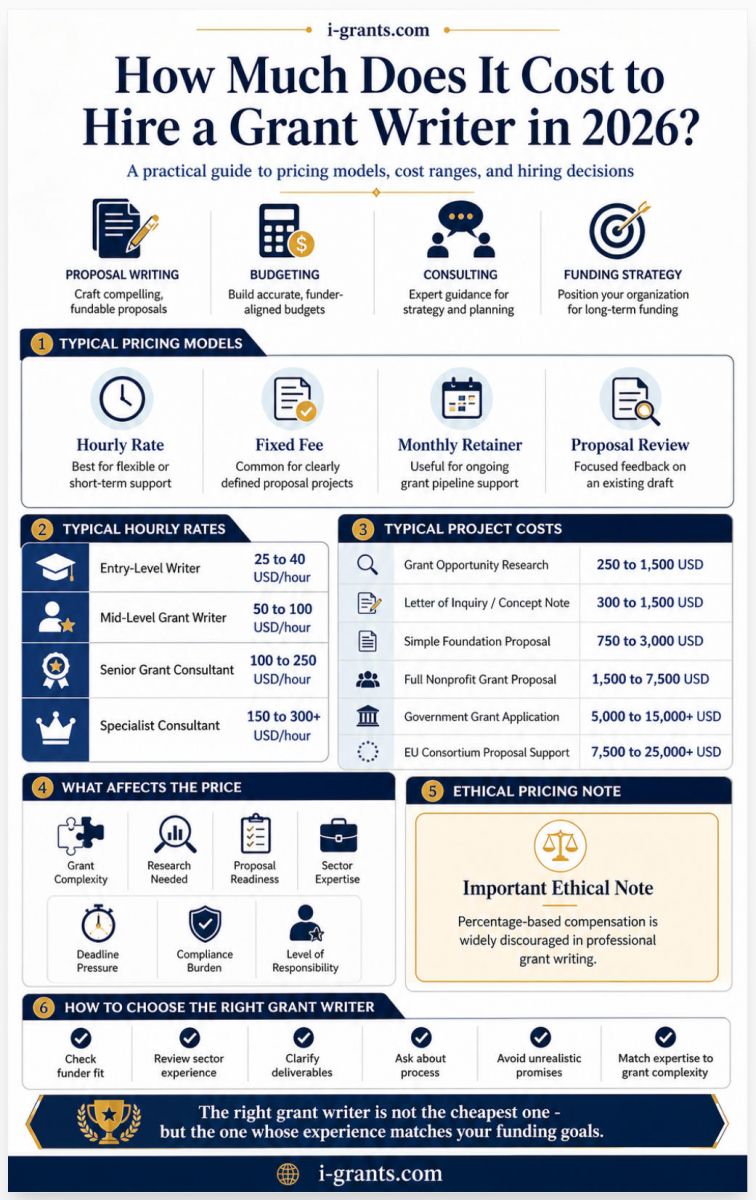
Most grant writers use one of four pricing models: hourly rate, fixed project fee, monthly retainer, or limited proposal review package. Commission-based compensation is controversial and often considered unethical, especially when payment is calculated as a percentage of the grant award.
1. Hourly Rates
Hourly pricing is common when the scope is not fully defined yet. For example, an organization may need help improving a proposal, reviewing eligibility, editing a draft, building a budget justification, or preparing answers in an online application portal.
Typical hourly ranges in 2026:
| Grant writer level | Typical hourly range | Best fit |
|---|---|---|
| Entry-level writer | 25-40 USD/hour | Simple applications, editing, basic research |
| Mid-level grant writer | 50-100 USD/hour | Foundation grants, nonprofit proposals, standard applications |
| Senior grant consultant | 100-250 USD/hour | Government, EU, institutional, research, or high-value grants |
| Specialist consultant | 150-300+ USD/hour | Complex technical fields, consortium grants, compliance-heavy funding |
These ranges are broad because the market is fragmented. A low hourly rate does not always mean a lower final cost. An inexperienced writer may need 60 hours to complete what a specialist can do in 20.
Hourly work is useful when the exact scope is still unclear. However, it requires trust and regular alignment on priorities.
2. Fixed Project Fees
Fixed-fee pricing is common for clearly defined deliverables: a foundation proposal, a government grant application, a letter of inquiry, a funder research report, or a strategic proposal review.
Typical fixed-fee ranges:
| Service | Typical cost range |
|---|---|
| Grant opportunity research | 250-1,500 USD |
| Letter of inquiry or concept note | 300-1,500 USD |
| Simple foundation proposal | 750-3,000 USD |
| Full nonprofit grant proposal | 1,500-7,500 USD |
| Government or institutional grant application | 5,000-15,000+ USD |
| EU consortium proposal support | 7,500-25,000+ USD |
| Proposal review with evaluator-style feedback | 300-2,500 USD |
| Grant readiness audit | 500-3,000 USD |
Fixed fees are often easier for clients because they make budgeting more predictable. The key is to define exactly what is included: kickoff calls, number of revisions, attachments, budget narrative, partner coordination, portal submission, and corrections after administrative review.
3. Monthly Retainers
A retainer is usually best for organizations that apply for grants regularly. Instead of hiring a grant writer for one deadline, the organization pays for ongoing support.
Typical monthly retainers:
| Monthly retainer | What it may include |
|---|---|
| 1,000-2,500 USD/month | Light research, funding calendar updates, small proposals, editing |
| 2,500-5,000 USD/month | Ongoing proposal development, funder pipeline, several applications |
| 5,000-10,000+ USD/month | Strategic grant function, major applications, donor mapping, reporting support |
Retainers work well for NGOs, research teams, universities, cultural institutions, and social enterprises that need a funding pipeline rather than a one-time application. They also help the grant writer understand the organization more deeply, which improves proposal quality over time.
4. Proposal Review Packages
Sometimes you do not need someone to write the whole proposal. You need an expert to review it before submission.
A review package may include:
-
scoring against funder criteria
-
clarity and compliance review
-
budget logic check
-
impact language improvement
-
red flag identification
-
evaluator-style comments
Typical cost: 300-2,500 USD, depending on the proposal’s length and complexity.
This is often one of the highest-value options for organizations that already have internal writing capacity but need external professional judgment.
Why “Cheap Grant Writing” Can Become Expensive
A low-cost grant writer may be enough for a small, low-risk application. But for strategic funding, cheap writing can create hidden costs.
The most common risks are:
-
applying to the wrong funder
-
misunderstanding eligibility
-
writing a generic proposal
-
promising unrealistic outcomes
-
underdeveloping the budget
-
missing required attachments
-
submitting a narrative that does not match scoring criteria
-
failing to prove organizational capacity
-
treating the grant as a writing task instead of a funding strategy
The most expensive grant proposal is not the one with the highest writer fee. It is the one that consumes staff time, partner trust, and leadership attention while having little chance of success.
A professional grant writer should help you avoid that situation before writing begins.
Can You Pay a Grant Writer a Percentage of the Grant?
Many first-time applicants ask this question: “Can we pay the grant writer only if we win?” Or: “Can the writer receive five percent of the awarded grant?”
In professional grant writing, percentage-based compensation is widely discouraged and often considered unethical.
There are several reasons.
First, grant funds are usually restricted. If a donor awards funding for education, healthcare services, research, equipment, or community programs, that money normally has to be used according to the approved project budget. Paying a grant writer a share of the award after funding is received may not be an allowable cost.
Second, percentage-based compensation can create the wrong incentives. A writer may push an organization toward larger grants even when they do not truly fit the organization’s mission or capacity.
Third, grant success is never controlled by the writer alone. It depends on eligibility, the organization’s track record, competition, funder priorities, budget quality, partnerships, timing, and evaluation criteria.
A more professional structure is to pay for services rendered: research, strategy, writing, review, editing, budget justification, or submission support.
What You Are Really Paying For
A strong grant writer does much more than produce polished paragraphs.
They help answer funder-critical questions:
-
Is this opportunity actually a good fit?
-
Does the applicant meet the eligibility rules?
-
Does the project solve a problem the funder cares about?
-
Are the objectives measurable?
-
Is the budget realistic?
-
Do the outcomes match the activities?
-
Is the organization credible enough to implement the project?
-
Are partners necessary, and are their roles clear?
-
Does the proposal follow the scoring rubric?
-
Is the application compliant?
In competitive grantmaking, these questions matter more than style. A beautifully written but poorly aligned proposal will usually lose.
Cost by Type of Grant
Different types of grants require different levels of effort.
Small Foundation Grants
Typical cost: 750-3,000 USD
These are often manageable for a mid-level grant writer. The work may include a short narrative, organizational background, project description, budget, expected outcomes, and attachments.
Best for: local NGOs, community programs, small cultural projects, education initiatives.
Corporate and CSR Grants
Typical cost: 1,000-4,000 USD
These proposals often require strong storytelling, alignment with the funder’s brand, social impact language, and concise outcomes. They may be less technical than government grants, but they still require strategic positioning.
Best for: nonprofits, social enterprises, youth projects, community initiatives.
Government Grants
Typical cost: 3,000-15,000+ USD
Government grants usually require more compliance work, detailed budgets, documentation, and strict formatting. The grant writer may need to coordinate with finance staff, program teams, leadership, and external partners.
Best for: established nonprofits, municipalities, service providers, research institutions.
EU Grants
Typical cost: 5,000-25,000+ USD
EU funding can require consortium design, work packages, impact sections, deliverables, milestones, dissemination strategy, budget coordination, and partner contributions. For complex programs, writing is only one part of the work.
Best for: universities, research teams, NGOs, innovation projects, cross-border partnerships.
Startup and Innovation Grants
Typical cost: 2,000-10,000+ USD
These applications often combine business model logic, technical innovation, market analysis, product development, team credibility, and commercialization strategy.
Best for: startups, SMEs, cleantech, healthtech, agritech, edtech, deep tech.
Research Grants
Typical cost: 3,000-15,000+ USD
Research grants require technical clarity, methodology, awareness of the literature, institutional capacity, ethics, data management, and often a strong impact pathway.
Best for: universities, labs, research institutes, academic consortia.
How to Know Whether a Grant Writer Is Worth the Cost
A good grant writer should not promise that you will win. No ethical professional can guarantee a grant award.
Instead, look for signs of quality:
-
they ask about eligibility before discussing price
-
they want to see the call guidelines
-
they discuss funder fit
-
they ask for budget details early
-
they can explain their process
-
they define deliverables clearly
-
they are honest about weak applications
-
they understand your sector
-
they know how evaluators think
-
they avoid commission-based pricing
A weak grant writer usually focuses on “beautiful writing.” A strong professional focuses on fit, evidence, compliance, scoring, and funder logic.
How to Budget for Grant Writing
Before hiring a specialist, define your needs in practical terms.
Ask yourself:
-
Do we already know the grant opportunity?
-
Do we need funder research first?
-
Do we have a clear project concept?
-
Do we have a realistic budget?
-
Do we have past performance data?
-
Do we need partners?
-
Who will provide technical content?
-
Who will review drafts internally?
-
Who will submit the application?
-
What is the deadline?
The less prepared your organization is, the more time the grant writer will need. That is not a problem, but it should be budgeted honestly.
A Realistic 2026 Pricing Scenario
Imagine a nonprofit organization wants to apply for a 250,000 USD grant.
A low-cost option might look like this:
-
general writer
-
35 USD/hour
-
25 hours
-
total: 875 USD
This may work if the grant is simple and the organization already has all materials ready.
A professional option might look like this:
-
experienced grant writer
-
fixed fee
-
research, interviews, narrative, budget narrative, revisions
-
total: 3,500-7,500 USD
A strategic option might look like this:
-
senior consultant
-
full proposal development leadership
-
funder fit, project design, budget logic, partner coordination, review
-
total: 8,000-15,000+ USD
The right choice depends on the funder, competition, and the organization’s readiness. For a high-value opportunity, underinvesting in proposal quality can cost more than hiring the right expert.
When You Should Not Hire a Grant Writer Yet
Sometimes the best professional advice is: wait.
You may not be ready to hire a grant writer if:
-
your organization has no defined project
-
your financial documents are not ready
-
you cannot clearly explain your target beneficiaries
-
you have no implementation capacity
-
you are applying only because “there is money available”
-
leadership cannot review drafts quickly
-
the deadline is too close
-
the grant does not match your mission
In these cases, start with a grant readiness audit or a funding strategy session instead of a full proposal. It is cheaper and often much more useful.
How i-grants.com Helps Reduce Hiring Risk
The grant writing market is difficult to navigate because price alone tells you very little. A writer charging 40 USD per hour may be excellent for a small foundation grant. A consultant charging 150 USD per hour may be necessary for a complex EU application. The real issue is fit.
That is where a specialized grant marketplace can help.
On i-grants.com, applicants can approach grant writing as a professional matching problem: the right expert for the right funder, sector, geography, budget level, and deadline. For NGOs, startups, universities, cultural institutions, and research teams, this can reduce the risk of hiring someone who writes well but does not truly understand the funding environment.
For grant writers, the platform also creates a clearer market: specialists can position themselves by donor type, sector, language, geography, and proposal experience.
In 2026, grant writing is no longer just a freelance writing service. It is part of funding strategy.
Final Answer: How Much Should You Expect to Pay?
For most organizations in 2026, realistic grant writer costs look like this:
| Need | Expected budget |
|---|---|
| Basic proposal review | 300-1,000 USD |
| Grant research shortlist | 250-1,500 USD |
| Small foundation proposal | 750-3,000 USD |
| Standard nonprofit proposal | 1,500-7,500 USD |
| Government grant application | 3,000-15,000+ USD |
| EU or consortium proposal | 7,500-25,000+ USD |
| Monthly grant support retainer | 1,500-10,000+ USD/month |
| Hourly consulting | Usually 50-150 USD/hour, higher for specialists |
The best grant writer is not the cheapest one and not always the most expensive one. The best grant writer is the one whose experience matches the funder, sector, application type, and level of strategic support your organization actually needs.
A grant proposal is not just a document. It is a test of fit, credibility, evidence, budget logic, and implementation capacity. Paying for the right grant writer means paying for someone who can help your organization pass that test.