

 Français
  Deutsch
  Українська
Germany is one of Europe’s most attractive markets for small business funding, startup support, industrial modernisation, research and development, climate investment and regional business incentives. It is also one of the easiest markets to misunderstand.
Many international founders search for “small business grants in Germany” expecting a simple list of free money opportunities. In practice, the German funding system is more complex. A real opportunity may be a non-repayable grant, a subsidised loan, a repayment subsidy, a public guarantee, a regional investment incentive, an R&D grant, an energy efficiency programme, a startup stipend, or a combination of several instruments.
This distinction matters. A small company that searches only for direct grants may miss useful KfW financing. A startup that applies for a regional investment grant without checking its location may waste months. An SME that starts buying equipment before approval may lose eligibility. A foreign founder who assumes that every German programme is open internationally may discover too late that the company must operate in Germany, have a German establishment, work with a German bank, or meet EU state aid rules.
This guide explains how SMEs and startups can find real, official and relevant business funding opportunities in Germany in 2026 before spending time on the wrong programme.
Why Germany’s SME funding system is large, but fragmented
Germany’s small and medium-sized enterprises are not a niche part of the economy. They are the backbone of the German business landscape. In official German statistics, SMEs represent almost all enterprises and employ more than half of the workforce in the sectors studied. The Mittelstand includes micro-enterprises, family businesses, industrial suppliers, craft companies, technology startups, service companies, exporters and regional employers.
Because SMEs are so important, Germany does not rely on one single “business grant” scheme. Instead, funding is distributed across several policy goals:
-
innovation and R&D
-
energy and resource efficiency
-
digitalisation
-
startup creation
-
regional development
-
export competitiveness
-
climate transformation
-
investment in structurally weaker regions
-
university spin-offs and research-based startups
This creates a rich funding environment, but it also creates confusion. The correct programme depends on what the company is, where it is located, what it wants to finance, whether the project has already started, how much own contribution is available, and whether the project fits a public policy objective.
For this reason, the first step is not to ask, “Where can I get a grant?” The better question is: “Which German funding instrument matches my company, project, location, cost structure and financing capacity?”
What “business grant” really means in Germany
In Germany, the word usually associated with a grant is Zuschuss. A Zuschuss is typically a non-repayable subsidy, often calculated as a share of eligible costs. But not every funding opportunity that appears in searches is a Zuschuss.
A business funding instrument may reduce cost, improve access to finance, lower bank risk, reimburse part of investment, support R&D personnel, subsidise consulting, or provide founder income during early startup preparation. Some instruments are paid only after costs are documented. Some are channelled through commercial banks. Some are available only in specific federal states. Some are restricted to SMEs. Some are open to larger companies as well.
Table 1. Main types of SME and startup funding in Germany
| Funding type | German term often used | What it usually means | Typical use case | Key risk for applicants |
|---|---|---|---|---|
| Direct grant | Zuschuss | Non-repayable support for approved eligible costs | R&D, energy efficiency, regional investment, consulting, startup preparation | Starting the project before approval or claiming ineligible costs |
| Promotional loan | Förderkredit | Publicly supported loan, often with favourable terms, usually through a bank | Startup finance, investment, working capital, climate and innovation projects | Treating it like a grant and ignoring repayment capacity |
| Guarantee | Bürgschaft | Public risk-sharing instrument that helps secure bank financing | Companies with insufficient collateral but viable business models | Weak financial documents or unclear repayment logic |
| Repayment subsidy | Tilgungszuschuss | A portion of a loan may be reduced if conditions are met | Energy or climate investment, depending on programme design | Misunderstanding when and how the subsidy is applied |
| Equity or VC support | Beteiligung, Wagniskapital | Publicly backed venture capital or fund investment | High-growth startups, deep tech, scale-ups | Applying too early without investor-ready evidence |
| Startup stipend or allowance | Gründungszuschuss, EXIST grant logic | Personal or project support during startup preparation | University spin-offs, researchers, unemployed founders, early teams | Wrong founder status, weak innovation case, missing institutional support |
This is the most important point for international readers: Germany has many business funding instruments, but only some are direct grants. In many cases, the realistic opportunity is not “free money”, but a structured financing package with conditions, documentation and co-financing.
Start with official sources, not generic grant lists
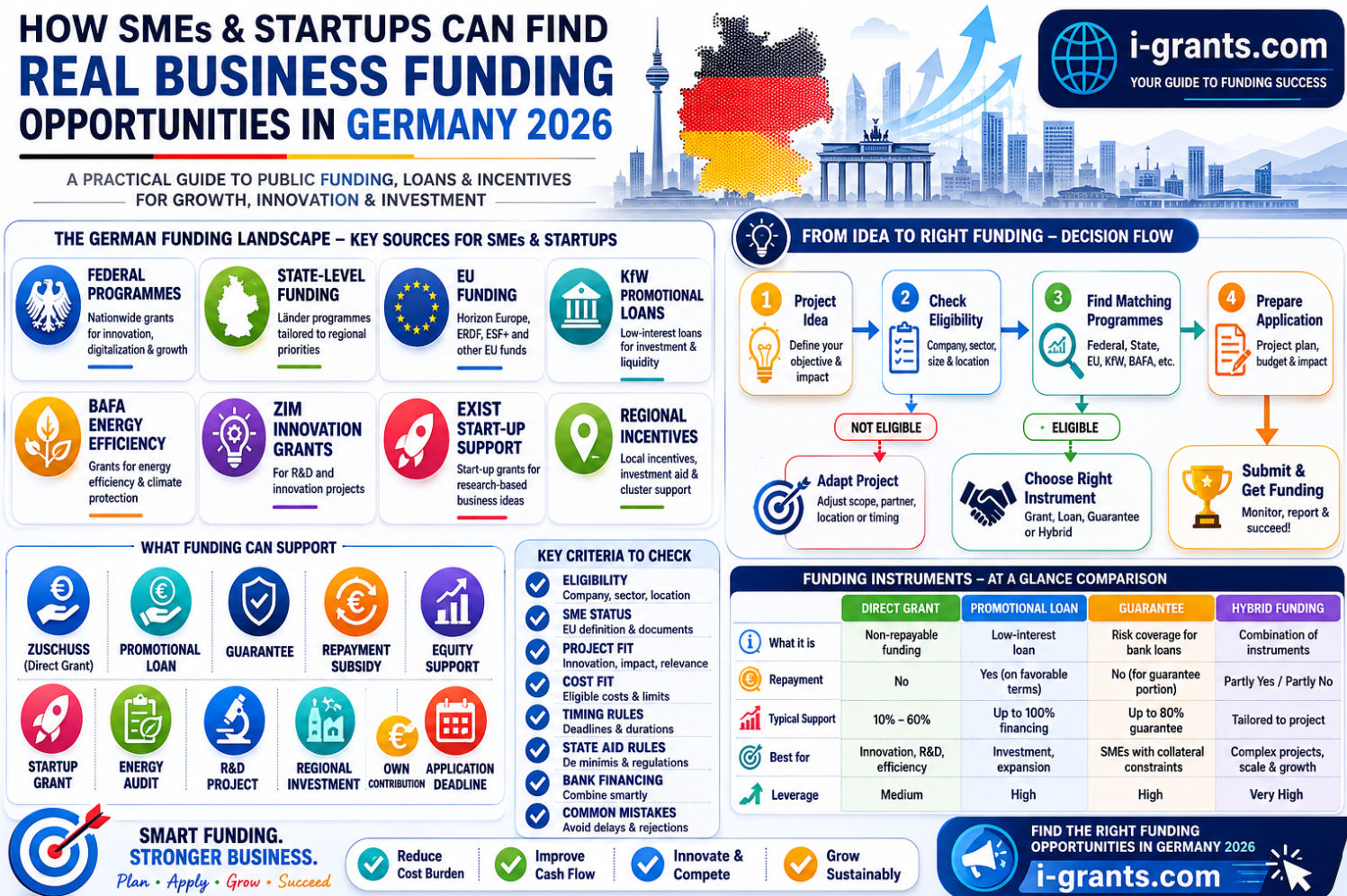
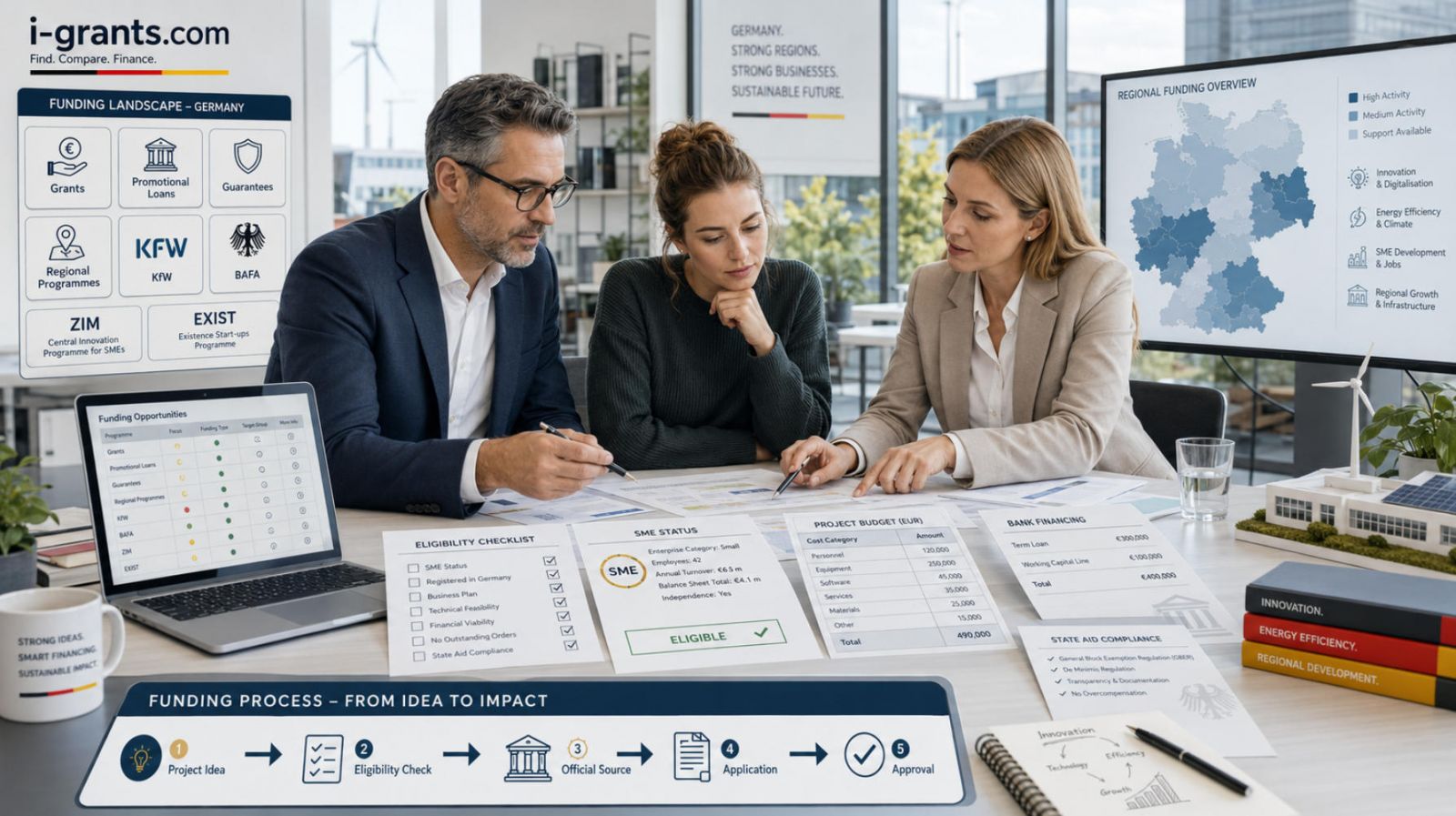
The safest starting point for business funding research in Germany is the Förderdatenbank, the federal funding database. It provides an overview of funding programmes from the federal government, the federal states and the European Union. It allows users to search by topic, region, funding area and target group.
For an SME or startup, this matters because Germany is a federal country. A company in Berlin, Bavaria, North Rhine-Westphalia or Saxony may face different regional programmes, different development banks and different investment incentives. A programme that fits one region may be irrelevant in another.
A practical funding search should normally follow this sequence:
-
Define the project first. Is it R&D, energy efficiency, machinery investment, digitalisation, export, startup preparation, hiring, consulting, or regional expansion?
-
Check whether the company qualifies as an SME under EU rules.
-
Search the Förderdatenbank by project type, region and target group.
-
Compare federal, state-level and EU instruments.
-
Identify whether the instrument is a grant, loan, guarantee, equity instrument or hybrid structure.
-
Read the original programme guideline before preparing an application.
-
Check whether the application must be submitted before project start.
-
Confirm who submits the application: the company, a bank, a university, a project consortium, or another authorised body.
This sequence prevents one of the most common mistakes: choosing a programme because the title sounds attractive rather than because the rules match the project.
Check SME status before searching too deeply
Many German business funding schemes use the EU SME definition. Under this approach, the company’s number of employees, annual turnover and balance sheet total are relevant. A medium-sized enterprise normally has fewer than 250 employees and either annual turnover not exceeding EUR 50 million or a balance sheet total not exceeding EUR 43 million.
However, SME status is not always as simple as counting the employees in one legal entity. Linked and partner enterprises may need to be considered. A startup owned by a larger corporate group may not qualify as an SME even if its own team is small. A company with international shareholders may need to analyse ownership and control relationships. This is especially important for venture-backed companies, subsidiaries and spin-offs.
For a first funding search, the applicant should answer three questions:
-
Does the company meet the employee and financial thresholds?
-
Are there linked or partner enterprises that affect SME status?
-
Does the specific programme use the EU SME definition, a national definition, or its own target group rules?
This is not only a formal issue. SME status can affect eligibility, maximum funding rate, documentation requirements and the ranking of an application.
Understand the three funding levels: federal, state and EU
Germany’s funding landscape works across several levels. A company may find one opportunity through a federal ministry, another through a state development bank, another through a European programme, and another through a bank-based promotional loan.
Table 2. Where SMEs and startups can find funding opportunities in Germany
| Funding level | Typical institutions or portals | What it may fund | Best suited for |
|---|---|---|---|
| Federal level | BMWE programme portals, BAFA, ZIM, KfW, EXIST-related structures | Innovation, R&D, energy efficiency, startup finance, climate investment, business transformation | SMEs with projects aligned with national policy priorities |
| Federal state level | Landesförderbanken, state ministries, regional investment agencies | Regional investment, startup support, digitalisation, consulting, growth, local economic development | Companies with a clear location and regional impact |
| EU level | Horizon Europe, European Structural Funds, EU-backed regional programmes | Research, innovation, cooperation, regional development, sustainability | Companies in consortia, innovation projects or EU-supported regions |
| Bank-based promotional finance | KfW and state development banks through commercial banks | Loans, risk-sharing, investment finance, startup finance, climate and innovation projects | Companies that need capital and can demonstrate repayment capacity |
| University and research ecosystem | EXIST, universities, research institutions, startup centres | Knowledge-based and technology-oriented startups | Students, researchers, graduates and academic spin-offs |
The federal level is often the most visible internationally, but regional programmes are highly important in practice. Some investment grants depend on the location of the project. Some startup schemes are administered by federal states or city-level institutions. Some support is available only through state development banks.
This is why “business grants in Germany” should never be researched only at national level. Location can be as important as sector.
Examples of real funding routes for German SMEs and startups
The first article in this series is not meant to replace detailed programme guides. Still, it is useful to understand the main routes a business may encounter.
ZIM is one of Germany’s most important innovation funding programmes for SMEs. It supports companies with business operations in Germany that want to develop new or significantly improved products, processes or technical services. For an SME with a genuine R&D project, technical uncertainty and market potential, ZIM may be more relevant than a general small business grant.
BAFA energy and resource efficiency programmes are relevant for companies investing in energy-efficient technologies, process heat, resource efficiency, monitoring systems, transformation concepts or systemic optimisation. These programmes are especially important for manufacturing and service companies facing high energy costs or climate transformation pressure.
KfW funding is central to German business finance, but it is often misunderstood by grant seekers. KfW frequently provides promotional loans, risk-sharing and subsidised financing rather than direct grants. For example, startup finance can be channelled through the applicant’s regular bank, with KfW assuming part of the credit risk for the bank. This can be extremely valuable, but it still requires a bankable business case.
EXIST is relevant for university graduates, scientists, students and research teams preparing technology-oriented or knowledge-based startups. It is not a general grant for any small business. It is designed for science-based and innovation-driven startup projects, usually connected to a university or research institution.
Regional grants and state-level programmes may support investment, growth, startup activity, digitalisation or local economic development. The right contact may be a state development bank, a regional ministry, a local economic development agency, or a specific programme portal.
The strategic lesson is simple: the best funding route depends on the project type. A bakery replacing ovens, a SaaS startup from a university lab, a manufacturer developing a new sensor technology and a logistics SME investing in energy efficiency should not all search for the same grant.
How to judge whether an opportunity is real
A real German funding opportunity should be traceable to an official source. It should have a programme page, a guideline, an administrator, eligibility rules, eligible cost categories, deadlines or application windows, and a clear submission process.
Applicants should be careful with unofficial websites that promise guaranteed grants, sell generic lists, or present loans as if they were free subsidies. Grant research should begin with official portals and continue with programme guidelines, not with marketing summaries.
Before investing time in an application, check five dimensions:
-
Applicant fit: legal form, SME status, age of company, location, sector, ownership and financial condition.
-
Project fit: innovation level, investment type, energy savings, regional impact, startup status or R&D content.
-
Cost fit: eligible cost categories, VAT treatment, personnel costs, equipment, external services, construction, software or consulting.
-
Timing fit: application deadline, approval before project start, procurement rules and implementation period.
-
Funding fit: grant rate, own contribution, bank financing, de minimis limit, state aid cumulation and reporting duties.
If one of these dimensions fails, the opportunity may not be real for that specific company, even if the programme itself is official.
The project start rule can decide eligibility
One of the most expensive mistakes in German funding is starting too early. Many programmes require the application to be submitted, and sometimes approved, before the applicant commits to the project. A signed contract, placed order, paid invoice or binding supplier agreement may be treated as project start.
This rule is especially important for equipment investments, energy efficiency projects, construction-related measures, consulting assignments and R&D contracts. Even if the investment is clearly useful, it may become ineligible if the company begins before the programme allows it.
For this reason, SMEs should create a funding decision point before procurement. The internal rule should be: no binding order, no signed contract and no project launch until the relevant funding rules have been checked.
De minimis and state aid rules are not just legal details
Many smaller grants and subsidies in Germany fall under EU state aid rules, including de minimis aid. The general de minimis ceiling is EUR 300,000 over a three-year period for one undertaking, with specific exclusions and additional rules for certain sectors and aid forms.
For applicants, this means that previous subsidies matter. The company may need to declare de minimis aid already received. Linked companies can also matter because state aid rules may treat a group as one undertaking. Grants, guarantees and interest-reduced loans can all have a state aid value.
This is why a company should not look at each grant in isolation. It should maintain a funding history file that records approvals, de minimis certificates, grant amounts, subsidy equivalents, related companies, project costs and cumulation rules. This becomes especially important when combining regional grants, consulting vouchers, innovation support and promotional finance.
Common wrong assumptions about German business grants
International applicants often make mistakes before they even open an application form. The most common wrong assumptions are:
-
“Grant” always means non-repayable cash.
-
A programme listed in Germany is automatically open to foreign companies without German operations.
-
A startup with a good idea automatically qualifies for public funding.
-
KfW funding is the same as a grant.
-
A company can start the project first and apply later.
-
Any business cost can be included if it supports growth.
-
A high funding rate means the project will be easy to finance.
-
A consultant can guarantee approval.
-
A national programme is always better than a regional one.
-
A small grant does not require state aid checks.
These assumptions lead to wasted time, rejected applications and poor funding strategy. In Germany, the strongest applications are usually not those that ask for the most money. They are the applications that match the programme logic precisely.
A practical pre-application checklist
Before preparing a full German funding application, an SME or startup should complete a short readiness review.
Company readiness
The company should confirm its legal status, German establishment or planned establishment, SME classification, ownership structure, financial situation, tax and registration documents, and previous public aid received.
Project readiness
The project should have a clear objective, defined activities, measurable outputs, realistic timeline, supplier or partner logic, evidence of need, and a strong explanation of why public support is justified.
Budget readiness
The budget should separate eligible and non-eligible costs, show own contribution, explain VAT treatment, include documentation for personnel, equipment and external services, and avoid vague lump sums unless the programme explicitly allows them.
Funding readiness
The applicant should know whether it is applying for a grant, loan, guarantee, equity instrument or hybrid support. It should also know whether a commercial bank, university, project partner or public agency must be involved.
Evidence readiness
The company should collect market evidence, technical evidence, financial statements, business plan, energy audit, innovation description, quotations, ownership documents, CVs, cooperation agreements or regional impact data depending on the programme.
This review does not replace legal or programme-specific advice. It helps the applicant decide whether the opportunity is worth pursuing.
When a grant writer can add value
A grant writer or funding consultant is most useful when the company already has a real project but needs help matching it to the right instrument, interpreting eligibility rules, building a funding narrative, preparing evidence, structuring the budget or coordinating documentation.
For German funding, the value is often not only in writing persuasive text. It is in avoiding the wrong programme, identifying hidden eligibility risks, translating technical or business content into the logic of the funder, and making sure that the application is consistent across strategy, budget, evidence and formal requirements.
For SMEs and startups working internationally, this can be especially important. A company may understand its technology or business model very well but still misunderstand German funding vocabulary, state aid logic, regional eligibility, bank-based promotional finance or documentation expectations.
Platforms such as i-grants.com and Grantologic can help applicants connect with specialists who understand specific grant instruments, sectors and countries. This is particularly useful in Germany, where the right answer is rarely “apply for every grant”. The right answer is usually “choose the funding route that fits the project before the application is written”.
Final takeaway
Germany offers real funding opportunities for SMEs and startups in 2026, but the system rewards precision. The strongest first step is not to collect random grant lists. It is to understand the structure of German support: federal programmes, state-level programmes, EU funding, KfW promotional finance, BAFA energy and efficiency schemes, ZIM innovation grants, EXIST startup support and regional investment incentives.
A German business funding opportunity is real only if it matches the applicant, the project, the location, the costs, the timing and the financing structure. Once that match is clear, the application becomes a strategic exercise rather than a search for free money.
For SMEs and startups, this is the core rule: do not start with the word “grant”. Start with the project, then find the instrument that Germany actually uses to support that type of project.