

 Français
  Deutsch
  Українська
Small business grants remain one of the most attractive funding topics for entrepreneurs, startups, local companies, women-owned businesses, exporters, manufacturers and community-based enterprises. The reason is clear: small business grants sound like non-repayable capital at a time when many business owners face expensive credit, higher operating costs, tighter cash flow and a constant need to invest in people, equipment, technology, marketing and resilience.
But this search phrase can also be misleading. In 2026, small business grants are real, but they are rarely “free money” for any company that asks. Most legitimate grants are tied to a defined public, economic, scientific, social or regional purpose. They may support innovation, research and development, exporting, workforce training, clean technology, local revitalization, inclusive entrepreneurship or community impact. They usually do not exist to cover ordinary business expenses without conditions.
That is the first rule every applicant should understand: real small business grants start with the funder’s mission, not with the applicant’s wish for free cash.
A company that searches for small business grants without understanding this rule may waste weeks on outdated lists, irrelevant programmes or suspicious offers. A company that understands how grants work can search more strategically, verify official sources, assess eligibility and prepare a stronger application. This is where small business grants become a real funding route rather than a confusing internet promise.
Why small business grants attract so much attention
Small businesses matter economically. They create jobs, serve local communities, test new products, support supply chains and often bring innovation into markets faster than large institutions. In the United States, small businesses represent almost all registered businesses, employ tens of millions of people and contribute a major share of economic activity. Globally, small and medium-sized enterprises are also central to employment, entrepreneurship and regional development.
This is why governments, foundations, development institutions and corporate donors sometimes support small business grants. Funders do not usually support small businesses just because a business needs money. They support small businesses when the funding can advance a larger objective: more jobs, stronger manufacturing, cleaner energy, better technology, export growth, rural development, digital transformation, women’s entrepreneurship or stronger local economies.
That distinction is important. Small business grants are not a universal substitute for revenue, investment or loans. They are targeted tools. They exist where the funder sees a public benefit or strategic outcome.
This also explains why competition is high. Millions of companies may search for small business grants, but only a fraction will fit a specific programme. A bakery seeking a new oven, a SaaS startup developing medical technology, a rural manufacturer training workers and a woman-owned export business may all search for small business grants. But they need different opportunities, different funders and different application strategies.
What small business grants really are
A grant is usually a non-repayable financial award for a defined purpose. That definition sounds simple, but the “defined purpose” is the most important part. Real small business grants are normally linked to eligible activities, budget rules, deadlines, review criteria and reporting obligations.
A grant may support prototype development, technology commercialization, export readiness, employee training, energy efficiency, equipment upgrades, local storefront recovery, rural business development or a community entrepreneurship programme. In each case, the applicant must show that the project fits the funder’s priorities.
Small business grants should not be confused with loans. A loan must be repaid. A grant usually does not need to be repaid if the recipient follows the rules, spends funds correctly and reports the results. Small business grants should also not be confused with contracts. A contract pays a business to deliver goods or services to a buyer, often a government agency. A grant supports an activity that advances the funder’s mission.
Tax credits are different again. A tax credit reduces tax liability after a qualifying activity, such as research, hiring, energy investment or training. Accelerators may offer funding, mentoring and investor access, but some require equity or investment rights. Challenge prizes may resemble small business grants, but they usually reward a specific solution to a defined problem. Technical assistance may be valuable, but it often provides coaching, advisory support or market access rather than direct cash.
This matters because many online lists mix all these categories together. A page titled “small business grants” may include loans, contests, accelerators, tax incentives, reimbursement programmes and training support. That does not make the list useless, but it means every opportunity must be classified before a business invests time in an application.
Where real small business grants usually come from
Real small business grants can come from several types of funders.
Federal agencies may support research, innovation, commercialization, exporting, manufacturing, workforce development or sector-specific programmes. State and regional agencies may fund companies that create jobs, support local supply chains, rebuild after disasters or strengthen priority industries. Cities and counties may provide small business grants for downtown revitalization, commercial corridors, facade improvements, main street recovery or neighborhood development.
Foundations may support social enterprises, community businesses, inclusive entrepreneurship, cultural entrepreneurship, environmental projects or businesses serving underserved groups. Corporate donors may run small business grants for women entrepreneurs, supplier diversity, rural business development, digital adoption, sustainability or local recovery.
Internationally, small business grants can also appear through development agencies, EU programmes, innovation funds, climate funds, embassies, chambers of commerce, entrepreneurship initiatives and regional development institutions. For i-grants.com, this international view is especially important because grant seekers do not need only country-specific lists. They need a verified funding intelligence workflow that can classify opportunities by donor, geography, eligibility, applicant type, sector, funding amount, deadline and official source.
The strongest categories of small business grants in 2026
Not every business has the same grant path. The most realistic small business grants usually fall into several broad categories.
Innovation and R&D grants support companies developing new technologies, products, scientific solutions or commercial applications of research. These small business grants are especially relevant for startups, deep-tech companies, health technology firms, climate technology ventures, education technology companies, advanced manufacturers and software businesses with a strong innovation component.
Export and trade development grants help eligible companies enter international markets, attend trade shows, adapt marketing materials, meet certification requirements or build export capacity. These small business grants usually work best for companies that already have a viable product or service and a realistic international growth plan.
Local economic development grants support businesses that contribute to jobs, local revitalization, rural development, disaster recovery or commercial corridor improvement. These small business grants may come from cities, counties, local foundations, chambers, community development funds or regional agencies.
Workforce and training grants support skills development, apprenticeships, manufacturing training, digital skills, green jobs or employer partnerships. These small business grants are usually measured by people trained, jobs retained, jobs created or productivity improvements.
Sustainability and energy grants support energy efficiency, renewable energy adoption, low-carbon production, circular economy models, sustainable agriculture, climate resilience or green innovation. These small business grants are increasingly relevant as governments and funders connect business development with climate goals.
Inclusive entrepreneurship grants support women-owned businesses, minority-owned businesses, veteran entrepreneurs, rural founders, immigrant entrepreneurs, Indigenous businesses or companies serving underrepresented communities. These small business grants usually require clear proof of ownership, eligibility and community or economic impact.
Challenge grants and prizes support companies that solve a specific technical, market or social problem. They may not always be traditional small business grants, but they can provide non-dilutive funding and visibility.
Why most businesses do not receive unrestricted grant money
Many entrepreneurs are disappointed when they learn that small business grants are limited, competitive and specific. This disappointment usually comes from a misunderstanding created by search results, social media posts and low-quality funding lists.
A real funder rarely says, “Here is money for any business need.” More often, the funder says, “We want to solve this problem, support this type of applicant, in this geography, for this purpose, by this deadline.” The applicant must then prove fit.
This is why a general business that simply wants working capital may struggle to find small business grants. A funder may not support rent, debt repayment, past expenses, ordinary inventory purchases or unrestricted marketing. But the same business may become eligible if it proposes a fundable project: training workers, adopting clean technology, expanding exports, revitalizing a local commercial district, developing a new product or serving a priority community.
The practical lesson is simple: small business grants are not awarded to need alone. They are awarded to eligible projects that match funder priorities.
How to verify small business grants before applying
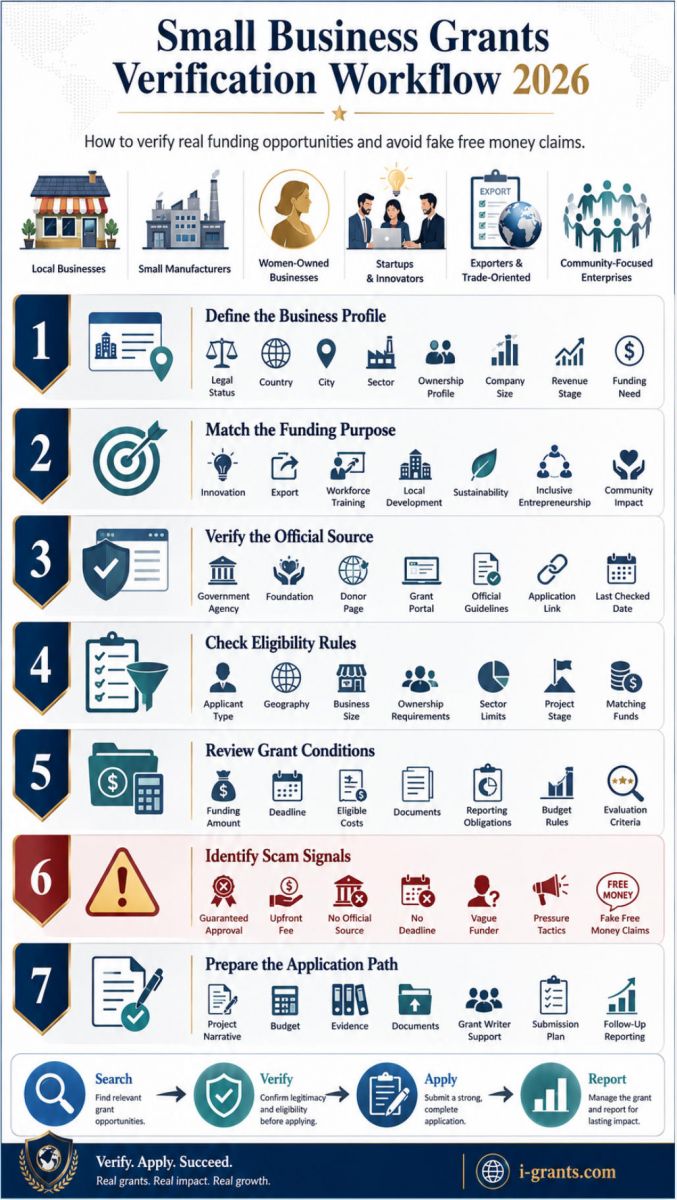
Verification is the difference between serious funding work and wasted time. A business should never rely only on a blog article, social media post, private message or advertisement. Every promising opportunity should be checked against an official source.
Start with the funder. Is the programme published on an official government, foundation, corporate, university, development institution or donor website? If the opportunity cannot be traced to an official source, treat it as unverified.
Then check eligibility. Which countries, states, regions or cities can apply? Is the applicant required to be a registered business, startup, nonprofit partner, exporter, manufacturer, women-owned company, research-based company or consortium member? Does the programme have size limits, revenue limits, employee limits or ownership rules?
Next, verify the funding purpose. Real small business grants usually explain what the money can pay for and what it cannot pay for. Eligible costs may include R&D labour, prototype costs, equipment, training, consulting, export development, energy upgrades or project implementation. Ineligible costs may include debt repayment, unrelated expenses, owner withdrawals, past costs or general business activity.
Then check the funding amount, match requirement, deadline, application method and required documents. A serious opportunity should provide enough detail for an applicant to decide whether the effort is realistic.
Finally, record the last checked date. Small business grants expire, reopen, change rules or run out of budget. An old article may still rank in Google after the grant has closed. A reliable funding workflow should track source link, deadline, status, geography, applicant type, sector, funding amount, documents and application portal.
A practical verification table for small business grants
| Field to verify | Why it matters |
|---|---|
| Official source | Confirms that the opportunity is real and not copied from an outdated or suspicious list |
| Funder identity | Shows who provides the money and what mission the grant serves |
| Eligible geography | Defines which countries, states, cities or regions can apply |
| Applicant type | Confirms whether small businesses, startups, nonprofits, universities or consortia are eligible |
| Funding purpose | Shows what the grant is designed to support |
| Funding amount | Helps assess whether the opportunity is worth the application effort |
| Deadline | Prevents wasted work on closed or outdated calls |
| Match requirement | Shows whether the applicant must provide co-financing |
| Required documents | Helps estimate preparation time and complexity |
| Reporting obligations | Shows what the recipient must prove after receiving funds |
| Last checked date | Protects against stale funding information |
This kind of structured verification is essential for small business grants because grant information changes constantly. A real grant intelligence workflow should not only collect opportunities. It should classify and verify them.
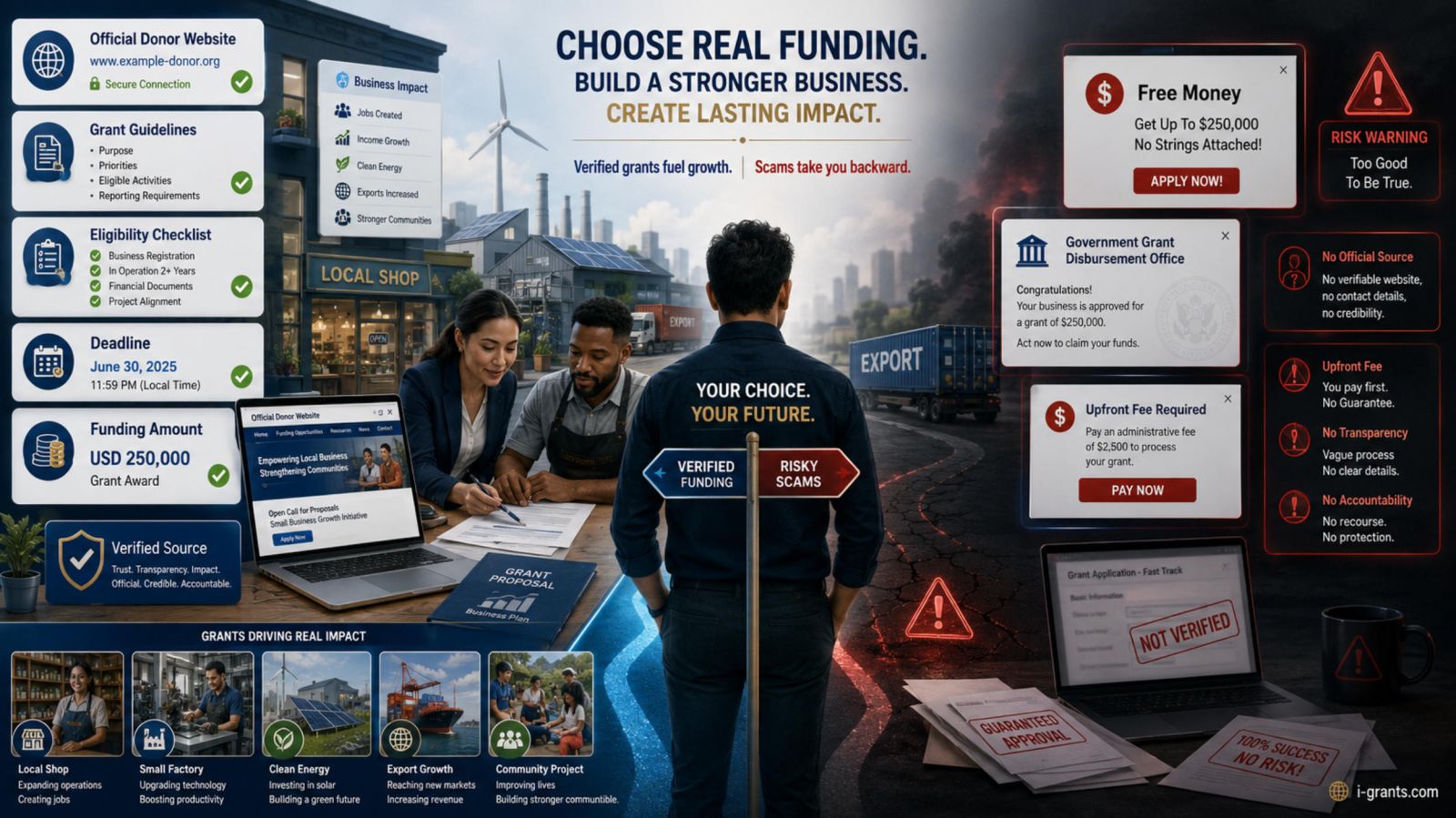
How to avoid fake “free money” claims
Fraud risk is high around small business grants because the phrase attracts people who need capital urgently. Scammers know that “government grant,” “business grant” and “free money” sound persuasive. They may use official-looking logos, fake agency names, social media ads, direct messages, messaging apps, cold emails or phone calls.
Fake small business grants often promise guaranteed approval. They may ask for an upfront processing fee before any official award. They may claim that the business has already been selected, even though no application was submitted. They may provide no official guidelines, no eligibility rules, no deadline, no funder identity and no review process. They may ask for bank details, identity documents or payment before any legitimate award notice.
Real small business grants are different. They are usually public, documented, competitive and rule-based. They require review. They often require business registration documents, tax records, financial statements, budgets, project narratives, ownership proof, partner letters, milestones or reporting. That paperwork may be inconvenient, but it is often a sign that the opportunity is real.
A useful rule is this: if a grant has no official source, no eligibility rules, no deadline, no budget rules and no reporting obligations, it is not a funding opportunity. It is a risk signal.
Why matching matters more than searching
Many entrepreneurs search for small business grants in the broadest possible way. They type a generic phrase, open several lists and apply randomly. This approach usually fails because grants are not distributed by general interest. They are distributed by fit.
The best search for small business grants begins with a project profile. A company should define its legal status, location, ownership profile, sector, revenue stage, employee count, innovation level, export readiness, community impact, funding need and implementation timeline.
Once the profile is clear, small business grants can be filtered by donor purpose, geography, applicant type, sector, deadline, funding amount and official source. This is a much more effective approach than chasing every result that contains the word “grant.”
For example, a manufacturer seeking training support should not spend time on R&D grants unless it has a research project. A software startup should not focus only on local storefront grants if its strongest funding path is innovation. A woman-owned business should not assume that every women entrepreneur grant fits its sector, stage or geography. Matching protects time and improves application quality.
When a small business should consider a grant writer
A business does not need a professional grant writer for every opportunity. If the application is a short local form for a small microgrant, the founder may complete it alone. If the award is a simple monthly prize with a basic questionnaire, professional help may cost more than it returns.
But competitive small business grants are different. Professional support can be useful when the application requires a technical narrative, detailed budget, measurable outcomes, evidence of market demand, partner letters, compliance language, an R&D work plan, an export strategy, financial projections or post-award reporting.
A grant writer cannot make an ineligible business eligible. But a strong grant writer can help a business understand funder priorities, structure the application, clarify outcomes, prepare a budget, reduce compliance risk and present the project in a way that matches the scoring criteria.
For many companies, the question is not simply, “Can we write?” The better question is, “Can we prove fit, feasibility, impact and compliance better than competing applicants?” If the answer is uncertain, expert help may be a practical investment.
How i-grants.com can support the small business grants workflow
The value of i-grants.com is not to repeat generic lists of small business grants. The stronger role is to help applicants and grant writers move from search to verification, and from verification to action.
For applicants, a structured grant intelligence workflow makes it easier to see whether an opportunity is real, current and relevant. Instead of reading old lists, a business can evaluate the donor, donor geography, eligible countries, applicant type, sector, funding amount, deadline, status and official verification link.
For grant writers, small business grants create a practical marketplace opportunity. Grant writers can identify active calls, understand funder priorities, match opportunities to client profiles and help businesses prepare stronger applications. The grant database becomes not only content, but an operational foundation for collaboration.
This is especially important because small business grants are not one universal category. They include local development grants, innovation grants, export grants, workforce grants, sustainability grants, women entrepreneur grants, startup grants and challenge awards. Each requires different evidence, different documents and different application logic.
A platform that classifies and verifies opportunities can save time for both sides. Applicants can avoid irrelevant or closed grants. Grant writers can focus on real calls where professional work can improve the chance of success.
Small business grants in 2026 are real, competitive and highly specific. They can support innovation, exporting, workforce development, local revitalization, sustainability, inclusive entrepreneurship and community impact. But they are not magic cash for any business, and they should never be confused with fake “free money” claims.
The businesses that benefit from small business grants usually treat grant search as a professional funding workflow. They define the project, verify the official source, check eligibility, understand the funder’s purpose, prepare credible documents and decide when expert support is worth the investment.
That is the practical path from search traffic to real funding action. Small business grants can be valuable, but only when entrepreneurs and grant writers approach them with discipline, verification and strategic fit.