

 Français
  Deutsch
  Українська
Ścieżka SMART is one of the most important innovation grant instruments for Polish small and medium-sized enterprises in the 2021-2027 EU funding period. It is also one of the programmes that SMEs can easily misunderstand. It is not a general business development subsidy for any company that wants to buy equipment, expand production, or improve ordinary operations. It is a competitive funding route for companies that can prove a credible innovation project, a clear R&D or R&D implementation logic, and the capacity to deliver the project under public funding rules.
For Polish SMEs, the timing is important. By mid-June 2026, Poland’s 2021-2027 EU funding programmes were already in an active implementation phase, with thousands of calls launched, tens of thousands of applications submitted, and a large part of the EU allocation already contracted. This means that companies should not treat grant preparation as a last-minute administrative task. In popular schemes such as Ścieżka SMART, demand can exceed the available budget several times over.
The 2026 edition of Ścieżka SMART is especially relevant because PARP simplified the programme structure. Instead of the previous modular logic, the 2026 calls separate R&D projects from projects focused on implementing R&D results. This makes the programme easier to understand, but not necessarily easier to win. Applicants still need strong evidence, a realistic budget, a financial model, a market logic, and a project that fits the evaluation criteria.
Why Ścieżka SMART matters for Polish SMEs
Poland has a very large SME sector. Micro, small, and medium-sized enterprises represent almost the entire business population in the country, and microenterprises alone account for the overwhelming majority of firms. This makes SME-focused innovation grants strategically important, but it also creates high competition when attractive funding is available.
Ścieżka SMART matters because it targets a specific gap in the SME market: the difficulty of financing innovation. R&D, technology validation, product development, industrial property protection, implementation, and market entry can be expensive and risky. A grant can reduce part of this burden, but it does not remove the need for financial discipline. The applicant must still show that the project is feasible, that the company can cover its own contribution, and that the expected results are commercially meaningful.
A useful way to understand Ścieżka SMART is to see it as a grant for evidence-based innovation. The programme is not designed to reward a company for saying that it is modern or ambitious. It rewards companies that can demonstrate what is new, why the market needs it, how the R&D or implementation process will work, and why the requested costs are necessary.
What changed in Ścieżka SMART in 2026?
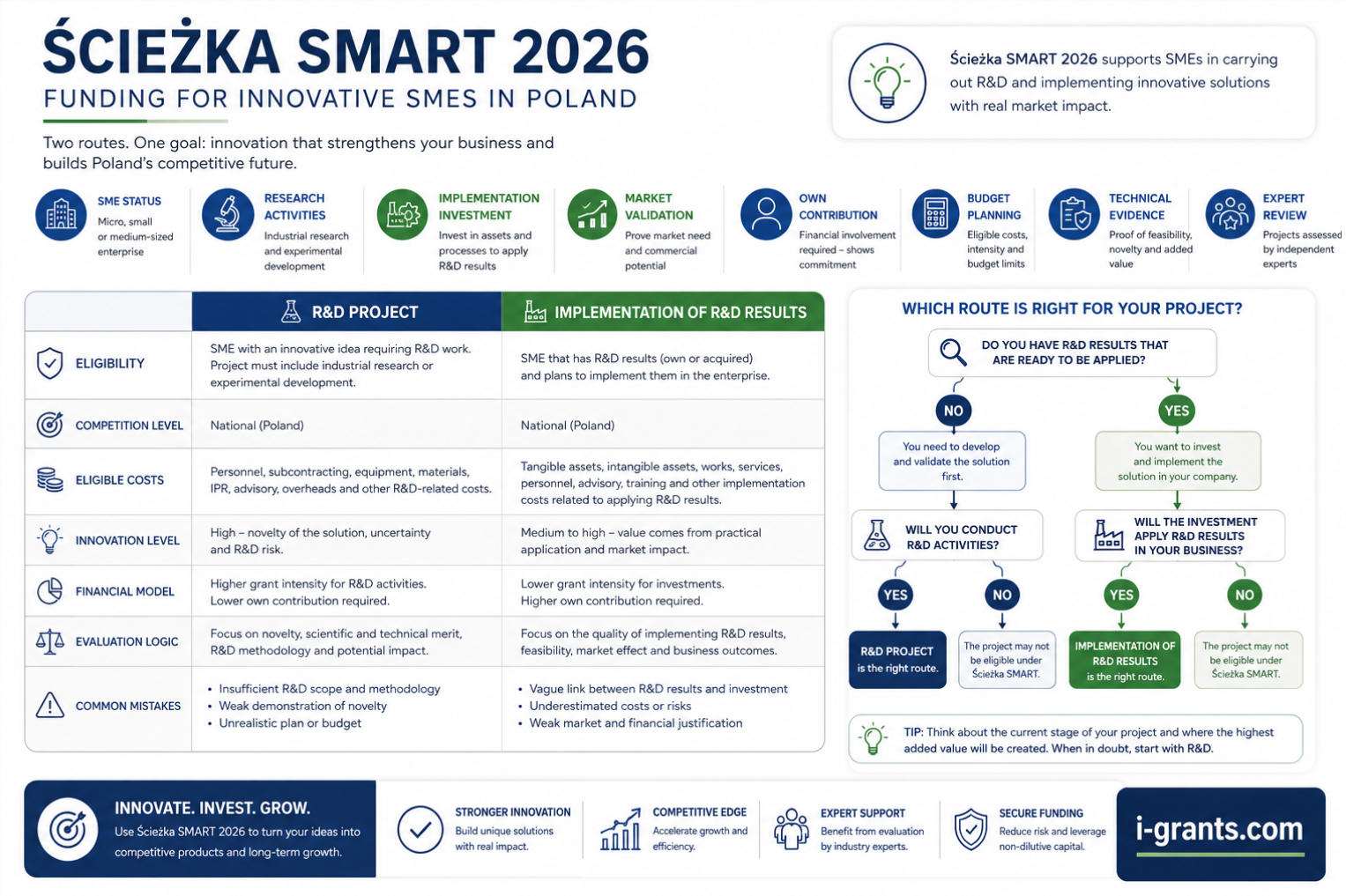
The key change in 2026 is the clearer separation between two project paths: R&D projects and implementation of R&D results. In previous editions, applicants worked with a broader modular structure. In 2026, the programme became more focused. A company must first decide whether it is still developing the innovation or whether it already has R&D results ready for implementation.
This distinction is not just technical. It affects the entire application strategy. If a company still needs to conduct industrial research or experimental development, it should build the application around R&D uncertainty, technical challenges, research tasks, validation, and expected results. If the company already has R&D results, it must prove that those results exist, that it has the right to use them, and that the planned investment will implement them in a commercially meaningful way.
Table 1. Ścieżka SMART 2026 routes for Polish SMEs
| Route | Best fit | Project logic | Main risk |
|---|---|---|---|
| R&D project | An SME that still needs to conduct industrial research or experimental development | Develop a new or significantly improved product, service, process, or technology | The project may look like routine engineering rather than genuine R&D |
| Implementation of R&D results | An SME that already has documented R&D results and wants to commercialise them | Invest in production, technology, equipment, intangible assets, skills, or market entry linked to R&D results | The applicant may fail to prove the quality, ownership, or commercial relevance of the R&D results |
| Poor fit for Ścieżka SMART | A company seeking ordinary equipment, working capital, standard expansion, or general marketing support | General business growth without a strong innovation and R&D basis | The application may fail mandatory criteria before it reaches full scoring |
The 2026 simplification should help companies choose the right path earlier. However, it also makes weak project logic more visible. A standard investment cannot easily be hidden inside a broader modular structure. A company must now explain clearly whether the project is about creating new knowledge and technology or implementing already developed R&D outcomes.
How competitive is Ścieżka SMART in 2026?
The competition level is high. In the 2026 R&D call, PARP received 566 applications for more than PLN 3.6 billion in funding. The call budget was PLN 700 million. After the first evaluation stage, 332 projects worth more than PLN 2.3 billion met the first-stage criteria. This means that even after an initial filter, the value of projects still significantly exceeded the available allocation.
The implementation call showed a similar pattern. Entrepreneurs submitted 297 applications for approximately PLN 2.8 billion in funding, while the allocation was PLN 700 million. This means that requested funding was almost four times higher than the available budget.
Table 2. Ścieżka SMART 2026 demand and competition signals
| Indicator | R&D projects call | Implementation of R&D results call |
|---|---|---|
| Call period | 26 February to 31 March 2026 | 14 May to 11 June 2026 |
| Call budget | PLN 700 million | PLN 700 million |
| Applications submitted | 566 | 297 |
| Funding requested | More than PLN 3.6 billion | Approximately PLN 2.8 billion |
| Demand compared with allocation | More than five times the budget | Almost four times the budget |
| Practical meaning for SMEs | A technically weak R&D project is unlikely to survive expert review | A weak link between R&D results and implementation can be fatal |
These numbers matter for applicants. They show that Ścieżka SMART is not a programme where formal eligibility is enough. A company may be an SME, operate in Poland, and submit all required documents, but still lose if the innovation case is weak, the financial model is not convincing, or the project does not clearly match the call logic.
Who can apply for Ścieżka SMART?
Ścieżka SMART is aimed at micro, small, and medium-sized enterprises conducting business activity in Poland. In the 2026 R&D call, PARP indicated that only micro, small, and medium-sized entrepreneurs operating in the territory of the Republic of Poland could apply. The implementation call was also addressed to SMEs, with the project location in Poland and potential territorial reach in Poland and abroad.
However, SME status is only the starting point. A credible applicant must also meet programme logic. The project should fit the objective of increasing research and innovation capacity. In the implementation route, the company must be able to connect the investment directly with the results of R&D work. In both routes, the innovation level is critical. Applicants should be prepared to show that the project brings product or process innovation at least at the national level.
A company should therefore ask more than “Are we an SME?” It should also ask whether it has a project that can survive technical, market, financial, and compliance evaluation.
What costs can Ścieżka SMART support?
Eligible costs depend on the route and the specific call documentation. In the R&D route, the project may include costs directly connected with research and development work. These can include research staff salaries, external services, advisory services, depreciation of research equipment, devices and buildings used for R&D, intangible assets, land-related costs, and supplies other than fixed assets. The minimum eligible cost value for R&D work was PLN 3 million, and the maximum was PLN 50 million.
In the implementation route, funding can support investment and complementary activities linked to commercialising R&D results. This can include purchase or leasing of real estate and land, construction works, machinery and equipment, intangible assets, advisory services, and expert services. Complementary tasks may also relate to internationalisation, industrial property protection, or competence development, provided they support the implementation logic.
Table 3. Evidence evaluators expect in a strong Ścieżka SMART application
| Evaluation area | Weak version | Strong version |
|---|---|---|
| Innovation | “Our product is modern and better for customers” | Specific comparison with solutions available on the Polish market, with measurable technical or user benefits |
| R&D logic | General product development work | Clear industrial research or experimental development tasks, technical uncertainty, methodology, and validation |
| R&D results | A broad statement that research was done | Documented results, ownership or legal access, technical parameters, and relevance for implementation |
| Market need | General market growth description | Defined target customers, pain points, competitors, pricing logic, and adoption barriers |
| Budget | Equipment list prepared before the project logic | Costs linked to work packages, eligible categories, quotations, procurement logic, and financing plan |
| Financial capacity | Assumption that the grant will solve financing | Own contribution, liquidity planning, repayment timing, financing sources, and realistic cash flow |
| Implementation capacity | Founder enthusiasm and general experience | Named team roles, external expertise, timeline, risk management, and operational readiness |
| Compliance | Application written after the business idea is fixed | Project designed around call rules, criteria, eligible costs, documents, and deadlines |
The budget should never look like a shopping list. Each cost must have a role in the project. If a machine is included, the application should explain why it is necessary for the R&D work or for implementing the R&D results. If advisory services are included, their role should be connected to the project’s technical, legal, market, or implementation needs. If competence development is included, the link with the innovation project should be visible.
The role of the financial model
One practical mistake is treating the financial model as a document to prepare later. In some 2026 procedures, the financial model and financing-source documents could be submitted at the second stage, after the first-stage results. This may create a false sense of comfort. In reality, a company that waits until the second stage to think about financial capacity can lose valuable time.
The financial model is not only an attachment. It is a test of whether the project makes business sense. It helps evaluators understand whether the applicant can finance its own contribution, manage liquidity, support the project during reimbursement cycles, and commercialise the results. A project with strong technology but weak finances may still be risky.
For SMEs, this is especially important because public grants rarely finance every cost at full intensity. The level of support depends on the type of cost, the form of aid, the company size, and the project location. For investment costs, regional aid rules can play a major role. For R&D work, different aid categories and cost types may apply. A responsible applicant should model several scenarios before submission, not after evaluation begins.
How to decide whether Ścieżka SMART is the right grant route
The best starting point is not the application form. It is a diagnostic review of the project. A company should first define the innovation claim, identify the project stage, check whether R&D is still needed, verify ownership or access to R&D results, test market relevance, and estimate the financing gap.
A project is a stronger fit for the R&D route when the company can describe technical uncertainty and a development process that goes beyond routine engineering. There should be a real question to solve, not just a known technology to buy. The application should explain why the work is experimental or research-based, what will be tested, what results are expected, and how success will be measured.
A project is a stronger fit for the implementation route when the company already has R&D results and can show how the planned investment will bring them to market. The key is the bridge between R&D and commercialisation. Evaluators need to see that the investment is not generic. It must be necessary to implement specific results and achieve a product or process innovation.
A company should be cautious if its project is mainly about replacing old equipment, increasing production capacity with standard technology, launching ordinary marketing activities, or financing general business growth. Such projects may be valuable for the business, but they may not be the right fit for Ścieżka SMART.
Application strategy for SMEs
A strong Ścieżka SMART application usually has one coherent storyline. The company identifies a real market problem, explains why current solutions are insufficient, presents a technically credible innovation, connects that innovation with R&D or R&D results, builds a budget around the work plan, and shows how the project will be financed and commercialised.
The application should be written for evaluators, not only for the company’s internal team. This means that claims need evidence. Technical advantages should be compared with existing market solutions. Market demand should be supported by specific customer segments and realistic adoption logic. Costs should be necessary, eligible, and proportionate. The timeline should reflect actual implementation capacity.
It is also important to prepare for expert questions. Ścieżka SMART evaluation can involve detailed technical and financial review. If the company cannot explain why the project is innovative at the national level, why the R&D results are credible, why each cost is needed, or how the company will finance implementation, the application is vulnerable.
Common mistakes in Ścieżka SMART applications
Many weak applications fail because they confuse innovation with modernisation. Buying new equipment may improve a company’s productivity, but that does not automatically make the project innovative. The application must explain what is new in the product or process and how it differs from solutions already available on the Polish market.
Another frequent problem is weak R&D evidence. A company may describe development work, but not prove research uncertainty, methodology, testing, validation, or results. For implementation projects, the opposite problem can appear: the applicant claims that R&D results exist, but does not sufficiently document their origin, ownership, quality, or readiness for commercial use.
Budget inconsistency is also a major risk. If the budget appears inflated, poorly linked to tasks, or built around desirable purchases rather than project needs, evaluators may question both eligibility and credibility. Financial weakness creates another risk. A company that cannot show own contribution, stable financing sources, or liquidity planning may struggle even if the innovation itself is promising.
When an SME should wait before applying
Not every SME should apply immediately. Waiting may be better if the company has not yet defined the innovation, lacks documentation of R&D results, cannot explain the national-level novelty, has no realistic financing plan, or still needs to clarify ownership of intellectual property.
Waiting does not mean abandoning the grant opportunity. It can mean preparing properly. The company can use the time to complete technical validation, collect market evidence, secure financing, obtain external expertise, prepare quotations, review eligible costs, and map the project against evaluation criteria.
For many SMEs, the most valuable work happens before submission. A well-prepared company may decide that Ścieżka SMART is the right opportunity. Another may discover that a regional programme, a smaller innovation voucher, a digitalisation grant, or a different EU funding route is more suitable. This diagnosis is not a failure. It is part of professional grant strategy.
Conclusion
Ścieżka SMART 2026 is a major funding opportunity for innovative Polish SMEs, especially those working on R&D projects or implementing documented R&D results. The 2026 structure makes the programme clearer by separating R&D from implementation. It also makes strategic fit more important. Companies need to choose the right route, prepare evidence early, and build the application around evaluation logic.
The programme is attractive, but highly competitive. The number and value of submitted applications show that SMEs are actively seeking this funding and that available budgets can be oversubscribed several times. This is why a successful application cannot rely on eligibility alone.
For Polish SMEs, the central question is not “Can we apply?” The better question is “Do we have an innovation project that can withstand expert evaluation?” If the answer is yes, Ścieżka SMART can support a significant step from research to market. If the answer is not yet, the smartest strategy may be to strengthen the project before entering the competition.