

 Français
  Deutsch
  Українська
A writer in Kyiv can draft a Horizon Europe proposal for a research institute in Portugal, funded by Brussels, on the same day a writer in Nairobi prepares a foundation application for an organization in Georgia. This is not a hypothetical. It is the ordinary shape of remote grant writing opportunities in 2026, and it is why this corner of freelance work has quietly become one of the most international careers a skilled writer can build.
The general question of where paid grant work lives is covered in our guide to grant writing opportunities. This article goes narrower and deeper into the part that has changed the most: remote grant writing opportunities that cross borders, connecting writers with international donors and the nonprofits, universities and startups chasing their money. The funding landscape shifted sharply over the past two years, and that shift created demand precisely where a multilingual, remote-first writer is best placed to meet it.
Why Remote Grant Writing Opportunities Are Booming
Grant writing was remote-friendly long before remote work was normal, because the job is research, writing and communication, all of which happen on a screen. What changed is the volume. Remote-first job boards now list these roles by the hundreds, and the pay has held up rather than eroded. As of mid-2026, the average salary for a remote grant writer in the United States sits around 66,000 dollars a year, with most earning between 52,000 and 73,500 dollars, while freelancers continue to charge 50 to 150 dollars an hour depending on expertise and complexity.
Those figures describe the domestic market, but the more interesting story is that geography has stopped being a gatekeeper. A remote grant writing opportunity posted by a nonprofit in Boston can be filled by a specialist anywhere, and increasingly is. The competition that once protected local writers has become global, which is bad news for the generalist and very good news for anyone with a genuine international specialization. The rest of this guide is about building that specialization.
Remote grant writing opportunities have turned a local profession into a global one. The writers who thrive are not the ones nearest the client, but the ones who understand the donor.
The 2026 Shift That Created the Demand
To understand why international remote grant writing opportunities multiplied, you have to look at what happened to the money. The old certainties of bilateral government aid came apart quickly. United States foreign aid spending fell from roughly 68 billion dollars in 2024 to about 32 billion in 2025, and the 2026 budget proposed a further 60 percent cut to global health funding alone. Estimates suggest up to 83 percent of formerly funded programs were affected by the closure of the largest bilateral agency, and by April 2025 at least 81 nonprofits had shut one or more offices.
Money did not simply vanish, though. It redistributed. Globally, 62 percent of official development assistance now flows directly to recipient governments or multilateral bodies, up from 48 percent in 2018, and private foundations have been pushed to the center of the sector. Foundations spent 12.5 billion dollars on development in 2023, and while that is substantial, analysts are blunt that philanthropy cannot fully replace withdrawn public money: global official development assistance still fell by around 15 billion dollars in 2024. Multilateral agencies feel the same squeeze, with UNICEF projecting its 2026 budget to drop by at least 20 percent against 2024.
For the organizations caught in this, the response is survival by diversification. A nonprofit that once relied on a single government donor now has to write applications to the European Union, to private foundations, and to multilateral funds at the same time, each with its own rules, formats and evaluation logic. That is a dramatic increase in the volume and complexity of proposals, and it lands directly on the desks of grant writers. The demand that fuels remote grant writing opportunities in 2026 is, in large part, the demand created by organizations learning to court many international donors at once.
Where the International Money Is: EU Programmes Worth Knowing
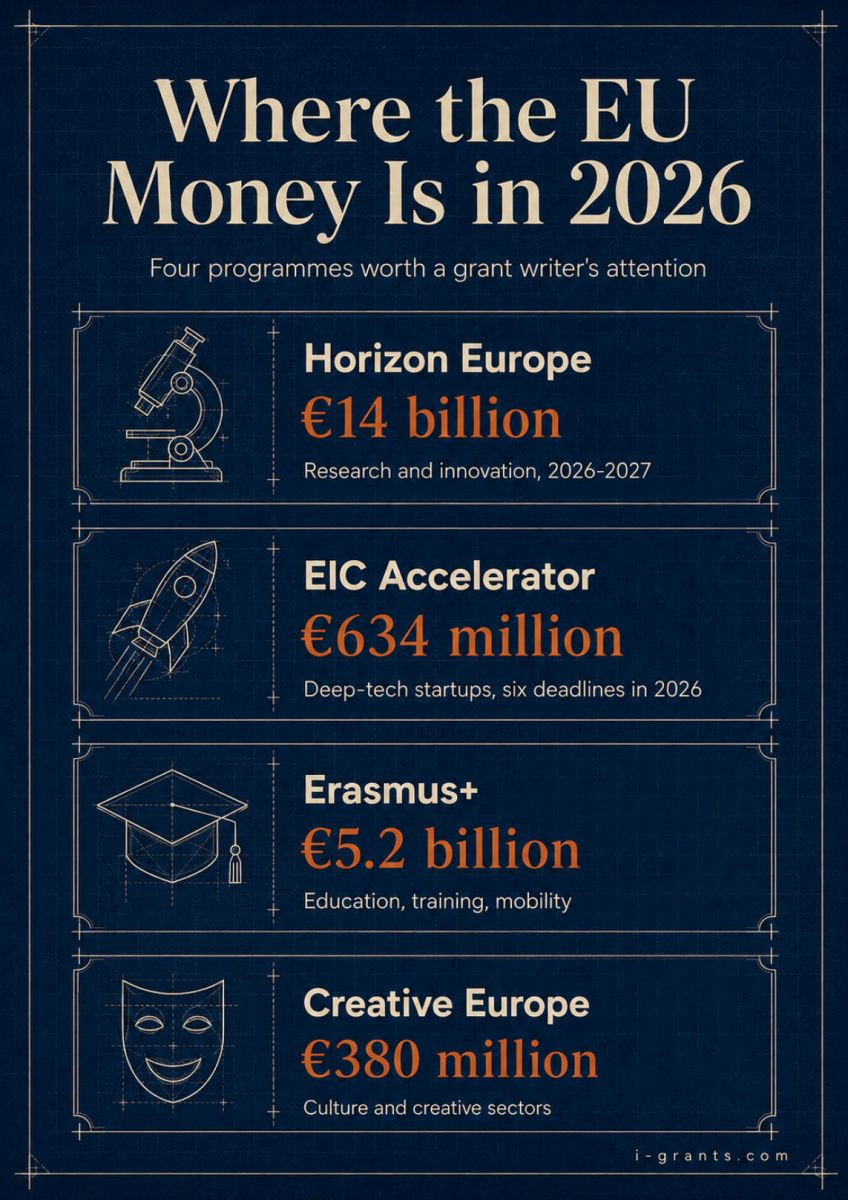
The single richest and most accessible source of international funding, and therefore of remote grant writing opportunities tied to it, is the European Union. Its programmes are large, published on a predictable calendar, open to consortia that often span several countries, and chronically in need of writers who understand how they are scored. A writer who learns two or three of these instruments well has a durable specialization that generalists cannot easily copy.
Table 1. Major EU Funding Programmes in 2026
| Programme | 2026 scale | What it funds | Application rhythm |
|---|---|---|---|
| Horizon Europe | €14 billion (2026-2027 work programme) | Research and innovation; universities, research institutes, SMEs in consortia | Cluster and mission calls staggered across the year |
| EIC Accelerator | €634 million | Deep-tech startups and SMEs (grant up to €2.5M plus equity up to €10M) | Six 2026 cut-offs: Jan, Mar, May, Jul, Sep, Nov |
| Erasmus+ | ~€5.2 billion | Education, training, youth and mobility; 100,000+ organisations | Annual call with sector deadlines |
| Creative Europe | €380 million | Culture and creative sectors; cross-border cooperation projects | European Cooperation Projects plus rolling calls |
Horizon Europe is the anchor. Its overall budget runs to 95.5 billion euros across 2021 to 2027, and the work programme adopted in December 2025 commits 14 billion euros for 2026 and 2027, with at least 35 percent directed to climate goals and a new 540 million euro horizontal call supporting the Clean Industrial Deal. Individual calls carry real money and firm deadlines: a culture and creativity call worth 298.5 million euros, a civil security call worth 129.5 million euros, and dozens of cluster topics besides. Proposals are written to fixed evaluation sections, Excellence, Impact and Implementation, which is exactly the kind of structured, learnable task a specialist writer can master.
For startups, the EIC Accelerator is the marquee instrument, with a 634 million euro budget in 2026 split between open and challenge calls. It offers up to 2.5 million euros in grant funding alongside equity of up to 10 million, and in 2026 it moved from two annual deadlines to six, opening far more windows for writers. The application is demanding in a way that rewards professionals: a 20 page proposal plus business plan, financials, a pitch deck, a three minute video and letters of intent. Its selectivity is the whole point of hiring help. In one recent round, only 61 companies were selected from the 121 that reached the interview stage, a reminder that organizations facing those odds will pay for a writer who improves them.
Education and culture round out the picture. Erasmus+ carries roughly 5.2 billion euros in 2026 and supports over 100,000 organisations, while Creative Europe runs a 380 million euro annual programme whose European Cooperation Projects call alone offered 60.27 million euros, funding up to 1 million euros per medium scale project at a 70 percent rate. These programmes require partnerships across multiple countries, which means someone has to coordinate and write for a consortium, and that someone is increasingly a remote specialist.
Beyond the EU: Global Foundations and Multilateral Donors
As bilateral aid retreated, private foundations became the funders that international nonprofits chase hardest, and the writers who know how these institutions think are in demand. Foundation applications are a different craft from EU proposals: shorter, more narrative, more focused on theory of change and measurable impact, and often gated behind an invited letter of inquiry. That difference is itself a specialization.
Table 2. Major International Foundations and What They Fund
| Funder | Primary focus | Recent scale |
|---|---|---|
| Gates Foundation | Global health, vaccines, agriculture | $5.47 billion in development spending (2023) |
| Wellcome Trust | Health and biomedical research | $887.7 million development (2023); £16 billion research pledged over the decade |
| Open Society Foundations | Rights, equity, justice, independent media | $590.3 million development (2023); new $300 million US commitment in 2026 |
| Ford Foundation | Inequality and social justice | One of the largest civil-rights and social-action funders |
| Mastercard Foundation | African youth employment | Young Africa Works: unlocking jobs for 30 million young people by 2030 |
The scale here is large but concentrated. The Gates Foundation alone spent 5.47 billion dollars on development projects in 2023, and its founder has committed to giving away roughly 200 billion dollars over a twenty year sunset, which means the pipeline of health, vaccine and agriculture proposals will not slow. Wellcome, primarily a health funder, directed 887.7 million dollars to development in 2023 and has pledged 16 billion pounds to research over the decade. Open Society Foundations put 590.3 million dollars into development in the same year and announced a fresh 300 million dollar commitment in 2026, with a focus on rights, justice and independent media that maps neatly onto the NGO and social project vertical.
Multilateral and regional funders matter too, and they route money differently. Because so much assistance now flows through governments and UN agencies rather than through NGOs directly, the writers who understand how to position an organization as an implementing partner, or to build the consortium that a multilateral will fund, hold a genuine advantage. The geography of the work follows the money: in 2023 the top recipients of foundation development spending were Kenya, India, Ethiopia, Nigeria and Ukraine, which is a fair map of where internationally focused remote grant writing opportunities cluster.
Where Remote Grant Writing Opportunities Actually Appear
Knowing where the money is does not tell you where the work is posted. International remote grant writing opportunities surface through channels that differ from the local job board, and a writer building an international pipeline should watch several at once.
Specialized grant platforms. Platforms built specifically to connect organizations with professional grant writers are the most direct route to cross-border work, because they carry the international context that a general marketplace lacks. This is the model behind i-grants (Grantologic), which matches writers to clients across EU grants, international foundations, government funding, research and the other verticals where donor knowledge is the differentiator. For a remote writer, the value is that the client already understands they need a specialist, not the cheapest bidder.
EU consortia and consultancies. Research institutes, SMEs and specialist consultancies across Europe recruit freelance proposal writers directly for Horizon Europe, EIC, Erasmus+ and similar instruments, often through LinkedIn and their own networks. These engagements reward writers who can coordinate a multi-partner consortium remotely and write to the evaluation criteria, and they tend to become repeat relationships because the programmes run on cycles.
Remote-first job boards. Boards such as FlexJobs, Indeed and Idealist list hundreds of remote grant writing roles, from contract gigs to salaried positions, and many international organizations recruit here specifically because they expect a distributed workforce. Filtering for remote and for the funders you specialize in turns a flood of listings into a shortlist.
Direct outreach to international nonprofits. Some of the most durable remote grant writing opportunities never reach a board at all. Organizations scrambling to replace lost bilateral funding often do not know how to recruit a writer who understands EU or foundation applications. A specialist who approaches them directly, with evidence of relevant donor knowledge, meets almost no competition.
How Cross-Border Grant Writing Actually Works
The romance of working with international donors runs into practical questions fast: how do you get paid across a border, what does the contract look like, and who handles the tax. None of this is difficult once you have done it once, but getting it wrong costs time and money, so it is worth setting up properly before the first international client.
Table 3. Getting Paid Across Borders in 2026
| Method | Cost and speed | Best for |
|---|---|---|
| Wise | ~0.4 percent to 1.5 percent fee, mid-market rate, 1 to 2 days | Multi-currency invoicing for EUR, USD and GBP clients |
| Payoneer | Low fees, 190+ countries, 22+ currencies | Marketplace payouts and recurring NGO clients |
| Deel and similar platforms | Bundles contracts and tax forms, 150+ countries | Ongoing contractor relationships needing compliance |
| Traditional SWIFT wire | $15 to $45 per transfer plus 2 percent to 4 percent FX markup, slower | Large one-off transfers only |
On payment, the practical rule is to avoid old-fashioned international wires for routine invoices. A SWIFT transfer can cost 15 to 45 dollars and add a 2 to 4 percent currency markup, whereas services like Wise and Payoneer settle in one to two business days at a fraction of that cost, with Wise fees typically running 0.4 to 1.5 percent at the mid-market rate. Holding a multi-currency balance also lets you invoice a Brussels client in euros and a US client in dollars without bleeding money on conversion each time.
On tax, working with United States clients introduces one recurring piece of paperwork. A US organization will usually ask an international contractor to complete a W-8BEN form, which establishes foreign status and, in most cases, prevents an automatic 30 percent withholding on your fee. It is a standard, one page form, not a trap, but a client cannot pay you cleanly without it. Reporting thresholds also apply on the client side, and a professional writer who can hand over the right form on day one signals exactly the reliability that turns a first project into a standing arrangement.
Set up your cross-border payment and tax basics before your first international client, not during. The writer who can invoice cleanly in the client's currency and hand over a W-8BEN without being asked looks like a professional, because they are one.
Two softer factors round out the practical picture. Time zones are a feature, not only a friction: a writer several hours ahead of a client can turn work around overnight, which clients value near a deadline. And contracts should be explicit about scope, currency, milestones and revision limits, because the misunderstandings that are annoying with a local client become expensive across a border and a language.
The Multilingual Edge
Everything above rewards specialization, and the sharpest specialization available to an international writer is language. European calls frequently expect English at a very high level, often C2, yet many of the organizations applying operate primarily in French, German, Ukrainian or another national language. A writer who can move between the donor's English and the applicant's own language occupies a narrow, well paid niche that monolingual competitors simply cannot enter.
The competitive logic is stark. Horizon Europe proposals succeed at an average rate of around 13 percent, so an organization facing five chances in six of rejection is highly motivated to hire a writer who improves its odds and can also work in its language. For anyone comfortable across the English, French, German and Ukrainian markets, cross-border and multilingual remote grant writing opportunities offer both higher rates and far thinner competition than the crowded English-only marketplace.
How to Evaluate a Remote International Grant Writing Opportunity
International work adds a few checks on top of the usual ones. Before committing to a cross-border project, run through these quickly, because a problem you would shrug off locally can become serious across a border.
- Donor fit. Confirm you actually understand the funder in question. Writing your first Horizon Europe proposal live on a paid deadline, with no prior exposure to the format, is a way to lose both the grant and the client.
- Eligibility across borders. Check that the organization is eligible for the international programme it is chasing, including any country, partnership or consortium requirements that EU and multilateral funders impose.
- Payment and currency. Agree the currency, the payment rail and the schedule in writing before starting, and never accept a percentage of the award, which international donors disallow and professional ethics prohibit.
- Realistic timeline. A complex EU or foundation proposal cannot be written well in a few days. An unrealistic deadline across time zones is a warning sign, not a lucrative rush.
- Access to information. Cross-border work makes access harder, so confirm you will reach the people, budgets and data the proposal needs, despite the distance.
These checks protect your time and your rate, and running them visibly also reassures an international client that they have hired a professional who has done this before.
Final Takeaway
The collapse of old aid certainties was painful for the organizations that depended on them, but it reshaped the market for writers in a specific direction. As money moved from a handful of bilateral donors toward the European Union, private foundations and multilateral funds, the work of chasing it became more international, more complex and more remote. That is the exact territory where remote grant writing opportunities now concentrate.
The path to claiming them is consistent. Learn two or three international donors deeply, whether that is Horizon Europe and the EIC, or the major health and rights foundations, until you can write to their formats from memory. Set up your cross-border payment and tax basics so working with a client in another country is routine. Lean on any language you have beyond English, because multilingual capacity is the rarest and best paid edge in this market. And treat every international project as the start of a relationship, since donor cycles repeat and reputation travels.
The broader map of paid work is in our companion guide to grant writing opportunities. But if you want the fastest growing, least crowded part of that map, it is here: remote grant writing opportunities that connect a skilled, multilingual writer with the international donors and nonprofits who need exactly what they can do.
i-grants (Grantologic) connects organizations that need funding with professional grant writers across EU grants, international foundations, government funding, research, sustainability, social projects, startups and the arts. Writers can create a professional profile and meet international clients who are already looking for specialist, remote help.