

 Français
  Deutsch
  Українська
For supermarket owners in Denmark, reducing energy consumption is no longer simply an environmental objective. Refrigeration, space heating, ventilation and lighting are significant operating expenses, and the interaction between these systems can determine whether a grocery store remains competitive as energy prices, equipment requirements and investment costs change.
A supermarket may operate refrigeration equipment continuously while purchasing additional energy to heat its sales floor. At the same time, refrigeration compressors release heat that could potentially replace part of that purchased heating. Older installations may also consume more electricity than modern alternatives, particularly where compressor control, condensation pressure management and heat recovery have not been optimised.
Denmark's Erhvervspuljen offers a potential financing route for businesses investing in measurable energy savings and carbon dioxide reductions. The programme is administered by the Danish Energy Agency, Energistyrelsen, and supports qualifying investments across several commercial sectors, including services.
Under the rules introduced in March 2026, certain projects undertaken by small enterprises can qualify for support of up to 60 percent of eligible costs. However, this maximum does not apply to every supermarket investment. Standard energy optimisation generally has a lower aid ceiling, while the final grant also depends on calculated energy savings, emissions reductions, eligible expenditure and other regulatory limitations.
Understanding these distinctions is essential. A technically successful refrigeration upgrade does not necessarily produce a large grant, and replacing old equipment is not automatically sufficient to establish eligibility.
This guide examines how Erhvervspuljen works for Danish supermarkets, which investments may qualify, how subsidies are calculated, and what grocery retailers should consider before committing to a modernisation project.
Erhvervspuljen: Denmark's Business Energy Grant Programme
Erhvervspuljen is a national investment support programme designed to encourage businesses to reduce final energy consumption and greenhouse gas emissions.
Unlike funding instruments limited to manufacturing or research and development, the programme can also support qualifying projects in commercial services. This makes it relevant to supermarkets, independent grocery retailers, convenience stores and other food retail businesses operating in Denmark.
Examples of investments covered by the programme's general framework include replacing gas boilers with heat pumps or district heating, improving energy-intensive process systems and recovering surplus heat for internal use.
For the 2026 budget year, Erhvervspuljen has a stated allocation of DKK 279 million. The Danish Energy Agency subsequently announced additional funding in September and October in response to strong demand. An additional DKK 35 million was allocated in October after the previous DKK 65 million increase had already attracted sufficient applications to absorb the available funding.
Applications are processed in the order received. Where demand exceeds available funds, applications may be placed in a queue and processed only if resources become available.
Under the published 2026 arrangements, the programme is scheduled to close no later than 30 November, although closure can occur earlier if the annual allocation is committed. Consequently, businesses should check the official application portal rather than treating the published closing date as a guarantee that funding remains available.
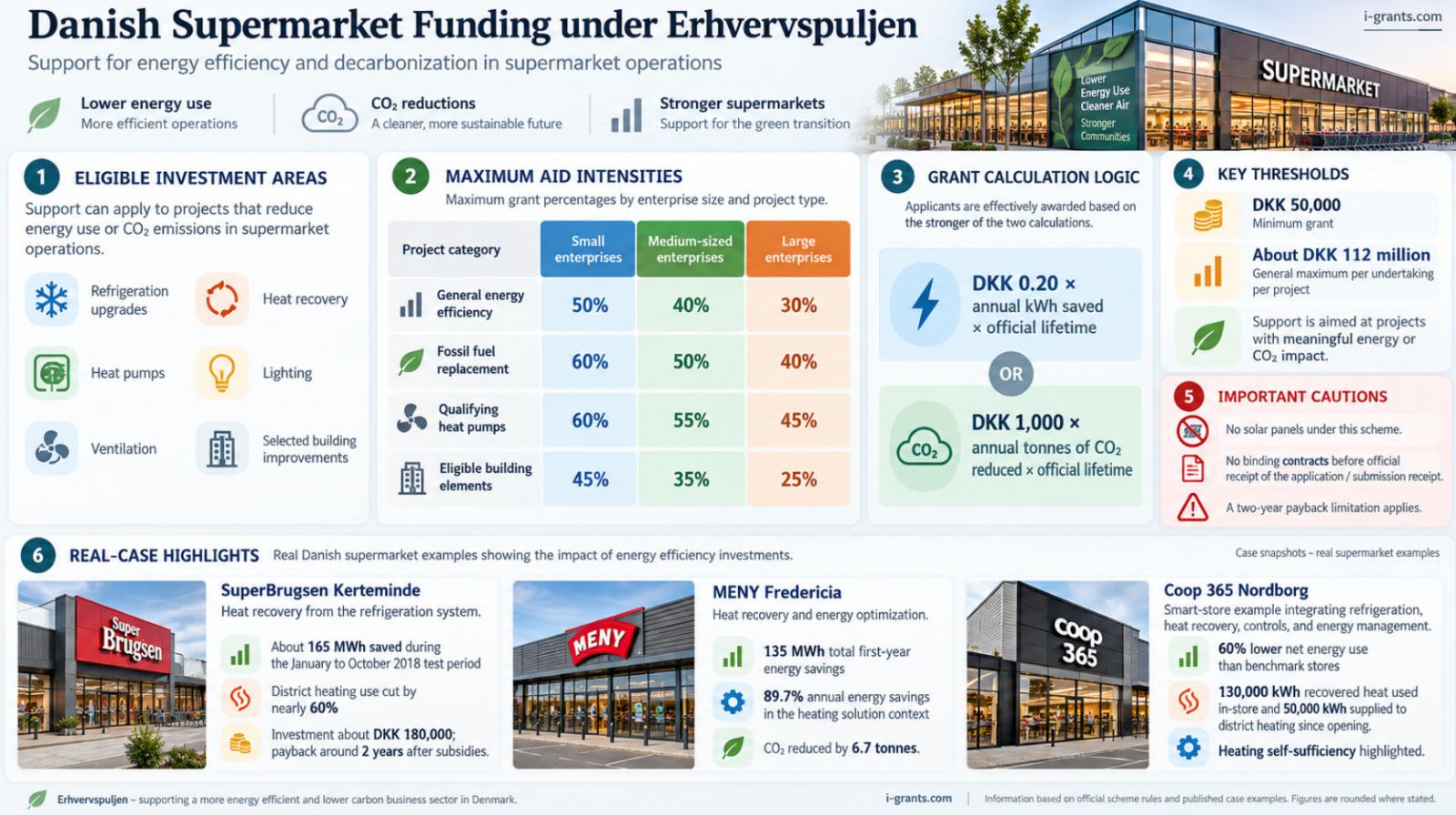
The programme's minimum grant is DKK 50,000, while its overall maximum is approximately DKK 112 million, equivalent to €15 million, per undertaking per project. These figures define the programme's general financial boundaries, not the amount that a typical supermarket can expect to receive.
The current funding framework is connected to Denmark's wider energy efficiency and decarbonisation policies. During 2022 to 2026, the programme has also been co-financed through the European Union's recovery framework.
For retailers planning investments beyond the current budget year, continuation and future funding allocations must be confirmed through subsequent official announcements. An existing programme framework should not be interpreted as a guarantee of funding in every future year.
Can Independent Supermarkets and Grocery Chains Apply?
A fundamental advantage of Erhvervspuljen is that eligibility is based on economic activity and qualifying energy investments rather than on belonging to a narrowly defined industry.
Independent supermarkets, grocery stores, cooperative retail businesses and companies operating multiple stores may therefore be suitable applicants.
However, eligibility depends on the legal and financial structure of the business, the location of the energy savings, and responsibility for the proposed investment.
The applicant must generally be the undertaking incurring the investment expenditure. This distinction is important where a retailer leases its premises, operates under a franchise arrangement or occupies property owned by another company.
A supermarket tenant financing replacement refrigeration equipment may have a different applicant position from a property owner investing in the building's heating infrastructure. Where the project relates to energy consumption in a property, the specific rules concerning ownership and tenant energy use must also be examined.
Enterprise size determines the maximum permitted subsidy rate.
European Union SME definitions distinguish micro, small and medium-sized enterprises using staff numbers, annual turnover and balance sheet totals. Microenterprises have fewer than ten employees and no more than €2 million in annual turnover or balance sheet total. Small enterprises have fewer than 50 employees and a financial threshold of €10 million. Medium-sized enterprises have fewer than 250 employees and annual turnover of no more than €50 million or a balance sheet total of no more than €43 million.
For the relevant Erhvervspuljen aid ceilings, microenterprises fall within the small-enterprise category.
A grocery shop employing only 20 people is not necessarily a small enterprise for grant purposes. If it belongs to a larger corporate group, the financial and employment figures of linked and partner enterprises may need to be included.
This is particularly important for franchise systems, cooperative structures and national supermarket chains. The commercial brand displayed above the entrance does not establish the business's size category. Ownership, control and the applicable enterprise-linkage rules are decisive.
There is no general rule that excludes all large supermarket chains. Large undertakings may qualify, but they normally face lower maximum aid intensities.
How Much Funding Can a Danish Supermarket Receive?
The most important financial distinction is between the programme's maximum aid intensity and the amount calculated for an individual project.
The revised Erhvervspuljen framework introduced different subsidy ceilings for energy optimisation, fossil-fuel conversion, heat pump projects and building improvements.
Table 1. Maximum Erhvervspuljen Aid Intensities by Project Type and Enterprise Size
| Investment category | Small enterprises | Medium-sized enterprises | Large enterprises |
|---|---|---|---|
| General energy optimisation | 50 percent | 40 percent | 30 percent |
| Conversion away from fossil fuels | 60 percent | 50 percent | 40 percent |
| Qualifying heat pumps using natural heat sources, with SCOP of at least 2.3 | 60 percent | 55 percent | 45 percent |
| Installation of supplementary components in existing equipment | 50 percent | 40 percent | 30 percent |
| Installation or replacement of building elements | 45 percent | 35 percent | 25 percent |
Note: Other heat pump projects have separate aid ceilings depending on the energy source and the type of energy consumption being replaced. All figures represent maximum percentages of eligible costs, not guaranteed grant rates.
This distinction substantially changes how supermarket investment projects should be presented.
A small grocery retailer replacing an inefficient refrigeration installation would generally need to examine the rules for energy optimisation. The maximum aid intensity under that category is 50 percent.
A project replacing fossil-fuel heating with a qualifying non-fossil solution may fall within a category with a maximum rate of 60 percent for small enterprises.
A qualifying heat pump extracting heat from air, water or ground and meeting the specified seasonal performance requirement may also benefit from the applicable heat pump ceiling.
Nevertheless, reaching the maximum percentage depends on the calculation of actual eligible support. A project can qualify for a category with a 60 percent ceiling while receiving considerably less than 60 percent of its eligible investment.
For a medium-sized or large supermarket, the permitted ceiling may be substantially lower.
Retailers should therefore avoid preparing financial forecasts around the maximum published percentage without first calculating the expected eligible grant.
The Grant Calculation: Energy Savings Matter More Than Equipment Prices
Erhvervspuljen is not a conventional reimbursement scheme in which every qualifying business automatically receives a fixed percentage of its investment.
The programme uses standard calculation mechanisms linked to energy savings and carbon dioxide reductions.
The principal calculation rates are:
-
DKK 0.20 for each kWh of annual energy savings, multiplied by the prescribed lifetime of the measure.
-
DKK 1,000 for each tonne of annual carbon dioxide reduction, multiplied by the prescribed lifetime of the measure.
The calculation mechanism selects the higher preliminary support amount.
For certain qualifying conversions from fossil fuels to alternative energy sources, an additional factor of 1.25 can apply.
However, the resulting amount is subsequently subject to other limits, including the maximum permitted aid intensity, eligible cost calculations and payback-related restrictions.
The lifetime used in the calculation is not necessarily the manufacturer's expected physical lifetime of the equipment.
Instead, the programme applies prescribed lifetime categories. Optimisation of control and regulation systems may have a four-year calculation period, while improvements to certain installations may use eight years and the replacement of installations may use ten years. Building envelope improvements can have a longer prescribed period.
A supermarket cannot simply claim that a refrigeration system will operate for 20 years and automatically use that period to multiply its annual savings.
The correct classification must be established under the programme's official methodology.
Why the Calculation Can Produce Less Funding Than Expected
Consider a hypothetical supermarket proposing a refrigeration control upgrade expected to save 40,000 kWh annually.
If the measure falls within a four-year calculation category, the energy-based calculation would produce:
40,000 kWh × DKK 0.20 × 4 years = DKK 32,000.
This amount is below the general minimum grant threshold of DKK 50,000. The project would therefore not independently satisfy the minimum grant requirement on the basis of this energy calculation alone.
The example does not determine the project's final legal position. Carbon dioxide calculations, qualifying project combinations and other applicable rules would need to be examined.
It illustrates why relatively inexpensive energy-saving improvements do not automatically become viable grant projects.
Conversely, a more expensive investment does not necessarily result in a proportionally higher subsidy.
A refrigeration modernisation costing DKK 1 million cannot simply be multiplied by 50 percent to establish a DKK 500,000 grant. The energy and emissions calculations must first support the requested amount, and eligible expenditure may differ from the full purchase price.
The Two-Year Payback Restriction
Another important limitation concerns investment profitability.
Erhvervspuljen restricts support where the subsidy would reduce the calculated payback period below two years.
For supermarkets, this can be significant because certain refrigeration and heat recovery investments already have attractive commercial payback periods without public support.
An investment with substantial annual savings may therefore receive less financial assistance than a retailer initially expects.
In some circumstances, the payback restriction can eliminate an otherwise calculated grant.
The practical lesson is that applicants should evaluate the project's profitability both before and after the proposed subsidy.
Eligible Costs Are Not Always the Full Replacement Cost
The revised rules also distinguish between types of investment and the methods used to calculate eligible expenditure.
For certain projects replacing existing equipment, the calculation may involve the present value of future maintenance, repair and replacement costs associated with the existing installation.
The relevant methodology can involve a 25-year calculation period and an 8 percent discount rate.
Consequently, the amount considered eligible for support may be different from the total invoice for a new refrigeration system.
For a retailer comparing several technical solutions, understanding this methodology can be just as important as obtaining competitive supplier prices.
Refrigeration Grants: Which Supermarket Investments May Qualify?
Refrigeration is an especially relevant investment area because supermarkets must maintain food safety while operating cooling and freezing equipment throughout the year.
Older refrigeration systems can create avoidable electricity consumption through inefficient compressors, poor controls, excessive condensing pressures, outdated display equipment and inadequate heat recovery.
Modernisation can address several of these weaknesses simultaneously.
However, Erhvervspuljen finances qualifying reductions in energy consumption and emissions, not the simple purchase of any refrigeration product labelled energy-efficient.
Table 2. Potential Erhvervspuljen Investments in Supermarket Refrigeration and Building Systems
| Proposed investment | Potential funding treatment | Important qualification |
|---|---|---|
| Replacement of an inefficient refrigeration system | Potentially eligible energy optimisation | Measurable savings and eligible replacement costs must be demonstrated |
| Modern CO₂ refrigeration equipment | Potentially eligible | Refrigerant choice alone does not establish grant eligibility |
| Energy-efficient compressors | Potentially eligible | Must form part of a qualifying investment |
| Electronic expansion valves and advanced pressure controls | Potentially eligible | Savings and investment classification must be documented |
| Floating condensing pressure optimisation | Potentially eligible | Requires a credible technical energy calculation |
| Refrigeration monitoring and automatic controls | Potentially eligible | Ordinary monitoring without qualifying investment savings is insufficient |
| Refrigerated display cabinets and freezer units | Requires project-specific assessment | Replacement and equipment classification matter |
| Doors and covers for display refrigeration | Requires project-specific assessment | The measure must satisfy applicable equipment and energy-saving requirements |
| Internal heat recovery | Potentially eligible | Only qualifying internal savings may be counted |
| Replacement of fossil-fuel heating with a heat pump | Recognised funding route | Heat pump category and performance determine the relevant ceiling |
| Efficient ventilation, fans and pumps | Potentially eligible | Demonstrable energy savings are necessary |
| Lighting improvements | Recognised calculation category | Applicable standard methodology must be followed |
| Insulation, windows and other building envelope elements | Potentially eligible | Building-related rules and lower aid ceilings may apply |
| Solar photovoltaic panels | Not eligible under Erhvervspuljen | Electricity generation is not supported through this route |
| Ordinary supermarket refurbishment | Not eligible as such | Cosmetic upgrades and unrelated retail improvements are not energy-saving measures |
Note: Potential eligibility does not mean that every individual component or project is automatically approved.
Replacing Conventional Refrigeration with CO₂ Systems
Carbon dioxide refrigeration technology has become an important part of modern food retail engineering.
These systems use CO₂ as a refrigerant and can be designed to combine efficient refrigeration with heat recovery, compressor optimisation and integrated control.
For a Danish supermarket, such a system may provide operational advantages, particularly when replacing inefficient equipment and improving the interaction between refrigeration and heating.
From a grant perspective, the business must demonstrate the eligible improvement relative to the relevant baseline.
A project justified solely by the need to replace equipment that has reached the end of its service life may require a different assessment from a project introducing measurable efficiency improvements beyond ordinary replacement.
Likewise, replacing a refrigerant primarily to satisfy an existing regulatory obligation should not automatically be presented as an eligible investment.
Applicants should establish what the existing system consumes, which performance improvements are technically achievable, and which costs qualify under the programme's rules.
Supplier calculations should reflect realistic annual operating conditions, including the changing cooling demand during different seasons.
Compressors, Controls and Refrigeration Optimisation
A complete system replacement is not always necessary.
Some supermarkets may be able to improve performance through new compressors, variable-speed operation, advanced control equipment or optimisation of condensation pressures.
Electronic expansion valves, sensors and automated monitoring may also contribute to reduced electricity consumption when appropriately integrated.
However, the funding case must concern a qualifying investment, not ordinary maintenance or routine adjustment of existing equipment.
For example, a supermarket replacing worn control components with equivalent equipment cannot simply claim the full replacement expenditure as an energy efficiency investment without demonstrating a meaningful eligible improvement.
For larger installations, detailed energy modelling may be needed to separate the contribution of each measure.
A further consideration is whether several improvements overlap. The same electricity savings cannot be claimed independently under multiple components if they arise from a single combined technical effect.
Heat Recovery: Turning Refrigeration Waste Heat into Useful Energy
Heat recovery is one of the most commercially interesting opportunities for Danish supermarkets.
A refrigeration system removes heat from refrigerated products and display areas. That heat must then be rejected elsewhere.
Where suitable technical conditions exist, part of it can be recovered and used for space heating, domestic hot water or other internal thermal requirements.
The approach can reduce the amount of heat purchased from a gas boiler, district heating network or another heating source.
It can also change the economics of refrigeration system replacement by creating value from energy that would otherwise be discarded.
For grant applicants, the most important distinction is between internal heat recovery and heat supplied outside the undertaking.
Erhvervspuljen generally supports qualifying energy savings in the applicant's own final energy consumption.
If a supermarket recovers heat and uses it to warm the sales floor, that internal reduction in purchased heating may form part of the eligible savings calculation.
If the same supermarket exports surplus heat to a district heating company, the externally supplied portion cannot simply be included as additional internal energy savings under Erhvervspuljen.
Where a system supports both internal heat recovery and external heat delivery, the relevant costs and energy effects must be allocated appropriately.
This does not mean that exporting surplus heat is technically undesirable. It means that commercial heat sales and grant-eligible internal savings are different matters.
For some supermarket projects, separating these two functions at the planning stage can make the application more accurate and prevent later disputes about eligible expenditure.
The specific classification of the heat recovery investment also matters. Internal recovery from a process installation may be treated differently from recovery associated with systems providing comfort heating or ventilation.
Therefore, the maximum aid ceiling for heat recovery should not automatically be assumed to be 60 percent.
Heat Pumps and the Replacement of Fossil-Fuel Heating
A supermarket may also qualify for Erhvervspuljen support by replacing fossil-fuel heating with a lower-emission alternative.
The programme explicitly recognises projects involving replacement of gas boilers with heat pumps or district heating.
For a small enterprise, qualifying fossil-fuel conversion projects can benefit from a maximum aid ceiling of 60 percent.
Heat pump projects using natural heat sources and meeting the specified seasonal performance requirement may have their own maximum aid intensities, reaching 60 percent for small enterprises, 55 percent for medium-sized enterprises and 45 percent for large enterprises.
Other heat pump projects require separate classification. In particular, the rate can differ depending on whether the system replaces fossil-fuel consumption or other energy sources.
This distinction is particularly relevant where a supermarket intends to use waste heat from refrigeration as the source for a heat pump.
The project must be assessed according to the relevant technical and legal definitions rather than automatically being assigned the maximum rate for an air-source, water-source or ground-source heat pump.
A retailer replacing its gas boiler should also consider the expected heating demand after implementing refrigeration heat recovery.
If heat recovery will already supply a large proportion of the store's heating requirements, the proposed heat pump may need a smaller capacity than originally planned.
Correct sequencing can reduce both capital expenditure and the risk of overstating future energy savings.
Ventilation, Lighting and Building Improvements
Although refrigeration is the central investment opportunity, it is rarely the only source of avoidable energy consumption in a supermarket.
Ventilation systems may operate for extended periods with inefficient fans or poorly coordinated controls. Lighting installations may also be outdated, especially in stores that have not undergone substantial energy modernisation.
Other opportunities can include heating distribution pumps, building management systems, insulation and selected building envelope improvements.
The treatment of these measures differs.
Lighting projects have recognised calculation methodologies, while building envelope improvements fall under categories with different maximum aid ceilings from standard energy optimisation.
For example, small enterprises can have a maximum aid intensity of 45 percent for relevant building element projects, compared with 50 percent for general energy optimisation.
A retailer considering new windows, insulation or external doors must also determine whether the investment is an energy-saving measure, a maintenance obligation or an ordinary building refurbishment.
The fact that a new building component has better thermal characteristics is not always sufficient to establish eligibility for the full replacement cost.
Energy monitoring equipment likewise requires careful assessment. Software, sensors or a building management system may contribute to measurable savings, but general digitalisation expenditure should not automatically be included.
Solar photovoltaic installations deserve particular attention. Erhvervspuljen explicitly excludes solar panels.
A supermarket may reasonably choose to install rooftop solar alongside refrigeration and heating improvements, but solar electricity generation should be financed separately and not represented as a standard eligible cost under this programme.
Standalone battery storage should also not be assumed eligible merely because it is connected to a wider energy project.
Real Danish Supermarket Cases: What the Energy Savings Look Like
The commercial value of supermarket energy modernisation is demonstrated by several Danish projects.
These cases help explain technical feasibility and achievable operational results. However, they should not automatically be treated as examples of Erhvervspuljen beneficiaries.
A distinction between an energy-efficient project and a documented programme recipient is essential.
SuperBrugsen Kerteminde: Recovering Heat from Refrigeration
SuperBrugsen in Kerteminde provides an instructive example of how recovered refrigeration heat can reduce purchased heating.
The supermarket, covering approximately 3,500 square metres, implemented a heat recovery solution that used surplus energy from its refrigeration system.
The project also demonstrated how recovered heat could be integrated with the wider district heating infrastructure.
According to the published technical case, the store's heating consumption during the January to October comparison period declined from approximately 290 MWh to 125 MWh.
That represents a reduction of about 165 MWh over the reported period, equivalent to approximately 57 percent of the baseline figure.
The reported investment was approximately DKK 180,000, with a payback period of about two years after taking an energy subsidy into account.
The example is particularly relevant for grocery retailers because it demonstrates that heat recovery can produce economic value without completely rebuilding a store.
Nevertheless, this project was documented in 2018 and should not be described as having received support from the later Erhvervspuljen framework.
Its relevance lies in the technology, measured performance and business economics.
MENY Fredericia: Heat Recovery and Control Optimisation
Another example comes from the MENY supermarket in Fredericia.
The store, covering approximately 1,900 square metres, introduced a Danfoss heat recovery solution connected to its CO₂ refrigeration system.
The recovered heat was used to support space heating and domestic hot water needs.
During the first year, the supermarket achieved reported energy savings of 135 MWh.
Of that total, 56 MWh was attributed directly to the heat recovery unit, while another 79 MWh was associated with the EnergyTrim optimisation service.
The project also produced a reported reduction of 6.7 tonnes of carbon dioxide emissions.
The supplier reported an 89.7 percent reduction in the store's external heating requirement. This should not be confused with an 89.7 percent reduction in the entire supermarket's energy consumption.
The commercial lesson is that integrated optimisation may deliver benefits beyond the performance of one newly installed component.
For grant applications, however, improvements arising from different measures must be documented according to the programme's applicable calculation rules.
The available case material does not establish that the MENY installation received Erhvervspuljen funding.
Coop 365 in Nordborg: The Integrated Smart Store
The Coop 365 Smart Store in Nordborg demonstrates a more comprehensive approach.
Developed with Danfoss, the supermarket combines efficient refrigeration, heat recovery, electronic controls, sensors, energy management and renewable electricity generation.
In its September 2026 update, Danfoss reported that the store had achieved approximately 60 percent lower net energy use than the selected reference stores.
Since opening, it had used approximately 130,000 kWh of recovered heat internally and supplied another 50,000 kWh to the local district heating network.
The distinction between these two heat streams is particularly relevant to Erhvervspuljen.
The internally recovered heat illustrates a potential route to reduce purchased heating, while the externally supplied heat demonstrates an additional commercial or energy-system function that should not automatically be counted as eligible internal savings.
The store also includes solar generation, which forms part of its overall energy strategy but is not eligible for direct support through Erhvervspuljen.
The case demonstrates how multiple technologies can work together. It does not establish that every component received the same grant or that the project as a whole was financed through Erhvervspuljen.
Table 3. Real Supermarket Energy Efficiency Cases in Denmark
| Supermarket | Modernisation focus | Reported results | Important funding distinction |
|---|---|---|---|
| SuperBrugsen Kerteminde | Refrigeration heat recovery and heating integration | Approximately 165 MWh less heating consumption in the reported ten-month comparison period | Historical technical case, not an Erhvervspuljen beneficiary case |
| MENY Fredericia | CO₂ refrigeration heat recovery and operational optimisation | 135 MWh annual energy savings and 6.7 tonnes less CO₂ | Erhvervspuljen funding not established |
| Coop 365 Smart Store, Nordborg | Integrated refrigeration, heat recovery, controls and renewable energy | Approximately 60 percent lower net energy use against selected reference stores | Integrated demonstration, not evidence that all components qualify for grants |
Note: The cases use different baselines, measurement periods and technical scopes. Their results are not directly comparable and should not be treated as guaranteed savings for another supermarket.
How Significant Is Erhvervspuljen in Denmark?
The programme is not merely a small pilot initiative.
According to the Danish Energy Agency's 2025 status report, Erhvervspuljen received 445 applications during that year, requesting approximately DKK 250 million in support.
A total of 368 projects received positive grant decisions, representing approximately DKK 225.9 million in approved support.
The expected annual energy savings associated with those approved projects amounted to approximately 191 GWh, alongside expected annual carbon dioxide reductions of 54,607 tonnes.
These figures describe the expected outcomes of approved projects rather than completed, independently verified savings.
By 12 August 2026, the programme had recorded 1,631 completed projects with grant payments across its operating period, with approximately DKK 408 million disbursed.
The reported annual energy savings associated with completed projects amounted to approximately 688 GWh, while reported carbon dioxide reductions reached 180,018 tonnes annually.
These programme-wide results demonstrate substantial activity, but they should not be interpreted as supermarket-specific statistics.
In the 2025 application data, small enterprises represented the largest category by number of submissions, with 239 applications. Medium-sized businesses accounted for 62, while large companies submitted 144.
This distribution indicates that the programme is used by both SMEs and larger undertakings.
For supermarket applicants, it also illustrates the importance of preparing complete documentation and applying while funding remains available.
When Can a Supermarket Start Its Investment?
One of the most consequential Erhvervspuljen rules concerns the start of the investment.
The project must not begin before the Danish Energy Agency has acknowledged receipt of the application.
This does not necessarily mean that the company must wait for the final grant approval.
Once the official application receipt has been issued, the applicant can generally begin implementing the project, but does so entirely at its own financial risk.
If the application is subsequently rejected, the company remains responsible for its expenditure.
Before receiving the official acknowledgement, the applicant must not undertake irreversible investment commitments.
This includes signing binding equipment purchase contracts or beginning physical construction, installation or dismantling activities associated with the project.
A contract conditional upon receiving a grant may still be regarded as an irreversible commitment under the programme's rules.
An agreement for district heating connection can also constitute project commencement.
By contrast, preliminary technical planning, energy calculations, supplier discussions and preparation of quotations can generally take place before the application, provided they do not create an irreversible investment obligation.
For a supermarket, the difference is highly practical.
Requesting a quotation for refrigeration compressors is not the same as signing a binding contract for their delivery. Preparing an engineering drawing is not the same as beginning the dismantling of the existing refrigeration plant.
Businesses with urgent maintenance requirements should be especially careful. A breakdown requiring immediate replacement may create a conflict with the programme's project-start conditions.
Where the commercial risk of waiting is unacceptable, the business must decide whether proceeding without grant certainty is financially viable.
Preparing a Strong Erhvervspuljen Application
A successful application begins with a credible technical baseline rather than a supplier's headline savings estimate.
The business should establish its existing electricity, gas and heating consumption and identify which systems are responsible for the relevant energy use.
For supermarkets, historical consumption should be interpreted alongside store opening hours, refrigeration loads, heating demand, seasonal operating conditions and equipment performance.
The official guidance generally requires evidence that the relevant existing installation has been in operation, including energy consumption documentation covering the preceding 12 months where applicable.
The future system must then be modelled using the appropriate methodology.
For some categories, mandatory standard calculation tools apply. For other measures, applicants may need detailed engineering calculations and the programme's prescribed assumptions.
The investment budget must distinguish directly related eligible expenditure from unrelated refurbishment costs.
Consultancy expenses connected with developing and documenting the energy project can be eligible when they meet the programme's conditions. This makes professional energy assessments and application preparation relevant parts of project planning.
Table 4. Practical Application Roadmap for Danish Supermarkets
| Stage | Required preparation | Main risk to avoid |
|---|---|---|
| Establish the baseline | Collect energy bills, equipment specifications and operating information | Using unsupported or unrepresentative consumption estimates |
| Define the investment | Identify refrigeration, heating and other improvements | Including ordinary refurbishment as eligible expenditure |
| Model the savings | Calculate future energy consumption and emissions | Counting the same savings more than once |
| Classify the applicant | Assess enterprise size, ownership and linked undertakings | Incorrectly claiming small-enterprise status |
| Calculate the potential grant | Apply official calculation rates, lifetime categories and aid ceilings | Assuming the maximum percentage applies to total investment |
| Prepare the documents | Complete project budget, technical evidence and required standard forms | Missing mandatory calculations or declarations |
| Submit the application | Use the official portal and retain the acknowledgement | Signing binding contracts before acknowledgement |
| Implement the project | Follow the approved scope and maintain records | Making material changes without addressing approval requirements |
| Request payment | Submit invoices, evidence of payment and completion documentation | Missing the payment deadline or documentation requirements |
Note: Additional declarations, procurement requirements, financial evidence or technical documentation may apply to particular applicants and project structures.
What Documents Should Be Prepared?
A supermarket planning a substantial refrigeration or heating investment should prepare a coherent documentation package.
This may include company and registration information, enterprise-size declarations, historical energy bills, information about existing equipment, technical calculations, supplier quotations, a detailed investment budget, implementation dates and financing arrangements.
A company acting through a consultant may require an appropriate authorisation.
Some projects also require mandatory calculation templates, leasing documentation or specialised eligible-cost calculations.
Businesses should not assume that every Erhvervspuljen application requires precisely three supplier quotations. The applicable rules depend on the project and any relevant procurement obligations.
Likewise, financial statements, permits and other supporting materials may be required according to the applicant's circumstances and project structure rather than through a universal checklist.
The strongest approach is to match every significant budget item with its technical purpose and the expected energy-saving effect.
A refrigeration system quotation should make it possible to distinguish the proposed equipment, installation work and associated controls from ordinary maintenance or unrelated construction.
VAT, Leasing and Financing the Investment
Erhvervspuljen should be treated primarily as investment support rather than an advance payment covering the retailer's initial expenditure.
Businesses must plan how the project will be financed until the relevant subsidy can be paid.
Recoverable VAT should not be treated as an eligible cost merely because it appears on a supplier invoice.
For a typical VAT-registered retailer entitled to recover input VAT, the relevant investment calculation should generally exclude that recoverable amount.
Where an applicant cannot recover certain VAT expenditure, its treatment must be assessed under the applicable programme rules.
Bank financing may help provide the capital required to implement a project.
Leasing and credit purchase arrangements are also addressed in the Erhvervspuljen guidance, but special calculation and payment rules can apply.
Consequently, a retailer should not assume that a leased refrigeration installation receives identical treatment to an outright purchase.
The business must also satisfy applicable state-aid conditions, including rules concerning undertakings in difficulty and any outstanding recovery obligations relating to unlawful state aid.
Importantly, Erhvervspuljen is not generally subject to a universal €300,000 de minimis limit. The programme operates within the relevant state-aid framework, including applicable provisions of the General Block Exemption Regulation.
The €300,000 de minimis threshold is relevant where financial assistance is specifically awarded under that legal basis, but it should not be confused with the overall Erhvervspuljen maximum.
Applicants must also avoid receiving incompatible public funding for the same investment costs.
If a supermarket finances solar panels through another programme while using Erhvervspuljen for a separately eligible heat recovery system, the projects should be clearly separated and assessed under the respective funding conditions.
A single invoice or energy-saving measure should not be used to claim incompatible assistance twice.
When Is the Grant Paid?
In the ordinary investment model, the supermarket completes its project and subsequently requests payment of the approved grant.
The programme generally allows a maximum implementation period of two years following the grant decision.
The payment request must be submitted no later than three months after project completion.
The applicant must demonstrate that the investment was implemented in accordance with the relevant conditions and provide the required documentation of actual expenditure.
This can include invoices, payment records, technical evidence, completion information and the necessary declarations.
Projects receiving larger grants are subject to additional audit requirements. Under the published guidance, grants of DKK 500,000 or more trigger specific auditor documentation requirements.
Smaller projects may use the relevant invoice and payment documentation procedures, subject to the applicable rules.
Special instalment payment arrangements can exist for qualifying leasing or credit purchase projects.
Approved payments are transferred through the company's NemKonto.
Where a project is delayed or its technical scope changes, the company should contact the Danish Energy Agency and seek the appropriate amendment or extension.
A changed refrigeration design, heat pump capacity or investment budget should not simply be treated as equivalent to the originally approved project without checking the consequences.
Practical Investment Example: Modernising an Independent Danish Supermarket
Consider a hypothetical Danish supermarket operating an older central refrigeration system and a gas-fired heating installation.
The store also has inefficient compressor controls, limited energy monitoring and no effective recovery of refrigeration waste heat.
Management plans to modernise the store over the next two years.
The project involves five potential expenditure groups: refrigeration replacement, heat recovery, a new heating solution, controls and ordinary retail refurbishment.
Instead of submitting the entire modernisation budget as one energy grant application, the retailer should first identify the components creating eligible energy savings.
The refrigeration upgrade would require an assessment of electricity consumption before and after replacement. The business would need to identify the relevant eligible costs and the appropriate lifetime category.
A heat recovery component would then be assessed according to the internal heating demand it could replace.
If the supermarket continues to require supplementary heating, a heat pump may be considered to replace the existing gas boiler.
However, its expected contribution must be calculated after accounting for heat already supplied by refrigeration recovery.
Advanced controls may create additional savings, but these must not duplicate savings included in the refrigeration system replacement calculations.
Finally, unrelated investments such as new shelving, checkout furniture, interior decoration and ordinary store refurbishment should be removed from the Erhvervspuljen calculation.
Why Project Integration Matters
Suppose the existing refrigeration installation supplies no useful heat to the store.
A new refrigeration system may consume less electricity than the old one while producing a different quantity of recoverable heat.
If a heat recovery unit is installed, the store's purchased heating requirement decreases.
A heat pump selected using the original heating requirement could consequently be oversized.
In addition, a control optimisation measure may affect both compressor electricity consumption and the temperature at which useful heat can be recovered.
These technical relationships make it inappropriate to calculate each proposed improvement in isolation and then add the results without adjustment.
A coordinated engineering model should evaluate the combined final system.
This approach can improve grant accuracy, reduce unnecessary expenditure and produce a more reliable business case.
Should the Retailer Combine Everything into One Application?
There is no universal answer.
A combined project may be appropriate where measures interact technically and share an implementation schedule.
Separate investments may be more suitable where costs, technical boundaries and energy savings can be reliably distinguished.
However, splitting an investment must not be used to evade applicable funding limits or duplicate the same energy savings.
The best structure depends on the programme's rules, the physical system and the specific company's financial circumstances.
For a complex supermarket project, collaboration between the refrigeration supplier, energy consultant and funding specialist can be particularly valuable before any binding investment commitment is made.
Alternative Financing for Supermarket Energy Modernisation
Not every Danish supermarket project will satisfy Erhvervspuljen's conditions.
An investment may be too small to reach the minimum grant threshold, produce insufficient eligible savings or fall outside the programme's permitted cost categories.
Some businesses may also prefer financing that does not depend on a competitive grant allocation.
EIFO, Denmark's Export and Investment Fund, offers financing instruments that can support eligible business investments and growth projects.
Its loan and guarantee solutions may be relevant where a retailer needs bank financing for modernisation, subject to the applicable product conditions and credit assessment.
These are financial instruments rather than grants, and repayment obligations must be considered.
SMVøn and related Danish SME support initiatives have also provided assistance for aspects of green business transformation, depending on the specific programme and funding round.
Such support may be relevant to environmental investment planning, consultancy or competence development, but it should not be represented as automatically available for refrigeration equipment.
Potential tax relief or refunds relating to certain energy taxes may offer additional operational benefits for qualifying businesses, although these measures are distinct from direct investment grants.
The appropriate funding mix therefore depends on the supermarket's size, the nature of the investment, available financing and the specific costs covered by each instrument.
Common Mistakes That Can Weaken an Application
Several mistakes deserve particular attention in supermarket energy projects.
The first is confusing an aid ceiling with a guaranteed subsidy. A maximum rate of 60 percent does not mean that every small retailer will receive 60 percent of its investment.
The second is beginning the project too early. Signing equipment contracts before receiving the official application acknowledgement can jeopardise eligibility even where construction has not yet started.
The third is failing to distinguish ordinary equipment replacement from an investment delivering eligible energy savings.
The fourth is using unrealistic or overlapping savings calculations. This is particularly relevant when refrigeration replacement, heat recovery and heat pumps are installed together.
The fifth is misclassifying the applicant's enterprise size. A small individual store may belong to a large undertaking under EU state-aid definitions.
The sixth is incorporating ineligible expenditure, such as solar panels, ordinary refurbishment or unrelated retail equipment, into the eligible investment budget.
Another mistake is relying solely on promotional figures from equipment manufacturers. Real supermarket case studies provide valuable evidence of technological potential, but the results depend on store size, operating conditions, heating systems and existing installations.
Finally, applicants should avoid preparing financial plans that depend on receiving the grant immediately. The ordinary payment process takes place after the investment is completed and appropriately documented.
How a Grant Writer Can Improve the Project
For a supermarket owner, the main challenge may appear to be selecting refrigeration equipment or obtaining a supplier quotation.
For a grant application, however, the investment must also be translated into a defensible technical and financial case.
A qualified grant writer working alongside an energy engineer can help establish the appropriate programme category, confirm applicant eligibility and identify which parts of the proposed investment should be included.
The work can involve examining the business's ownership structure, reviewing the eligible expenditure calculation, organising technical documentation and aligning the project timetable with the application rules.
An experienced funding specialist can also help identify weaknesses before submission, such as insufficient baseline evidence, inconsistent investment figures or a proposed project structure that counts the same savings more than once.
This type of preparation is particularly useful for businesses undertaking several interdependent improvements.
Through i-grants.com, businesses can connect with grant-writing professionals who help prepare funding applications and organise the supporting financial and technical documentation.
The objective is not simply to submit more paperwork. It is to develop a credible investment proposal that can withstand the programme's eligibility, calculation and verification requirements.
Frequently Asked Questions About Supermarket Grants in Denmark
Can a small supermarket receive 60 percent funding for refrigeration equipment?
Not automatically. Standard refrigeration energy optimisation generally falls under a category with a maximum aid intensity of 50 percent for small enterprises. The 60 percent ceiling applies to certain other project types, including qualifying fossil-fuel conversions and heat pump investments. The actual grant may be lower than the relevant ceiling.
Are independent grocery stores eligible for Erhvervspuljen?
Potentially, yes. Independent grocery retailers undertaking qualifying energy efficiency investments in Denmark can apply if they satisfy the programme's legal and technical conditions. The business must also meet requirements concerning the applicant's responsibility for the investment.
Can large supermarket chains apply?
Large enterprises are not universally excluded. However, they generally face lower maximum aid intensities, and individual stores cannot automatically claim SME status if they are part of a larger linked undertaking.
Can a supermarket receive funding to replace an old refrigeration installation?
Potentially. The project must demonstrate qualifying energy savings or emissions reductions and satisfy the relevant rules for eligible expenditure. Ordinary maintenance or replacement without a qualifying improvement does not automatically create entitlement to support.
Does Erhvervspuljen support heat recovery from refrigeration?
Yes, qualifying internal use of surplus heat is a recognised programme area. However, heat exported to an external district heating network cannot automatically be counted as internal energy savings eligible for support.
Can a supermarket install solar panels using Erhvervspuljen?
No. Solar photovoltaic installations are explicitly excluded from the programme. A retailer considering solar generation alongside refrigeration improvements should examine separate financing options.
Must the company wait until grant approval before starting the project?
Not necessarily. Under the published rules, implementation may begin after the Danish Energy Agency has issued its official acknowledgement of receiving the application. Starting before a grant decision remains entirely at the applicant's financial risk.
Is the grant paid before equipment is purchased?
The standard model involves payment after project completion and submission of the necessary documentation. Special procedures can apply to qualifying leasing and credit purchase arrangements.
Can a grant cover the full cost of replacing a refrigeration system?
No general entitlement to full-cost reimbursement exists. Funding is subject to the calculated support amount, eligible expenditure and applicable maximum aid intensities.
How long does a supermarket have to complete the investment?
Under the published programme framework, the general implementation period is up to two years from the grant decision, followed by a deadline for requesting payment. Extensions and changes require appropriate handling under the programme's conditions.
Conclusion: Build the Energy Business Case Before Calculating the Grant
Denmark's Erhvervspuljen creates a meaningful opportunity for qualifying supermarkets to invest in refrigeration efficiency, internal heat recovery, improved controls and lower-emission heating systems.
The programme is especially relevant where outdated energy infrastructure creates measurable opportunities to reduce electricity or heating consumption.
However, the grant is not a general subsidy for all supermarket equipment.
The headline maximum of 60 percent applies only to certain types of projects and applicants. Standard refrigeration modernisation can face a lower ceiling, while the final amount is further restricted by energy savings calculations, eligible expenditure and payback rules.
Real Danish supermarket projects demonstrate the practical opportunities. SuperBrugsen Kerteminde achieved substantial reductions in purchased heating through waste heat recovery. MENY Fredericia combined refrigeration heat recovery with operational optimisation, while the Coop 365 Smart Store in Nordborg illustrates the value of integrating refrigeration, heating and energy management.
These projects show what modern technology can accomplish, but do not establish automatic grant eligibility for similar investments.
For businesses considering Erhvervspuljen, the most effective approach is to start with a documented energy baseline, define the technical improvements, model the combined savings and examine the relevant funding conditions before placing binding equipment orders.
A well-prepared application should demonstrate not only that the supermarket intends to install more efficient equipment, but also how the investment delivers verifiable savings, complies with the programme's requirements and remains commercially sound.
For grocery retailers investing in long-term competitiveness, that combination of engineering evidence, financial planning and grant expertise can be as valuable as the subsidy itself.