

 Français
  Deutsch
  Українська
Commercial laundries in Germany face a difficult investment challenge. Industrial washing machines, dryers, steam generators, water heating systems and finishing equipment consume substantial amounts of energy and water, while customers increasingly expect reliable service, competitive prices and environmentally responsible operations.
For businesses processing hotel linen, hospital textiles, workwear, towels and industrial cleaning materials, the cost of energy is closely connected to profitability. An inefficient drying system can increase gas consumption across thousands of operating hours, while poorly insulated steam pipes, outdated pumps and unused wastewater heat can create additional expenses throughout the production process.
Modernisation offers significant opportunities, but investment costs can be substantial. Replacing an industrial washer or dryer is rarely comparable to purchasing ordinary commercial equipment. Larger projects may involve new process infrastructure, electrical connections, heat exchangers, water treatment systems, monitoring equipment and substantial modifications to existing production lines.
Germany's Federal Funding for Energy and Resource Efficiency in Business programme, known as Bundesförderung für Energie- und Ressourceneffizienz in der Wirtschaft (EEW), provides several financing routes for qualifying investments.
Depending on the project, businesses may obtain direct investment grants administered by the Federal Office for Economic Affairs and Export Control (BAFA), or subsidised loans with partial debt forgiveness through the KfW development bank.
Certain measures qualify for maximum support rates of 60 percent, although these rates apply only to specific funding categories. Industrial washing machines, tumble dryers and complete laundry production lines are not automatically eligible for the highest subsidy.
The most important questions are therefore not simply whether a laundry can obtain a grant, but which EEW module matches its investment, what environmental improvements must be demonstrated, and how the amount of eligible support is calculated.
This guide examines the relevant EEW modules, funding limits, technical requirements, application procedures and real German laundry efficiency projects. It also explains how a small or medium-sized laundry can develop an investment strategy that combines commercial viability with grant eligibility.
Why Energy Efficiency Matters for Germany's Commercial Laundry Industry
Professional textile cleaning is a resource-intensive business involving multiple energy and material flows.
Industrial laundries must heat washing water, generate steam, remove moisture during drying, operate motors and pumps, and maintain appropriate hygiene and textile quality.
The energy requirements differ substantially according to the textiles processed. Hospital and care-home linen, hotel bedding, protective workwear, entrance mats and industrial cleaning cloths have different washing temperatures, hygiene requirements, drying characteristics and water treatment needs.
As a result, energy consumption cannot reliably be estimated from the number of washing machines alone.
A laundry operating large continuous-batch washing systems may have a different energy profile from a smaller business using conventional washer-extractors. Similarly, a company processing heavily soiled industrial mats may consume more water and thermal energy per kilogram than a facility specialising in lightly soiled hotel textiles.
Germany's Federal Statistical Office, Destatis, provides useful information on the economic scale of professional textile cleaning.
According to its 2024 crafts statistics, businesses classified under the Textilreiniger occupational category generated nearly €2 billion in annual turnover and employed approximately 30,000 people.
Table 1. German Textile Cleaning Industry: Official Business Statistics for 2024
| Indicator | Reported value |
|---|---|
| Businesses in the Textilreiniger crafts category | 1,536 |
| Total persons engaged | 29,722 |
| Employees subject to social security contributions | 21,783 |
| Marginally employed workers | 6,351 |
| Average persons engaged per business | 19 |
| Total annual turnover | €1.958 billion |
| Annual turnover per person engaged | €65,883 |
Source basis: Destatis, Handwerkszählung 2024, GENESIS table 53111-0002, occupational category HWO-B1-31 Textilreiniger.
These figures describe enterprises classified within the relevant crafts statistical category. They should not be interpreted as the complete number of industrial laundries, dry cleaners or textile service establishments operating throughout Germany.
Broader economic classifications cover additional business structures and activities. Combining statistics from different classifications without examining their scope can produce misleading industry estimates.
The importance of resource efficiency is also demonstrated by technical research.
The Fraunhofer Institute for Ceramic Technologies and Systems (IKTS) cites industry-specific water consumption ranging from approximately 5.0 to 13.7 litres per kilogram of processed textiles, depending on the type of laundry and cleaning requirements.
These values are not universal performance standards. They illustrate the considerable differences between textile categories and operating processes.
For a company processing several tonnes of textiles every day, relatively small improvements in water heating, washing efficiency or drying performance can translate into substantial annual savings.
This relationship explains why Germany's energy and resource efficiency funding is particularly relevant to commercial laundries.
Understanding Germany's EEW Funding Programme
EEW is a federal programme designed to reduce energy and resource consumption in businesses while contributing to lower greenhouse gas emissions.
It supports investments in energy-efficient equipment, renewable process heat, energy management technology and the optimisation of industrial and commercial production processes.
The programme is not restricted to manufacturing companies.
Private commercial businesses with an establishment in Germany can generally apply, provided they satisfy the relevant eligibility conditions.
This means that independent commercial laundries, industrial textile service companies and eligible businesses operating laundry facilities may potentially benefit.
Companies providing outsourced textile cleaning for hotels, hospitals, restaurants and industrial clients can be particularly relevant applicants because their washing and drying operations are part of their core commercial activity.
For a hotel, hospital or other organisation operating an internal laundry, eligibility depends on the legal status of the applicant, the nature of the economic activity and the specific programme rules. Such facilities should not automatically be treated in the same way as an independent commercial laundry.
The programme also distinguishes between small, medium-sized and large enterprises.
Under European Union definitions, small enterprises generally have fewer than 50 employees and annual turnover or a balance sheet total not exceeding €10 million.
Medium-sized enterprises have fewer than 250 employees and annual turnover not exceeding €50 million or a balance sheet total not exceeding €43 million.
The classification may require consideration of linked and partner enterprises. A laundry with a relatively small workforce can therefore fall into a larger enterprise category if it belongs to a corporate group.
Company size affects grant intensity, access to certain funding modules and the applicable limits on financial assistance.
BAFA Grants and KfW Loans Are Different Financing Instruments
One of the most important distinctions concerns the form of support.
Under the BAFA grant route, eligible businesses can receive a non-repayable investment subsidy after meeting the programme's requirements.
Under KfW Programme 295, the business obtains a loan through an eligible financing partner, generally a commercial bank.
The programme may then provide a Tilgungszuschuss, which is a repayment subsidy that reduces the outstanding loan principal after the required conditions have been fulfilled.
A repayment subsidy is not the same as having the entire loan cancelled.
For example, a laundry financing eligible investments through a KfW loan may receive a reduction in the amount of principal it must repay. The remaining loan balance and applicable interest obligations continue according to the financing agreement.
KfW Programme 295 can finance up to 100 percent of eligible investment costs, with loans of up to €100 million per project and repayment periods extending to 20 years.
The applicable interest rate depends on the borrower's financial circumstances, creditworthiness and collateral.
The advantage of this structure is that a business may obtain both investment financing and a potential repayment subsidy through the same funding arrangement.
However, it must be able to satisfy the financing partner's credit requirements.
The direct BAFA grant and KfW loan routes should be compared before the company commits to its investment.
EEW Funding Modules for Commercial Laundries
EEW consists of several modules, each targeting different technologies and investment objectives.
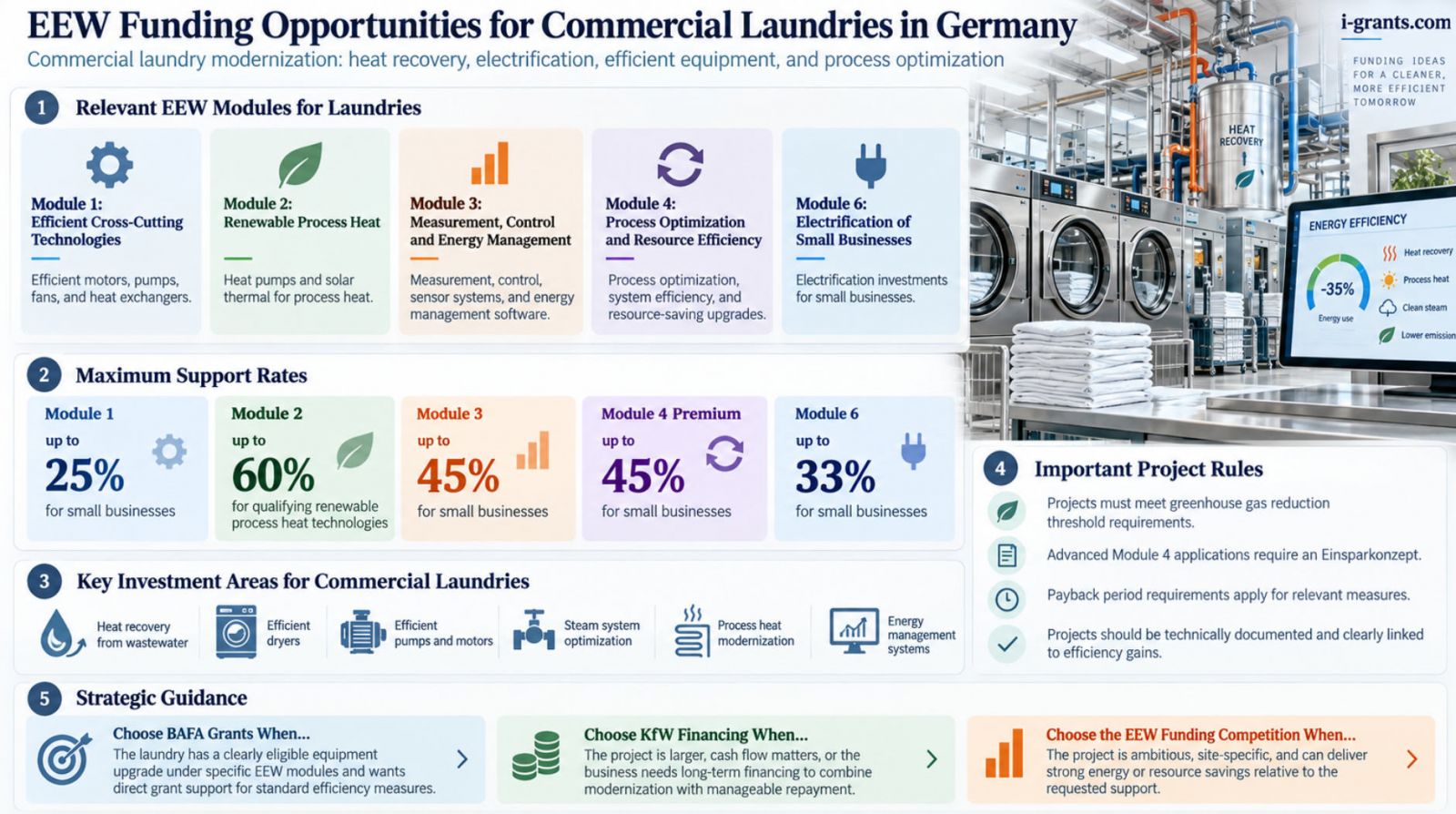
For laundry operators, the most relevant areas include efficient motors and pumps, heat recovery equipment, renewable process heat, energy management systems, comprehensive process optimisation and electrification.
Table 2. EEW Funding Rates and Relevant Modules for German Commercial Laundries
| Funding module | Small enterprises | Medium-sized enterprises | Large enterprises | Main relevance to laundries |
|---|---|---|---|---|
| Module 1: Cross-cutting technologies | Up to 25 percent | Up to 20 percent | Not generally available | Efficient motors, pumps, fans, frequency converters and heat exchangers |
| Module 2: Renewable process heat, qualifying technologies | Up to 60 percent | Up to 50 percent | Up to 40 percent | Heat pumps, solar thermal systems and qualifying renewable heat installations |
| Module 2: Biomass combustion installations | Up to 40 percent | Up to 30 percent | Up to 20 percent | Eligible biomass-based process heat |
| Module 3: Measurement, control and energy management | Up to 45 percent | Up to 35 percent | Up to 25 percent | Sensors, monitoring and eligible energy management technology |
| Module 4: Basic funding | Up to 15 percent | Up to 10 percent | Not generally available | Replacement of equipment in specifically permitted categories |
| Module 4: Premium funding, additional investment costs | Up to 45 percent | Up to 35 percent | Up to 25 percent | Complex process optimisation and resource efficiency |
| Module 4: Premium funding, total eligible investment costs under the reduced-rate method | Up to 20 percent | Up to 15 percent | Up to 10 percent | Qualifying investment structures using the applicable full-cost method |
| Module 6: Electrification of small enterprises | Up to 33 percent | Not available | Not available | Eligible replacement of fossil-fuel-powered equipment with electrical equipment |
Note: These are maximum funding rates under the relevant categories. Module 4 contains additional cost-calculation methods, exceptions and possible decarbonisation bonuses. The precise legal basis can change the applicable rate. Eligibility and actual support are determined individually.
The choice of module should be based on the technical nature of the investment rather than simply selecting the highest published percentage.
An efficient motor replacement, a new industrial dryer, a process heat pump and a comprehensive production-line renovation may all require different applications.
Module 1: Funding Efficient Motors, Pumps and Heat Recovery Components
Module 1 supports defined cross-cutting technologies used across many industries.
For commercial laundries, this can include efficient electric motors, electrically driven pumps, fans, frequency converters, compressed air equipment and qualifying thermal insulation for industrial installations.
Heat exchangers used to recover waste heat are also included within the programme's relevant technology categories.
These components can be significant sources of energy savings.
An outdated circulation pump may consume unnecessary electricity because it operates continuously at an inefficient speed. Replacing it with a qualifying efficient system can reduce consumption while maintaining the required process conditions.
Similarly, appropriately designed heat exchangers can capture energy from wastewater or other thermal streams and transfer it to incoming water.
However, Module 1 is not a general subsidy for any equipment connected to a laundry operation.
The installation must meet the applicable technical requirements, and the project must satisfy the rules governing replacement investments and eligible expenditure.
The maximum repayment subsidy or grant for Module 1 is €200,000, subject to the programme's conditions.
For a smaller laundry undertaking specific equipment improvements rather than a complete production-line replacement, Module 1 may offer a more straightforward route than the extensive calculations required under Module 4 Premium funding.
Module 2: Renewable Process Heat for Washing and Drying
Heating is central to commercial laundry operations.
Water must be heated for washing, while drying and finishing processes often require substantial thermal energy.
Module 2 supports qualifying installations that generate process heat from renewable sources.
Relevant technologies can include solar thermal collectors, eligible heat pumps, geothermal systems and certain biomass installations.
A commercial laundry replacing conventional fossil-fuel process heat with a suitable renewable system may therefore be able to obtain significant investment support.
For qualifying heat pumps, solar thermal and certain other renewable heat technologies, the maximum funding intensity reaches 60 percent for small enterprises, 50 percent for medium-sized enterprises and 40 percent for large enterprises.
Biomass combustion installations have lower maximum rates.
An important distinction is the purpose of the heat produced.
Module 2 is intended for process heat. A heat pump supplying hot water for industrial washing may therefore require a different assessment from a heat pump used exclusively to warm the company's offices.
The source of heat, its temperature level, seasonal performance and integration into the production process can all influence eligibility.
Heat Pumps Using Wastewater or Ambient Heat
Commercial laundries can be suitable locations for heat pump applications because they often have simultaneous heating requirements and potentially recoverable thermal energy.
Warm wastewater may provide a useful heat source for a heat pump, while the upgraded heat can contribute to fresh water heating.
However, a heat pump using industrial waste heat must be classified according to the applicable technical requirements.
It should not automatically be described as a qualifying renewable energy heat pump simply because it reduces gas consumption.
Depending on its configuration, a project involving process heat recovery and heat pumps may be more appropriately assessed under Module 4 Premium funding.
A technically sound application should therefore explain the source of heat, the electricity required by the new installation and the resulting reduction in fossil-fuel consumption.
Module 3: Measurement, Control and Energy Management
Energy management is another relevant investment area for industrial laundry businesses.
A company may have several washing lines, dryers, steam systems and heat recovery units operating simultaneously.
Without appropriate measurements, management may struggle to determine which processes consume the most energy or whether equipment is performing efficiently.
Module 3 supports eligible measurement, control and regulation technology, sensors and energy management software.
For a commercial laundry, a project might involve monitoring electricity consumption across production equipment, measuring water and steam flows, or integrating process data into an energy management system.
The maximum funding rates reach 45 percent for small enterprises, 35 percent for medium-sized enterprises and 25 percent for large enterprises.
Nevertheless, ordinary office software, general administrative digitalisation and unrelated information technology expenses are not automatically eligible.
The equipment and software must meet the module's specific functional requirements.
This distinction is important because purchasing a general business management platform is not equivalent to installing a system designed to monitor and optimise energy or resource flows.
Module 4: The Main Route for Complex Laundry Modernisation
For many industrial laundries, Module 4 is the most strategically important part of EEW.
It supports improvements to production systems and processes that reduce energy consumption, resource use or greenhouse gas emissions.
Unlike modules focused on narrowly defined equipment categories, Module 4 Premium funding is largely technology-neutral.
This makes it relevant to integrated laundry projects involving washing technology, drying systems, heat recovery, process heating and resource efficiency.
However, the module has two substantially different funding routes.
Basic Funding: A Restricted Equipment List
The basic funding route supports replacing existing equipment with more efficient new installations.
The replacement must achieve an annual final energy reduction of at least 15 percent.
However, only specific equipment categories are eligible.
The official list includes technologies such as injection moulding machines, laser cutting systems, spray booths and certain other equipment.
Ordinary industrial washing machines and laundry dryers are not included as general eligible equipment categories.
This is an important limitation for laundry operators.
A company cannot assume that replacing a conventional washer-extractor with a more efficient model qualifies for Module 4 Basic funding merely because energy consumption decreases.
Even when the expected energy saving exceeds 15 percent, the equipment must also belong to an eligible category.
For a comprehensive industrial laundry modernisation, Premium funding will often deserve closer examination.
Premium Funding: Broader Technology Eligibility
Module 4 Premium funding covers a wider range of investments, including process conversion, energy and resource optimisation, waste heat recovery and electrification.
For laundries, qualifying measures may include comprehensive improvements to washing and drying operations, process heat supply, thermal energy distribution and resource-intensive production stages.
The central requirement is a sufficiently large reduction in greenhouse gas emissions.
Under the published funding conditions, a project must meet at least one of the following alternatives: achieve a greenhouse gas emissions reduction of at least 30 percent within the relevant project boundary, or achieve an annual absolute reduction of at least 100 tonnes of CO₂ equivalent for a small enterprise, 300 tonnes for a medium-sized enterprise or 1,000 tonnes for a large enterprise.
These alternatives matter because even a relatively small company may be eligible for Premium funding if it achieves the required relative reduction.
For example, a small laundry project reducing the relevant emissions from 100 tonnes to 65 tonnes annually would achieve a 35 percent reduction.
It would satisfy the relative emissions threshold, even though its absolute reduction of 35 tonnes would remain below the separate 100-tonne threshold.
This does not establish final eligibility, because the project must also meet the remaining conditions.
The Payback Period Must Exceed Three Years
Another important requirement concerns investment profitability.
Under Module 4 Premium funding, the project must have a payback period exceeding three years without public funding.
The calculation compares eligible investment expenditure with expected annual savings in energy and resource costs.
Additional revenues associated with the project may also need to be considered.
For some commercial laundries, this restriction can significantly affect the investment strategy.
A simple heat recovery measure that pays for itself in less than three years may offer an excellent commercial return but fail the relevant Premium funding condition.
By contrast, a more comprehensive project with a longer payback period may satisfy this requirement.
It is therefore important to evaluate not only energy savings but also the investment's economic performance before the subsidy.
The Einsparkonzept Requirement
Premium funding requires a formal energy and resource savings concept known as an Einsparkonzept.
This document is not merely a short statement prepared by an equipment supplier.
It must describe the initial technical situation, the planned measures and the expected reduction in greenhouse gas emissions using the prescribed methodology.
It also establishes the technical basis for the funding calculation and provides a reference for subsequent verification.
An appropriate energy efficiency expert must be involved according to the programme's requirements and permitted procedures.
The business is expected to operate the funded installations in accordance with the approved savings concept and realise the calculated improvements.
This makes the quality of the initial engineering analysis particularly important.
A project based on unrealistic assumptions about annual operating hours, drying temperatures or energy consumption can create difficulties both during application assessment and after installation.
The Hidden Financial Limit: Funding per Tonne of CO₂ Saved
One of the most important financial restrictions under Module 4 Premium funding is the carbon dioxide subsidy ceiling.
The programme does not simply multiply every eligible investment by its maximum subsidy percentage.
It also limits the support amount according to the annual greenhouse gas reduction achieved.
The relevant ceilings are €2,600 for each tonne of annual CO₂ equivalent savings for small enterprises, €2,200 for medium-sized enterprises and €1,600 for large enterprises.
These amounts establish an additional maximum subsidy based on the project's calculated annual emissions reduction.
For example, consider a hypothetical small commercial laundry planning an investment with an annual reduction of 35 tonnes of CO₂ equivalent.
The carbon dioxide-related ceiling would be:
35 tonnes × €2,600 = €91,000.
This means that the Premium subsidy generally cannot exceed €91,000 under this specific ceiling, even if the percentage-based calculation produces a larger amount.
Now assume that the project has €180,000 in qualifying additional investment costs and is eligible for the maximum 45 percent rate under that method.
The percentage calculation would be:
€180,000 × 45 percent = €81,000.
In this simplified example, the percentage-based limit of €81,000 is lower than the emissions-related ceiling of €91,000.
The potential support would therefore be limited to €81,000 before considering any additional legal or programme restrictions.
This calculation is illustrative, not an actual grant offer. It assumes that the investment meets the relevant emissions threshold, exceeds the required payback period, qualifies for the specified cost methodology and satisfies all other eligibility conditions.
For actual projects, the applicable state-aid basis and cost calculation can materially change the result.
Additional Investment Costs Versus Total Investment Costs
The distinction between additional investment costs and total eligible investment costs is another major issue.
Under the standard Premium approach for additional investment costs, small enterprises can receive up to 45 percent, medium-sized enterprises up to 35 percent and large enterprises up to 25 percent.
When the reduced-rate method based on total eligible investment costs applies, the standard maximum rates are 20, 15 and 10 percent respectively.
There are also specific exceptions for clearly identifiable investments and certain additional environmental protection components, where other eligible cost methods may be permitted.
Therefore, the full purchase price of a new industrial dryer cannot automatically be treated as qualifying additional investment expenditure.
The applicant must determine the applicable methodology and provide the appropriate cost evidence.
Can the Funding Rate Be Increased?
Certain Module 4 Premium projects may qualify for a decarbonisation bonus.
The bonus can apply to eligible external waste heat utilisation, particular electrification projects using electricity from renewable sources, and qualifying hydrogen-related investments.
Depending on the legal and cost calculation method, the increase may reach ten percentage points or, under certain reduced-rate methods, five percentage points.
The bonus is not a universal addition to all laundry efficiency projects.
An applicant must demonstrate that the investment meets the specific technical and legal conditions.
This is especially important for businesses considering large-scale process electrification or the supply of recovered heat to external customers.
Which Laundry Equipment May Qualify for EEW Funding?
The practical application of EEW requires a distinction between the technical investment and the funding category.
A new industrial dryer can reduce energy consumption, but its eligibility depends on more than its energy efficiency rating.
Likewise, an industrial heat exchanger, wastewater treatment system or advanced process controller may qualify through a different module.
Table 3. Laundry Modernisation Investments and Potential EEW Funding Routes
| Investment | Potential EEW route | Main eligibility consideration |
|---|---|---|
| High-efficiency electric motors | Module 1 | Must meet the relevant technical efficiency and replacement requirements |
| Efficient industrial pumps | Module 1 | Qualifying existing equipment replacement and technical specifications |
| Frequency converters and efficient fans | Module 1 | Equipment must satisfy the applicable requirements |
| Heat exchangers for waste heat recovery | Module 1 or qualifying Module 4 Premium project | Correct classification and eligible use of recovered heat |
| New industrial washing machines | Potentially Module 4 Premium | Demonstrable qualifying process and emissions improvements |
| Continuous-batch washing systems | Potentially Module 4 Premium | Integrated energy and resource savings assessment |
| Industrial tumble dryers | Potentially Module 4 Premium | Technical performance, eligible replacement and emissions reduction |
| Heat pumps for process hot water | Module 2 or Module 4 Premium | Heat source, process application and technical classification |
| Solar thermal collectors | Module 2 | Renewable heat used for eligible industrial processes |
| Advanced energy management equipment | Module 3 | Compliance with functional energy management requirements |
| Electrification of fossil-fuel equipment | Module 6 for small enterprises or Module 4 Premium | Genuine qualifying conversion of the process |
| Wastewater recovery and reuse systems | Potentially Module 4 Premium | Resource and emissions savings, technical eligibility |
| Complete production process modernisation | Module 4 Premium or EEW funding competition | Integrated emissions reduction and financial conditions |
| Office refurbishment and ordinary cosmetic works | Generally outside EEW investment support | No qualifying process energy or resource efficiency benefit |
Washing Machines and Continuous-Batch Systems
Modern industrial washing systems can reduce water use, heating requirements and chemical consumption.
Continuous-batch washing equipment may also enable improved heat management, better water reuse and more efficient production.
However, a company replacing older washing machines must establish the actual environmental improvement.
The calculation should consider the quantity and type of textiles processed, water consumption, washing temperature, operating cycles and expected energy demand.
Where production capacity increases, comparisons must be particularly carefully designed.
A new machine processing substantially more textiles may consume more energy in total while requiring less energy per kilogram.
That improvement in specific energy consumption does not automatically establish the greenhouse gas reduction required by Module 4 Premium funding.
The applicant must use the appropriate project boundary and official calculation methodology.
Industrial Dryers and Heat Recovery
Drying can be one of the most energy-intensive stages of textile processing.
Traditional gas-fired dryers may discharge considerable heat through exhaust air, particularly when heat recovery is limited.
Modern equipment can incorporate improved airflow management, temperature regulation, moisture measurement and heat recovery.
Some dryers can also be integrated into systems that preheat incoming air or use heat pumps to reduce demand for fossil-fuel heat.
However, not all efficiency improvements produce the same environmental result.
A dryer with lower energy consumption per kilogram may not reduce annual emissions if the business simultaneously increases throughput substantially.
The application must distinguish between improved production efficiency and qualifying absolute or relative emissions reductions.
Wastewater Heat Recovery
Laundry wastewater can carry substantial thermal energy.
Depending on the system, this energy may be recovered through heat exchangers or used as a heat source for a heat pump.
A basic system may transfer heat from outgoing wastewater to incoming fresh water.
More advanced installations can combine wastewater treatment, heat recovery and water reuse.
The financial value depends on the wastewater temperature, discharge volume, available heat demand and the additional electricity required by the recovery equipment.
For grant applications, the resulting energy savings must be supported by an appropriate engineering calculation.
Steam Systems and Thermal Distribution
Older industrial laundries may operate central steam systems with avoidable distribution losses.
Potential improvements include more efficient steam generation, thermal insulation, condensate recovery and better process control.
In some facilities, decentralised heat generation or electrified process heating may offer a commercially attractive alternative.
The applicable EEW module depends on the equipment and its intended use.
The company must also distinguish industrial process heating from ordinary building heating.
EEW is not a general building renovation programme, and improvements to administrative offices or building insulation should not automatically be included in the investment budget.
Module 6: Electrification Opportunities for Small Laundries
Small businesses using fossil-fuel-powered equipment may also consider EEW Module 6.
This module supports eligible electrification measures, including replacing existing equipment with electrically operated new installations or converting existing equipment to electricity.
The maximum funding rate reaches 33 percent of eligible costs, with a maximum subsidy of €200,000 per project.
For a small commercial laundry, a potential example could involve replacing an existing gas-powered process installation with qualifying electrical equipment.
However, Module 6 is not a general grant for any electric industrial dryer.
The business must demonstrate that the measure constitutes an eligible electrification of an existing installation and meets the module's detailed conditions.
The company's SME classification must also be correct, because Module 6 is specifically intended for small enterprises.
An important planning consideration is the resulting electricity demand.
Electrification can reduce direct fossil-fuel consumption while increasing the need for electricity and potentially requiring upgrades to the electrical connection.
The company should therefore evaluate grid capacity, peak loads, equipment efficiency and operating costs before selecting the investment.
The EEW Funding Competition: Up to 60 Percent for Ambitious Projects
Germany also operates a separate competitive funding route under EEW, known as the Förderwettbewerb Energie- und Ressourceneffizienz.
This mechanism is particularly relevant to larger or more ambitious projects that combine substantial investment with strong greenhouse gas reductions.
Unlike the standard grant or KfW loan routes, the funding competition compares eligible applications according to their expected environmental effectiveness relative to the requested public subsidy.
The maximum funding rate is 60 percent of eligible project costs, with support of up to €20 million per project.
For the fifth competition round of 2026, the published budget was €60 million, with the round scheduled from 1 September to 31 October.
These dates relate to that specific competition round. Businesses preparing future investments must confirm the relevant later round and its available budget.
The application procedure is divided into stages.
An applicant first submits a project outline for assessment. After receiving a positive preliminary evaluation, the business can prepare and submit its full funding application during an appropriate competition round.
A completed Einsparkonzept is required for the full application.
The competition focuses on the relationship between the requested funding amount and the expected annual greenhouse gas reduction.
A laundry with a technically strong project may therefore improve its competitiveness by requesting less than the maximum subsidy rate.
The programme also generally requires a payback period exceeding four years without funding, based on the relevant energy and resource cost savings.
Although the maximum funding intensity is attractive, it should not be treated as a guaranteed award.
The competition is most appropriate for businesses able to demonstrate convincing technical savings, sufficient investment scale and a credible implementation plan.
Standard Module 4 or the Funding Competition?
For a small laundry replacing a single component, the administrative demands of a full competition application may outweigh the potential advantages.
For a larger textile service business investing in integrated washing systems, heat recovery, process electrification and wastewater reuse, the competitive route may be worth examining.
The decision should consider the project's investment volume, available engineering documentation, expected emissions reduction, payback period and financing requirements.
Businesses should not assume that the maximum percentages from different EEW instruments can be combined for the same expenditure.
Each funding route has its own eligibility, award and state-aid rules.
Real German Laundry Projects: Lessons from Measured Results
One of the best ways to assess modernisation potential is to examine real facilities where energy and resource efficiency improvements have already been implemented.
German research institutions and environmental funding programmes have documented several relevant projects.
However, the following cases should not be confused with verified recipients of EEW Module 4 Premium funding.
They demonstrate technological outcomes and investment lessons, not automatic eligibility for the current EEW programme.
CHMS GmbH & Co. KG: Major Water Savings but Higher Emissions
The commercial laundry CHMS GmbH & Co. KG, located in Rödental, Bavaria, provides a particularly instructive case.
The company specialises in washing and handling entrance mats, fabric towel rolls and cleaning mop covers.
It implemented a substantial modernisation project supported by Germany's Environmental Innovation Programme, known as Umweltinnovationsprogramm, rather than EEW.
The project combined automated processes, equipment improvements, water reuse, wastewater heat recovery and a newly developed cascade dryer.
According to the official project assessment, the company achieved annual drinking water savings of approximately 3,979 cubic metres.
Its specific drinking water consumption per unit of processed textiles declined by approximately 26 percent.
The cascade dryer, developed in cooperation with machinery manufacturer Lavatec, was reported to use up to 50 percent less energy than a conventional individual dryer in the relevant comparison.
However, the overall environmental results were more complicated.
The introduction of a natural gas-powered combined heat and power installation contributed to a 14.6 percent increase in natural gas consumption and a 4.7 percent increase in carbon dioxide emissions.
This represented approximately 44 additional tonnes of CO₂ annually.
The project therefore did not fully achieve its expected overall environmental performance.
This is a valuable lesson for businesses preparing EEW applications.
A successful water-saving investment does not necessarily reduce total greenhouse gas emissions.
Likewise, installing an efficient dryer does not guarantee that an entire laundry facility will meet the emissions reduction requirements of Module 4 Premium funding.
Companies should evaluate the complete energy balance rather than selectively reporting improvements in individual resource categories.
DBU Research: More Than 75 Percent Less Steam Demand in a Washing Process
Another significant example comes from a research project supported by the German Federal Environmental Foundation, Deutsche Bundesstiftung Umwelt (DBU).
The project was coordinated by the German Textile Cleaning Association and examined a commercial laundry processing towel rolls, entrance mats and cleaning mop covers.
Researchers investigated the interaction between washing technology, drying, water treatment, steam generation and material flows.
The objective was to identify improvements across the complete production system rather than optimising individual machines in isolation.
The results were substantial.
The project achieved a reduction of more than 75 percent in the steam demand used to heat a towel washing line.
Fresh water requirements declined by approximately 80 percent within the investigated process configuration.
The gas consumption of the dryer used for entrance mats was reduced by approximately 33 percent.
Through a combination of heat exchangers and process improvements, the required steam generation capacity decreased from approximately 1,462 kW to 942 kW.
The DBU provided €124,991 in support for the research project.
This funding was not a standard EEW equipment grant. It supported research and demonstration activities under a separate programme.
The findings nevertheless highlight a central principle of industrial laundry efficiency.
Optimising the interactions between washing, drying and heat supply can produce significant improvements beyond what is achievable by replacing one machine.
The researchers also noted that the results were specific to the investigated textile types and production configuration.
A laundry processing hotel bedding or hospital linen cannot simply assume that it will achieve identical savings.
Fraunhofer ReWaMem: Recycling Industrial Laundry Wastewater
A more recent research direction involves the treatment and reuse of wastewater.
Fraunhofer IKTS has investigated ceramic membrane systems for industrial laundry wastewater recycling through the ReWaMem project.
The work includes ceramic nanofiltration technology designed to remove contaminants and enable the reuse of suitable wastewater streams.
In the pilot installation, a treatment configuration recovered approximately 80 percent of the initial water volume under the investigated operating conditions.
The system achieved a reduction in the measured chemical oxygen demand of approximately 68 percent in the pilot configuration.
The treated towel wastewater could be reused for prewashing entrance mats.
Fraunhofer reported economic savings of €1.52 per cubic metre for a specified treated mat wastewater application, or €3.23 per cubic metre under the relevant towel wastewater treatment and reuse configuration.
The institute also stated that the overall economic assessment was not yet complete.
These are research and pilot results, not guaranteed financial savings for every commercial laundry.
Moreover, the project was supported through a separate research funding framework, not automatically through EEW.
For future EEW applications, such technologies may deserve examination where resource efficiency measures generate qualifying emissions reductions and satisfy the chosen module's requirements.
The important distinction is between technological feasibility and actual grant eligibility.
The Wider Scale of EEW Funding in Germany
EEW has become an important instrument in Germany's business energy transition.
An official federal evaluation covering 2019 to 2023 reported more than 55,000 projects supported through the programme.
The evaluation identified approximately €2.9 billion in federal support and investments of around €9.7 billion associated with the funded projects.
It also estimated annual greenhouse gas savings of approximately seven million tonnes of CO₂ equivalent.
These results cover businesses across multiple industries, not just commercial laundries.
The evaluation demonstrates the programme's wider economic importance, but historical figures should not be mistaken for the remaining budget available to new applicants.
For laundry operators, the main relevance is that EEW is an established federal investment support framework with multiple financing routes, rather than a small sector-specific pilot scheme.
Its practical accessibility nevertheless depends on current funding availability, the selected module and the company's ability to demonstrate the required technical improvements.
How to Prepare an EEW Application for a Laundry Business
A strong application begins with the technical and economic baseline.
The company should establish the quantity of textiles processed, the types of materials handled and the energy and water consumed by the relevant production equipment.
Where possible, the baseline should distinguish washing, drying, steam generation, finishing and other processes.
This allows the business to identify which systems offer the greatest improvement potential.
For example, a laundry processing hotel linen may determine that its main opportunity lies in reducing the gas consumption of industrial dryers.
Another company processing entrance mats may discover that wastewater heat recovery and water reuse offer the strongest potential.
The applicant should then define the proposed investment and identify the most appropriate EEW module.
Table 4. Practical EEW Application Roadmap for German Commercial Laundries
| Application stage | Required preparation | Important risk |
|---|---|---|
| Establish the existing energy baseline | Collect electricity, gas, steam and water data with production volumes | Using consumption figures unrelated to actual textile throughput |
| Define the technical improvements | Identify washing, drying, heating, heat recovery and control investments | Including ordinary maintenance or unrelated upgrades |
| Select the relevant EEW module | Compare Modules 1, 2, 3, 4 and 6 and the competition route | Choosing a module based only on the highest subsidy rate |
| Determine enterprise size | Assess employees, turnover and linked businesses | Incorrect SME classification |
| Calculate emissions reductions | Prepare calculations using prescribed emissions factors | Overestimating reductions or counting savings twice |
| Prepare the investment budget | Separate eligible costs from unrelated expenditure | Treating the entire equipment invoice as eligible without justification |
| Develop the Einsparkonzept where required | Work with an appropriate energy efficiency specialist | Incomplete or inconsistent calculations |
| Arrange financing | Compare BAFA grants, KfW loans and own financing | Assuming the subsidy covers all immediate project costs |
| Submit the application | Use the required application system and follow the project-start rules | Signing binding contracts or beginning works prematurely |
| Implement and document the project | Maintain invoices, technical records and evidence of completion | Deviating from the approved scope without addressing the funding implications |
Note: The precise documentation and approval requirements depend on the selected module, funding instrument and applicable legal basis.
Preparing an Einsparkonzept
For Module 4 Premium funding, the Einsparkonzept is central to the application.
It should identify the relevant existing installations and establish an appropriate baseline for future comparisons.
The energy expert must assess expected consumption after implementation, calculate the greenhouse gas reduction and document the assumptions used.
Where the project combines multiple measures, the calculation must consider their interactions.
For example, replacing a dryer with a more efficient unit may reduce the heat available for recovery.
Similarly, installing wastewater heat recovery may reduce the remaining process heat requirement, affecting the size and operation of a planned heat pump.
Counting these savings separately without considering interactions can lead to unrealistic results.
The application should also explain the cost calculation and demonstrate that the project satisfies the applicable payback requirement.
Where required, supporting documentation must establish the condition and technical characteristics of the existing equipment.
Under relevant Premium replacement rules, equipment used as the comparison baseline must still be fully operational when the application is made. Its subsequent disposal or transfer may also be subject to specific conditions.
An obsolete or already dismantled machine should therefore not automatically be used as the basis for a replacement grant.
The Application Portal and Financing Partner
For direct BAFA grants, applications submitted under the current digital procedure are administered through the Förderzentrale Deutschland platform.
The system provides electronic application management, document submission and communication during the funding process.
For KfW Programme 295, the application takes place through an eligible financing partner.
This means a business interested in the KfW route should involve its bank before making binding investment commitments.
The bank will evaluate the company's financial position and the proposed credit arrangement in addition to the programme's technical eligibility.
For the competitive EEW route, applications follow the separate process involving preliminary project assessment and submission through the designated electronic application system.
Businesses should not use a single generic application procedure for all EEW funding routes.
When Can the Laundry Start Its Investment?
Project-start rules are among the most important conditions of German investment funding.
A company should not assume that submitting an application automatically permits it to begin ordering, constructing or installing equipment.
Under KfW Programme 295, the standard process requires the financing application to be submitted before the project begins.
Implementation generally follows the relevant funding commitment.
KfW also provides a procedure for approved early project commencement in qualifying circumstances.
However, permission must be obtained through the prescribed process rather than assumed.
BAFA grants have their own rules governing the grant decision, contracts and project implementation.
Certain contractual arrangements may be permitted under specific conditions, but these should not be treated as a universal right to begin physical works before approval.
For a laundry, the difference between planning and implementation is particularly important.
Conducting energy measurements, obtaining supplier quotations and commissioning eligible preliminary technical analysis are not necessarily equivalent to ordering new equipment or beginning dismantling.
A binding purchase agreement, installation order or construction commitment can affect funding eligibility.
Before signing a contract for a washer-extractor, industrial dryer, heat pump or steam installation, the business should confirm exactly which project-start rules apply to the chosen financing route.
This is particularly important where equipment failure creates pressure for immediate replacement.
A company may reasonably decide that operational continuity is more important than uncertain funding, but the financial consequences should be understood in advance.
Financing, VAT and State-Aid Restrictions
The financial structure of an EEW project must be considered alongside its technical requirements.
A direct grant may reduce the final investment cost, but the business still needs sufficient financing to implement the project.
The KfW loan route can provide investment capital, although credit approval depends on the participating financial institution.
A repayment subsidy reduces the outstanding principal only according to the programme's conditions.
It is not equivalent to receiving a grant that covers the entire investment.
Recoverable input VAT is generally not an eligible investment expense for businesses entitled to deduct it.
Where the applicant cannot recover VAT, the applicable treatment must be assessed under the relevant funding provisions.
EEW also operates within European Union state-aid rules, including the General Block Exemption Regulation and, where applicable, de minimis provisions.
The general de minimis ceiling of €300,000 over a rolling three-year period should not be presented as a universal limit on every EEW project.
Different funding categories can operate under different legal bases and have much higher individual programme limits.
Businesses must also avoid incompatible accumulation of public funding for the same expenditure.
A publicly supported loan, guarantee or separate regional programme may include an element of state aid that needs to be considered.
Applicants should therefore assess the entire financing structure, rather than assuming that several maximum subsidy rates can simply be added together.
Practical Investment Example: Modernising a German Commercial Laundry
Consider a hypothetical independent commercial laundry in Germany that processes hotel bedding, towels and workwear.
The facility operates conventional gas-fired dryers, older circulation pumps and a central hot water system.
Its washing lines generate warm wastewater, but most of this thermal energy is discharged without recovery.
Management plans to modernise the installation to reduce energy costs and improve environmental performance.
A sensible investment strategy would begin with an audit of water, electricity and gas flows.
The first potential investment might involve replacing inefficient pumps and motors. Depending on the technical specifications, these components could be assessed under Module 1.
A second investment might introduce a heat exchanger to recover heat from wastewater.
A third could involve a heat pump supplying eligible process hot water.
The laundry may also consider replacing its conventional dryers with more efficient equipment.
If the company is a small enterprise and the project involves a qualifying conversion from fossil-fuel-powered equipment to electricity, Module 6 may deserve examination.
If the modernisation substantially changes the production process and delivers sufficient greenhouse gas savings, Module 4 Premium could provide a more comprehensive funding route.
Building a Combined Investment Model
The business should not simply add the potential savings calculated for each component by different suppliers.
For example, wastewater heat recovery reduces the energy required to heat fresh water.
A heat pump installed after this improvement may operate with a different heating demand from the one assumed in the original design.
Likewise, replacing a gas-fired dryer can change the temperature and quantity of waste heat available for recovery.
The correct calculation must evaluate the combined technical system.
Suppose the laundry initially uses electricity and natural gas for washing, drying and heat production.
The proposed investment replaces part of the gas heating with a heat pump and introduces improved dryer controls.
The new electricity consumption must be included in the emissions calculation, along with the reduced use of natural gas.
For an accurate grant application, the business must use the official emissions factors and prescribed methodology rather than simply treating all electricity consumption as emissions-free.
Where the business claims renewable electricity-related benefits, the applicable programme conditions must also be satisfied.
Comparing the Funding Routes
The final investment may be divided into technically distinct measures, but artificial separation must be avoided.
A company should not split a connected investment solely to maximise multiple grants or circumvent funding limits.
Instead, it should determine which measures are independently eligible, which belong to a combined process improvement and whether savings can be calculated separately.
For a relatively small investment, a standard equipment module may be the most practical solution.
For a broader renovation involving several integrated technologies, Module 4 Premium or the EEW funding competition may offer more appropriate structures.
An experienced energy expert and funding specialist can help determine the most defensible approach.
Module 5: Transformation Plans for Larger Laundry Businesses
Companies planning substantial long-term decarbonisation may also consider EEW Module 5.
This module supports the preparation of a Transformationsplan, a structured plan for moving the business towards greenhouse gas neutrality.
It can include analysis of the company's existing emissions, future reduction objectives and a detailed catalogue of proposed measures.
The financial support is directed towards planning and related eligible professional services, not the direct purchase of industrial washing machines.
The standard maximum funding rates are 60 percent for small enterprises, 50 percent for medium-sized enterprises and 40 percent for large enterprises.
The general maximum grant is €60,000 per transformation plan.
For companies actively participating in a qualifying energy efficiency and climate protection network, the applicable rate can increase by ten percentage points and the maximum grant can reach €90,000.
This route may be especially useful to large textile service companies operating several production facilities.
A transformation plan can help establish the sequence for replacing fossil-fuel heating, integrating heat recovery, electrifying processes and improving resource efficiency.
However, the planning grant should not be confused with the investment subsidy for implementing the measures.
The company must separately assess whether the planned equipment investments qualify under another EEW module.
Alternative Funding: Environmental Innovation and Research Support
EEW is the main federal framework examined in this article, but it is not the only possible source of support.
Germany's Umweltinnovationsprogramm can support qualifying demonstration projects involving innovative environmental technologies.
Its relevance is illustrated by the CHMS commercial laundry project, where an extensive package of water and process improvements was implemented.
However, the programme is not an ordinary subsidy for replacing every commercial washer or dryer.
Its focus is on projects meeting specific innovation and environmental requirements.
The German Federal Environmental Foundation, DBU, is another possible funding source for qualifying research, innovation and environmental projects.
Its previous support for laundry process optimisation demonstrates that textile cleaning technologies can fall within its areas of interest.
Nevertheless, a historical funded research project does not establish automatic eligibility for routine equipment modernisation.
Companies evaluating such alternatives should distinguish investment grants from research funding, loans, guarantees and consultancy support.
The appropriate funding instrument depends on the innovation level, technical objective and commercial structure of the proposed investment.
Common Reasons Laundry Funding Applications Fail
A common mistake is assuming that every energy-efficient washer or dryer automatically qualifies for an EEW grant.
The actual conditions depend on the selected module, equipment category and environmental performance.
Another problem is applying for Module 4 Basic funding when the proposed equipment does not belong to its restricted eligible technology list.
A third issue is failing to achieve the minimum greenhouse gas savings required under Premium funding.
An investment can reduce water consumption significantly and still fail to deliver the necessary emissions reduction.
Applicants may also overestimate their potential subsidy by applying the highest aid percentage to the total invoice without considering eligible cost methodologies and carbon dioxide subsidy ceilings.
Incomplete baseline data can weaken the Einsparkonzept, particularly when production volumes or textile categories change.
A further risk arises when projects combine drying improvements, wastewater heat recovery and heat pumps without properly accounting for interactions.
Finally, signing binding equipment contracts or beginning construction before the permitted project-start date can compromise funding eligibility.
These mistakes can be expensive, particularly where a laundry has already committed substantial capital to specialised machinery.
How Grant Writers Can Support Commercial Laundry Investments
Professional grant preparation becomes particularly valuable when the project involves several technical systems and multiple possible funding routes.
An experienced grant writer can help the business understand which EEW modules are relevant, compare their requirements and organise the supporting documentation.
However, complex energy calculations and technical evidence should be developed with appropriately qualified energy efficiency experts and engineers.
The grant writer's role is to connect the technical project with the funding rules.
This can involve analysing applicant eligibility, reviewing investment budgets, coordinating supplier documents, preparing financial explanations and ensuring that deadlines and procedural requirements are addressed.
For Module 4 Premium projects, close cooperation with the energy expert preparing the Einsparkonzept is especially important.
Funding professionals can also assist in evaluating whether BAFA direct grants, KfW loans or a competitive funding application offer the most suitable structure.
Through i-grants.com, businesses can connect with grant-writing specialists who support funding applications and help organise financial and technical project documentation.
For commercial laundries making substantial investments, this support can help reduce procedural mistakes and improve the clarity and credibility of the funding proposal.
Frequently Asked Questions About Commercial Laundry Grants in Germany
Can a small commercial laundry receive a grant for a new washing machine?
Potentially, but not automatically. Ordinary industrial washing machines are not generally included in the restricted equipment list for Module 4 Basic funding. A more comprehensive process improvement may qualify for Module 4 Premium if it satisfies the relevant energy, resource and greenhouse gas reduction requirements.
Can a laundry receive funding for a new industrial dryer?
A qualifying dryer modernisation may be eligible under Module 4 Premium or another relevant route, depending on the technical circumstances. The business must demonstrate the required improvements and meet the specific module conditions.
Does Germany provide up to 60 percent funding for laundry equipment?
Certain EEW categories offer maximum funding rates of 60 percent, including qualifying renewable process heat measures and the EEW funding competition. This does not mean that every washing machine or dryer is eligible for that rate.
Are heat exchangers eligible for EEW funding?
Qualifying heat exchangers for waste heat recovery are included in Module 1. They may also be relevant to certain Module 4 Premium projects, subject to the applicable classification and technical conditions.
Can a laundry receive a grant for a heat pump?
Potentially, yes. Module 2 supports qualifying renewable process heat installations, including certain heat pumps. Other process heat configurations may need to be evaluated under Module 4 Premium.
What is the difference between BAFA and KfW financing?
BAFA administers direct investment grants, while KfW Programme 295 provides loans through financing partners with potential repayment subsidies. A repayment subsidy reduces the outstanding loan principal rather than cancelling the entire financing obligation.
What is the minimum greenhouse gas reduction for Module 4 Premium?
A project must meet the relevant relative or absolute emissions reduction requirement. The published alternatives include a reduction of at least 30 percent or an annual absolute reduction of at least 100 tonnes of CO₂ equivalent for small enterprises, 300 tonnes for medium-sized enterprises and 1,000 tonnes for large enterprises.
Is an energy consultant required?
For Module 4, the involvement of an appropriately qualified energy efficiency expert is required under the relevant conditions. Premium funding additionally requires an Einsparkonzept prepared using the prescribed methodology.
Can a laundry start ordering equipment after submitting its application?
Not automatically. Project-start rules depend on the funding route, and binding commitments made too early can jeopardise support. Businesses should confirm the applicable requirements before signing purchase or installation contracts.
Can EEW funding be combined with other grants?
Potential combinations depend on the applicable programme and state-aid rules. The same investment costs cannot automatically receive multiple incompatible subsidies, and the combined support must remain within the relevant legal limits.
Conclusion: Choose the Right EEW Module Before Investing in New Laundry Equipment
Germany's EEW programme offers commercial laundries several potential routes to finance energy and resource efficiency improvements.
Smaller investments involving eligible motors, pumps, fans and heat exchangers may fit Module 1, while renewable process heat technologies can be supported through Module 2.
Energy management equipment may qualify under Module 3, and small businesses replacing fossil-fuel equipment with qualifying electrical installations can examine Module 6.
For larger and more integrated investments, Module 4 Premium is particularly relevant.
Its technology-neutral approach can accommodate comprehensive improvements to washing, drying, process heating and resource efficiency. However, applicants must satisfy demanding requirements concerning greenhouse gas reductions, payback periods, eligible expenditure and technical documentation.
The separate EEW funding competition can offer additional opportunities for ambitious projects, with maximum support reaching 60 percent of eligible costs. Nevertheless, applications are assessed competitively, and funding is not guaranteed.
Real German projects demonstrate both the opportunities and the difficulties of industrial laundry modernisation.
The CHMS project achieved substantial water savings but also demonstrated that improvements in one resource category do not necessarily reduce overall greenhouse gas emissions.
DBU-supported research showed how integrated changes across washing, drying and steam systems can produce significant efficiencies.
Fraunhofer's wastewater recycling research highlights further possibilities for reducing water consumption and recovering valuable resources.
These examples reinforce an important principle: successful laundry modernisation requires an assessment of the complete production system, not just the efficiency of individual machines.
For businesses considering an EEW application, the most effective approach is to establish a reliable technical baseline, identify qualifying investments, evaluate the combined savings and choose the appropriate funding route before making binding financial commitments.
When supported by sound engineering calculations, careful financial planning and professional grant preparation, energy-efficient modernisation can strengthen a laundry's long-term competitiveness while reducing operating costs and environmental impacts.