

 Français
  Deutsch
  Українська
Type "grant writing opportunities" into a search engine and the results will pull in four different worlds at once: salaried jobs at nonprofits, freelance projects on marketplaces, subcontracts from consulting agencies, and open calls from foundations, universities and EU consortia. They all use the same words, but they pay differently, require different things, and reward completely different strategies.
This is the first thing any writer looking for paid work needs to understand. Grant writing opportunities are not a single market. They are a set of channels, each with its own entry point, its own pay logic, and its own competition. A beginner hoping for a first paid proposal and a specialist coordinating a Horizon Europe consortium are technically searching for the same thing, yet they should not begin in the same place.
The purpose of this guide is practical. It maps where paid grant writing opportunities actually live in 2026, what each channel pays, how to qualify for the better-paid work, and how to tell a serious engagement from one that will waste weeks of your time. The numbers below reflect current 2026 market data rather than general career advice.
Why "Grant Writing Opportunities" Is Not One Market
The confusion starts with the word "opportunity" itself. For an organization, a grant opportunity is a funding call. For a writer, a grant writing opportunity is paid work. These are related but they are not the same thing, and mixing them is the most common reason people struggle to find grant writing opportunities that actually match their situation.
Paid grant writing work reaches writers through several distinct routes. First, there are permanent and part-time staff roles, mostly at nonprofits, universities and research institutions. Second, there are freelance projects, sourced through general marketplaces or specialized platforms. Third, there is subcontracting, where established agencies hand overflow work to independent writers. Fourth, there are consortium and proposal-writer roles tied to specific funding programmes, which are especially common in the European Union. Each of these carries a different rate structure and a different bar to entry.
Do not start by searching for "grant writing opportunities" in general. Start by deciding which channel fits your experience, your availability, and the funders you can credibly write for. The channel determines almost everything else.
The 2026 Paradox: Tighter Funding, Stronger Demand for Writers
It would be reasonable to assume that a difficult funding year means fewer grant writing opportunities. In 2026 the opposite is closer to the truth, and understanding why is the key to positioning yourself well.
The funding environment has tightened sharply on the public side. Major federal agencies in the United States, including the National Institutes of Health and the National Science Foundation, have seen billions in cancelled funding, and indirect cost rates have been pushed down toward 15 percent. Private philanthropy is growing, with foundation giving projected to rise roughly 5 to 7 percent, but that increase cannot fully replace the public money that has disappeared. The result is a squeeze: around one third of nonprofits report federal funding declines, while 87 percent of foundation leaders report rising demand for the grants they distribute.
For grant seekers this is bad news. For skilled grant writers it is, paradoxically, an expansion of opportunity. When roughly 1.9 million registered nonprofits in the United States compete for a little over 100,000 foundations, a merely competent proposal is no longer enough. As one sector analysis put it plainly, competence is now the floor rather than the ceiling. Organizations that once wrote their own applications increasingly need professional help to stand out, and 67 percent of organizations reported submitting more grant applications in 2025 than they had originally planned. More applications, higher stakes and tougher review standards all translate into more paid work for writers who can deliver quality.
Table 1. What the 2026 Funding Shift Means for Grant Writers
| What changed in the funding market | Effect on organizations | What it means for grant writing opportunities |
|---|---|---|
| Deep federal cuts, lower indirect cost rates | Loss of reliable public funding, urgent pivot to private sources | More organizations enter the freelance market for the first time |
| Foundation giving up 5 to 7 percent, but not enough to backfill | Same dollars, far more applicants per funder | Higher bar rewards experienced and specialized writers |
| 87 percent of funders report rising demand | Shorter cycles, invite-only rounds, application caps | Premium on writers who can target and prioritize calls |
| Reviewers demand evidence, evaluation and impact data | Proposals need theory of change and measurable outcomes | Demand shifts toward methodology-literate specialists |
| Two thirds of nonprofits adopt AI tools | Faster drafting, but weaker strategy and compliance | Opportunity for writers who combine tools with real judgment |
The strategic takeaway for a writer is direct. The organizations flooding into the private funding space need people who can do more than assemble a document. They need writers who understand funder priorities, evaluation frameworks and compliance. That is precisely the profile that commands the higher end of the market described later in this guide.
Where Paid Grant Writing Opportunities Actually Live
There is no single portal that lists every grant writing opportunity, in the same way that there is no single portal listing every grant. Work reaches writers through at least seven channels, and most sustainable careers eventually draw from several of them at once. Treating them as a menu, rather than betting everything on one, is what separates a steady pipeline from a feast-and-famine cycle.
Table 2. Seven Channels Where Grant Writing Opportunities Appear
| Channel | Typical work | Best suited to |
|---|---|---|
| General freelance marketplaces | One-off proposals, hourly projects, milestone contracts | Writers building a portfolio and client reviews |
| Specialized grant platforms | Curated grant projects, matched clients, vetted writers | Writers who want funder-relevant, better-qualified leads |
| Nonprofit and mission job boards | Staff, part-time and remote grant roles | Writers wanting stability or a salaried base |
| Direct outreach to organizations | Local nonprofits, museums, schools, clinics | Writers with a niche or a geographic community |
| Agencies and consultancies | Subcontracted overflow, white-label writing | Reliable writers who deliver without hand-holding |
| EU consortia and programme roles | Horizon Europe, Erasmus+, LIFE, Interreg proposals | Multilingual writers with technical or research depth |
| Retainers and repeat clients | Ongoing pipeline management for one organization | Experienced writers with a proven track record |
General freelance marketplaces. Platforms such as Upwork, Fiverr, Freelancer, Guru, PeoplePerHour and goLance carry a constant flow of grant writing opportunities, from a single foundation letter of inquiry to a full federal application. They are the fastest way to land a first paid project and to accumulate the reviews that later justify higher rates. The trade-off is obvious: competition is heavy, clients are price-sensitive, and platform fees eat into the margin. These channels are best understood as a starting point and a portfolio builder rather than a long-term home.
Specialized grant platforms. A newer and more targeted category connects organizations that need proposals directly with professional grant writers, often with matching, vetting and funder context built in. This is the model that i-grants (Grantologic) is built around: instead of competing on price against every generalist copywriter, a grant writer meets clients who already know they need specialist help, across defined verticals such as EU grants, international foundations, government funding and research. For writers, the value of a specialized platform is qualification. The leads are closer to real funding calls, and the person on the other side understands that a strong proposal is an investment, not a commodity purchase.
Nonprofit and mission job boards. If you want stability rather than gig income, boards such as Idealist, Indeed and FlexJobs list staff and part-time grant writing opportunities daily, and remote-focused boards have made these roles far less dependent on geography. Universities, hospitals and larger nonprofits post development-writer and grants-manager positions here throughout the year. Many writers keep one salaried or part-time anchor role and freelance around it.
Direct outreach to organizations. Some of the most durable grant writing opportunities never appear on any board at all. Smaller organizations, community groups, museums, historical societies, clinics and schools frequently need help but do not know how to advertise for it. A writer who approaches them directly, ideally with a relevant background or a local connection, faces almost no competition. This is also the most reliable route to a first client for beginners, precisely because these organizations rarely receive polished applicants.
Agencies and consultancies. Established grant consulting firms routinely take on more work than they can staff, and they subcontract the overflow. For an independent writer, agency work trades a slice of the fee for a steady stream of briefs and no client acquisition effort. It rewards reliability above all: an agency that can hand you a brief and trust the result will keep coming back.
EU consortia and programme roles. On the international side, a whole category of grant writing opportunities is tied to specific European Union programmes. Research institutes, SMEs and consultancies across Europe recruit freelance proposal writers for Horizon Europe, the EIC Accelerator, Erasmus+, LIFE, Interreg, Creative Europe and similar instruments. These roles are discussed in detail further down, because they pay well and reward a very specific profile.
Retainers and repeat clients. The most valuable channel is the one you build yourself. Once an organization trusts a writer, a monthly retainer to manage its entire grant pipeline replaces the uncertainty of one-off gigs with predictable income. Experienced independents often earn most of their revenue from a handful of retainer clients rather than from a stream of strangers. This is the destination, not the starting line.
What Grant Writing Opportunities Pay in 2026
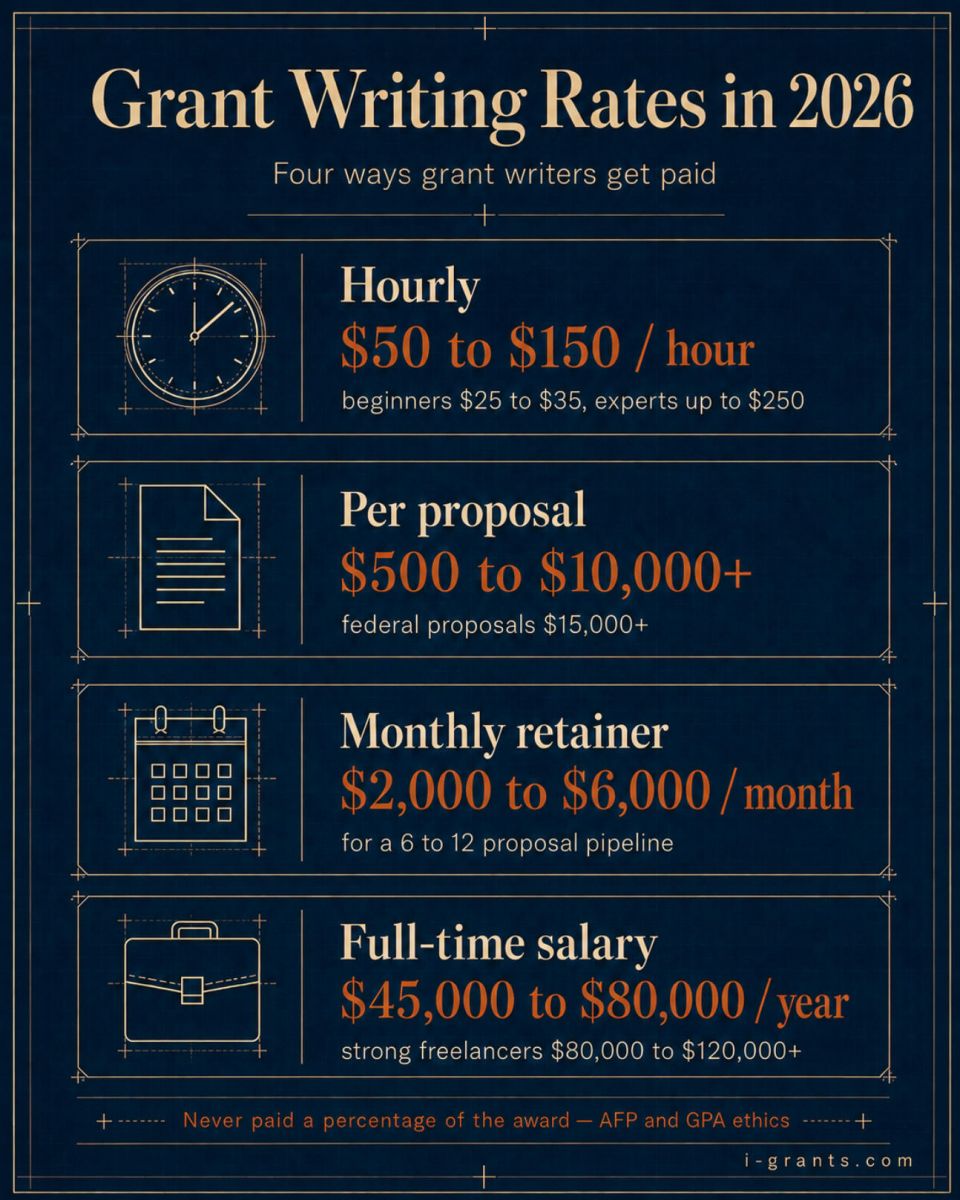
Pay varies more in this field than in almost any other kind of writing, because the same job title covers a first-time foundation letter and a two-hundred-hour federal application. In 2026, grant writers are compensated through four main models, and knowing all four lets you quote the one that fits the work rather than the one the client happens to expect.
Table 3. 2026 Grant Writing Rates by Pricing Model
| Pricing model | Typical 2026 range | When it fits |
|---|---|---|
| Hourly | $50 to $150 per hour (beginners $25 to $35, experts up to $250) | Undefined scope, advisory work, ongoing edits |
| Per proposal (flat fee) | $500 to $10,000 and up; federal proposals $15,000 and up | One-off submissions with a known deliverable |
| Monthly retainer | $2,000 to $6,000 per month | Clients with a 6 to 12 proposal annual pipeline |
| Full-time salary | $45,000 to $80,000 per year; strong freelancers $80,000 to $120,000 and up | Staff roles at nonprofits, universities, agencies |
Several forces move a writer inside these ranges. Federal grant specialists command the top of the hourly scale, roughly $150 to $250 per hour, because of the compliance expertise the work demands. A subject-matter expert in a client's field can charge two to three times a generalist rate for the same word count. Turnaround matters too: rush work against a two-week deadline costs more than a project planned over two months. Remote work has flattened much of the old regional pricing, though writers based in high-cost cities still tend to sit near the top of the range.
The effort behind these numbers is easy to underestimate. A straightforward foundation grant can take 20 to 40 hours of work. A complex federal application can easily take 200 hours or more and often requires a full team. This is exactly why per-proposal and retainer pricing exist: they protect the efficient writer from being penalized for speed, and they give the client a number they can plan around.
One rule in this market is not negotiable, and every serious writer should be able to state it in a single sentence.
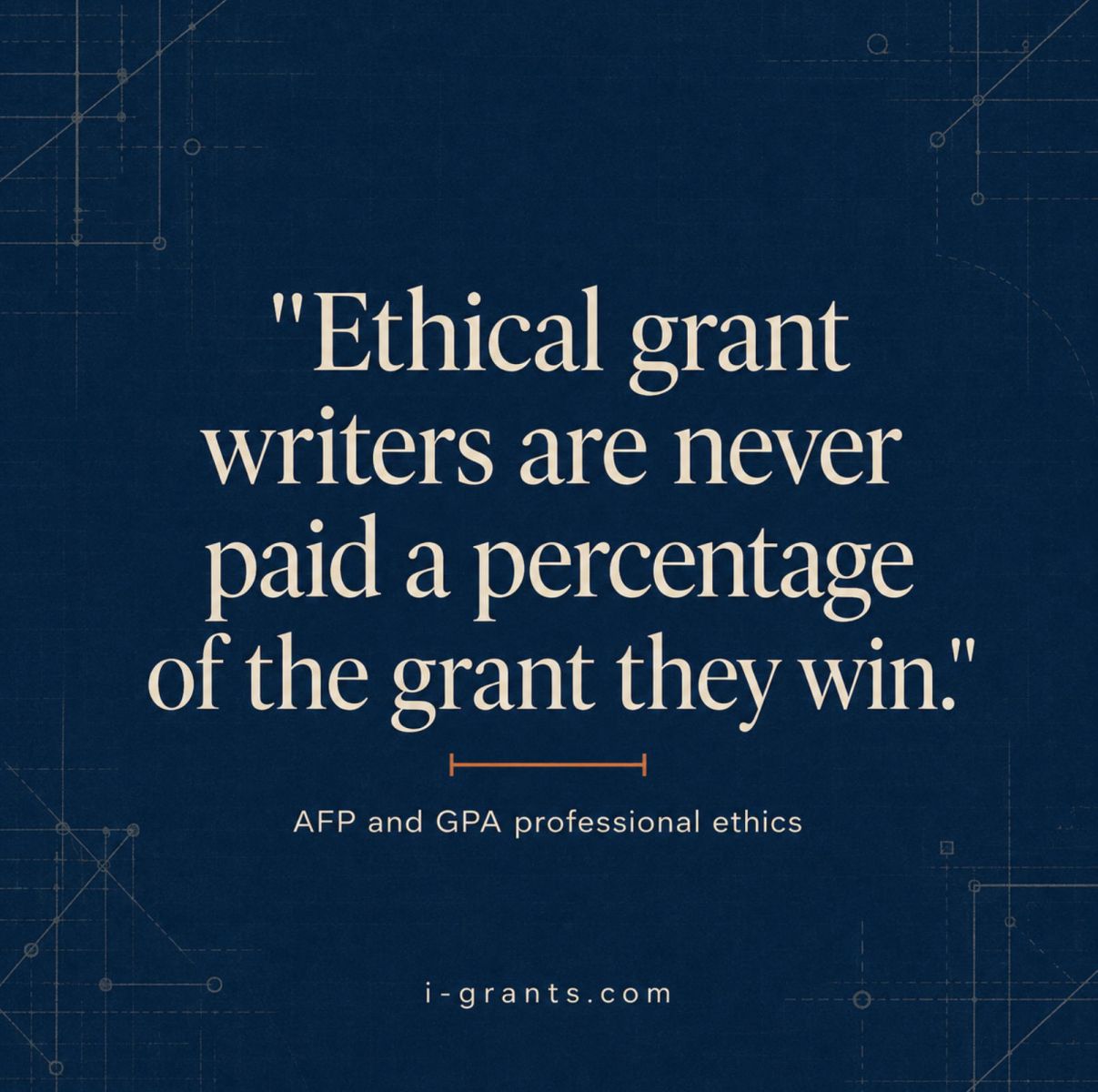
Ethical grant writers are never paid a percentage of the grant they win. The Association of Fundraising Professionals and the Grant Professionals Association both prohibit contingent, commission-based compensation, and most federal funders will not allow grant writing fees to be paid out of awarded funds at all.
If a prospective client insists on paying a cut of the award, that is not a lucrative opportunity. It is a signal that they do not understand how the profession works, and a warning that the engagement will create ethical and legal problems for both sides. Quote hourly, flat fee or retainer, and hold the line.
How to Qualify for Better Grant Writing Opportunities
The gap between the bottom and the top of the ranges above is not luck. It reflects three things a writer can deliberately build: credentials, a demonstrable track record, and specialization.
Credentials. The recognized credential in the field is the Grant Professional Certified, or GPC, administered by the Grant Professionals Certification Institute, a sister organization to the Grant Professionals Association. It is not an entry-level badge. Candidates need at least three years of experience, five successful proposals in the previous seven years, and must pass a two-part written exam, accumulating a minimum score across multiple competency areas. The exam costs $639 for GPA members and $875 for non-members, and the credential is renewed every three years. Its scarcity is the point: only around 11 percent of grant professionals held the GPC in the most recent reporting year, which makes it a genuine differentiator for a freelancer trying to justify a higher rate. GPC holders, on average, report higher earnings than those without it.
Track record. Funders and clients increasingly want evidence, and so should your pitch. A portfolio that names the programmes you have written for, the outcomes you helped secure and, where you can share it, a success rate, does far more than a generic claim of "experienced grant writer." In a market where 2026 reviewers demand measurable impact from applicants, the writers who win the best grant writing opportunities are the ones who can show, not just say, that their proposals get funded.
Specialization. The single fastest way to move up the rate scale is to stop being a generalist. A writer who owns a niche, whether that is federal health grants, EU research consortia, climate and sustainability funding or arts and culture, becomes the obvious choice for a specific kind of client and stops competing on price with everyone else. Specialization also compounds: each project in a niche makes the next one easier to win and faster to write.
The International Angle: Cross-Border and EU Grant Writing Opportunities
For writers willing to work across borders, the European Union is one of the richest sources of well-paid grant writing opportunities anywhere, and it is systematically underserved by generalist freelancers who never learn its rules.
Across Europe, research institutes, SMEs, NGOs and specialist consultancies recruit freelance proposal writers to prepare applications for Horizon Europe, the EIC Accelerator, Erasmus+, LIFE, Interreg, Creative Europe, EU4Health and related instruments. These roles are demanding. They typically require a very high command of English, often at C2 level, familiarity with the relevant submission platforms and templates, and the ability to coordinate a proposal across a multi-partner consortium while hitting the Excellence, Impact and Implementation sections that evaluators score. Many postings also value a technical or scientific background alongside the writing.
The reason this work pays is the same reason it is hard to win: European calls are ferociously competitive. The average success rate across Horizon Europe proposals sits at roughly 13 percent, and specialist firms that consistently beat that average are highly valued for it. An organization facing a five in six chance of rejection is very willing to pay for a writer who can meaningfully improve its odds. For a multilingual writer, especially one comfortable across English, French, German or Ukrainian markets, cross-border grant writing opportunities offer both higher rates and far less crowding than the general English-language marketplace.
A writer who can navigate EU programme rules, coordinate a consortium and write to the evaluation criteria is not competing with the global pool of generalist freelancers. They are competing with a small group of specialists, and they are paid accordingly.
How to Evaluate a Grant Writing Opportunity Before You Say Yes
Not every opportunity is worth taking, and experienced writers turn work down regularly. Before committing to a project, a few checks will tell you whether it is a real opportunity or a trap that will cost you weeks and possibly your reputation.
- Compensation structure. Walk away from any offer to pay a percentage of the award. It is prohibited by professional ethics and disallowed by most funders.
- Access to information. A fundable proposal needs real input. If the client cannot give you access to programme staff, budgets and outcome data, the timeline and the quality will both suffer.
- Deadline realism. A complex federal or EU proposal cannot be written well in a few days. An unrealistic deadline is usually a sign of a disorganized client, not a lucrative rush job.
- Eligibility fit. Confirm the organization is actually eligible for the funder it is chasing. Beautifully written applications fail every day because someone ignored the eligibility rules.
- Scope clarity. Know whether you are writing a two-page letter of inquiry or managing a full submission with attachments, a budget narrative and multiple stakeholders. These are very different jobs at very different prices.
Running these checks before you quote protects both your time and your rate. It also signals professionalism to the client, which is often the moment a one-off gig starts turning into a repeat relationship.
Building a Pipeline, Not Chasing One-Off Gigs
The writers who thrive are rarely the ones who are best at finding individual grant writing opportunities. They are the ones who stop needing to look. Grant writing has a pronounced seasonality, and writers who rely purely on project income tend to swing between overload and empty months. The way out of that cycle is to convert good one-off work into ongoing relationships.
A practical progression looks like this:
- Land the first projects. Use marketplaces, specialized platforms and direct outreach to build a portfolio and gather references.
- Pick a niche. Concentrate on a funder type or a sector where your background gives you an edge, and let each project deepen it.
- Deliver reliably. Meet deadlines, communicate clearly and make the client's life easier. Reliability, more than brilliance, is what generates repeat work.
- Convert to retainers. Offer your best clients ongoing pipeline management instead of one proposal at a time, trading uncertainty for predictable monthly income.
- Monitor continuously. Treat funder calls as something to track year-round, not to scramble for at the last minute. The writer who already knows the calendar is the one clients keep.
Handled this way, the search for grant writing opportunities gradually becomes a search you no longer have to run, because the opportunities arrive through reputation instead.
Final Takeaway
Grant writing opportunities in 2026 are more plentiful than the difficult funding headlines suggest, but they are scattered across channels that reward different things. Tighter budgets have raised the bar for applicants, and that has raised demand for writers who can clear it.
The practical path is consistent. First, choose the channels that fit your stage, from marketplaces and specialized platforms for building a portfolio to retainers and consortium roles for established writers. Second, price by model rather than by habit, and never accept commission on an award. Third, invest in the credentials, track record and specialization that separate the top of the rate scale from the bottom. And fourth, treat cross-border and EU work as a serious opportunity rather than an afterthought, because that is where competition is thinnest and rates are highest for those who learn the rules.
The question is not really "where are the grant writing opportunities?" There are many, in every channel above. The better question is the one that shapes a career: which channel fits the writer you are now, and which one fits the writer you intend to become?
i-grants (Grantologic) connects organizations that need funding with professional grant writers across EU grants, international foundations, government funding, research, sustainability, social projects, startups and the arts. Writers can create a professional profile and meet clients who are already looking for specialist help.