

 Français
  Deutsch
  Українська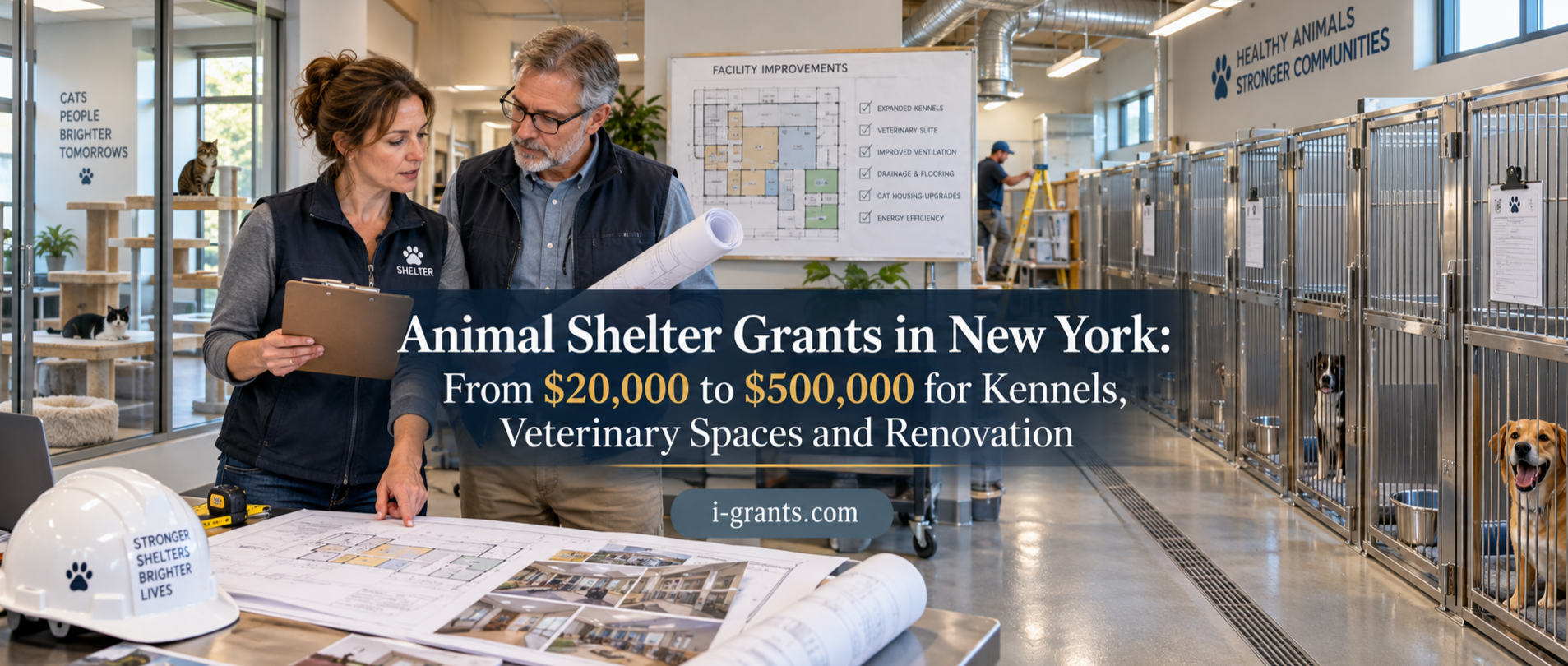
For animal shelters across New York State, outdated kennels, inadequate ventilation, deteriorating flooring, and insufficient veterinary facilities represent far more than maintenance problems. These conditions can directly affect animal health, disease prevention, staff safety, and the ability to provide humane care while dogs and cats await adoption. Yet the organizations responsible for sheltering abandoned, surrendered, and stray animals often operate with limited financial resources, making major infrastructure improvements difficult to finance.
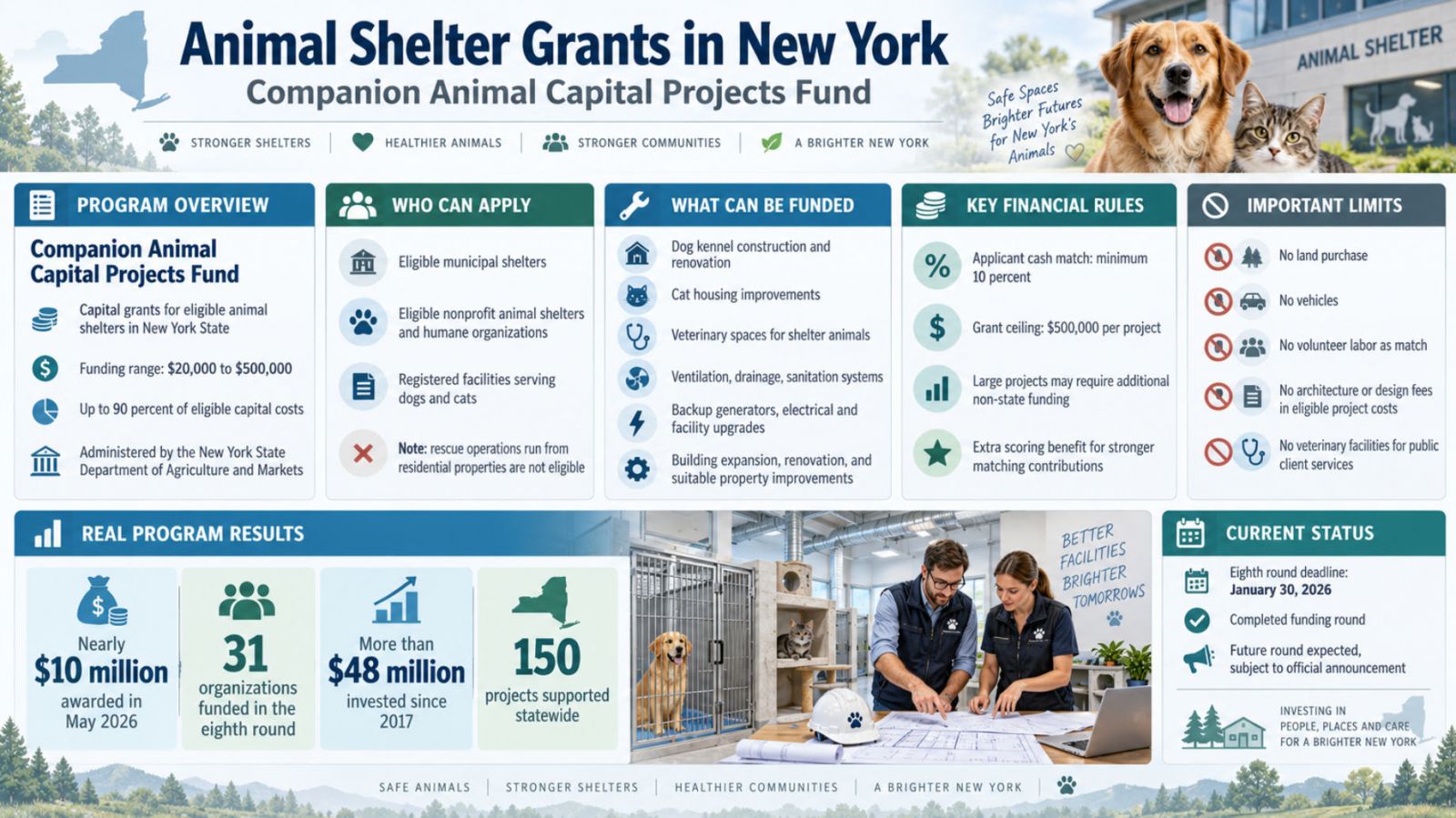
New York State has established a substantial funding mechanism to address these challenges through the Companion Animal Capital Projects Fund, administered by the New York State Department of Agriculture and Markets. Under the most recently completed competitive funding round, eligible municipal and nonprofit animal shelters could request grants ranging from $20,000 to $500,000, covering up to 90 percent of qualifying capital project costs.
The program has already produced measurable investment in animal welfare infrastructure. On May 22, 2026, Governor Kathy Hochul announced nearly $10 million in grants for 31 animal care organizations through the eighth round of the fund. The supported projects included new shelter construction, upgraded dog kennels, improved cat housing, veterinary treatment facilities, ventilation systems, drainage improvements, and emergency power equipment.
Since the program was established in 2017, New York State has dedicated more than $48 million to the Companion Animal Capital Projects Fund, supporting 150 projects statewide as reported in May 2026. The enacted 2026-2027 state budget also continued funding for a subsequent round, demonstrating an ongoing policy commitment to shelter infrastructure.
However, prospective applicants must distinguish between continued budgetary support and an active grant competition. The eighth-round application deadline was January 30, 2026, and that competition has closed. As of October 2026, a new application window with updated guidelines and a confirmed deadline had not been identified in the Department's published funding opportunities. Consequently, the grant amounts, matching requirements, and evaluation procedures explained in this article refer to the 2025-2026 competition, RFP 0388, and provide a practical foundation for preparing for a future opportunity. Applicants must verify the terms of any newly announced round before applying.
The timing is particularly important because New York has also introduced more detailed animal shelter operating and facility standards through Article 26-C of the Agriculture and Markets Law. The Companion Animal Care Standards Act, which took effect in December 2025, creates an additional reason for shelter operators to evaluate their buildings, housing systems, sanitation facilities, and veterinary infrastructure.
This guide explains how the capital funding program works, which organizations qualify, what improvements can receive support, how matching contributions are calculated, and how applications are evaluated. It also examines actual grants awarded to animal shelters in New York and provides financial examples that illustrate how smaller nonprofit rescues and larger municipal facilities can structure eligible capital investments.
Understanding New York's Companion Animal Capital Projects Fund
The Companion Animal Capital Projects Fund is a competitive state funding program specifically designed to strengthen the infrastructure used to shelter dogs and cats.
Unlike ordinary animal welfare donations, which may support food, veterinary treatment, transportation, or daily operating expenses, this program focuses on substantial investments in buildings, equipment, and facilities. Its purpose is to help shelters create safer, healthier, and more effective environments for animals in their care.
Eligible capital projects may include the construction, renovation, rehabilitation, installation, acquisition, or expansion of appropriate buildings and equipment necessary for secure animal containment, health, and adequate care.
The program is administered by the New York State Department of Agriculture and Markets, which also oversees important aspects of animal shelter regulation and welfare standards.
Its financial structure is particularly attractive because the state can cover most of the eligible project budget. Nevertheless, the program is not intended to finance every operational need of an animal rescue organization, and its maximum award creates clear limits for larger construction projects.
The eighth round was administered through Request for Proposals RFP 0388, with Statewide Financial System event identification CACF8.
Table 1. New York Companion Animal Capital Projects Fund: Main Funding Conditions of the Eighth Round
| Program parameter | Official 2025-2026 funding conditions |
|---|---|
| Administering agency | New York State Department of Agriculture and Markets |
| Total competitive funding | $10 million |
| Minimum grant request | $20,000 |
| Maximum grant request | $500,000 |
| Maximum state contribution | 90 percent of eligible project costs |
| Minimum applicant contribution | 10 percent of total eligible project costs |
| Required matching contribution | Cash funding supported by appropriate documentation |
| Eligible project purpose | Secure containment, health, and adequate care of sheltered dogs and cats |
| Project implementation period | Completion and invoicing within three years of the contract start date |
| Application system | New York Statewide Financial System, SFS |
| Eighth-round application deadline | January 30, 2026, at 4:00 p.m. local time |
| Competition status | Closed; subsequent application terms require a new official announcement |
A key financial advantage is that eligible organizations do not necessarily need to finance half of a project themselves.
For example, a shelter planning a qualifying $100,000 capital improvement could request $90,000 from the state and provide the remaining $10,000 in cash matching funds.
However, the $500,000 maximum award still applies. A shelter cannot obtain $900,000 for a $1 million project simply because that amount represents 90 percent of the project budget.
In addition, the matching contribution must be committed to eligible project costs and must be supported by evidence of available financing at the application stage.
The program is therefore most suitable for shelters with clearly defined capital needs, adequate legal and administrative standing, and a realistic plan for securing and managing the required funds.
Which Animal Shelters Are Eligible for Funding?
One of the most important eligibility distinctions is that the Companion Animal Capital Projects Fund is not a general grant for everyone involved in animal rescue.
The program specifically serves qualifying municipal and incorporated nonprofit shelters, humane societies, animal pounds, and rescue facilities.
Under the eighth-round guidelines, applicants had to qualify as a dog pound or shelter established and maintained under Section 114 of the New York Agriculture and Markets Law, or be appropriately registered with the Department under Section 408.
Rescue organizations operating from residential premises were excluded.
This distinction matters because an individual who regularly rescues animals, a foster-based network using private homes, or an animal welfare group without qualifying shelter operations does not automatically meet the program's requirements.
Likewise, operating a commercial boarding facility or veterinary clinic does not establish eligibility merely because the business provides animal care services.
The program's legal and operational requirements must be evaluated before preparing a capital funding application.
Municipal Shelters and Nonprofit Organizations Under Municipal Contracts
The first major category includes municipal pounds and shelters providing animal shelter services under the relevant provisions of state law.
These facilities may be operated directly by local governments or maintained through appropriate agreements with organizations providing required shelter services.
A county operating a public animal shelter or a nonprofit humane society holding a qualifying contract with a municipality may potentially fall within this category.
In RFP 0388, $9 million of the initial funding allocation was assigned to the municipal shelter category.
This allocation reflected the substantial public responsibility associated with housing stray and other animals entering municipal shelter systems.
Independent Nonprofit Shelters Serving Underserved Areas
The second category specifically recognized shelters and rescue organizations that were not operated by or under contract with municipalities to provide pound or shelter services.
To qualify under this category, the organization needed to be registered with the Department and demonstrate that it provided comparable services to municipalities or regions with insufficient shelter resources.
An initial $1 million was reserved for this category in the eighth-round competition.
This was an important opportunity for independent nonprofit shelters operating in communities where animal welfare infrastructure is limited.
However, the allocation rules allowed certain uncommitted funding to be pooled and redistributed among remaining eligible applicants after the initial category-based ranking process.
Consequently, the initial $1 million allocation should not be interpreted as a permanent maximum on the total amount that independent shelters could ultimately receive.
Table 2. Applicant Categories and Eligibility Requirements Under RFP 0388
| Eligibility factor | Municipal shelters and qualifying contracted providers | Independent nonprofit shelters |
|---|---|---|
| Organization type | Municipal pound, shelter, or qualifying provider of municipal shelter services | Incorporated nonprofit shelter, humane society, or eligible rescue |
| Legal requirements | Compliance with relevant municipal shelter provisions | Appropriate Department registration |
| Municipal relationship | Municipal operation or qualifying shelter services agreement | Not operated by or under contract with a municipality for pound or shelter services |
| Additional geographic requirement | Applicable service area requirements | Must demonstrate comparable services in underserved municipalities or regions |
| Initial eighth-round funding allocation | $9 million | $1 million |
| Maximum individual grant | $500,000 | $500,000 |
| Minimum cash contribution | 10 percent | 10 percent |
| Statewide Financial System requirement | Registration and applicable administrative requirements | Registration and required nonprofit prequalification |
Another significant rule concerned organizations that had previously received funding through the same program.
Previous grant recipients could submit another application only when their earlier funded projects had been completed by the time of the new application.
This requirement is especially relevant to shelters planning multiple phases of modernization. An organization cannot necessarily apply for another award while still carrying out an earlier funded project.
Applicants should therefore maintain clear records of project completion, contract performance, and final reporting.
Why New York's New Animal Shelter Standards Matter
The introduction of Article 26-C of the New York Agriculture and Markets Law has changed the context in which animal shelter infrastructure decisions are made.
The Companion Animal Care Standards Act established detailed requirements concerning shelter licensing, facilities, animal housing, sanitation, veterinary care, emergency preparedness, and operational management.
For organizations operating older buildings, these requirements can reveal infrastructure deficiencies that cannot be resolved through ordinary cleaning, staff training, or administrative changes alone.
A shelter may need to replace unsuitable kennel materials, improve drainage, install more effective ventilation, construct isolation areas, or increase its ability to maintain safe environmental conditions.
This creates a strong connection between the capital grant program and the practical obligations of animal shelter operators.
Importantly, the eighth-round funding guidelines explicitly instructed applicants to reference relevant sections of Article 26-C when explaining how their proposed investments would improve compliance or make compliance more efficient.
For grant-writing purposes, this is particularly valuable.
Rather than stating that a building is outdated, an applicant can identify a specific legal or animal welfare requirement, describe the existing infrastructure problem, and explain how the proposed capital investment will address that problem.
Facility Temperature and Ventilation Standards
Section 424 requires indoor animal housing temperatures to be routinely maintained between 60 and 80 degrees Fahrenheit, while also requiring shelters to monitor individual animals and provide conditions appropriate to their particular needs.
The same section establishes an ammonia concentration limit below two parts per million and requires regular maintenance of air-handling systems.
These standards make the condition of heating, ventilation, and air conditioning infrastructure especially important.
A shelter struggling to maintain appropriate temperatures during winter or summer could potentially develop a capital project involving heating equipment, air distribution improvements, insulation, and temperature regulation.
Similarly, an organization with poor ventilation in dog kennel areas may need technical improvements that address indoor air quality and sanitation.
The strongest funding justification would connect the existing deficiency to measured conditions, technical assessments, and a proposed solution appropriate for the animals housed in the facility.
Housing Materials, Drainage, and Disease Prevention
Article 26-C also establishes requirements for materials used in animal housing areas.
Surfaces in direct contact with animals must be nonporous, water-resistant, nontoxic, and capable of withstanding regular cleaning and disinfection.
Adequate drainage must prevent the accumulation of water and other liquids on floors.
These provisions are directly relevant to older shelters with damaged concrete floors, porous surfaces, ineffective drainage, or housing units that are difficult to sanitize.
The law also requires appropriate separation and isolation for animals with certain infectious diseases, as determined by a licensed veterinarian.
Shelters without adequate isolation facilities may face practical difficulties in maintaining infection control.
Such deficiencies can provide a clear basis for capital projects involving new housing areas, isolation rooms, drainage systems, or appropriate interior surfaces.
Noise, Animal Welfare, and Environmental Enrichment
Shelter infrastructure must also address the effects of noise.
Section 424 requires shelters to minimize continuous exposure of animals and staff to sound levels exceeding 85 decibels. It also requires regular sound measurements and the maintenance of corresponding records.
Older dog kennel areas may produce high noise levels because of hard reflective surfaces, closely positioned enclosures, and inadequate acoustic treatment.
Capital improvements could therefore include appropriate sound-reducing materials, redesigned kennel arrangements, or other structural measures that reduce harmful noise exposure.
The law also contains requirements related to animal housing arrangements and environmental enrichment, including special considerations for animals that remain in shelter custody for extended periods.
These requirements help explain why investments in kennel design, suitable cat housing, and enriched living spaces can be relevant to both regulatory compliance and animal welfare.
Table 3. Article 26-C Facility Standards and Potential Capital Investments
| Regulatory requirement | Relevant standard or obligation | Potential shelter improvement |
|---|---|---|
| Indoor temperature | Generally maintain animal housing areas between 60 and 80°F | Heating, cooling, insulation, and temperature controls |
| Air quality | Ammonia levels below two parts per million | Ventilation systems, improved air circulation, sanitation infrastructure |
| Housing surfaces | Nonporous, water-resistant, nontoxic, cleanable materials | New kennel flooring, wall coverings, and housing surfaces |
| Drainage | Prevent standing water and other liquids | Floor drainage, plumbing, and appropriately designed surfaces |
| Infectious disease isolation | Suitable separation of animals requiring isolation | Isolation rooms, separate housing areas, doors, and ventilation arrangements |
| Noise | Minimize continuous exposure above 85 decibels and maintain required measurements | Sound-reducing materials and improved kennel arrangements |
| Electrical power and water | Maintain essential services and emergency arrangements for outages exceeding four hours | Electrical improvements, backup power, and water systems |
| Animal housing | Suitable, secure enclosures that meet applicable welfare requirements | Replacement kennels, cat enclosures, expanded housing |
| Longer stays | Additional housing or enrichment arrangements under applicable rules | Enhanced enclosures, improved room housing, and suitable enrichment infrastructure |
These examples identify possible links between statutory standards and capital projects. They do not mean that every improvement listed is automatically eligible for funding.
The program's capital expenditure rules still apply, and projects must be assessed against the actual conditions of the building and the complete legal requirements.
For shelter operators, the broader lesson is that capital planning should begin with a facility compliance assessment rather than a wish list of equipment purchases.
What Animal Shelter Renovations Can Receive Grant Funding?
The Companion Animal Capital Projects Fund supports capital improvements directly connected to the safe containment, health, and adequate care of sheltered dogs and cats.
This includes a range of substantial building and equipment investments.
Dog Kennels and Animal Housing Facilities
Kennel construction and renovation are among the most clearly relevant project types.
Many older shelters contain cages or runs that are difficult to clean, poorly ventilated, inadequately insulated, or no longer appropriate for the animals housed within them.
A qualifying modernization project may include replacement kennel units, improved partitions, appropriate flooring, secure doors, drainage infrastructure, and other permanent improvements.
Such investments should be supported by technical specifications describing enclosure dimensions, materials, cleaning methods, and suitability for the expected animal population.
The program has supported numerous projects involving kennel replacements and expanded dog housing.
For example, Jefferson County SPCA received a $500,000 award in the eighth round for new kennels, enrichment equipment, insulation, ventilation, and flooring.
Orleans County also received $500,000 for improvements that included kennel installations, fencing, heating and ventilation systems, structural repairs, and drainage.
These awards demonstrate that complete housing improvements can be more comprehensive than the purchase of individual enclosures.
Cat Housing and Isolation Areas
Cat housing presents different technical requirements.
Suitable enclosure design, separation of animals, sanitation, and the availability of appropriate enrichment can have significant consequences for animal welfare.
Capital projects may involve dedicated rooms, permanent cat housing systems, redesigned isolation areas, ventilation, and related building improvements.
In the eighth funding round, Finger Lakes SPCA received $409,955 for improvements involving cat housing, isolation, and supporting spaces.
Animal Kind received $500,000 for electrical, plumbing, and ventilation improvements together with new infrastructure for cats.
These examples show how shelter operators can combine animal housing improvements with necessary building systems within one coherent project.
Veterinary Treatment Facilities
Veterinary infrastructure is another important funding area, but it has a crucial eligibility restriction.
The eighth-round guidelines allowed medical equipment and facilities used exclusively for sheltered dogs and cats.
They excluded medical equipment or facilities used for community or outpatient services.
This distinction must be understood before a nonprofit organization includes a veterinary treatment area in its grant budget.
A medical suite intended to examine, treat, or isolate animals in the custody of the shelter may potentially qualify.
By contrast, a community veterinary clinic offering services to privately owned pets cannot automatically use this capital program to finance the same equipment.
Where a building accommodates both shelter animals and public veterinary services, the applicant must carefully separate the relevant project activities and costs.
One of the strongest real examples is the Town of Hempstead, which received $500,000 in the eighth round for a canine medical suite, kennel installations, soundproofing, and improvements to heating, ventilation, plumbing, and drainage.
Ventilation, Sanitation, and Emergency Power
Not every important shelter investment is immediately visible to the public.
Heating systems, mechanical ventilation, electrical infrastructure, water supply, drainage, and emergency generators can determine whether a shelter remains safe and functional during normal operations and unexpected disruptions.
The eighth-round recipients included multiple organizations receiving support for these systems.
Mr. Greys Strays received $22,421.25 for an upgraded heating, ventilation, and air conditioning system.
Warwick Valley Humane received $90,000 for an emergency generator.
Wanderers Rest received $500,000 for gas and electrical improvements and the installation of new heat pump and ventilation systems.
These projects demonstrate how focused technical investments can address important welfare and safety requirements without necessarily involving complete new shelter construction.
Which Expenses Are Excluded From the Grant?
A fundamental distinction in this program concerns eligible capital costs versus expenditures that cannot be included in the project budget.
The official eighth-round guidelines contained a dedicated appendix explaining these restrictions.
Eligible costs generally included direct expenses associated with qualifying construction, renovation, rehabilitation, installation, acquisition, or expansion of buildings, equipment, and facilities.
Contractor labor was allowed, as was qualifying work performed by municipal employees. Project oversight by shelter management was also identified as an eligible expense.
However, ordinary construction labor performed by shelter employees, management personnel, or volunteers was generally excluded, subject to the specific municipal employee exception.
The guidelines also excluded architecture and design fees, land purchases, vehicle purchases and maintenance, certain driveway improvements, and veterinary facilities used for community outpatient services.
These restrictions are particularly important because ineligible expenditures cannot be counted as either grant-funded costs or matching contributions.
A shelter cannot satisfy its required cash contribution by assigning an estimated monetary value to volunteer labor.
Nor can it count excluded architectural design fees as part of the eligible project contribution merely because those services are necessary to prepare the construction.
Table 4. Eligible and Ineligible Shelter Capital Expenditures Under RFP 0388
| Expense | Funding treatment | Important qualification |
|---|---|---|
| Construction and renovation of eligible animal housing | Eligible | Must support sheltered dogs and cats |
| New kennels and permanent cat housing | Potentially eligible | Appropriate project scope and technical specifications required |
| Heating, ventilation, and air conditioning equipment | Eligible | Must serve qualifying shelter infrastructure |
| Medical equipment for sheltered animals | Eligible | Restricted to animals in shelter care |
| Construction labor performed by outside contractors | Eligible | Must be properly documented |
| Qualifying municipal employee labor | Eligible | Subject to applicable program conditions |
| Project oversight by shelter management | Eligible | Distinguished from ordinary construction labor |
| Shelter employee construction labor | Generally ineligible | Municipal employee exception applies where permitted |
| Volunteer construction labor | Ineligible | Cannot be used as the required cash match |
| Architecture and design fees | Ineligible | Excluded from both grant funding and matching costs |
| Purchase of land | Ineligible | Different from potentially qualifying building acquisition |
| Veterinary facilities serving community clients | Ineligible | Public outpatient services are excluded |
| Purchase, lease, or maintenance of vehicles | Ineligible | Even when vehicles support shelter operations |
| Driveway blacktopping | Ineligible | Specifically excluded in the eighth-round guidelines |
| Archaeological studies | Ineligible | Specifically excluded in the eighth-round guidelines |
One unusual feature deserves particular attention.
The guidelines allowed qualifying acquisition costs for buildings or facilities, while expressly excluding land purchases.
This distinction matters when a shelter intends to acquire a new property.
For example, Westfield Stray Cat Rescue received $288,000 in the eighth round to purchase a new facility.
That award demonstrates that building acquisition can be relevant to the program. It does not establish that every real estate transaction or every portion of a property purchase is eligible.
Applicants planning to buy a facility should obtain clarification on the treatment of land value, ownership, legal documentation, and associated acquisition costs before preparing their final budget.
How Matching Funds Work
The minimum applicant contribution under RFP 0388 was 10 percent of total eligible project costs.
Matching funds had to be provided in cash and supported by documentation demonstrating their availability when the application was submitted.
This arrangement makes the program more accessible than capital grants requiring equal contributions from the applicant and the state.
However, two separate limits must always be respected: the state can cover no more than 90 percent of the eligible project cost, and an individual award cannot exceed $500,000.
The first limit determines the maximum share of government financing. The second establishes the absolute maximum grant amount.
For example, a $300,000 eligible project could potentially receive $270,000 from the state, with a minimum applicant contribution of $30,000.
For a $600,000 project, 90 percent would equal $540,000, but the grant request would still be capped at $500,000. The applicant would therefore need to provide at least $100,000 from other resources.
Additional Matching Contributions Can Improve an Application's Score
The eighth-round evaluation framework awarded preference points to applicants providing more than the minimum matching contribution.
Applications could earn up to five additional points depending on the percentage of the total project budget financed through eligible matching funds.
A contribution between 11 and 20 percent attracted one preference point, while larger contributions could earn progressively higher scores under the published thresholds. Matching funds exceeding 50 percent of the total project cost could earn the maximum five preference points.
This created an incentive for financially stronger applicants to provide a larger contribution.
However, additional matching funds should not be treated as the primary determinant of success.
The technical quality and justification of the project accounted for most of the available points. Moreover, a shelter that commits too much of its available cash to a construction project may create financial difficulties for its ongoing animal care operations.
The optimal contribution is therefore not necessarily the highest possible contribution. It is the amount that improves competitiveness without undermining the organization's financial stability.
How New York Evaluates Animal Shelter Grant Applications
The eighth-round competition used a structured scoring system that provides valuable insight into the Department's priorities.
Eligible proposals were first reviewed for completeness and compliance with the program's basic requirements.
Applications passing this initial screening were then evaluated according to three main criteria: demonstrated need, project description and work plan, and reasonableness of cost.
The maximum basic score was 95 points, with up to five additional preference points available for matching contributions.
Table 5. Official Evaluation Structure for Companion Animal Capital Projects Fund Applications
| Evaluation area | Maximum points | Main considerations |
|---|---|---|
| Need Assessment | 48 | Organizational capacity, animal welfare needs, community need, expected impact, shelter statistics |
| Project Description and Work Plan | 27 | Cost estimates, technical compliance, floor plans, letters of support, permits, implementation plan |
| Reasonableness of Cost | 20 | Connection to Article 26-C, realistic costs, financial planning, matching funds |
| Maximum basic score | 95 | Competitive evaluation before preference points |
| Additional matching preference | Up to 5 | Matching funds exceeding the minimum requirement |
| Maximum final score | 100 | Basic score plus applicable preference points |
An important rule established a minimum average basic score of 62 out of 95.
Applications scoring below that threshold were not considered for funding, regardless of remaining available funds.
This means that a shelter cannot compensate for a poorly prepared project solely by offering a larger matching contribution.
Demonstrating Need
The largest share of points related to the assessment of need.
Applicants needed to explain how the proposed project would improve secure animal containment, health, and adequate care.
The application also required evidence demonstrating why the project was needed in the relevant municipality or region.
This included consideration of the population served, existing shelter infrastructure, community characteristics, and animal-related operational statistics.
A statement such as "our kennels are old and need replacing" is therefore less convincing than a documented explanation identifying structural deterioration, sanitation problems, inadequate housing arrangements, and the specific standards the replacement project would address.
Providing Technical Evidence
A competitive proposal also needed credible plans, specifications, and cost estimates.
For projects involving new kennels, runs, or cat housing, the Department expected floor plans showing enclosure layouts and dimensions.
Hand-drawn plans could receive lower scores than sufficiently detailed plans prepared by an architect or appropriate design software.
Applicants also needed to present realistic contractor estimates and explain how the proposed materials and equipment would comply with Article 26-C.
This is especially important because two apparently similar kennel renovation proposals can have very different costs depending on enclosure dimensions, drainage design, surface materials, ventilation requirements, and the condition of the existing building.
Choosing the Right Letters of Support
The Department's scoring criteria identified specific types of support letters that could contribute points.
Letters from elected or municipal officials, established nonprofit partners, and veterinarians were eligible for consideration under the relevant scoring rules.
By contrast, letters from corporate sponsors, volunteers, or people who had adopted animals from the shelter were not considered for these particular points.
This is a practical distinction.
A shelter may have hundreds of loyal supporters but still lose points if its application contains the wrong type of supporting evidence.
The content of each letter also matters. A useful recommendation should demonstrate that the writer understands the organization, its local role, and the proposed capital investment.
Application Documents and Administrative Preparation
Grant applications under RFP 0388 were submitted through the New York Statewide Financial System.
Eligible nonprofit applicants were required to complete the state's prequalification process before the application deadline.
Prequalification involved organizational information and financial documentation, including relevant IRS Form 990 materials, financial statements, and Charities Bureau filings.
Because these documents require periodic updates, organizations that were previously prequalified still needed to confirm that their status remained valid.
The application also required a detailed work plan, project budget, responses to specific questions, and supporting materials.
The eighth-round electronic application limited individual text responses to 2,000 characters and permitted PDF attachments of up to 20 megabytes.
Consequently, applicants needed to present detailed technical information in supporting documents while keeping narrative responses focused and evidence-based.
Table 6. Documents Needed to Prepare a Competitive Animal Shelter Capital Grant Application
| Document or evidence | Purpose |
|---|---|
| Organizational registration and legal status | Demonstrates applicant eligibility |
| SFS registration and nonprofit prequalification | Establishes administrative eligibility |
| Current organizational financial documents | Supports prequalification and financial review |
| Evidence of available matching funds | Confirms the required cash contribution |
| Detailed capital project budget | Identifies eligible costs and funding sources |
| Contractor and equipment supplier estimates | Supports cost credibility |
| Technical drawings and facility floor plans | Demonstrates construction and installation feasibility |
| Kennel or cat housing dimensions | Supports compliance with animal housing requirements |
| Basic Animal Stats Matrix | Documents shelter operations and animal population |
| Community need information | Explains why the project is necessary in the service area |
| Letters from eligible supporters | Provides relevant third-party evidence |
| Work plan and implementation schedule | Shows how and when the project will be completed |
| Permits and approvals, or a documented timetable | Addresses regulatory readiness |
| Property rights and site documentation | Supports the ability to implement the capital investment |
The Basic Animal Stats Matrix is particularly important because it connects the proposed infrastructure investment with the organization's actual animal population.
Shelters should maintain reliable information about animal intake, housing capacity, outcomes, and animals entering from outside New York State.
A shelter planning to build additional isolation rooms, for example, should be able to explain how its existing capacity and animal health needs justify the investment.
Similarly, a proposal to expand cat housing should be supported by information about intake patterns, available spaces, and how the proposed facilities would improve animal welfare.
A professional application should use actual records rather than estimates invented solely for the funding request.
Real Grant Recipients: What New York Actually Funded in 2026
The eighth round provides unusually useful evidence because the Department published the names of all 31 successful organizations, their awards, and the purposes of their projects.
Adding the published individual awards produces a total of approximately $9.87 million, consistent with the state's announcement of nearly $10 million in funding.
Twelve organizations received the maximum $500,000 award.
The results show that capital funding was distributed across several types of infrastructure, including new construction, building acquisition, improved animal housing, veterinary facilities, ventilation systems, and sanitation improvements.
The following table presents the complete eighth-round award list.
Table 7. All 31 Animal Shelter Capital Grant Recipients in New York's Eighth Funding Round
| Organization | Award | Funded project |
|---|---|---|
| Ada Howe Kent Memorial | $200,000 | Expanded cat housing, electrical and plumbing improvements, HVAC, building renovation |
| Animal Kind | $500,000 | Electrical, plumbing, HVAC upgrades, new infrastructure for cats |
| Animal Rescue Foundation | $71,804 | New cat housing, laundry equipment, backup generator |
| Chautauqua County Humane Society | $500,000 | Sanitation improvements, upgraded walls and floors |
| City of Buffalo | $370,838.18 | Shelter renovation, new outdoor area, garage conversion |
| City of Glen Cove | $90,535 | Cat isolation improvements, dog kennel partitions, fire alarm system |
| City of Newburgh | $500,000 | New shelter construction |
| Cortland County SPCA | $276,575.79 | Security cameras, drainage, kennel doors |
| Finger Lakes SPCA | $409,955 | Cat housing, isolation improvements, entrance, laundry and storage areas |
| Fulton County SPCA | $500,000 | Electrical, lighting, fire protection, laundry facilities, dog kennels |
| Happy Life Animal Rescue | $500,000 | Sanitation improvements, animal housing, ventilation |
| Jefferson County SPCA | $500,000 | New kennels, enrichment equipment, insulation, HVAC, flooring |
| Livingston County | $256,302.90 | Monitoring system, roof awning, extended dog runs |
| Mr. Greys Strays | $22,421.25 | HVAC modernization |
| Northern Chautauqua Canine Rescue | $500,000 | New shelter construction |
| Ontario County | $500,000 | Existing shelter expansion and improvements |
| Orleans County | $500,000 | Kennels, fencing, HVAC, structural repairs, drainage |
| Paws in the Falls | $103,500 | Kennels, electrical and plumbing systems, drainage, generator, HVAC |
| Pets Alive | $376,715 | New enriched cat housing |
| St. Lawrence Valley SPCA | $500,000 | Kennels, flooring, soundproofing, office renovation |
| Town of Bethel | $101,513.70 | Replacement shelter building |
| Town of Guilderland | $116,002 | HVAC, backup generator, exterior improvements, storage, electrical work |
| Town of Hempstead | $500,000 | Canine medical suite, kennels, soundproofing, HVAC, plumbing, drainage |
| Town of Lancaster | $498,845 | HVAC, generator, flooring, building expansion, kennels, fencing |
| Town of North Hempstead | $200,000 | Replacement kennels and epoxy flooring |
| Town of Penfield | $203,225.69 | Redesigned animal control area, kennels, temperature controls |
| Town of Schroeppel | $132,341.44 | Increased shelter capacity |
| Town of West Seneca | $65,700 | Kennel floor resurfacing, enrichment area, fencing, doors, HVAC |
| Wanderers Rest | $500,000 | Gas and electrical improvements, heat pump, ventilation |
| Warwick Valley Humane | $90,000 | Emergency generator |
| Westfield Stray Cat Rescue | $288,000 | Acquisition of a new facility |
These are announced grant awards, not necessarily final amounts paid or confirmation that every funded project has been completed.
The results offer several important conclusions.
First, new construction was not the only priority. Many grants financed renovations to existing shelters, including relatively focused improvements to ventilation, drainage, kennels, and emergency infrastructure.
Second, smaller awards remained possible. Mr. Greys Strays received slightly more than $22,000, while Animal Rescue Foundation received approximately $72,000.
Third, the maximum grant was not reserved exclusively for large municipal shelters. Independent organizations such as Animal Kind and Fulton County SPCA were among those receiving $500,000.
For future applicants, this demonstrates that the quality and relevance of a capital project can matter more than the public visibility or size of the organization.
City of Buffalo: A Real Capital Project With Documented Matching Funds
The City of Buffalo offers a particularly useful example because local government records identify both the state grant and the accompanying financial contribution.
In the eighth round, the City of Buffalo Animal Shelter received an award of $370,838.18.
The project involves upgrading the shelter's interior, creating a new outdoor animal area, and converting an existing garage into usable animal space.
According to the city's public announcement, the project also received a financial contribution from Friends of the City of Buffalo Animal Shelter.
Table 8. Real Financing Structure for the City of Buffalo Animal Shelter Project
| Funding source | Amount |
|---|---|
| New York State capital grant | $370,838 |
| Friends of the City of Buffalo Animal Shelter | $41,204 |
| Total announced project financing | $412,042 |
The figures in this table are rounded to whole dollars as reported in the local announcement.
The example illustrates how a municipal animal shelter can work with a supporting nonprofit organization to provide the cash contribution necessary for a capital investment.
It also demonstrates that a strong funding strategy does not always require the municipality itself to provide every dollar of matching financing.
However, the contribution must still meet the grant's requirements and be properly documented.
For a shelter preparing a future application, early coordination with a supporting charitable organization can therefore be as important as obtaining contractor estimates.
Town of Hempstead: Veterinary Infrastructure for Sheltered Dogs
The Town of Hempstead received a $500,000 award for a project that included a new canine medical suite, kennel installations, soundproofing, and improvements to mechanical and plumbing systems.
This is one of the most relevant examples for shelters planning medical infrastructure.
The investment demonstrates that veterinary facilities may qualify when they are designed to support animals in shelter care.
A dedicated medical area can improve the ability to examine and treat animals, support infection prevention, and reduce the operational burden associated with inadequate existing spaces.
Nevertheless, a shelter considering a similar project must carefully distinguish internal animal care facilities from veterinary services offered to the general public.
The Department's eighth-round guidelines expressly excluded medical facilities and equipment used for community or outpatient services.
A facility serving both purposes would require careful project definition and cost separation.
The Town of Hempstead award therefore supports the relevance of veterinary infrastructure, but it should not be interpreted as unrestricted funding for commercial or public veterinary clinics.
Finger Lakes SPCA: Cat Housing and Isolation Improvements
Finger Lakes SPCA received $409,955 to improve its infrastructure for cats, including housing and isolation areas.
The project also involved improvements to supporting spaces such as laundry, storage, and entrance facilities.
This award illustrates an important principle: animal housing cannot always be evaluated independently of the surrounding building infrastructure.
An appropriate cat isolation room may require suitable ventilation, washable surfaces, controlled access, and the capacity to maintain sanitary conditions.
Similarly, adequate laundry and storage areas can be important to maintaining cleanliness and separating supplies.
The grant demonstrates how a shelter can develop a coordinated capital project that improves both the physical animal housing environment and the systems necessary to support it.
Animal Kind and Fulton County SPCA: Maximum Awards to Independent Organizations
Animal Kind and Fulton County SPCA each received $500,000 in the eighth round.
Both organizations were identified in the official award list as not being under contract with municipalities or regions.
Animal Kind's project included improvements to electrical, plumbing, and heating and ventilation systems, alongside new infrastructure for cats.
Fulton County SPCA's project involved electrical and lighting improvements, fire protection, laundry infrastructure, and new dog kennels.
These awards are especially relevant to independent nonprofits concerned that capital funding is largely reserved for government-operated facilities.
The program provided a specific mechanism for independent shelters serving underserved communities, and the results demonstrate that organizations in this category could receive the maximum individual award.
However, applicant eligibility still depends on the specific registration, operational, and geographic conditions of the competition.
What the Program's Historical Results Reveal
The Companion Animal Capital Projects Fund has grown into a substantial source of public investment in New York's animal welfare infrastructure.
In May 2025, the state announced more than $10.4 million in capital funding for 30 animal care organizations.
The following year, nearly $10 million was awarded to 31 organizations.
By May 2026, the state reported more than $48 million dedicated to the program since 2017 and 150 projects supported statewide.
Table 9. Recent New York Companion Animal Capital Projects Fund Results
| Indicator | 2025 awards | 2026 awards |
|---|---|---|
| Funding announced | More than $10.4 million | Nearly $10 million |
| Organizations receiving support | 30 | 31 |
| Principal project types | Shelter renovation, medical areas, housing, infrastructure | New construction, kennels, cat housing, sanitation, HVAC, veterinary facilities |
| Funding status | Awards announced | Awards announced |
| Future application availability | Previous competition completed | Eighth competition completed |
These figures show that New York has continued to invest in the physical conditions of animal shelters rather than relying solely on routine operating support.
They also suggest that infrastructure compliance and animal welfare improvements remain important policy priorities.
Nevertheless, funding statistics must be interpreted carefully.
The number of grant recipients does not establish the acceptance rate for applicants. A reliable success rate would require the total number of eligible applications submitted to the same round, which was not confirmed for the eighth competition.
Likewise, the total historical funding amount should not be treated as funding currently available to new applicants.
The figures describe public investment already committed or awarded over the program's history.
Financial Model: A Small Cat Shelter Seeking $90,000
Consider a hypothetical independent nonprofit cat shelter serving a rural community with limited animal care infrastructure.
The organization operates a qualifying facility and has identified deficiencies in existing cat housing, ventilation, and sanitation.
Its proposed capital project would replace inadequate enclosures, install more suitable flooring, improve air circulation, and modernize drainage.
Assume that the shelter satisfies the program's organizational eligibility requirements and can document the availability of the required matching contribution.
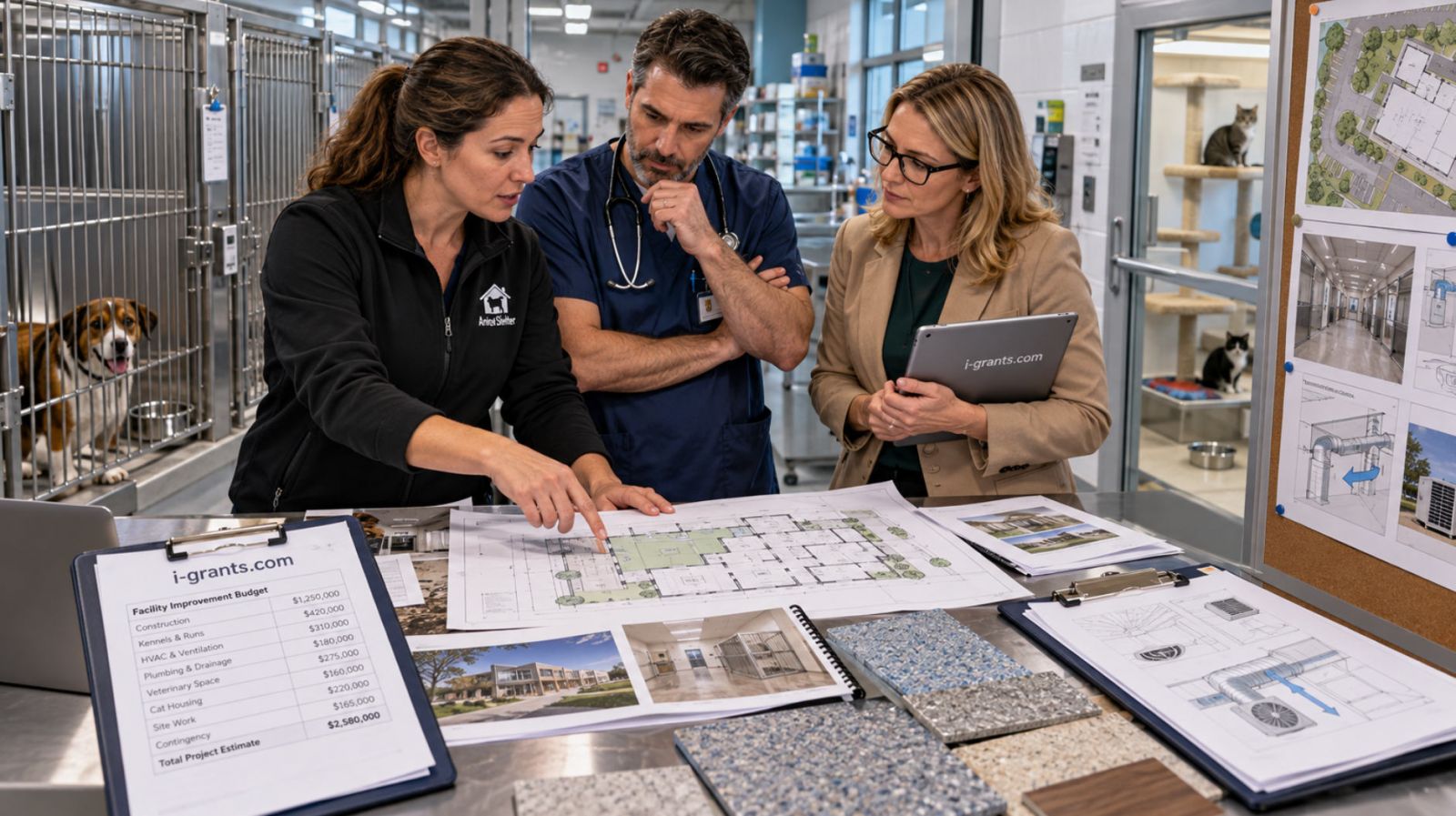
The total eligible project budget is estimated at $100,000.
Table 10. Illustrative $100,000 Cat Shelter Capital Improvement Budget
| Proposed expenditure | Estimated cost |
|---|---|
| Permanent cat housing units | $35,000 |
| Washable flooring and wall surfaces | $20,000 |
| Ventilation improvements | $25,000 |
| Plumbing and drainage | $12,000 |
| Contractor installation work | $8,000 |
| Total eligible project budget | $100,000 |
| Potential NYSCA grant request | $90,000 |
| Required cash contribution | $10,000 |
This is a hypothetical financing model, not an actual awarded grant or a budget approved by the Department.
The scenario illustrates the maximum 90 percent state contribution under the eighth-round rules.
The organization would need to provide evidence that its $10,000 contribution is available in cash and can be applied to eligible project costs.
It would also need appropriate contractor estimates, technical specifications, and a clear explanation of how the improvements address animal care standards.
A strong application might explain that existing surfaces cannot be adequately disinfected, that current ventilation contributes to poor indoor conditions, and that the proposed cat housing will create a safer and more suitable environment.
The organization should avoid making unsupported claims about improved adoption rates or reduced disease incidence.
Instead, it should identify practical and measurable outcomes, such as new compliant housing units, improved ventilation capacity, safer isolation arrangements, and better sanitation conditions.
Financial Model: A $300,000 Shelter Veterinary Improvement
A larger nonprofit shelter may need to establish a dedicated veterinary treatment area for animals already in its care.
Its existing building may have inadequate examination space, insufficient isolation capacity, and ventilation systems that do not support the desired separation of animal housing and treatment areas.
Assume the organization develops an eligible capital project costing $300,000.
Under the eighth-round funding structure, the shelter could potentially request $270,000 and contribute $30,000 in cash.
Table 11. Illustrative $300,000 Shelter Veterinary and Isolation Project
| Proposed expenditure | Estimated cost |
|---|---|
| Renovation of veterinary treatment area | $100,000 |
| Medical equipment exclusively for sheltered animals | $65,000 |
| Isolation facilities | $55,000 |
| Ventilation improvements | $45,000 |
| Sanitation and drainage systems | $25,000 |
| Contractor installation | $10,000 |
| Total eligible project budget | $300,000 |
| Potential NYSCA grant request | $270,000 |
| Required cash contribution | $30,000 |
This model is illustrative and assumes all proposed expenditures are accepted as eligible.
A key planning requirement is the exclusive shelter use of the medical facilities and equipment financed through the grant.
If the organization also operates a veterinary clinic for privately owned animals, the applicant must separate that activity from the proposed state-funded investment.
The project should demonstrate how the improvements strengthen medical care, infection control, and safe animal handling within the shelter.
For example, improved isolation facilities may reduce inappropriate contact between animals requiring different housing conditions.
Ventilation improvements can also support the safe operation of treatment areas when designed for the specific building and animal population.
The budget should distinguish direct construction and installation costs from excluded design fees or other noneligible expenses.
As with all capital projects, the organization must prepare a realistic implementation schedule, obtain required approvals, and ensure that the funding arrangement will allow contractors to be paid on time.
Financial Model: A $600,000 Kennel and Infrastructure Modernization
A larger municipal shelter may plan a comprehensive modernization involving dog kennels, ventilation, emergency electrical systems, drainage, and fire protection.
Suppose the total eligible project cost is estimated at $600,000.
Although 90 percent of that amount equals $540,000, the maximum individual grant under RFP 0388 was $500,000.
Therefore, the shelter would need to secure the remaining $100,000.
Table 12. Illustrative $600,000 Animal Shelter Modernization Budget
| Proposed capital expenditure | Estimated amount |
|---|---|
| New dog kennels | $180,000 |
| Heating and ventilation systems | $140,000 |
| Electrical infrastructure and backup generator | $90,000 |
| Drainage and sanitation improvements | $85,000 |
| Fire protection systems | $55,000 |
| Contractor construction and installation | $50,000 |
| Total project cost | $600,000 |
| Maximum potential grant request | $500,000 |
| Required additional financing | $100,000 |
In this scenario, the state contribution would represent approximately 83.33 percent of total project cost, while the applicant would provide approximately 16.67 percent.
The example is important because it demonstrates the interaction between the two funding limits.
The minimum cash matching requirement is not always the only amount the applicant must provide. Once the grant request reaches the $500,000 maximum, any additional eligible project cost must be financed from other resources.
A shelter considering a substantially larger project may therefore benefit from separating the work into appropriate phases or clearly defined capital components.
Funding One Component of a Much Larger Shelter Construction Project
The eighth-round guidelines expressly allowed applicants to request financing for a distinct portion of a larger capital project.
For example, a shelter constructing a new facility at a total cost of $5 million could potentially apply for funding specifically for a heating and ventilation system costing $600,000.
For the purposes of the grant request, the relevant project budget would be the $600,000 system, rather than the entire $5 million construction program.
The applicant would still need to explain how the broader development is financed and demonstrate that the proposed component forms a credible part of an achievable overall project.
This approach offers a practical funding strategy for large shelter construction projects whose total costs exceed the program's maximum individual grant.
When Does a Shelter Actually Receive the Grant Money?
One of the most significant financial risks in capital funding is the difference between receiving an award and having enough cash available to pay construction invoices.
Under RFP 0388, grant payments could not be issued until the required contract approvals had been completed.
After approval by the Office of the State Comptroller, the recipient could request an initial payment of up to 25 percent of the total award, subject to the Department's discretion.
Remaining funding was generally disbursed through reimbursement of qualifying expenditures.
The Department also retained the final 10 percent of the award until acceptance of the final project report.
Table 13. Illustrative Payment Structure for a $500,000 Shelter Capital Grant
| Payment component | Amount |
|---|---|
| Total approved grant | $500,000 |
| Maximum possible initial payment, 25 percent | $125,000 |
| Potential interim reimbursements, assuming full initial payment | Up to $325,000 |
| Final retained payment, 10 percent | $50,000 |
| Total potential disbursement | $500,000 |
The amounts illustrate the payment structure and do not represent a guaranteed advance or a fixed timetable for reimbursements.
This arrangement creates a substantial working capital requirement.
A shelter may need to pay contractors before receiving the corresponding reimbursement.
For example, an organization could have a $500,000 grant award and a fully documented $100,000 matching contribution, but still experience a temporary cash shortage if construction invoices become due before later reimbursements are processed.
The problem can become more serious when delays arise from incomplete reporting, missing invoices, unresolved contract requirements, or unexpected construction changes.
Shelter managers should therefore prepare a cash flow forecast showing expected contractor payments, available organizational funds, anticipated grant disbursements, and possible financing gaps.
A capital grant is valuable, but it should never be confused with unrestricted cash that can be spent immediately.
Reporting, Contracting, and Compliance Obligations
Winning a capital grant creates obligations extending beyond the construction work itself.
Under the eighth-round rules, grant recipients were required to submit quarterly progress reports.
Claims for payment could be delayed when the organization was not current with its reporting obligations.
Reimbursement requests also required appropriate documentation of completed work and updated financial information.
A final report was required within 30 days of project completion, addressing the work undertaken, the project's long-term viability, and any problems encountered during implementation.
The Department and the Office of the State Comptroller also reserved the right to examine relevant project records during implementation and for up to six years after completion.
These obligations mean that construction documentation, financial records, and grant administration should be established as part of the project management process from the beginning.
Larger capital projects may also involve state requirements concerning participation by minority- and women-owned businesses and service-disabled veteran-owned businesses.
RFP 0388 established an overall 30 percent participation goal for minority- and women-owned businesses, together with a six percent goal for qualifying service-disabled veteran-owned businesses, subject to applicable procedures and approved modifications.
Shelters should review the specific contractual requirements rather than assume that ordinary private-sector contractor selection procedures will satisfy all state grant obligations.
Common Mistakes That Can Weaken an Animal Shelter Capital Grant Application
Animal welfare organizations often have compelling reasons to improve their facilities. Nevertheless, a legitimate need does not eliminate the program's formal requirements.
One major risk is applying through an organization that does not qualify as an eligible shelter.
Another is proposing an investment that supports general animal welfare activities but does not meet the definition of an eligible capital project.
Budget errors can be equally damaging.
For example, a shelter might include architectural design fees as part of its required matching contribution, unaware that those expenses were expressly excluded under the eighth-round rules.
Other organizations may underestimate the importance of technical drawings, animal population statistics, or evidence of available cash matching funds.
Table 14. Major Animal Shelter Grant Application Risks and Recommended Solutions
| Risk | Potential consequence | Recommended response |
|---|---|---|
| Ineligible applicant structure | Application rejected | Confirm legal registration and shelter operating status |
| Rescue operating from a residence | Failure to meet program eligibility | Review qualifying facility requirements |
| Previous capital grant project incomplete | Ineligibility for another award | Complete prior contractual obligations |
| Missing cash matching evidence | Application weakness or disqualification | Secure and document eligible cash financing |
| Volunteer labor included as match | Incorrect project budget | Exclude ineligible noncash contributions |
| Architectural fees included in eligible costs | Budget noncompliance | Finance excluded design expenses separately |
| Veterinary equipment used for community services | Expense ineligible | Restrict the funded project to animals in shelter care |
| Insufficient technical drawings | Lower evaluation score | Prepare accurate plans with required dimensions |
| Incomplete animal statistics | Weak needs assessment | Maintain reliable animal intake and outcome records |
| Unqualified support letters | Lost scoring opportunities | Obtain letters from eligible officials, partners, and veterinarians |
| Unrealistic construction schedule | Project completion risk | Prepare a realistic implementation timetable |
| Insufficient working capital | Delayed contractor payments | Develop a cash flow plan |
| Incomplete quarterly reporting | Reimbursements delayed | Establish grant reporting procedures |
| Unresolved permits or property rights | Construction delays or contract problems | Verify site control and regulatory requirements early |
The broader lesson is that application quality depends on the consistency of the entire proposal.
An applicant should not describe a project as a veterinary isolation improvement when the drawings show no adequate separation of the relevant spaces.
Similarly, a budget should not claim that new kennel housing will meet statutory requirements when the project lacks appropriate dimensions, material specifications, or sanitation arrangements.
An effective application connects the need, technical solution, cost estimate, project schedule, and expected animal welfare outcomes.
How to Prepare a Stronger Application for a Future Funding Round
The most effective preparation begins well before a new competition opens.
An animal shelter should first conduct a structured assessment of its facilities, reviewing the condition of kennels, cat housing, veterinary spaces, drainage, ventilation, electrical systems, sanitation arrangements, and emergency infrastructure.
The findings should then be compared with the applicable requirements of Article 26-C.
This helps management identify which problems are primarily operational and which require capital investment.
For example, a sanitation problem caused by inadequate cleaning procedures may require better staff training, while a sanitation problem caused by damaged porous flooring may require a construction project.
The distinction matters because the Capital Projects Fund is intended to support qualifying infrastructure, not ordinary daily operations.
Once the capital need has been identified, the shelter should prepare a sufficiently detailed project scope.
The project description should explain the existing deficiency, the proposed technical improvement, and the expected practical benefit.
A new kennel installation might improve secure containment, sanitation, environmental enrichment, and the ability to house animals appropriately.
A ventilation project might improve air circulation, temperature stability, and the shelter's ability to maintain healthier indoor conditions.
Whenever possible, these benefits should be supported by actual measurements, animal population data, building assessments, and appropriate professional recommendations.
The financial plan should then be prepared alongside the technical documentation.
Contractor estimates, equipment specifications, construction schedules, available matching funds, and cash flow projections should describe the same project.
A common weakness is preparing these documents independently without checking whether they are consistent.
For instance, the work plan might include a new isolation room, while the budget covers only new partitions and excludes necessary ventilation modifications.
A professional review can identify such inconsistencies before the application is submitted.
The Role of Professional Grant Writers in Animal Shelter Capital Projects
Animal shelter capital grants require a combination of nonprofit administration, financial planning, infrastructure knowledge, and understanding of animal welfare regulations.
For a relatively small project, professional grant-writing support may help an organization select the appropriate funding category, prepare the needs assessment, organize supporting documents, and present a clear connection between the proposed investment and animal welfare outcomes.
For larger projects, the work becomes more complex.
A grant writer may need to coordinate information from shelter management, veterinarians, architects, construction contractors, financial personnel, and municipal representatives.
The objective is not merely to produce persuasive language. It is to ensure that the application presents a technically credible, legally appropriate, and financially achievable project.
For example, a shelter seeking $500,000 for a comprehensive kennel modernization must demonstrate not only that existing facilities need improvement but also that the proposed equipment and construction materials satisfy relevant standards, that costs are realistic, that matching funds are available, and that the project can be completed within the contractual period.
Professional grant writers can also help identify missing evidence, inconsistent figures, and expenditures that may not qualify.
They do not replace veterinarians, engineers, architects, or legal advisers. Instead, they help translate technical and organizational information into a coherent funding application that addresses the grant maker's evaluation criteria.
Through i-grants.com, animal welfare nonprofits and shelter operators can connect with grant-writing professionals experienced in preparing funding proposals and coordinating complex application documents.
This can be especially valuable for smaller rescue organizations that lack dedicated administrative or fundraising staff but have legitimate infrastructure needs.
Frequently Asked Questions About Animal Shelter Grants in New York
Can a nonprofit animal shelter receive a $500,000 grant in New York?
Yes. Under the eighth round of the Companion Animal Capital Projects Fund, eligible shelters could receive up to $500,000 for qualifying capital investments. The state contribution could not exceed 90 percent of the eligible project budget, and applicants were required to provide cash matching funds. Future competitions may establish revised conditions.
Is the Companion Animal Capital Projects Fund currently accepting applications?
The eighth-round competition closed on January 30, 2026. Although the state continued funding for a subsequent round in its 2026-2027 budget, a new application deadline and updated competition rules had not been confirmed as of October 2026. Interested organizations should monitor the Department of Agriculture and Markets and the Statewide Financial System for official announcements.
Can a small independent animal rescue apply?
Potentially, yes, if it satisfies the program's organizational, registration, facility, and service requirements. The eighth round provided a separate funding route for qualifying independent shelters serving underserved municipalities or regions. Rescue operations conducted from residential premises were excluded.
Can the grant pay for new dog kennels?
Yes. Appropriate kennel construction, replacement, and expansion have been supported through the program. The proposed improvements must qualify as capital investments and meet relevant animal housing and welfare requirements.
Can a shelter receive funding for a veterinary room?
Potentially. The eighth-round guidelines allowed eligible medical equipment and facilities used exclusively for sheltered dogs and cats. Medical facilities serving community or outpatient clients were excluded.
How much matching funding is required?
Under RFP 0388, applicants had to provide at least 10 percent of the total eligible project cost in cash. The contribution needed to be documented when the application was submitted. Additional matching funds could improve the application's score, but the $500,000 maximum grant limit still applied.
Can volunteer work count toward the required match?
No. The eighth-round guidelines required matching contributions in cash and excluded volunteer construction labor from eligible expenses. Ineligible costs could not be included as either the state-funded portion or the matching contribution.
Can the grant pay for architectural plans?
Architecture and design fees were expressly excluded under RFP 0388. Even when architectural work was necessary to prepare the project, those costs could not be included in the eligible grant budget or counted as matching expenditures.
Can a shelter use the grant to purchase a new building?
Qualifying facility acquisition could be eligible, as demonstrated by the $288,000 award to Westfield Stray Cat Rescue for purchasing a new facility. However, the eighth-round rules separately excluded land purchases. The eligibility of a specific property transaction requires careful review.
How long does a shelter have to complete a funded project?
The eighth-round guidelines required projects to be capable of completion and invoicing within three years of the contract start date. Additional administrative and reporting provisions were set out in the grant contract.
Final Assessment: Capital Grants as a Practical Tool for Improving Animal Welfare
New York's Companion Animal Capital Projects Fund offers a valuable model for strengthening animal shelter infrastructure through substantial public investment.
The program's importance extends beyond the individual grants it provides. It helps shelters address physical conditions that directly influence the health, security, and welfare of animals in their care.
The eighth funding round demonstrated the breadth of those needs. Successful projects ranged from relatively small ventilation upgrades to major kennel reconstruction, veterinary treatment facilities, facility acquisition, and new shelter construction.
The introduction of more detailed animal shelter standards under Article 26-C makes this infrastructure focus particularly significant. Shelters must increasingly evaluate whether their buildings and operating systems provide suitable conditions for dogs and cats, including appropriate housing, sanitation, ventilation, temperature control, and disease prevention.
However, the availability of public funding does not remove the need for careful planning.
A shelter seeking capital support must satisfy the program's organizational eligibility requirements, define an appropriate investment, prepare technical documentation, secure the necessary cash contribution, and demonstrate the ability to manage construction and grant reimbursements.
The strongest applications are those that connect specific infrastructure deficiencies to measurable improvements in animal care and demonstrate how the investment will meet relevant legal standards.
For independent nonprofit shelters, the greatest obstacles may be administrative capacity, access to technical expertise, and the availability of matching funds. For larger municipal facilities, the challenges may involve construction complexity, procurement obligations, and coordinating several sources of project financing.
In both cases, successful preparation begins with a clear understanding of the animal welfare problem and a realistic plan for addressing it.
As New York continues its commitment to companion animal shelter infrastructure, organizations considering future grant applications should use the completed eighth-round competition as a practical reference while carefully monitoring new official announcements.
With sound technical planning, reliable financial arrangements, and well-prepared applications, capital funding can help shelters create healthier, safer, and more sustainable facilities for the animals and communities they serve.