

 Français
  Deutsch
  Українська
Installing electric vehicle charging stations is becoming an increasingly relevant investment for hotels, motels, and other accommodation businesses in New York State. Travelers who drive electric vehicles need reliable charging infrastructure, particularly when staying overnight, and properties that provide this service can offer an additional convenience without requiring guests to visit a separate charging location.
However, installing commercial charging equipment involves more than purchasing a charger. Property owners may need electrical upgrades, professionally installed infrastructure, network subscriptions, permits, protective equipment, and long-term maintenance arrangements. For independent hotels, these expenses can make the investment difficult to justify without external financial assistance.
New York State offers a specific funding opportunity through Charge Ready NY 2.0, administered by the New York State Energy Research and Development Authority (NYSERDA). Eligible hotel and motel properties can receive a rebate of $3,000 per Level 2 charging port, increasing to $4,000 per port at qualifying locations within designated Disadvantaged Communities.
Under the standard rates, a qualifying installation of four charging ports could receive $12,000, while six ports could generate $18,000 in rebate funding. For properties in eligible disadvantaged communities, these amounts increase to $16,000 and $24,000 respectively. Additional bonus incentives may also be available when applicants complete specific activities promoting electric vehicle adoption.
The opportunity is substantial, but eligibility is more restrictive than the headline amounts suggest. Hotels must satisfy parking capacity requirements, install a minimum number of ports, use approved equipment, comply with property ownership rules, and maintain the installation for at least five years.
This guide examines the funding structure, application requirements, financial implications, technical specifications, and operational responsibilities of Charge Ready NY 2.0. It also explains which hotel projects are unlikely to qualify, how state tax incentives may interact with the rebate, and how property owners can assess whether EV charging is a financially reasonable investment.
Why EV Charging Infrastructure Matters for New York Hotels
New York has one of the largest tourism economies in the United States, supporting accommodation businesses across major cities, rural destinations, recreational regions, and transportation corridors.
According to tourism research commissioned by Empire State Development and I LOVE NEW YORK, the state welcomed approximately 321.2 million visitors in 2025. Direct visitor spending reached approximately $97.6 billion, while the industry's total economic impact was estimated at $152.7 billion.
These figures demonstrate the scale of the broader market served by New York's hotels, although they do not indicate how many visitors require electric vehicle charging.
The state's electric vehicle market is also expanding. Data published by the U.S. Department of Energy's Alternative Fuels Data Center indicate approximately 209,300 registered battery electric light-duty vehicles and 125,100 plug-in hybrid electric light-duty vehicles in New York in 2025. Together, these categories represented approximately 334,400 registered vehicles capable of using external charging infrastructure.
For hotels, this development creates an infrastructure planning question rather than an automatic business opportunity. A property near an interstate highway may serve drivers traveling long distances, while a resort in the Finger Lakes or Adirondack region may attract guests who expect to charge during an overnight stay. Urban business hotels may experience different usage patterns, particularly where guests rely on public transportation or arrive without personal vehicles.
Charging demand also depends on the type of accommodation. A roadside motel with dedicated parking directly outside guest rooms may have different installation costs from an urban hotel with a multilevel parking garage. A larger suburban property may have sufficient electrical capacity but limited charging demand, while a smaller destination hotel may have strong guest interest but insufficient parking to meet program requirements.
For these reasons, the decision to install charging stations should be based on guest characteristics, parking arrangements, electrical capacity, installation costs, and long-term operating expenses rather than electric vehicle adoption statistics alone.
What Is Charge Ready NY 2.0?
Charge Ready NY 2.0 is a New York State incentive program designed to expand Level 2 electric vehicle charging infrastructure at workplaces and multi-unit dwelling properties.
NYSERDA administers the initiative with support from program partners responsible for application processing, technical guidance, and outreach activities.
Hotels and motels are explicitly included among eligible property types. Under the program rules, they are treated as multi-unit dwelling locations, even though their business model differs from conventional apartment buildings and residential complexes.
The program reduces the cost of purchasing and installing eligible charging equipment by providing a fixed rebate for each qualifying charging port.
Importantly, Charge Ready NY 2.0 is not a conventional competitive grant awarded according to a project's narrative quality or innovation score. It operates as an incentive program with defined eligibility conditions, technical requirements, and documentation obligations.
Eligible applicants can submit applications before or after installation. Payments are generally made after the charging equipment has been installed, the required documentation has been accepted, and NYSERDA has approved the project.
Program Budget and Application Deadline
In February 2026, NYSERDA announced an additional $15 million in funding for Charge Ready NY 2.0, increasing the program's total budget to $28 million.
This figure supersedes the original funding allocation described in earlier versions of the program documentation.
The published application deadline under Program Opportunity Notice 5367 is December 31, 2026, at 3:00 p.m. Eastern Time. Applications are considered on an open-enrollment, first-come, first-served basis, subject to available funding.
NYSERDA may modify the application period, revise program requirements, or close the opportunity earlier if available funds are exhausted. Consequently, a hotel should not rely on the published deadline without checking the remaining budget and current application status before committing to the project.
The agency maintains an online funding dashboard showing committed and available resources. This is particularly relevant for projects requiring extensive electrical improvements, because obtaining permits, completing utility coordination, and scheduling installation may take longer than anticipated.
A property owner considering participation should therefore distinguish three dates: the program's published application deadline, the date of any project pre-approval, and the deadline for submitting completed installation documents.
Which Hotels and Motels Can Apply?
Private hotels, independently owned motels, and potentially properties operating under major hotel brands can participate if the legal applicant and project site satisfy NYSERDA's eligibility requirements.
The program does not provide a separate preferential rate for small businesses. A qualifying independent hotel and a qualifying larger hotel generally use the same per-port rebate structure.
Nevertheless, ownership arrangements can make eligibility considerably more complicated for hospitality businesses.
An eligible equipment owner must be authorized to conduct business in New York State and possess an Employer Identification Number. The applicant must purchase and install new approved charging equipment at an eligible location.
For properties classified as multi-unit dwellings, the equipment owner must also own the site where the chargers are installed.
This condition is particularly important for franchise hotels and management companies. The entity operating a hotel may lease the property from a real estate company, while another company owns the brand or provides management services. A hotel operator should not assume that it can apply independently if it does not own the underlying site.
The corporate structure, equipment ownership, application documentation, and contractual relationships must be reviewed before submission.
Minimum Property and Parking Requirements
The most important restriction for small accommodation businesses is the minimum project size.
NYSERDA requires at least four new charging ports at an eligible location. The property must also contain at least 20 parking spaces.
Additional multi-unit dwelling requirements apply, including a minimum of ten dwelling units across the site and at least five units in each qualifying building. Although hotels and motels are explicitly included in the program, property owners should confirm how these unit definitions apply to their particular accommodation configuration.
Applicants must also consider the program's general description of multi-unit dwelling parking, including the requirement concerning vehicles regularly parked by residents. Hotels serve temporary guests, so unusual operating arrangements should be clarified with the administrator rather than interpreted independently.
The maximum number of subsidized charging ports is generally limited to 25 percent of the relevant parking spaces, subject to additional restrictions and an overall ceiling of 40 ports per site.
Existing charging ports are deducted when determining the allowable number of new ports.
The distinction between assigned and unassigned parking is also important. The program applies its percentage limits separately to these parking categories.
Table 1. Charge Ready NY 2.0 Eligibility Requirements for Hotel Properties
| Requirement | Program Rule | Practical Implication |
|---|---|---|
| Eligible properties | Hotels and motels are included under multi-unit dwelling rules | Hospitality businesses can participate |
| Applicant | Eligible entity conducting business in New York State with an EIN | Proper legal documentation is required |
| Property ownership | MUD equipment owner must own the project site | Lease-only hotel operators may be ineligible |
| Minimum site size | Ten dwelling units, with at least five per qualifying building | Very small properties require careful verification |
| Parking capacity | At least 20 parking spaces | Properties with smaller parking areas are excluded |
| Minimum installation | Four new charging ports | A two-port project alone is insufficient |
| Port limitation | Generally no more than 25 percent of relevant parking spaces | Parking capacity determines project scale |
| Maximum installation | Up to 40 ports per site, subject to other limitations | Large projects remain subject to a site ceiling |
| Seasonal operation | At least nine months annually | Short-season properties are excluded |
| Equipment operation | At least five years | Long-term maintenance and network costs are mandatory |
For example, consider an independently owned motel with 12 guest rooms and 16 parking spaces. Even if its owner is prepared to purchase four compliant charging ports, the property fails the program's minimum parking requirement.
A second hotel with 35 guest rooms and 24 unassigned parking spaces may be able to accommodate six eligible ports under the 25 percent limitation, provided that all other criteria are satisfied.
However, the presence of 24 parking spaces does not automatically guarantee eligibility for six ports. Existing chargers, reserved parking arrangements, site layout, property ownership, and the administrator's assessment must also be considered.
This distinction is crucial for hotel owners preparing investment budgets. The first step should be an eligibility review, not a purchase order.
How Much Funding Can a Hotel Receive?
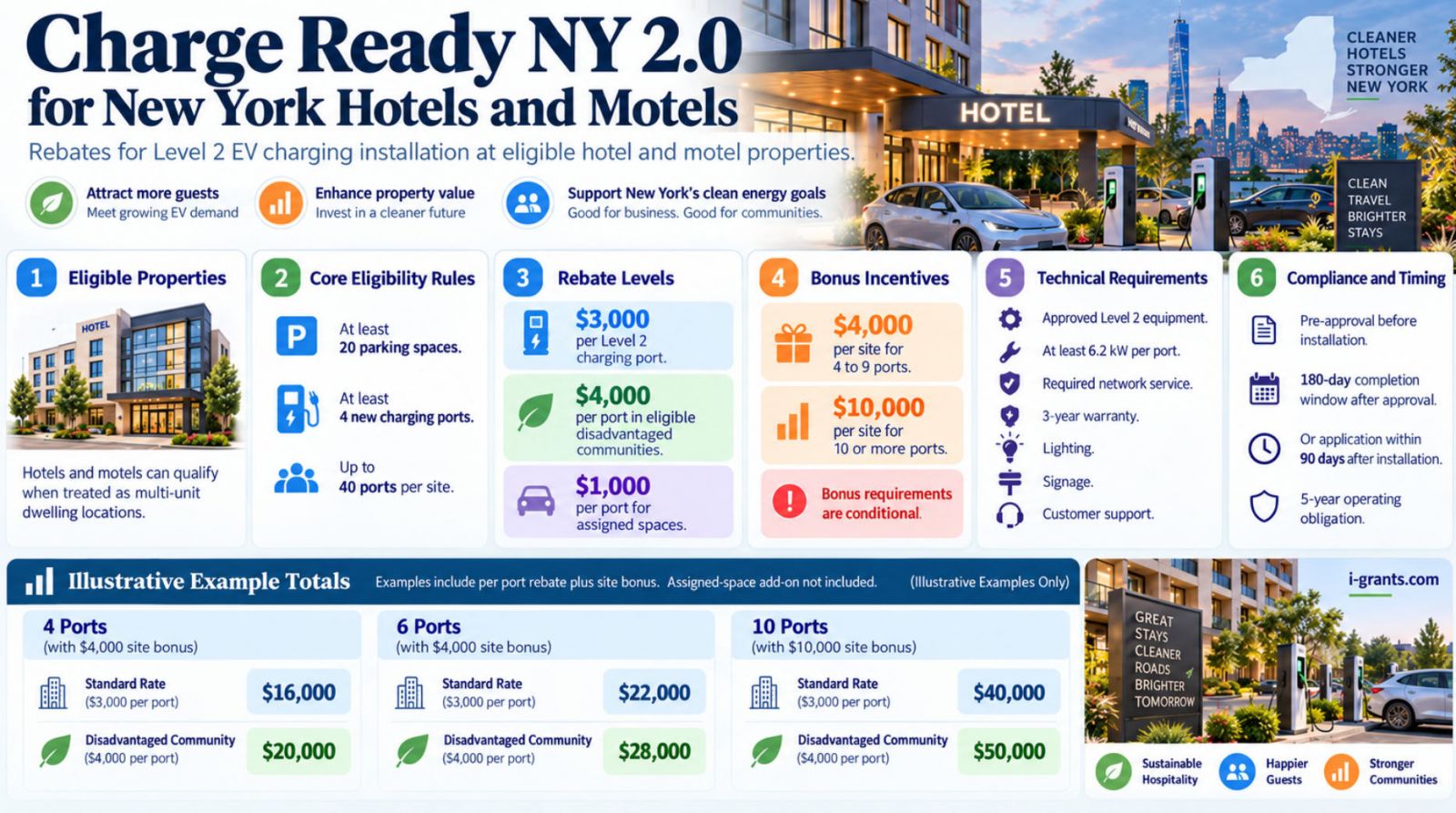
Charge Ready NY 2.0 provides fixed incentive amounts based on the number and classification of eligible charging ports.
The standard rebate is $3,000 per port for installations in eligible parking spaces available to users of the qualifying property.
At locations officially designated as Disadvantaged Communities, the incentive increases to $4,000 per port.
Charging ports installed in spaces reserved exclusively for individual drivers or qualifying fleet vehicles are subject to a reduced incentive of $1,000 per port, regardless of whether the property is located in a disadvantaged community.
A designated hotel guest parking area should not automatically be classified as assigned parking merely because a guest reserves a space during a stay. Applicants should confirm the proposed parking arrangements with the program administrator.
Table 2. Charge Ready NY 2.0 Rebate Amounts and Funding Limits
| Funding Category | Amount or Limit |
|---|---|
| Standard Level 2 charging port | $3,000 per port |
| Level 2 charging port in an eligible DAC | $4,000 per port |
| Port in an assigned parking space | $1,000 per port |
| Additional incentive for 4 to 9 ports | $4,000 per site |
| Additional incentive for 10 or more ports | $10,000 per site |
| Maximum incentives for an equipment owner | $300,000 per calendar year |
| Maximum applications by an installer | $1,000,000 in incentives per calendar year |
| Maximum eligible charging ports | Generally 40 per site |
The annual limits are particularly relevant to hotel companies managing multiple properties. NYSERDA may aggregate or limit applications submitted by affiliated entities, and the program tracks annual limitations using application approval dates.
The maximum rebate should never be confused with full reimbursement of project costs. An installation costing $45,000 does not automatically qualify for $45,000 in assistance, even if its actual expenses substantially exceed the standard incentive.
How Disadvantaged Community Eligibility Works
A Disadvantaged Community, commonly abbreviated DAC, is a geographically defined area identified under New York State's climate and environmental justice framework.
DAC designation considers socioeconomic and environmental burdens. The boundaries are determined using official geographical criteria rather than hotel classifications or municipal names.
A property in Buffalo, Rochester, Albany, or New York City does not automatically qualify for the higher rate simply because it is located in one of those cities.
Likewise, a small hotel in an otherwise economically prosperous municipality may qualify if its exact property location falls within an eligible designated area.
NYSERDA makes the final determination during the application process.
For a four-port installation, this geographical distinction represents an additional $4,000 in potential assistance. For a ten-port installation, the difference reaches $10,000.
Hotel owners should verify the property address using the state's official Disadvantaged Communities mapping resources before finalizing their funding projections.
Additional Bonuses: Can Hotels Receive More Than $4,000 per Port?
Charge Ready NY 2.0 includes a separate Bonus Incentive Program intended to encourage electric vehicle education and adoption.
Eligible workplace and multi-unit dwelling projects installing between four and nine ports may qualify for an additional $4,000 per site. Projects installing ten or more ports may qualify for an additional $10,000.
These incentives are provided on top of the standard per-port rebate but are not automatic.
Participating equipment owners must distribute NYSERDA educational materials and industry updates quarterly over a one-year period. They must also complete at least two additional activities from the program's qualifying categories.
These include participating in or organizing an electric vehicle ride-and-drive event or approved dealer presentations, facilitating qualifying electric vehicle purchases or leases, and providing free on-site charging for at least one year.
The vehicle acquisition requirements vary with installation size. For a small installation, at least one qualifying vehicle purchase is required under the applicable activity. Larger installations require at least two.
Equipment owners have up to 18 months from rebate approval to fulfill the bonus requirements, subject to the program's procedures.
Why the Bonus Requires Special Attention for Hotels
Although hotels are recognized as multi-unit dwelling locations, several bonus activities are described in terms of employees or tenants rather than temporary accommodation guests.
This creates an important administrative question for hotel owners intending to provide free charging to overnight guests.
Free charging offered exclusively to hotel guests should not automatically be assumed to satisfy the program's requirements for employees or tenants.
Before including the bonus in a financial plan, the hotel should obtain confirmation from the Electrification Coalition or the responsible program administrator that its proposed activities are eligible.
A hotel can therefore treat the standard port rebate as its primary funding scenario while considering the additional bonus as a separate opportunity requiring documented compliance.
What Charging Equipment Does NYSERDA Support?
Charge Ready NY 2.0 is specifically designed for Level 2 alternating-current charging equipment.
Level 2 chargers are particularly suitable for locations where vehicles remain parked for several hours, including overnight accommodation properties.
Unlike high-powered direct-current fast chargers, which are designed primarily for rapid charging stops, Level 2 systems can provide energy over longer parking periods without requiring the same level of instantaneous electrical capacity.
Nevertheless, the program imposes specific performance requirements.
Each charging port must be capable of delivering at least 6.2 kW simultaneously.
Power-sharing systems may be used, but charging performance must continue to meet the minimum requirement unless an individual customer agrees to a lower charging rate.
For a hotel installing four ports, the simultaneous minimum output is therefore 24.8 kW. A six-port installation would represent at least 37.2 kW of simultaneous charging output under the standard requirement.
These figures are charging outputs, not complete estimates of the electrical service upgrades required by the property. Actual electrical design must account for equipment efficiency, existing building demand, peak loading, local utility rules, and any approved charging management system.
Approved Chargers and Network Services
Not every commercial Level 2 charger qualifies.
NYSERDA maintains an approved list of charging equipment manufacturers, models, and network service providers through its RFQL 5312 qualification process.
Equipment must be approved at the time required by the program rules, including the application submission date.
A charger marketed as suitable for hotels is not necessarily eligible for the rebate.
The same applies to rebranded or white-label charging equipment. If a model has not received the required approval, it may be excluded even when the underlying hardware resembles an approved product.
Property owners should request the exact manufacturer, model number, network provider, and relevant approval information in writing before purchasing equipment.
At installation, the equipment owner must purchase at least one year of service from an approved network provider. Network connectivity and the required sharing of charging data must then be maintained throughout the five-year reporting period.
The equipment must also have a minimum three-year warranty.
For independent hotels, the practical consequence is that a cheaper non-networked charger may be an unsuitable investment, even if it would otherwise meet guests' basic charging needs.
Parking Layout, Safety and Customer Support
Charging equipment must be installed in accordance with applicable federal, state, and local requirements.
Program rules also specify visible parking signage or pavement markings identifying spaces reserved for electric vehicles while charging. Required signage must address unauthorized parking.
Equipment must be protected from vehicle impacts using compliant bollards or wheel stops. The manual specifies bollards at least 36 inches high or permanent wheel stops positioned at least 36 inches from the equipment.
The charging spaces must be adequately illuminated between dusk and dawn.
A toll-free customer support number must be displayed clearly on or near the charging equipment, with assistance available 24 hours a day, seven days a week.
Where charging fees apply, the equipment must provide the required pricing information, including applicable additional charges, before the charging session.
These conditions are particularly important for smaller hotels without dedicated technical staff. The owner must ensure that guests can obtain assistance when charging fails, even if the front desk is unable to diagnose the problem.
Which Installation Costs Should a Hotel Budget For?
The advertised rebate covers the project through a fixed incentive calculated per qualifying port, rather than reimbursing every cost item separately.
A realistic charging infrastructure budget generally involves several distinct components, and the price of the charging unit may represent only part of the investment.
The first component is the equipment itself. This includes eligible charging stations, mounting structures, network activation, warranties, and potentially integrated payment functionality.
The second component is electrical installation. Depending on the existing infrastructure, the project may require additional circuits, electrical panels, protection devices, wiring, conduit, disconnects, and labor.
More complicated projects may involve electrical service upgrades or coordination with the local distribution utility.
A third component involves site preparation. Hotels may need concrete foundations, protective bollards, trenching, pavement removal and restoration, new signage, lighting, or changes to parking arrangements.
Finally, the owner should budget for permits, professional design, network subscriptions, monitoring, repairs, and ongoing customer support.
NYSERDA requires installation invoices to identify relevant cost categories separately, including labor, electrical service upgrades, hardware, directly related site work, permitting fees, and project management.
However, the existence of a category on the required invoice does not mean the program provides a separate reimbursement for that category.
For example, a $10,000 electrical panel replacement does not generate an additional $10,000 NYSERDA payment beyond the applicable fixed per-port incentive.
Hotel owners should obtain an itemized contractor proposal that separates charging hardware, electrical work, site preparation, permitting, and continuing operating expenses.
The proposal should also identify the total cost of maintaining the required network service throughout the five-year period.
How to Apply for Charge Ready NY 2.0
The program allows applications through two distinct pathways: pre-installation approval and post-installation approval.
Both options require compliance with the same fundamental equipment and site requirements, but they expose applicants to different financial and administrative risks.
Pre-Installation Approval
Under the pre-installation pathway, the equipment owner or an authorized installer submits a project application before completing the installation.
After the application has been reviewed and approved, NYSERDA reserves the corresponding incentive funds.
The applicant then has 180 calendar days from the pre-approval date to complete the installation and submit all final documentation.
This approach provides greater budget predictability because the program allocates funding to the approved project before construction is completed.
Nevertheless, pre-approval is not an unconditional payment commitment.
Failure to meet program requirements or submit the documents within the permitted period can result in cancellation and the release of reserved funds.
For hotels requiring complicated electrical upgrades, the 180-day period should be considered during project planning. Utility coordination, contractor availability, permit processing, and seasonal construction constraints may all affect the schedule.
Post-Installation Approval
The alternative pathway allows an applicant to complete an eligible installation before submitting the rebate application.
The application must be received within 90 calendar days of the installation date.
This option may be useful when a project is already proceeding and the owner is confident that the equipment, site, and documentation meet program rules.
However, it creates greater funding uncertainty. The owner may incur installation costs before obtaining any reservation of rebate funds.
A fully completed project can still be denied if its site is ineligible, the selected equipment is not approved, the application is late, or funding has become unavailable.
For a small independent hotel, pre-installation approval is generally the more cautious choice when timing permits.
Required Application Documents
The application process requires substantially more information than a basic business description.
A pre-installation application generally includes a completed online application, an applicable permit or written confirmation that no permit is required, the Equipment Owner Agreement, Site Host Agreement, and Installer Agreement when applicable.
Applicants must also provide an itemized installation quotation identifying equipment models, hardware costs, network fees, warranty terms, and anticipated longer-term network expenses.
A site map must show the parking spaces and the proposed locations of new charging equipment, together with existing charging infrastructure.
The Equipment Owner Agreement requires a handwritten signature under the program rules. Other application documents may generally be signed electronically.
After installation, the applicant must provide additional evidence, including charging equipment serial numbers, network identifiers, geographical coordinates, equipment photographs, signage photographs, customer support information, and evidence of compliant installation.
The final documentation also includes contractor certification, applicable permits, proof of equipment and installation payments, and evidence of the required network service.
New York's Department of Agriculture and Markets EVSE notification requirements must also be addressed, with the completed notification submitted as part of the applicable documentation package.
One easily overlooked detail is the requirement to provide GPS coordinates to six decimal places for the charging equipment.
Another is the need to photograph specific compliance elements, including protective equipment, pricing information, serial numbers, and customer support details.
A project can be physically complete but administratively incomplete. Preparing the documentation checklist before construction begins helps prevent avoidable delays.
Who Actually Receives the Rebate?
Applications may be submitted by the equipment owner or by the installer acting on the owner's behalf.
The rebate can be paid directly to the equipment owner or, under an approved arrangement, to the installer.
If the installer receives the payment, the full incentive must be passed through to the equipment owner, and this treatment must be clearly documented on the invoice.
The equipment owner must complete the required Participation Agreement even when the installer manages the project application.
This distinction matters because a contractor may advertise an installation price after rebates. The hotel should verify who will receive the incentive, when that payment will occur, and whether the quoted price assumes funding that has not yet been approved.
Financial Examples: Four, Six and Ten Charging Ports
The simplest way to assess the benefit of Charge Ready NY 2.0 is to compare the applicable rebate against the proposed installation budget.
The following scenarios demonstrate the program's fixed funding mechanism.
All project costs are hypothetical planning assumptions, not published average installation prices or verified contractor quotations.
The calculations assume that the sites meet all eligibility criteria, the ports are installed in qualifying unassigned parking spaces, and NYSERDA approves the full claimed incentives.
Table 3. Illustrative Hotel EV Charging Investments and NYSERDA Rebates
| Project Scenario | 4 Ports | 6 Ports | 10 Ports |
|---|---|---|---|
| Hypothetical total project cost | $36,000 | $51,000 | $85,000 |
| Standard NYSERDA rebate | $12,000 | $18,000 | $30,000 |
| Owner contribution after standard rebate | $24,000 | $33,000 | $55,000 |
| Rebate in an eligible DAC | $16,000 | $24,000 | $40,000 |
| Owner contribution after DAC rebate | $20,000 | $27,000 | $45,000 |
| Potential separate bonus, if approved | $4,000 | $4,000 | $10,000 |
These examples demonstrate why the location of the hotel can materially affect the project budget.
For a four-port installation costing an assumed $36,000, the standard $12,000 rebate would cover one-third of the stated investment.
If the property qualifies for the DAC rate, the $16,000 rebate would reduce the owner's contribution to $20,000, before considering any other eligible financial incentives or financing arrangements.
However, the program's rules should not be represented as offering a universal reimbursement percentage. The proportion of the cost covered by a fixed rebate changes according to the actual investment.
A more expensive project with extensive electrical upgrades may receive exactly the same per-port rebate as a relatively straightforward installation.
Why Two Charging Ports Are Not Enough
Consider a small motel planning to install one dual-port charger at a total cost of $14,000.
At first glance, multiplying two ports by the standard $3,000 incentive suggests $6,000 in potential assistance.
That calculation would be misleading.
Charge Ready NY 2.0 requires a minimum of four new charging ports at each eligible site. A standalone installation involving only two ports does not satisfy the minimum requirement.
The motel would need to consider a larger qualifying project, another suitable financing opportunity, or a fully self-financed installation.
For owners who only require one or two charging connections, increasing project size solely to qualify for the rebate may not be financially sensible.
The optimal installation is not necessarily the one generating the highest grant or rebate payment. It is the one that meets actual operational demand at a reasonable total cost.
What Does It Cost to Operate Hotel Charging Stations?
The initial installation incentive is only one component of the financial decision.
Once installed, charging equipment consumes electricity, requires an active network connection, and may generate maintenance and customer service expenses.
Some hotels offer free charging as an accommodation benefit. Others charge guests directly, apply a fee through the charging network, or combine free charging for registered guests with paid access for additional users where permitted.
Each model produces different financial outcomes.
A Four-Port Operating Example
Suppose a hotel installs four charging ports and each port is used for one charging session per day.
Assume each charging session delivers an average of 20 kWh to a vehicle.
Over a 30-day period, the installation would deliver 2,400 kWh to guests' vehicles.
If the charging process operates at an assumed 90 percent efficiency, electricity purchased from the grid would be approximately 2,667 kWh.
With an illustrative electricity cost of $0.20 per kWh, the monthly energy expense would be approximately $533.
If the hotel charged customers $0.35 per kWh delivered to their vehicles, gross charging revenue would be $840.
The difference between charging revenue and the electricity cost would be approximately $307 before all other operating expenses.
Table 4. Illustrative Monthly Operating Economics for Four Hotel Charging Ports
| Indicator | Assumption or Calculation |
|---|---|
| Charging ports | 4 |
| Average sessions per port per day | 1 |
| Energy delivered per session | 20 kWh |
| Monthly electricity delivered to vehicles | 2,400 kWh |
| Assumed charging efficiency | 90 percent |
| Monthly electricity purchased | Approximately 2,667 kWh |
| Electricity purchase price | $0.20 per kWh |
| Monthly electricity expense | Approximately $533 |
| Customer charging price | $0.35 per kWh |
| Monthly gross charging revenue | $840 |
| Balance before other operating expenses | Approximately $307 |
This example is deliberately simplified.
The $307 balance is not net operating profit. It excludes network fees, payment processing charges, repairs, insurance implications, depreciation, potential electricity demand charges, and applicable taxes.
It also assumes consistent daily use, which may be unrealistic for a hotel with strong seasonal demand.
A property with lower utilization could generate significantly less revenue while still paying recurring network and service costs.
For a hotel offering charging free of charge, direct revenue would be zero. The commercial case would then depend on indirect benefits such as guest satisfaction, possible room bookings influenced by charging availability, or improved competitiveness.
Those benefits should not be assigned arbitrary monetary values without evidence from the hotel's actual business.
Understanding Electricity Demand Charges
One of the most frequently overlooked issues in commercial charging investments is the structure of the electricity tariff.
Commercial customers may pay not only for the electricity consumed in kWh but also for their maximum electrical demand during a billing period.
Adding several charging ports can increase peak electrical demand if guests begin charging simultaneously during periods when the hotel's heating, cooling, kitchen, laundry, and other systems are also operating at high capacity.
A property might therefore experience a higher electricity bill than a simple multiplication of kWh consumption and the energy rate suggests.
Before installation, an electrical professional should review the property's existing electricity consumption and demand profile.
Load management may help coordinate vehicle charging with other building loads, provided the system continues to satisfy NYSERDA's technical requirements.
A meaningful feasibility study should compare overnight charging patterns, electricity tariffs, equipment capacity, projected utilization, and long-term maintenance requirements.
Can Charge Ready NY 2.0 Be Combined with Other Incentives?
New York hotel owners may encounter multiple EV charging incentives, including NYSERDA rebates, utility infrastructure support, state tax credits, and historical federal programs.
These opportunities are not automatically interchangeable or compatible.
The key question is whether the same charging equipment or costs are receiving funding from a source that the program prohibits.
New York State EV Charging Property Tax Credit
New York State provides a separate tax credit for qualifying alternative fuel vehicle refueling and electric vehicle recharging property.
The state credit is generally calculated as the lesser of $5,000 per eligible installation or 50 percent of qualifying property costs after accounting for the applicable grant-funded amounts.
Charge Ready NY 2.0 expressly permits participating projects to claim the New York State charging property tax credit, subject to the relevant tax rules and the required reduction for NYSERDA funding.
However, the tax credit differs fundamentally from the NYSERDA rebate.
A rebate is an incentive payment issued after successful completion and verification of the funded project.
The state tax credit is nonrefundable and applies through the taxpayer's relevant tax return. Its financial value depends on the applicant's tax position, the applicable statutory requirements, and the calculation performed under the state's tax rules.
Hotel owners should also avoid assuming that a charging port and a qualifying installation are identical units for tax purposes. The applicable tax forms and definitions must be used when calculating the maximum available credit.
An accountant familiar with New York business taxation should assess the credit separately from the NYSERDA application.
Federal Alternative Fuel Infrastructure Tax Credit
The federal Alternative Fuel Vehicle Refueling Property Credit under Internal Revenue Code Section 30C previously offered additional support for qualifying installations.
However, legislative changes accelerated the termination of this credit.
Under the revised federal rules, Section 30C is not available for qualifying property placed in service after June 30, 2026.
Consequently, a hotel beginning a new installation after that date should not include this federal credit in its projected financing package.
Older promotional materials or online articles referring to a termination date in 2032 should not be used without considering the subsequent legislative changes.
Utility Make-Ready Programs
Utility make-ready programs historically supported infrastructure required to connect charging stations to the electricity network.
These programs may address costs such as electrical infrastructure, distribution upgrades, and certain installation work.
However, availability varies by utility and program status.
For example, Con Edison's PowerReady Light-Duty program stopped accepting new Level 2 project applications on April 22, 2026.
A hotel cannot assume that a utility incentive remains available simply because the program's historical documentation or past recipient announcements remain online.
Furthermore, Charge Ready NY 2.0 excludes projects receiving charging equipment funding from certain other state and federal programs, including specified NYSDEC initiatives, the NYPA ReCharge NY Workplace Charging Program, and federal NEVI or CFI charging grants.
Projects in which third parties have completely paid for the charging equipment are also excluded.
Utility make-ready contributions and other third-party incentives must be clearly disclosed in the installation invoices submitted to NYSERDA.
Before combining financing sources, hotel owners should obtain written clarification on compatibility, identify the precise costs covered by each source, and ensure that no expense is improperly funded twice.
A Real New York Hotel Charging Project: Batavia Downs
An example from Western New York illustrates the scale and practical structure of a hotel charging investment supported by utility incentives.
In August 2024, National Grid announced that Batavia Downs Gaming & Hotel had installed 16 Level 2 EV charging plugs through its Electric Vehicle Make-Ready Program.
The installation included 12 plugs in the main parking lot and four additional plugs in the VIP and valet parking area.
According to National Grid, the project received $96,000 in incentives, covering approximately 78 percent of infrastructure-related construction costs, including eligible labor and materials.
The investment also helped increase the site's electrical infrastructure capacity to accommodate potential future charging expansion.
This case provides several practical lessons for hotel businesses.
First, EV charging investments often include substantial infrastructure work beyond the visible charging stations. Second, the parking layout can influence how charging equipment is distributed and used. Third, electrical modernization may allow a property to expand charging capacity later as demand develops.
However, the distinction between incentive programs is essential.
The documented $96,000 payment was provided through National Grid's Electric Vehicle Make-Ready Program. It should not be described as a Charge Ready NY 2.0 award.
The project is therefore a verified example of hotel EV charging supported by public utility incentives, not evidence that Batavia Downs received the NYSERDA rebate discussed in this guide.
Earlier Hotel Experience in Albany
Another documented example involves the Albany Holiday Inn Express, which installed Level 1 and Level 2 charging equipment in September 2011.
A historical NYSERDA case study reported an installation cost of approximately $7,000, paid by the hotel itself.
Although this project predates Charge Ready NY 2.0 by many years, it demonstrates that accommodation businesses were experimenting with EV charging before dedicated charging infrastructure incentives became more widely available.
The case should be treated as historical operational experience rather than a current program funding example.
Together, the two examples reinforce the importance of distinguishing verified projects, specific financing sources, and operational lessons. Installing charging equipment does not establish that a hotel participated in Charge Ready NY 2.0.
Five-Year Operating Obligations and Repayment Risks
Receiving the rebate creates a continuing obligation.
Under Charge Ready NY 2.0, equipment owners must maintain the charging stations at their approved locations for at least five years from installation.
The equipment must remain functional and connected to the required charging network throughout the reporting period.
Owners must also provide NYSERDA with access to the prescribed charging data, including information necessary to verify ongoing operation and program performance.
If equipment is replaced or the approved network provider changes, the owner must notify the program administrator and provide the required updated information, generally within 30 days.
The owner is responsible for arranging repairs and must initiate the repair process within 24 hours after receiving notice of a malfunction or operational problem.
Equipment that remains out of service for 90 consecutive days because of technical problems may be considered inoperable under the program rules.
These obligations are not merely administrative.
NYSERDA may require partial repayment if funded charging equipment is removed, relocated, becomes inoperable, or loses required network service before the end of the five-year period.
The program uses a proportional recoupment mechanism based on the remaining period of the obligation.
For example, if a hotel received a $16,000 rebate and permanently retired the funded installation after 30 months, the remaining 30 months could result in a repayment obligation of approximately $8,000, assuming the circumstances fall under the standard recoupment rules and no qualifying replacement is accepted.
For hotel properties that may be sold, renovated, or converted to another use, this obligation should be considered before signing the participation agreement.
A planned property sale does not automatically eliminate the equipment owner's obligations under the program.
Common Application Mistakes That Hotel Owners Should Avoid
Several seemingly minor mistakes can cause delays, cancellation, or the loss of an otherwise valuable incentive.
The most important risks concern project size, property ownership, equipment eligibility, documentation quality, and application timing.
-
Incorrect parking calculations. A hotel may meet the minimum of 20 parking spaces but still exceed the applicable limit on the number of eligible charging ports. Assigned and unassigned spaces must be counted correctly, including any existing chargers.
-
Ineligible ownership structure. A hotel operator may incorrectly submit an application despite not owning the property, which is particularly problematic under the program's multi-unit dwelling rules.
-
Equipment purchased without approval verification. A charging station may meet ordinary commercial specifications while failing NYSERDA's approved equipment or network requirements.
-
Insufficient installation documentation. Missing permits, itemized invoices, photographs, network identifiers, signatures, or payment evidence can prevent the release of funds.
-
Missed deadlines. Pre-approved projects must meet the 180-day completion and documentation requirement, while post-installation applications generally must be submitted within 90 days after installation.
-
Failure to maintain the equipment. Network disconnection, prolonged technical failures, or premature removal can trigger repayment obligations.
Applicants generally have 15 calendar days after notification to correct incomplete or deficient application materials.
If deficiencies are not corrected within the required period, the application may be cancelled and any reserved funds released.
Because the program uses fixed eligibility criteria, preparing an exceptionally detailed business narrative cannot compensate for installing unapproved equipment or failing the required parking capacity test.
For many small hotels, careful compliance management may therefore be more valuable than an elaborate promotional description of the proposed investment.
The Role of a Professional Grant Writer or Funding Adviser
Although Charge Ready NY 2.0 is primarily a rebate program, its application process requires coordinated legal, technical, financial, and administrative work.
A professional grant writer or funding adviser can help hotel owners organize this process, particularly when the applicant does not maintain a dedicated internal project management or compliance team.
The adviser can begin by assessing eligibility against the program's property and parking requirements. This includes reviewing the proposed applicant's legal status, the ownership structure, the project location, and the number of eligible charging ports.
The next stage may involve assembling a funding checklist, reviewing contractor quotations for completeness, documenting eligible equipment models, and coordinating the required agreements among equipment owners, site owners, and installers.
A funding professional can also help prepare the overall investment budget, compare the standard and DAC rebate scenarios, identify the documentation needed for tax advisers, and clarify potential interactions with other incentive programs.
During implementation, the adviser may maintain an application calendar, track outstanding documents, organize final submission materials, and support communication with the program administrator.
Importantly, a grant writer does not replace a licensed electrician, engineer, architect, legal adviser, or tax professional.
Electrical capacity assessments, equipment installation, construction permits, compliance with electrical codes, and technical certification must remain with the appropriately qualified specialists.
The most effective arrangement combines a technically competent installation team with professional financial and administrative coordination.
For hotels exploring available support, platforms such as i-grants.com can help connect project owners with grant-writing and funding professionals who understand application preparation, program compliance, and investment documentation.
Is Charge Ready NY 2.0 Worthwhile for a Small Hotel?
The financial attractiveness of the program depends on more than the nominal rebate.
A qualifying hotel that can install four ports using existing electrical infrastructure may face a considerably different investment decision from a property requiring a major electrical service upgrade.
A favorable scenario is one in which the hotel has sufficient parking, suitable electrical capacity, an eligible legal ownership structure, and a reasonable expectation that guests will use the chargers regularly.
A less favorable scenario involves an installation driven mainly by the desire to receive an incentive, despite limited parking, uncertain customer demand, or disproportionately expensive electrical improvements.
For an independent hotel, the most useful financial comparison is the total five-year investment and operating cost after realistic incentives, rather than the amount of the initial rebate alone.
That comparison should include the installation budget, eligible rebate, potential tax treatment, annual electricity consumption, network fees, maintenance requirements, and expected charging utilization.
It should also consider whether charging is intended as a paid service or an amenity supporting the accommodation business.
A hotel that cannot demonstrate direct charging profitability may still reasonably invest in charging infrastructure if the service supports its broader commercial strategy. However, claims about increased occupancy, room rates, or guest spending must be supported by actual operating data rather than assumptions about electric vehicle owners.
A Practical Decision Framework
Before committing to the investment, the hotel owner should resolve four questions.
Can the property qualify? The hotel must satisfy the applicable ownership, accommodation, parking, seasonal operation, and minimum port requirements.
Can the equipment be installed economically? An electrical assessment should identify the actual infrastructure work needed and determine whether the project can be completed within a reasonable budget.
How much confirmed assistance is available? The owner should distinguish the standard rebate from DAC supplements, conditional bonuses, tax credits, and discontinued utility programs.
Can the installation remain operational for five years? The hotel's financial plan must accommodate network service, maintenance, customer support, and compliance responsibilities throughout the required operating period.
A positive answer to all four questions creates a much stronger investment case than the rebate amount alone.
Frequently Asked Questions
Can an independently owned motel apply for Charge Ready NY 2.0?
Yes, motels are expressly included among the eligible property types. However, the property must meet the minimum site requirements, including the applicable dwelling-unit and parking rules, and must install at least four qualifying charging ports.
A small motel with fewer than 20 parking spaces does not meet the minimum parking requirement, even if it operates legally and wants to install commercial charging equipment.
Is the program available throughout New York State?
Yes. Charge Ready NY 2.0 is a statewide initiative, not a funding program limited to New York City.
Eligible hotels in upstate New York, Long Island, the Hudson Valley, the Capital Region, Western New York, and other parts of the state may participate.
The higher $4,000 rebate depends on the property's location within an officially designated Disadvantaged Community.
Can a hotel receive $4,000 for every charger?
Not necessarily. The standard rebate is $3,000 per qualifying port, with an additional $1,000 for eligible locations within a designated disadvantaged community.
The program calculates payments per charging port rather than simply counting physical charging stations.
Moreover, assigned parking spaces receive a reduced rate, and the property must meet all applicable conditions.
Can a hotel install only two charging ports?
A standalone two-port installation does not satisfy the program's four-port minimum.
For a property that genuinely needs only one or two ports, the owner should investigate other financing possibilities rather than automatically expanding the project to meet the minimum.
Does the hotel receive funding before the chargers are installed?
Generally, no. NYSERDA pays the rebate after the eligible installation is completed and the required documentation is approved.
Pre-installation approval reserves the corresponding incentive funds but does not constitute an advance payment.
Are fast chargers eligible?
Charge Ready NY 2.0 is intended for approved Level 2 charging equipment.
Direct-current fast charging projects require evaluation under other financing structures, where available, and should not be assumed eligible for the standard Charge Ready NY 2.0 rebates.
Can the hotel charge guests for electricity?
The program does not generally require charging to be provided free of charge under the standard rebate.
However, pricing display, network operation, and other applicable requirements must be satisfied.
Free charging may form part of the separate bonus incentive conditions, but the eligibility of a hotel's specific guest charging arrangement should be confirmed before claiming that bonus.
How long must the chargers remain operational?
The minimum operating and reporting commitment is five years.
Equipment removal, disconnection, failure to maintain network service, or other specified compliance breaches during this period may result in partial repayment of the rebate.
Final Assessment: A Valuable Rebate with Strict Eligibility Conditions
Charge Ready NY 2.0 gives eligible New York hotels and motels a concrete opportunity to reduce the cost of installing Level 2 electric vehicle charging infrastructure.
The standard $3,000 per-port rebate, increased to $4,000 in designated disadvantaged communities, can meaningfully reduce the initial investment for qualifying properties.
An eligible four-port project may receive $12,000 to $16,000 before any separately approved bonus, while larger installations can receive proportionally greater assistance within the program's limits.
However, the program is not designed for every small accommodation business.
The minimum four-port installation requirement, 20-space parking threshold, property ownership rules, approved equipment requirements, and five-year operational commitment can exclude smaller or structurally complicated projects.
Moreover, the rebate does not eliminate construction costs or guarantee a profitable charging service.
Hotel owners should therefore approach Charge Ready NY 2.0 as part of a carefully planned infrastructure investment. A complete project assessment should combine funding eligibility, electrical feasibility, realistic operating assumptions, and long-term compliance obligations.
With the right property characteristics and investment structure, the program can help accommodation businesses add a practical service for electric vehicle travelers while reducing the financial burden of modernization.
For property owners navigating the process, coordinated support from qualified engineers, installers, tax professionals, and grant-funding advisers can make the difference between a technically completed installation and a fully compliant, financially supported project.