

 Français
  Deutsch
  Українська
For a small nonprofit theater, a leaking roof, outdated stage lighting, an inaccessible entrance, or a failing ventilation system can threaten far more than the condition of a building. These problems can reduce the number of performances, limit audience participation, increase operating costs, and eventually undermine an organization's ability to serve its community. Yet capital improvements are among the most difficult investments for cultural nonprofits to finance because ticket revenue, donations, and ordinary operating grants rarely provide enough money for major construction or equipment purchases.
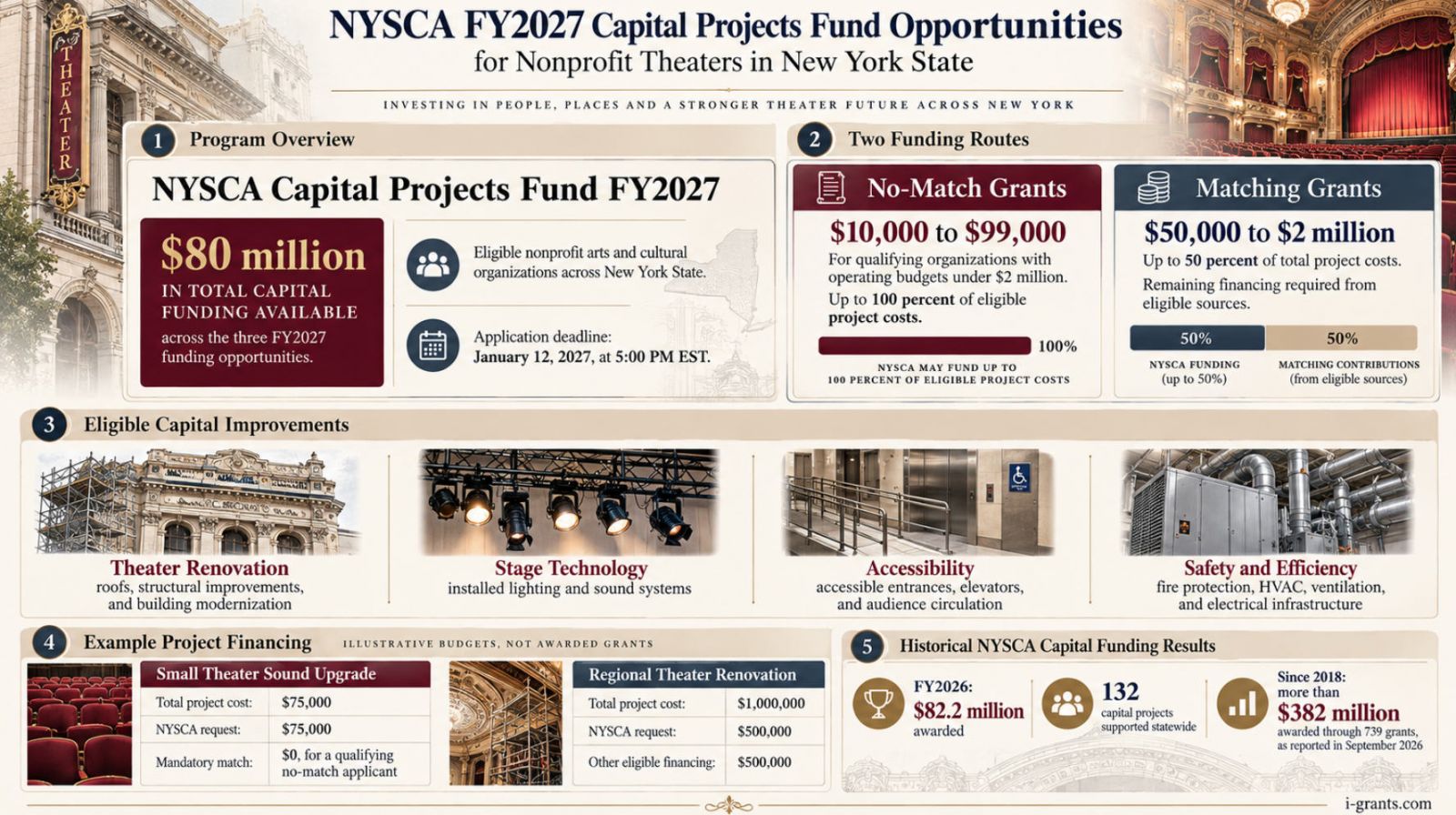
New York State offers a substantial funding opportunity through the New York State Council on the Arts (NYSCA) Capital Projects Fund. Under the FY2027 Small and Midsize Capital Improvement Grants for Arts and Culture, eligible nonprofit organizations can request between $10,000 and $2 million for qualifying construction and capital equipment projects. Smaller organizations may qualify for grants of up to $99,000 without mandatory matching funds, while larger requests can cover up to 50 percent of a project's total cost.
The latest funding round is particularly significant. On September 15, 2026, New York State announced $80 million in capital funding for nonprofit arts and cultural organizations through three complementary NYSCA opportunities. Applications for the FY2027 Capital Projects Fund are open, with a deadline of January 12, 2027, at 5:00 p.m. Eastern Standard Time.
The program is not restricted to prominent New York City theaters or major performing arts institutions. Eligible organizations throughout New York State can seek support for investments that improve cultural infrastructure, strengthen accessibility, preserve historic facilities, reduce environmental impacts, and create safer, more functional spaces for artists and audiences.
However, the difference between a promising theater renovation and a competitive NYSCA application is substantial. Applicants need to understand the program's funding categories, establish appropriate control over their premises, distinguish capital expenditures from ordinary operating costs, and demonstrate that the proposed investment can be completed and maintained.
This guide examines the FY2027 funding opportunity, eligibility requirements, financing rules, eligible projects, actual NYSCA-funded theaters, and practical budget scenarios. It also explains how nonprofit theater managers can prepare stronger applications without exposing their organizations to unnecessary financial or construction risks.
Understanding the NYSCA Capital Projects Fund
The New York State Council on the Arts is a state agency supporting artistic and cultural development across New York. Its Capital Projects Fund focuses on the physical infrastructure that allows cultural organizations to operate, expand their programming, and remain accessible to the public.
Unlike general operating grants, which may support regular organizational activities, the Capital Projects Fund is designed for investments in buildings, facilities, and qualifying capital equipment. Its purpose is not simply to improve the appearance of cultural venues. NYSCA seeks investments that strengthen an organization's ability to serve audiences, support artistic work, contribute to community development, and operate sustainably over time.
For nonprofit theaters, this creates several possible funding pathways. A small community theater might replace an outdated installed sound system, while a regional performing arts center could undertake extensive accessibility improvements. A historic theater might seek support for structural restoration, and a larger institution could modernize its ventilation, electrical, or fire protection systems.
The FY2027 Capital Projects Fund contains three major opportunities. Although this article focuses on Small and Midsize Capital Improvement Grants, applicants should understand how the other categories fit into the overall funding structure.
Table 1. NYSCA FY2027 Capital Projects Funding Categories and Grant Requirements
| Funding category | Grant amount | Funding conditions | Appropriate projects |
|---|---|---|---|
| Small and Midsize Capital Improvement, no-match | $10,000 to $99,000 | For qualifying organizations with operating budgets under $2 million; up to 100 percent of eligible costs | Smaller construction and capital equipment improvements |
| Small and Midsize Capital Improvement, matching | $50,000 to $2 million | NYSCA covers no more than 50 percent of total project cost; organizations of any operating size may apply | Theater renovations, accessibility, infrastructure, installed equipment systems |
| Large Capital Improvement | $2 million to $10 million | Projects must cost at least $4 million; NYSCA funding cannot exceed 50 percent | Major cultural construction, expansion, and redevelopment |
| Capital Design, no-match | $10,000 to $99,000 | Available to qualifying organizations with budgets under $2 million | Eligible development of capital project design documentation |
| Capital Design, matching | $50,000 to $500,000 | Up to 50 percent of design-phase costs; organizations with budgets of $10 million or less | Mid-stage and advanced architectural or engineering design |
The $80 million announced for FY2027 represents the combined capital funding opportunity, not a separate $80 million allocation exclusively for nonprofit theaters or for the Small and Midsize category.
Another important distinction concerns grant requests below $100,000. The no-match category is not simply a smaller version of the standard matching grant. It has specific organizational budget restrictions and can finance up to the full eligible project cost. Meanwhile, organizations requesting between $50,000 and $99,000 under the matching route must satisfy the matching conditions applicable to that category.
A theater requesting $75,000 could therefore face very different financing requirements depending on its organizational eligibility and selected funding route.
Organizations should also distinguish capital improvement grants from Capital Design Grants. A theater that is still investigating possible construction solutions, preparing technical designs, or developing architectural documentation may not yet be ready for an implementation grant. In some circumstances, the design opportunity offers a more suitable route to preparing a future construction project.
Who Can Apply for Nonprofit Theater Grants in New York?
The central requirement is that the applicant must be an eligible nonprofit arts and cultural organization operating in New York State.
For most potential applicants, this means an organization recognized as tax-exempt under Section 501(c)(3) of the Internal Revenue Code, with a primary mission connected to arts and culture. The organization must satisfy the applicable New York State registration, location, and operational requirements, and the proposed capital project must be situated within the state.
A community theater presenting plays and educational performances, a nonprofit performing arts organization operating its own theater, or a cultural center maintaining a publicly accessible performance venue may be suitable applicants.
A privately owned commercial theater does not qualify merely because it stages artistic performances or occupies a historic building. Likewise, a profitable entertainment business cannot automatically become eligible by creating a charitable fundraising campaign around its renovation.
The applicant's legal identity and actual organizational purpose matter.
Organizations whose primary mission is not arts and culture, fiscally sponsored projects, commercial companies, and publicly administered institutions may face exclusions or special eligibility restrictions. Applicants operating within a larger nonprofit structure should consult NYSCA when their organizational arrangement is not straightforward.
The no-match category introduces an additional financial condition. The FY2027 program identifies organizations with operating budgets under $2 million as potentially eligible for grants between $10,000 and $99,000 without mandatory matching funds. The exact operating expense documentation and measurement requirements must be checked against the applicable FY2027 guidelines.
For organizations with larger operating budgets, the standard matching category remains available, provided the applicant satisfies the remaining conditions.
Why Operating Budget Size Matters
Operating budget size is not the same as the proposed construction budget.
Consider two hypothetical theaters. The first has annual operating expenses of $680,000 and plans a $75,000 sound system installation. The second has annual operating expenses of $3.4 million and wants to complete an identical investment.
The first organization could potentially use the no-match funding route, subject to all other requirements. The second would not qualify for that route solely on the basis of its operating budget and would need to examine the matching category or another suitable funding opportunity.
Importantly, the smaller theater is not prohibited from applying for a matching grant. If its investment is substantial and it has reliable co-financing, the matching route may be appropriate.
This distinction matters because many small nonprofit theaters assume that a smaller organization must always request a smaller grant. In reality, NYSCA offers different financing structures, and the correct selection depends on organizational eligibility, the scale of the investment, and the organization's capacity to finance the overall project.
Building Ownership and Long-Term Site Control
Property rights are among the most easily underestimated eligibility issues in cultural infrastructure funding.
A nonprofit theater can have a successful artistic program, substantial community support, and an urgent need for renovation without having sufficient legal control over the building in which it operates.
NYSCA capital funding requires applicants to demonstrate an appropriate legal relationship with the project site. Ownership is the most straightforward arrangement, but qualifying long-term leases and other permitted forms of site control may also be relevant.
The critical question is whether the organization can legally implement the proposed improvement and continue using the resulting capital asset for its expected useful life.
For example, installing expensive permanent ventilation equipment in a building with only a short remaining lease creates an obvious risk. The organization could lose access to the building before the investment delivers its intended long-term benefits.
Earlier NYSCA capital guidelines linked site-control requirements to the expected useful life of capital improvements, with specific exceptions for certain smaller equipment projects. Applicants to FY2027 must consult the current rules rather than assume that every previous exception remains unchanged.
A theater that owns its building should prepare appropriate ownership documentation and identify any restrictions affecting construction. A theater operating under a lease should carefully review the remaining term, renewal rights, permissions for structural work, and the allocation of responsibilities between tenant and landlord.
Landlord consent may be necessary, but consent alone does not necessarily establish the level of site control required by NYSCA.
This issue becomes particularly important for organizations operating in historic buildings, municipal facilities, shared cultural centers, or spaces owned by third parties.
A theater planning to spend $300,000 on improvements to leased premises should resolve these legal questions before investing heavily in architectural drawings or grant-writing services.
What Renovation and Equipment Projects Can Receive Funding?
The strongest NYSCA capital proposals address a clearly defined physical infrastructure problem and explain how solving it will strengthen cultural activities over the long term.
The FY2027 program emphasizes accessibility, artistic development, sustainability, health and safety, structural improvements, and the preservation of cultural facilities.
For nonprofit theaters, these priorities translate into a wide range of potential investments.
Theater Renovation and Structural Improvements
Qualifying construction and renovation may involve substantial improvements to existing theatrical buildings, new construction, expansion, or restoration.
For example, replacing a deteriorated roof as part of a qualifying capital restoration can protect expensive sound and lighting equipment, prevent water damage, and allow a theater to continue operating safely.
Other potential projects include modernizing electrical distribution systems, renovating public entrances, reconfiguring performance spaces, improving building envelopes, and installing new systems necessary for the safe operation of a cultural venue.
However, the program distinguishes capital improvements from routine repairs or maintenance.
Replacing a failed component as ordinary maintenance does not automatically qualify as a capital project. The applicant must demonstrate that the proposed expenditure meets the relevant definition of a capital investment, including the required relationship to a lasting physical asset or improvement.
Stage Lighting and Sound Equipment
Technical equipment can be especially important for small theaters because outdated systems may limit production quality and increase the complexity of artistic work.
NYSCA has previously supported complete sound systems, theatrical lighting systems, and other installed production technologies.
A competitive application should describe the complete system being proposed, its technical specifications, how it integrates with the venue, and why it represents a qualifying capital investment rather than a routine equipment purchase.
A request for several portable microphones or individual replacement fixtures is not equivalent to a comprehensive installed system. Equipment classification, permanence, useful life, and the program's detailed eligibility rules can determine whether an expenditure is allowable.
Accessibility Improvements
Accessibility investments are particularly relevant to nonprofit theaters because physical barriers can prevent people with disabilities from attending performances, participating in educational programs, or working as artists and staff.
Potential projects include accessible entrances, appropriate ramps and doorways, elevators or lifting systems, accessible restrooms, improvements to audience circulation, and capital alterations to seating areas.
Certain installed assistive listening systems may also be relevant, depending on the equipment and project structure.
A strong accessibility proposal should explain which barriers currently exist, whom they affect, how the improvements address those barriers, and how the organization will measure increased access.
The project should also account for applicable building codes, accessibility standards, architectural requirements, and the practical needs of the theater's users.
Heating, Ventilation, Energy Efficiency, and Safety
Older theater buildings often contain aging heating, cooling, ventilation, electrical, or fire protection systems. These may become increasingly expensive to operate while making the building less comfortable or safe.
Capital improvements can therefore serve several purposes simultaneously.
Replacing obsolete HVAC equipment could improve audience comfort, protect sensitive theatrical equipment, and reduce energy consumption. Upgrading electrical infrastructure may support safer theatrical systems, while new fire protection equipment can address major building safety needs.
Environmental sustainability is an explicit NYSCA priority, but an applicant should not assume that every energy-saving appliance or minor efficiency measure is automatically eligible.
The proposed work must still qualify as a capital expenditure under the program.
Table 2. Potential NYSCA-Funded Theater Improvements and Important Eligibility Considerations
| Investment type | Potential capital project | Main eligibility consideration |
|---|---|---|
| Structural renovation | Roof reconstruction, building restoration, substantial structural improvements | Must qualify as a capital improvement rather than routine maintenance |
| Stage lighting | Complete installed lighting system, electrical infrastructure, control systems | Permanent installation, technical specifications, useful life |
| Sound equipment | Integrated theatrical sound systems and installation | Capital character of the complete system, not merely portable equipment |
| Accessibility | Accessible entrances, lifts, elevators, restrooms, audience circulation improvements | Appropriate design, codes, site control, eligible construction costs |
| HVAC and ventilation | Replacement or modernization of qualifying building systems | Capital eligibility, energy and operational justification |
| Fire safety | Sprinkler systems, qualifying fire protection and building safety improvements | Technical compliance, permits, capital scope |
| Historic preservation | Substantial restoration of culturally important architectural elements | Historic review and other regulatory requirements |
| Audience facilities | Qualifying seating and significant interior improvements | Permanent capital improvement and documented audience benefit |
| Routine operations | Staff salaries, performances, ordinary utilities, maintenance | Generally outside the Capital Projects Fund |
| Property acquisition | Purchase of a building or land | Not generally payable directly with NYSCA capital grant funds |
The table identifies project types that may be relevant to theaters, not an automatic approval of every listed purchase. Exact cost eligibility, documentation, and funding restrictions are governed by the FY2027 program guidelines and eventual grant agreement.
Which Expenses Are Not Eligible?
An important reason for unsuccessful capital applications is the inclusion of costs that belong to ordinary theater operations rather than infrastructure investment.
Expenses associated with producing performances, paying actors, marketing upcoming productions, providing everyday administrative services, or maintaining existing equipment generally do not qualify under this capital funding opportunity.
Likewise, the purchase of isolated portable equipment, routine repair work, general overhead, and unrelated professional services can fall outside the program's permitted scope.
Certain expenditures associated with a construction project, such as architectural and engineering services, construction management, project contingencies, or other related professional costs, may be eligible subject to specific limitations.
The FY2027 funding information identifies restrictions on soft costs, including a general ceiling of 15 percent of the NYSCA grant amount, with additional limitations applying to individual expense categories.
This is not a universal allowance to spend 15 percent of the award on consulting or administration. Only expenditures expressly permitted by the guidelines can be included, and the applicable sublimits must also be respected.
For example, a theater requesting $500,000 might calculate that 15 percent equals $75,000. That calculation does not mean the organization can automatically allocate $75,000 to grant-writing services, legal fees, permitting fees, or general administration.
Instead, the theater needs an itemized budget that distinguishes eligible construction expenses, qualifying installed systems, permitted project-related professional costs, and expenditures that must be financed outside the NYSCA grant.
This distinction should be settled during budget preparation, not after the grant has been awarded.
How Matching Funds Work for Theater Renovation Grants
NYSCA offers two fundamentally different financing routes for Small and Midsize Capital Improvement Grants.
Under the no-match category, an eligible smaller organization may request between $10,000 and $99,000 and finance up to 100 percent of eligible project costs through the grant.
Under the matching category, the grant may not exceed 50 percent of the project's total cost.
That means a theater seeking $500,000 from NYSCA must have an overall qualifying project budget of at least $1 million. The remaining funding must be provided through other eligible sources.
Importantly, the match is not calculated as 50 percent of the requested grant. It is based on the total project cost.
For a theater requesting $150,000, the minimum corresponding total project budget under a 50 percent funding structure would be $300,000, not $225,000.
State Funding Cannot Simply Be Counted Twice
The matching category also restricts the proportion of project financing that can come from New York State sources.
NYSCA funding combined with other committed New York State funding cannot exceed 50 percent of the overall project cost under the applicable matching rules.
Consider a hypothetical theater with a $1 million project.
If it requests $500,000 from NYSCA, it cannot automatically count an additional $200,000 state grant as part of the remaining contribution without accounting for the combined state funding limit.
A more viable financing structure might include $500,000 from NYSCA, $300,000 from private foundations and donors, and $200,000 from unrestricted organizational reserves.
Other scenarios may be possible, but applicants must carefully classify every contribution and follow the specific rules governing its use.
NYSCA also expects applicants to demonstrate that project financing is realistic. A funding plan supported by documented contributions and committed resources is different from a plan dependent entirely on future fundraising.
If some financing is not yet secured, applicants should explain how it will be raised, when it is expected, and what will happen if the expected funding does not materialize.
Applicants should also consider the possibility of receiving a smaller award than requested. A successful financing strategy should identify which project elements are essential, which could be deferred, and whether alternative funding sources could cover an unexpected shortfall.
Application Timeline, Grant Period, and Required Preparations
The FY2027 capital funding opportunity opened in September 2026. Completed applications must be submitted by January 12, 2027, at 5:00 p.m. EST.
NYSCA expects to announce awards in late spring 2027.
The Small and Midsize Capital program identifies a grant activity period running from July 1, 2027, through June 30, 2030, with possible extensions subject to the program's conditions.
For theater managers, these dates provide an important planning framework. Preparing an application in late 2026 does not mean the organization will immediately receive public funding or that every expenditure incurred before the grant period will be reimbursable.
The FY2027 guidance distinguishes expenses eligible for NYSCA reimbursement from earlier project expenditures that might qualify for other financing purposes. In particular, NYSCA-funded expenditures are tied to the applicable grant activity period, and applicants should confirm the treatment of any costs incurred before July 1, 2027.
Table 3. NYSCA FY2027 Capital Grant Timeline and Recommended Theater Preparations
| Stage | Official timing or preparation period | Recommended action |
|---|---|---|
| Funding announcement | September 15, 2026 | Select the appropriate funding category and review eligibility |
| Preliminary preparation | Autumn 2026 | Confirm nonprofit status, SFS qualification, site control, and project scope |
| Technical preparation | Before application deadline | Obtain technical plans, contractor estimates, and required supporting documents |
| Optional site-control review | By December 7, 2026, under FY2027 program instructions | Seek preliminary feedback on qualifying ownership or lease documentation where appropriate |
| Final application questions | By January 7, 2027, for the program's stated response window | Resolve unresolved eligibility or technical questions |
| Application deadline | January 12, 2027, 5:00 p.m. EST | Submit the complete application through the NYSCA portal |
| Award announcements | Expected late spring 2027 | Review the award decision and prepare contract documentation |
| Grant activity period | July 1, 2027 to June 30, 2030 | Implement eligible activities within the authorized period |
| Possible extension | Subject to NYSCA approval | Request an extension if permitted and necessary |
Meeting the deadline requires more than finishing the narrative before 5:00 p.m. The organization must also satisfy registration and prequalification requirements.
NYSCA applications are submitted through its SmartSimple application portal. Statewide Financial System (SFS) prequalification is a separate administrative requirement that applicants must manage in advance.
Organizations must be in Prequalified status at the relevant application deadline. An application showing that prequalification documents have merely been submitted, or that additional information has been requested, is not equivalent to approved prequalification.
Since prequalification expires annually, returning applicants should not assume their previous approval remains valid. NYSCA also requires qualifying prequalification status at payment stages, which makes this an ongoing compliance responsibility rather than a one-time application formality.
The Documents That Make a Theater Project Credible
Capital grant applications require evidence that extends beyond the artistic merits of a theater.
NYSCA needs to understand what will be built or installed, how much it will cost, who will carry out the work, whether the organization has appropriate rights to the premises, and how the resulting investment will support its mission.
Documentation requirements vary according to grant size and project type. Applicants should therefore use the official FY2027 instructions as their mandatory checklist.
For most substantial theater capital projects, the working documentation package should cover the following areas:
-
Organizational eligibility: nonprofit status, registration information, relevant financial statements, operating budgets, board information, and current SFS prequalification.
-
Site control: ownership documents, qualifying lease arrangements, necessary permissions, and evidence that the organization can legally undertake and maintain the improvement.
-
Technical preparation: project descriptions, sufficiently developed drawings or specifications, relevant engineering information, site photographs, and documentation of expected useful life.
-
Budget and procurement: an itemized project budget, comparable contractor or supplier estimates, explanations of major cost assumptions, and the required treatment of soft costs.
-
Project financing: secured and prospective funding sources, financing commitments where available, organizational cash resources, and a realistic cash management plan.
-
Implementation and compliance: construction schedules, responsible project personnel, appropriate regulatory reviews, and documentation concerning historic preservation or contractor requirements where applicable.
These categories cover the most important practical needs, but the exact required uploads must be determined from the application instructions.
FY2027 program information emphasizes obtaining at least two comparable contractor or supplier estimates where applicable, or providing an explanation when comparable estimates cannot be obtained. This is especially relevant to theater installations, where technical specifications can vary dramatically among vendors.
A proposal for a sound system that costs $75,000 should explain precisely what that amount includes. One vendor might quote only equipment, while another includes installation, cabling, configuration, testing, and warranties. Unless estimates cover an equivalent scope, comparing their total prices can be misleading.
Capital projects also need appropriate attention to historic preservation and regulatory review. The FY2027 program includes State Historic Preservation Office review requirements, making it important to initiate the required process and determine whether a theater's building or proposed work introduces additional obligations.
For grant requests of $100,000 or more, applicants should also examine the applicable Minority- and Women-Owned Business Enterprise requirements. NYSCA identifies MWBE compliance as part of its capital grant contracting process, and project-specific participation goals and documentation can affect procurement planning.
These issues are particularly important when a nonprofit theater intends to rely on contractors who are not accustomed to publicly funded construction projects.
How NYSCA Evaluates Capital Projects
A competitive application must satisfy two different tests: eligibility and quality.
First, NYSCA determines whether the applicant and proposed investment meet the basic requirements. A project that fails a mandatory eligibility condition may not proceed to competitive evaluation, regardless of its cultural importance.
Eligible applications are reviewed by professionals with relevant expertise, including areas such as architecture, engineering, construction, theatrical production, cultural administration, and community development.
The FY2027 program describes three principal areas of evaluation: Design and Technical Review, Managerial and Fiscal considerations, and Community Relevance and Access.
The review framework assigns scores from zero to five in each area. Applicants receiving very low scores in an individual evaluation category can be excluded from support, even if other aspects of the proposal are comparatively strong.
Design and Technical Review
Reviewers examine whether the proposed construction or equipment investment is suitable for its intended purpose and whether the design is sufficiently developed.
For a theater replacing its HVAC system, the application should demonstrate that the proposed installation is technically appropriate for the building and expected use. For a stage lighting modernization, the proposal should explain the current system's limitations and the function of the proposed replacement.
The strength of the technical documentation matters because a reviewer cannot confidently assess a project whose scope is undefined or whose cost assumptions are unsupported.
Managerial and Financial Capacity
NYSCA also evaluates whether the applicant can manage the project and sustain the resulting improvements.
A theater may have an excellent artistic reputation but lack sufficient financial resources to manage a major construction program.
The review therefore considers the credibility of the project budget, the organization's administrative capacity, the availability of other financing, and the proposed implementation schedule.
An applicant should demonstrate that the investment will not create an unsustainable future burden. For example, replacing an inefficient heating system may reduce operating costs, but installing complex equipment without a maintenance plan could introduce new financial risks.
Community Relevance and Access
Capital funding is intended to strengthen cultural participation, not simply increase the value of a building.
Applicants should describe the audiences and communities that will benefit from the investment and explain how the project will improve their experience.
A theater upgrading its entrance to provide better access for wheelchair users should explain current access barriers and identify the practical improvements the new design will create.
A community theater replacing inadequate sound equipment might demonstrate how the project will improve performances, educational programming, and opportunities for local artists.
Strong applications connect the physical investment to measurable cultural outcomes rather than relying exclusively on general statements about the importance of the arts.
Real NYSCA Grants Awarded to Nonprofit Theaters
The strongest evidence that NYSCA capital grants are relevant to smaller theaters comes from actual funding decisions.
Recent recipients include community performing arts centers, independent theaters, historic venues, and nonprofit organizations operating theatrical spaces. The grants cover building preservation, sound and lighting technologies, accessibility, safety, and major infrastructure modernization.
The examples below are historical awards from earlier funding rounds. They do not represent funding already awarded under the FY2027 competition.
Table 4. Real NYSCA Capital Grants for Theaters and Performing Arts Facilities
| Award year | Organization | Award amount | Funded project |
|---|---|---|---|
| FY2026 | Endicott Performing Arts Center | $50,000 | Lyric Theater roof restoration |
| FY2026 | Trumansburg Conservatory of Fine Arts | $25,000 | Sound system equipment and installation |
| FY2026 | Tupper Arts | $99,000 | Fire sprinkler system for Adirondack State Theater |
| FY2025 | Alleyway Theatre | $96,000 | Projection and live capture systems |
| FY2025 | Brooklyn Arts Exchange | $25,000 | Theater lighting improvements |
| FY2025 | Charles R. Wood Theater | $50,000 | Lighting system installation |
| FY2025 | Center for the Arts at Ithaca | $75,000 | Sound system replacement |
| FY2024 | 1891 Fredonia Opera House | $93,000 | Auditorium seating replacement |
| FY2024 | Arc Stages | $50,000 | Theater sound system acquisition |
| FY2024 | ARS Nova Theater | $205,000 | HVAC, boiler, and building management systems |
| FY2024 | Auburn Public Theater | $50,000 | Fire alarm system and main entrance staircase restoration |
| FY2024 | Chemung County Performing Arts | $150,000 | Sound equipment and stage infrastructure improvements |
| FY2024 | Clemente Soto Vélez Cultural Center | $187,000 | Technical systems at Flamboyan Theater |
These figures refer to published grant awards, not necessarily the final amounts disbursed or proof that every project has been completed.
Endicott Performing Arts Center: $50,000 for Roof Restoration
The Endicott Performing Arts Center provides a particularly clear example of capital support for a historic theatrical building.
In FY2026, the organization received a $50,000 NYSCA grant for the EPAC Roof Restoration project.
The center operates in the Lyric Theater, which dates back to 1917 and has long served as an important cultural venue in the Southern Tier region.
Roof restoration is a practical capital priority because the deterioration of a building envelope can expose interiors, electrical infrastructure, audience facilities, and specialized theatrical equipment to significant damage.
For a small or regional nonprofit theater, this type of investment may protect the entire cultural operation rather than merely address an isolated maintenance concern.
The case demonstrates how preserving an existing community facility can align with public cultural investment objectives.
Trumansburg Conservatory of Fine Arts: $25,000 for Sound Equipment
Another FY2026 example is the Trumansburg Conservatory of Fine Arts, which received $25,000 for sound system equipment and installation.
This project illustrates the relevance of capital equipment funding to smaller organizations that do not need a comprehensive building renovation.
A sound system can directly affect the quality and flexibility of public performances. Appropriate modernization may allow a venue to accommodate a broader range of artistic activities while improving the experience of audiences and performers.
The key lesson for potential applicants is that a well-defined equipment project can be a credible capital investment when it meets the grant's technical and eligibility requirements.
Alleyway Theatre: $96,000 for Projection and Live Capture
Buffalo's Alleyway Theatre received a $96,000 NYSCA capital grant announced in May 2025 for projection and live capture systems.
The project focused on theatrical production technology rather than basic building repair.
The theater had also received earlier NYSCA support for technical improvements, demonstrating the value of approaching modernization through identifiable projects over time.
The FY2025 investment reflects how performance technology can become part of cultural infrastructure, particularly when a complete installed system expands a theater's production capabilities.
However, earlier support does not guarantee future awards. Each application must independently meet the eligibility, financing, and competitive review requirements applicable to its funding round.
ARS Nova Theater: $205,000 for Climate Control Modernization
ARS Nova Theater received a $205,000 FY2024 NYSCA capital grant for an HVAC and boiler replacement project combined with building management system installation.
This case is notable because it connects building infrastructure to a theater's operating environment.
Climate control systems affect audience comfort, working conditions for performers and technical staff, and the protection of equipment. Modern building management technologies can also create opportunities for improved operational control.
The investment demonstrates that NYSCA-supported theatrical projects are not confined to visible stage improvements. Behind-the-scenes infrastructure can be equally important to the long-term functionality of a cultural venue.
Historic Theaters and Larger Accessibility Projects
Major capital investments also illustrate the range of potential project objectives.
In FY2026, NYSCA announced support for the Westhampton Beach Performing Arts Center's theater expansion, including improvements to the stagehouse, additional seating, and new production and community spaces.
The Joyce Theater Foundation was also identified as a recipient for a project designed to modernize its facilities while improving accessibility, safety, functionality, and energy efficiency.
These larger investments should not be confused with the smaller grants presented in the preceding table. They demonstrate the broader scale of the Capital Projects Fund, including opportunities for major cultural institutions undertaking complex construction work.
For nonprofit theaters considering their first capital grant, smaller projects with clearly defined scopes may be more manageable than immediately pursuing extensive building redevelopment.
What NYSCA's Funding Statistics Reveal About Smaller Cultural Organizations
The NYSCA Capital Projects Fund has become a significant source of investment in New York State's cultural infrastructure.
On June 2, 2026, the governor announced that NYSCA had awarded $82.2 million in capital funding to 132 projects across all ten regions of the state.
According to that announcement, 77 percent of the grants went to organizations with budgets below $3 million.
The previous funding round had provided approximately $86 million for 134 capital projects.
By September 2026, NYSCA reported that the Capital Projects Fund had awarded 739 grants totaling more than $382 million since its establishment in 2018.
Table 5. NYSCA Capital Projects Fund: Recent Award Results and New Funding
| Indicator | FY2025 | FY2026 | FY2027 |
|---|---|---|---|
| Capital funding | Approximately $86 million awarded | $82.2 million awarded | $80 million announced as available |
| Number of funded capital projects | 134 | 132 | Not yet determined |
| Geographic coverage | Statewide | All ten regions | Eligible projects statewide |
| Small organization participation | Significant representation | 77 percent of grants went to organizations with budgets under $3 million | Results not yet available |
| Funding status | Awards announced | Awards announced | Applications open as of October 2026 |
These numbers reveal that cultural capital funding is not reserved exclusively for the state's largest institutions.
At the same time, they should be interpreted carefully.
The FY2026 figure of 77 percent does not mean that a small theater has a 77 percent probability of receiving a grant. It describes the composition of funded organizations, not the success rate among all applicants.
A reliable approval rate would require information about how many applications were submitted, how many satisfied eligibility requirements, and how many were ultimately funded.
Likewise, the FY2027 budget should not be treated as a predetermined amount available solely for theater renovation.
The funding must support applicants from multiple cultural disciplines and across several capital grant categories.
The practical significance is therefore not that every small theater can expect financial support. Rather, the historical awards demonstrate that small and mid-sized cultural organizations have successfully competed for meaningful infrastructure grants.
Financial Model: A Small Theater Seeking $75,000
To understand how a capital grant might work, consider a hypothetical nonprofit community theater with annual operating expenses of $650,000.
The organization operates a publicly accessible performance venue and needs to modernize its installed sound infrastructure.
Its existing system suffers from unreliable components, inconsistent coverage, and limitations that make performances difficult to manage.
Assume the theater satisfies the FY2027 no-match eligibility criteria and can document the proposed system as a qualifying capital investment.
Table 6. Illustrative $75,000 Theater Sound System Project
| Proposed expense | Estimated cost |
|---|---|
| Installed loudspeaker system | $26,000 |
| Amplifiers and digital processing | $14,000 |
| Sound control equipment | $13,000 |
| Permanent wiring, connections, and mounting | $10,000 |
| Installation and electrical work | $9,000 |
| Technical configuration and system testing | $3,000 |
| Total project budget | $75,000 |
Under the no-match category, the theater could potentially request $75,000 toward the eligible project costs, without a mandatory matching contribution.
The budget is an illustrative planning model, not an official NYSCA-approved cost schedule or a statement that every individual component is automatically eligible.
The theater would need to demonstrate that the proposed system meets the definition of a qualifying capital equipment project. It would also need to provide appropriate estimates, installation specifications, and documentation establishing its rights to the premises.
The most convincing narrative would connect the technical investment to the theater's cultural activity.
Instead of describing the project simply as a sound system upgrade, the application could explain how unreliable equipment currently restricts performances, increases technical preparation time, or reduces the organization's ability to accommodate different productions.
The theater should also establish who will maintain the new system, whether additional staff training will be necessary, and how any noneligible supporting expenditures will be financed.
Although no mandatory financial match applies to this category, the organization still needs sufficient working capital to manage the grant's payment arrangements and any costs excluded from NYSCA reimbursement.
Financial Model: A $300,000 Accessibility and Safety Renovation
A second hypothetical theater has a broader infrastructure problem.
Its main entrance is difficult to access for wheelchair users, its public restrooms require substantial modification, and its building safety infrastructure needs modernization.
The organization has developed an initial construction plan with an estimated cost of $300,000.
Under the matching category, it could request $150,000 from NYSCA, provided it satisfies the relevant eligibility and financial requirements.
Table 7. Illustrative $300,000 Theater Accessibility Project
| Proposed expenditure | Estimated amount |
|---|---|
| Accessible entrance and associated construction | $95,000 |
| Accessible restroom reconstruction | $85,000 |
| Qualifying fire safety improvements | $55,000 |
| Audience circulation and seating-area alterations | $45,000 |
| Potentially eligible project-related costs and contingency | $20,000 |
| Total project cost | $300,000 |
| Requested NYSCA grant | $150,000 |
| Other required financing | $150,000 |
A possible financing structure would involve $100,000 from private foundations and donors, combined with $50,000 in eligible organizational reserves.
This is a useful example because the proposed work addresses a concrete community access problem. The theater could explain how the current building configuration limits participation and how the renovation will improve access to performances, educational events, and other cultural activities.
However, the project also introduces significant technical obligations.
Accessible alterations may require architectural designs, building permits, specialized contractors, inspections, and coordination with existing mechanical or electrical systems.
The applicant should not rely on a single informal contractor estimate. A construction budget should reflect a sufficiently developed scope and account for the practical conditions of the existing building.
The financial plan must also address the possibility of cost escalation or a smaller grant award. If the building requires unexpected structural modifications, an organization with no contingency or alternative financing may struggle to complete the work.
Any project-related soft costs included in the model must comply with the applicable NYSCA limits and definitions.
Financial Model: A $1 Million Regional Theater Modernization
A larger regional nonprofit theater might pursue a comprehensive modernization involving building systems, audience accessibility, and permanent stage infrastructure.
Assume the organization has prepared advanced project specifications and estimates the total investment at $1 million.
The theater plans to request $500,000 under the NYSCA matching category and provide the remaining $500,000 from eligible non-state resources.
Table 8. Illustrative $1 Million Theater Capital Improvement Budget
| Capital expenditure | Estimated amount |
|---|---|
| Structural and building improvements | $250,000 |
| HVAC and ventilation modernization | $250,000 |
| Accessibility improvements | $200,000 |
| Permanent stage infrastructure | $180,000 |
| Electrical and fire safety systems | $90,000 |
| Potentially eligible project-related costs | $30,000 |
| Total project cost | $1,000,000 |
| NYSCA grant request | $500,000 |
| Private contributions | $300,000 |
| Organizational reserves | $200,000 |
This scenario demonstrates the importance of organizational financial capacity.
Even if NYSCA awards the full $500,000, the theater must still secure its share of the project financing and manage contractor payments before the grant is fully disbursed.
The organization also needs to demonstrate that the investment is financially sustainable after completion.
A newly modernized building may reduce some operating costs but create others, including ongoing equipment maintenance, inspections, insurance adjustments, or specialist servicing.
A strong proposal should anticipate those consequences and demonstrate that the theater can maintain the improved facility without compromising its artistic programs.
The Hidden Financial Challenge: Grant Payments and Cash Flow
One of the most consequential details in NYSCA capital funding is the timing of grant payments.
A grant award does not necessarily mean the entire amount becomes immediately available for construction.
The FY2027 Small and Midsize Capital funding structure provides for advance payments and progress-based reimbursements, depending on the size of the award.
For grants below $50,000, the program provides for payment of the full award after the relevant contract requirements have been completed.
For grants of $50,000 or more, the payment structure identifies an initial 25 percent payment, followed by a 35 percent payment after an approved interim report documenting at least 60 percent project completion, and the remaining 40 percent following an approved final report documenting at least 95 percent substantial completion.
Table 9. Illustrative Payment Schedule for a $500,000 NYSCA Capital Grant
| Payment stage | Share of grant | Payment |
|---|---|---|
| After contract execution and required processing | 25 percent | $125,000 |
| Approved interim report at required project completion milestone | 35 percent | $175,000 |
| Approved final report at required substantial completion milestone | 40 percent | $200,000 |
| Total grant | 100 percent | $500,000 |
For a $1 million project, the implications are considerable.
A theater may need to pay contractors for a substantial amount of work before becoming eligible for a later NYSCA payment.
Consequently, a financially viable capital plan requires more than demonstrating that total funding commitments equal total construction costs.
It also requires showing that sufficient cash or appropriately arranged financing will be available when payments become due.
For example, if a contractor requires $250,000 during an early construction stage while only $125,000 of NYSCA funds have been received, the theater must have another way to cover the difference.
This might involve unrestricted cash reserves, available private contributions, planned fundraising receipts, or another appropriate source of short-term financing.
The financial burden becomes more severe if payments are delayed because supporting documentation is incomplete or project milestones have not been adequately verified.
This is why NYSCA's financial and managerial evaluation matters as much as the technical design.
Common Reasons Theater Capital Applications Fail
An application can be artistically compelling and still present serious eligibility or implementation problems.
A recurring weakness in cultural capital funding is the assumption that an urgent need automatically justifies an investment. NYSCA must evaluate whether the organization is eligible, the expenditure is appropriate, and the project can be completed responsibly.
Table 10. Major NYSCA Application Risks and How Nonprofit Theaters Can Address Them
| Common problem | Why it matters | Practical response |
|---|---|---|
| Incorrect organizational status | The applicant may be ineligible | Verify nonprofit and arts mission requirements before preparing the full application |
| Expired SFS prequalification | The application can fail an administrative requirement | Renew prequalification well before the deadline |
| Insufficient site control | The theater may lack legal authority or long-term access | Review ownership or lease documentation early |
| Routine maintenance presented as capital work | The expenditure may not qualify | Define the lasting capital improvement and document useful life |
| Incomplete technical design | Reviewers cannot assess feasibility | Prepare appropriate drawings, specifications, and engineering documents |
| Unsupported equipment costs | Project costs may appear speculative | Obtain comparable supplier estimates |
| Inadequate matching funds | The project may not be financially viable | Identify realistic financing sources and provide supporting evidence |
| Excessive reliance on state funding | Matching rules may be violated | Check the combined share of NYS funding |
| Premature expenditure | Some costs may fall outside allowable grant periods | Confirm applicable cost dates before committing NYSCA-funded expenditures |
| Weak cash flow management | The organization may be unable to pay contractors | Prepare a milestone-based financing schedule |
| Unresolved permits or historic review | Construction may be delayed | Address regulatory requirements before submission |
| No long-term maintenance plan | The investment may not be sustainable | Include future operating and maintenance costs in financial planning |
An additional mistake is submitting an application that describes the theater's history at great length but provides little concrete information about the proposed investment.
An organization's cultural achievements help establish its importance, but capital reviewers also need to understand the building, the technical scope, the budget, and the expected project outcomes.
For example, describing a theater as an essential cultural institution is less convincing than showing that an accessibility renovation will remove specific barriers affecting its audiences.
Similarly, presenting a sound system as obsolete is less informative than explaining which functional limitations the new installed system will address.
The strongest proposals translate organizational needs into evidence-supported capital investments.
How to Build a More Competitive NYSCA Application
The application process should begin with a project assessment rather than with drafting the narrative.
A theater should first determine whether its planned investment is eligible, whether it has sufficient site control, and whether the project is mature enough for implementation funding.
If those conditions are satisfied, management can develop a credible technical and financing plan.
An especially effective approach is to establish a clear relationship between four elements: the current infrastructure problem, the proposed capital improvement, the resulting operational change, and the cultural benefit to the community.
Consider an aging regional theater whose entrance does not provide adequate access for certain audience members.
The infrastructure problem is the physical barrier. The capital improvement is a redesigned accessible entrance. The operational change is the ability to accommodate more visitors safely and independently. The cultural benefit is improved participation in theatrical performances and community activities.
These elements form a stronger application narrative than a generic statement that the theater wishes to become more inclusive.
Where possible, the organization should provide reasonable indicators of impact. These might include the number of public performances, annual attendance, participation in educational programs, anticipated additional programming opportunities, or the accessibility barriers that the project will remove.
Such indicators should be factual, realistic, and directly related to the proposed investment.
An applicant should avoid inventing ambitious attendance increases or unsupported economic benefits merely to make the project appear more attractive.
When a Theater Should Consider Capital Design Funding Instead
Not every cultural organization is ready to begin construction.
A theater might know that its stage infrastructure needs major reconstruction without yet having architectural drawings, engineering specifications, accurate cost estimates, or regulatory approvals.
In that situation, a construction grant application may be premature.
NYSCA's Capital Design Grants can provide a separate route for eligible organizations preparing mid-stage or advanced designs for future capital improvements.
Under FY2027, these grants include awards of $50,000 to $500,000 covering up to half of eligible design-phase costs, as well as smaller no-match awards for qualifying organizations.
A theater considering a complicated accessibility project may benefit from developing its design to a higher level before requesting implementation funding.
This approach can improve budget accuracy, reduce technical uncertainty, and produce a more credible future capital improvement application.
Do Small Nonprofit Theaters Have a Real Chance of Receiving NYSCA Funding?
The historical grant recipients demonstrate that smaller theaters and community performing arts organizations can receive meaningful NYSCA capital support.
Real examples include grants of $25,000 for sound equipment, $50,000 for roofing and theatrical systems, and larger awards for HVAC modernization or comprehensive infrastructure improvements.
The no-match opportunity also creates an important pathway for smaller organizations that cannot easily raise a substantial capital contribution.
However, the availability of smaller awards does not eliminate the need for careful preparation.
A $25,000 application can still fail because an organization is not properly qualified, the proposed purchase does not constitute a capital investment, or the applicant cannot demonstrate suitable control over the premises.
Conversely, a well-prepared smaller theater may present a stronger proposal than a larger institution whose project financing and construction plans are uncertain.
The most suitable candidates are therefore not necessarily the organizations with the greatest financial need. They are organizations that can connect a qualifying investment to a clear cultural purpose while satisfying the program's legal, technical, and financial requirements.
Where Professional Grant Writers Can Make the Greatest Difference
Capital grant writing is more complex than preparing a general cultural project proposal.
A strong application must connect several areas of expertise: nonprofit eligibility, program interpretation, construction planning, financial modeling, documentation, cultural impact, and grant compliance.
For a relatively small equipment project, a professional grant writer can help the theater select the correct funding category, organize technical evidence, prepare the project narrative, and ensure consistency between budgets and supporting documents.
For a major renovation, the role becomes broader.
The grant writer may coordinate information from the organization's leadership, finance team, architects, engineers, technical consultants, and contractors to create a coherent application.
A professional can also identify inconsistencies that might otherwise weaken the proposal.
For example, the construction narrative might describe a fully accessible entrance while the budget covers only door replacement. Or the financing section may claim the required match has been secured while the supporting documentation shows that part of the contribution remains conditional.
These problems are often preventable when financial and technical documentation is reviewed before submission.
Grant writers do not replace architects, attorneys, engineers, or financial officers. Their value lies in translating the technical and organizational evidence into a structured funding proposal that directly addresses the grant maker's criteria.
Through i-grants.com, nonprofit arts organizations can connect with grant-writing professionals experienced in funding applications and capital project documentation. The platform can help organizations identify the expertise needed to strengthen their applications while allowing theater managers to remain focused on their artistic and community responsibilities.
Frequently Asked Questions About NYSCA Theater Grants
Can a small nonprofit theater receive $75,000 without matching funds?
Potentially, yes. The FY2027 Small and Midsize Capital Improvement opportunity includes no-match grants ranging from $10,000 to $99,000 for qualifying organizations with operating budgets under $2 million. The project and applicant must still satisfy the applicable eligibility, technical, and administrative requirements. No-match status does not mean that ordinary operating costs or ineligible equipment purchases can be financed.
Are commercial theaters eligible?
The Capital Projects Fund is intended for eligible nonprofit arts and cultural organizations. A commercial theater company does not automatically qualify because it operates a performance venue. Applicants should confirm that their legal status, primary mission, and organizational structure satisfy NYSCA requirements.
Can a nonprofit theater apply if it does not own its building?
Ownership is not necessarily the only possible arrangement, but adequate legal control over the project site is essential. A qualifying long-term lease or another permitted arrangement may be relevant. The required documentation and period of control depend on the current guidelines and the type of capital improvement.
Can grant money finance new stage lighting or sound equipment?
Qualifying complete capital equipment systems and permanent installations may receive support. However, ordinary purchases of portable equipment or individual components may not qualify. Applicants need to document the nature, useful life, installation, and capital eligibility of the proposed system.
Does NYSCA provide funding for accessibility improvements?
Yes. Accessibility is a stated priority of the Capital Projects Fund. Eligible capital projects may include substantial improvements to entrances, circulation, restrooms, audience areas, and other building features that remove barriers to cultural participation.
Is a $500,000 NYSCA grant sufficient to finance a $500,000 renovation?
Not under the standard matching category. A request for $500,000 generally requires a qualifying project budget of at least $1 million because the grant cannot exceed 50 percent of total project cost. A nonprofit theater must demonstrate how the remaining financing will be provided.
Can another New York State grant serve as matching funding?
Applicants must consider the rule limiting combined New York State support under the matching category. NYSCA funding together with other committed state funds cannot exceed the applicable 50 percent ceiling for total project costs. Other funding sources must also satisfy their own restrictions.
When is the NYSCA FY2027 application deadline?
The FY2027 Capital Projects Fund application deadline is January 12, 2027, at 5:00 p.m. Eastern Standard Time. Applicants must submit their completed application and satisfy required prequalification conditions by the applicable deadline.
Can a theater start construction before receiving its grant?
Applicants must carefully review the program's eligible expenditure dates. Starting work early does not automatically establish eligibility for reimbursement, and expenses incurred outside the permitted period may not be covered by the NYSCA award. An organization should obtain appropriate guidance before relying on the grant to pay for work already underway.
How long does a theater have to complete its project?
The FY2027 Small and Midsize Capital program identifies an activity period from July 1, 2027, through June 30, 2030. Extensions of up to two additional years may be considered under the relevant requirements. The executed grant agreement will determine the organization's binding schedule and obligations.
Final Assessment: Turning Cultural Infrastructure Needs Into Fundable Projects
The NYSCA FY2027 Capital Projects Fund represents a meaningful opportunity for nonprofit theaters across New York State to address infrastructure problems that ordinary cultural operating budgets often cannot finance.
Its funding structure is particularly useful because it serves organizations at different stages of development. A small theater may seek a no-match grant for a qualifying installed equipment system, while a more established institution can pursue a much larger renovation through the matching category. Organizations that have not yet completed their technical design may also find a suitable route through Capital Design Grants.
The historical funding record demonstrates that these opportunities are practical rather than merely theoretical. NYSCA has supported roof restoration, theatrical sound and lighting systems, fire protection improvements, HVAC modernization, accessibility measures, and major performance venue redevelopment.
Nevertheless, obtaining a grant requires more than identifying an eligible construction project.
A successful applicant needs a legally sound relationship with its premises, a realistic budget, sufficiently developed technical plans, an appropriate financing strategy, and clear evidence that the investment will improve access to cultural activity.
The most compelling theater applications treat construction and equipment as instruments for achieving a broader public purpose. A restored roof protects a community venue, an accessible entrance welcomes people previously excluded by physical barriers, and modern stage infrastructure allows artists to deliver more ambitious performances.
For nonprofit theater leaders considering capital investment, the essential task is therefore to translate an infrastructure problem into a technically credible, financially achievable, and culturally valuable project.
With the right preparation, NYSCA capital funding can help turn that project into a lasting improvement for artists, audiences, and the communities that depend on their theaters.