

 Français
  Deutsch
  Українська
Developing an innovative product and manufacturing it reliably at commercial scale are two very different challenges.
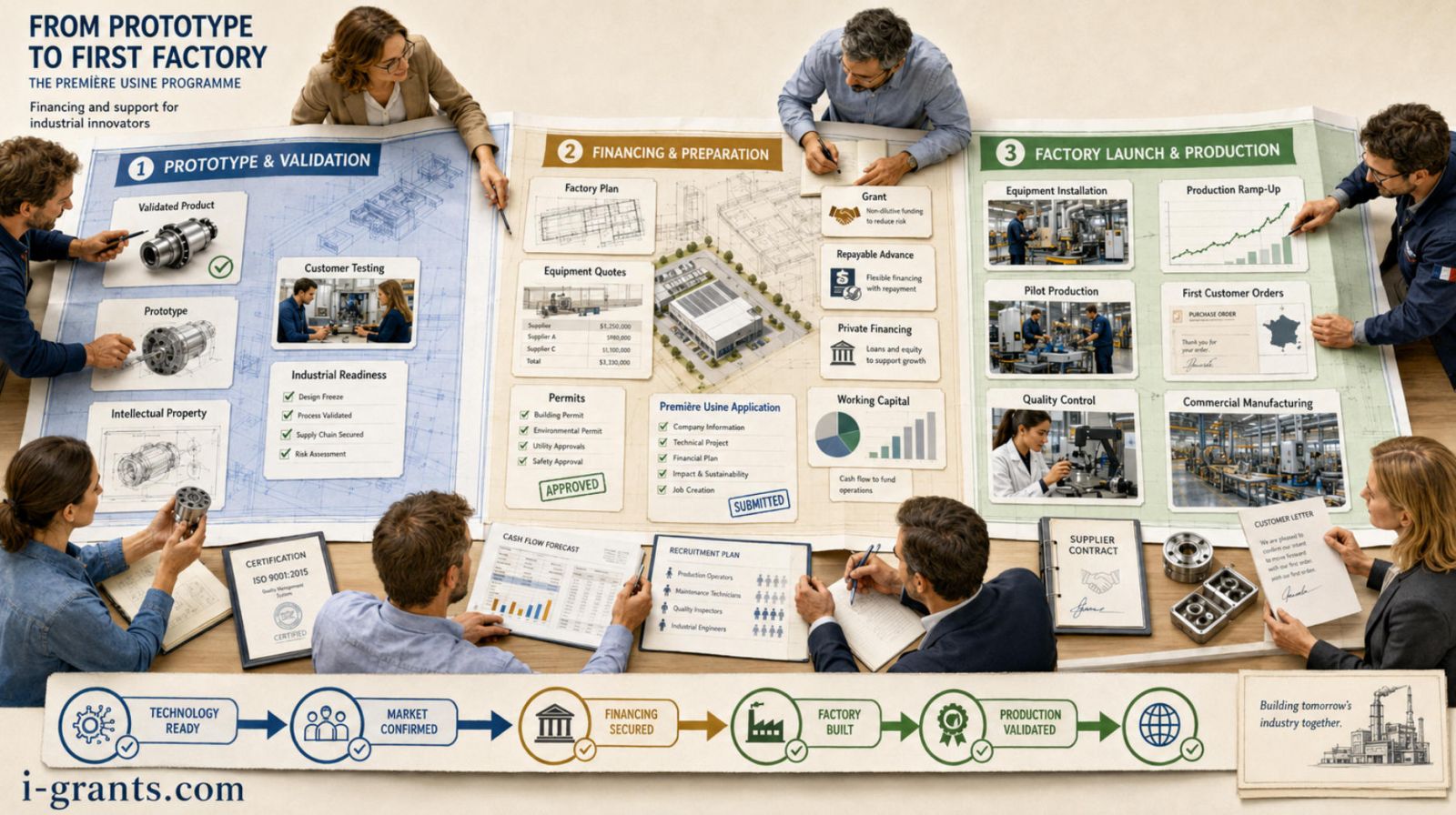
A French startup may successfully complete laboratory research, protect its intellectual property, build a prototype, and validate its technology with prospective customers. It may still lack the resources required to purchase industrial equipment, qualify a manufacturing process, obtain certifications, establish a production site, recruit an industrial team, and finance the period before the factory reaches stable output.
The France 2030 Première Usine programme was created to address this industrialisation gap.
Première Usine supports innovative industrial startups and small and medium-sized enterprises preparing the first industrial deployment of a new product or production process in France. The programme can contribute to the establishment of a first factory, a pilot or initial production line, or shared pre-industrial capacity that enables innovative products to reach the market.
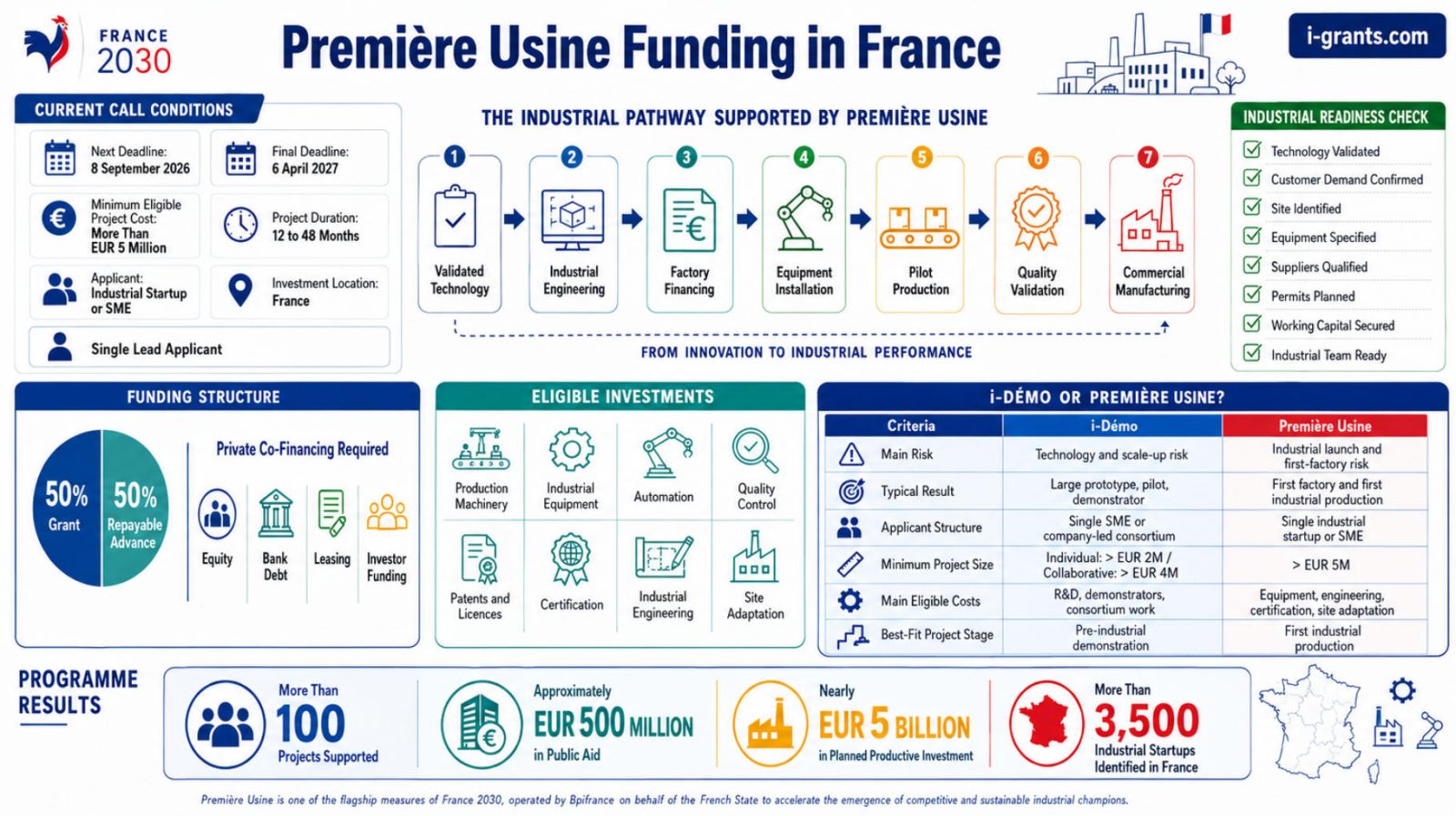
As of 23 July 2026, the call remains open. The next published submission cut-off is 8 September 2026 at 12:00 Paris time, followed by a final scheduled cut-off on 6 April 2027 at 12:00. Projects must generally exceed EUR 5 million in total eligible expenditure and are expected to last approximately 12 to 48 months.
What Is the Première Usine Programme?
Première Usine is a France 2030 funding instrument managed by Bpifrance on behalf of the French state. It is overseen by the French Directorate-General for Enterprise and the General Secretariat for Investment.
The programme was launched in 2022 to help innovative industrial startups and SMEs establish their first manufacturing capacity in France. Its purpose is not only to support individual companies but also to convert French scientific and entrepreneurial capabilities into productive assets, industrial employment, strategic supply chains, and commercially viable manufacturing operations.
Première Usine belongs to the later part of the France 2030 innovation funding pathway. Programmes such as i-Lab, i-Nov, and i-Démo primarily reduce scientific, technological, and development risks. Première Usine addresses the next challenge: proving that an innovative product can be manufactured repeatedly, economically, safely, and at a scale compatible with market demand.
This distinction is essential. A technically validated prototype does not automatically constitute a production-ready product. Industrialisation requires repeatable processes, qualified suppliers, quality controls, production tooling, regulatory compliance, trained personnel, working capital, and a realistic plan for reaching the expected production rate.
The Current 2026-2027 Call
The current version of the programme opened in January 2026 and includes three published cut-off dates: 7 April 2026, 8 September 2026, and 6 April 2027.
The April 2026 cut-off has passed. The next relevant date for new applications is therefore 8 September 2026, with the final scheduled opportunity on 6 April 2027.
The published application process begins with a simplified application dossier. Projects that pass the initial review may then be asked to provide a complete technical, industrial, environmental, and financial application.
The simplified dossier should not be treated as an informal expression of interest. It must already establish that the company, technology, factory concept, financing structure, and market opportunity fit the programme.
Table 1. Main Conditions of the Current Première Usine Call
| Condition | Current requirement |
|---|---|
| Call status | Open as of 23 July 2026 |
| Next cut-off | 8 September 2026 at 12:00 Paris time |
| Final scheduled cut-off | 6 April 2027 at 12:00 Paris time |
| Applicant | An innovative industrial startup or SME |
| Application structure | Normally one lead company rather than a funded consortium |
| Minimum project size | More than EUR 5 million in total eligible expenditure |
| Indicative project duration | 12 to 48 months |
| Location of investment | France |
| Funding form | Grant combined with a repayable advance |
| Current funding split | 50 percent grant and 50 percent repayable advance |
| Main objective | First industrialisation of an innovative product or process |
The EUR 5 million threshold refers to the total eligible expenditure presented for the project. It is not the minimum amount of public funding and does not mean that the state will finance the full investment.
Who Can Apply?
The current programme is intended for innovative industrial startups and SMEs.
Under the European SME definition, the company must generally employ fewer than 250 people and have either annual turnover not exceeding EUR 50 million or an annual balance-sheet total not exceeding EUR 43 million.
The calculation must include relevant partner and linked enterprises. A company cannot determine its SME status solely from the accounts of the French legal entity submitting the application if it belongs to a larger group.
The official wording of the current call focuses on industrial startups and innovative SMEs. Older materials and previous descriptions may also refer to mid-cap companies, but applicants should rely on the current call specifications rather than archived programme summaries.
The applicant must be capable of leading the industrial project and exploiting its results. Suppliers, engineering firms, construction companies, equipment manufacturers, laboratories, and prospective customers can contribute to the project, but Première Usine is not structured like an i-Démo research consortium in which several partners receive separate awards.
A special structure may also be used to establish shared pre-industrial or production capacity for several industrial startups. Such a project requires a credible ownership, access, governance, and financing model.
It must be clear who controls the assets, how companies obtain access, how operating costs are covered, and how the facility contributes to the industrialisation of innovative products.
What Counts as a First Factory?
The expression “first factory” should not be interpreted too narrowly.
A company does not necessarily need to be building its first physical production building. The relevant question is whether the project represents the first industrialisation of the specific innovative product, technology, or production process concerned.
An existing SME may therefore qualify when it establishes a genuinely new manufacturing activity that is materially different from its current production.
A company that previously relied on contract manufacturing may qualify when it creates its first internal industrial capacity. A pilot or initial production line may also qualify when it is necessary for commercial launch and represents a genuine transition from development to industrial production.
Table 2. Types of Projects That May Fit Première Usine
| Project type | Possible industrial objective | Main condition |
|---|---|---|
| First commercial factory | Establish the first manufacturing site for an innovative product | Technology and product must be sufficiently mature |
| First production line | Launch repeatable commercial or pre-commercial production | The line must represent genuine first industrialisation |
| Industrial pilot line | Validate manufacturing performance while supplying initial customers | The project must go beyond a research demonstrator |
| New industrial activity within an existing SME | Produce a new product through a materially different process | It must not be routine expansion of current operations |
| Production capacity on a third-party site | Install a dedicated line at a specialised manufacturing location | The applicant must retain adequate control over the project |
| Shared industrial platform | Provide equipment or capacity to several innovative companies | Governance, access, ownership, and revenue arrangements must be credible |
A company should define the industrial starting point precisely. It should explain what has already been validated, what production capability does not yet exist, and why the proposed investment constitutes a first industrial deployment rather than routine growth.
What Première Usine Does Not Finance
Première Usine is not a general factory construction subsidy.
A conventional capacity increase for an established product is unlikely to fit. Replacing obsolete machines with standard equipment, opening an ordinary regional branch, moving an existing production line, or financing a property project without substantial technological and industrial content would not normally correspond to the programme’s purpose.
A project may also be premature if the core technology still requires extensive research, fundamental redesign, or uncertain large-scale demonstration. In that situation, i-Démo or another research and development instrument may be more suitable.
At the other end of the development cycle, an investment may be too routine if the process is already fully standardised and the only objective is to increase the volume of a commercially established product.
The central issue is the remaining risk. Première Usine can address first-of-a-kind industrial execution risk, but it is not intended to replace ordinary corporate financing for predictable expansion.
The Difference Between Technical and Industrial Readiness
Applicants often underestimate the gap between a functioning prototype and a stable production system.
Technical readiness means that the underlying product or process can perform its intended function. Industrial readiness means that it can be produced with consistent quality, within the target cost, at the planned rate, with acceptable yields and supply-chain reliability.
A company may have a successful prototype while still lacking production specifications, process controls, qualified materials, industrial test procedures, regulatory approvals, reliable suppliers, maintenance arrangements, and an experienced manufacturing team.
For Première Usine, the company should be able to demonstrate that the principal research questions have been resolved. Some industrial optimisation may remain necessary, but the project should no longer depend on proving whether the core invention works at all.
Eligible Expenditure
The programme can support expenditure directly connected to the industrialisation project.
Depending on the applicable state aid framework and project appraisal, eligible categories may include:
-
production machines, tooling, automated systems, quality-control equipment, and specialised industrial installations;
-
engineering and industrialisation work required to convert a validated design into a controlled manufacturing process;
-
patents, licences, technical knowledge, software, and other intangible assets necessary for production;
-
testing, qualification, certification, standardisation, and regulatory work connected to industrial launch;
-
certain land, building, fit-out, and site-related costs where permitted under the applicable aid regime;
-
directly attributable personnel, consultancy, and external technical costs where accepted under the programme rules.
Not every cost in the total factory budget will automatically be eligible. The overall financing requirement may include non-eligible property expenditure, commercial costs, working capital, contingency reserves, financing charges, and operating losses during the production ramp-up.
The applicant should therefore distinguish between the total industrial project cost, the eligible expenditure base, the requested public aid, and the remaining private financing requirement.
The Project Start Rule
State aid must have an incentive effect. This means that the company should apply before making irreversible commitments that would demonstrate the project would proceed in the same form without public support.
Applicants should be particularly careful before signing binding equipment orders, starting construction, accepting non-cancellable industrial contracts, or beginning the activities for which support will be requested.
Preparatory studies, discussions with suppliers, site searches, technical planning, and financing negotiations may not always be treated in the same way as the formal start of the investment. However, the distinction can be legally and financially significant.
The safest approach is to establish a documented project chronology and obtain written clarification from Bpifrance before committing substantial expenditure.
A strong industrial project can lose access to funding if the eligible investment is considered to have started too early.
Grants and Repayable Advances
The current Première Usine call provides support through a combination of grants and repayable advances.
The award is divided equally:
-
50 percent of the awarded aid as a grant;
-
50 percent of the awarded aid as a repayable advance.
This is a division of the public aid, not a promise that public support will cover 100 percent of project costs.
Consider a project with EUR 10 million in eligible expenditure. If the final public aid intensity were set at 30 percent, the total award would be EUR 3 million.
Under the equal split, EUR 1.5 million would be provided as a grant and EUR 1.5 million as a repayable advance. The company would still need to finance EUR 7 million of eligible expenditure, as well as any non-eligible costs and working-capital needs.
Table 3. Illustrative Première Usine Financing Calculation
| Financing item | Illustrative amount |
|---|---|
| Total eligible project expenditure | EUR 10,000,000 |
| Illustrative public aid intensity | 30 percent |
| Total public aid | EUR 3,000,000 |
| Grant, 50 percent of the aid | EUR 1,500,000 |
| Repayable advance, 50 percent of the aid | EUR 1,500,000 |
| Eligible expenditure financed by the company and other private sources | EUR 7,000,000 |
This example is illustrative and does not represent a guaranteed aid intensity.
The final amount depends on the applicable state aid rules, project characteristics, location, company size, eligible cost categories, other public support, and Bpifrance’s financial assessment.
The company must also understand the repayment mechanism. A repayable advance is not equivalent to equity and should not be treated as a permanent source of capital.
The funding agreement will establish the repayment conditions, timetable, and potentially the relationship between repayment and project or commercial outcomes.
Why Private Financing Remains Essential
Première Usine is designed to mobilise private capital, not replace it.
The applicant must normally demonstrate access to sufficient equity, shareholder support, bank debt, leasing, investor financing, or other credible resources.
Public aid may strengthen the financing structure and reduce industrial risk, but the company remains responsible for a substantial share of the investment.
The latest official evaluation of France 2030 support for industrial startups found that Première Usine awards to industrial startups had a median value of about EUR 2 million, while the median public aid rate was approximately 37 percent of the supported project expenditure.
The assessment also found that a France 2030 award can act as a positive signal to banks, investors, customers, and suppliers, although private investors still conduct their own technical and commercial examination.
This evidence is useful for applicants. It shows that a Première Usine award can improve financing credibility, but companies should not expect public selection to substitute for investment readiness, customer evidence, or a bankable industrial plan.
The Vulkam financing package illustrates this principle. The company announced a EUR 34 million financing operation for its first amorphous-metals factory, combining EUR 14 million in equity and approximately EUR 20 million in debt and public financing.
Of the latter amount, EUR 6 million came through France 2030 instruments, including Première Usine, while EUR 14 million consisted of bank borrowing supported by Bpifrance.
The Application Process
The published process begins with a simplified dossier submitted by the relevant cut-off date.
This initial application should present the company, innovation, proposed factory, eligible investment, industrial schedule, market opportunity, environmental effects, and financing plan.
Projects considered suitable may then be invited to submit a more complete dossier.
The detailed stage normally requires greater evidence concerning the technical process, site, equipment, permits, procurement strategy, customers, suppliers, intellectual property, financial forecasts, shareholder financing, bank support, and implementation risks.
A company should not wait for shortlisting before beginning serious preparation. Equipment quotations, site analysis, regulatory planning, market evidence, financing negotiations, and industrial recruitment can take months.
At the same time, the company must avoid starting the eligible investment prematurely.
This creates a scheduling challenge: the project must be sufficiently advanced to be credible, but not irreversibly committed before the applicable aid date.
How Première Usine Projects Are Evaluated
A convincing project must show more than an interesting technology and an attractive factory design.
Evaluators need to understand whether the company can build the site, operate it, finance the ramp-up, produce at the required quality, secure customers, and create lasting economic value in France.
Table 4. Main Première Usine Evaluation Areas
| Evaluation area | Questions the application should answer |
|---|---|
| Product innovation | Is the product genuinely differentiated and protected from easy imitation? |
| Process innovation | Does the production system create a meaningful industrial advantage? |
| Technical maturity | Have the main scientific and prototype risks already been resolved? |
| Industrial feasibility | Are the site, equipment, suppliers, permits, staffing, and timetable credible? |
| Market evidence | Are customers prepared to buy the planned production? |
| Production economics | Can the factory reach competitive unit costs, yields, and output levels? |
| Financial capacity | Can the company finance its own contribution, delays, and working capital? |
| Strategic impact | Will the project strengthen industrial capability, supply chains, or sovereignty in France? |
| Employment and regional impact | Will it create durable industrial jobs and local investment? |
| Environmental performance | Does the facility support decarbonisation or avoid significant environmental harm? |
| Intellectual property | Does the applicant have sufficient rights to manufacture and commercialise the product? |
| Management capacity | Does the team include the industrial, financial, and operational expertise required? |
The industrial business plan must connect these subjects.
Production volume should be linked to customer demand. Equipment capacity should correspond to the sales forecast. Recruitment should match the commissioning schedule. Working capital should reflect supplier and customer payment terms. Environmental claims should be supported by measurable comparisons.
The Importance of Customer Evidence
An industrial plant can fail even when its technology works perfectly.
The factory must have enough demand to cover its fixed costs and support the production ramp-up. Applicants should therefore distinguish between a large theoretical market and accessible customer demand.
General statements about a global market worth billions of euros are rarely sufficient.
The application is stronger when supported by customer trials, qualification programmes, letters of intent, conditional purchase commitments, supply agreements, distribution partnerships, or detailed discussions with named industrial users.
Official evaluations of support for industrial startups identify access to first markets as a central challenge. Companies and investors consistently emphasise that contracts and credible commercial evidence can be more decisive for industrial growth than additional technical subsidies alone.
A letter of intent is not the same as a binding order, but it can still demonstrate that a customer understands the product, expected price, qualification route, delivery schedule, and production risk.
Industrial Economics and the Ramp-Up Period
Many factory plans focus heavily on construction and equipment while underestimating the period after commissioning.
A new production line rarely reaches full output immediately. Early operations may involve lower yields, rework, supplier problems, employee training, customer qualification, machine adjustments, and delays in obtaining final approvals.
The financial model should therefore include a realistic production ramp rather than assuming that the plant reaches maximum capacity in its first month.
The company also needs working capital. Materials may need to be purchased before customers pay. Finished goods may remain in stock during qualification. Suppliers may require deposits.
Staff, energy, rent, insurance, and maintenance must be paid even when output remains below plan.
Première Usine may contribute to the investment, but the applicant must demonstrate that it can survive the operational period between construction and stable positive cash flow.
Latest Programme Results
Première Usine has become one of the central industrialisation instruments within France 2030.
In April 2025, the French government announced nine winners in the programme’s seventh selection round. Nearly EUR 49 million of aid was allocated to those projects.
At that point, Première Usine had supported 91 projects with EUR 392 million in public aid, representing almost EUR 5 billion in planned productive investment.
Industrial startups accounted for 20 percent of new factory openings in France in 2024, excluding expansions of existing sites.
In March 2026, the government announced 13 additional winners from the eighth and ninth selection rounds.
Approximately EUR 60 million was allocated to the eighth round and nearly EUR 21 million to the ninth, bringing support for the 13 projects to more than EUR 80 million.
The government reported that the programme had financed more than 100 projects with approximately EUR 500 million in public support since its launch.
Table 5. Key Première Usine Programme Results
| Indicator | Officially reported result |
|---|---|
| Programme launch | 2022 |
| Projects supported by April 2025 | 91 |
| Public aid committed by April 2025 | EUR 392 million |
| Productive investment represented by those projects | Nearly EUR 5 billion |
| New winners announced in March 2026 | 13 |
| Aid for the eighth and ninth rounds | More than EUR 80 million |
| Total projects reported by March 2026 | More than 100 |
| Total programme support reported by March 2026 | Approximately EUR 500 million |
| Industrial startups identified in France by March 2026 | More than 3,500 |
| French net balance of factory openings and major expansions in 2025 | Positive 19 |
The government also reported that almost 150 additional factory projects were emerging in France during 2025.
The increase from more than 2,500 identified industrial startups in April 2025 to more than 3,500 by March 2026 may partly reflect improved identification and changes in the monitored population, not only the creation of 1,000 entirely new companies.
The figures should therefore be interpreted as ecosystem indicators rather than a direct company-creation series.
What the Latest Winners Are Building
The eighth and ninth selection rounds demonstrate the programme’s sectoral breadth.
The 13 selected projects include battery remanufacturing, low-carbon fertiliser, electronics refurbishment, thermal storage, veterinary diagnostics, advanced materials, hybrid-electric aviation propulsion, space structures, and industrial data infrastructure.
Table 6. Selected Winners from the Eighth and Ninth Première Usine Rounds
| Company | Project | Planned industrial activity |
|---|---|---|
| Fertighy France | JUNO | First low-carbon fertiliser plant using electrolytic hydrogen |
| Cykero | Cykero | Robotic facility for diagnosing, cleaning, and refurbishing electronic devices |
| Maash France | Champignac | Industrial production of mycoprotein through submerged fermentation |
| Mecano I.D | Starman | Manufacturing of large structures and critical components for space systems |
| Voltr | PU2BL | Battery remanufacturing plant with capacity of about 40 tonnes per month |
| Ascendance Flight Technologies | Pionair | Hybrid-electric propulsion systems for aviation |
| Enalees | Bâtiment EBE | Production of veterinary diagnostic testing kits |
| Water Horizon | H2C FAB | Mobile thermal storage systems using waste heat for industrial cooling |
| Eclairion Paris Sud | AINFRA Factory | Development of a new-generation data centre |
| Orixha | L2B2 | Industrial treatment of breathable liquid for liquid ventilation |
| Carbon Waters | EXFG II | Production of ready-to-use multifunctional additives based on advanced materials |
| Wattalps | Wattsup | Immersion-cooled batteries for industrial machinery |
| Woodoo | BR | High-performance enhanced wood biomaterial for construction |
These examples show that Première Usine is not confined to one industrial field.
The common factors are an innovative product or process, readiness for first industrial deployment, significant capital requirements, and the creation of production capacity in France.
Practical Case: Expliseat
Expliseat developed and certified lightweight transport seating based on advanced composite and titanium technologies.
Before establishing its own factory, the company operated through an asset-light model and outsourced much of its production.
The Première Usine-supported PUEXP project enabled Expliseat to establish its own manufacturing facility in Avrillé near Angers.
The project illustrates a broader interpretation of “first factory”: the company already had products and customers, but it had not yet internalised its first major industrial production capacity.
Expliseat identifies the opening of its new industrial facility as a major milestone in its development. The company now reports more than 10,000 seats in service and more than 25 airline customers.
Its factory provides a practical example of how control over manufacturing can become strategically important for quality, delivery, customer qualification, and further growth.
The main lesson is that Première Usine can support a transition from outsourced or limited production to controlled internal manufacturing when that transition represents the first industrial deployment of the innovative product.
Practical Case: Vulkam
Vulkam develops amorphous metal alloys and precision manufacturing processes based on technology originating from decades of academic research.
By the time the company prepared its first factory, it had already completed technology qualification and prototyping.
The remaining challenge was industrialisation: building a production site, installing equipment, establishing repeatable processes, and serving sectors requiring high-value precision components.
Vulkam announced EUR 34 million of financing, including EUR 14 million in equity and approximately EUR 20 million in debt and public financing.
France 2030 instruments, including Première Usine, contributed EUR 6 million. The first plant in Isère was budgeted at approximately EUR 15 million and intended to produce millions of parts annually.
This case shows why a Première Usine application cannot be assessed in isolation from the wider financing package.
The public award was important, but the factory also required shareholder capital and significant bank financing.
Practical Case: Toopi Organics
Toopi Organics developed a process for collecting and transforming human urine into agricultural biostimulants.
Its Première Usine project concerned the establishment of the company’s first industrial unit in Gironde, with expected annual processing capacity of approximately two million litres.
The facility was intended to enable commercial distribution of the company’s biostimulants in France.
The case demonstrates that Première Usine can support unconventional circular-economy technologies when the company has progressed beyond laboratory validation and can define a credible industrial process, supply system, market, regulatory route, and production facility.
Première Usine Versus i-Démo
The distinction between i-Démo and Première Usine is one of the most important programme-selection decisions for an innovative SME.
Table 7. i-Démo Compared with Première Usine
| Criterion | i-Démo | Première Usine |
|---|---|---|
| Main purpose | Complete major R&D, integration, and demonstration | Establish first industrial production |
| Central uncertainty | Will the technology work at representative or large scale? | Can the product be manufactured reliably and economically? |
| Typical result | Prototype, pilot system, or industrial demonstrator | Factory, production line, or initial industrial capacity |
| Applicant structure | Individual SME or company-led consortium | Normally one industrial startup or SME |
| Minimum project scale | More than EUR 2 million individually or EUR 4 million collaboratively | More than EUR 5 million in eligible expenditure |
| Typical duration | 36 to 60 months | 12 to 48 months |
| Main expenditure | Research, engineering, testing, integration, and demonstration | Equipment, production assets, industrialisation, and site establishment |
| Strong sign of fit | Significant technological uncertainty remains | Core technology is validated and factory execution is now the main risk |
| Strong sign of poor fit | Project mainly concerns routine factory construction | Core technology still requires fundamental validation |
The programmes can follow one another, but the transition is not automatic.
A company that completed an i-Démo project must still demonstrate that its technology is mature enough for industrialisation, that customers exist, that the production plan is credible, and that the new application has a separate incentive effect.
Is the Project Ready for Première Usine?
Before investing heavily in the application, the company should be able to answer the following questions:
-
Has the core product and technology been validated beyond an early prototype?
-
Is the principal remaining challenge industrial execution rather than fundamental research?
-
Does the project create the first industrial capacity for this innovation?
-
Are the site, equipment, suppliers, permits, and production timetable sufficiently defined?
-
Is there credible customer evidence for the planned output?
-
Can the company finance its contribution, non-eligible costs, delays, and working capital?
-
Does the management team include genuine industrial and operational expertise?
-
Will the project create measurable industrial, employment, environmental, or strategic value in France?
A company that cannot yet answer these questions may need additional product validation, customer trials, private financing, industrial engineering, or an i-Démo-type project before seeking Première Usine support.
Common Application Weaknesses
Recurring weaknesses include:
-
Presenting a research project as an industrial investment even though the core technology remains uncertain.
-
Describing routine capacity expansion as the first industrialisation of an innovation.
-
Failing to demonstrate enough equity, debt, or investor support to complete the financing package.
-
Using ambitious market forecasts without customer validation, qualification programmes, or purchasing evidence.
-
Underestimating working capital, commissioning delays, production yields, and factory ramp-up losses.
-
Starting or irreversibly committing the investment before the permitted aid date.
Other significant risks include unresolved intellectual property, incomplete site permits, dependence on one unqualified supplier, lack of an experienced industrial director, unrealistic equipment delivery schedules, and weak environmental evidence.
The official evaluation of industrial-startup support also identified a possible threshold effect.
Some interviewed companies considered the EUR 5 million minimum project size high enough to encourage applicants to design projects that were larger than their genuine industrial needs.
This is an important warning: the investment should be shaped by a credible industrial plan, not artificially expanded to cross a funding threshold.
Preparing a Competitive Application
A strong application begins with the industrial problem, not the grant.
The company should explain why its validated innovation cannot reach the market without the proposed production capacity.
It should identify the difference between current capability and required commercial capability, including production volume, quality, cost, yield, regulatory standards, and delivery times.
The industrial plan should define the site, layout, equipment, commissioning sequence, staffing, supplier strategy, production tests, and output ramp.
Each major cost should have a clear connection to an industrial function.
The commercial plan should show which customers will purchase the product, when qualification will be completed, how demand translates into factory utilisation, and how prices compare with production costs.
The financing plan should integrate the grant, repayable advance, equity, bank debt, leases, shareholder support, and any regional or European funding.
It should also explain how the company will cover delays, cost overruns, and the working-capital peak.
Finally, the application should demonstrate why the investment matters to France.
Relevant impacts may include domestic production, technological sovereignty, regional employment, reduced imports, strategic supply chains, lower emissions, resource efficiency, exports, and the creation of specialised industrial knowledge.
Final Assessment
Première Usine is one of the strongest France 2030 instruments for innovative SMEs that have validated their technology but have not yet established their first substantial industrial production capacity.
The programme can support the transition from prototype to production, but it does not remove the commercial and financial responsibilities of the applicant.
A competitive project needs a mature product, a credible manufacturing process, customer demand, a realistic factory plan, significant private co-financing, sufficient working capital, and a team capable of building and operating the facility.
The current call offers two remaining published submission opportunities: 8 September 2026 and 6 April 2027.
Companies targeting the September 2026 cut-off should already be working on equipment quotations, customer evidence, site planning, environmental and regulatory requirements, intellectual property, and private financing.
For the right company, Première Usine can help close one of the most difficult financing gaps in the innovation cycle: the gap between a proven technology and a functioning factory capable of producing it repeatedly, competitively, and at commercial scale.