

 Français
 Deutsch
 Українська
The pharmaceutical industry is facing a difficult technological challenge: medicines must become more sustainable to manufacture without compromising their quality, safety, affordability or availability. Conventional pharmaceutical production can require substantial quantities of chemical solvents, energy-intensive purification, specialised equipment and tightly controlled environments. Even relatively small improvements in these processes can create significant opportunities to reduce waste, improve manufacturing productivity and strengthen pharmaceutical supply chains.
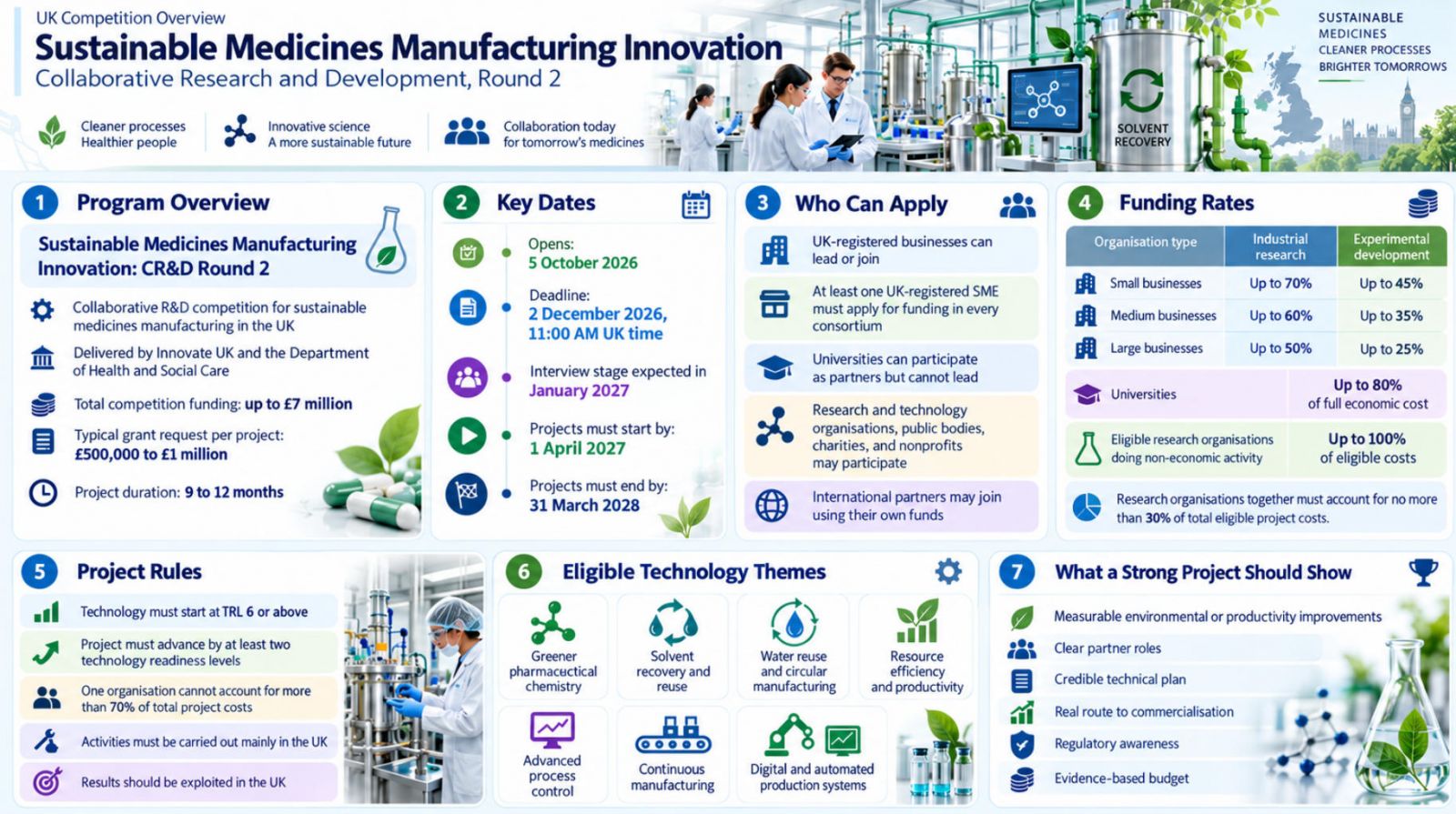
The United Kingdom is addressing this challenge through the Sustainable Medicines Manufacturing Innovation: Collaborative Research and Development (CR&D), Round 2 competition. Delivered by Innovate UK, part of UK Research and Innovation (UKRI), in partnership with the Department of Health and Social Care (DHSC), the programme offers collaborative research projects between £500,000 and £1 million in grant funding.
The competition has an overall funding allocation of up to £7 million and supports technologies that can make medicines manufacturing more environmentally sustainable and commercially competitive. Applications opened on 5 October 2026, with a closing deadline of 2 December 2026 at 11:00 a.m. UK time.
However, the programme is not a conventional equipment replacement grant. It is designed for collaborative industrial research and experimental development involving technologies that have already reached a relatively advanced stage of development. Applicants must demonstrate measurable environmental or productivity benefits, a credible route towards commercial adoption, and the participation of at least one eligible UK-registered small or medium-sized enterprise.
For pharmaceutical manufacturers, biotechnology companies, process engineering specialists and research organisations, understanding these distinctions is essential. The grant can substantially reduce the financial risk of developing a promising manufacturing technology, but a successful application requires considerably more than an environmentally attractive concept.
Why Sustainable Pharmaceutical Manufacturing Is a Strategic Priority in the UK
The United Kingdom has one of Europe's most established pharmaceutical research and manufacturing ecosystems. Its strengths extend beyond multinational medicines producers to specialist chemical manufacturers, biotechnology startups, contract development and manufacturing organisations, engineering companies, analytical technology suppliers and internationally recognised research institutions.
According to the Office for Life Sciences, companies operating in the UK's biopharmaceutical subsector generated approximately £81.5 billion in turnover during 2024/25 and employed around 148,200 people. The subsector contained approximately 3,100 companies, demonstrating the scale of the commercial and scientific activities connected with medicine development and supply.
The broader British life sciences sector generated £125.8 billion in turnover during the same period. Within that sector, companies whose primary activity was manufacturing generated £38.1 billion in turnover and employed approximately 120,200 people. This manufacturing figure includes medical technology businesses as well as biopharmaceutical companies, so it should not be interpreted as pharmaceutical manufacturing revenue alone.
Another indication of the industry's economic importance comes from the UK's Life Sciences Competitiveness Indicators. Pharmaceutical manufacturing generated approximately £20.4 billion in gross value added in 2023, measured in constant 2020 prices. The country's pharmaceutical exports reached £24.7 billion in 2024, while imports of pharmaceutical products amounted to approximately £25.9 billion.
Research expenditure also demonstrates the industry's technological intensity. British businesses performed approximately £9.3 billion of pharmaceutical research and development in 2024, equivalent to 17 percent of all business R&D expenditure in the United Kingdom. About 63 percent of pharmaceutical R&D spending was funded by businesses themselves, while overseas sources accounted for approximately 34 percent.
These figures illustrate why relatively targeted public innovation grants can matter. The programme cannot replace the billions invested by pharmaceutical companies in research and manufacturing, but it can help overcome specific technological and commercial barriers that prevent promising processes from progressing beyond demonstration.
Table 1. Key Indicators of the UK Pharmaceutical and Life Sciences Sector
| Indicator | Verified value | Reference period |
|---|---|---|
| Turnover of UK biopharmaceutical companies | £81.5 billion | 2024/25 |
| Employment in the biopharmaceutical subsector | 148,200 people | 2024/25 |
| Number of biopharmaceutical companies | Approximately 3,100 | 2024/25 |
| Turnover of all UK life sciences companies | £125.8 billion | 2024/25 |
| Turnover of life sciences companies primarily engaged in manufacturing | £38.1 billion | 2024/25 |
| Business expenditure on pharmaceutical R&D | £9.3 billion | 2024 |
| Pharmaceutical exports | £24.7 billion | 2024 |
| Gross value added of pharmaceutical manufacturing | £20.4 billion | 2023, constant 2020 prices |
The statistics describe different economic measures and business populations. Biopharmaceutical turnover includes activities beyond manufacturing, while the wider life sciences manufacturing category also includes medical technology companies. The gross value added estimate measures the pharmaceutical manufacturing sector more specifically.
The latest Office for Life Sciences figures also incorporate methodological revisions to previously published estimates. For comparisons over time, revised historical data should be used rather than combining figures from incompatible statistical releases.
Environmental performance is becoming increasingly important alongside traditional measures of productivity and quality. NHS England identifies medicines as a substantial contributor to the health service's overall carbon footprint, with their wider lifecycle responsible for approximately one quarter of NHS emissions. This includes emissions associated with production, distribution, use and other lifecycle stages, rather than emissions from British factories alone.
Improving medicines manufacturing is therefore only one component of healthcare decarbonisation, but it is a component in which industrial technology can produce measurable results. Reducing solvent consumption, improving chemical yields, minimising failed production batches, recovering useful materials and developing more efficient biological manufacturing processes can lower resource demand while supporting manufacturing resilience.
The Sustainable Medicines Manufacturing Innovation programme addresses this intersection between environmental performance, pharmaceutical productivity and long-term industrial competitiveness.
What the Sustainable Medicines Manufacturing Innovation Grant Actually Funds
The second Collaborative R&D competition is part of the wider Sustainable Medicines Manufacturing Innovation Programme, which forms part of the UK government's broader investment arrangements for the life sciences sector.
The competition is administered through Innovate UK's Innovation Funding Service and is supported through collaboration with the Department of Health and Social Care. Its purpose is to accelerate the technical development and commercial readiness of technologies that make the manufacture of human medicines more sustainable.
The £7 million allocation represents the maximum funding intended for this competition, subject to sufficient high-quality applications and the applicable funding decisions. It is not a guarantee that the full allocation will be awarded.
Individual collaborative projects must normally request between £500,000 and £1 million in grant funding. Importantly, this range applies to the combined grant request of the eligible project partners, not to the overall economic cost of the project.
A consortium can therefore propose a research programme costing more than £1 million if the participants provide the required contributions towards their eligible expenditure.
Projects must last between nine and twelve months, begin no later than 1 April 2027 and finish by 31 March 2028. The programme requires participating funded organisations to carry out their project work in the United Kingdom, intend to exploit the results in the UK and spend most of the grant funding within the country.
The projects must start on the first day of a calendar month. Work cannot begin before the Grant Offer Letter has been approved by Innovate UK.
Table 2. Sustainable Medicines Manufacturing Innovation CR&D Round 2: Funding Conditions
| Programme requirement | Official condition |
|---|---|
| Funding authority | Innovate UK and the Department of Health and Social Care |
| Competition funding allocation | Up to £7 million |
| Grant request per collaborative project | £500,000 to £1 million |
| Opening date | 5 October 2026 |
| Application deadline | 2 December 2026, 11:00 a.m. UK time |
| Project duration | 9 to 12 months |
| Latest permitted project start | 1 April 2027 |
| Latest permitted project completion | 31 March 2028 |
| Eligible research categories | Industrial research and experimental development |
| Minimum starting technology readiness | TRL 6 |
| Required technological advancement | At least two TRL levels |
| Mandatory business participation | At least one UK-registered SME requesting grant funding |
| Maximum share of total project costs claimed by one organisation | 70 percent |
| Research organisations undertaking non-economic activity | Combined participation limited to 30 percent of total eligible project costs |
These conditions show that the funding is intended for focused industrial development rather than indefinite scientific exploration. Applicants need to demonstrate that their innovation is sufficiently mature to reach meaningful technical and commercial milestones within a comparatively short implementation period.
Which Pharmaceutical Companies and Organisations Can Apply?
The competition is designed for genuine collaborative projects. An eligible project cannot consist of one business applying independently for its own research expenditure.
The lead organisation must be registered in the United Kingdom and can be a business of any size, a research and technology organisation, a Catapult centre, a not-for-profit organisation, a public sector organisation or a charity.
Academic institutions may participate as collaborative partners but cannot act as project leads.
Every consortium must include at least one UK-registered micro, small or medium-sized enterprise that requests grant funding. This requirement is particularly significant because it creates opportunities for smaller technology developers to work alongside established pharmaceutical manufacturers.
For example, a specialist biotechnology company developing an innovative biocatalytic process might collaborate with a contract manufacturer capable of conducting industrial trials. An analytical technology supplier could work with a pharmaceutical business to demonstrate an automated system that reduces failed production batches. A company specialising in solvent recovery could partner with a research organisation and a medicines manufacturer to validate the quality and environmental performance of recovered materials.
The programme does not require the SME to lead the project in every case. A large pharmaceutical company may lead an eligible consortium provided the mandatory SME participation and other collaboration requirements are satisfied.
When a research and technology organisation acts as the project lead, it must collaborate with two businesses, including one SME and another business of any size.
The lead organisation and at least one additional partner must request funding. No single organisation may claim more than 70 percent of the project's total costs, and the applicants must explain why collaboration is necessary and how the partners will work together.
These rules are intended to encourage meaningful cooperation rather than nominal partnerships established solely to satisfy eligibility criteria.
A university may provide specialist analytical equipment, pharmaceutical formulation expertise, lifecycle assessment or research infrastructure. A technology company may contribute proprietary processes, software or equipment. An established manufacturer may offer production facilities, quality systems, technical personnel and an industrial route to adoption.
The strongest consortium is one in which the partners contribute complementary capabilities that would be difficult or substantially more expensive to combine through ordinary commercial procurement.
International participation is possible, but the funding structure is primarily British. Organisations based outside the UK can participate without claiming Innovate UK funding, using their own resources to support their activities. Such partners may perform work in their home countries.
Overseas subcontractors may also be considered, although applicants must provide a specific justification for using them rather than suitable UK suppliers. A lower overseas price alone is not an adequate justification.
The programme also limits the number of applications an eligible organisation can lead to two. There is no equivalent numerical limit on participation as a collaborative partner.
How Much Funding Can Small, Medium and Large Pharmaceutical Companies Receive?
The amount of financial support available depends on two fundamental characteristics: the size of the participating commercial organisation and the research category under which the project is classified.
Innovate UK distinguishes between industrial research and experimental development. Industrial research generally involves planned research aimed at developing new knowledge, capabilities or technologies for improved products or processes. Experimental development is generally closer to commercial application and includes the refinement, testing, demonstration or improvement of technologies using existing knowledge.
Although both categories are eligible, the maximum grant percentages are different.
Table 3. Maximum Innovate UK Grant Rates by Company Size and Research Category
| Company size | Industrial research | Experimental development |
|---|---|---|
| Micro or small enterprise | 70 percent | 45 percent |
| Medium-sized enterprise | 60 percent | 35 percent |
| Large enterprise | 50 percent | 25 percent |
A small pharmaceutical technology company participating in an industrial research project may therefore receive a grant covering up to 70 percent of its eligible costs. A large pharmaceutical manufacturer participating in the same research category may receive up to 50 percent.
If the project is classified as experimental development, the corresponding maximum rates decrease to 45 percent and 25 percent.
These percentages are maximum limits, not guaranteed awards. They apply to the eligible expenditure of each participating company, while the consortium must still comply with the overall grant request range and collaboration rules.
An important consideration is the legal classification of company size. A UK-registered subsidiary of a large international pharmaceutical group cannot necessarily claim the rate available to independent small companies merely because its own local workforce is relatively small. Ownership relationships and relevant group-level financial information can affect its classification.
Companies should establish their correct organisational status before completing the financial section of the application.
How Universities and Research Organisations Are Funded
The programme has separate rules for research organisations carrying out non-economic activities.
Collectively, these organisations may account for up to 30 percent of the project's total eligible costs. The limit is shared between all participating research organisations undertaking such activities.
Eligible research and technology organisations, charities, not-for-profit organisations, public sector organisations and qualifying research organisations may receive up to 100 percent of their eligible non-economic project costs.
Academic institutions may receive funding equivalent to 80 percent of the full economic cost of their research. Universities must use the applicable Transparent Approach to Costing methodology and submit the required financial information through the Innovation Funding Service.
This distinction becomes important when designing the project budget. A university's research cost cannot simply be combined with company expenditure and assigned the funding percentage applicable to an SME.
The classification of activities also matters. A research organisation conducting commercial or economic activities within the project may be subject to the commercial funding limits rather than the rules for non-economic research.
For applicants, the appropriate approach is to identify the technical contribution of every partner first and then determine the applicable cost and funding treatment.
A Realistic Example of a £920,000 Collaborative R&D Grant
Understanding grant percentages is easier when they are translated into an actual budget structure.
Consider a hypothetical consortium developing an advanced technology for recovering and reusing pharmaceutical manufacturing solvents. A small UK technology company leads the technical development, a medium-sized industrial partner contributes processing expertise and demonstration facilities, and a research and technology organisation performs independent testing and environmental analysis.
Assume the commercial work qualifies as industrial research and that the research organisation carries out eligible non-economic activities.
Table 4. Illustrative Collaborative Research Budget for Sustainable Pharmaceutical Manufacturing
| Consortium partner | Eligible project costs | Grant rate | Requested grant | Partner contribution |
|---|---|---|---|---|
| Small UK technology company | £600,000 | 70 percent | £420,000 | £180,000 |
| Medium-sized industrial company | £500,000 | 60 percent | £300,000 | £200,000 |
| Research and technology organisation | £200,000 | 100 percent | £200,000 | £0 |
| Total | £1,300,000 | Mixed rates | £920,000 | £380,000 |
This table is an illustrative financial model, not a real funded project or an approved Innovate UK budget.
In this scenario, the consortium undertakes £1.3 million of eligible research activity while requesting £920,000 in public grant funding. The commercial partners contribute £380,000, while the research organisation receives full support for its assumed eligible non-economic work.
The largest participant accounts for approximately 46.2 percent of the project's eligible costs, below the 70 percent single-organisation limit. The research organisation accounts for approximately 15.4 percent of total eligible costs, below the 30 percent limit for non-economic research participation.
The grant request also falls within the programme's permitted range.
However, the financial structure would not be sufficient on its own to secure funding. The applicants would still need to prove the required starting technology readiness, technological progress, environmental benefits, commercial feasibility and compliance with every other competition condition.
The model also demonstrates why the phrase up to £1 million should not be confused with a fully financed £1 million investment. The project may require significant private contributions, and companies must be capable of financing their share.
Applicants should also consider the timing of cash expenditure. Innovate UK grants are normally claimed against eligible expenditure under the relevant grant conditions, rather than paid in full as unrestricted funding at the beginning of the project. Companies therefore need adequate working capital to meet payroll, materials, subcontracting and demonstration expenses before receiving the corresponding grant payments.
Which Research and Manufacturing Costs Are Eligible?
The programme uses Innovate UK's established rules for eligible project costs, subject to its specific competition conditions.
Personnel expenditure is likely to be a substantial component of many pharmaceutical innovation budgets. Eligible labour may include the work of chemists, engineers, analytical scientists, biotechnology researchers, project managers and other staff directly involved in the research activities. The costs must be calculated according to Innovate UK's prescribed approach and supported by appropriate records.
The programme may also cover eligible overhead expenditure, materials, the project-related use of equipment, subcontracting, necessary travel and certain other directly attributable costs.
For pharmaceutical manufacturers, this can include consumable reagents, enzymes, catalysts, laboratory materials, analytical testing, pilot processing activities and specialist services required to validate the technology.
However, eligibility depends on how each cost is incurred and used.
Purchasing a new industrial reactor for £250,000 does not automatically make the entire purchase price eligible for grant support. Where the equipment is treated as a capital asset, the relevant cost may be limited to the depreciation attributable to its use during the research project.
Similarly, manufacturing materials consumed during experimentation may be eligible, while expenditure on routine commercial production or ordinary business operations may not be.
Subcontracted activities must be necessary, proportionate and properly justified. A company may need external specialists to perform chemical impurity analysis, evaluate environmental impacts or undertake particular engineering tests. However, a substantial subcontracting budget should not substitute for genuine collaboration between the principal project partners.
The budget must also avoid double-counting costs, including overhead expenditure already incorporated into another claim.
Research funding should not be confused with unrestricted capital investment assistance. Ordinary factory construction, infrastructure design without appropriate technology demonstration, and routine equipment replacement are not the central purposes of this programme.
Applicants should therefore construct the financial model around the work packages required to develop and validate the innovation, rather than beginning with an equipment shopping list and attempting to classify the purchases as research.
Green Chemistry: Reducing the Environmental Cost of Pharmaceutical Synthesis
Green chemistry is the first major technological pillar of the competition. It includes innovations that reduce the use of hazardous chemicals, improve reaction efficiency, replace environmentally intensive materials and create more sustainable pathways for manufacturing active pharmaceutical ingredients.
Pharmaceutical production can involve complex multistep synthesis, particularly for small-molecule drugs. Multiple reactions, purification stages and solvent exchanges may be required before a material reaches the purity needed for further processing.
The environmental consequences of a process therefore depend not only on the final chemical reaction but also on the resources consumed throughout the entire manufacturing pathway.
Biocatalysis offers one potentially valuable approach. Enzymes can enable highly selective reactions under conditions that differ from conventional chemical manufacturing. In suitable applications, biocatalytic processes may reduce the need for certain reagents, improve selectivity and simplify downstream purification.
However, the benefits are not automatic. Enzyme stability, reaction concentration, catalyst production, separation requirements and process economics all influence whether the approach offers a genuine industrial advantage.
Another promising area is flow chemistry, in which reactions are conducted continuously rather than exclusively through conventional batch operations. Continuous processing can provide improved reaction control, more efficient heat transfer and opportunities to reduce the size of processing equipment. It can also present significant technical challenges involving solids handling, fouling, process control and cleaning.
Under the current grant competition, a proposal involving flow chemistry would need to demonstrate more than the general advantages associated with continuous manufacturing. It would require a specific innovation, a sufficiently advanced starting technology and measurable performance improvements relevant to medicines production.
Sustainable solvents represent a further area of interest. Conventional pharmaceutical processes often depend on organic solvents for synthesis, extraction, purification, crystallisation and cleaning. Replacing a fossil-derived solvent with a renewable alternative can potentially reduce lifecycle emissions, but the substitute must also satisfy pharmaceutical quality requirements.
Purity, residual impurities, moisture content, stability, compatibility with existing processes and the energy required for purification all influence whether a new solvent can be adopted.
The programme's green chemistry pillar also encompasses new chemical catalysis, solvent-free systems, biomanufacturing of pharmaceutical ingredients and alternatives to traditional solid-phase synthesis.
For applicants, the strongest proposition is usually a clearly defined process change whose effects can be measured against a credible existing manufacturing method.
Circular Manufacturing: Solvent Recovery, Water Reuse and Material Efficiency
The second programme pillar is circularity, which aims to reduce resource consumption and waste by keeping materials in productive use for longer.
In pharmaceutical manufacturing, circularity involves technical challenges that differ from those in many other industries. Materials may come into contact with active substances, toxic reagents, biological products or sensitive intermediate compounds. Recovering a material does not automatically make it appropriate for reuse.
Solvent recovery illustrates this challenge particularly well.
A manufacturing facility may generate substantial quantities of solvent-containing waste streams. A recovery system could separate valuable chemicals from those streams and return them to suitable applications, reducing the demand for newly purchased solvent.
However, recovered solvents must satisfy relevant specifications. Residual impurities, degradation products and the potential accumulation of contaminants need to be understood and controlled.
A grant-funded demonstration might investigate an innovative membrane separation process, a more efficient purification configuration or a hybrid recovery technology designed to reduce the energy demand of conventional separation methods.
The relevant environmental assessment should consider the complete recovery process rather than concentrating solely on the quantity of solvent collected.
A system that recovers more solvent but requires excessive energy for purification may deliver a smaller environmental improvement than its recovery rate initially suggests.
Water reuse presents similar challenges. Pharmaceutical facilities may consume water during cleaning, formulation, equipment preparation and other manufacturing operations. Innovative treatment and reuse technologies can potentially reduce freshwater demand, but the application must respect the quality requirements associated with the intended use.
Water recovered for a utility process is not automatically appropriate for product-contact operations. The project must establish the necessary water quality, monitoring arrangements, contamination controls and applicable regulatory requirements.
Circularity can also extend to plastic materials, pharmaceutical packaging and components used in biomanufacturing. Innovative solutions may involve recycling, material substitution, improved separation systems or processes that reduce dependence on single-use consumables.
In all these areas, pharmaceutical safety and manufacturing quality remain essential. The environmental benefit cannot be considered independently of contamination risks, material compatibility and the practical requirements of regulated production.
Productivity and Resource Efficiency: Where Digital Manufacturing Fits
The third pillar focuses on improving productivity and resource efficiency through technological innovation.
In pharmaceuticals, higher productivity does not necessarily mean manufacturing more medicine with fewer employees. It can involve increasing the proportion of usable output, reducing failed production batches, improving equipment utilisation, shortening development cycles and eliminating unnecessary consumption of chemicals, energy or materials.
Continuous processing, process intensification, automation, robotics, artificial intelligence and advanced analytical systems can contribute to these objectives.
Process Analytical Technology, commonly known as PAT, is particularly relevant. Instead of relying exclusively on delayed laboratory testing, manufacturers can use process measurements to understand critical conditions during production.
A more informative monitoring system can potentially identify deviations earlier, support process control and reduce the likelihood that unsuitable material progresses through further manufacturing stages.
Digital twins can support similar objectives by representing production processes in a computational environment. Depending on the technology, a digital model may help researchers investigate operating conditions, predict process behaviour or explore changes before conducting physical experiments.
However, a digital model is not inherently sustainable. The environmental argument must be supported by evidence that its use improves a relevant outcome.
For example, if an automated process optimisation system reduces the number of experimental runs needed to identify acceptable conditions, the applicant should quantify the materials and energy associated with those avoided experiments. If a monitoring system reduces production losses, the proposal should define the baseline loss rate and the method used to assess improvement.
Artificial intelligence proposals also need to address data quality, model reliability, validation and the practical integration of outputs into a regulated manufacturing environment.
The competition can accommodate digital innovation, but a proposal consisting only of general software development without a convincing connection to sustainable medicines manufacturing would be unlikely to demonstrate the required scope.
Technology Readiness Levels: Why Early Laboratory Research May Not Qualify
One of the most distinctive requirements of CR&D Round 2 is the minimum starting Technology Readiness Level.
The competition requires technologies to have reached TRL 6 or above and to advance by at least two TRL levels during the project.
TRL 6 generally describes technology demonstrated in a relevant environment. It represents a substantially more advanced stage than an initial scientific concept or laboratory proof of principle.
For a solvent recovery technology, relevant evidence might include previous operation of a representative pilot system using materials comparable to those found in pharmaceutical manufacturing.
For a biocatalytic manufacturing process, it might include sufficiently developed reaction and processing data demonstrating that the technology works beyond small exploratory experiments.
A company that has only identified a promising enzyme or membrane material in preliminary laboratory tests may therefore be too early for this competition.
Conversely, a technology already demonstrated at TRL 6 could propose a structured programme to reach TRL 8, provided the project can realistically achieve the necessary verification and validation milestones.
Applicants must also consider Commercial Readiness Levels. A technically successful demonstration does not automatically establish commercial readiness.
The market may require additional regulatory work, manufacturing investment, customer qualification, integration with existing production facilities or evidence that the innovation offers an acceptable economic return.
A strong proposal should therefore explain two connected development paths: how the technology will progress technically and how the grant will reduce barriers to subsequent commercial adoption.
This is particularly important in pharmaceuticals because industrial implementation can require lengthy validation and regulatory work even when the underlying technology performs successfully.
Real UK Projects Demonstrating Sustainable Medicines Manufacturing Innovation
The broader Sustainable Medicines Manufacturing Innovation Programme has already supported projects that illustrate the technologies and collaboration models relevant to the current competition.
In March 2025, Innovate UK Business Connect announced that 14 collaborative R&D projects had received a share of £13 million in funding. The projects covered green chemistry, circularity, and productivity and resource efficiency.
Separately, the programme has funded nine larger Grand Challenge projects with more than £61 million in committed grant funding and over £16 million in industrial co-investment, according to its February 2026 project portfolio.
These are important precedents, but they are not awards under the current CR&D Round 2 competition. The financial limits and project requirements of the earlier collaborative competition and the Grand Challenges are different.
Table 5. Confirmed UK Sustainable Medicines Manufacturing Innovation Projects
| Lead organisation | Project or technology | Confirmed funding information | Main innovation |
|---|---|---|---|
| HydRegen Ltd | Bio2Amine-Fampridine | Earlier Collaborative R&D recipient; individual amount not specified in the reviewed announcement | Biocatalytic manufacturing of an active pharmaceutical ingredient |
| EnsiliTech with CPI | Antibodies Unchained | £1.4 million awarded through the earlier programme | Antibody stabilisation technology intended to reduce cold-chain dependence |
| Proxisense Ltd | Project SENSE, LiquiSensor | Earlier Collaborative R&D recipient; individual amount not specified in the reviewed announcement | Continuous process and solvent monitoring |
| Exactmer | Industrialising UK Bio-Based Solvents | £7,316,907 Grand Challenge funding | Pharmaceutical-grade renewable solvents and advanced purification |
| AstraZeneca UK | A Sustainable Future Factory | £9,781,258 Grand Challenge funding | Robotics, automation, artificial intelligence and improved manufacturing processes |
| Origin Peptides | Environmental Peptide Production | £6,411,241 Grand Challenge funding | Aqueous peptide synthesis and industrial scale-up |
The figures represent published funding awards or commitments for previous projects under the wider programme, not funding awarded through Round 2. Project objectives should not be interpreted as independently verified completed outcomes.
HydRegen: Developing a Biocatalytic Route for Pharmaceutical Ingredients
HydRegen provides an example of how a specialist British technology company can pursue greener pharmaceutical manufacturing through a clearly defined chemical innovation.
Its Bio2Amine-Fampridine project, developed with partner Drochaid, was included among the earlier Sustainable Medicines Manufacturing Collaborative R&D recipients.
The project uses HydRegen's biocatalytic technology to investigate a manufacturing pathway for an active pharmaceutical ingredient. Its intended advantages include reducing reliance on metal catalysts and improving the sustainability and economic performance of the process.
This type of research is particularly relevant to the green chemistry pillar because it addresses a specific manufacturing transformation rather than a generic environmental management activity.
An industrially useful biocatalytic process must deliver acceptable selectivity, yield, impurity control and consistency. These characteristics determine whether the technology can genuinely compete with conventional manufacturing.
For future applicants, the HydRegen example demonstrates the value of choosing a specific pharmaceutical process, identifying its technical weaknesses and developing a measurable alternative.
The official announcement confirms the project and its participation in the earlier funding programme. It does not establish a separately verified individual award amount or final commercial performance outcome.
EnsiliTech and CPI: Reducing Dependence on Cold-Chain Manufacturing and Distribution
Another important example is the collaboration between EnsiliTech and CPI, which received £1.4 million through Innovate UK's Sustainable Medicines Manufacturing Innovation Programme.
The project investigates EnsiliTech's Ensilication technology, which aims to stabilise antibody-based medicines and reduce their dependence on temperature-controlled storage and transport.
The research uses trastuzumab, a monoclonal antibody employed in the treatment of certain cancers, as a model therapeutic product.
Many biological medicines are sensitive to storage and transportation conditions. Maintaining appropriate temperatures can involve energy-consuming infrastructure, monitoring systems, specialist packaging and additional logistical expenditure.
A technology capable of maintaining product stability under less demanding storage conditions could potentially reduce some of these requirements. It might also help reduce product losses associated with disruptions to the temperature-controlled supply chain.
The CPI collaboration is intended to evaluate the technical feasibility of integrating the stabilisation process into antibody manufacturing. Its planned activities also include cost analysis and lifecycle assessment.
This is an important distinction. The confirmed £1.4 million award establishes that the project received funding for technology development and evaluation. It does not by itself establish that industrial adoption has been completed or that a particular quantity of carbon emissions has already been eliminated.
The example nevertheless illustrates how sustainable medicines manufacturing can extend beyond the synthesis of active ingredients to include formulation, storage requirements and the broader production-to-delivery lifecycle.
Exactmer: Developing Pharmaceutical-Grade Bio-Based Solvents
Exactmer leads one of the larger Grand Challenge projects, with confirmed funding of £7,316,907 for the industrialisation of bio-based solvents.
The wider project has a reported total value of approximately £9.29 million and brings together technology suppliers, chemical companies, pharmaceutical industry partners and research organisations.
Its collaborators include Celtic Renewables, CPI, Croda, Cytiva, OXCCU, Queen Mary University of London and the University of Leeds. GSK participates as a strategic non-funded partner.
The project focuses on bio-based alternatives to conventional fossil-derived solvents, including acetonitrile, acetone and heptane-related materials.
A central challenge is achieving the purity and moisture specifications necessary for pharmaceutical manufacturing without undermining the potential environmental benefits through excessive purification costs or energy use.
The consortium plans to employ advanced membrane purification technologies and demonstrate the solvents in realistic medicines manufacturing environments.
Its stated ambition is to achieve lifecycle greenhouse gas reductions of at least 60 percent compared with conventional solvent equivalents.
That figure is a project target, not an independently established completed result.
The Exactmer project provides a particularly useful example of the relationship between chemical innovation, supply chain development and industrial adoption. A renewable material may offer significant environmental potential, but it must also be commercially available, compatible with existing operations and capable of meeting pharmaceutical quality expectations.
AstraZeneca: Building a More Sustainable Future Factory
AstraZeneca UK leads the Grand Challenge project A Sustainable Future Factory, supported by £9,781,258 in grant funding.
The consortium includes major pharmaceutical organisations, specialised technology companies and several research institutions. Its development programme involves automation, robotics, artificial intelligence, advanced analytics and approaches intended to improve manufacturing efficiency.
The project explores how technologies such as self-optimising reactors, automated experimentation and data-driven process monitoring can reduce waste and make pharmaceutical manufacturing more efficient.
Its significance lies partly in the industrial collaboration model.
Large pharmaceutical companies can provide real operating requirements, production expertise and access to relevant manufacturing environments. Smaller companies can contribute specialised technologies that may be difficult to develop entirely within a single industrial organisation.
Research institutions can then support analytical validation, modelling, process engineering and independent measurement.
Although the scale of AstraZeneca's Grand Challenge funding exceeds the limits of the current Round 2 competition, the underlying partnership model remains instructive for smaller collaborative research proposals.
The funding award confirms the project's development programme. It should not be treated as evidence that all proposed technologies have already achieved the intended reductions in waste or energy consumption.
Origin Peptides: Rethinking the Chemistry of Peptide Production
Origin Peptides leads the Environmental Peptide Production Grand Challenge, which has received £6,411,241 in funding.
Its partners include CPI, New Gradient and Queen Mary University of London.
The project addresses the environmental challenges associated with peptide production through a novel aqueous synthesis approach and the development of industrially relevant manufacturing technology.
Peptide manufacturing can involve considerable reagent and solvent use, particularly when complex synthesis and purification stages are required. New approaches that reduce dependency on resource-intensive chemical processes may therefore offer substantial advantages.
Origin Peptides' technology has been demonstrated at a small laboratory scale, according to the published project description. The larger funded programme aims to develop the process and associated equipment towards industrial production.
The difference between a demonstrated laboratory method and a scalable pharmaceutical manufacturing process is substantial. Successful scale-up must address reaction consistency, purification, product quality, process control, equipment design and overall economics.
This case also illustrates why applicants should describe verified achievements separately from expected future outcomes.
Measuring Environmental Improvements: What Strong Applications Need to Demonstrate
One of the defining requirements of CR&D Round 2 is that sustainability claims must be supported by baseline measurements and clearly defined metrics.
This requirement has major implications for project planning.
A proposal that promises greener pharmaceutical manufacturing without identifying how improvement will be measured leaves an essential part of the technical argument unresolved.
Applicants should establish a credible reference process and explain how the new technology will be compared with it. Ideally, the comparison should use an equivalent quantity of pharmaceutical output that meets the same relevant quality requirements.
For active pharmaceutical ingredient production, useful indicators can include energy consumed per kilogram of acceptable product, total material inputs per kilogram of product, solvent consumption, recovered solvent quality and waste generated during processing.
Process Mass Intensity, or PMI, is especially valuable when evaluating material consumption. It describes the relationship between total material input and the quantity of product obtained.
For water recovery projects, measurements may include freshwater consumption, recovered water quality, treatment energy requirements and the percentage of recovered water that is suitable for the intended application.
For biotechnology manufacturing, performance measures might include product yield, production cycle duration, media use, consumable waste, failed batches and the energy required for processing and purification.
Carbon footprint calculations require additional care. A reduction in direct factory energy consumption does not necessarily produce the same reduction in total lifecycle emissions.
If an alternative solvent requires less energy during pharmaceutical synthesis but substantially more energy during its production or purification, the overall environmental result may differ from the apparent factory-level improvement.
Lifecycle assessment can help identify these trade-offs by examining a more complete range of inputs, emissions and process stages.
Where relevant, applicants should also discuss the quality of available data, uncertainty in their calculations and the assumptions used to compare the proposed technology with the baseline.
Measurable objectives should be ambitious but credible. A proposal promising exceptionally large savings without supporting evidence can be less convincing than one offering more moderate improvements backed by robust experimental data.
For example, an applicant might propose to reduce the amount of solvent required per kilogram of acceptable product. The project should define the initial consumption, the planned improvement, the test conditions, the measurement method and the evidence needed to verify success.
If the improvement is based on modelling rather than completed trials, the application should identify the result as a forecast and explain how the project will validate it.
Such discipline is essential because Innovate UK is funding technological development, not simply rewarding environmental aspirations.
Regulatory Requirements Can Determine Whether an Innovation Reaches the Factory
Pharmaceutical manufacturing is a highly regulated activity. Any technology that changes the manufacturing process may raise questions involving product quality, contamination, validation, process control or the regulatory status of the medicine.
The competition explicitly requires applicants to consider regulatory barriers and explain how these barriers will be addressed.
For green chemistry, changing a route of synthesis may alter the impurity profile or other critical characteristics of an active pharmaceutical ingredient. Even if the new process is environmentally preferable, it must still meet the relevant quality specifications.
For solvent recovery, manufacturers may need to establish that recovered materials meet defined purity requirements and that their reuse does not introduce unacceptable contamination.
For continuous processing, developers may need to demonstrate suitable process control, traceability, material handling and strategies for managing deviations.
The Medicines and Healthcare products Regulatory Agency, or MHRA, oversees the relevant pharmaceutical regulatory framework in the United Kingdom. Good Manufacturing Practice provides essential requirements for the consistent production and control of medicines.
Internationally recognised guidance, including ICH Q13 on continuous manufacturing, can also inform the technical development of suitable pharmaceutical production systems.
The precise regulatory pathway depends on the medicine, the technology and the nature of the proposed manufacturing change. Not every innovation will require the same approvals, and regulatory acceptance cannot be assumed simply because a process demonstrates environmental advantages.
Applicants should therefore involve relevant quality and regulatory expertise during project design rather than waiting until the end of technical development.
In some cases, the project may not be able to complete every regulatory step within the nine-to-twelve-month funding period. The important requirement is to identify the barriers, conduct appropriate development and validation activities, and establish a credible pathway for the remaining work.
A proposal that addresses both process performance and regulatory implementation is more commercially convincing than one that treats regulatory compliance as a future administrative detail.
Preparing the Partnership and Application
The application process is managed through Innovate UK's Innovation Funding Service.
The lead organisation establishes the application and invites participating organisations to join. Partners are responsible for entering their own financial information and completing the required project impact sections.
The application contains project details, assessed technical and commercial questions, financial information and project impact information.
A strong application should begin with a specific manufacturing problem rather than an abstract technology description.
For example, a company developing solvent recovery equipment should explain the characteristics of the relevant waste stream, the limitations of available separation processes and the technical barrier that prevents existing solutions from achieving the required quality or cost.
The applicant should then show how its innovation addresses the barrier, what preliminary evidence demonstrates its current readiness and which experimental activities will establish the next level of performance.
This technical argument needs to be connected to a commercial opportunity.
Potential customers might include active pharmaceutical ingredient manufacturers, contract manufacturing organisations, biotechnology producers or suppliers of specialised pharmaceutical materials.
The application should explain why those customers would adopt the technology, what financial or operational benefits they could obtain and how the innovation would compete with existing alternatives.
It should also demonstrate that the project improves the productivity, competitiveness and growth prospects of at least one participating UK SME.
This requirement should be addressed explicitly. It is not enough to state that the wider pharmaceutical industry will benefit.
For a smaller technology developer, the expected commercial advantages may involve validating a product with an industrial customer, creating intellectual property, gaining access to a new market or establishing a credible path to licensing and future sales.
The application must also explain the additional value created by public funding. Assessors want to understand why the proposed activities would be delayed, reduced or undertaken differently without the grant.
A convincing explanation of additionality is based on real financial and technical constraints rather than a generic statement that funding would be helpful.
The financial section should demonstrate that the partners can provide the necessary contributions and support the development of the technology beyond the grant-funded period.
What Innovate UK Assessors Will Examine
Applications are reviewed by independent assessors who evaluate the technical, commercial, organisational and financial quality of the project.
The scored questions address the need for the innovation, the proposed approach, the capabilities of the team, the market opportunity, routes to commercialisation, wider impacts, project management, risk and value for money.
Applicants should treat these areas as interconnected rather than separate administrative sections.
The technical approach should explain why the proposed innovation is different from existing solutions and how the planned experiments will produce reliable evidence.
The commercial argument should demonstrate that the technology addresses a real manufacturing problem for identifiable customers.
The project management section should show that the activities can be completed within the permitted funding period, while the risk assessment should explain the main uncertainties and how they will be controlled.
For the approach and innovation question, applicants have a maximum of 800 words. Several of the other scored questions, including team and resources, market awareness, outcomes and route to market, wider impacts, project management, risks, added value and costs, allow up to 400 words each.
A project plan or Gantt chart must accompany the project management response, and a risk register must accompany the risk response. Each required appendix must be submitted as a PDF of no more than two A4 pages and no larger than 10 MB.
Applicants may also provide permitted technical diagrams and supporting information in designated appendices, subject to the applicable limits.
Importantly, the online application rules state that website links inserted into the written answers will not be opened by assessors. Essential evidence must therefore be presented directly in the answers or in permitted supporting documents.
The project should also include appropriate management arrangements for technical responsibilities, decision-making, data access and intellectual property.
After initial assessment, shortlisted applicants are expected to participate in interviews scheduled for 25 to 29 January 2027. The published competition timetable identifies 15 January as the date for interview invitations and 3 February 2027 for applicant notifications.
The interview stage requires applicants to explain and defend their proposal, including its technical assumptions, financial structure, commercial potential and key risks.
Because the competition has a limited budget, a technically eligible application is not guaranteed funding. Innovate UK also applies a portfolio approach intended to support a range of technologies and project types.
Common Mistakes That Can Make a Pharmaceutical Grant Application Uncompetitive
A frequent problem is confusing general environmental improvement with fundable innovation.
Installing established energy-efficient equipment may reduce electricity consumption, but a proposal centred entirely on standard equipment replacement may not demonstrate the industrial research or experimental development required by this competition.
A second problem is overstating technology readiness. Applicants sometimes describe a process as ready for industrial demonstration when the evidence consists only of preliminary laboratory experiments.
For CR&D Round 2, the starting TRL requirement is explicit. The proposed technology must already have reached TRL 6 or above, and the project must be capable of advancing it by at least two levels.
Weak sustainability evidence is another significant risk. Claims about reduced emissions, waste or material consumption need suitable baselines and measurement methods.
Without those elements, the projected environmental advantages may be difficult for assessors to distinguish from promotional statements.
Financial errors can also undermine an otherwise attractive proposal. Common examples include applying the funding rate for a small enterprise to a company that should be classified as part of a larger group, requesting full reimbursement for ordinary capital equipment purchases, or failing to demonstrate the required private contribution.
Partnership design deserves equally careful attention. A consortium must include the mandatory UK SME, and the collaboration must have a convincing technical purpose.
A project dominated by one organisation, with minor nominal contributions from other participants, may struggle to satisfy either the formal cost-sharing rules or the programme's wider collaborative objectives.
Applicants should also avoid assuming that an earlier successful project can simply be resubmitted for another grant. The competition does not allow previously submitted applications to be reused without the required new activity, and work already funded cannot be financed again.
Projects involving the manufacture of medicines for non-human use, medical device manufacturing or infrastructure design without appropriate demonstration are outside the stated scope.
Finally, the project must have a realistic timetable. A proposal that depends on developing an entirely new technology, obtaining extensive regulatory approvals and completing full commercial deployment within twelve months may not be credible unless substantial preparatory work has already been completed.
What a Strong Twelve-Month Manufacturing Innovation Project Looks Like
A competitive project is likely to have a clearly defined industrial objective, an existing body of technical evidence and a manageable sequence of development activities.
Consider a hypothetical UK company that has already demonstrated a new solvent purification technology at TRL 6. Its next objective is to verify performance in a relevant pharmaceutical manufacturing environment, establish an appropriate quality-control strategy and develop the commercial evidence required for wider adoption.
During the opening phase, the consortium could confirm baseline operating conditions, material specifications, environmental indicators and the technical requirements for industrial demonstration.
The next stage could focus on adapting the pilot equipment and process configuration to the characteristics of pharmaceutical solvent streams.
The central phase would involve controlled demonstration trials, measurements of product quality and analysis of energy and material performance. Technical problems identified during testing would feed into process adjustments and further validation.
The final phase could concentrate on evaluating the results, demonstrating technological progress, assessing commercial costs and preparing the next steps towards deployment.
Such a project would allow the partners to produce evidence covering technical feasibility, resource efficiency, quality and commercial readiness.
It would also create a logical distribution of responsibilities. The technology company might own process development, the industrial manufacturing partner might manage demonstration trials, and a research organisation might undertake specialised analytical work and lifecycle assessment.
This is an illustrative project design rather than a funded example or an Innovate UK-mandated schedule. Nevertheless, it demonstrates how the programme's technological, environmental and commercial requirements can be integrated into one coherent development plan.
Why This Grant Matters for British Pharmaceutical SMEs
The mandatory involvement of a UK SME is more than an administrative condition. It reflects the role smaller technology companies can play in developing manufacturing innovations that are valuable to larger pharmaceutical businesses.
Specialist SMEs often possess knowledge of a particular chemical reaction, separation method, analytical technology or automation system. However, transferring such technologies into pharmaceutical production can require facilities, expertise and validation resources that are difficult for a smaller company to finance independently.
Collaborative R&D grants can reduce part of this financial barrier.
A smaller business may gain access to industrial operating environments, sophisticated analytical capabilities and prospective customers while developing evidence needed for future commercialisation.
The established manufacturer may gain an opportunity to evaluate a promising technology without bearing the entire development risk.
Research organisations may contribute specialist expertise and independent assessments that improve the reliability of results.
These advantages are particularly significant when commercial adoption depends on more than demonstrating basic technical functionality.
A pharmaceutical manufacturer must often consider production consistency, regulatory requirements, integration costs, operator training, supply chain stability and long-term equipment reliability.
A grant that enables these barriers to be investigated systematically can create value well beyond the immediate research budget.
However, applicants should remain realistic about what the grant can deliver. Successful technical development does not guarantee that the technology will achieve commercial sales, obtain all necessary approvals or attract subsequent investment.
The strongest projects therefore combine an ambitious technological objective with credible assumptions about what remains to be accomplished after the grant ends.
How to Apply Before the Deadline
Organisations preparing an application for CR&D Round 2 should work backwards from the official deadline of 2 December 2026 at 11:00 a.m. UK time.
The first priority is to confirm eligibility and project scope. Companies should establish their correct size classification, verify the participation of a UK-registered SME requesting funding, confirm the project's starting TRL and determine whether the planned work qualifies as industrial research or experimental development.
The partners should then agree on the manufacturing problem, technical objectives, work packages, commercial responsibilities and budget.
Financial preparation is especially important because each participating organisation must complete its own information in the Innovation Funding Service. The lead applicant must ensure that all required sections are complete and that the partners have accepted the relevant terms before submission.
The project plan, risk register, technical evidence and sustainability baseline should be developed alongside the written responses.
Applicants whose proposed funding request or project duration falls outside the normal eligibility range must contact Innovate UK with an appropriate justification at least ten working days before the competition closes. Any exceptional treatment requires Innovate UK's approval and should never be assumed.
The official competition documentation also encourages early contact where accessibility assistance or additional application support is required.
After submission, eligible proposals proceed through the assessment process. Shortlisted applicants may be invited to interview, followed by funding decisions and the required project setup procedures.
Successful applicants must complete those procedures and obtain approval of their Grant Offer Letter before beginning funded project work.
The Future of Sustainable Medicines Manufacturing in the UK
The Sustainable Medicines Manufacturing Innovation Programme demonstrates a wider change in the way pharmaceutical manufacturing competitiveness is being defined.
Historically, investment decisions often focused principally on production capacity, compliance, manufacturing cost and reliability. These factors remain essential, but resource efficiency, environmental performance and supply chain resilience are becoming increasingly influential.
The technologies being developed through previous programme rounds show that sustainable pharmaceutical production is not limited to renewable electricity or improvements in building efficiency.
Innovations are emerging in synthetic chemistry, biotechnology, advanced materials, solvent purification, process analytics, robotics, digital manufacturing and pharmaceutical product stability.
The existing portfolio also demonstrates that environmental performance and industrial competitiveness can be pursued together.
Improving a chemical reaction may reduce waste while increasing output. Recovering a valuable solvent may reduce material purchases and disposal requirements. Better process monitoring may reduce unsuccessful batches while improving manufacturing reliability.
Not every technology will achieve all these benefits, and the actual results must be demonstrated rather than assumed. Nevertheless, the programme provides a practical mechanism for investigating where such improvements are technically and economically possible.
For British SMEs, the current £7 million competition creates an opportunity to move sufficiently mature innovations closer to industrial adoption through collaboration with manufacturers and research partners.
For larger pharmaceutical businesses, the programme offers a route to participate in the development of technologies that could eventually improve their manufacturing processes and supply chains.
For universities and research organisations, it creates opportunities to apply specialist capabilities to clearly defined industrial problems.
The central challenge is to bring these capabilities together in projects that deliver credible, measurable and commercially relevant results within the permitted funding period.
Conclusion: Turning Sustainable Pharmaceutical Innovation Into a Fundable Project
The Sustainable Medicines Manufacturing Innovation: Collaborative R&D, Round 2 competition offers up to £1 million in grant funding for collaborative projects aimed at making pharmaceutical manufacturing more sustainable and productive.
Its funding is relevant to businesses developing advanced green chemistry processes, solvent and material recovery systems, improved biotechnology manufacturing methods, continuous processing technologies and innovative digital manufacturing solutions.
However, access to the programme depends on meeting demanding conditions. Projects must involve an eligible UK SME, demonstrate an appropriate collaborative structure, begin with technology at TRL 6 or higher, advance it by at least two TRL levels and provide evidence of measurable sustainability improvements.
Applicants must also demonstrate suitable financial contributions, a realistic implementation plan, consideration of regulatory barriers and a credible route towards commercial use.
The experiences of previously supported organisations such as HydRegen, EnsiliTech, Exactmer, AstraZeneca and Origin Peptides provide useful insight into the kinds of innovations attracting public support. Their projects illustrate the potential of combining specialist technology development with industrial demonstration and research expertise, while also highlighting the distinction between promised improvements and verified results.
For businesses considering an application, the most important task is not simply to identify a technology that could make pharmaceutical production greener. It is to demonstrate that the technology is mature enough for the competition, that the proposed development will produce reliable evidence, and that the resulting innovation offers a realistic opportunity for industrial adoption.
A carefully constructed consortium, a defensible financial plan and a rigorous measurement strategy can make the difference between an interesting technical concept and a competitive grant application.
i-grants.com (Grantologic) is being developed to connect organisations seeking grant funding with professional grant writers and funding specialists. For pharmaceutical manufacturers, biotechnology startups and technology developers preparing collaborative innovation projects, access to suitable grant-writing expertise can help translate complex technical and commercial plans into well-structured funding applications.
As sustainable manufacturing becomes more important to the future of healthcare, funding programmes such as this can help promising British technologies progress from validated industrial demonstrations towards practical commercial implementation.