

 Français
 Deutsch
 Українська
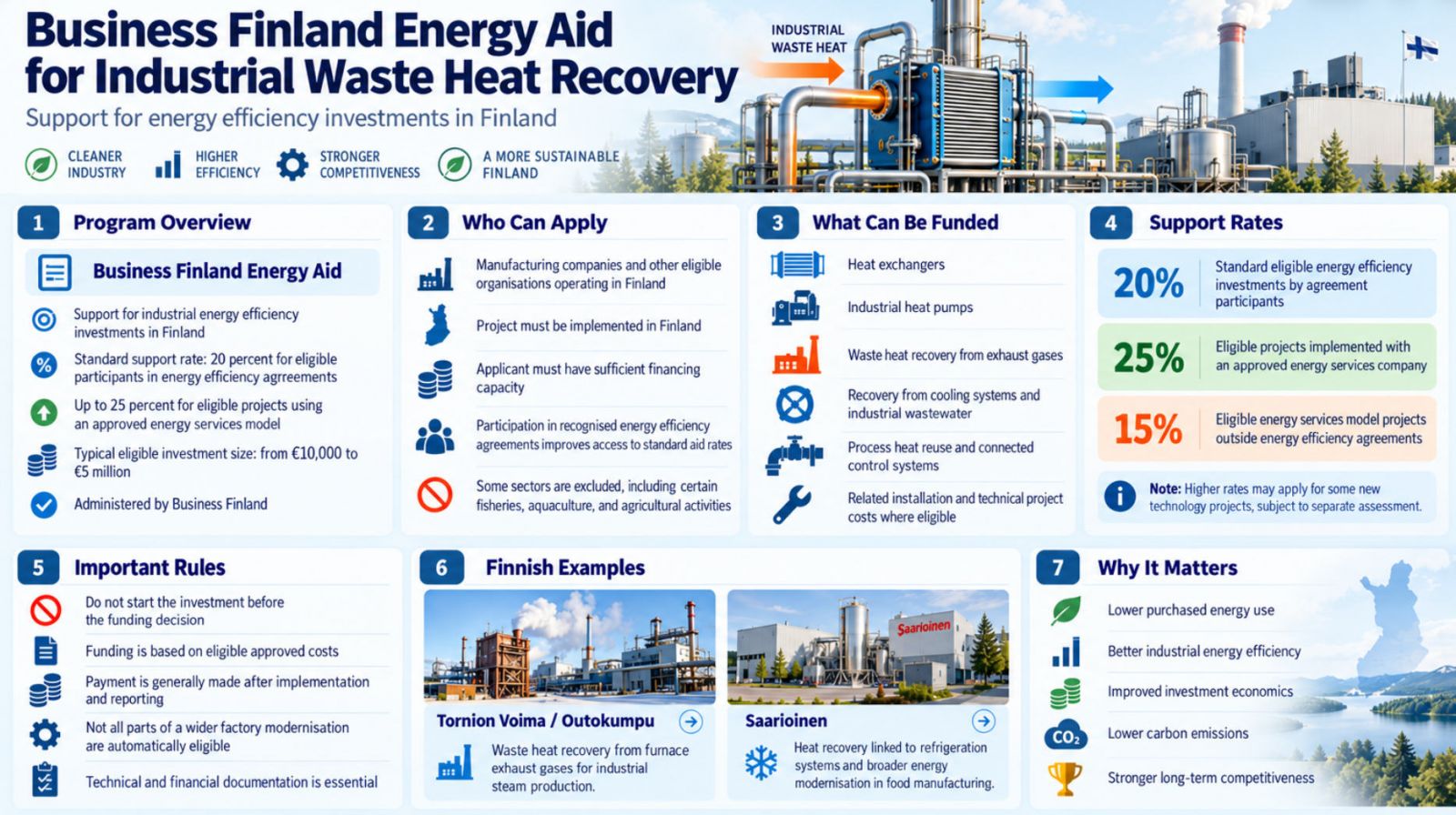
Industrial waste heat represents a valuable but frequently underutilised energy resource for manufacturing companies. In Finland, businesses seeking to recover heat from production processes can apply for public investment support through the Business Finland Energy Aid programme. Under the applicable funding arrangements, companies participating in recognised energy efficiency agreements may receive support covering 20 percent of eligible investment costs, while those implementing projects through qualifying Energy Service Company (ESCO) arrangements can obtain up to 25 percent. These grants can improve the economics of industrial heat recovery systems, including heat exchangers, industrial heat pumps and equipment designed to redirect thermal energy into productive use.
For a manufacturing company planning a €750,000 investment, the difference between the standard and enhanced funding rates is financially significant. A 20 percent grant would represent €150,000 in public support, while a qualifying ESCO project could receive €187,500 if the entire investment cost were approved as eligible. Larger projects can receive proportionally higher amounts, with the standard Energy Aid framework covering qualifying energy efficiency investments costing between €10,000 and €5 million. Nevertheless, the maximum rate is not available to every applicant, and the final amount depends on the company's circumstances, the technical characteristics of the investment and the conditions established by Business Finland.
Finland's industrial structure makes this funding opportunity particularly relevant. Food manufacturers operate refrigeration systems while simultaneously requiring hot water and process heat. Wood-processing companies use substantial quantities of thermal energy for drying, while metal and chemical manufacturers frequently release heat through exhaust gases, cooling circuits and industrial processes. Commercial laundries face similar opportunities because they continually heat incoming water while discharging wastewater that may retain substantial thermal energy. In these industries, recovering heat can reduce purchases of electricity, fuel or district heating, although the financial benefits depend on how efficiently the recovered energy can be used.
The practical experience of Finnish manufacturers demonstrates that such investments can deliver meaningful results when projects are properly designed. Tornion Voima has received confirmed Energy Aid covering 20 percent of an industrial flue gas heat recovery investment serving Outokumpu's steelworks in Tornio. Food manufacturer Saarioinen has also received Business Finland support for energy efficiency improvements at its Huittinen production facility, where the company has developed an integrated approach to refrigeration, heat recovery and building systems. These two businesses provide useful examples of how public assistance, industrial engineering and financial planning can work together, while also illustrating why the technical scope and funding conditions of each project must be examined individually.
Finland's Industrial Energy Consumption Creates Opportunities for Waste Heat Recovery
Finland has one of Europe's most energy-intensive industrial structures, reflecting the importance of pulp and paper production, wood processing, chemicals, metals and other manufacturing activities. According to Statistics Finland, manufacturing energy consumption amounted to 452 petajoules in 2024, equivalent to approximately 125.6 terawatt-hours. This represented a decrease of 0.8 percent compared with 2023. Wood fuels accounted for approximately 41 percent of manufacturing energy consumption, while purchased electricity represented around 22 percent. These figures reveal the scale of the country's industrial energy requirements, although they do not indicate how much energy could realistically be recovered from individual production processes.
Industrial waste heat is generated whenever part of the energy entering a process is released without being used for another productive purpose. In a food factory, refrigeration compressors reject heat while maintaining low temperatures in production and storage areas. Industrial dryers release warm exhaust air, while metal-processing equipment transfers heat to cooling water or surrounding systems. Steam networks can also contain recoverable thermal energy in condensate and other process streams. The potential value of these resources depends on their temperature, availability, location and compatibility with the facility's heating requirements. A large quantity of low-temperature heat may be less commercially useful than a smaller but continuously available stream at a temperature suitable for direct process integration.
Motiva, Finland's national energy efficiency expert organisation, has estimated that additional beneficial utilisation of industrial surplus heat could reach approximately four terawatt-hours annually. This figure represents an estimate of technical potential rather than a verified measurement of unused industrial heat in 2026. Nevertheless, it illustrates why waste heat recovery remains an important component of Finland's energy efficiency strategy. The opportunity is not limited to replacing fossil fuels. Even manufacturing facilities using renewable electricity or biomass-based energy can benefit from reducing their overall energy requirements, particularly when this releases electrical capacity, lowers maintenance demands or improves the efficiency of industrial heating networks.
The commercial attractiveness of waste heat recovery has become increasingly connected to the broader modernisation of production systems. A factory may initially investigate a heat exchanger to reduce heating costs, only to discover that the most efficient solution also requires changes to pumping equipment, automation, process temperatures or the timing of production activities. Heat pumps can increase the usefulness of low-temperature thermal energy, while appropriate control systems can coordinate heat supply and consumption. In some facilities, recovered energy can also serve neighbouring industrial operations or district heating networks, although such arrangements introduce additional costs associated with pipelines, contracts and the reliability of external customers.
Public investment assistance is valuable in this context because the financial benefits of energy efficiency improvements accumulate over time, whereas the capital expenditure must generally be incurred before the savings materialise. An investment that is technically feasible may still be postponed because of competing capital requirements, uncertainty about future energy prices or the complexity of integrating new equipment into an operating factory. Business Finland Energy Aid is intended to address such barriers by supporting qualifying investments that improve energy efficiency and contribute to national energy and climate objectives. However, the programme cannot compensate for an investment that lacks a reliable heat source, an appropriate consumer or an economically credible operating model.
How Business Finland Energy Aid Supports Industrial Investments
Energy Aid, known in Finnish as Energiatuki, is a national funding instrument supporting qualifying investments and studies that improve energy efficiency, promote energy savings and contribute to the development of the energy system. Its legal framework includes Government Decree 262/2023, as amended, which establishes general conditions for energy aid during 2023–2027. Business Finland administers the relevant funding process for investment projects within its applicable responsibilities, evaluates applications and establishes the conditions attached to individual funding decisions. The programme is available to eligible companies and organisations of different sizes, provided the project is implemented in Finland and satisfies the relevant technical and financial requirements.
Business Finland expressly identifies the utilisation of waste heat from industrial processes as a typical energy efficiency investment. This provides an identifiable funding route for manufacturers wishing to capture thermal energy from production wastewater, exhaust streams, cooling systems or other industrial sources. Depending on the project, eligible expenditure can include the acquisition, installation and commissioning of necessary machinery and equipment, along with certain preparation, planning and infrastructure costs. However, Energy Aid does not provide a general subsidy for factory renovation or equipment replacement. Applicants must demonstrate that the investment serves an eligible energy efficiency objective and that the proposed costs are directly connected to achieving that objective.
The programme gives particular priority to investments involving new technologies. Business Finland generally defines these as solutions not previously used in Finland that have significance for energy and climate objectives, often involving an initial commercial implementation. Such projects may qualify for different assistance intensities, reflecting the additional financial and technical risks associated with introducing unfamiliar technology. For qualifying new technology investments, the published maximum aid intensity can reach 40 percent for small and medium-sized enterprises and 30 percent for large companies. These are separate ceilings rather than standard grants for ordinary heat recovery equipment, and the actual rate is determined through project-specific assessment.
Conventional energy efficiency projects follow a different funding structure, based primarily on participation in recognised energy efficiency agreements and the use of qualifying ESCO arrangements. Under these conditions, the published rates are 20 percent for participating companies and organisations, 25 percent for participating applicants using eligible ESCO services, and 15 percent for eligible ESCO projects implemented outside the agreements. A company that does not participate in an agreement and does not use a qualifying ESCO model should not assume that a conventional technology investment will receive one of these rates. Such a project may require another eligible basis, including genuinely new technology, before it can be considered for assistance.
Business Finland operates the standard Energy Aid programme through a continuous application process, allowing companies to prepare proposals according to their investment schedules rather than waiting for a single annual competition. However, continuous applications do not mean that funding is unlimited or that approval is guaranteed. Public resources remain subject to budgetary constraints, and projects are evaluated according to the programme's conditions and priorities. The wider Finnish energy aid budget also includes activities and commitments beyond conventional industrial waste heat recovery, so applicants should not interpret the government's total energy aid expenditure as money reserved specifically for new heat exchangers or industrial heat pumps.
Which Companies Qualify for Energy Aid?
The programme is relevant to established manufacturers, industrial service providers and other eligible organisations operating facilities in Finland. Business Finland does not restrict ordinary Energy Aid applications exclusively to small businesses, although company size can influence the maximum intensity available for certain new technology projects. A foreign-owned company may potentially qualify when the applicant meets the relevant funding requirements and the proposed investment is implemented in Finland. The decisive considerations concern the applicant's legal and operational circumstances, financial capacity, the nature of the project and compliance with applicable funding conditions rather than the nationality of its shareholders alone.
Industrial applicants must also distinguish eligible energy-saving investments from projects undertaken solely to meet mandatory regulatory obligations. Energy Aid is intended to support voluntary investments, not simply reimburse expenditure that a company is already legally required to incur. If a manufacturer must install certain equipment to satisfy an existing environmental requirement, the fact that the installation also improves efficiency does not automatically make it eligible. The company's proposal should therefore explain both the anticipated energy benefits and the circumstances that make the investment suitable for discretionary public assistance.
Certain activities are specifically excluded. These include fishing and aquaculture enterprises, including processing businesses in those sectors, as well as farms and projects connected with agricultural production, subject to narrowly defined exceptions. Ordinary residential properties, housing associations and certain state-funded organisations are also outside the programme's standard scope. These exclusions matter when a company operates in an industry that appears technically suitable for heat recovery but falls within a restricted applicant category. A seafood processor, for example, may operate refrigeration equipment similar to that used in another food manufacturing facility, yet still face a sector-specific exclusion under Energy Aid.
Financial capacity is another essential condition. Business Finland requires applicants to have sufficient resources to finance the entire investment before receiving the grant, which is generally paid after the final report and supporting expenditure documentation have been approved. Consequently, a company planning a €500,000 installation cannot assume that it needs access only to the portion remaining after the anticipated subsidy. The business must be capable of paying suppliers and completing the approved project before reimbursement, whether through its own capital, permissible financing or a combination of funding sources. This requirement is particularly important for smaller manufacturers whose projects may be profitable over several years but place immediate pressure on liquidity.
Energy Efficiency Agreements and Their Influence on Grant Rates
Finland's voluntary energy efficiency agreements are an established mechanism for encouraging companies to improve energy performance while maintaining flexibility over the investments they undertake. A new agreement period began on January 1, 2026, and continues until December 31, 2035. It includes arrangements covering industrial activities, energy companies, services, property-related operations and public organisations. Manufacturing businesses can participate through the relevant sectoral action plan, including arrangements for food production, chemicals, technology industries, wood products, energy-intensive industries and general industrial activities.
Under the current framework, participating organisations generally establish an indicative savings target corresponding to 10 percent of representative annual energy consumption by 2035, with an interim target corresponding to six percent by 2030. These percentages are used to calculate the savings effects expected from energy efficiency measures and should not be interpreted as universal requirements to reduce absolute energy consumption by the same percentages. A company may expand production and increase its total energy requirements while simultaneously achieving measurable efficiency improvements. The agreement framework therefore focuses on systematic action, reporting and the effects of implemented measures rather than imposing a simple limit on business activity.
Agreement participation involves incorporating energy efficiency into management practices, identifying cost-effective improvements, considering energy performance in purchasing decisions and reporting progress. For industrial companies, these activities can also improve the quality of future investment proposals because the organisation develops more reliable information about its energy use and potential savings. A manufacturer that has already examined its heat flows, documented process efficiency opportunities and established relevant energy performance indicators is generally better prepared to develop a technically convincing grant application than one relying solely on a preliminary equipment quotation.
The relationship between agreement membership and grant eligibility creates a practical incentive to examine participation before making investment decisions. Companies that previously belonged to the 2017–2025 agreements should verify their status under the new 2026–2035 framework rather than assume that historic participation automatically establishes current eligibility. Joining an agreement should not be treated merely as a procedural formality to obtain a higher subsidy. It creates ongoing responsibilities, but it can also provide a structured foundation for identifying and implementing energy-saving measures across several production facilities.
Table 1. Business Finland Energy Aid Rates and Principal Eligibility Conditions
| Investment arrangement | Applicable grant rate | Main consideration |
|---|---|---|
| Conventional energy efficiency investment by an energy efficiency agreement participant | 20 percent | Eligible investment and recognised agreement participation |
| Qualifying ESCO investment by an agreement participant | 25 percent | ESCO performance guarantee and verification requirements |
| Qualifying ESCO investment outside an agreement | 15 percent | Eligible ESCO arrangement and general funding conditions |
| Conventional investment outside an agreement without ESCO | No general standard rate under these arrangements | Another eligibility basis must be established |
| Qualifying new technology investment | Determined individually | Separate assessment, with higher maximum intensities possible |
The table illustrates why applicants should not use the highest published percentage when preparing their initial budgets. The correct rate depends on the applicant and the investment model, while the final grant is calculated against costs approved by Business Finland. A company may also find that some elements of a wider factory modernisation are ineligible, reducing the effective subsidy as a share of total expenditure. Establishing the relevant agreement status, technology category and eligible cost base early in project development is therefore essential for producing a realistic financing plan.
What Industrial Heat Recovery Technologies Can Receive Funding?
The central technical requirement is that the proposed installation must contribute to an eligible improvement in energy efficiency. Heat exchangers, industrial heat pumps and associated process equipment can serve this purpose when they recover energy that would otherwise be lost and transfer it to a useful application. In a production facility, recovered heat may preheat incoming water, supply a process heating circuit, reduce boiler fuel consumption or provide energy for a suitable heating network. The proposed use must be supported by calculations showing that the system can operate under realistic production conditions, including periods of reduced output, maintenance and changing thermal demand.
Heat exchangers are frequently the simplest form of waste heat recovery equipment. They transfer thermal energy between process streams, potentially allowing a factory to reuse heat without operating a compressor-based system. Their usefulness depends on the temperatures and flow rates of the available streams, and their design must account for pressure losses, contamination, corrosion and maintenance access. Industrial wastewater heat recovery, for example, may require measures to prevent fouling or facilitate cleaning. A low-cost exchanger that becomes blocked during normal operations may be less economical over its lifetime than a more expensive solution designed for the actual characteristics of the wastewater.
Industrial heat pumps become relevant when recovered energy is available at a temperature below that required by the receiving process. A heat pump can upgrade low-temperature heat, allowing it to replace a portion of conventional heating. However, the technology requires electricity and introduces additional operating costs, making its economic performance dependent on the relationship between electricity prices, the cost of displaced heating energy and the achievable temperature lift. An industrial project should therefore be evaluated using realistic annual operating conditions rather than a manufacturer's nominal coefficient of performance alone.
Business Finland applies specific restrictions to larger heat pumps. Under the published rules, energy efficiency investments involving heat pumps above 1 MW can be supported when the project qualifies as new technology or is connected to a low-temperature heating network. A specific exception applies when surplus heat is used as the heat source: conventional technology heat pumps with a capacity of up to 5 MW may be eligible under that arrangement. Projects involving heat pumps larger than 5 MW may also be considered when they qualify as new technology. These thresholds cannot be interpreted as universal approval for all equipment below a particular capacity, because the source of heat and the purpose of the installation remain essential.
Thermal storage creates another area requiring careful assessment. Storing recovered energy may be technically useful when heat is generated at a different time from when it is required, but conventional water-based heat storage and ordinary geothermal heat storage are not generally supported under the standard technology provisions. New technology storage projects can be assessed separately. Similarly, Business Finland excludes conventional lighting investments, ordinary building envelope improvements and the recovery of waste heat from data centres. Certain flue gas scrubber and associated heat recovery investments are also excluded where they relate to emissions trading installations or heating plants above the specified 10 MW threshold. These restrictions make it important to evaluate the precise equipment and installation context rather than relying on a broad description such as industrial energy modernisation.
The Engineering Requirements Behind a Profitable Waste Heat Recovery Project
A credible recovery project begins with a detailed examination of how energy enters, moves through and leaves the industrial facility. Engineers must identify recoverable thermal streams, determine their temperatures and flow rates, and establish how their availability changes during ordinary production. The company must also identify the processes capable of using that heat and evaluate whether their operating schedules are compatible. A factory may generate large quantities of warm exhaust air while having little useful demand for low-temperature heat, making direct recovery commercially unattractive. Conversely, an installation with a smaller but reliable heat source and continuous demand may achieve high utilisation and a relatively short payback period.
The relationship between available and required temperatures is particularly important. Heat recovered at 65 degrees Celsius may be useful for preheating water, but it cannot necessarily replace a process requiring temperatures well above 100 degrees Celsius without additional technology. Where a heat pump is required, its electricity consumption must be included in the energy balance. The coefficient of performance describes the relationship between useful heat output and electrical input under specified conditions, but it does not directly measure the net energy savings of an entire industrial installation. Those savings depend on the existing heating system, the additional electricity needed by the new equipment, auxiliary pumps and the actual quantity of recovered energy used over the year.
An illustrative manufacturer might currently require 2,400 MWh of useful process heat annually from a boiler operating at an assumed efficiency of 90 percent. Producing that heat would require approximately 2,667 MWh of fuel input. If a proposed heat pump could deliver the same useful heat at an average annual coefficient of performance of three, the heat pump itself would consume approximately 800 MWh of electricity while drawing the remaining thermal energy from the recovery source. The comparison suggests significant potential to reduce purchased energy input, but the final calculation must include circulation pumps, controls, operating losses and the different prices of fuel and electricity. These figures represent a hypothetical engineering calculation, not a documented result from a Finnish grant recipient.
Another important consideration is whether the recovered heat can actually be used throughout the year. Many manufacturers operate different production shifts, experience seasonal variations or shut down particular processes for maintenance. A system designed around maximum theoretical heat availability may perform below expectations if the source is available only intermittently. The financial model should therefore use realistic annual operating hours and evaluate how the system performs under partial load. It should also consider whether the factory needs a backup heating source when recovery equipment is unavailable and whether modifications to the production schedule could improve heat utilisation.
These requirements explain why preliminary energy studies are valuable even where a separate grant-funded audit is not universally mandatory. Business Finland expects investment plans to include numerical objectives, technical descriptions, cost estimates and profitability calculations. A properly conducted study can establish the existing energy baseline, quantify the expected improvement and identify technical risks before the company commits substantial capital. It can also determine whether direct heat exchange, heat pump upgrading or another process modification offers the best combination of energy savings and investment cost.
Tornion Voima and Outokumpu: A Confirmed Industrial Waste Heat Recovery Grant
One of the strongest documented examples of Business Finland Energy Aid supporting industrial waste heat recovery comes from Tornio, where Tornion Voima has developed energy infrastructure serving Outokumpu's steelworks. In April 2022, Tornion Voima announced an investment decision to acquire a flue gas heat recovery steam generator for the cold-rolling mill at the Outokumpu production site. The project was designed to capture thermal energy from furnace exhaust gases and use that energy to generate process steam for the industrial facility. Importantly, Tornion Voima explicitly confirmed that the investment received Energy Aid covering 20 percent of its costs from Business Finland.
The technical concept addresses a common challenge in large manufacturing facilities: thermal energy released by one production process can remain unused even while another process requires externally supplied steam or heat. At the Outokumpu site, the planned recovery generator was designed to produce process steam at a pressure of five bar using waste heat from the cold-rolling furnace. According to Tornion Voima's announcement, the new solution could replace up to 30 percent of the steelworks' then-current steam demand. This illustrates how a recovery project can reduce the need for separately produced process heat by redirecting energy already generated during industrial operations.
The importance of the project extends beyond its expected savings. Steel production is a technically demanding environment where equipment integration must account for production reliability, temperature conditions and the characteristics of industrial exhaust gases. A heat recovery installation must operate without undermining the performance of the production equipment supplying its thermal energy. Depending on the design, engineers may need to consider temperature fluctuations, pressure losses, fouling and maintenance access. A successful system also requires a reliable connection between the recovery equipment and the steam network, ensuring that the recovered energy can be delivered at the required operating pressure and quality.
The project is especially useful as evidence of the type of industrial investment that has received public support in Finland. Unlike a general statement about theoretical grant opportunities, Tornion Voima's announcement identifies a real investment, its intended technical function and a confirmed grant percentage. Nevertheless, the published information does not provide enough detail to reconstruct the complete approved eligible budget or the exact value of the subsidy. It would therefore be inappropriate to invent a euro amount or treat the installation's expected 30 percent steam replacement potential as an independently verified operating result. The announcement also belongs to an earlier funding period, so present-day applicants must satisfy the current rules rather than assume that an identical project would automatically be approved under unchanged conditions.
There is another important lesson concerning regulatory classification. Modern Energy Aid rules exclude certain flue gas scrubber and related recovery investments connected to emissions trading installations or heating plants above the specified capacity threshold. This does not automatically establish that every industrial furnace heat recovery system is prohibited, but it demonstrates why a contemporary applicant should examine the exact process, equipment and regulatory status before using Tornion Voima as a precedent. A verified historical grant establishes that Business Finland has supported such industrial technology; it does not override later restrictions or guarantee future eligibility.
For manufacturing businesses considering similar investments, the Tornio case illustrates the benefits of integrating energy recovery into an existing industrial utility system. Recovering heat becomes particularly attractive when the factory already operates a steam network capable of receiving useful output from the new equipment. This reduces the need to create an entirely new consumer of recovered energy and allows the project to target an established operating cost. At the same time, the economic assessment must account for the technical costs of integrating the generator, its actual annual utilisation and any influence it has on existing steam production equipment.
The financial structure can be illustrated using a hypothetical investment budget, without attributing invented costs to Tornion Voima. If a comparable eligible industrial project cost €2 million, a 20 percent grant would represent €400,000 in potential support, leaving €1.6 million of expenditure not covered by that grant. A qualifying 25 percent ESCO arrangement would produce a different hypothetical grant amount, but Tornion Voima's published project should not be described as having received that enhanced rate. Its confirmed support was 20 percent. This distinction between published facts and illustrative financial modelling is essential when using real projects to guide potential applicants.
Ultimately, the Tornio example demonstrates that waste heat recovery can be more than an isolated energy-saving measure. When carefully integrated into a production facility's heat and steam infrastructure, it can become part of the factory's long-term energy strategy. The combination of a clearly identified thermal source, a practical industrial heat consumer and a documented public funding decision makes Tornion Voima an important case for companies evaluating the commercial potential of similar investments.
Saarioinen: How a Finnish Food Manufacturer Combined Heat Recovery with Wider Energy Modernisation
A different but equally informative example comes from Saarioinen, a Finnish food manufacturer operating a production facility in Huittinen. The factory produces food products including salads, jams and dressings, requiring a combination of refrigeration, ventilation, heating and temperature-controlled manufacturing processes. Over several decades, the facility expanded to approximately 24,000 square metres, creating an industrial environment in which different generations of equipment and building systems operated together. This situation is familiar to many established manufacturers, where individual technical improvements are introduced over time but the overall energy system gradually becomes more complicated and difficult to optimise.
Saarioinen had already implemented heat recovery in its refrigeration operations before undertaking a broader modernisation programme. According to Motiva's published case study, the factory uses a heat pump to transfer recovered heat from its refrigeration plant to domestic hot water production. The arrangement demonstrates a practical relationship found in many food facilities: refrigeration systems remove heat from production and storage areas while the factory simultaneously requires warm water for other activities. Instead of releasing all of that rejected heat, the facility can use suitable equipment to recover part of it and reduce the need for separate heating.
The factory's refrigeration infrastructure is substantial. Motiva describes two refrigeration plants with ammonia systems providing a combined cooling capacity of approximately 1,500 kilowatts. Cooling is distributed through the facility using a dedicated network, supporting both production-related requirements and temperature control in working areas. For a plant manufacturing temperature-sensitive food products, the reliability of this infrastructure is essential. Any energy efficiency investment must therefore preserve refrigeration performance and maintain the conditions required for safe and consistent production.
As Saarioinen evaluated opportunities for further improvement, management recognised that replacing individual components separately might not deliver the full benefits available from a coordinated modernisation. The facility contained ventilation equipment, automation systems, lighting and other installations originating from different periods, while accumulated technical maintenance needs increased the complexity of operations. Rather than undertaking several disconnected projects, the company decided to pursue a comprehensive energy renovation through a specialised external partner. LeaseGreen was selected to manage the project, bringing experience in energy efficiency services and performance-oriented implementation.
The decision reflected an important practical consideration for industrial companies. A food manufacturer may have qualified engineers and maintenance personnel, but those employees must also ensure the continuous operation of production equipment. Managing a substantial energy modernisation can require specialist expertise, detailed scheduling and coordination among several technical suppliers. Outsourcing project implementation does not eliminate the manufacturer's responsibility, but it can allow an experienced provider to organise the work while internal staff concentrate on maintaining production and ensuring that the technical solution meets operational requirements.
The modernisation addressed several interconnected systems. Ventilation units and exhaust equipment were upgraded, heating circuit pumps were renewed, and building automation was improved to regulate ventilation according to actual demand. The project also addressed cooling conditions in the factory's berry-processing department, where the preparation of jams and marmalades generates substantial heat. To manage temperature peaks, the project introduced a cooling coil with a capacity of approximately 340 kilowatts into the supply-air system, integrating its operation with the wider automation arrangements. This measure was intended to improve working conditions while using the facility's existing refrigeration infrastructure.
A particularly significant element of the project was the digital integration of technical systems. The modernised equipment was connected to an energy and indoor conditions management service, allowing performance to be monitored and controlled more systematically. This illustrates why energy efficiency investments frequently extend beyond replacing individual pieces of equipment. The effectiveness of a heat recovery system depends partly on how well it interacts with pumps, ventilation, refrigeration and process requirements. Better controls can help avoid unnecessary operation, improve equipment coordination and make the resulting savings easier to verify.
The project also included modernisation of conventional lighting and other building-related equipment. These measures formed part of Saarioinen's wider factory renovation, but their inclusion in the historical project does not mean that every component would qualify for a new Energy Aid application under current rules. Business Finland now expressly excludes conventional lighting projects and certain ordinary building technology investments. Applicants should therefore separate the technical scope of a company's overall modernisation from the components specifically accepted for grant funding. Historical results can demonstrate the value of integrated energy management without proving that each individual measure received a subsidy.
According to Motiva, the modernisation achieved approximately 1,550 MWh of annual heating energy savings and 1,140 MWh of annual electricity savings, while reducing carbon dioxide emissions by more than 600 tonnes. These figures are important because they demonstrate measurable results from an implemented industrial efficiency project rather than theoretical expectations. However, they refer to the broader modernisation programme, not exclusively to the refrigeration heat recovery installation. Attributing the full savings to a single heat pump or exchanger would misrepresent the published evidence and overstate the performance of that specific technology.
Saarioinen also confirmed that participation in Finland's energy efficiency agreement enabled the company to receive Energy Aid from Business Finland. The company's experience therefore demonstrates how an established manufacturer can use agreement participation as part of a wider strategy for improving energy performance. The published case study does not provide a sufficiently detailed breakdown to identify the exact amount of Energy Aid awarded to each technical component, and the final investment cost should not be inferred from the reported energy savings alone. What the case does confirm is that the company combined a structured efficiency programme with public support and achieved documented operational improvements.
An additional challenge was the need to implement substantial technical changes within a functioning food production facility. Motiva notes that Saarioinen had to coordinate construction work with production schedules and comply with strict hygiene requirements. These factors can strongly influence the cost and practicality of industrial modernisation. Equipment installation may need to be scheduled during shutdowns, access to production areas may be restricted, and commissioning must be organised without compromising food safety. The project consequently demonstrates the importance of considering implementation risks alongside energy calculations and potential grant amounts.
The Saarioinen example offers a different lesson from Tornion Voima. While Tornion Voima illustrates a clearly defined recovery installation serving an industrial steam demand, Saarioinen demonstrates the potential value of combining heat recovery with broader improvements to factory energy management. Both approaches can contribute to energy efficiency, but they require different project scopes, cost structures and performance calculations. A company planning to follow Saarioinen's example should avoid assuming that all planned improvements can be submitted as one eligible Energy Aid investment. Instead, it should identify which components meet the current funding requirements and how those components contribute to measurable savings.
For other food manufacturers, Saarioinen's experience is particularly relevant because it shows that recovery opportunities often exist within equipment already essential to production. Refrigeration cannot simply be eliminated from a factory that needs cooling, but part of the heat rejected by that equipment may be put to productive use. The same principle can apply to dairies, beverage factories, prepared-food production and other industrial facilities where heating and cooling demands coexist. The technical task is to determine whether the available heat can be recovered at a useful temperature and whether the additional installation costs are justified by the savings achievable under actual production conditions.
Comparing Tornion Voima and Saarioinen: Two Approaches to Industrial Energy Efficiency
The two Finnish businesses demonstrate different approaches to recovering and managing industrial energy. Tornion Voima's documented investment focused on transforming waste heat from furnace exhaust gases into process steam for a specific industrial consumer. Saarioinen's experience involved an established refrigeration heat recovery application alongside a comprehensive energy modernisation combining several technical improvements. Both projects demonstrate how industrial facilities can reduce the amount of energy required from separate supply systems, but their technical boundaries and published performance indicators are different.
Table 2. Confirmed Finnish Energy Efficiency Projects and Practical Lessons
| Feature | Tornion Voima / Outokumpu | Saarioinen |
|---|---|---|
| Location | Tornio, Finland | Huittinen, Finland |
| Industry | Steel manufacturing and industrial energy services | Food manufacturing |
| Main heat recovery application | Furnace flue gas heat recovery for process steam | Refrigeration waste heat recovery for hot water |
| Wider investment context | Industrial steam production efficiency | Comprehensive factory energy modernisation |
| Published technical information | Production of 5-bar process steam | Refrigeration infrastructure, heat pumps and integrated automation |
| Published performance result | Designed to replace up to 30 percent of then-current steam demand | 1,550 MWh heat and 1,140 MWh electricity savings annually from broader modernisation |
| Evidence of Energy Aid | Confirmed 20 percent Business Finland grant | Business Finland Energy Aid confirmed |
| Main lesson | Integrate recovered heat into an existing industrial utility system | Coordinate heat recovery with wider technical and operational improvements |
The comparison also highlights why published industrial case studies require careful interpretation. Tornion Voima's announcement provides direct confirmation of a 20 percent grant and an expected steam replacement capacity, but not a full record of final operating savings. Saarioinen's case provides documented realised savings from a broader renovation and confirms Business Finland support, but does not isolate the energy savings or grant amount attributable to each individual component. These are not shortcomings in the projects themselves. They are limitations of the information publicly available to external readers and should be respected when using the cases to guide investment decisions.
For potential applicants, the underlying message is that a successful project depends on aligning technology with real industrial demand. In the Tornio case, the industrial utility system provided a clear use for recovered thermal energy. At Saarioinen, the opportunity arose from managing simultaneous heating and cooling requirements within a complex operating factory. Manufacturers evaluating their own projects should begin by identifying comparable relationships between energy sources and consumers, then establish the investment costs and the applicable funding route. The most appropriate design may be a relatively simple heat exchanger, a heat pump or a coordinated package of several improvements, depending on the actual conditions of the facility.
Financial Models for Industrial Heat Recovery Investments
The potential value of Energy Aid can be illustrated through several investment budgets representing different project scales. A smaller company might invest €100,000 in a heat exchanger and related installation work, while an industrial laundry could require €350,000 for a more comprehensive wastewater heat recovery system. A larger manufacturer might spend €750,000 on industrial heat pumps and associated equipment, while a major industrial facility could develop an eligible project costing €2 million. The following calculations apply the published Energy Aid rates to these hypothetical budgets, assuming that every euro of expenditure is accepted as eligible and the corresponding funding arrangement is approved.
Table 3. Potential Energy Aid Grants for Industrial Investments in Finland
| Eligible investment costs | Grant at 15 percent | Grant at 20 percent | Grant at 25 percent |
|---|---|---|---|
| €100,000 | €15,000 | €20,000 | €25,000 |
| €350,000 | €52,500 | €70,000 | €87,500 |
| €750,000 | €112,500 | €150,000 | €187,500 |
| €2,000,000 | €300,000 | €400,000 | €500,000 |
These amounts should be interpreted as mathematical illustrations rather than confirmed grant offers. The applicable percentage depends on agreement membership and ESCO conditions, while the eligible budget may be lower than the company's overall project expenditure. For example, a manufacturer could plan a €750,000 modernisation but discover that only €600,000 represents costs directly connected with the qualifying industrial energy efficiency investment. Under an illustrative 20 percent rate, the potential grant would then be €120,000 rather than €150,000. The distinction between the total project budget and approved eligible expenditure can therefore affect the amount of public support as much as the difference between individual funding rates.
A further issue concerns cash flow. Business Finland generally pays Energy Aid after the approved project has been implemented and the required documentation has been accepted, rather than providing the full grant as an advance. Consequently, an applicant planning a €750,000 investment needs a financing structure capable of covering the complete implementation cost before reimbursement. The eventual grant can reduce the final capital burden, but it does not eliminate the need for sufficient liquidity during construction, equipment installation and commissioning. Companies should therefore evaluate their credit arrangements, working capital requirements and potential schedule changes before treating the grant as part of their investment financing strategy.
Does the ESCO Model Make a Higher Grant Financially Attractive?
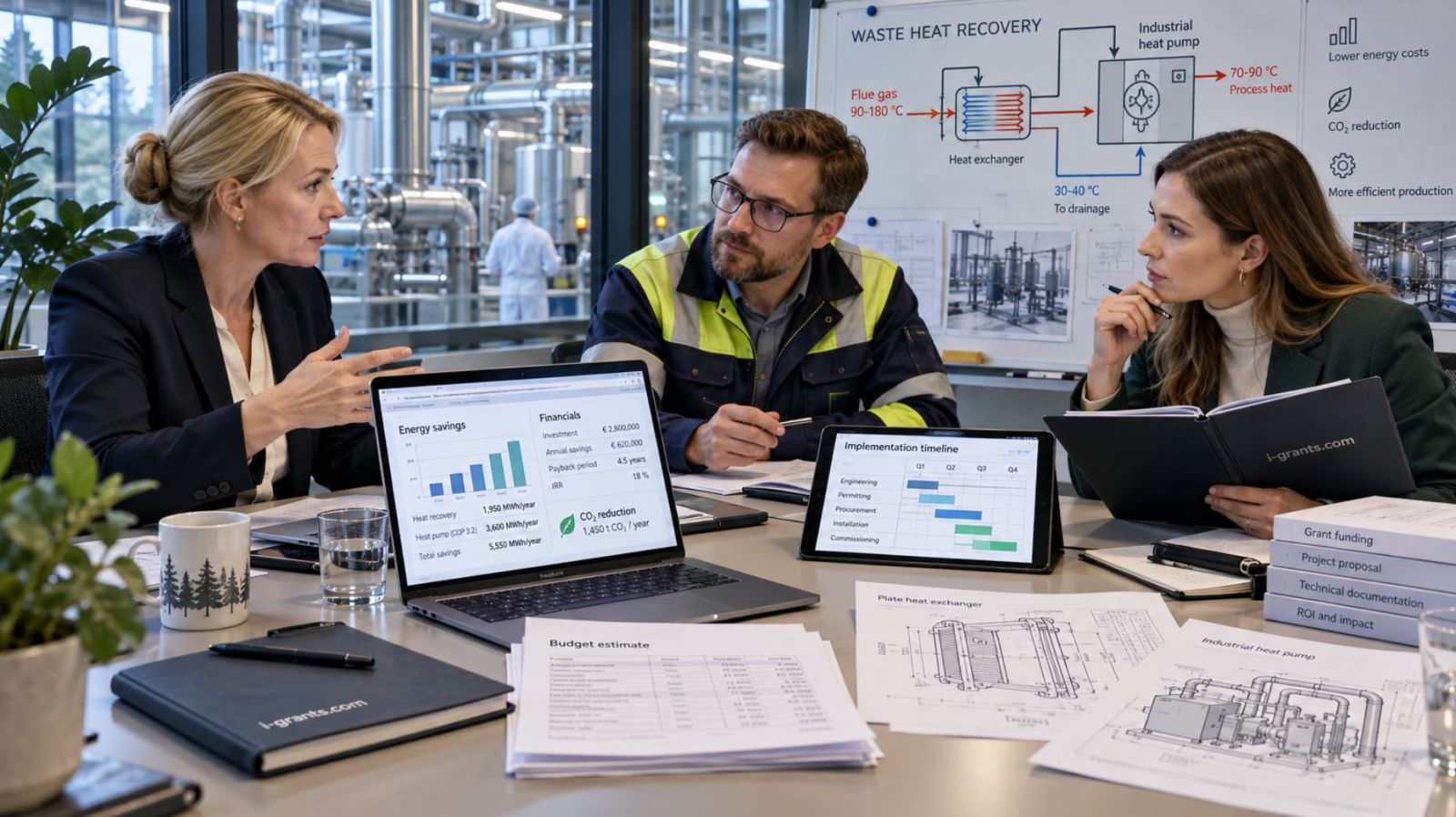
The enhanced 25 percent rate can make an ESCO arrangement attractive, particularly for larger investments. An ESCO, or Energy Service Company, provides energy efficiency services under a contractual model in which the provider accepts specified performance obligations, potentially including responsibility for implementation, monitoring and guaranteed savings. Unlike a conventional equipment purchase, a qualifying ESCO arrangement must demonstrate a contractual relationship between the proposed improvements and measurable performance results. Business Finland requires a minimum savings guarantee of 50 percent, while at least 80 percent of total savings during the verification period must be verifiable in monetary terms.
These conditions have practical implications for contract design. A manufacturer must establish a reliable baseline and agree on how energy savings will be measured after implementation. If production volumes, operating hours or energy prices change, the contract should explain how those changes affect performance calculations. An agreement that simply promises lower electricity consumption without defining the measurement process may be insufficient to demonstrate the required guarantee. The provider and the manufacturer should also establish responsibilities for maintenance, monitoring and underperformance, ensuring that the commercial contract reflects the actual technical risks of the project.
The difference between the standard agreement rate and the enhanced ESCO rate is five percentage points. For a project costing €350,000, this represents an additional potential grant of €17,500, while a €2 million investment could receive €100,000 more under the qualifying ESCO arrangement. However, the higher subsidy must be considered alongside service fees, measurement costs and any additional financing or contractual expenses. A smaller company might find that the administrative costs of an ESCO model offset much of the additional grant. A larger manufacturer may value the performance guarantee and specialist management sufficiently to justify the arrangement even before considering the enhanced funding percentage.
The decision should therefore be based on the total economics of the investment rather than the headline grant rate. An ESCO arrangement may reduce certain performance risks and provide access to specialist expertise, but it also creates contractual obligations that can extend beyond the initial installation period. Manufacturers should compare the expected lifetime savings, financing costs, maintenance responsibilities and allocation of risk under both conventional procurement and ESCO models. The most advantageous structure is the one that delivers the best combination of financial value, technical reliability and manageable operational obligations.
How Much Can Waste Heat Recovery Improve Investment Payback?
The financial benefits of recovering industrial heat depend on the energy that the new system replaces, the cost of operating the recovery equipment and the quantity of recovered energy actually used. A project displacing expensive purchased heat may deliver attractive savings, while a technically similar installation replacing relatively inexpensive internally generated heat may have a longer payback period. Industrial heat pumps also introduce additional electricity costs, meaning that their profitability depends partly on the relationship between electricity prices and the cost of conventional heating. A credible financial model should therefore be based on the specific energy prices and operating conditions of the facility rather than on generic assumptions.
Consider a hypothetical manufacturer preparing a €350,000 recovery project that is expected to reduce existing energy purchases by €72,000 annually. If the system requires an additional €12,000 each year for electricity, maintenance and other operating expenses, the net annual operating benefit would be €60,000. Without a grant, the simple payback period would be approximately 5.8 years. If the company qualified for a 20 percent grant covering €70,000, the effective capital cost after reimbursement would decrease to €280,000, producing an illustrative simple payback period of approximately 4.7 years. Under a 25 percent grant, the remaining capital expenditure would be €262,500, corresponding to a simple payback period of approximately 4.4 years.
These calculations illustrate how public support can improve a project's financial attractiveness, but they exclude financing costs, tax effects, discounting and possible changes in future operating conditions. Larger investments should also be evaluated using net present value and sensitivity analysis, particularly when the expected savings depend on energy prices or long operating periods. A manufacturer should investigate how the project would perform if electricity costs increased, production hours decreased or the available heat source delivered less energy than expected. Such analysis can also support the funding application by demonstrating that the investment has been assessed under realistic conditions and that the company understands its principal financial risks.
It is equally important to distinguish the financial benefits of a project from the amount of energy it physically recovers. A system recovering 1,500 MWh annually does not necessarily reduce purchased energy by precisely the same amount, particularly when a heat pump or additional circulation equipment is involved. The correct comparison depends on the previous heating system and the complete energy balance after installation. Companies that develop their financial calculations from a sound technical model are better positioned to demonstrate credible benefits and avoid investment decisions based on inflated savings forecasts.
Energy Audits and Technical Studies Before Applying
Industrial energy assessments can substantially improve the quality of investment planning by identifying suitable recovery opportunities and establishing the technical evidence required for decision-making. Business Finland provides separate Energy Aid support for certain eligible energy audits and investigations, with published rates of 50 percent for applicable Motiva-type audits undertaken by energy efficiency agreement participants and 40 percent for corresponding eligible applicants outside the agreements. In-depth investigations can also receive 40 percent support under the relevant conditions. These percentages concern the cost of eligible studies rather than the subsequent equipment investment, and applicants should not combine them with investment grant rates as though they financed the same expenditure.
An effective industrial audit may examine fuel and electricity consumption, steam networks, cooling systems, process temperatures and existing control equipment. It can identify recoverable energy that is not immediately apparent from annual utility bills and determine whether that energy can be used productively. In facilities with several potential heat sources, the study may compare different recovery configurations and rank opportunities according to their expected savings, capital costs and implementation requirements. The resulting information can inform the investment plan and help the company avoid selecting equipment before fully understanding the operating conditions it must satisfy.
Technical studies can also demonstrate when a proposed investment is unlikely to be economical. A manufacturer may discover that a heat source is available only intermittently, that the temperature difference is too small for efficient direct recovery or that connecting the source to a useful consumer would require extensive infrastructure. Identifying these limitations before equipment procurement can prevent costly mistakes. For grant applicants, such assessments also create a clearer basis for calculating annual savings and explaining why the proposed technology is appropriate for the facility.
A separate grant-funded audit is not automatically required for every Energy Aid investment, but the application must contain sufficiently detailed information about the proposed project. The company must explain the equipment, investment costs, expected energy benefits and financial rationale. For technically complex projects, independent engineering studies and reliable measurements may therefore be essential in practice, even when they are not formally required as a separate funded activity. The scope of the investigation should be proportionate to the investment's complexity and the risks associated with its implementation.
Preparing and Submitting an Energy Aid Application
The application process begins with establishing whether the proposed investment meets Business Finland's eligibility requirements. The company should verify its agreement participation, the appropriate funding rate, the eligibility of its technology and the expected investment cost. It must also confirm that the project has not already been started in a manner prohibited by the funding conditions. Once these preliminary questions are resolved, the applicant can prepare the project plan and supporting documents, including a technical description, equipment specifications, cost estimates, savings calculations, implementation schedule and financing arrangements.
Business Finland requires the applicant to appoint a responsible project manager from within its own organisation. This person remains responsible for coordinating the project and its reporting obligations after a positive decision, even when external consultants, engineers or ESCO providers participate in the work. A separate contact person may assist with communication and application administration, but the company retains responsibility for the accuracy of the information submitted. For industrial projects involving several technical contractors, clear internal responsibility is essential because equipment procurement, installation work, cost documentation and performance reporting must remain consistent with the approved investment plan.
One of the most consequential rules concerns when the investment may begin. Business Finland generally requires companies not to place binding equipment orders or begin irreversible implementation before receiving the funding decision. The published instructions describe limited exceptions, including certain contracts that are genuinely conditional on approval of the grant and certain preliminary site works. However, applicants should not interpret these exceptions as a general permission to start purchasing equipment before approval. Where the installation schedule creates uncertainty, the company should obtain clarification from Business Finland before entering into commitments that could jeopardise eligibility.
This timing requirement can be challenging for industrial businesses because major equipment may have long delivery periods and installation work may need to coincide with scheduled production shutdowns. A manufacturer may wish to reserve a heat pump or specialist exchanger months in advance, particularly when suppliers have limited production capacity. Nevertheless, a technically attractive investment can become ineligible if procurement is handled incorrectly. The safest planning approach is to conduct the necessary engineering and commercial preparation, submit a complete application, obtain the relevant decision and only then proceed with binding purchases under the approved conditions.
After receiving a positive decision, the applicant must formally accept the terms and implement the project according to the approved plan. Business Finland generally requires the decision to be accepted within one month after notification, subject to the rules concerning conditional decisions. The company must maintain appropriate accounting records and preserve documentation demonstrating that costs relate to the supported investment. Changes to the project scope or timetable may require approval, and applicants should not assume that alternative equipment or additional expenditure will automatically be accepted.
At completion, the beneficiary submits the required final report and financial documentation. Business Finland generally requires an independent auditor's report for the project period, although specified projects involving no more than five supplier invoices may qualify for an alternative documentation arrangement. Payment is based on approved expenditure and satisfactory reporting, making financial management an essential part of successful project implementation. A company that prepares a strong application but fails to maintain reliable records may encounter delays or reductions in the amount ultimately reimbursed.
Why Eligible Costs May Be Lower Than the Total Investment
Energy Aid finances approved expenditure connected with the eligible project rather than every cost incurred during a factory modernisation. Machinery acquisition, installation, commissioning and necessary preparation or planning may qualify, together with certain civil engineering and monitoring costs under the relevant conditions. By contrast, ordinary salaries and indirect personnel expenses of the beneficiary, overheads, travel, banking and financing costs, and unrelated administrative expenditure are generally excluded from standard investment projects. Routine maintenance and ordinary building improvements also require careful treatment because they are not automatically eligible merely because they occur alongside an energy efficiency investment.
This distinction becomes particularly important when a manufacturer combines heat recovery with other improvements. A factory may plan a new industrial heat pump while simultaneously renovating office areas, installing ordinary LED lighting or improving building insulation. These measures may contribute to overall efficiency or working conditions, but they cannot all be assumed eligible under the same Energy Aid application. The budget should therefore identify the equipment and services directly necessary for the qualifying investment, with unrelated costs recorded separately. Where a component serves several purposes, the applicant should establish a defensible allocation method and confirm its treatment under the funding conditions.
For example, a company might plan total expenditure of €500,000, of which €390,000 relates to approved heat recovery equipment, installation, controls and necessary engineering work. If the applicant qualified for a 20 percent grant, the illustrative subsidy would be €78,000, not €100,000. The company would still need to finance the remainder of the total investment, including the ineligible costs. This example demonstrates why financial projections should be based on an itemised eligible budget rather than on the gross project price presented by an equipment supplier.
Common Risks in Industrial Waste Heat Recovery Projects
Technical risk is frequently underestimated when a company begins by selecting equipment rather than investigating its actual thermal processes. A supplier may present an attractive estimate based on maximum annual heat availability, but a factory's production conditions rarely remain constant throughout the year. If the recovery system operates for fewer hours than expected, energy savings may fall substantially below the original forecast. Industrial heat pumps can also perform differently under varying source temperatures and partial-load conditions, making it important to use realistic annual performance assumptions. A technically convincing proposal should consider the complete installation rather than relying solely on nominal equipment specifications.
Financial risk arises when businesses underestimate the capital required before grant reimbursement or overstate the savings that will be achieved. Energy prices may change, maintenance costs may be higher than expected and production volumes may fluctuate. A project with an attractive simple payback period under favourable assumptions can become considerably less profitable when operating conditions differ. Manufacturers should therefore assess alternative scenarios and ensure that the investment remains manageable even if implementation is delayed or the approved grant is lower than originally anticipated.
Administrative risk is equally significant. A company may use an incorrect grant percentage, misunderstand the conditions for ESCO support or include equipment excluded by current rules. It may also begin procurement too early, fail to document eligible expenditure or overlook reporting deadlines. These mistakes are often preventable through systematic preparation and early clarification of uncertain funding conditions. The company's application should present a technically credible investment with a clear financing plan and a realistic implementation schedule, rather than attempt to justify an equipment purchase that has already been irreversibly committed.
Finally, applicants should examine the interaction between Energy Aid and other public funding instruments. Finland has supported industrial decarbonisation and heat recovery through several mechanisms, including programmes distinct from the standard Business Finland Energy Aid arrangements. Historical grants under other schemes do not necessarily establish current eligibility, and overlapping public support may be restricted. A manufacturer developing a larger investment should identify all proposed subsidies, determine which expenditure each would finance and ensure that the combined funding structure complies with the applicable rules.
Finland's Energy Efficiency Agreements Have Delivered Measurable Results
The wider experience of Finland's voluntary energy efficiency agreements helps explain why the country continues to support investment in industrial efficiency. In September 2026, Motiva published results from the 2017–2025 agreement period, reporting approximately 34,500 implemented energy efficiency measures and more than €2.1 billion in associated investments. The measures delivered approximately 18.6 terawatt-hours of annual energy savings compared with the relevant baseline, while public energy aid for investments associated with the agreements amounted to nearly €170 million. The reported measures also contributed to annual carbon dioxide emission reductions of up to four million tonnes.
These figures cover a broad range of participating businesses, municipalities and energy efficiency measures rather than industrial heat recovery alone. They should therefore not be interpreted as evidence that every supported investment involved heat pumps or recovered process energy. Nevertheless, they demonstrate the scale of investment activity that can be encouraged through a framework combining voluntary commitments, monitoring and public assistance. The new 2026–2035 agreements build on this experience while introducing a further period of targets and reporting obligations.
For individual manufacturers, the national results provide an important context but do not replace the need for facility-specific analysis. A company cannot determine its potential grant or annual savings from aggregate statistics alone. The relevant questions concern its own energy consumption, available heat sources, possible consumers and financial capacity. The practical value of Energy Aid lies in supporting suitable investments within that broader policy framework, not in offering a uniform subsidy or guaranteed level of energy savings to every industrial applicant.
How a Professional Grant Writer Can Improve Application Preparation
Industrial Energy Aid applications require technical, financial and administrative expertise that may not all be available within a manufacturing company's existing team. Engineers must calculate the expected performance of heat recovery equipment, assess process integration and identify operational risks. Financial specialists must establish eligible costs, determine financing requirements and evaluate profitability. A professional grant writer can coordinate these contributions and ensure that the resulting application presents a clear, consistent explanation of the investment and its intended benefits.
A consultant can assist with preliminary eligibility checks, agreement membership verification, funding rate calculations and the organisation of required documents. For projects involving ESCO arrangements, the grant writer can work with technical and legal specialists to ensure that the proposal explains the savings guarantee and measurement methodology. This is particularly useful when several suppliers are involved or when the investment combines multiple technical components. Clear coordination can reduce inconsistencies between equipment specifications, cost estimates, financial calculations and the project narrative submitted to Business Finland.
The grant writer's role does not replace the qualified engineer responsible for verifying energy performance or the company's management responsibility for implementing the investment. Nor can professional assistance guarantee that public support will be approved. Its value lies in reducing avoidable errors, identifying missing information and organising a technically complex proposal according to the funding authority's requirements. Through i-grants.com, industrial businesses can connect with grant-writing professionals who understand how to prepare funding applications and coordinate the supporting evidence required for investment projects.
Conclusion: Turning Industrial Waste Heat into Long-Term Business Value
Industrial waste heat recovery offers Finnish manufacturers an opportunity to reduce energy costs, improve production efficiency and extract additional value from resources already used in their operations. Business Finland Energy Aid can strengthen the financial case for suitable investments, particularly when applicants participate in recognised energy efficiency agreements and structure their projects according to the programme's requirements. The published standard grant rate of 20 percent, together with the possibility of 25 percent funding through qualifying ESCO arrangements, can meaningfully reduce eligible capital expenditure. However, successful applications depend on appropriate technology, credible savings calculations, sufficient financing and compliance with investment timing rules.
The experience of Tornion Voima and Saarioinen demonstrates how different industrial businesses can benefit from energy efficiency investments. Tornion Voima provides a documented example of public support for equipment that recovers furnace exhaust heat and converts it into useful process steam. Saarioinen illustrates the benefits of a wider approach that combines refrigeration heat recovery with coordinated technical improvements across an operating food manufacturing facility. Both cases show that energy recovery investments are most valuable when they respond to actual production requirements and form part of a carefully designed energy strategy.
For companies preparing their own projects, the essential task is to identify a reliable heat source, determine how the recovered energy can be used and establish whether the investment satisfies Business Finland's current funding conditions. The availability of public support can improve profitability, but it cannot compensate for poor engineering or unrealistic financial assumptions. A successful project should therefore begin with sound technical analysis, proceed through an accurate eligibility assessment and reach implementation only after the appropriate financing and funding arrangements have been established.
Planning an industrial waste heat recovery project in Finland? Connect with an experienced grant writer through i-grants.com to assess your Business Finland Energy Aid eligibility, prepare technical and financial documentation, and develop a stronger application for public investment support.