

 Français
 Deutsch
 Українська
Businesses in Ireland can receive up to €325,200 in public funding to install solar photovoltaic systems under the Sustainable Energy Authority of Ireland's Non-Domestic Microgen Grant. Following changes introduced in October 2026, the programme offers substantially higher financial support for eligible commercial solar installations, with grants calculated using an enhanced capacity-based payment schedule and limited to 45 percent of approved installation costs.
The temporary increase creates an important investment opportunity for manufacturers, agricultural businesses, hotels, warehouses, supermarkets and other organisations seeking to reduce electricity costs. Eligible applicants can receive support for solar photovoltaic installations with capacities of up to 1,000 kilowatts peak, although larger installations may also qualify for funding calculated on their first 1,000 kilowatts peak of capacity. The maximum grant is available only when the installation meets the programme requirements, the calculated grant reaches the applicable ceiling and the final eligible expenditure is sufficiently high.
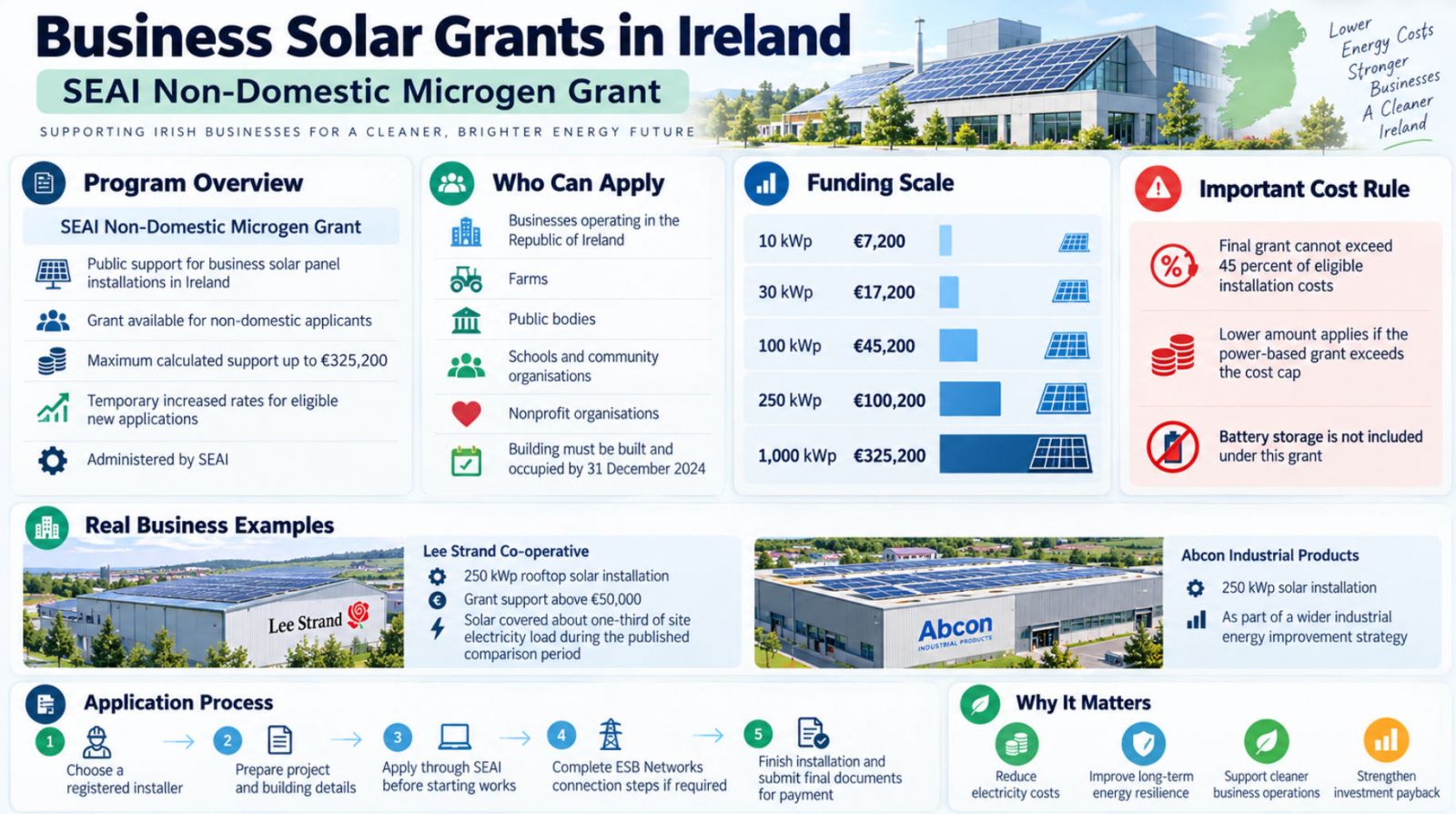
For a manufacturing company considering a 100 kWp rooftop solar installation, the enhanced payment schedule provides a potential grant of €45,200. A larger 250 kWp system can qualify for a calculated grant of €100,200, while the maximum published amount for 1,000 kWp reaches €325,200. These figures represent the amounts generated by the official capacity-based formula before applying the restriction that public support cannot exceed 45 percent of eligible installation costs. The distinction is essential because businesses with relatively inexpensive installations may receive less than the amount shown in the grant calculator.
The enhanced rates apply to new applications submitted from October 6, 2026, under a temporary arrangement scheduled to continue until July 6, 2027. Applications submitted before the increase do not automatically receive the higher amounts, and businesses that have already started installation work under an earlier grant offer cannot simply request a recalculation. Companies planning solar investments must therefore consider not only the equipment and installation costs but also the application date, building eligibility, electricity network requirements and timing of procurement decisions.
Ireland already has documented examples of businesses using the Non-Domestic Microgen Grant to implement commercially relevant solar projects. Lee Strand Co-operative, a dairy processor in County Kerry, installed a 250 kWp rooftop system with grant assistance exceeding €50,000 and subsequently reported that solar generation supplied approximately one-third of its electrical load during a measured comparison period. Abcon Industrial Products, a manufacturing company in County Cavan, also installed a 250 kWp solar system under the scheme before undertaking additional building improvements through a separate SEAI funding programme.
These businesses demonstrate that grant-funded solar investment can form part of a broader strategy for managing electricity consumption, improving production efficiency and reducing exposure to volatile energy prices. However, their experiences also reveal why successful projects begin with accurate energy consumption data, appropriate system sizing and careful coordination between financial planning, technical installation and public funding requirements.
Why Commercial Solar Investment Has Become More Attractive in Ireland
Ireland's electricity system has undergone substantial changes as renewable generation has expanded. Wind power remains a major contributor, but solar photovoltaic technology has become an increasingly important part of the country's electricity supply. According to the Sustainable Energy Authority of Ireland, solar photovoltaic generation reached approximately 1.65 terawatt-hours in 2025, an increase of 50 percent compared with 2024 and 150 percent compared with 2023. Large solar farms accounted for approximately two-thirds of the electricity generated from solar energy during that year, while smaller rooftop installations contributed to the remainder.
The figures demonstrate the rapid growth of solar electricity in a country sometimes associated with cloudy weather and relatively modest solar irradiation. Commercial solar installations do not require Mediterranean sunshine to provide useful electricity. Their economic performance depends on the amount of electricity produced throughout the year, the proportion consumed directly by the business, the price of displaced electricity and the capital expenditure required to install the system. Well-designed photovoltaic installations can generate electricity during daylight hours across much of the year, with higher output during spring and summer and lower production during winter.
For businesses, the main financial attraction lies in reducing the amount of electricity purchased from the grid. A dairy processor may require electricity throughout the day to operate refrigeration equipment, processing machinery and packaging lines. A supermarket consumes energy for refrigeration, lighting, ventilation and other services, while a hotel may have substantial daytime electricity requirements for kitchens, laundry operations and building systems. These consumption patterns can create opportunities to use solar electricity directly rather than exporting most of it to the network.
The distinction between self-consumption and electricity export matters because the financial value of each can differ significantly. Electricity generated and consumed within the business can replace electricity that would otherwise have been purchased at the applicable retail or commercial tariff. Surplus generation exported to the grid may receive compensation under an appropriate export payment arrangement, but the amount paid will depend on the supplier, metering arrangements and applicable rules. An installation producing substantial electricity is not necessarily the most profitable option if much of that production occurs when the business has little demand.
Ireland's government has responded to wider energy affordability concerns by expanding several public funding measures. On September 29, 2026, the government announced a package developed through the National Energy Affordability Taskforce, including increased support for business solar installations. The changes became effective for new Non-Domestic Microgen Grant applications from October 6, 2026. The enhanced funding was designed to make renewable electricity investments more affordable, help businesses manage operating costs and improve the country's energy security.
This policy change is significant because initial capital expenditure remains one of the principal obstacles to commercial solar investment. A solar installation can provide electricity for many years, but the business must normally pay for equipment, electrical works and installation before obtaining the full benefits of reduced electricity purchases. Public grant assistance lowers the final investment cost and can shorten the period required for operating savings to recover the remaining capital expenditure.
Nevertheless, increased funding does not eliminate the need for a sound commercial assessment. A business considering solar generation must evaluate roof condition, installation costs, network connection requirements, expected energy production and the timing of electricity demand. The most effective investment is not always the largest system that can physically fit on a building. It is the system whose generation profile and cost structure correspond most closely to the company's operational and financial circumstances.
How the SEAI Non-Domestic Microgen Grant Works
The Non-Domestic Microgen Grant, commonly abbreviated as NDMG, is administered by the Sustainable Energy Authority of Ireland. It operates under Ireland's Microgeneration Support Scheme and provides financial assistance for eligible non-domestic organisations installing solar photovoltaic systems to produce electricity for consumption on their premises. The programme supports the design, purchase and installation of qualifying solar photovoltaic equipment, subject to the relevant technical standards, public funding rules and completion requirements.
Although the programme retains the name Microgen, its financial scope extends well beyond the smallest microgeneration installations. SEAI can calculate grant support for installations up to 1,000 kWp, equivalent to 1 MWp of solar photovoltaic capacity. A system exceeding that capacity may potentially receive the maximum grant applicable to its first 1,000 kWp, but no additional support is calculated for capacity above the threshold. The actual electrical connection arrangements must be examined separately, since the capacity of the solar panels and the allowable connection capacity are not necessarily the same.
NDMG is structured around a standardised grant calculation rather than a competition in which businesses submit proposals for individually negotiated percentages. The amount is calculated using the rated capacity of the photovoltaic installation and the relevant payment bands. The final grant is then limited according to the programme's state aid rules and the eligible installation expenditure. This makes the initial calculation relatively transparent, although applicants still need to determine whether their buildings, installation plans and contractors satisfy all of the requirements.
The scheme is part of SEAI's wider range of business energy supports. Other programmes may assist eligible businesses with building insulation, heating and cooling equipment, solar thermal installations or technical improvements. However, the Non-Domestic Microgen Grant should not be confused with these separate measures. Solar photovoltaic equipment produces electricity, while solar thermal installations produce useful heat. The technologies serve different purposes and may be subject to different grant rules, even when installed at the same business premises.
Under the enhanced NDMG arrangements, the temporary funding increase is scheduled to apply to new applications submitted between October 6, 2026, and July 6, 2027. The official application guide identifies the enhanced support period and explains that applications submitted before the change cannot be retrospectively upgraded to the new rates. This is particularly important for businesses that began considering an installation before October 2026 but have not yet formally applied.
The current programme also includes a requirement that the relevant building must have been constructed and occupied on or before December 31, 2024. This updated eligibility condition broadens access compared with the earlier requirement concerning buildings constructed before 2021. Businesses operating relatively new warehouses, manufacturing facilities or commercial premises should therefore examine their eligibility rather than assume that only older buildings qualify.
Who Can Apply for Solar Panel Grants in Ireland?
NDMG supports a broad range of organisations operating in the Republic of Ireland. Eligible categories include businesses, agricultural enterprises, public sector bodies, schools, community centres and non-profit organisations. The programme can therefore be relevant to small businesses and larger manufacturers, provided the applicant meets the conditions governing the building, installation, contractor and financial position.
Businesses in the hospitality sector can investigate rooftop solar for hotels, restaurants and other accommodation facilities. Agricultural operators may consider installations serving dairy farms, storage facilities or other eligible agricultural premises. Manufacturing companies can evaluate electricity generation for production machinery, refrigeration systems and industrial utilities, while warehouses and distribution centres may have substantial roof areas suitable for photovoltaic panels.
However, belonging to an eligible category does not automatically guarantee a grant. The premises must satisfy the construction and occupancy requirements, and the applicant must meet the applicable financial and state aid conditions. SEAI excludes applicants that qualify as undertakings in difficulty under the relevant European Union General Block Exemption Regulation provisions. Applicants must also demonstrate sufficient financial resources to pay for the installation.
The location requirement is straightforward but important for international businesses. The installation must be situated in the Republic of Ireland. The programme should not be presented as a grant available throughout the island of Ireland, because Northern Ireland operates within a different public funding and electricity regulatory framework.
NDMG generally supports one solar photovoltaic system per Meter Point Reference Number, commonly known as an MPRN. This is the identifier associated with an electricity supply connection in Ireland. Businesses operating several sites should therefore examine the MPRN arrangements for each premises and the implications of any previous supported installation. The programme also allows applications involving a domestic MPRN where the associated electrical infrastructure supplies a registered business, subject to the other eligibility requirements.
The scheme is designed primarily for electricity generation for self-consumption. An eligible installation should serve premises with genuine electricity demand rather than operate exclusively as a commercial power station exporting all its production to the grid. Exporting surplus electricity may be possible, but that does not change the programme's central purpose of supporting on-site consumption. The application guide also allows certain off-grid installations, provided they meet the applicable technical and eligibility requirements.
Another significant restriction concerns previous public assistance. A business cannot receive NDMG support for an installation already funded through another relevant government grant. The programme also restricts combining state funding sources for the same supported measure. This does not necessarily prevent a business from undertaking separate building improvements through another scheme, but the respective projects and expenditures must be clearly distinguished.
Solar PV Grant Rates: From Small Installations to 1 MW
The enhanced NDMG payment schedule is cumulative. Different portions of a solar installation's capacity are assigned different grant rates, and the resulting amounts are added together. This is an important distinction because applying the final payment band to the entire installation would produce an incorrect grant estimate.
The first two kilowatts peak receive the highest rate per unit of capacity. The next two kilowatts attract a lower rate, followed by a capacity interval between four and six kilowatts for which no additional grant is calculated. Higher installation capacities receive support through successive payment bands up to the programme's 1,000 kWp calculation limit.
Table 1. SEAI Non-Domestic Microgen Grant Rates for New Applications Under the Enhanced 2026–2027 Scheme
| Solar PV capacity band | Grant calculation |
|---|---|
| First 2 kWp | €1,800 for each kWp |
| Additional capacity above 2 kWp up to 4 kWp | €600 for each additional kWp |
| Capacity above 4 kWp up to 6 kWp | No additional grant |
| Additional capacity above 6 kWp up to 20 kWp | €600 for each additional kWp |
| Additional capacity above 20 kWp up to 200 kWp | €400 for each additional kWp |
| Additional capacity above 200 kWp up to 1,000 kWp | €300 for each additional kWp |
| Capacity exceeding 1,000 kWp | No additional grant beyond the first 1,000 kWp |
The grant calculation can be illustrated with a 30 kWp installation. The first four kilowatts generate €4,800 of support, while the capacity from four to six kilowatts adds nothing. The next fourteen kilowatts, from six to twenty, contribute €8,400, bringing the total for twenty kilowatts to €13,200. The final ten kilowatts fall within the next band and contribute another €4,000. The resulting grant is €17,200 before the restriction based on eligible installation costs is applied.
For a 100 kWp installation, the calculation reaches €45,200. A 200 kWp system has a capacity-based grant of €85,200, while the next fifty kilowatts in a 250 kWp installation contribute an additional €15,000, producing a total of €100,200. At 1,000 kWp, the maximum scheduled amount is €325,200. These figures are calculated independently of the price charged by the installation contractor, which is why the 45 percent cost restriction must be assessed separately.
Table 2. Calculated NDMG Grants for Different Commercial Solar PV System Sizes
| Installed solar PV capacity | Grant under the capacity-based schedule |
|---|---|
| 4 kWp | €4,800 |
| 7 kWp | €5,400 |
| 10 kWp | €7,200 |
| 15 kWp | €10,200 |
| 20 kWp | €13,200 |
| 30 kWp | €17,200 |
| 50 kWp | €25,200 |
| 100 kWp | €45,200 |
| 200 kWp | €85,200 |
| 250 kWp | €100,200 |
| 500 kWp | €175,200 |
| 1,000 kWp | €325,200 |
These amounts represent the published payment schedule and calculations derived from it. They are not guaranteed final grants, since applicants must satisfy all eligibility conditions and the award must remain within the permitted percentage of eligible installation costs.
The programme's maximum amount is therefore most relevant to businesses considering substantial commercial rooftop installations or other appropriately designed photovoltaic systems. However, smaller systems can also benefit significantly, especially where the business has a reliable daytime demand and the initial investment cost is manageable.
A company should avoid choosing installation capacity solely to move into a higher grant category. Increasing the capacity of a solar array can generate a higher scheduled subsidy, but it also increases capital costs and may require additional network approvals. The financial value of the additional electricity depends on whether the business can use it productively or receive sufficient compensation for exports.
The 45 Percent Rule: Why the Final Grant Can Be Lower Than Expected
One of the most important features of the enhanced NDMG programme is that the public funding amount cannot exceed 45 percent of the eligible installation cost. SEAI applies this restriction in conjunction with the capacity-based schedule, meaning the final grant is determined by the lower of the scheduled payment amount and the permitted percentage of qualifying expenditure.
This prevents applicants from receiving a grant that exceeds the programme's state aid intensity limit. It also means that the announced 45 percent funding should not be interpreted as a promise that every business automatically receives a subsidy equal to that proportion of its installation budget. In some cases, the scheduled grant will already be lower than 45 percent of project costs. In others, the restriction will reduce the grant below the amount displayed by the capacity calculator.
For example, a 30 kWp installation has a scheduled grant of €17,200. If its eligible installation cost is €30,000, the maximum payment under the 45 percent rule would be €13,500. The business would therefore receive no more than €13,500 even though the capacity-based calculation produces a higher figure. Conversely, a 100 kWp installation costing €110,000 would have a 45 percent ceiling of €49,500, which exceeds its scheduled grant of €45,200. Assuming the installation qualifies in full, the scheduled amount would therefore remain the limiting factor.
Table 3. Illustrative Commercial Solar PV Budgets and Grant Payments After the 45 Percent Cap
| Solar PV capacity | Hypothetical eligible installation cost | Scheduled grant | Potential grant after cap | Remaining cost after grant |
|---|---|---|---|---|
| 10 kWp | €18,000 | €7,200 | €7,200 | €10,800 |
| 30 kWp | €30,000 | €17,200 | €13,500 | €16,500 |
| 100 kWp | €110,000 | €45,200 | €45,200 | €64,800 |
| 250 kWp | €170,000 | €100,200 | €76,500 | €93,500 |
| 1,000 kWp | €600,000 | €325,200 | €270,000 | €330,000 |
The installation costs in this table are hypothetical financial assumptions, not quotations or verified market prices. They are intended to demonstrate the operation of the grant formula. The amounts also assume that the stated installation expenses are accepted as eligible and that there are no additional limitations affecting the applicant.
The final row illustrates the maximum grant restriction particularly clearly. Although the published grant schedule for 1,000 kWp reaches €325,200, an installation with eligible costs of €600,000 would be limited to €270,000 because of the 45 percent rule. To receive the full scheduled €325,200 without the percentage restriction reducing it, qualifying expenditure would need to be at least approximately €722,667.
This is a calculated financial threshold, not a minimum installation price set by SEAI. Businesses should obtain detailed supplier quotations and establish the actual accepted cost of their chosen equipment before making decisions based on the maximum grant.
The distinction is especially important for companies comparing competing contractors. A lower installation price can improve project economics even if it reduces the grant under the 45 percent cap. The objective should be the best overall financial result, not merely the largest public subsidy. A company paying more for equipment solely to increase the eligible cost base could end up with a worse investment despite receiving a higher nominal grant.
What Equipment and Installation Costs Are Eligible?
The Non-Domestic Microgen Grant primarily supports the design, purchase and installation of qualifying solar photovoltaic systems. Eligible expenditure can include the solar modules and other standard components necessary to create a functioning installation, subject to SEAI's technical code and the applicable terms. Relevant installation labour and related works can also qualify when carried out under the appropriate arrangements.
However, not every expense associated with a broader energy project is eligible. Battery storage and other supplementary equipment outside the standard solar photovoltaic system are specifically excluded from the NDMG grant calculation. A business may decide that batteries are useful for increasing the amount of solar electricity consumed outside daylight hours, but the batteries must be accounted for separately rather than included in the grant-supported cost of the photovoltaic installation.
This distinction matters for hotels, hospitality businesses and manufacturing companies that operate outside ordinary daylight hours. Adding storage may improve the ability to use solar generation during evening production or overnight operations, but it increases capital expenditure and introduces additional technical and financial considerations. The decision to install batteries should therefore be assessed separately, including their cost, usable capacity, expected cycling, efficiency losses and potential role in reducing electricity purchases.
Similarly, an industrial business may need to strengthen or replace a roof before installing photovoltaic panels. The roof works may be commercially necessary and could potentially fall within another funding mechanism, but that does not mean they automatically qualify as NDMG expenditure. The company should distinguish between the photovoltaic project and any general building improvements when preparing its budget.
SEAI also requires new materials and equipment to be used in accordance with the scheme requirements. An installation that has already received relevant public funding for the same measure cannot simply be presented again as a new grant-supported investment. Where a contractor installs a solar system on its own premises, the rules also distinguish the treatment of materials and labour, with the contractor's own labour not qualifying in the same way as expenditure under an ordinary external installation contract.
Careful cost separation is particularly important for larger projects involving rooftop reinforcement, electrical upgrades, batteries and monitoring equipment. Businesses should establish which items belong to the eligible solar installation and which represent separate works or supplementary features. Transparent invoices and a clear division of expenditure make it easier to calculate the expected grant and reduce the risk of problems during SEAI's final payment assessment.
How Businesses Should Choose the Right Solar PV Capacity
Choosing the correct size of a commercial photovoltaic installation is a technical and economic decision that should begin with the business's electricity consumption rather than the available roof area. A large industrial roof may accommodate several hundred kilowatts of solar panels, but this does not necessarily mean that using its entire surface will produce the best financial outcome.
The first step is to understand when electricity is consumed. Annual utility bills show how much energy a business purchases over a year, but they do not necessarily reveal the hourly or daily variation in demand. For solar investment, this distinction is critical because photovoltaic output follows the availability of daylight. A business with strong electricity consumption during working hours may be able to use most of its solar production directly, whereas a business that operates mainly in the evening may export a larger proportion of the energy it generates.
Half-hourly electricity consumption records, smart meter data or existing energy management systems can provide useful evidence. These records allow engineers to compare the proposed solar generation profile with actual site demand. The company can then determine whether a smaller installation would achieve a high self-consumption rate or whether additional capacity could still be used effectively.
The correct system size also depends on expected future changes. A food-processing business may be planning an additional production line, while a hotel might intend to electrify more of its heating or introduce electric vehicle charging. Such developments can increase daytime electricity demand, making a larger installation commercially appropriate. However, the projected changes should be sufficiently credible to justify their inclusion in the financial model rather than being used merely to support a more ambitious solar proposal.
Physical characteristics of the building must also be examined. Roof orientation, pitch, shading, structural capacity, fire safety considerations and maintenance access affect the installation design and its expected output. Flat roofs may require mounting arrangements that differ from those used on pitched roofs, while rooftop equipment, ventilation outlets and neighbouring buildings may create shading. The condition and remaining service life of the roof are particularly important because removing and reinstalling solar panels to carry out major roof repairs can substantially increase long-term costs.
The experience of Irish dairy processor Lee Strand demonstrates why reliable measurement of electricity use can be more valuable than selecting a system based solely on the largest capacity eligible for public support.
Lee Strand Co-operative: A 250 kWp Solar Investment Based on Real Energy Data
Lee Strand Co-operative is a farmer-owned dairy business located in Tralee, County Kerry. The company operates a milk-processing facility and employs more than 100 people across its business activities. Its operations involve the energy requirements typical of dairy processing, including refrigeration, production machinery, processing equipment and associated industrial services. Such businesses can benefit from on-site solar generation because electricity is a significant operating expense and many production-related activities continue during daylight hours.
Before investing in solar panels, Lee Strand faced a challenge familiar to many industrial companies: management knew that the facility consumed substantial amounts of electricity but lacked sufficiently detailed information about exactly where, when and how that energy was being used. General electricity bills showed the financial burden, but they did not provide the operational detail needed to identify the most effective opportunities for reducing consumption or investing in generation equipment.
In 2024, Lee Strand addressed this problem by introducing a comprehensive electricity monitoring and measurement system with support from Enterprise Ireland. The system made it possible to examine consumption patterns and identify opportunities for improving equipment operation. Rather than proceeding directly to solar installation, the company first used its improved understanding of electricity demand to make practical operating changes.
According to the case study published by SEAI, these changes reduced the facility's overall electricity consumption by more than 12 percent. The measures included adjustments to compressor operation, temperature settings and operating schedules. This result is particularly significant because it demonstrates that an important share of energy savings was achieved before the solar system itself was introduced. The company first reduced the amount of electricity required to operate its existing facility, then proceeded with investment in renewable generation.
The new monitoring information also played an important role in determining the appropriate size of the solar installation. By examining the actual demand profile, the project team could evaluate how photovoltaic production would interact with the facility's daily electricity requirements. This reduced the risk of installing excessive capacity that would produce large amounts of surplus electricity at times when the business could not use it.
In February 2025, Lee Strand began implementing a rooftop photovoltaic project under the management of local consultant DCS Group. More than 400 solar panels were installed, providing a total generation capacity of 250 kWp. The installation was designed to contribute directly to electricity consumption at the dairy-processing facility rather than operate as an independent commercial solar farm.
The company applied for the SEAI Non-Domestic Microgen Grant and received rapid approval. According to the official case study, the grant exceeded €50,000 and made a substantial contribution to the investment. The availability of financial support helped accelerate the company's decision to proceed, and management indicated that the project might otherwise have been delayed for a considerable period.
This illustrates the importance of public funding in industrial investment decisions. A technically attractive solar installation may still compete with expenditure on production equipment, refrigeration improvements, vehicles or other operational priorities. Grant assistance lowers the effective capital requirement and can improve the financial justification for approving a renewable energy project.
The results reported by Lee Strand provide further evidence of the investment's practical impact. SEAI compared the facility's performance in May 2024 and May 2025, reporting that the solar installation supplied an average of approximately 33 percent of the site's electrical load during the relevant comparison period. This is a meaningful result for a business with substantial electricity demand, demonstrating that solar generation can cover an important share of consumption even at an industrial facility where continuous refrigeration and processing equipment require reliable power.
However, this result should not be interpreted as evidence that the solar system supplied one-third of electricity demand throughout the entire year. Seasonal solar generation changes considerably in Ireland, and the published comparison concerns a specific period. Likewise, the earlier reduction in electricity consumption of more than 12 percent resulted from improvements identified through the energy monitoring system, not solely from the subsequent installation of solar panels.
These distinctions are important because combining different types of savings can exaggerate the reported benefits of a particular investment. Lee Strand's experience is strongest when understood as a sequence of complementary measures. The company first improved visibility into energy use, then reduced unnecessary consumption and finally installed photovoltaic generation sized according to the facility's actual demand.
The case also offers a useful financial comparison with the enhanced NDMG rates introduced in October 2026. Under the current capacity-based schedule, a new eligible installation of 250 kWp would generate a calculated grant of €100,200 before applying the 45 percent cost cap. This is substantially higher than Lee Strand's historical grant of slightly more than €50,000. Nevertheless, the company cannot retrospectively claim the difference for a previously approved and completed project, and the final amount for any new investment would depend on its eligible costs and the rules governing support at the relevant MPRN.
For other dairy processors and food manufacturers, the principal lesson is that the accuracy of electricity consumption data can materially improve the investment decision. Refrigeration and production equipment often create large, relatively predictable electrical loads, but their operating patterns still need to be measured. A company that understands these patterns can design a solar installation capable of delivering useful electricity when it is required, potentially improving both grant utilisation and long-term financial returns.
Lee Strand's experience also demonstrates the role of specialist project management. Solar installation at an operating dairy-processing facility requires coordination among management, contractors, electricians and potentially the network operator. The project must be implemented without disrupting production or compromising the reliable operation of essential equipment. Proper coordination can therefore be as important as the grant calculation itself.
Abcon Industrial Products: Solar Generation as Part of a Wider Manufacturing Strategy
Abcon Industrial Products provides a different example of commercial solar investment in Ireland. Based in Cootehill, County Cavan, the company was established in 2005 and has developed into a substantial industrial manufacturer employing more than 180 people. Its operations include specialist activities associated with industrial abrasives, hoses and rubber lining, creating electricity and building energy requirements different from those of a dairy-processing facility.
For manufacturing companies of this type, electricity is consumed by production equipment, machinery and building services. Energy efficiency investment can support competitiveness by reducing operating costs while improving the performance and condition of industrial premises. However, meaningful improvement often requires a sequence of measures rather than one isolated equipment purchase.
Abcon began developing a more systematic approach to energy and environmental performance in 2022, when it commissioned a detailed decarbonisation strategy with support from Enterprise Ireland's GreenPlus grant. The exercise helped establish the company's longer-term direction and contributed to progress towards recognised management standards. According to the SEAI case study, Abcon achieved ISO 50001 and ISO 14001 certification in 2024.
The company's photovoltaic investment followed in 2023. Abcon installed a solar array with a capacity of 250 kWp using financial support provided by SEAI under the Non-Domestic Microgen Scheme. The installation represented a substantial commitment to producing electricity on site and reducing reliance on purchased energy during periods when solar generation could contribute to the factory's demand.
The installation also formed part of a longer investment strategy. Abcon subsequently examined opportunities to expand photovoltaic capacity across additional roof areas, demonstrating that renewable electricity generation was being considered in connection with the wider development of its industrial premises.
The company continued its modernisation efforts in 2025, when it engaged with SEAI's business energy upgrade supports to replace the roof of one manufacturing area. The original roof consisted of a single-skin construction that created problems related to heat loss, comfort and production conditions. The replacement used a highly insulated composite panel roof system, addressing building performance issues while supporting the company's broader efforts to reduce energy waste.
These two projects are financially and technically distinct. The 250 kWp solar installation received support through NDMG, while the roof replacement was supported through the relevant building fabric measure of the Business Energy Upgrades Scheme. They should not be described as a single grant-funded solar project, and the expenditure supported by one programme should not automatically be included in calculations for another.
Nevertheless, the relationship between the measures is commercially important. Solar generation reduces the amount of electricity a facility needs to purchase, while improved building fabric can reduce heat loss and other energy requirements. Together, these investments can improve the energy performance of the site even though they address different technical problems.
According to SEAI's published case study, the photovoltaic installation and roof improvement were estimated to generate combined annual energy savings of approximately 450 MWh. The associated annual financial savings were estimated at €66,500, with an expected reduction in carbon dioxide emissions of approximately 110 tonnes. These results were based partly on detailed simulations where measured performance information was not yet available.
It would therefore be incorrect to attribute the entire 450 MWh energy saving or the full €66,500 annual financial benefit solely to the solar installation. The published figures describe the expected combined effect of the photovoltaic and roofing improvements. They are also estimates rather than independently verified measured outcomes for every component.
SEAI confirms that Abcon received NDMG support for the 250 kWp photovoltaic installation, but its published case study does not provide the exact historical value of that grant. The amount should not be reconstructed from the new 2026 payment schedule because the installation took place in 2023, under an earlier version of the programme.
The Abcon example is particularly relevant for manufacturers whose facilities require both renewable electricity and improvements to their physical infrastructure. A company might have sufficient roof area for a substantial photovoltaic array but also need insulation upgrades, structural work or replacement of ageing roof materials. These requirements influence the best sequence of investments and may involve different grant programmes.
A poorly planned approach could result in solar panels being installed on a roof that subsequently requires major replacement, creating avoidable dismantling and reinstallation costs. A more coordinated approach considers the condition of the building, the expected lifetime of photovoltaic equipment and the planned development of manufacturing operations before finalising the investment.
Abcon's experience illustrates the value of developing an energy strategy that identifies several related projects, prioritises them according to operational requirements and matches each investment with an appropriate funding mechanism. The objective is not to maximise the number of grants used, but to improve the performance of the entire business while maintaining clear separation between eligible expenditures.
Comparing Lee Strand and Abcon: What Their Projects Reveal About Solar Grants
Although Lee Strand and Abcon operate in different manufacturing sectors, their experiences reveal several common elements of successful commercial solar investment. Both installed 250 kWp photovoltaic systems, both received support through the Non-Domestic Microgen Grant and both connected solar generation with a broader process of improving energy performance.
The differences between their projects are equally instructive. Lee Strand focused heavily on measuring electricity consumption before selecting system capacity. Abcon approached solar as one part of a multi-year industrial improvement strategy that also involved building modernisation and environmental management.
Table 4. Verified Irish Business Examples of SEAI Non-Domestic Microgen Grant Support
| Project characteristic | Lee Strand Co-operative | Abcon Industrial Products |
|---|---|---|
| Location | Tralee, County Kerry | Cootehill, County Cavan |
| Main business activity | Dairy processing | Industrial manufacturing |
| Solar PV capacity | 250 kWp | 250 kWp |
| Installation year | 2025 | 2023 |
| Confirmed NDMG support | Slightly more than €50,000 | Grant confirmed; exact amount not published |
| Related investment | Electricity monitoring and operational optimisation | Industrial roof replacement and wider energy improvements |
| Published results | More than 12 percent electricity reduction from earlier operational measures; solar supplied about 33 percent of site load in the reported May comparison | Estimated combined savings of 450 MWh and €66,500 annually from solar PV and roof improvement |
| Main investment lesson | Use measured demand to size the solar system | Coordinate solar investment with long-term factory modernisation |
The comparison shows why published case studies should be interpreted carefully. A grant amount confirmed for an earlier project is useful evidence that the funding scheme has supported similar businesses, but it does not determine what a new applicant will receive under the enhanced rates. Likewise, energy savings from several coordinated improvements cannot automatically be assigned to solar generation alone.
For prospective applicants, the most important lesson is to combine technical evidence with appropriate financing. A system may be eligible for a substantial public grant, but its commercial success depends on how well the generated electricity corresponds to the business's actual consumption and whether the building and network infrastructure can support the installation.
Which Types of Irish Businesses Could Benefit Most?
The financial value of commercial solar generation depends significantly on the relationship between daylight hours and electricity demand. Businesses with substantial daytime consumption often have opportunities to use a high proportion of the electricity produced by their panels. However, the economic result must be calculated individually, because electricity purchasing arrangements, seasonal production patterns and building characteristics vary considerably across sectors.
Food processors can be promising candidates because their production activities often require significant electricity for refrigeration, processing, packaging and cleaning equipment. Dairy processors may have particularly consistent demand from cooling systems, although the timing of milk collection, processing and other activities should be examined. Lee Strand's experience demonstrates that understanding compressor operation and electricity usage patterns can help establish an appropriate photovoltaic system size.
Hotels and hospitality businesses may benefit from solar electricity used for kitchens, ventilation, laundry equipment, cooling and general building services. Seasonal demand can be particularly relevant, since many accommodation businesses experience high occupancy during periods when solar electricity production is relatively strong. Nevertheless, individual facilities have different occupancy patterns, and a rural hotel may face different electricity demands from an urban business hotel.
Supermarkets and food retailers often operate refrigeration systems throughout the day, creating a potential base load that can absorb some solar generation. A store that remains open for extended hours may also consume significant electricity outside daylight periods, making it necessary to examine the proportion of solar electricity used immediately and the amount exported. A large roof does not by itself determine the appropriate array capacity.
Warehouses and distribution centres frequently have substantial roof areas, but their electricity consumption can differ sharply. A temperature-controlled logistics centre may operate energy-intensive refrigeration equipment, while a conventional storage building may consume relatively little electricity outside lighting, ventilation and material-handling operations. The commercial logic of a large solar installation will therefore be different even when two warehouses have similar physical dimensions.
Agricultural businesses may also find solar investment attractive where electricity is used for dairy milking systems, refrigeration, ventilation or processing. However, agricultural electricity demand can be highly dependent on the type of operation and the time of year. The project should be evaluated against actual consumption data rather than generic assumptions about farm electricity use.
Across these sectors, solar photovoltaic investment offers the strongest prospects when the business has a suitable site, reliable daytime electricity demand and an installation budget that remains commercially attractive after considering the expected grant and operating costs.
Grid Connection Requirements: Why ESB Networks Approval Matters
Obtaining a grant offer from SEAI and receiving permission to connect a photovoltaic system to the electricity network are separate processes. A business may qualify for public funding but still need to satisfy electrical connection requirements that affect installation capacity, export arrangements, commissioning and project cost.
ESB Networks is responsible for the relevant distribution network connection processes in Ireland. The applicable procedure depends on the characteristics of the proposed generating system, including inverter capacity and the electrical connection. For smaller generators, the network rules provide simplified arrangements, while larger installations require more detailed applications and technical assessments.
Table 5. Principal ESB Networks Connection Categories for Solar Generation
| Connection category | General capacity range | Relevant procedure |
|---|---|---|
| Micro-generation | Up to approximately 6 kVA single-phase or 11 kVA three-phase | NC6 |
| Mini-generation | Above microgeneration limits, up to approximately 17 kVA single-phase or 50 kVA three-phase | NC7 |
| Small-scale generation | Above mini-generation limits, up to 200 kVA | NC8 for qualifying inverter-connected systems; NC5 for certain synchronous systems |
| Larger generation | Above the applicable small-scale generation limit | Separate generator connection process |
The distinction between kilowatts peak and kilovolt-amperes is important. Kilowatts peak measure the rated direct-current output of a photovoltaic array under standard test conditions, while the relevant network categories concern the generator and its connection characteristics. A 100 kWp array should therefore not automatically be classified solely by its panel capacity without examining the inverter arrangements and the applicable network requirements.
The SEAI application process requires the installation contractor to engage with ESB Networks before the solar system is installed. SEAI advises allowing at least twenty working days for the network application process, although larger and more complex projects may require additional assessments and longer timescales. Businesses should not assume that receiving rapid grant approval means the installation can immediately proceed without network consideration.
The network assessment can influence the financial model. An installation may require additional protection equipment, connection modifications or limitations on the electricity it can export. In some cases, the maximum export capacity permitted by the network can be lower than the generating capacity of the photovoltaic system. Such restrictions may change how much electricity is available for export and could affect the commercial value of installing additional panels.
This is particularly relevant to larger industrial projects approaching several hundred kilowatts of generation capacity. The cost of the photovoltaic equipment itself may be only one part of the total investment, and the business should examine network requirements before committing to a final design.
The SEAI grant process also requires appropriate documentation showing that the relevant ESB Networks procedures have been completed. Depending on the type of installation, this can include the appropriate NC forms, installation confirmation certificates or final operational notifications. Incomplete network documentation can delay or prevent final grant payment even when the panels have already been installed and are functioning.
Planning Permission, Roof Condition and Installation Safety
Ireland has expanded planning exemptions for rooftop solar installations, reducing regulatory barriers for many commercial and industrial buildings. The regulations introduced in October 2022 allow qualifying rooftop solar installations on industrial, commercial, agricultural, educational and other specified buildings to proceed without ordinary planning permission, subject to the relevant conditions and limitations.
However, the exemptions are not universal. Specific restrictions apply in designated Solar Safeguarding Zones near certain aviation facilities, where reflections from photovoltaic panels can create safety concerns. In these zones, the planning exemption for relevant non-domestic rooftops is generally subject to a 300-square-metre limit per roof. Larger installations may require planning permission. Additional restrictions can also apply to protected structures, architectural conservation areas and other circumstances specified by planning legislation.
The responsibility for determining whether planning permission is required rests with the applicant. SEAI's approval of a grant does not establish that the installation satisfies all planning rules, and the authority does not replace the relevant local planning body. A business should therefore determine the applicable planning status before finalising its investment timetable.
Roof condition is another fundamental concern. Commercial photovoltaic panels are intended to operate over an extended period, so installing them on a roof approaching the end of its useful life can create significant future costs. A structural assessment may be needed to determine whether the roof can accommodate the additional load of panels, mounting systems and associated equipment. The design must also consider wind loads, access for maintenance and other applicable safety requirements.
Electrical safety is equally important. NDMG requires the use of appropriately registered installation companies and qualified electrical installers. The work must comply with SEAI's technical code and relevant electrical standards. Installation records, testing documentation and certification form part of the evidence required for final grant payment.
A business planning rooftop solar should also inform its relevant insurance providers and examine how the new installation affects existing property and business insurance arrangements. This is especially important for manufacturing facilities where roof damage, electrical faults or interruptions to production could cause significant financial losses.
Calculating Electricity Savings and Solar Payback Periods
A commercial solar investment should be evaluated using realistic electricity generation assumptions and the business's actual consumption profile. SEAI's technical guidance has used an illustrative annual yield of approximately 900 kWh per kWp for a well-designed, appropriately oriented photovoltaic installation in Ireland. This is a useful starting point for preliminary calculations, but it is not a guaranteed annual yield for every roof or location.
Actual generation depends on geographical location, orientation, tilt, shading, equipment performance and system losses. The amount of electricity consumed directly by the business depends on its operating hours and the timing of electricity demand. An installation producing 90,000 kWh annually may provide substantial benefits to one business but require a different financial assessment for another organisation with lower daytime consumption.
Consider a hypothetical manufacturing business planning a 100 kWp rooftop photovoltaic installation. Assuming an annual yield of 900 kWh per kWp, the system would produce approximately 90,000 kWh annually. If the company consumed 80 percent of that output directly, it would use 72,000 kWh of solar electricity on site and potentially export the remaining 18,000 kWh, subject to its network and supply arrangements.
Suppose the electricity avoided through self-consumption would otherwise cost €0.23 per kWh, while exported electricity earned an illustrative €0.08 per kWh. The annual value of the electricity used on site would be €16,560, with another €1,440 potentially generated through export payments. Together, those values would produce a gross annual financial benefit of €18,000.
If the installation required approximately €1,500 in annual operating and maintenance expenditure, the illustrative net annual benefit would be €16,500. With a hypothetical eligible installation cost of €110,000 and a qualifying scheduled grant of €45,200, the capital cost remaining after grant payment would be €64,800. Dividing this amount by the estimated annual net benefit produces a simple payback period of approximately 3.9 years.
This is an illustrative financial model, not a confirmed market quotation, current electricity tariff or guaranteed investment return. It excludes taxes, financing costs, changes in electricity prices, degradation in panel output, major component replacement and the time value of money. The assumed export payment is also not a claim that every Irish electricity supplier offers the same rate.
For larger investments, a financial assessment should extend beyond simple payback. Net present value, financing costs, future electricity prices and expected equipment replacement expenditure can influence the investment decision. Businesses should examine the effect of lower solar generation, reduced operating hours and changes in self-consumption.
For example, a manufacturer operating production machinery only during certain shifts may achieve a high self-consumption rate on working days but export more electricity during weekends. A hotel may have strong seasonal demand that coincides with periods of higher solar output, while a warehouse with relatively low electricity consumption may need a smaller photovoltaic array to avoid exporting most of its generation.
The appropriate calculation should therefore use a time-based model rather than multiplying the annual electricity bill by an assumed solar coverage percentage. By examining the relationship between hourly demand and generation, a business can determine whether additional capacity improves or weakens the financial performance of the proposed installation.
Application Process: From Contractor Selection to Grant Payment
The NDMG application process is standardised, but applicants must follow the correct sequence to preserve their eligibility. A business should begin by confirming that the premises meet the relevant construction and occupancy requirements and that the proposed installation is appropriate for its electricity needs. It must then select a registered SEAI Non-Domestic Microgen installation company and agree on the formal contractual arrangements required by the scheme.
SEAI recommends obtaining quotations from several registered companies. Comparing proposals allows the business to assess equipment specifications, installation costs, warranties, contractor experience and the expected level of annual electricity generation. A lower purchase price is not necessarily the best option if the proposed equipment is poorly matched to the roof, electricity demand or maintenance requirements.
The applicant must submit the grant application through SEAI's online system. The installation contractor or an external adviser cannot simply replace the applicant in the formal process. An appropriately authorised individual acting for the organisation is responsible for submitting the application and accepting the applicable conditions.
Before applying, the business should have the relevant MPRN, building information, details of the selected registered company and technical characteristics of the proposed installation. It should also confirm that the building was constructed and occupied before 2025 and that the proposed investment has not received incompatible public funding.
A critical condition is that the applicant must receive the SEAI grant offer before purchasing materials or commencing the installation works. Although the programme requires a formal contract with the selected contractor before the application, that contractual arrangement must be managed consistently with the prohibition on beginning grant-supported works before approval. Businesses should not assume that signing any form of purchase order or making an irreversible equipment commitment is acceptable merely because a contractor has been selected.
Once approval has been received, the grant offer is generally valid for eight months. The project must be completed and the required documentation submitted within the applicable period. Businesses planning larger installations should pay particular attention to equipment lead times and network connection procedures, since these may influence whether the project can be completed on schedule.
The contractor must apply to ESB Networks as appropriate before installation, and the work must comply with the applicable connection approval. Once the necessary requirements have been satisfied, installation and commissioning can proceed. The applicant must arrange payment for the eligible works according to the scheme's conditions and ensure that the relevant documentation is completed.
The final payment process requires the registered company and installer to submit evidence through SEAI's electronic system. This includes the Declaration of Works, technical testing and commissioning records, electrical certification, relevant ESB Networks documentation, invoices and installation photographs. SEAI may also request additional evidence and select projects for technical inspection.
Once the full documentation has been received and the installation has passed the applicable checks, SEAI indicates a typical grant payment period of four to six weeks, with additional time where an inspection is necessary. This is an administrative estimate rather than an unconditional payment guarantee. Funding availability, incomplete records or additional verification can affect the timing.
The business should also examine its tax compliance obligations. Applicants receiving more than €10,000 in grants, subsidies or similar payments from public authorities during a calendar year may need a valid Tax Clearance Certificate in accordance with the relevant requirements. Banking information must also be accurate because incorrect payment details can delay the transfer of grant funds.
The Most Common Mistakes in Commercial Solar Grant Applications
One of the most significant errors is misunderstanding the grant formula. Businesses may see the announcement of 45 percent funding and assume that SEAI will reimburse 45 percent of any solar installation invoice. In reality, the authority applies the capacity-based payment schedule and the maximum permitted proportion of eligible expenditure. Both calculations must be considered before the company uses the anticipated grant in its financial planning.
Another mistake involves relying on the maximum published grant amount when the project is substantially smaller than 1,000 kWp. The €325,200 figure is the upper limit of the enhanced schedule, not a general grant available to every participating business. A 30 kWp system, for example, has a calculated grant of €17,200 before the cost cap, and its final payment may be lower.
Businesses can also misinterpret the temporary increase. Applications submitted under the previous rates do not automatically qualify for the enhanced grant, and projects already started under an earlier offer cannot simply be resubmitted for higher payment. The application date and the status of the installation therefore need to be verified before calculating the expected support.
Starting work too early is another serious risk. Ordering equipment, purchasing materials or beginning installation before receiving the appropriate SEAI approval can jeopardise grant eligibility. Companies should review contractual terms and procurement schedules carefully, especially when equipment must be reserved in advance.
Technical planning errors can be equally expensive. An oversized system may generate more electricity than the business can use productively, while an inadequately assessed roof may require unexpected structural improvements. A project that ignores ESB Networks connection requirements may face restrictions, additional costs or delays after the grant application has already been prepared.
Incomplete documentation can create problems at the payment stage. The business must ensure that the installation contractor submits all required records and that invoices identify the eligible works correctly. Missing electrical certification, inappropriate network documentation or an incomplete Declaration of Works may delay payment even when the installation is technically operational.
Finally, businesses should avoid combining incompatible funding sources or including unrelated expenditure in the NDMG cost base. Batteries, ordinary roof modernisation and other supplementary investments may be useful components of a wider energy strategy, but their costs must not automatically be treated as eligible solar photovoltaic expenditure. Clear separation between grants and project budgets helps protect the applicant from potential state aid compliance problems.
Ireland's Solar Growth Demonstrates the Scale of the Opportunity
The expansion of the Non-Domestic Microgen Grant should be understood in the context of Ireland's wider renewable electricity development. SEAI's preliminary energy balance indicates that solar photovoltaic generation reached 1.65 TWh in 2025, significantly exceeding the levels recorded in earlier years. The growth reflects the combined contribution of utility-scale solar projects and smaller distributed installations rather than NDMG recipients alone.
Government figures published in September 2026 also demonstrate that the business grant scheme has already supported substantial investment activity. Since the launch of NDMG in 2022, approximately 3,160 installations had received support totalling more than €33 million, while more than 6,100 applications had been submitted.
These figures establish that NDMG is an operating public funding programme with thousands of supported projects rather than a newly announced initiative without implementation experience. However, the difference between applications and supported installations should not be treated as a simple approval rate. Some applications may have been pending, withdrawn or at different implementation stages when the statistics were compiled.
The enhanced programme was introduced partly to accelerate investment and help businesses reduce their exposure to high electricity costs. Government estimates associated with the expanded measures included indicative annual savings of approximately €12,000 for a typical supported business installation and an anticipated reach of around 1,250 businesses. These are forward-looking policy estimates, not verified outcomes from the new funding rates.
The wider development of solar energy creates opportunities for manufacturers and commercial organisations to reconsider investments that were previously delayed by capital constraints. Nevertheless, the financial case remains highly dependent on individual operating conditions. A business with substantial daytime electricity demand can experience different results from one with limited on-site consumption, even if the two install panels of identical capacity.
Public funding should therefore be evaluated as one part of the investment decision. It reduces capital expenditure, but the durable economic value comes from electricity generated and used over the lifetime of the equipment.
How a Grant Writer Can Help Businesses Prepare an NDMG Application
Although NDMG uses a standardised application system, preparing a successful commercial solar investment still requires coordination between financial, administrative and technical specialists. Businesses must confirm their eligibility, understand the funding calculation, select an appropriate registered installer and ensure that the proposed installation satisfies the relevant network and documentation requirements.
A professional grant writer can help review the programme conditions and identify potential problems before the company makes binding investment commitments. This may include examining the building eligibility date, checking previous public funding, calculating the expected grant and confirming which expenditure belongs in the supported installation budget.
For larger manufacturing projects, the grant writer can work with engineers and financial advisers to ensure that the proposed system capacity is supported by realistic electricity consumption data and that financial calculations distinguish self-consumption from electricity exports. The specialist can also help organise the information required for internal investment approval and subsequent SEAI documentation.
The role of professional assistance should nevertheless be described accurately. NDMG requires the applicant to submit its own application through the relevant system, and the registered contractor remains responsible for appropriate technical installation and completion records. A grant writer does not replace those responsibilities or guarantee that the investment will be approved.
Through i-grants.com, Irish businesses and international companies operating in Ireland can connect with grant-writing professionals who can assist with eligibility reviews, financial planning and preparation of the supporting information needed for public funding applications.
This support can be especially valuable when solar generation forms part of a wider energy investment programme involving building improvements, heating systems or other technologies supported through different mechanisms. Coordinating these investments carefully helps ensure that the business pursues suitable funding opportunities without confusing the eligibility conditions or claiming multiple grants for the same expenditure.
Final Considerations: Using Ireland's Enhanced Solar Grants to Reduce Business Energy Costs
The temporary expansion of Ireland's Non-Domestic Microgen Grant creates a significant opportunity for businesses planning commercial solar photovoltaic installations. Under the enhanced arrangements introduced in October 2026, eligible organisations can receive capacity-based support reaching €325,200 for the first 1,000 kWp of an installation, subject to a maximum grant intensity of 45 percent of eligible costs.
The programme is relevant to manufacturers, agricultural enterprises, hospitality businesses, warehouses, educational institutions and other eligible organisations that can use electricity generated on their premises. However, the most appropriate installation capacity depends on actual electricity consumption, building characteristics, network requirements and the financial relationship between installation costs and long-term energy savings.
The experience of Lee Strand Co-operative demonstrates the value of measuring and improving electricity use before investing in solar generation. By introducing detailed energy monitoring, the dairy processor identified operational improvements that reduced electricity consumption by more than 12 percent before proceeding with its 250 kWp solar project. The subsequent photovoltaic installation, supported by an SEAI grant exceeding €50,000, provided a substantial share of the facility's electricity during the reported comparison period.
Abcon Industrial Products illustrates a different but equally important approach. Its 250 kWp installation formed part of a broader manufacturing energy strategy that later included roof replacement and other improvements. The company's published experience demonstrates how solar generation and building efficiency measures can complement one another, while remaining separate investments with different funding arrangements.
For businesses preparing new applications, the most important step is to develop a commercially credible project before focusing on the maximum possible grant. The company should understand its electricity demand, confirm the eligibility of the building, establish the appropriate capacity and obtain technically reliable installation proposals. It must also apply the enhanced grant formula correctly, verify the ESB Networks connection process and wait for the required SEAI approval before beginning supported works.
The improved funding rates can shorten the period needed to recover capital expenditure, but they do not eliminate the need for a realistic financial assessment. Electricity prices, annual generation, self-consumption, equipment maintenance and the potential cost of network modifications remain important determinants of investment value.
With careful preparation, the SEAI Non-Domestic Microgen Grant can help Irish businesses turn suitable rooftop space into a productive source of electricity, reduce exposure to purchased energy costs and strengthen their long-term competitiveness.
Planning a commercial solar PV installation in Ireland? Connect with an experienced grant writer through i-grants.com to review your SEAI Non-Domestic Microgen Grant eligibility, calculate potential financial support and prepare the documentation needed for a well-structured investment application.