

 Français
 Deutsch
 Українська
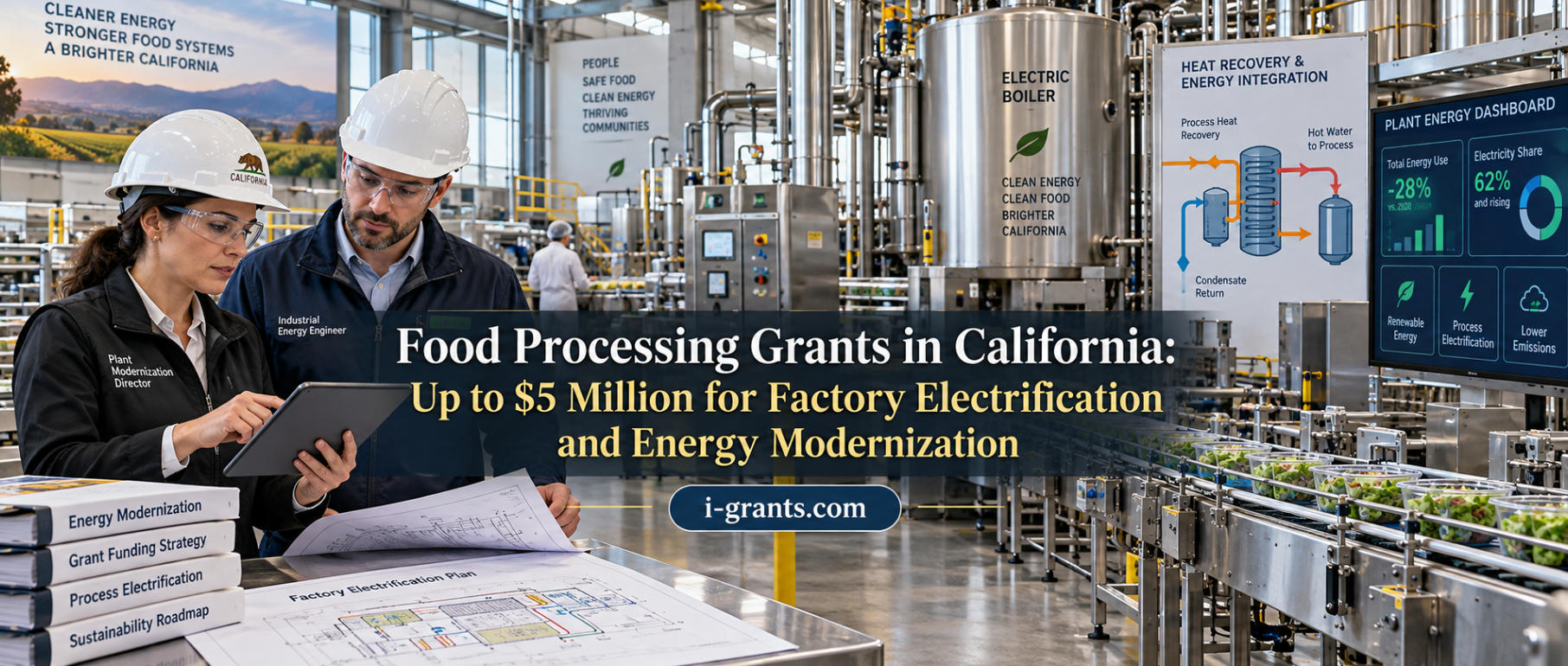
Food processing companies in California face an increasingly complex investment challenge. They must maintain reliable production, control energy expenses, comply with environmental requirements, and modernize industrial equipment without compromising food safety or product quality. For manufacturers that depend on natural gas boilers, industrial refrigeration, drying systems, compressed air, and process heating, meaningful improvements in energy performance can require investments running into millions of dollars. These costs are particularly challenging for businesses operating with seasonal production schedules, fluctuating commodity prices, and limited opportunities to interrupt manufacturing operations.
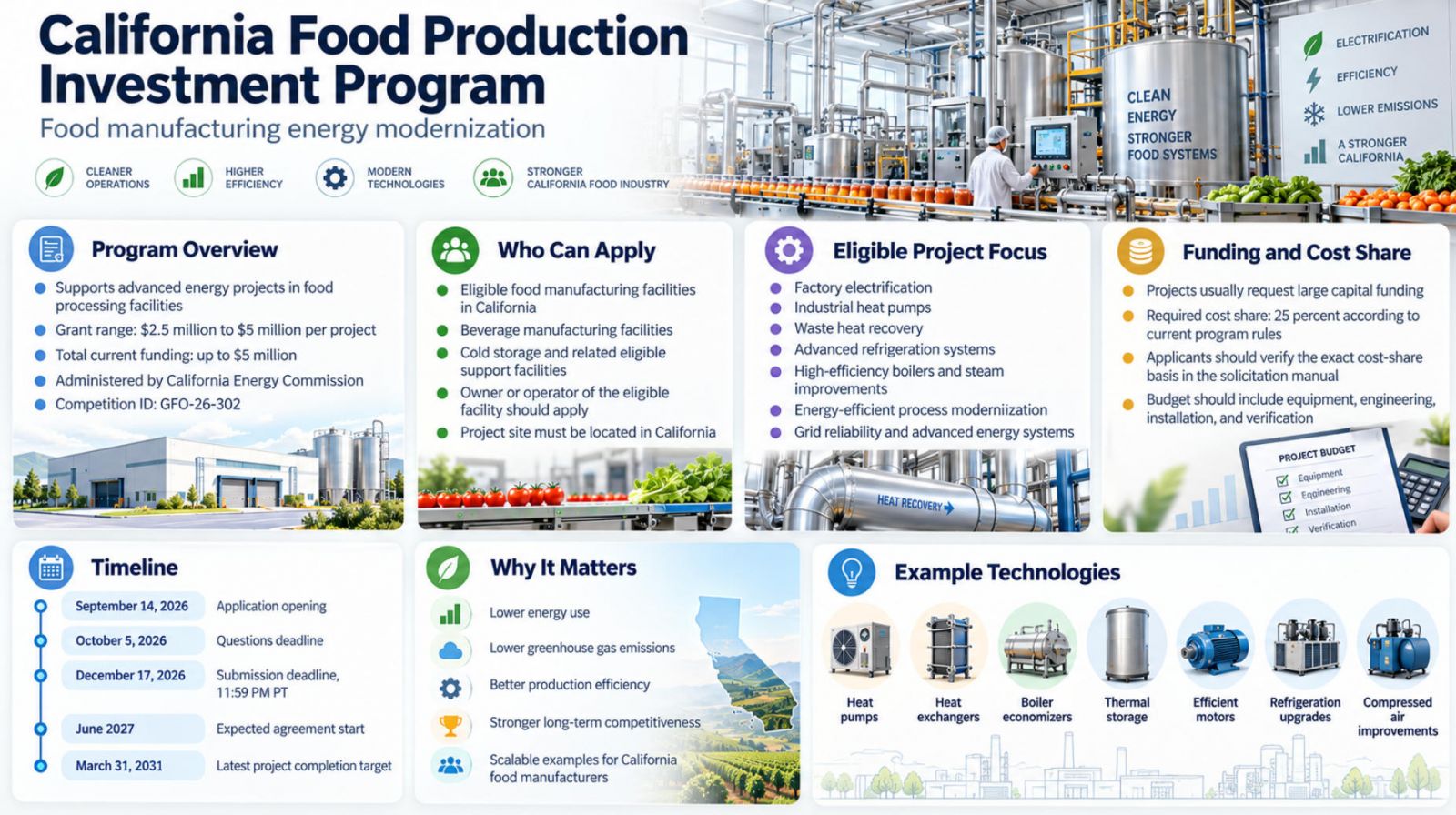
California's Food Production Investment Program (FPIP) offers a significant funding opportunity for businesses seeking to address these challenges. Administered by the California Energy Commission (CEC), the programme supports the implementation and demonstration of advanced energy efficiency and decarbonization technologies at eligible food processing facilities. Its current competition, GFO-26-302, provides grants ranging from $2.5 million to $5 million per project, with an overall funding allocation of up to $5 million. Applications opened on September 14, 2026, and must be submitted by December 17, 2026, at 11:59 p.m. Pacific Time.
The programme is particularly relevant to manufacturers planning substantial improvements in industrial heating, refrigeration, electrical systems, waste heat recovery, and other energy-intensive processes. However, FPIP is not a conventional business expansion grant or a general subsidy for replacing outdated machinery. It is designed to support technologies that deliver measurable improvements in energy efficiency, greenhouse gas emissions, or electrical grid reliability and that can demonstrate their value under actual manufacturing conditions. Successful applicants must therefore present more than an equipment purchase proposal. They need a technically credible investment plan supported by energy data, financial commitments, realistic implementation arrangements, and a convincing explanation of the expected environmental benefits.
Why California Is Investing in Cleaner Food Manufacturing
California has the largest concentration of food and beverage manufacturing establishments in the United States, reflecting the state's position as a leading agricultural producer and major food processing centre. According to the US Department of Agriculture's Economic Research Service, California had 6,569 food and beverage manufacturing establishments in 2022, representing approximately 15 percent of the national total. Texas ranked second with 2,898 establishments, followed by New York with 2,748. This extensive manufacturing network includes dairy processors, meat manufacturers, fruit and vegetable processors, nut processing operations, wineries, beverage producers, bakeries, and companies manufacturing prepared foods.
The industry's scale is closely connected with California's agricultural economy. According to the California Department of Food and Agriculture, farms and ranches in the state generated approximately $64.7 billion in cash receipts during 2025, an increase of 4.5 percent compared with the previous year. Milk production was valued at $8.39 billion, almonds at $6.87 billion, grapes at $5.21 billion, and tomatoes at approximately $1.36 billion. California's agricultural exports also reached $23.8 billion in 2024. Although these agricultural figures are not equivalent to food manufacturing revenue, they demonstrate the enormous volume of commodities that must be cleaned, sorted, refrigerated, processed, preserved, dried, packaged, or transformed into higher-value products.
Each of these manufacturing activities creates different requirements for heat, electricity, refrigeration, compressed air, and mechanical power. Dairy facilities consume energy during pasteurization, cooling, evaporation, cleaning, and drying, while meat processors require dependable refrigeration, steam, sanitation water, and tightly controlled operating conditions. Tomato processing plants rely on energy-intensive concentration and evaporation, whereas fruit and nut processors frequently use industrial drying systems, conveyors, air compressors, and specialized processing equipment. The resulting energy demand can be substantial, particularly when factories operate continuously or process large quantities of agricultural products within relatively short seasonal periods.
Energy modernization is therefore closely connected with the long-term competitiveness of California's food industry. Reducing unnecessary energy consumption can lower operating costs, improve production reliability, and reduce exposure to changes in energy prices. At the same time, food manufacturers must consider whether new technologies can operate consistently during peak production, meet food safety requirements, and integrate with existing equipment without creating unacceptable interruptions. An industrial heat pump, for example, may be highly effective in one dairy factory but less suitable for another facility with different temperature requirements or production schedules. This is why successful industrial decarbonization begins with a detailed understanding of the manufacturing process rather than the selection of a particular technology.
Table 1. Key Economic Indicators Relevant to California Food Processing
| Indicator | Verified value | Reference period |
|---|---|---|
| Food and beverage manufacturing establishments in California | 6,569 | 2022 |
| California's share of US food and beverage manufacturing establishments | Approximately 15 percent | 2022 |
| Food and beverage manufacturing establishments in Texas | 2,898 | 2022 |
| Food and beverage manufacturing establishments in New York | 2,748 | 2022 |
| California agricultural cash receipts | $64.7 billion | 2025 |
| California milk production value | $8.39 billion | 2025 |
| California almond production value | $6.87 billion | 2025 |
| California grape production value | $5.21 billion | 2025 |
| California tomato production value | $1.36 billion | 2025 |
| California agricultural exports | $23.8 billion | 2024 |
The figures describe different parts of California's agricultural and manufacturing economy and should not be combined as if they represented the same economic activity. Agricultural cash receipts measure revenue received by agricultural producers, while manufacturing establishment statistics describe facilities involved in processing and transforming products. This distinction is particularly important when evaluating eligibility for FPIP because the programme supports qualifying food manufacturing facilities and related infrastructure rather than agricultural production in general.
Understanding California's Food Production Investment Program
The Food Production Investment Program was established in 2018 as part of California Climate Investments, a statewide initiative that uses public revenues associated with California's carbon emissions trading system to support greenhouse gas reductions, environmental improvements, economic development, and benefits for disadvantaged communities. The California Energy Commission administers FPIP, with funding provided through the state's Greenhouse Gas Reduction Fund and General Fund. Since the programme was established, its public funding allocation has reached approximately $150.2 million, including $144 million from the Greenhouse Gas Reduction Fund and $6.2 million from the General Fund.
The programme's central purpose is to accelerate the adoption of advanced technologies that can reduce industrial energy consumption and greenhouse gas emissions while supporting the reliability of California's electrical grid. Unlike funding schemes intended primarily for early laboratory research, FPIP focuses on implementing technologies at operating industrial facilities and demonstrating their performance in actual production environments. Applicants are expected to show how the proposed equipment will improve measurable indicators, explain why the technology is appropriate for the facility, and establish a credible method for verifying its benefits after installation.
California Energy Commission records show that FPIP has awarded approximately $137 million to 63 projects across the state's food processing sector. These projects represent several major industrial categories, including prepared foods, fruit and vegetable processing, dairy manufacturing, meat processing, beverages, wineries, and animal feed production. The programme estimates that its supported projects can collectively reduce greenhouse gas emissions by approximately 176,000 metric tons of carbon dioxide equivalent per year, together with annual energy savings of approximately 25 million therms of fossil gas and 16 million kilowatt-hours of electricity. Reported lifetime greenhouse gas reductions across the portfolio are estimated at approximately 3.35 million metric tons of carbon dioxide equivalent.
These are substantial figures, but their interpretation requires care. Programme-level estimates may include projected benefits that have not yet been fully verified through post-installation measurements at every facility. They should therefore not be described as uniformly confirmed operating results. The distinction between anticipated and measured performance is especially important for readers comparing grant recipients or evaluating the practical effectiveness of specific technologies. Completed project reports provide stronger evidence when they explain the operating data, engineering assumptions, and verification methods used to calculate savings.
Beyond individual factory improvements, FPIP also aims to demonstrate technologies that other food manufacturers may eventually adopt. A successful installation can provide practical information about equipment performance, integration costs, operating requirements, and environmental outcomes. These lessons can be valuable to other companies processing similar products or operating comparable thermal and electrical systems. The wider contribution of a project therefore depends not only on the benefits achieved at one facility but also on whether its results can help inform future industrial investments.
FPIP 2026: Grant Amounts, Deadlines, and Financial Conditions
The current FPIP competition is identified as GFO-26-302 and was released on September 14, 2026. It provides a total funding allocation of up to $5 million, with individual projects expected to request between $2.5 million and $5 million. Because the competition's entire allocation is relatively small compared with the maximum individual award, the California Energy Commission anticipates supporting approximately one or two projects. This makes the programme highly selective, even though the potential grant amount is substantial.
Applications must be submitted through the Energy Commission Agreement Management System, known as ECAMS, by December 17, 2026, at 11:59 p.m. Pacific Time. The deadline for submitting formal questions regarding the competition was October 5, 2026. The published timetable anticipates agreement activities beginning around June 2027 and concluding no later than March 31, 2031, although actual project schedules will depend on the applicable funding decisions, contractual arrangements, and implementation requirements. These dates should be treated as planning milestones rather than guarantees that every approved project will begin or finish on precisely the same dates.
The competition also requires applicants to provide matching funds, which means the CEC grant cannot be treated as unrestricted financing for the entire investment. Published descriptions identify a 25 percent matching contribution requirement, but applicants must pay close attention to the definition of the calculation base in the current solicitation manual. Previous FPIP clarifications calculated the requirement as a percentage of the requested grant, while some descriptions of the current competition refer to a percentage of eligible costs. Because these approaches produce different financial outcomes, businesses should confirm the controlling definition in GFO-26-302 before finalizing their budgets or making financing commitments.
Table 2. California Food Production Investment Program 2026: Main Funding Conditions
| Programme requirement | Published condition |
|---|---|
| Programme | Food Production Investment Program |
| Competition identification | GFO-26-302 |
| Administering authority | California Energy Commission |
| Total competition funding | Up to $5 million |
| Minimum grant request | $2.5 million |
| Maximum grant request | $5 million |
| Expected number of funded projects | Approximately one or two |
| Matching contribution | 25 percent requirement, subject to the applicable definition in the current solicitation |
| Eligible location | California |
| Main target applicants | Owners or operators of eligible food processing and related facilities |
| Competition opening date | September 14, 2026 |
| Application deadline | December 17, 2026, 11:59 p.m. Pacific Time |
| Application system | ECAMS |
| Anticipated agreement start | June 2027 |
| Latest planned agreement completion | March 31, 2031 |
Another important consideration is the difference between the requested grant and the total investment. A company receiving a multimillion-dollar award may still need to finance a substantial portion of the project through internal resources, commercial financing, or other permitted sources. Additional expenses may arise from electrical infrastructure modifications, engineering work, permitting, production interruptions, maintenance requirements, or items that fall outside the grant's eligible expenditure categories. Consequently, applicants should prepare both a budget that follows FPIP's funding rules and a broader investment plan covering the full economic cost of implementing the technology.
The programme is not designed to finance ordinary factory expansion or equipment purchases unrelated to its energy and environmental objectives. A manufacturer seeking support for a new production line must therefore demonstrate that the proposed investment includes eligible advanced energy technologies and delivers the benefits required by the competition. The presence of modern machinery or higher production capacity is not sufficient on its own. Funding decisions are intended to support industrial improvements that contribute to measurable public energy and environmental goals.
Which Food Processing Businesses Can Apply?
FPIP primarily targets companies that own or operate eligible food processing facilities or related support infrastructure located in California. The connection between the applicant and the facility is fundamental because the grant supports equipment that will be installed and demonstrated at a real manufacturing location. A technology supplier may provide an innovative industrial heat pump, refrigeration system, or energy management solution, but the supplier's technical capabilities do not automatically establish eligibility to apply independently. In many cases, the appropriate applicant will be the food manufacturer that owns or operates the site where the equipment will be installed, while equipment suppliers and engineering companies participate as technical partners or contractors.
The programme has historically used the North American Industry Classification System, or NAICS, to determine eligible industrial activities. Important classifications include NAICS 311 for food manufacturing, NAICS 3121 for beverage manufacturing, and NAICS 493120 for refrigerated warehousing and storage. Certain postharvest processing activities may also fall within the scope of the current competition, subject to the precise definitions and restrictions in the 2026 solicitation manual. Applicants should verify their actual principal business activity and the applicable classification rather than assuming eligibility based on a broad description such as food business, agricultural company, or warehouse operator.
Food manufacturing encompasses a wide range of operations, including dairy processing, meat manufacturing, fruit and vegetable preservation, nut processing, bakeries, and prepared food production. Beverage manufacturing may include wineries, breweries, and other qualifying industrial beverage facilities, while refrigerated storage operations can be relevant when they meet the programme's definition of an eligible support facility. However, ordinary grocery stores, restaurants, retail food businesses, and agricultural operations without qualifying processing activities should not assume that they satisfy the requirements simply because they handle or sell food.
Location requirements deserve equally careful attention. A company operating facilities in several states cannot treat an investment outside California as eligible merely because it also has a registered office or another business operation within the state. The proposed equipment must be installed at an appropriate California facility, and the applicant should be able to document the operating entity, location, nature of its manufacturing activity, and relevant ownership or operating arrangements. Establishing these facts early can prevent substantial application preparation expenses from being incurred on a project that does not meet the basic eligibility conditions.
Which Energy Technologies Are Most Relevant to FPIP?
The 2026 competition distinguishes between commercially available technologies and advanced emerging technologies. Commercially available systems may replace existing equipment or operate alongside established production infrastructure, but they must offer performance that exceeds ordinary industry-standard practice. Simply purchasing a newer version of a conventional machine is not necessarily sufficient. Applicants need to demonstrate what makes the proposed system meaningfully more efficient, how its benefits differ from standard alternatives, and why it represents an appropriate investment for the particular facility.
The second category, cutting-edge emerging technologies, concerns advanced systems that have already demonstrated practical effectiveness but are not yet widely deployed in California. Published descriptions of the 2026 competition identify a minimum Technology Readiness Level of 8 for this category, along with evidence of previous commercial use in food processing and independently verified benefits. This distinction means FPIP is not intended to finance an untested laboratory concept from the beginning of its development. Instead, the programme seeks technologies that are sufficiently mature to produce reliable results when installed in operating manufacturing environments.
Table 3. Energy Technologies Relevant to California Food Processing Facilities
| Technology | Potential food processing application | Main performance indicators |
|---|---|---|
| Industrial heat pumps | Process water heating, pasteurization, selected industrial heating operations | Electricity consumption, fossil gas displacement, useful heat output |
| Waste heat recovery | Recovering heat from refrigeration, boilers, dryers, and other processes | Recovered thermal energy, reduced fuel consumption |
| Process electrification | Replacing suitable fossil-fuel-based thermal operations | Greenhouse gas reductions, electrical demand, operating efficiency |
| Advanced refrigeration systems | Dairy plants, meat processing, frozen food manufacturing, cold storage | Electricity consumption, cooling efficiency, refrigerant losses |
| Mechanical dewatering | Removing water before energy-intensive drying | Reduced evaporation energy, improved production efficiency |
| High-efficiency motors and controls | Pumps, compressors, conveyors, industrial process equipment | Electricity use, equipment efficiency, performance under variable loads |
| Advanced thermal process controls | Boilers, dryers, ovens, and steam systems | Fuel consumption, process stability, product consistency |
| Facility microgrids and energy storage | Supporting critical manufacturing loads and grid reliability | Peak electricity demand, storage performance, operational resilience |
These technologies represent potentially relevant investment directions rather than a list of equipment automatically approved for funding. Their actual eligibility depends on the current solicitation, the selected technology category, the proposed manufacturing application, and the quality of the supporting technical evidence. Previous FPIP awards can provide useful examples of industrial modernization, but they do not guarantee that identical equipment will qualify under GFO-26-302.
Industrial Heat Pumps and Process Electrification
Industrial heat pumps are particularly promising for food manufacturers that require substantial quantities of low- or medium-temperature heat. Unlike traditional boilers, which generate heat by burning fuel, heat pumps transfer thermal energy from one medium or location to another. When suitable conditions exist, they can supply useful process heat efficiently and reduce dependence on fossil-fuel combustion. Their potential applications include heating water for sanitation, supporting selected pasteurization processes, and recovering heat from refrigeration systems or other industrial operations.
Dairy manufacturing is a useful example because facilities often need refrigeration and hot water simultaneously. Milk and dairy products must be cooled during processing and storage, while cleaning, pasteurization, and sanitation consume thermal energy. A properly designed system can potentially recover heat released during refrigeration and use it to meet part of the factory's heating demand. However, the performance of an industrial heat pump depends on the temperature difference between its heat source and the required output temperature. A system with a relatively small temperature difference may operate efficiently, while one that must deliver much higher temperatures may require substantially more electricity.
For these reasons, a grant application should examine actual production conditions rather than relying only on the manufacturer's rated equipment efficiency. Relevant considerations include operating temperatures, annual working hours, seasonal variations, available waste heat, maintenance requirements, and the capacity of the existing electrical infrastructure. The financial assessment should also incorporate local electricity and natural gas prices, possible demand charges, installation costs, and the useful life of the equipment. A heat pump may reduce fossil gas consumption without automatically reducing total energy expenditure, making a complete comparison essential.
Process electrification creates additional opportunities but also changes a facility's relationship with the electricity grid. Replacing gas-fired heating equipment with electrical systems can reduce direct combustion emissions, yet the new equipment may require significant electrical power and upgrades to transformers, switchgear, distribution systems, or utility connections. These requirements can materially affect the project's capital cost and implementation schedule. For factories operating refrigeration or other critical equipment continuously, electrical reliability is particularly important because a prolonged interruption can result in product losses, safety concerns, and financial damage.
The strongest electrification projects therefore assess both the environmental benefits and the consequences for electrical demand. Where permitted under the competition, appropriate energy storage, load management, or microgrid technologies may help improve reliability and reduce demand during peak periods. However, neither electrification nor energy storage automatically produces lower greenhouse gas emissions or operating costs. Their actual performance depends on how electricity is supplied and used, the efficiency of the equipment, and the operating conditions of the facility.
Waste Heat Recovery and Integrated Energy Systems
Waste heat recovery is another important opportunity because many food manufacturing processes release thermal energy that can potentially be reused. Boilers discharge hot exhaust gases, refrigeration systems reject heat during cooling, and dryers or evaporators release warm process streams. Recovering some of this energy can reduce the amount of additional heat required elsewhere in the factory, particularly when a suitable heat source and a simultaneous demand for thermal energy are available.
A boiler economizer, for example, can transfer heat from exhaust gases to incoming boiler feedwater. Because warmer feedwater requires less additional heating to produce steam, the system can reduce fuel consumption during production. Similar principles apply to heat exchangers that recover energy from process liquids, warm exhaust air, or cooling systems. However, the practical value of recovered heat depends on its temperature, quantity, timing, and compatibility with other production operations. Heat that is available only during one shift may be difficult to use when the main heating demand occurs at another time, unless thermal storage or changes to the production schedule are introduced.
Low-temperature heat may also require upgrading through an industrial heat pump before it can serve a higher-temperature process. That additional equipment creates costs and electricity consumption, which must be included in the overall analysis. As a result, the most persuasive projects are designed around the factory's full energy system rather than an isolated piece of equipment. Applicants must show not simply that waste heat exists, but that their proposed technology can recover it reliably and deliver useful energy under realistic operating conditions.
Real California FPIP Projects and Their Verified Results
One of the programme's most valuable features is its history of funding real industrial projects and publishing technical reports on their performance. The California Energy Commission has supported manufacturers across different food processing sectors, including dairy production, poultry processing, dried fruit manufacturing, and the processing of animal byproducts. These examples provide practical information about grant amounts, matching contributions, equipment integration, and measured or calculated energy savings, although they belong to previous funding rounds rather than the current GFO-26-302 competition.
Table 4. Confirmed California Food Processing Investment Program Projects
| Company | Previous FPIP grant | Matching contribution | Main technology | Reported annual greenhouse gas reduction |
|---|---|---|---|---|
| Baker Commodities, Kerman | $860,596 | $463,398 | High-efficiency boiler and improved material feeding controls | 2,891 metric tons of CO₂ equivalent |
| California Dairies, Visalia | $3,002,821 | $600,000 | Solar thermal system for boiler feedwater heating | 539 metric tons of CO₂ equivalent |
| Foster Farms | $2,238,287 | $1,205,231 | Boiler economizers, improved controls, and heat recovery systems | 2,665 metric tons of CO₂ equivalent |
| Sunsweet Growers, Yuba City | $1,591,643 | $864,545 | Boilers, compressed air equipment, and steam system improvements | More than 4,500 metric tons of CO₂ equivalent |
The grant amounts and matching contributions are drawn from the CEC's published project records, while the energy and environmental outcomes are based on the relevant technical reports. Some reported emissions reductions are calculated from measured energy performance and engineering assumptions rather than direct measurement of greenhouse gas emissions. The figures should therefore be interpreted in the context of each project's verification methodology rather than treated as fully comparable performance measures.
Baker Commodities: Better Process Control and Lower Energy Consumption
Baker Commodities provides a particularly interesting example of improving energy efficiency in a facility processing animal byproducts and other organic materials. Its Kerman plant uses energy-intensive thermal operations to transform incoming materials into commercially useful products. Through the Kerman Energy Efficiency Upgrade Program, the company implemented a high-efficiency boiler and an improved material feeding system intended to reduce fuel consumption and stabilize production.
The material feeding system played an important role because inconsistent throughput can cause variations in heating demand and reduce the efficiency of thermal processing. By improving the consistency of material movement, the company was able to achieve more stable operating conditions and better coordination between production equipment and the boiler system. This illustrates how improvements to process control can reinforce the environmental benefits of more efficient machinery, even when the basic manufacturing activity remains unchanged.
According to the California Energy Commission's final report published in November 2025, the project achieved annual greenhouse gas reductions of 2,891 metric tons of carbon dioxide equivalent. The original forecast had anticipated approximately 1,388 metric tons annually, meaning the reported post-installation result was more than twice the initial estimate. The difference demonstrates the importance of verifying actual performance rather than relying exclusively on pre-installation projections.
The broader lesson is that industrial energy efficiency can depend on interactions between different pieces of equipment. An efficient boiler may deliver stronger results when the production process provides a stable and predictable demand for heat. For future applicants, this example supports the value of analysing material handling, production controls, thermal systems, and operational conditions together. Nevertheless, because Baker Commodities received funding under an earlier FPIP round, its award does not establish that the same type of equipment replacement would automatically satisfy the 2026 competition's technology requirements.
California Dairies: Renewable Thermal Energy for Milk Processing
California Dairies Inc. demonstrates how renewable thermal energy can be incorporated into a major food manufacturing facility. Working with Skyven Technologies, the company installed a solar thermal system at its dairy processing plant in Visalia, California. The installation includes 1,091 solar collectors with a combined absorption area of approximately 21,820 square feet. Instead of generating electricity, the collectors provide thermal energy used to preheat water entering the facility's boiler system, thereby reducing the amount of natural gas required to achieve the necessary operating temperature.
The project is particularly informative because the original engineering concept evolved as the team examined actual manufacturing requirements. Although solar thermal energy had initially been considered for drying operations, the system was ultimately directed towards preheating boiler feedwater. This change illustrates an essential principle of industrial energy modernization: the most suitable application may become clear only after engineers analyse the facility's temperatures, operating schedules, energy flows, and integration limitations.
Following twelve months of measurement and verification, the project reported approximately 8,403 million British thermal units of annual solar heat delivery. Using the measured thermal output and an assumed boiler efficiency of 82.8 percent, annual natural gas savings were calculated at approximately 101,481 therms, corresponding to an estimated greenhouse gas reduction of 539 metric tons of carbon dioxide equivalent. These figures combine actual operating measurements with engineering assumptions, so the calculated emissions savings should not be described as direct measurements of greenhouse gas releases.
The California Dairies example shows that industrial heating improvements can be designed around existing production infrastructure without requiring complete replacement of the manufacturing process. At the same time, the project demonstrates why equipment selection must be driven by realistic operating conditions rather than general claims about renewable energy. As this was a previous FPIP award, an identical solar thermal installation should not be assumed eligible under the current solicitation without a separate review of its technology requirements.
Foster Farms: Recovering Waste Heat in Poultry Processing
Foster Farms used previous FPIP funding to improve thermal efficiency across five poultry processing facilities through a combination of boiler economizers, upgraded boiler controls, and hot water recovery systems. Poultry manufacturing requires substantial amounts of heat for sanitation and other production activities, making steam and hot water systems important contributors to overall energy demand. The company's project addressed these requirements by improving the efficiency with which thermal energy was generated, controlled, and reused.
Boiler economizers recover part of the heat contained in exhaust gases and transfer it to incoming feedwater, allowing the boiler to produce steam with less additional fuel. Improved combustion and operating controls can help maintain suitable conditions when production demand changes, while hot water recovery systems reduce the need to generate heat that would otherwise be lost. The combined approach demonstrates why industrial energy upgrades can be more effective when they address several related parts of the same system rather than a single isolated machine.
According to the California Energy Commission's final report, the project achieved reported annual natural gas savings of approximately 458,050 therms, together with greenhouse gas reductions of 2,665 metric tons of carbon dioxide equivalent. Because the project covered several facilities, these figures should be understood as results of the described group of measures rather than as savings attributable to one identical installation at every location.
For manufacturers considering future energy projects, Foster Farms offers a useful example of how proven engineering improvements can reduce the energy required for essential production activities. However, the current FPIP competition places its own conditions on technology eligibility and performance. The fact that boiler economizers and related improvements were funded previously does not eliminate the need to demonstrate that a proposed 2026 project meets the new requirements.
Sunsweet Growers: Modernizing Steam and Compressed Air Systems
Sunsweet Growers, a major dried fruit processor based in Yuba City, California, implemented an energy modernization project involving both thermal equipment and compressed air systems. Its manufacturing activities require steam for processing operations, including fruit rehydration and heating water for equipment and facility sanitation. The company replaced two older boilers, upgraded 175 steam traps, and installed a new 200-horsepower variable-speed air compressor in place of two older fixed-speed compressors.
These improvements addressed different sources of energy inefficiency within the same facility. More efficient boilers can reduce fuel consumption, properly functioning steam traps can limit energy losses within the steam distribution network, and a variable-speed air compressor can adjust its output to changes in demand instead of operating continuously at a fixed level. Combining these measures can improve overall plant performance because food manufacturing depends on numerous supporting systems in addition to the main processing equipment.
The California Energy Commission's final report describes energy measurements before installation and during twelve months of operation after the improvements. Based on those results, the project achieved reported annual greenhouse gas reductions exceeding 4,500 metric tons of carbon dioxide equivalent. The example demonstrates the potential value of modernizing utility systems that may receive less attention than the primary production line but nevertheless account for substantial energy consumption.
For prospective FPIP applicants, the main lesson is to examine the entire facility when identifying energy efficiency opportunities. Boilers, compressors, steam traps, and control systems may each contribute to unnecessary energy use, and improvements can interact in ways that strengthen the overall result. At the same time, companies must distinguish ordinary maintenance from the advanced technological improvements required by the current competition.
What Previous FPIP Projects Reveal About Successful Investments
The experience of previous FPIP recipients demonstrates that the largest grant does not necessarily deliver the greatest environmental benefit and that equipment price alone is a poor indicator of project quality. Baker Commodities achieved significant energy improvements through better process coordination and thermal equipment, while Foster Farms focused on heat recovery and boiler efficiency across multiple facilities. California Dairies demonstrated a renewable thermal energy application, and Sunsweet Growers reduced energy consumption through coordinated improvements in steam and compressed air systems. These projects involved different technologies, baseline conditions, production volumes, and measurement methods, making simplistic comparisons misleading.
A more meaningful analysis considers total investment, annual energy savings, operating hours, equipment life, maintenance requirements, and the reliability of the reported environmental results. For example, two facilities may each report reducing greenhouse gas emissions by 3,000 metric tons annually, but the cost of achieving those reductions may differ considerably. One project might involve relatively modest changes to an existing utility system, while another may require extensive electrical infrastructure, specialized equipment, or production modifications. The benefits must also be evaluated over the useful life of the investment rather than solely during its first year.
Operating conditions further complicate comparisons because many California food processors experience strong seasonal variations. A fruit processing plant may operate at maximum capacity during harvest periods and substantially below that level during the rest of the year, while some dairy facilities maintain more continuous production schedules. Changes in output can influence both total energy consumption and measured efficiency, so credible verification should account for production levels and other relevant operating variables. The strongest lesson from the existing FPIP portfolio is that technical integration, careful measurement, and realistic financial analysis are just as important as the selection of equipment.
Matching Funds and the Real Cost of a $5 Million Energy Project
The 25 percent matching contribution requirement is one of the most important financial considerations for potential applicants. It means that a food manufacturer cannot assume the CEC will cover the entire cost of an eligible industrial modernization project. However, the exact calculation must be based on the definitions in the current GFO-26-302 solicitation manual, since different wording can lead to materially different results.
If the required contribution equals 25 percent of the requested grant, a company seeking $4 million would need to provide $1 million in matching funds, creating a total project budget of $5 million. If the contribution instead represents 25 percent of total eligible project costs, the company would need to provide approximately $1.33 million alongside a $4 million grant, creating a total eligible budget of approximately $5.33 million. Both calculations are mathematically correct under their respective assumptions, but applicants must not select the more favourable interpretation without verifying the current rules.
Table 5. Illustrative FPIP Matching Contribution Calculations
| Assumed grant request | Match at 25 percent of grant | Total budget under that assumption | Match at 25 percent of total eligible budget | Total budget under that assumption |
|---|---|---|---|---|
| $2,500,000 | $625,000 | $3,125,000 | Approximately $833,333 | Approximately $3,333,333 |
| $3,000,000 | $750,000 | $3,750,000 | $1,000,000 | $4,000,000 |
| $4,000,000 | $1,000,000 | $5,000,000 | Approximately $1,333,333 | Approximately $5,333,333 |
| $5,000,000 | $1,250,000 | $6,250,000 | Approximately $1,666,667 | Approximately $6,666,667 |
These calculations are illustrative financial scenarios, not approved FPIP budgets. The correct matching contribution must be determined using the current competition's official definitions and cost eligibility rules.
The difference matters because an additional contribution of several hundred thousand dollars can affect whether a company is able to proceed with its investment. Applicants should also confirm which sources of funding may be used as matching contributions and whether the relevant costs satisfy the programme's requirements. The existence of private financing, another grant, or internally available funds does not automatically establish that the source can be counted towards FPIP's required match.
Large industrial projects also involve costs that are not immediately apparent from an equipment quotation. Consider a hypothetical dairy facility planning a $5 million investment in industrial heat pumps and waste heat recovery. The budget might include $2.1 million for heat pumps, $850,000 for heat exchangers and thermal infrastructure, $700,000 for electrical improvements, $450,000 for engineering and integration, $600,000 for installation and commissioning, $150,000 for measurement and verification, and $150,000 for other project activities. This example illustrates how the total investment can include substantial engineering, infrastructure, and operational costs in addition to the principal technology.
Such a budget is only a planning example and does not mean that every category would necessarily qualify for reimbursement under FPIP. Applicants must determine which expenses are eligible, how matching contributions are calculated, and which costs the business must finance separately. This distinction is especially important when an investment requires electrical utility upgrades, construction-related work, specialized permits, or modifications to existing production systems. A complete financial plan should therefore distinguish the eligible grant budget from the broader economic cost of completing the project.
Measuring Energy Savings and Environmental Performance
Reliable measurement is central to the Food Production Investment Program because the public value of an industrial energy project depends on the benefits it actually delivers. Applicants should establish a credible baseline describing the facility's energy consumption before the proposed investment and explain how performance will be assessed after the new equipment begins operating. For a plant using natural gas boilers, relevant information may include historical fuel consumption, steam production, production volumes, operating hours, and equipment efficiency. For industrial refrigeration systems, the analysis may require electricity consumption, cooling demand, operating temperatures, production schedules, and seasonal fluctuations.
The measurement methodology must also account for the changes introduced by the new technology. An electrification project may substantially reduce natural gas use while increasing electricity consumption, so evaluating only the displaced fuel would provide an incomplete picture. The analysis should consider the energy required by the replacement system and use appropriate emissions factors to estimate its net greenhouse gas effect. Similarly, energy savings should be interpreted in relation to manufacturing output where relevant, since lower total energy consumption caused by reduced production is not necessarily evidence of improved efficiency.
A useful approach may involve comparing energy consumption per ton of processed tomatoes, per unit of dairy product, or per kilogram of acceptable finished food, depending on the type of facility. Such indicators help establish whether a technology genuinely improves manufacturing efficiency instead of merely reflecting changes in production volume. Where seasonal conditions are important, the verification plan should explain how measurements will account for differences between harvest periods and lower-production months. The quality of the resulting evidence depends on the accuracy of the instruments, the completeness of operating data, and the appropriateness of any adjustments made during the calculations.
Applicants should also examine possible benefits beyond energy consumption. Improved process stability, reduced equipment downtime, more reliable temperature control, reduced local air pollution, and lower peak electricity demand may all be relevant to the programme's objectives. However, these benefits should be supported by appropriate evidence rather than described as automatic consequences of installing new machinery. Measurement systems and verification activities should therefore be included in the engineering plan from the beginning, allowing the company to collect meaningful operating data after the investment is completed.
Environmental Justice and Benefits for California Communities
The Food Production Investment Program is intended to create public environmental benefits as well as improvements within individual factories. As part of California Climate Investments, it contributes to statewide efforts to reduce greenhouse gas emissions and improve conditions in disadvantaged and low-income communities. This wider purpose is particularly important in industrial regions where residents may already experience substantial pollution burdens from transportation, manufacturing, or other sources.
Food processing facilities can contribute to local emissions through boilers, industrial heating systems, and other equipment that burns fossil fuels. Replacing or improving these systems may reduce greenhouse gas emissions and, in suitable circumstances, lower certain pollutants that affect local air quality. These benefits can be especially valuable where factories operate near residential communities exposed to cumulative environmental pressures. Programme information indicates that projects benefiting priority populations may receive favourable consideration within the applicable evaluation framework, although the precise treatment must follow the current competition's official rules.
Applicants should therefore consider whether their project can produce demonstrable community benefits in addition to factory-level energy savings. A facility's location may be relevant, but location alone does not establish that a proposed investment will deliver the claimed environmental outcomes. The application should explain how emissions or other relevant conditions are expected to change, which populations may benefit, and how the proposed improvements will be measured. The Baker Commodities project in Kerman offers a useful example because its final report identifies the surrounding community as disadvantaged and experiencing a particularly high pollution burden, providing important context for the project's local environmental significance.
Community benefits should be integrated into the overall technical and environmental argument rather than presented as a separate promotional claim. For example, if a project replaces combustion equipment, the applicant can describe its expected effect on relevant local pollutants alongside the greenhouse gas calculation. Where a proposal addresses electrical grid reliability or production resilience, the wider significance should also be explained using realistic assumptions. A credible assessment of these effects can strengthen the public value of the investment and clarify its contribution to California's broader climate and industrial policy objectives.
Preparing the FPIP Application and Supporting Documents
Applications for GFO-26-302 are submitted through the California Energy Commission's Energy Commission Agreement Management System. The official competition package includes forms and instructions covering the applicant's eligibility, facility information, proposed technology, implementation plan, budget, environmental review considerations, and expected benefits. Given the size of the grants and the technical complexity of eligible projects, preparation should involve senior management, financial personnel, plant engineers, relevant equipment suppliers, and specialists responsible for environmental or regulatory compliance.
The technical narrative should begin with a clearly identified industrial energy problem and explain why the proposed technology is appropriate for addressing it. A dairy processor might focus on high natural gas consumption in process heating, while a frozen food manufacturer might examine the electricity required for refrigeration. The application should then describe the existing system, proposed improvements, technical performance evidence, implementation arrangements, and expected benefits. These elements must be consistent with the budget, schedule, and measurement methodology presented elsewhere in the application.
Table 6. Main FPIP 2026 Application Documents and Their Purpose
| Document | Main purpose |
|---|---|
| Solicitation Manual | Defines eligibility, funding rules, technology requirements, and evaluation conditions |
| Application Submittal Checklist | Helps verify that the required materials are complete |
| Project Overview Form | Describes the applicant, facility, and proposed investment |
| Project Narrative | Explains the technology, technical objectives, benefits, and economic rationale |
| Scope of Work | Defines activities, responsibilities, deliverables, and expected outcomes |
| Project Schedule | Establishes implementation stages and major milestones |
| Budget Form | Identifies grant funding, costs, and matching contributions |
| CEQA Compliance Form | Provides information relevant to California environmental review requirements |
| Commitment and Support Letters | Documents participation, commitments, and relevant external support |
| Benefits Calculator | Supports calculations of energy and environmental improvements |
| Applicant Declarations | Contains the required formal statements and confirmations |
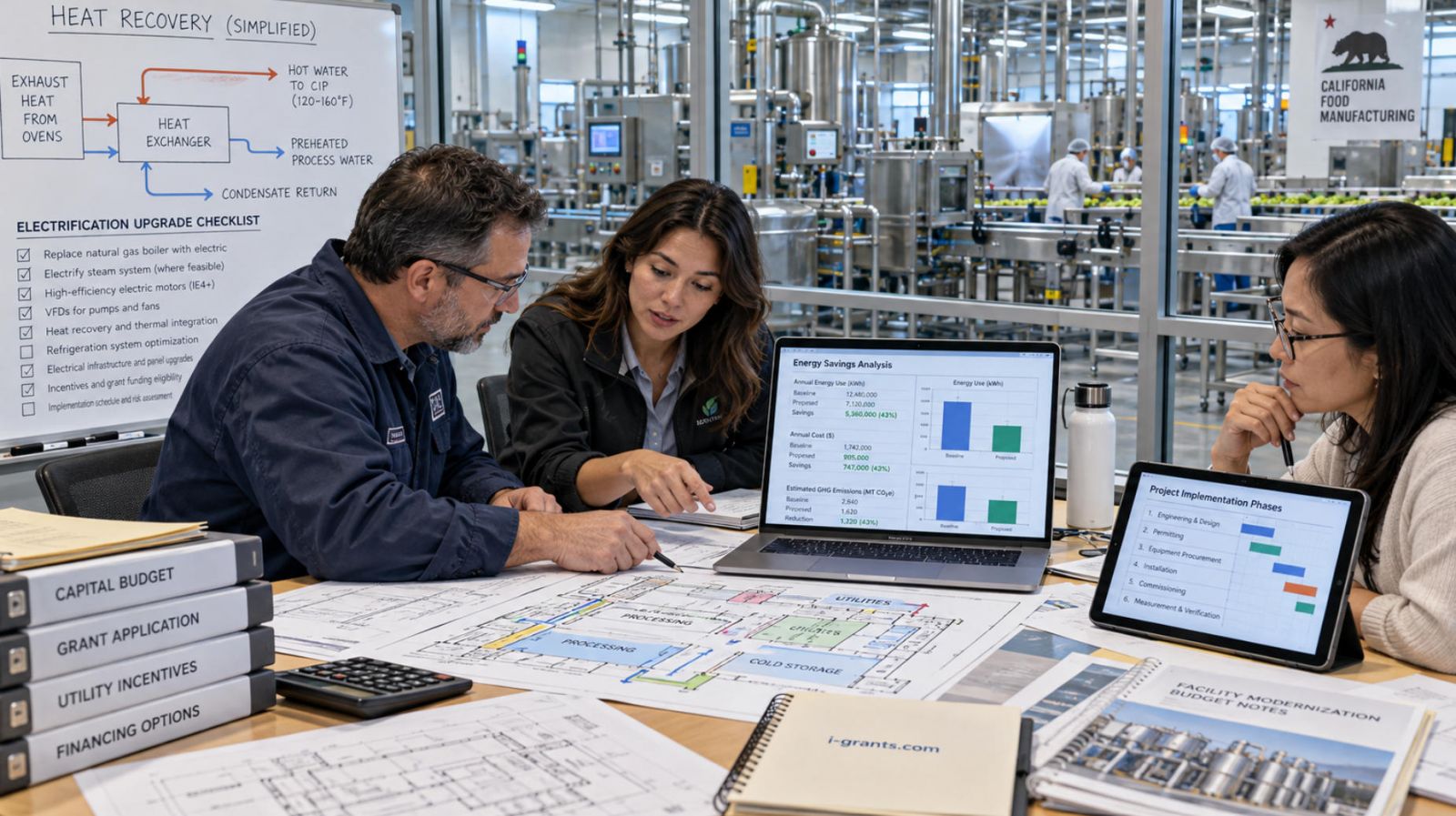
Consistency across the documents is essential. Equipment included in the project narrative should correspond to the proposed work packages and budget, while the implementation schedule should realistically account for engineering, procurement, installation, and commissioning. The projected energy savings should be based on the operating conditions and technologies actually described in the application, not on unrelated manufacturer performance claims. If a project requires significant electrical infrastructure upgrades, the associated costs and timelines should be incorporated into the plan rather than treated as minor details to be resolved after funding approval.
The application package also includes documentation related to the California Environmental Quality Act, commonly known as CEQA. This law establishes requirements for environmental review in applicable circumstances, but it does not mean that every FPIP project must undergo the same type of extensive assessment. The relevant procedure depends on the nature of the proposed work, its location, possible construction activities, permitting requirements, and other project-specific circumstances. Installing equipment within an existing industrial building may raise different considerations from constructing substantial new infrastructure.
Applicants should identify environmental compliance requirements early because unresolved approvals can delay implementation even after a project has been selected for funding. A realistic application should explain the physical changes that will occur at the facility, identify any necessary permits, and allocate responsibilities for obtaining required documentation. Equipment suppliers and engineering contractors may assist with this work, but the applicant remains responsible for ensuring that the project meets the programme's requirements.
How Innovate UK-Style Technical Proposals Differ From FPIP Applications
Although many business grant programmes require detailed technical and commercial documentation, FPIP has a particular emphasis on demonstrated industrial energy performance and public environmental benefits. A company accustomed to applying for research and development grants should therefore adapt its approach rather than relying on a standard innovation proposal. The central question is not only whether the technology is advanced but also whether it is suitable for the operating facility, whether its environmental performance can be verified, and whether the proposed investment advances California's energy and climate objectives.
For commercially available equipment, applicants should present a convincing comparison with ordinary industry-standard alternatives. This may involve equipment efficiency, process integration, energy recovery, operational reliability, or other performance characteristics relevant to the competition. For emerging technologies, the evidence should establish sufficient maturity and previous practical use, including independently verified benefits where required. In both cases, the proposal should connect technical capabilities to measurable improvements at the applicant's own facility rather than relying primarily on general statements about technological potential.
The financial argument should be equally specific. A project requesting several million dollars needs a realistic implementation budget, evidence of the necessary matching contribution, and an explanation of the business's ability to undertake and sustain the investment. A technology may offer significant environmental benefits but still face implementation obstacles if its installation requires major electrical upgrades, substantial downtime, or specialized expertise that the company has not planned for. Addressing these issues directly is more convincing than presenting an optimistic schedule that omits essential engineering work.
The project's wider value should also be made explicit. FPIP supports industrial investments intended to contribute to measurable state-level energy and environmental objectives, so the application should explain how its benefits extend beyond ordinary commercial replacement decisions. Depending on the project, this may involve substantial greenhouse gas reductions, improved energy efficiency, better grid performance, benefits for priority communities, or useful evidence about technologies that could be adopted by other manufacturers. Because the competition may fund only one or two projects, the applicant's ability to demonstrate a strong combination of these outcomes can be particularly important.
Common Mistakes That Can Weaken an FPIP Application
One of the most serious mistakes is beginning the application before confirming basic eligibility. A company may have an innovative technology but lack a qualifying California food processing facility, or it may operate a business whose principal activity falls outside the relevant industry classifications. Similarly, an equipment manufacturer should not assume that it can receive a factory modernization grant independently when the programme requires the applicant to own or operate an eligible site. Verifying the business classification, facility location, and operating arrangements at the beginning can prevent unnecessary preparation costs.
Another common weakness is treating ordinary equipment replacement as sufficient justification for funding. A manufacturer may need to replace an old boiler, compressor, or refrigeration unit for routine operational reasons, but the proposed investment must still satisfy the current competition's requirements for advanced technology and measurable benefits. Commercially available systems may need to demonstrate performance beyond industry-standard practice, while emerging technologies require credible evidence of technological maturity and practical results. Without this evidence, a project can appear to be an ordinary maintenance or capital replacement decision rather than a competitive energy innovation investment.
Financial and operational planning can create equally serious problems. Applicants may underestimate the required matching contribution, assume that all project expenditure is eligible, or overlook electrical infrastructure and installation expenses. They may also propose schedules that do not account for equipment procurement, environmental review, facility modifications, commissioning, or production interruptions. These omissions can undermine the project's credibility even when the selected technology is technically appropriate.
Weak environmental calculations are another major concern. A proposal may claim large greenhouse gas reductions based solely on displaced natural gas without including the electricity required by the replacement technology, or it may predict savings using equipment performance figures that are unrealistic for the facility's operating conditions. A project can also appear more efficient simply because production output has decreased, which is why suitable baseline measurements and production-related indicators are essential. In a competition with very limited funding, such weaknesses can make it difficult for assessors to distinguish an otherwise promising project from competing applications supported by more reliable evidence.
Evaluating the Financial Benefits of Factory Energy Modernization
Industrial energy investments may create several economic benefits beyond reducing greenhouse gas emissions. Lower fuel consumption can reduce operating expenditure, while improved process control may stabilize production, decrease equipment downtime, and reduce unnecessary energy use. More reliable thermal or refrigeration systems can also support food safety and product consistency, although such operational advantages depend on the specific technology and how successfully it is integrated into the factory.
The financial value of energy savings should be calculated using realistic energy prices and operating assumptions. For example, if a hypothetical food manufacturer reduces natural gas consumption by 100,000 therms annually and pays an assumed $1.20 per therm, the gross annual reduction in natural gas expenditure would be $120,000. This is an illustrative calculation rather than a documented result from an FPIP recipient. If the new technology also increases electricity consumption, the additional electricity expense must be deducted before estimating net energy cost savings.
A complete assessment should include maintenance, financing, capital investment, equipment service life, and any changes in production performance. Some technologies may lower energy expenditure but require more specialized maintenance, while others may improve product consistency or reduce downtime in ways that create additional economic value. These effects should be evaluated separately where possible to avoid overstating the benefits or counting the same improvement more than once.
Grant funding can improve an investment's financial feasibility by reducing the amount of private capital required for eligible costs, but it does not eliminate the need for sound financial planning. A manufacturer should be capable of operating and maintaining the technology after the grant-funded implementation period ends. The strongest investment proposals therefore connect public environmental benefits with long-term business sustainability, demonstrating that the technology has a credible role in the facility's future operations.
Planning a Major Electrification Project From Start to Finish
Implementing a multimillion-dollar energy project requires coordinated work across several parts of a food manufacturing business. Engineers must establish the existing energy baseline, assess available technologies, and determine how new equipment will interact with production systems. Financial managers must evaluate capital costs, matching contributions, cash requirements, and long-term operating expenses. Production teams must identify installation periods that minimize disruption, while environmental specialists must determine which approvals and compliance procedures apply.
These activities should be integrated into a realistic project schedule rather than developed independently. A dairy plant installing industrial heat pumps, for example, may need to coordinate electrical distribution upgrades, process piping, thermal storage, refrigeration integration, and control system modifications. If the factory operates seasonally or has periods of particularly high production demand, the installation and commissioning schedule must reflect those conditions. Attempting to make major changes to essential heating or cooling systems without sufficient operational planning could create risks to production continuity, food safety, and equipment performance.
Equipment suppliers and engineering contractors should provide credible information on technical specifications, delivery times, installation requirements, and previous performance. Where the project involves an emerging technology, the applicant should also obtain evidence of previous commercial deployment and independent verification of the relevant benefits. These documents support the technical credibility of the proposal and help establish whether the investment can realistically be completed within the planned period.
Measurement and verification should be included in the design from the beginning. Appropriate instruments, monitoring procedures, and reporting arrangements can make it possible to compare the new system's performance with the established baseline after installation. This helps the manufacturer demonstrate compliance with the grant's objectives and provides useful information for managing the equipment throughout its service life. A well-prepared FPIP application therefore functions not merely as a request for funding but also as a structured engineering and investment plan.
The Future of Food Processing Decarbonization in California
The Food Production Investment Program reflects a broader transformation in California's industrial economy. Food processing businesses are under increasing pressure to modernize manufacturing systems, manage energy costs, reduce environmental impacts, and adapt to changes in electrical infrastructure. These challenges will not be solved by one technology or a single approach because the state's food manufacturing sector includes facilities with widely different production processes, operating temperatures, seasonal patterns, and energy requirements.
For some companies, the most suitable investment may involve electrifying selected heating operations, while others may benefit more from recovering thermal energy, improving refrigeration performance, or integrating advanced controls into existing systems. In certain facilities, a combination of technologies may be necessary to achieve meaningful improvements without compromising production reliability. The relevant engineering decision depends on the actual manufacturing process, not on which technology is currently receiving the greatest attention.
The history of FPIP demonstrates that meaningful improvements are possible across different food processing activities. Baker Commodities shows the value of combining better material flow with efficient thermal equipment, California Dairies illustrates the integration of renewable thermal energy into industrial heating, Foster Farms demonstrates the potential of waste heat recovery, and Sunsweet Growers highlights the importance of supporting systems such as boilers and compressed air. These projects also demonstrate why manufacturers should distinguish between predicted improvements and verified results, since actual operating conditions can influence performance in ways that are difficult to capture during initial planning.
The current 2026 competition places a strong emphasis on proven advanced technologies, industrial decarbonization, and the relationship between manufacturing equipment and California's electrical grid. For applicants, this means that a compelling investment proposal should go beyond the general objective of installing more modern machinery. It should identify a specific energy problem, demonstrate why the proposed technology is appropriate, quantify the expected benefits, and show that the company has the financial and operational capacity to implement the project successfully.
Conclusion: Turning Factory Energy Modernization Into a Fundable Project
California's Food Production Investment Program offers a significant opportunity for qualifying food manufacturers to undertake major industrial energy improvements. The current GFO-26-302 competition provides grants ranging from $2.5 million to $5 million, supported by a total allocation of up to $5 million. The programme focuses on advanced technologies that can reduce greenhouse gas emissions, improve energy efficiency, support electrical grid reliability, and demonstrate practical performance within operating food processing facilities.
However, the substantial maximum award should not obscure the programme's demanding requirements or its limited funding availability. With an allocation that may support only one or two projects, applicants must demonstrate strong technical justification, appropriate facility eligibility, credible environmental benefits, sufficient matching funds, and realistic implementation arrangements. A project that merely replaces ordinary equipment or promises improvements without reliable evidence is unlikely to offer the same level of competitiveness as a carefully developed industrial investment.
The experiences of Baker Commodities, California Dairies, Foster Farms, and Sunsweet Growers demonstrate that industrial energy modernization can produce meaningful environmental results across different food processing sectors. Their projects also reinforce the importance of engineering integration, financial planning, and post-installation verification. For businesses preparing an application, the central task is therefore not simply to identify equipment that consumes less energy, but to explain how a specific technology will improve the performance of an actual manufacturing facility and why the proposed investment is both technically achievable and financially credible.
i-grants.com (Grantologic) is being developed as an international platform connecting organisations seeking grant funding with professional grant writers and funding specialists. For California food manufacturers planning major energy efficiency or electrification investments, access to suitable technical and grant-writing expertise can help transform complex industrial plans into structured funding applications supported by clear budgets, measurable objectives, and credible evidence.
As California's food industry continues to modernize, funding programmes such as FPIP can help accelerate the adoption of technologies that reduce environmental impacts while supporting long-term productivity, competitiveness, and manufacturing resilience.