

 Français
 Deutsch
 Українська

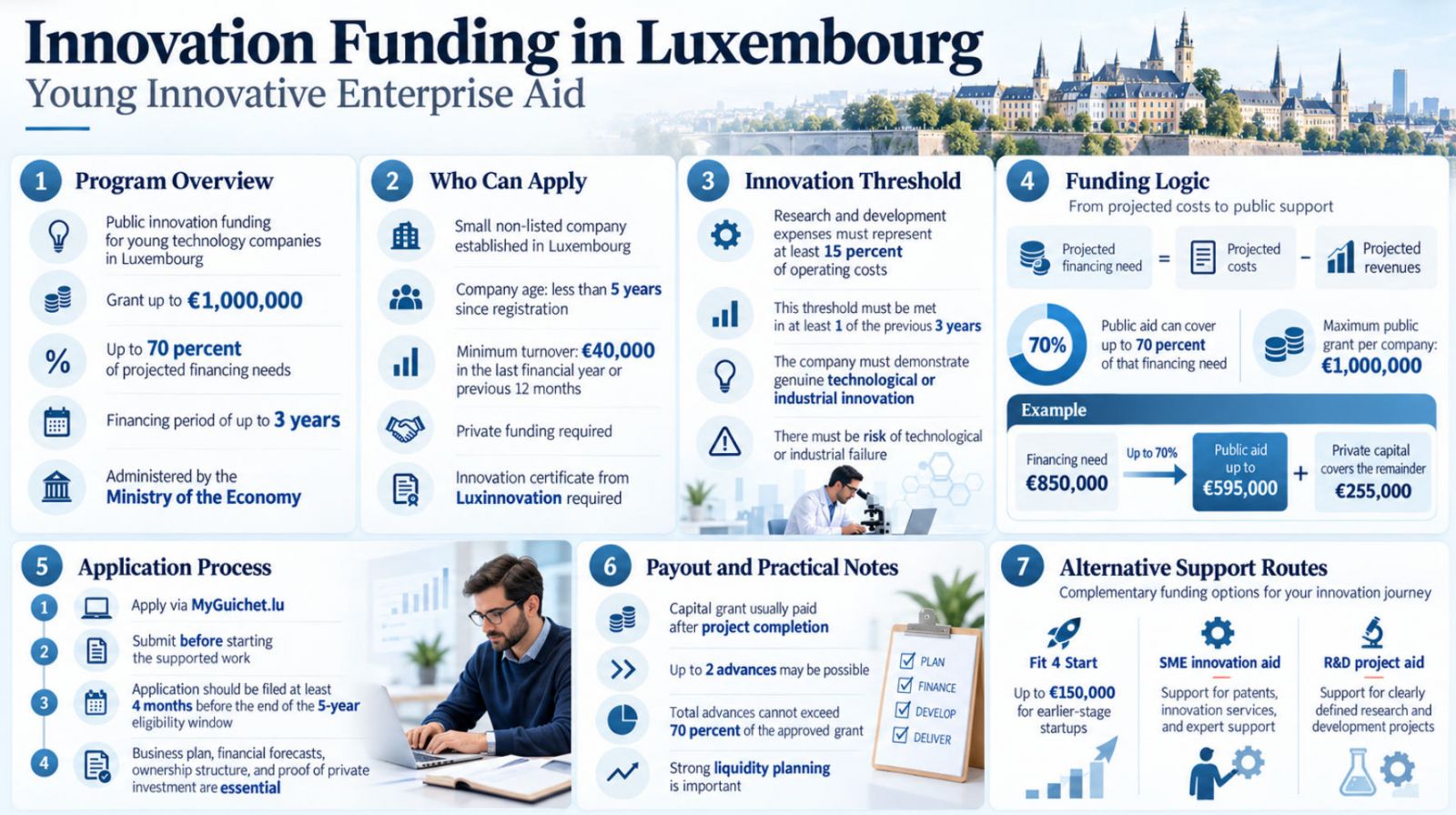
Luxembourg offers young technology companies access to a government funding mechanism that can provide up to €1 million in non-dilutive financial assistance. Under the Young Innovative Enterprise Aid scheme, eligible businesses may receive public support covering as much as 70 percent of their projected financing requirements over a period of up to three years. Unlike many conventional research grants, the programme is designed to support the broader financial needs of an innovative business preparing for accelerated commercial growth.
The opportunity is especially relevant to technology startups that have moved beyond the concept stage, developed an innovative product or service, generated initial sales and secured private investment. Such companies frequently face a difficult financing transition. Their technology may already have commercial potential, yet expanding engineering teams, strengthening infrastructure, obtaining regulatory approvals and reaching additional customers can require substantially more capital than early revenues generate.
Young Innovative Enterprise Aid is intended to address part of that financing challenge. By combining private capital with public support, Luxembourg enables qualifying companies to pursue larger development programmes without relying exclusively on additional equity investment.
However, the advertised €1 million maximum does not mean that every startup incorporated in Luxembourg can request or receive that amount. The programme has strict eligibility conditions concerning company age, enterprise size, commercial turnover, research expenditure, ownership history and innovation certification. Applicants must demonstrate their financing requirements through a credible business plan and prove that private financing is available to support the proposed expansion.
One of the most important requirements is that the applicant must have generated at least €40,000 in turnover during its most recent financial year or the preceding 12 months. It must also demonstrate qualifying research and development expenditure amounting to at least 15 percent of its total operating expenses in at least one of the preceding three years.
These conditions make the programme substantially different from early-stage startup competitions. It is not designed simply to finance a promising idea. It targets young enterprises with evidence of innovation, commercial activity and the capacity to implement an ambitious growth strategy.
For international founders, Luxembourg's combination of national innovation support, access to European markets and specialist business development services creates additional opportunities. Nevertheless, foreign entrepreneurs must understand the requirements concerning local establishment, corporate ownership and genuine business activity before developing a funding strategy.
This article examines the financial and legal structure of Young Innovative Enterprise Aid, explains how to calculate potential support, reviews official application requirements and presents detailed funding models for technology companies at different stages of development. It also explores the role of Luxinnovation, the importance of private investors, the financial consequences of delayed grant payments and the alternative support programmes available to startups that do not yet qualify.
Luxembourg's Innovation Economy and Its Approach to Startup Financing
Luxembourg has built an innovation ecosystem around international business activity, research cooperation, financial services, digital infrastructure and specialised technology sectors. Although the country has a relatively small domestic market, its location and international business environment make it an attractive base for companies developing products intended for customers throughout Europe.
Its innovation strategy increasingly extends beyond traditional financial services. Artificial intelligence, cybersecurity, health technologies, space applications, high-performance computing, advanced manufacturing and environmental technologies have become important areas of research and commercial development.
According to the European Innovation Scoreboard 2026, Luxembourg ranked seventh among the 27 European Union member states. Its innovation performance reached 115.8 percent of the EU average, placing the country in the Strong Innovators category for a second consecutive year.
This performance reflects the quality of the country's research environment, international scientific collaboration and capacity to attract skilled professionals. Yet innovation rankings do not automatically translate into available investment capital for individual companies.
Technology businesses still face considerable uncertainty when moving from product development to commercial growth. Even a successful startup may need to finance several years of development before recurring revenues can cover its operating expenses.
Public support is therefore structured around different stages of the innovation cycle. Early-stage founders may benefit from accelerator programmes, companies conducting defined research projects can seek research and development aid, and more mature startups may qualify for support linked to commercial expansion and increasing financing needs.
Young Innovative Enterprise Aid occupies a particularly important position in this funding landscape because it connects technological innovation with the broader financial requirements of company growth.
Luxinnovation, Luxembourg's national innovation agency, plays a central role in helping companies navigate these instruments. Its 2025 annual report recorded more than 1,000 companies supported across the agency's activities and 307 companies assisted in accessing finance.
During the same year, Luxinnovation supported the submission of 143 national funding applications to the Ministry of the Economy. Of these, 117 concerned research, development and innovation, including 101 applications specifically related to research and development aid.
These figures provide an indication of the national innovation support system's activity, but they do not represent the number of grants approved under Young Innovative Enterprise Aid. The distinction matters because Luxembourg operates several programmes with different eligibility conditions and financial structures.
The legal framework for research, development and innovation support was updated through the Law of 6 June 2025. This legislation renewed the national state aid system and provides the basis for the current Young Innovative Enterprise Aid conditions.
Companies evaluating the programme should therefore rely on the updated rules rather than older descriptions published when different funding ceilings or administrative arrangements applied.
What Is Young Innovative Enterprise Aid?
Young Innovative Enterprise Aid is a public financial assistance scheme administered by Luxembourg's Ministry of the Economy. It supports qualifying small, unlisted companies that are less than five years old and can demonstrate genuine technological or industrial innovation.
The instrument primarily takes the form of a capital grant. This means that the financial assistance is generally non-dilutive: the government does not acquire an ownership stake merely because it awards the subsidy.
The beneficiary must nevertheless comply with the conditions of the funding decision, maintain the necessary documentation and fulfil its reporting obligations. Non-dilutive funding should not be confused with unconditional funding, since breaches of the rules can result in recovery of the assistance.
The programme's purpose is to support companies that have already demonstrated commercial potential and require additional resources to move into a more demanding stage of development.
Luxinnovation describes the scheme as particularly suitable for research-intensive startups that have recently secured private financing and need further capital to scale their innovation.
An enterprise developing industrial artificial intelligence software, for example, might already have a functioning product and several paying customers. However, meeting demand from larger international manufacturers could require additional software engineers, specialised testing infrastructure, stronger cybersecurity systems and expanded technical support.
A medical technology company may face similar pressures when moving from initial commercial validation to broader deployment, especially where quality management, product development and regulatory requirements increase costs.
A cybersecurity startup could need to invest in vulnerability research, technical staff, secure computing infrastructure and commercial expansion before its recurring subscription revenue becomes sufficient to finance those activities independently.
In each case, the financing challenge extends beyond the cost of developing a single product feature.
The company must finance the transition from an emerging business to a commercially sustainable organisation. Young Innovative Enterprise Aid can contribute to that transition when the company meets the programme's legal and financial requirements.
Table 1. Young Innovative Enterprise Aid: Verified Funding Conditions
| Programme parameter | Official conditions |
|---|---|
| Programme name | Young Innovative Enterprise Aid |
| Country | Luxembourg |
| Responsible authority | Ministry of the Economy |
| Main financial instrument | Capital grant |
| Maximum public assistance | €1,000,000 per enterprise |
| Maximum co-financing rate | 70 percent of projected financing requirements |
| Financial planning period | Up to three years |
| Enterprise category | Small, unlisted enterprise established in Luxembourg |
| Maximum enterprise age | Less than five years since registration |
| Minimum commercial turnover | €40,000 in the last financial year or preceding 12 months |
| Research intensity | R&D expenditure of at least 15 percent of operating expenses in one of the preceding three years |
| Innovation verification | Certificate issued by Luxinnovation |
| Private financing | Required |
| Submission platform | MyGuichet.lu |
| Special age-related deadline | At least four months before the end of the five-year eligibility period |
| General timing condition | Application before the commencement of the supported work |
| Payment principle | Payment after completion, with conditional intermediate instalments |
The maximum public support is calculated using the applicant's justified financial requirements and the applicable funding limits. The actual award may be lower than the theoretical maximum, depending on the evaluation of the project and the financing arrangements.
There is also an important distinction between the programme's administrative availability and an unconditional open call. The official procedure is presented through MyGuichet.lu without a single annual competition deadline, but this does not guarantee continuous budget availability or automatic acceptance of applications.
Before undertaking significant financial commitments, companies should verify the current administrative position with the Ministry of the Economy or Luxinnovation.
Eligibility Begins With the Legal Structure of the Company
One of the most common misunderstandings surrounding public startup funding is that a new legal entity automatically qualifies as a young enterprise.
Under Young Innovative Enterprise Aid, the applicant must satisfy the European definition of a small enterprise and comply with restrictions concerning its history, ownership and commercial activities.
A small enterprise generally employs fewer than 50 people and has annual turnover or an annual balance sheet total not exceeding €10 million.
However, the European SME definition contains additional rules concerning partner and linked enterprises. These rules are particularly important when an applicant belongs to a larger group or has substantial corporate shareholders.
Consider a newly incorporated Luxembourg software company owned by a much larger international technology business. Although the Luxembourg company itself may employ only eight people and generate relatively little turnover, its classification can be affected by the size and ownership relationships of the wider corporate group.
The authorities may require information about the economic entity to which the applicant belongs rather than assessing only its standalone financial statements.
Similar issues can arise when a startup has undergone a merger, acquired another business or taken over existing commercial operations.
The Young Innovative Enterprise Aid conditions restrict companies that have taken over another enterprise's activity, distributed profits, acquired another enterprise or resulted from a merger. The precise legal treatment of any corporate restructuring should be assessed against the applicable legislation.
This makes early corporate planning important.
A founder considering the transfer of intellectual property or operating activities from an existing company into a new Luxembourg entity should not assume that the new registration date resolves the eligibility question.
The company's actual economic history and relationships may still be relevant.
Private investment also deserves careful consideration. Accepting venture capital does not automatically make a startup ineligible, but the resulting ownership structure may affect the SME classification.
An application should therefore include a clear ownership chart, identify relevant shareholder relationships and explain any corporate transactions that could influence eligibility.
For complex structures, a legal and financial review before preparing the full grant application may prevent substantial wasted effort.
The €40,000 Turnover Threshold: Why Commercial Traction Matters
The programme requires the applicant to have generated at least €40,000 in turnover during its most recent financial year or the preceding 12 months.
This condition is one of the clearest indicators that Young Innovative Enterprise Aid is intended for businesses beyond the earliest development stage.
A startup may have spent two years creating a technically impressive prototype, filed patent applications and attracted interest from potential customers. Nevertheless, if it has not yet generated the required commercial turnover, it does not meet this specific eligibility criterion.
The programme does not replace historical revenue with a forecast of future sales.
A different company with a less ambitious prototype but €60,000 in documented customer revenue may be better positioned to qualify, provided it meets all other conditions.
For international founders, the revenue requirement also raises practical accounting questions.
The applicant should determine which revenue belongs to the eligible Luxembourg enterprise, how it is recorded in the financial statements and whether the relevant 12-month period can be properly documented.
Expected income from unsigned contracts, letters of intent or prospective customers should not be presented as historical turnover.
Likewise, capital contributions from investors are not automatically equivalent to sales revenue. Equity financing increases the company's financial resources, but it is economically different from turnover generated through the sale of goods or services.
A well-prepared applicant should be able to reconcile turnover figures across accounting statements, invoices, management reports and the grant application.
The €40,000 threshold should be treated as a minimum legal condition, not as proof that the company has established a sustainable business model.
A company generating €45,000 in annual revenue while spending €600,000 may still be eligible in principle, but its financial forecasts and commercial development strategy will require convincing justification.
For grant assessment purposes, the quality of commercial evidence matters alongside the headline figure.
Recurring customers, repeat orders, signed agreements, identifiable sales channels and realistic revenue projections can all strengthen the business case.
How Luxembourg Defines an Innovative Enterprise
Commercial traction alone is not sufficient. The applicant must also demonstrate that it qualifies as an innovative enterprise.
The official conditions require a certificate from Luxinnovation confirming that the business is expected to develop products, services or processes that are new or substantially improved compared with the existing state of the art in the relevant industry.
The proposed development must also involve a risk of technological or industrial failure.
This requirement is more demanding than simply presenting a product as modern, digital or technologically advanced.
A company offering ordinary web development services may use sophisticated software tools without creating a genuinely innovative technology.
Similarly, a conventional online retail platform does not automatically become eligible merely because it incorporates artificial intelligence features already widely available elsewhere.
The application should demonstrate the nature of the technological improvement, the existing limitations in the market and the uncertainties that the company is attempting to overcome.
For an industrial technology company, the innovative element might involve a new sensing method, an original automated production process or a substantially improved industrial control system.
For a cybersecurity business, the innovation could concern a novel technical approach to detecting sophisticated attacks or protecting sensitive computing environments.
For a health technology developer, the innovative activity might involve a new diagnostic method, a technically complex device or an original digital treatment process.
These examples illustrate potentially relevant activities rather than automatically eligible sectors.
The decisive factor is not the industry label but the documented innovation and the company's compliance with the programme's requirements.
A strong technical explanation should distinguish existing industry solutions from the proposed technology, identify the unresolved technical challenge and explain how the research programme addresses that challenge.
It should also clarify why the outcome is uncertain.
A project that merely implements known technology at a predictable cost may have commercial risks, but those risks are not necessarily equivalent to the technological or industrial failure risk expected under the innovation criterion.
The 15 Percent R&D Expenditure Requirement
The innovation assessment also contains a measurable financial condition.
Research and development expenditure must represent at least 15 percent of total operating expenditure in at least one of the three years preceding the granting of aid.
This is an important distinction because a company can appear technologically sophisticated while spending relatively little on activities that qualify as genuine R&D.
Research expenditure should be identifiable in the company's accounting records and supported by documentation.
For example, suppose a startup recorded total operating expenditure of €320,000 during a financial year. If €62,000 can be properly documented as qualifying R&D expenditure, the research intensity ratio is approximately 19.4 percent.
That exceeds the programme's 15 percent threshold.
If the same company recorded only €35,000 of qualifying research expenditure, the ratio would be approximately 10.9 percent and would not satisfy the requirement for that year.
The applicant must therefore distinguish the costs of genuine research and development from ordinary operating activities.
Software engineers may perform both research tasks and routine maintenance. Manufacturing specialists may work on experimental processes as well as regular production. Product managers may coordinate research while also undertaking commercial work.
It would be inappropriate to classify every salary in a technology company as R&D expenditure without demonstrating the actual nature of the work.
The financial records should explain how research costs were identified and allocated.
Luxinnovation's certification procedure requires an independent confirmation of the R&D expenditure ratio by a chartered accountant belonging to Luxembourg's Ordre des Experts-Comptables.
The accountant's involvement should be planned early because reconstructing historical expenditure after several reporting periods can be difficult.
Companies should retain project descriptions, employee time records where relevant, technical documentation, invoices and accounting classifications that support the research expenditure calculation.
The authorities may also need to evaluate how the historical R&D evidence relates to the company's future innovation strategy.
A business that previously conducted substantial research but has since shifted entirely toward ordinary consulting services may need to explain how its current operations remain consistent with the programme's innovation objective.
Table 2. Illustrative R&D Expenditure Calculations
| Operating expenditure | Documented R&D expenditure | R&D intensity | Position against 15 percent threshold |
|---|---|---|---|
| €200,000 | €20,000 | 10 percent | Below threshold |
| €200,000 | €30,000 | 15 percent | Meets numerical threshold |
| €320,000 | €62,000 | Approximately 19.4 percent | Above threshold |
| €500,000 | €100,000 | 20 percent | Above threshold |
| €800,000 | €96,000 | 12 percent | Below threshold |
These are hypothetical accounting examples. Meeting the numerical threshold does not replace the required innovation certificate or other eligibility conditions.
For companies with fewer than three completed financial years, the documentation must reflect their actual operating history. Applicants should clarify with Luxinnovation how the relevant reporting periods are assessed in their circumstances.
This is particularly important for startups approaching their first or second annual reporting deadline.
Obtaining the Luxinnovation Innovation Certificate
The innovation certificate is one of the central documents in the application process.
Luxinnovation uses a dedicated procedure to evaluate whether a company satisfies the relevant requirements for innovative enterprise status.
The certification process is distinct from the Ministry's financial aid decision.
A positive innovation assessment does not mean that the Ministry has approved the requested grant amount, accepted the financial projections or confirmed that the private financing is sufficient.
The applicant should therefore treat certification as an important eligibility step rather than the final funding decision.
Luxinnovation requests information concerning the company's legal identity, ownership, employment, financial history, research expenditure and future business development.
The business plan is especially important because the innovation assessment must be connected to the company's actual commercial and technological activities.
A company developing a medical software platform, for example, should explain how the technology works, which clinical or technical problem it addresses, what makes its solution substantially different and how further development will lead to commercial deployment.
The technical explanation should remain consistent with the company's financial plan.
If the business intends to develop advanced machine learning models, the budget should account for appropriate engineering personnel, computing resources, data preparation, testing and other necessary activities.
If the technical plan describes substantial laboratory work, the financial model should explain how that work will be financed.
Inconsistencies between technical objectives and budget assumptions can weaken the overall credibility of the application.
Table 3. Documentation for Innovation Certification and Government Funding
| Document or information | Main purpose | Relevant stage |
|---|---|---|
| Company incorporation documents | Establish legal identity and registration | Certification and grant application |
| Authorisation of company representative | Confirm submission authority | Certification |
| Ownership and group structure | Establish corporate relationships and SME classification | Both |
| CCSS employee documentation | Verify employment information | Certification |
| Historical annual accounts | Demonstrate financial history and business activity | Both |
| R&D expenditure confirmation | Verify research intensity | Certification |
| Technical innovation description | Explain novelty and technological risk | Certification |
| Business plan | Present commercial objectives and development strategy | Both |
| Three-year cash flow forecast | Demonstrate financing requirements and liquidity | Financial assessment |
| Private investment evidence | Confirm financing available outside the requested grant | Grant application |
| Intellectual property information | Support technology and ownership claims where relevant | Certification |
| Project expenditure plan | Explain how financial resources will be used | Grant application |
| Relevant previous aid information | Support state aid compliance and cumulation checks | Grant application |
The Luxinnovation certification procedure may involve requests for additional evidence or corrections before the certificate is issued.
Applicants should therefore avoid assuming that submission of the initial package will immediately produce the certificate.
The Ministry's funding application has its own documentation requirements, including the applicant's organisational chart, recent annual accounts, company size, project characteristics and financial plan.
In general, the Ministry requests annual financial statements for the last two financial years, where available, together with relevant information concerning the wider economic entity.
Luxinnovation's certification assessment may require a broader view of historical financial and R&D information.
Preparing one consistent documentation package that can support both procedures is more efficient than developing conflicting versions for different authorities.
How the €1 Million Grant Is Calculated
The programme's headline financing conditions contain two separate limits.
First, support can reach up to 70 percent of the enterprise's projected financing requirements over a period of no more than three years.
Second, the total grant cannot exceed €1 million per enterprise.
Both restrictions must be considered simultaneously.
The projected financing requirement is calculated from the difference between forecast expenditure and expected revenue over the relevant period.
This makes the financial mechanism different from a simple investment subsidy calculated against the purchase price of a specific machine.
A technology startup might plan expenditure of €1.2 million over three years while expecting €500,000 in revenue during that period.
Its projected financing requirement would be €700,000, assuming the relevant revenue and expenditure figures are accepted for the calculation.
At the maximum 70 percent rate, the corresponding theoretical grant would be €490,000.
The remaining financing requirement would be €210,000.
If the company's total expenditure were incorrectly treated as its financing requirement, the resulting calculation would substantially overstate the potential support.
The preliminary financial formula is:
Projected financing requirement = Projected expenditure − Projected income
Theoretical maximum grant = Lower of 70 percent of the financing requirement or €1,000,000
The formula provides a useful planning estimate but does not independently establish the amount that the Ministry will award.
The official assessment considers the project's eligible costs, its financial structure, the applicable legal restrictions and other relevant circumstances.
Table 4. Young Innovative Enterprise Aid: Hypothetical Funding Scenarios
| Projected financing requirement | Maximum calculated public aid | Financing needed from other sources | Effective maximum public share |
|---|---|---|---|
| €300,000 | €210,000 | €90,000 | 70 percent |
| €500,000 | €350,000 | €150,000 | 70 percent |
| €700,000 | €490,000 | €210,000 | 70 percent |
| €850,000 | €595,000 | €255,000 | 70 percent |
| €1,000,000 | €700,000 | €300,000 | 70 percent |
| €1,500,000 | €1,000,000 | €500,000 | Approximately 66.7 percent |
| €2,000,000 | €1,000,000 | €1,000,000 | 50 percent |
| €2,500,000 | €1,000,000 | €1,500,000 | 40 percent |
All examples are hypothetical and assume that the maximum permitted public contribution is awarded. The amounts required from other sources are not automatically equivalent to confirmed eligible private investment.
The results demonstrate how the absolute €1 million ceiling becomes more important as the company's financing requirements increase.
For financing needs of €700,000, the 70 percent rate determines the maximum theoretical award.
For financing needs of €1.5 million, 70 percent would equal €1.05 million. Because the programme ceiling is €1 million, the effective maximum public share falls to approximately 66.7 percent.
A business requiring €2.5 million faces a substantially different financing structure. Even if it qualifies for the largest possible grant, public support would cover only 40 percent of its projected requirements.
This creates an important planning consideration.
The programme may be particularly attractive to companies whose financing needs are large enough to justify a substantial grant but not so large that the €1 million ceiling becomes a relatively small component of the overall financing plan.
However, companies should not artificially reduce or fragment legitimate financing requirements to fit a preferred funding ratio.
The business plan must reflect the real development strategy and expected operating needs.
Why Private Investment Is Essential
The programme requires the company's financing needs to be supplemented by private capital.
Luxinnovation explains that businesses seeking the maximum 70 percent public contribution must first secure at least 30 percent of their financing requirements through private investment.
This means that a startup should not expect the government to provide the entire amount needed to execute its development programme.
In addition, obtaining the maximum public contribution does not necessarily mean that the company has enough liquidity to implement its plans.
Private financing may come from founders, angel investors, venture capital funds or other appropriate sources, depending on the company's financial structure and the authority's assessment.
The documentation should distinguish committed capital from financing that is still being negotiated.
For example, a signed investment agreement subject to major unresolved conditions may create different financing certainty from capital already paid into the company's bank account.
Likewise, an investor's non-binding expression of interest is not equivalent to funds available to finance planned expenditure.
A sound application should explain the source of private capital, its expected payment schedule, relevant contractual conditions and how it will support the proposed development programme.
The timing of investment is particularly important.
A company may have secured a total investment commitment of €300,000, but if the funds will be released in several instalments after specific commercial milestones, the business must consider whether enough money will be available to pay salaries, suppliers and development expenses before those milestones occur.
Private investment also affects corporate ownership.
A startup raising equity capital may need to issue additional shares and accept new investor rights. The public grant itself generally does not create the same ownership dilution.
However, the economic advantage of non-dilutive funding must be assessed alongside administrative obligations, funding uncertainty and the time required to obtain payments.
The programme can strengthen a company's financing position, but it does not eliminate the need for disciplined capital management.
Detailed Financial Model: An Industrial AI Startup
Consider a hypothetical Luxembourg company developing artificial intelligence software for automated industrial quality inspection.
The business was incorporated approximately 18 months ago. It has completed an initial technical demonstration, obtained its first commercial customers and recorded €55,000 in turnover over the preceding 12 months.
Its historical R&D expenditure ratio exceeds the required 15 percent threshold, and it has arranged private financing for a planned expansion.
The company intends to develop its technology further, employ additional engineers, strengthen testing infrastructure and commercialise its software with manufacturing customers in several European markets.
Its three-year development plan is based on growing expenditure combined with gradually increasing revenue.
Table 5. Hypothetical Three-Year Financial Plan for an Industrial AI Company
| Financial indicator | Year 1 | Year 2 | Year 3 | Total |
|---|---|---|---|---|
| Projected expenditure | €320,000 | €470,000 | €640,000 | €1,430,000 |
| Projected revenue | €80,000 | €170,000 | €330,000 | €580,000 |
| Projected financing requirement | €240,000 | €300,000 | €310,000 | €850,000 |
This is an illustrative model created to demonstrate the programme's financial mechanism. It does not describe an actual grant beneficiary.
The company expects to spend €1.43 million over three years while generating €580,000 in revenue.
Its projected financing requirement is therefore €850,000.
Applying the maximum co-financing rate of 70 percent produces a theoretical public contribution of €595,000.
The company would need another €255,000 to cover the remaining financing requirement under this simplified model.
The next question is whether the proposed expenditure is commercially and technically justified.
The startup should be able to explain why its engineering costs increase, how equipment and computing expenditure support the innovation, and what commercial activities will generate the projected revenue.
The business should also show that the development schedule is achievable with the planned personnel and infrastructure.
Table 6. Illustrative Expenditure Breakdown for the Industrial AI Company
| Expenditure category | Three-year allocation |
|---|---|
| Engineering and technical personnel | €640,000 |
| Computing and technical infrastructure | €185,000 |
| Prototype testing and validation | €155,000 |
| Business development and commercial operations | €190,000 |
| Intellectual property, compliance and specialist services | €100,000 |
| Administration, premises and operating support | €160,000 |
| Total projected expenditure | €1,430,000 |
The budget is hypothetical. The categories illustrate possible components of a growth plan, not a pre-approved list of expenses under the programme.
Engineering personnel account for the largest share of the budget because the company intends to develop proprietary software and adapt it to more complex industrial environments.
Computing infrastructure and testing expenditure reflect the cost of processing technical data, maintaining development systems and validating performance.
Business development expenditure reflects the need to establish customer relationships and provide technical implementation services.
However, not every commercial activity will necessarily qualify for public financing in every circumstance. Costs must comply with the grant decision and the general state aid rules, including restrictions relating to certain export activities.
The remaining budget covers intellectual property, compliance, specialist services and operational infrastructure necessary to support a growing technology company.
A convincing funding application would connect these costs to measurable development outcomes.
For example, the engineering budget could be justified through the number of planned development roles, the required skills and the expected technical work.
The commercial budget could be linked to customer implementation capacity and the forecast sales pipeline.
The operating budget should reflect realistic rental, administrative and service costs.
The purpose is not merely to demonstrate that the company can spend €1.43 million. It is to show why that expenditure is necessary and how it contributes to a commercially sustainable business.
What Happens if Revenue Falls Below Forecast?
The previous financial model assumes that revenue grows from €80,000 in the first year to €330,000 in the third year.
That outcome is plausible only if the company can acquire customers, implement its technology and generate income according to plan.
Technology markets rarely develop without delays.
A manufacturer may postpone a software deployment, a regulatory process may take longer than expected, or a new product feature may require additional testing.
Suppose the company's third-year revenue reaches only €250,000 rather than the planned €330,000.
With expenditure unchanged, total three-year revenue would fall from €580,000 to €500,000.
The financing requirement would increase from €850,000 to €930,000.
At the same theoretical 70 percent rate, €930,000 would correspond to €651,000 in potential public support.
However, an existing grant award of €595,000 would not automatically increase simply because revenue was lower than forecast.
If the grant remained unchanged, the company would need €335,000 from other sources rather than the originally projected €255,000.
This means an €80,000 revenue shortfall would create an additional €80,000 financing requirement.
The example highlights an important principle: the maximum grant calculation should not be confused with guaranteed protection against future business losses.
The company must prepare a realistic downside financing strategy.
Such a strategy may involve additional private capital, flexible hiring schedules, expenditure prioritisation, available cash reserves or other financial arrangements consistent with the grant conditions.
Reducing expenditure after approval may also require consideration of whether the change affects the supported project or the financial assistance.
A startup should therefore identify the most important operational commitments and determine which expenditure can be delayed without undermining the agreed development objectives.
This is particularly relevant when the company expects to hire specialised personnel whose recruitment and employment costs create long-term financial commitments.
The Difference Between a Grant Award and Available Cash
One of the most financially significant aspects of Young Innovative Enterprise Aid concerns the timing of grant payments.
The official rules provide that the capital grant is generally paid after completion of the supported project.
However, up to two intermediate instalments may be paid during implementation, representing no more than 70 percent of the approved grant in total.
This means that a company cannot assume the entire awarded amount will be available at the beginning of its development programme.
Using the hypothetical industrial AI example, suppose the Ministry approves a grant of €595,000.
The maximum combined value of the two intermediate payments would be €416,500.
The remaining €178,500 would be associated with final settlement, subject to the conditions of the award and satisfactory supporting documentation.
Even the intermediate instalments may require evidence of eligible expenditure and compliance with the relevant payment procedure.
Consequently, the company may need to finance expenditure before it receives the corresponding public contribution.
This creates a potential working capital gap.
A business could hold an approval letter for a substantial grant while still experiencing difficulty paying monthly salaries or supplier invoices.
For a software company with significant personnel expenditure, payroll commitments continue regardless of when public funds are transferred.
For a hardware startup, the company may need to pay equipment suppliers well before development milestones can be documented and grant instalments requested.
The financing plan should therefore distinguish between the total amount expected from public support and the cash actually available at different points during implementation.
A three-year budget showing that total sources of funding equal total planned expenditure may still conceal short-term liquidity problems.
The applicant should calculate its expected monthly cash balance, identify periods of peak expenditure and ensure that sufficient working capital is available.
Founders should also avoid making contractual commitments solely on the assumption that intermediate grant payments will be approved at their maximum possible amount.
Payment conditions, administrative review and documentary requirements remain important even after the initial grant decision.
Eligible Costs and the Limits of Broad Growth Funding
Young Innovative Enterprise Aid has a wider cost framework than many project-specific research grants.
The official description states that all costs incurred by the young innovative enterprise are eligible during the project period.
This broad formulation allows the programme to respond to the financial requirements of a growing company rather than financing only a narrowly defined research task.
Nevertheless, the wording should not be interpreted as unconditional authorisation for every expenditure.
The costs must be connected to the approved project and satisfy the applicable state aid conditions.
For example, a young technology company may need to recruit researchers, software developers, technical support personnel and other employees whose work contributes to its development programme.
It may also require computing infrastructure, laboratory services, testing equipment, specialist consulting and support for intellectual property activities.
Luxinnovation's explanation of the scheme identifies product development, marketing, sales and international growth as activities relevant to the scaling stage.
However, the company must still examine whether particular costs are compatible with the applicable restrictions.
The general state aid framework excludes certain forms of export-related assistance, and companies should not assume that all expenses associated with entering foreign markets are automatically eligible.
A startup planning international expansion should distinguish general commercial development from activities that may be prohibited under state aid rules.
There are also limits on combining different funding instruments.
If a company receives public support for a particular expense under another programme, it must consider the applicable cumulation rules before including that same expense in a Young Innovative Enterprise Aid financing calculation.
The relevant issue is whether combining assistance would breach the legal limits for the costs concerned.
To avoid problems, applicants should maintain a clear record of other grants, subsidies and public assistance received or requested.
They should also avoid artificial division of financing activities merely to circumvent programme limits.
A useful approach is to prepare an expenditure register showing the purpose, timing, contractual basis and funding source for each major category.
This allows the company to identify potential double financing, maintain accurate reporting and respond more effectively to administrative questions.
The Five-Year Rule and the Application Deadline
Although the programme does not operate through a conventional annual competition, it contains an important age-related deadline.
An application must be submitted no later than four months before the end of the company's five-year eligibility period.
This requirement creates a narrower practical application window than the statement that businesses must be less than five years old might initially suggest.
Consider a company registered on 1 March 2022.
Its fifth anniversary falls on 1 March 2027. Under the official four-month rule, the company would need to submit its application no later than 1 November 2026, assuming that its registration date establishes the relevant eligibility period.
Waiting until January 2027 could therefore be too late, even though the company would still technically be younger than five years.
The application must also be submitted before the commencement of the supported work.
The incentive-effect requirement is a general condition of Luxembourg's research, development and innovation aid system.
It is intended to ensure that public assistance influences the decision to undertake the supported project.
A company that signs binding contracts or undertakes relevant commitments before applying may create eligibility risks.
This does not mean that an existing startup must stop all ordinary business operations while preparing the application.
Rather, it means that the specific activities and commitments for which public assistance is requested must comply with the official timing rules.
The distinction should be considered carefully when preparing a project involving new equipment, substantial recruitment or major contractual expenditure.
Applicants should establish their funding timetable before making commitments that cannot easily be reversed.
In practice, a startup approaching its fourth anniversary should already be assessing whether it can meet the turnover, innovation and private financing conditions.
Waiting until the last months of eligibility can be particularly risky because the Luxinnovation certification procedure requires a substantial documentation package.
Preparing a Convincing Business Plan
The business plan is central to the application because it connects technical innovation, commercial growth and financing requirements.
A strong plan should explain what the company has already achieved, why its technology is innovative and how the requested financing will enable further development.
The narrative should reflect the company's actual stage of growth.
For example, a startup that has completed its first commercial deployment should not present itself as if it were still searching for its initial use case.
Instead, it should explain what the first deployment demonstrated, which technical limitations remain and why additional funding is required to serve a larger customer base.
The commercial strategy should also be specific.
An industrial software business might identify its target manufacturing sectors, expected customer acquisition process, average implementation cost and recurring subscription model.
A medical technology company might need to explain how regulatory requirements, clinical validation and purchasing processes affect its route to market.
A cybersecurity business should demonstrate how its proposed service addresses a recognised security challenge and how customers are expected to adopt the solution.
The financial projections must follow from these commercial assumptions.
For example, a forecast of €500,000 in annual revenue should be supported by a plausible combination of customer numbers, pricing and sales timing.
If the company expects 20 customers paying €25,000 annually, it should explain how it intends to reach that customer base and whether its operational capacity is sufficient to deliver the service.
The business plan should also include appropriate downside scenarios.
A credible applicant acknowledges uncertainty rather than presenting every development milestone as guaranteed.
Technical risks may include difficulties achieving performance targets, unexpected testing results or integration problems.
Commercial risks can include slower customer adoption, longer sales cycles or higher implementation expenses.
Financial risks may concern delayed investment payments, insufficient working capital or increased personnel costs.
A rigorous plan should explain how management intends to respond if these risks materialise.
The purpose is not to eliminate uncertainty, which is often unavoidable in innovative businesses, but to demonstrate that the company understands its financial and technical exposure.
Application Procedure Through MyGuichet.lu
Applications for Young Innovative Enterprise Aid must be submitted through the official MyGuichet.lu electronic procedure.
The applicant or an authorised representative must authenticate using an accepted electronic identification method, including LuxTrust or an electronic identity card.
The application should contain accurate information about the enterprise, its ownership, financial position, innovation and proposed development programme.
Applicants must provide the Luxinnovation certificate and the documents required to establish eligibility.
The financial information should cover the estimated financing requirements, relevant costs, expected revenue and available private financing.
The government also requires information that allows it to assess the project's characteristics and the incentive effect of the assistance.
Companies should pay particular attention to consistency between the application and the documents used for innovation certification.
The revenue figures should reconcile with the accounts. The ownership structure should match the relevant corporate records. The R&D expenditure claims should be supported by the accountant's confirmation.
The financing plan should be consistent with actual investment arrangements.
The application may also need information concerning the company's location, the project's expected economic contribution and other details relevant to the assessment.
For applications involving less than €100,000 in assistance, the official procedures additionally require a declaration concerning other de minimis aid received under the applicable regulations.
This requirement should not be interpreted as meaning that every Young Innovative Enterprise Aid award is automatically treated as ordinary de minimis assistance.
The state aid classification and relevant rules must be considered according to the actual application and legal basis.
Following submission, the Ministry may require further information before reaching a decision.
The company should maintain a clear record of all submitted documents and correspondence to ensure that additional requests can be addressed accurately.
Why the Ownership and Financing Structure Deserve Special Attention
A company's ownership structure affects both eligibility and the practical consequences of obtaining finance.
For a startup seeking venture capital, the amount and type of investment can influence shareholder control, corporate governance and future fundraising opportunities.
Young Innovative Enterprise Aid is attractive partly because the public contribution is not an equity investment.
However, the programme still requires private financing, and that financing may affect the company's shareholder structure.
A startup planning to raise €300,000 in equity should consider whether the investment changes its SME classification or creates relationships that require additional disclosure.
The company should also examine whether the investment includes conditions that influence how funds can be used.
For example, an investor may require the company to meet particular commercial milestones before receiving the full committed amount.
Such arrangements can affect liquidity during the grant implementation period.
Another important question concerns the interaction between public funding and future investment rounds.
A grant may improve a company's financial position by extending its development runway, but investors will still evaluate commercial performance, ownership, operational risk and the sustainability of the business model.
The presence of public support should not be used to disguise weak unit economics or unrealistic revenue assumptions.
Founders should therefore evaluate the grant as part of a broader capital structure rather than as a substitute for a coherent investment strategy.
A Real Example: ANote Music and Luxembourg's Innovation Support
A documented example of a company benefiting from Young Innovative Enterprise Aid is ANote Music, a Luxembourg-based platform focused on investment in music royalties.
The company developed a marketplace through which music rights holders could monetise royalty interests and investors could gain access to a specialised financial asset category.
In June 2022, ANote Music publicly announced that it had obtained a Young Innovative Enterprise subsidy with the support of Luxinnovation and Luxembourg's Ministry of the Economy.
The announcement described the programme as a mechanism for supporting young innovative businesses through financial assistance linked to private investment.
ANote Music indicated that the support would contribute to team expansion, intellectual property research, product development and improvements to the customer experience.
This combination of activities is relevant because it illustrates the transition from initial product development toward more extensive commercial operations.
The company had previously participated in the Fit 4 Start accelerator in 2019.
Its subsequent Young Innovative Enterprise support demonstrates how different Luxembourg funding instruments can become relevant at different points in a startup's development.
The earlier accelerator experience helped the company during its initial development phase, while the later growth-oriented funding was intended to support expansion.
However, the historical programme conditions must be distinguished from the current rules.
The 2022 announcement referred to a Young Innovative Enterprise scheme with a maximum potential grant of €800,000 at that time.
It did not disclose a verified exact award amount for ANote Music.
Consequently, it would be misleading to state that ANote Music received €800,000 simply because that amount appeared as the programme's maximum.
It would also be incorrect to describe the company's historical award as an example of a €1 million grant issued under the newer legal framework.
Nevertheless, the case provides valuable evidence that the funding mechanism has supported real technology businesses undertaking commercial expansion.
It also shows how Luxembourg can support innovation in industries that do not fit the most conventional definition of deep technology.
ANote Music combines digital infrastructure, investment technology, intellectual property research and a specialised commercial marketplace.
The practical lesson is that the programme's relevance depends on the substance of innovation and company development rather than a narrow list of fashionable technology sectors.
Luxembourg's Innovation Ecosystem in Figures
A technology company evaluating Young Innovative Enterprise Aid should also consider the wider commercial and institutional environment in which it would operate.
Public financing is only one element of business development.
Access to qualified employees, specialised research partners, investors and international customers can determine whether the funded expansion succeeds.
Luxinnovation's recent reports provide several useful indicators of the country's support activities.
Table 7. Selected Indicators of Luxembourg's Innovation Ecosystem
| Indicator | Verified result | Reference period |
|---|---|---|
| European Union innovation ranking | 7th among 27 member states | 2026 |
| Innovation performance relative to EU average | 115.8 percent | 2026 |
| Companies supported by Luxinnovation across its activities | More than 1,000 | 2025 |
| Companies assisted in accessing finance | 307 | 2025 |
| National funding applications supported by Luxinnovation | 143 | 2025 |
| Research, development and innovation applications | 117 | 2025 |
| Applications specifically related to R&D aid | 101 | 2025 |
| New startups added to the Dealroom directory | 58 | 2025 |
| Startup incorporations supported by Luxinnovation | 41 | 2025 |
| Fit 4 Start applications for its 17th edition | 556 | 2026 |
| Countries represented among Fit 4 Start #17 applicants | 44 | 2026 |
| Startups announced for selection into Fit 4 Start #17 | 24, subject to final due diligence | October 2026 |
These statistics demonstrate both the scale of institutional activity and the international reach of Luxembourg's startup ecosystem.
The latest Fit 4 Start selection announcement is particularly informative.
The programme received 556 applications from 44 countries for its 17th edition. Following the selection process, 24 startups were announced, representing digital technologies, health technologies, space technologies and a newly introduced defence technology track.
The 24 announced companies comprised ten digital technology startups, five health technology startups, five space technology startups and four defence technology startups.
Their official admission remained subject to a final due diligence stage.
The programme was scheduled to take place during the first half of 2027.
These results illustrate the competition for early-stage acceleration support, but they must not be confused with Young Innovative Enterprise Aid statistics.
Fit 4 Start uses a different application process, different selection rules and a substantially smaller maximum grant.
Likewise, the 143 national funding applications supported by Luxinnovation during 2025 include several funding instruments and cannot be used to calculate the approval rate of Young Innovative Enterprise Aid.
A complete and verified recent public dataset of beneficiaries and individual awards under the current Young Innovative Enterprise Aid framework is not established by these aggregate reports.
It would therefore be inappropriate to claim that a particular percentage of applicants receives the grant or that the average beneficiary obtains a specific amount without programme-specific evidence.

Fit 4 Start: An Alternative for Earlier-Stage Startups
Not every innovative startup is ready to apply for Young Innovative Enterprise Aid.
A company may have promising technology but lack the required €40,000 turnover. Another may not yet have sufficient historical R&D documentation or private capital to support a three-year growth plan.
For such businesses, Fit 4 Start may provide a more suitable initial opportunity.
Fit 4 Start is Luxembourg's flagship technology startup acceleration programme. It combines structured coaching, expert support, networking opportunities and potential non-dilutive funding.
Selected startups may access up to €150,000 in financial assistance, subject to programme conditions.
The official financing structure consists of an initial €50,000 payment, a potential second payment of €80,000 and a final €20,000 balance.
These payments are conditional and should not be interpreted as an automatic entitlement to the full €150,000.
Unlike Young Innovative Enterprise Aid, Fit 4 Start allows founders to apply before incorporating a company, although establishment in Luxembourg and other requirements apply before the relevant public funding can be accessed.
This distinction makes Fit 4 Start potentially relevant to international founders exploring Luxembourg before committing to a complete company relocation or incorporation strategy.
The accelerator also provides business development support intended to help founders validate their commercial models and prepare for future investment.
However, competition can be substantial, as demonstrated by the 556 applications to the 17th edition.
That application round closed in July 2026, and the selected startups were announced in October. The programme should therefore not be presented as continuously open for new applications.
Founders interested in future editions should follow official announcements for the next application period.
An important strategic possibility is that a startup may begin with acceleration support and later become eligible for a different growth financing instrument.
ANote Music provides a documented historical example of such progression.
However, participation in Fit 4 Start does not guarantee future eligibility for Young Innovative Enterprise Aid, and any combination of public funding must respect the relevant legal conditions.
SME Innovation Aid and Project-Specific R&D Funding
Another important alternative is Luxembourg's SME Innovation Aid.
This instrument supports specific innovation activities undertaken by eligible small and medium-sized enterprises.
Potentially eligible expenditure includes the acquisition, validation and protection of patents and other intangible assets, certain arrangements involving highly qualified personnel, and defined innovation advisory and support services.
The funding rate for eligible intellectual property expenditure and qualifying highly skilled personnel arrangements can reach 50 percent.
For eligible innovation advisory and support services, the rate can reach 100 percent, subject to a cumulative maximum of €220,000 per enterprise over three years.
The distinction between this instrument and Young Innovative Enterprise Aid is significant.
SME Innovation Aid generally focuses on particular eligible costs. Young Innovative Enterprise Aid supports the broader financing requirements of a qualifying young innovative company.
A startup requiring assistance to protect intellectual property or obtain specialised innovation support may find SME Innovation Aid more appropriate than a comprehensive growth financing application.
A company undertaking a defined technical research project may instead consider Luxembourg's research and development project aid.
For small businesses, the published base funding intensities include 40 percent for experimental development and 60 percent for industrial research, with potential increases under specified conditions.
The appropriate instrument depends on the nature of the work and the relevant legal rules.
A narrowly defined research project with identifiable technical deliverables may be easier to structure under project-specific R&D aid.
A young innovative enterprise preparing for broader expansion, with demonstrated revenue and private investment, may be better aligned with Young Innovative Enterprise Aid.
The choice should follow the company's actual financial and technical requirements rather than the size of the largest advertised grant.
Table 8. Comparing Luxembourg's Main Startup Innovation Funding Routes
| Feature | Young Innovative Enterprise Aid | Fit 4 Start | SME Innovation Aid | R&D Project Aid |
|---|---|---|---|---|
| Main objective | Support growth of young innovative companies | Accelerate technology startups | Finance specific innovation activities | Support defined research projects |
| Maximum support | €1 million | €150,000 | Depends on eligible activity | Depends on project and aid rules |
| Main funding mechanism | Up to 70 percent of financing requirements | Conditional staged grant payments | Cost-based subsidy | Cost-based research subsidy |
| Typical applicant | Small innovative enterprise with turnover and private financing | Early-stage technology startup | Small or medium-sized enterprise | Enterprise undertaking eligible R&D |
| Innovation certificate | Required | Different selection process | Not the same certification requirement | Project-specific technical assessment |
| Main application channel | MyGuichet.lu | Accelerator competition followed by aid procedure | MyGuichet.lu | MyGuichet.lu |
| Funding focus | Broad approved growth requirements | Coaching and startup development | Specific innovation expenditure | Industrial research or experimental development |
The comparison shows that Luxembourg's innovation funding system contains multiple instruments that can serve different business stages.
However, the availability of several programmes does not mean a company can combine them freely.
State aid cumulation rules must be checked whenever different forms of public assistance concern the same expenditure.
Can Foreign Founders Apply?
Luxembourg's business environment attracts entrepreneurs from many countries, including founders who initially develop their technology outside the Grand Duchy.
The published Young Innovative Enterprise Aid conditions focus primarily on the qualifying company established in Luxembourg rather than imposing a general citizenship requirement on all shareholders or founders.
This means that foreign entrepreneurs may potentially benefit through an eligible Luxembourg enterprise.
Nevertheless, registering a company is not sufficient by itself.
Founders must consider the rules governing establishment, business authorisations, local operations, accounting, taxation and employment.
Where applicable, immigration requirements may also affect the ability of founders or key personnel to work in Luxembourg.
The programme is intended to support qualifying economic activity in Luxembourg, not merely provide financing to an unrelated foreign business.
A technology company headquartered elsewhere should therefore examine whether its proposed Luxembourg operations constitute a genuine and legally eligible business.
The company should also determine whether its foreign ownership affects SME classification.
A Luxembourg subsidiary owned by a large international corporate group may not qualify as a small enterprise under the applicable European rules.
Similarly, transferring an existing business into a newly registered Luxembourg company may raise questions about the programme's restrictions on taking over another enterprise's activity.
International founders should consider these issues before committing to corporate restructuring.
For a company planning substantial research and commercial operations in Luxembourg, the programme may become part of a broader strategy involving local recruitment, partnerships and access to European customers.
The strongest case is likely to be one where the company's legal structure, actual economic activities and proposed development plan are genuinely aligned with the programme's objectives.
Common Application Weaknesses and Legal Risks
A substantial grant application can fail for reasons unrelated to the quality of the underlying technology.
The programme contains mandatory eligibility conditions, and applicants must satisfy them before the authority can properly consider the proposed financing.
Insufficient turnover is one clear obstacle.
A company that has not generated the required €40,000 in revenue cannot replace that condition with investor interest or projected future sales.
Insufficient documented R&D expenditure is another potential problem. The 15 percent threshold must be supported by evidence, and the innovation certificate requires more than a general statement that the business operates in a technology sector.
Company age can also create difficulties. An otherwise suitable applicant may lose the opportunity by waiting too long to submit its application.
The four-month rule before the fifth anniversary is particularly important because certification and financial documentation take time to prepare.
Corporate history and ownership may produce further eligibility concerns.
An applicant that has undergone acquisitions, mergers or transfers of business activity should carefully examine whether it continues to satisfy the programme conditions.
Financial planning presents a separate category of risk.
A company may produce a budget with realistic expenditure but highly optimistic revenue projections. Another may underestimate the capital required to finance operations before grant payments arrive.
A third may claim private investment that is still subject to substantial unresolved conditions.
These weaknesses do not necessarily demonstrate that the business is commercially unsuccessful, but they can undermine the credibility of its funding application.
Applicants must also consider general state aid restrictions.
The relevant framework includes rules concerning excluded sectors, the incentive effect, outstanding state aid recovery orders and cumulation with other financial assistance.
Businesses in financial difficulty require particular attention. The applicable rules include exceptions relevant to innovative startups, so accumulated losses should not automatically be treated as proof of ineligibility. The company's full legal and financial position must be assessed.
The general framework also establishes consequences for providing false or incomplete information or failing to comply with approved project conditions.
These consequences can include recovery of the awarded assistance with interest.
Certain supported investments and operations may also be subject to restrictions on disposal, transfer or changes in use during a specified period after final payment.
Companies should therefore treat post-award compliance as an essential part of the funding strategy.
Reporting Obligations, Transparency and Grant Recovery
Grant compliance begins before the first application is submitted and continues after the final payment.
The beneficiary must be able to demonstrate that expenditure corresponds to the approved project and that the conditions attached to the assistance have been respected.
This requires an appropriate system for recording financial transactions, preserving supporting documents and monitoring changes to the business plan.
Luxembourg's official payment procedure distinguishes between detailed reporting for ten or fewer invoices and summary reporting by expenditure category where more than ten invoices are declared.
The company should nevertheless retain the underlying records necessary to substantiate its expenditure.
Depending on the funding decision, material changes to the project's objectives, activities or financial structure may require communication with the responsible authority.
Unilateral changes can create compliance risks, particularly where they alter the intended purpose of supported activities.
Transparency rules also apply to significant state aid awards.
Under Luxembourg's general RDI aid conditions, individual aid measures exceeding €100,000 must be published on the European Commission's state aid transparency system within the prescribed period.
The published information can include the beneficiary's name, company identification, relevant sector, financial assistance amount, granting authority and date of the award.
This is an important point for founders who assume all details of public financial support will remain confidential.
The requirement does not mean that all commercially sensitive information from the application becomes public, but certain award details may be disclosed.
Beneficiaries should understand these obligations before accepting support.
The general rules also permit recovery of assistance where the company has provided incorrect information, failed to satisfy grant conditions or improperly changed or managed the supported project.
In specified circumstances, repayment with interest may be required.
Consequently, obtaining the grant is only the beginning of the compliance process.
A well-prepared company should identify the person responsible for financial reporting, establish an internal review procedure and maintain a clear record of significant project decisions.
How a Professional Grant Writer Can Strengthen the Application
Young Innovative Enterprise Aid requires a combination of financial, legal, technical and commercial expertise.
The application process involves more than writing a description of an innovative product.
Applicants must confirm eligibility, document R&D expenditure, prepare financial projections, explain corporate relationships and demonstrate the availability of private capital.
A professional grant writer with experience in innovation funding can help organise these elements into a coherent application.
The work may begin with a preliminary eligibility assessment to identify whether the company satisfies the age, turnover, enterprise size and research requirements.
A grant specialist can then coordinate information from technical staff, accountants, founders and investors to ensure that the business plan reflects the company's actual development strategy.
The financial model is particularly important.
An experienced adviser can help identify inconsistencies between operating expenditure, revenue forecasts, private financing and the requested grant amount.
The adviser may also assist the company in preparing a realistic implementation timeline and understanding which documents are necessary at each administrative stage.
However, professional support does not replace mandatory eligibility conditions.
A company without the required turnover or research expenditure cannot become eligible simply by submitting a more persuasive narrative.
Nor can any adviser guarantee that the Ministry will award the maximum funding amount.
The real value of specialised support lies in improving accuracy, completeness, financial credibility and compliance with the official requirements.
For international companies unfamiliar with Luxembourg's administrative environment, professional guidance may be particularly useful when coordinating local accounting, company registration and grant procedures.
Platforms such as i-grants.com help connect organisations seeking funding with professional grant writers who can support the preparation of complex applications and financing strategies.
Building a Practical Funding Roadmap
A realistic Young Innovative Enterprise Aid strategy should begin before the company faces immediate financing pressure.
Founders should first establish whether the business meets the mandatory legal and financial criteria.
If turnover is below €40,000, the company should not treat this scheme as a substitute for early commercial development.
If the enterprise is close to the age deadline, management must consider whether the required certification and documentation can be completed in time.
Once eligibility appears plausible, the company should prepare a reliable R&D expenditure analysis and confirm the evidence required by Luxinnovation.
The next priority is private financing.
Investors and founders should understand the expected development budget and the amount of financing that must remain available outside the public contribution.
The business plan should then connect the proposed expenditure to realistic commercial and technological outcomes.
A three-year financing model needs to explain not only how much the company intends to spend, but also why its costs and revenue are expected to change.
The company should prepare a cash flow forecast that accounts for possible delays in public payments.
It should also identify the main technical and commercial uncertainties and determine how they affect the financing requirement.
Only after these elements have been coordinated should the company proceed with the formal application, ensuring that the supported work has not commenced in a way that conflicts with the incentive-effect rules.
The financial plan should remain realistic even if the approved grant is lower than requested.
The objective is to finance a viable development programme, not merely obtain the highest possible subsidy.
Final Assessment: Who Should Pursue Luxembourg's €1 Million Innovation Grant?
Young Innovative Enterprise Aid can be a valuable financing instrument for technology companies that have achieved initial commercial traction and need additional resources for expansion.
Its maximum contribution of €1 million is substantial for a small enterprise, especially when combined with private investment.
The ability to support broader development requirements also makes the programme different from grants limited to narrowly defined research activities or particular equipment purchases.
However, the opportunity is highly conditional.
The company must be established in Luxembourg, satisfy the small enterprise criteria, remain within the age limit and meet restrictions concerning its corporate history.
It must demonstrate at least €40,000 in commercial turnover and meet the required level of documented research expenditure.
It must obtain Luxinnovation certification, demonstrate genuine technological or industrial innovation and present a credible financing plan supported by private capital.
The maximum grant calculation is also subject to two simultaneous limits: 70 percent of projected financing requirements and €1 million per enterprise.
The amount ultimately approved may be lower than the theoretical maximum.
Furthermore, the timing of grant payments creates practical liquidity considerations. A company must be able to finance its operations while meeting the relevant implementation and reporting requirements.
These conditions mean that the programme is best understood as a growth financing tool for young innovative enterprises rather than a universal startup grant.
For founders who have already developed an innovative product, generated paying customers and secured investors, Luxembourg's support system may offer an opportunity to accelerate development while limiting additional equity dilution.
For businesses still developing their first prototype or searching for initial customers, programmes such as Fit 4 Start or project-specific R&D funding may provide a more appropriate route.
The most effective funding strategy begins with a clear understanding of the company's development stage, financial requirements and legal eligibility.
Luxembourg's innovation funding system offers several opportunities, but each instrument serves a particular purpose.
For a qualifying young technology company, Young Innovative Enterprise Aid can become an important part of a wider financing strategy that combines private investment, public support and sustainable commercial growth.
The central question is not whether a startup can request €1 million. It is whether the company can demonstrate that its technology, commercial performance, financial structure and development plan justify public support capable of producing meaningful additional growth.