

 Français
 Deutsch
 Українська
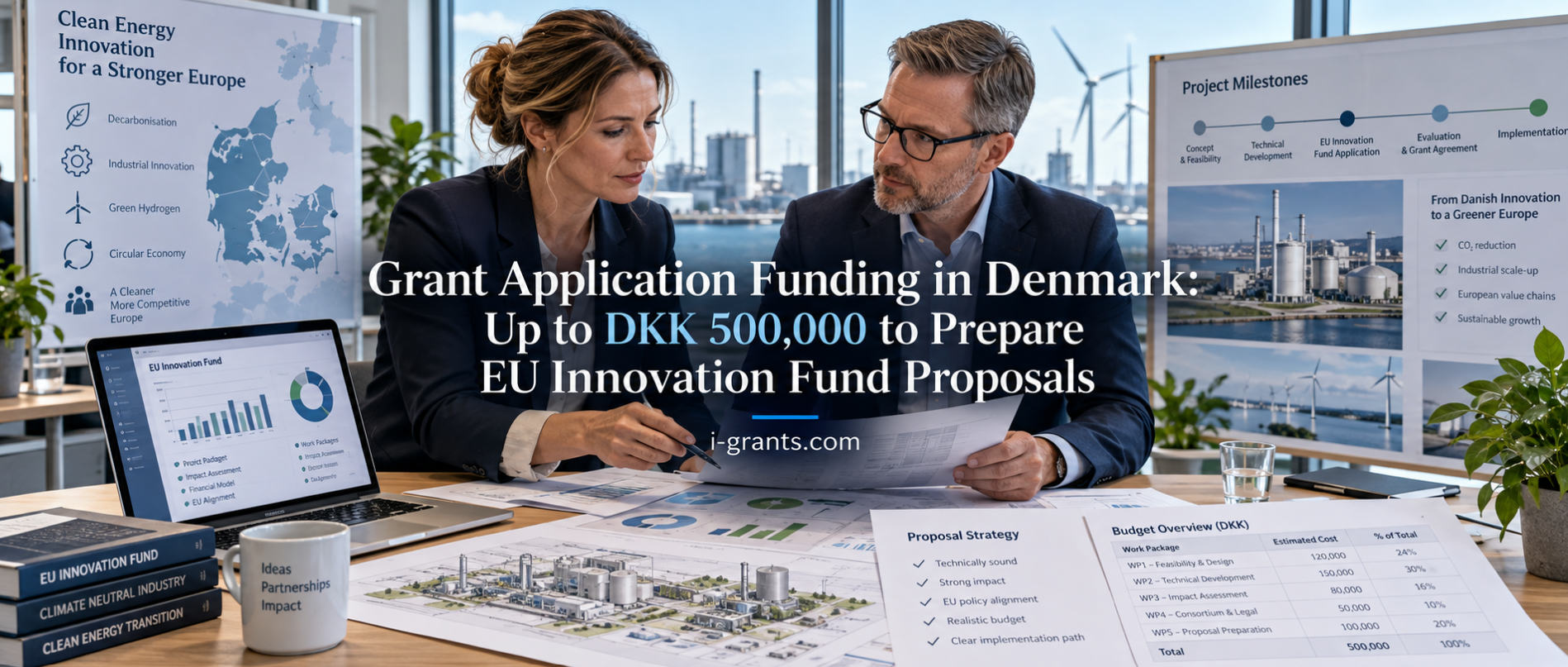
Preparing a competitive application for a major European innovation grant can require considerable financial resources long before a company receives any public funding. Industrial decarbonisation projects often involve complex engineering calculations, emissions assessments, financial modelling, technical documentation and specialised advisory services. For companies developing advanced low-carbon technologies, the preparation process itself can become a substantial investment.
Denmark has introduced a dedicated funding mechanism to address this challenge. Through the proINNOVFUNDING programme, the Danish Energy Agency provides grants of up to DKK 500,000 to help eligible Danish companies prepare applications for the European Union's Innovation Fund.
The scheme can cover up to 50 percent of eligible preparation costs, including certain salaries paid to a company's own employees and fees charged by external consultants. Its purpose is to encourage more Danish businesses to participate in European innovation funding competitions while improving the technical and financial quality of their applications.
For 2026, Denmark allocated DKK 10 million to proINNOVFUNDING. Applications opened on 12 January 2026 and are scheduled to close on 9 December 2026 at 12:00, unless the available budget is exhausted earlier.
The programme is particularly relevant to companies developing industrial decarbonisation technologies, renewable energy solutions, carbon capture and storage infrastructure, energy storage systems and other innovations potentially eligible for the EU Innovation Fund.
However, the distinction between the Danish and European funding instruments is essential.
proINNOVFUNDING finances the preparation of an EU Innovation Fund application. It does not finance the construction or implementation of the underlying industrial project.
A company may receive support to prepare a detailed European grant proposal without ultimately winning funding from the Innovation Fund itself. Conversely, submitting a proposal to the European programme does not automatically entitle the company to the Danish preparation grant.
Both processes have separate requirements, deadlines and administrative procedures.
Applicants must also understand that proINNOVFUNDING is not a general grant-writing subsidy available for every European funding programme. Its scope is restricted to applications for eligible EU Innovation Fund calls, excluding the fund's competitive bidding auctions.
This article explains how the Danish programme works, which businesses can apply, how the DKK 500,000 maximum is calculated, and which grant-writing and consultancy expenses can be financed. It also examines the evaluation methodology, application procedure, reimbursement conditions and practical financial risks.
Drawing on recent European funding statistics and documented Danish industrial projects, the analysis demonstrates why professional proposal preparation has become an important component of the clean technology financing process.
Why Denmark Finances the Preparation of EU Grant Applications
The European Union's Innovation Fund is one of the largest public financing instruments for the deployment of innovative low-carbon technologies.
Supported by revenues from the EU Emissions Trading System, the fund helps companies bring advanced technologies closer to commercial deployment. Its activities cover industrial decarbonisation, clean technology manufacturing, renewable energy, energy storage and other projects capable of reducing greenhouse gas emissions.
The programme is particularly relevant to innovations that have moved beyond fundamental research but still face significant technological, commercial or financial barriers before full-scale deployment.
Such projects can require investments ranging from several million euros to hundreds of millions of euros.
For applicants, obtaining European funding involves demonstrating much more than the environmental benefits of a technology.
A competitive application must establish the project's degree of innovation, expected greenhouse gas emissions avoidance, technical and financial maturity, ability to be replicated and cost efficiency.
These requirements create substantial preparation costs.
Industrial companies may need engineering teams to calculate technical performance, environmental specialists to construct emissions scenarios, financial analysts to evaluate investment requirements and external advisers to coordinate the application.
A carbon capture project, for example, must explain the technologies used to capture, transport and permanently store carbon dioxide. Its application may also need to demonstrate the availability of transport infrastructure, storage arrangements, permits, financing and a commercially sustainable operating model.
A company planning to manufacture low-carbon industrial equipment may need to substantiate its production capacity, capital expenditure, expected demand, competitive position and greenhouse gas reduction potential.
The challenge becomes particularly demanding when the proposed technology has not yet been demonstrated at the intended industrial scale.
The Danish Energy Agency recognises that the cost of preparing such documentation can discourage otherwise promising companies from participating in European competitions.
proINNOVFUNDING seeks to reduce that financial barrier.
By financing part of the preparation work, Denmark aims to increase both the number of applications submitted by Danish businesses and the quality of those applications.
This approach represents a different model of public innovation support.
Instead of financing only the innovative technology, the state invests in the professional preparation needed to compete for substantially larger European grants.
The potential benefit for Denmark is considerable. A national contribution of several hundred thousand Danish kroner may help a company prepare a proposal seeking several million euros in European support.
However, this outcome remains uncertain. A well-prepared application improves the quality of the submission but does not guarantee an Innovation Fund award.
How Competitive Is the EU Innovation Fund?
The latest completed application figures illustrate why companies may invest heavily in preparing a strong proposal.
The Innovation Fund 2025 Net-Zero Technologies Call opened in December 2025 and closed on 23 April 2026. It received 358 applications from 27 countries in the European Economic Area.
Collectively, those applicants requested approximately €17.5 billion in support.
The available budget was €2.9 billion.
In other words, the total amount requested was approximately six times the available funding.
The applications concerned industrial decarbonisation projects, clean technology manufacturing, demonstration facilities and other investments intended to support Europe's transition towards climate neutrality.
The previous Innovation Fund 2024 competition was similarly competitive.
It attracted 359 applications from 28 countries, with requests exceeding the available budget by more than nine times.
In November 2025, the European Commission initially selected 61 projects under that competition to proceed towards grant agreement preparation.
By 24 March 2026, 54 projects had signed grant agreements, securing approximately €2.7 billion in Innovation Fund financing.
The difference between projects initially selected and those with signed agreements is important. Selection for grant preparation is a major achievement, but it is not identical to completing all the requirements for a signed financing agreement.
Table 1. Recent EU Innovation Fund Competition and Funding Results
| Indicator | Innovation Fund 2024 | Innovation Fund 2025 |
|---|---|---|
| Applications received | 359 | 358 |
| Countries represented | 28 | 27 |
| Competition closing date | 24 April 2025 | 23 April 2026 |
| Demand relative to available funding | More than nine times the budget | Approximately six times the budget |
| Available competition budget | €2.4 billion at launch | €2.9 billion |
| Initially selected projects | 61, announced in November 2025 | Final selection not established by the application statistics |
| Signed grant agreements | 54 projects by March 2026 | Not established by the application statistics |
| Confirmed value of signed agreements | Approximately €2.7 billion by March 2026 | Not yet established in the figures cited |
The available budget at the launch of a call and the amount eventually committed through signed agreements can differ. The 2024 figures reflect subsequent selection and agreement developments, while the 2025 figures primarily describe application demand.
These results provide a useful perspective on the commercial value of professional proposal preparation.
A company may be competing against hundreds of applicants with sophisticated industrial projects, experienced engineering teams and significant financial resources.
The quality of the application can influence whether evaluators clearly understand the innovation and consider the project sufficiently mature for implementation.
However, high competition does not mean that professional writing alone determines success.
The underlying technology, project economics, environmental impact and implementation capacity remain essential.
A grant consultant can improve how the evidence is structured and presented, but cannot transform an immature industrial concept into a fully developed investment project simply through persuasive language.
This distinction is central to understanding the purpose of proINNOVFUNDING.
What Is proINNOVFUNDING?
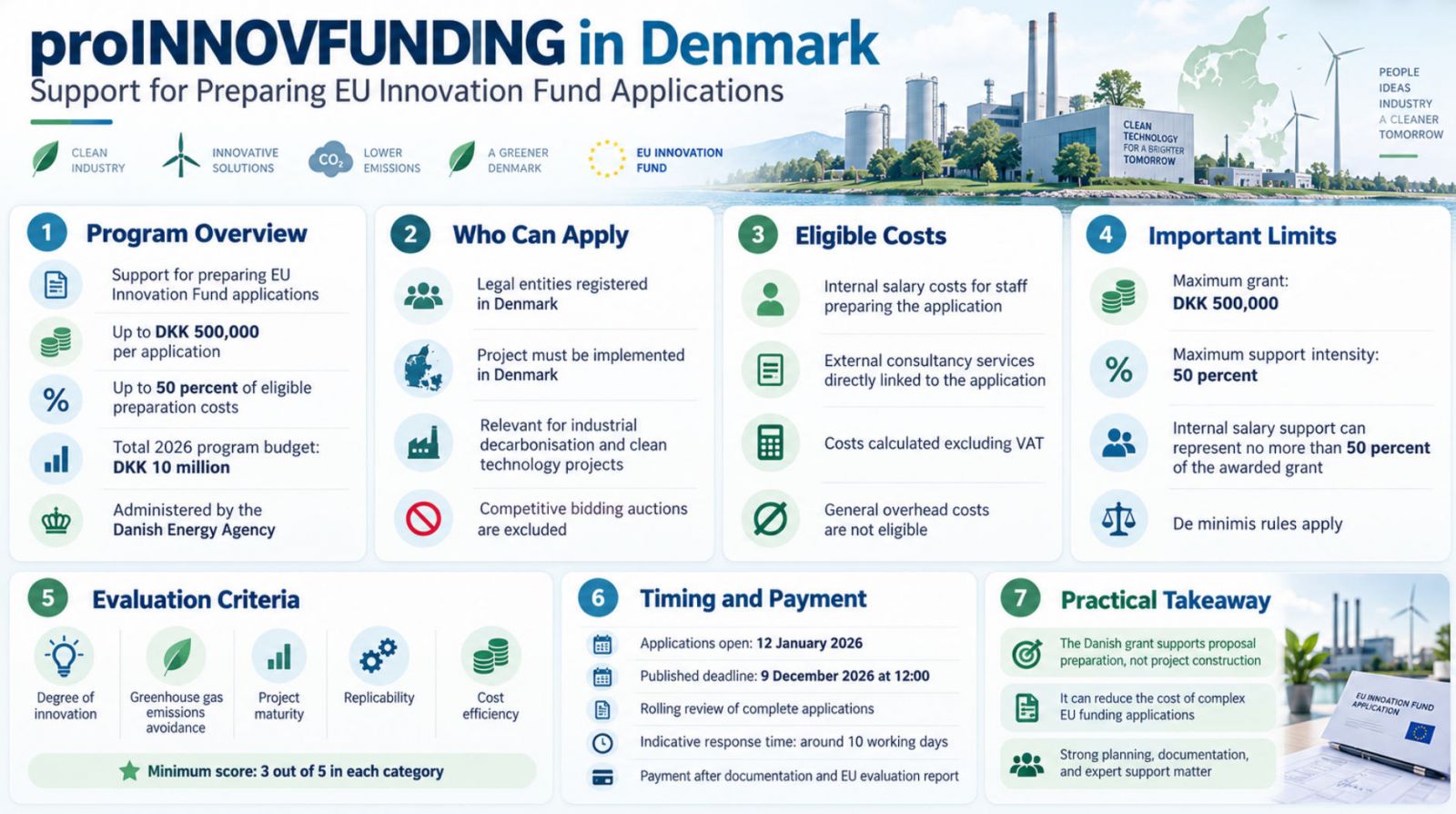
proINNOVFUNDING is a national Danish subsidy programme administered by the Danish Energy Agency, known in Denmark as Energistyrelsen.
It provides financial assistance specifically for the preparation of applications to the EU Innovation Fund.
The programme is intended to support Danish applicants proposing projects that will be implemented in Denmark.
It can finance eligible internal labour costs and purchased external consultancy services directly associated with developing the European proposal.
In 2026, the programme has an allocated budget of DKK 10 million.
The maximum grant is DKK 500,000 per application, and public assistance cannot exceed 50 percent of eligible preparation costs.
Applications are considered on a rolling basis according to the order in which complete submissions are received, until the budget is exhausted or the published application deadline is reached.
This principle does not eliminate qualitative assessment.
The Danish Energy Agency examines whether the underlying project can credibly satisfy the EU Innovation Fund's evaluation criteria. An application that fails to demonstrate sufficient project quality may be rejected even if money remains available in the Danish budget.
The programme is also subject to European de minimis state aid rules, which can affect the amount of assistance available to companies that have previously received other qualifying public support.
Table 2. proINNOVFUNDING: Main Conditions for 2026
| Programme parameter | Official condition |
|---|---|
| Country | Denmark |
| Programme | proINNOVFUNDING |
| Responsible authority | Danish Energy Agency |
| Total programme allocation for 2026 | DKK 10 million |
| Maximum grant per application | DKK 500,000 |
| Maximum grant intensity | 50 percent of eligible preparation costs |
| Eligible applicants | Legal entities registered in Denmark |
| Location of the underlying project | Denmark |
| Eligible activity | Preparation of an eligible EU Innovation Fund grant application |
| Internal salary costs | Eligible, subject to a specific restriction |
| External consultancy services | Eligible when directly connected with application preparation |
| Maximum internal salary contribution | 50 percent of the awarded Danish grant |
| Competitive bidding auctions | Excluded |
| Application opening | 12 January 2026, 12:00 |
| Published application deadline | 9 December 2026, 12:00 |
| Earlier closure | Possible if the budget is exhausted |
| Assessment process | Rolling review of complete applications |
| Indicative response time | Approximately 10 working days |
| Time allowed to accept an award | Four weeks after the award notification |
| Payment | After required documentation, including the EU evaluation report |
| State aid framework | De minimis rules |
The programme's published DKK 10 million allocation should not be confused with its uncommitted budget at any particular moment.
For example, dividing DKK 10 million by the DKK 500,000 maximum suggests a theoretical capacity to finance 20 applications at the maximum grant amount.
This is only a calculation of budget capacity.
It does not establish how many companies have received funding, how much has already been committed or whether the remaining budget is sufficient for another full award.
Actual grant amounts may vary substantially between applicants.
The existence of a published December deadline also does not guarantee that funds will remain available until that date.
Companies should therefore confirm the current status of the scheme before investing significant resources in an application.
Who Can Apply for the Danish Grant?
The central eligibility requirement is that the applicant must be a legal entity registered in Denmark.
The underlying industrial project for which the EU Innovation Fund proposal is being prepared must also be implemented in Denmark.
These two requirements should be assessed separately.
A company registered in Denmark may not necessarily qualify if its proposed Innovation Fund project concerns an industrial installation located entirely in another country.
Similarly, a foreign company planning an eligible project in Denmark should not automatically assume that it can obtain proINNOVFUNDING without satisfying the requirement concerning a Danish-registered legal entity.
International ownership is not, by itself, the same as an absence of Danish registration.
A Danish subsidiary belonging to an international industrial group may potentially meet the registration requirement, provided that the relevant legal entity can satisfy the other conditions.
However, group relationships may affect the applicable de minimis aid calculation and the company's disclosure obligations.
Applicants should therefore identify the precise legal entity that will receive the Danish preparation grant and confirm its role in the proposed European application.
The programme is particularly relevant to companies with sufficiently developed industrial projects that could satisfy the Innovation Fund's technical and financial criteria.
Potential applicants may include manufacturers developing low-carbon production methods, energy companies deploying innovative renewable technologies, industrial businesses planning carbon capture facilities and companies producing technologies for low-emission industrial operations.
The commercial sector alone is not decisive.
The underlying proposal must fall within the scope of the relevant EU Innovation Fund grant competition.
A conventional business expansion project without substantial innovation or greenhouse gas reduction potential would generally be poorly aligned with the programme's purpose.
The same applies to projects that remain at a preliminary idea stage without credible evidence of technical and financial readiness.
Importantly, proINNOVFUNDING does not cover applications to the EU Innovation Fund's competitive bidding auctions, including auction mechanisms used for certain hydrogen or industrial heat funding instruments.
Those competitions follow different procedures from the eligible Innovation Fund grant calls.
Applicants must therefore verify the exact European competition they intend to enter, rather than assuming that every funding instrument carrying the Innovation Fund name is covered by the Danish scheme.
Which Grant Preparation Costs Are Eligible?
The Danish Energy Agency identifies two principal categories of eligible expenditure.
The first concerns internal salary costs for a company's own employees working directly on preparing the EU Innovation Fund application.
The second concerns purchased external consultancy services necessary for the proposal.
These categories are relatively focused, but the work covered can be technically sophisticated.
Internal employees may include engineers preparing technical descriptions, financial personnel developing investment calculations, environmental specialists analysing emissions or managers coordinating information needed for the application.
External consultants may provide grant-writing expertise, financial modelling, emissions calculations, technical analysis or other specialist services directly associated with preparing the proposal.
The important condition is that the expenditure must be necessary, relevant and directly attributable to the preparation of the specific EU Innovation Fund application.
The official programme conditions exclude general overhead costs from the eligible budget.
Eligible expenditure is calculated excluding VAT under the scheme's specific rules.
A company cannot simply include the cost of its entire administration, its ordinary commercial operations or the construction of the proposed industrial installation.
Table 3. Practical Interpretation of Eligible and Ineligible Preparation Costs
| Proposed expenditure | Treatment under proINNOVFUNDING |
|---|---|
| Engineering time spent preparing the technical proposal | Potentially eligible internal salary expenditure |
| Financial staff preparing the investment and financing model | Potentially eligible internal salary expenditure |
| Environmental specialist preparing emissions calculations | Potentially eligible internal salary expenditure |
| External grant-writing consultant | Eligible category when directly connected with the application |
| External greenhouse gas assessment specialist | Potentially eligible consultancy service |
| External review of the financial model | Potentially eligible consultancy service |
| Consultancy supporting the project's innovation narrative | Potentially eligible consultancy service |
| Purchase of production machinery | Outside the specified application preparation cost categories |
| Construction of an industrial demonstration facility | Not an application preparation expense |
| Ordinary office rent and general administrative overhead | Excluded from the special programme budget |
| VAT | Excluded from the programme's eligible cost calculation |
| Costs incurred before the Danish grant approval | Not eligible for retroactive reimbursement |
The individual consultancy examples illustrate how the two official cost categories may apply in practice. They are not an independent list of services automatically approved by the Danish Energy Agency.
For grant-writing professionals, this creates a direct connection between public funding and specialist services.
A company preparing a technically complex European application may need assistance from several different advisers.
A lead grant consultant could coordinate the proposal and integrate the work of technical specialists. A financial adviser could prepare the capital expenditure model. An emissions specialist could validate the environmental calculations.
Each service should have a clear connection to the preparation of the application and should be supported by appropriate contractual and financial documentation.
The Danish Energy Agency's general grant conditions also require economical use of public funds.
Where appropriate, beneficiaries should obtain several commercial offers for subcontracted services to demonstrate that the proposed costs are reasonable.
This is particularly important when consultancy contracts represent a substantial share of the grant preparation budget.
A large consultancy fee should therefore be supported by a credible description of the work, the expertise required and the expected deliverables.
Understanding the DKK 500,000 Funding Calculation
The maximum proINNOVFUNDING award is subject to two financial limits.
First, the grant cannot exceed 50 percent of eligible application preparation costs.
Second, the absolute maximum is DKK 500,000 for one EU Innovation Fund application.
A company planning DKK 400,000 in eligible preparation expenses could therefore theoretically obtain up to DKK 200,000.
A company with DKK 600,000 in eligible costs could theoretically obtain up to DKK 300,000.
To reach the maximum DKK 500,000 grant at a funding intensity of 50 percent, eligible preparation expenditure must reach at least DKK 1 million.
If the company's preparation budget exceeds DKK 1 million, the grant remains capped at DKK 500,000.
This reduces the effective public funding percentage as the total preparation cost increases.
The simplified preliminary calculation is:
Theoretical maximum Danish grant = The lower of 50 percent of eligible preparation costs or DKK 500,000.
However, the programme also places a separate restriction on the grant contribution allocated to the applicant's own employees.
The internally financed salary component may represent no more than 50 percent of the awarded grant.
For a maximum award of DKK 500,000, the amount of public funding allocated to internal salaries must therefore not exceed DKK 250,000.
This restriction concerns the public grant contribution, not an unconditional prohibition on spending more than DKK 250,000 of the company's total preparation budget on its employees.
The calculation must be reflected appropriately in the submitted budget.
Table 4. Hypothetical proINNOVFUNDING Grant Scenarios
| Preparation scenario | Total eligible preparation budget | Theoretical maximum Danish grant | Financing required from other sources | Effective public funding share |
|---|---|---|---|---|
| Small application | DKK 300,000 | DKK 150,000 | DKK 150,000 | 50 percent |
| Moderate application | DKK 500,000 | DKK 250,000 | DKK 250,000 | 50 percent |
| Complex application | DKK 700,000 | DKK 350,000 | DKK 350,000 | 50 percent |
| Large industrial application | DKK 1,000,000 | DKK 500,000 | DKK 500,000 | 50 percent |
| Very large application | DKK 1,250,000 | DKK 500,000 | DKK 750,000 | 40 percent |
| Extensive proposal preparation | DKK 1,500,000 | DKK 500,000 | DKK 1,000,000 | Approximately 33.3 percent |
These figures are hypothetical calculations using the published programme ceilings. They assume that the costs are eligible and the separate restriction on internal salary support is satisfied. They are not examples of approved awards.
The table demonstrates an important characteristic of the funding mechanism.
The programme is proportionally most generous when the relevant preparation budget does not exceed the level at which the DKK 500,000 cap becomes binding.
For particularly complex industrial proposals, however, applicants must be prepared to cover a larger percentage of the preparation budget themselves.
A company should not conclude that a higher consultancy budget will automatically produce a larger public contribution.
Nor should it select external advisers solely to use the maximum available subsidy.
The budget must correspond to the actual preparation work required.
A Detailed Example: Preparing an Industrial Decarbonisation Proposal
Consider a hypothetical Danish manufacturing company developing a new industrial heat recovery and electrification system.
The technology is intended to reduce emissions from a high-temperature production process by recovering waste heat and replacing part of the facility's fossil fuel consumption with renewable electricity.
The company intends to submit a proposal to an appropriate EU Innovation Fund grant competition.
Its European project may eventually require several million euros in investment, but the preparation of the funding application is treated as a separate activity.
To produce a technically credible proposal, the company needs to document the existing industrial process, develop an emissions baseline, estimate the expected greenhouse gas reductions, explain the innovative technology and prepare a comprehensive investment model.
It also needs evidence concerning permits, construction schedules, industrial integration, commercial demand and operational readiness.
Suppose the company prepares a grant application budget of DKK 1 million.
Table 5. Illustrative DKK 1 Million Application Preparation Budget
| Preparation activity | Cost category | Estimated expenditure |
|---|---|---|
| Internal engineering and technology documentation | Internal salaries | DKK 220,000 |
| Internal finance and project management work | Internal salaries | DKK 180,000 |
| Specialist EU grant-writing consultancy | External services | DKK 260,000 |
| Independent greenhouse gas emissions assessment | External services | DKK 150,000 |
| Financial model and investment readiness review | External services | DKK 120,000 |
| External technical and compliance review | External services | DKK 70,000 |
| Total internal salary costs | DKK 400,000 | |
| Total external consultancy services | DKK 600,000 | |
| Total preparation expenditure | DKK 1,000,000 |
All figures are hypothetical and intended to explain budget preparation. The categories and amounts are not pre-approved costs or a representation of an actual Danish beneficiary.
With DKK 1 million in eligible expenditure, the theoretical maximum proINNOVFUNDING award is DKK 500,000.
A simplified allocation of that grant could include DKK 200,000 towards documented internal salary expenditure and DKK 300,000 towards purchased external services.
The internal component would account for 40 percent of the grant, remaining below the programme's 50 percent ceiling on grant-financed internal salary costs.
The company would therefore need to finance the remaining DKK 500,000 of the preparation budget itself.
This structure demonstrates how a company can combine its own technical resources with external advisers while observing the programme's financial limits.
The next question is whether the proposed tasks are justified.
The engineering team should produce technical material that is genuinely necessary for the EU Innovation Fund application.
The greenhouse gas assessment should provide documented calculations and assumptions rather than unsupported estimates.
The financial model should explain how the proposed industrial installation would be financed and operated, including investment costs, operating expenses and expected revenue or cost savings.
The grant-writing consultant should integrate this information into a coherent submission that responds directly to the European evaluation criteria.
The company should be able to demonstrate the purpose and results of each significant expenditure.
How Internal Employee Costs Are Calculated
One of the more technical aspects of proINNOVFUNDING concerns the calculation of eligible internal salary expenditure.
The Danish Energy Agency's standard grant conditions provide a specific method for determining the hourly rate of employees receiving monthly salaries.
The calculation uses the employee's actual annual gross salary divided by 1,642 hours.
The relevant gross salary may include qualifying salary components and employer-paid pension contributions under the applicable rules.
The resulting hourly rate is multiplied by the number of hours spent directly on the supported activity.
For example, consider an employee whose relevant annual gross salary is DKK 657,000.
Dividing that amount by 1,642 produces an hourly rate of approximately DKK 400.12.
If the employee spends 150 eligible hours preparing the Innovation Fund proposal, the calculated internal salary cost would be approximately DKK 60,018.
This is an illustrative calculation based on the published formula.
The exact amount must use the employee's actual qualifying salary figures and properly documented working time.
When the grant decision requires time records, employees must record their project hours on an ongoing basis, with confirmation by an appropriate supervisor or authorised person.
The company should not calculate internal expenditure from arbitrary consulting rates or an unsupported estimate of employee time.
Table 6. Illustrative Calculation of Internal Personnel Costs
| Employee function | Relevant annual gross salary | Approximate hourly rate | Eligible preparation hours | Calculated salary expenditure |
|---|---|---|---|---|
| Technical engineer | DKK 657,000 | DKK 400.12 | 150 | DKK 60,018 |
| Financial analyst | DKK 574,700 | DKK 350.00 | 120 | DKK 42,000 |
| Environmental specialist | DKK 739,000 | DKK 450.06 | 180 | DKK 81,011 |
| Total | 450 | DKK 183,029 |
Figures are rounded and illustrative. Actual eligible salary costs depend on documented payroll amounts, qualifying salary components, eligible hours and the applicable grant conditions.
It is also important to distinguish the special proINNOVFUNDING rules from the Danish Energy Agency's general grant conditions.
The standard conditions contain provisions for overhead expenditure in certain projects.
However, the specific proINNOVFUNDING guidance explicitly excludes overhead from eligible application preparation expenditure.
The specific programme rules must therefore be applied when constructing the budget.
A company should not automatically add general office costs or an overhead percentage to its internal salary calculations.
The Five Evaluation Criteria That Determine Project Readiness
Although applications are processed on a rolling basis, the Danish Energy Agency does not simply award funding to every registered Danish company.
It evaluates the proposed European project against five criteria corresponding to the Innovation Fund's assessment framework.
Each criterion receives a score between zero and five, with increments of half a point.
A score of three represents a good response that nevertheless contains certain shortcomings.
A score of four indicates a very good response with relatively minor weaknesses, while five represents an excellent assessment.
The critical feature is the minimum threshold.
An application must reach at least three points in each of the five evaluation areas.
A proposal receiving less than three points in one or more areas is considered insufficiently suitable for support and can be rejected.
This means that strong performance in one area does not automatically compensate for a serious weakness elsewhere.
Table 7. The Five proINNOVFUNDING Evaluation Criteria
| Evaluation criterion | What the applicant must demonstrate | Minimum score |
|---|---|---|
| Degree of innovation | Technology that advances beyond the existing state of the art | 3 out of 5 |
| Greenhouse gas emissions avoidance | Credible potential to avoid or reduce greenhouse gas emissions | 3 out of 5 |
| Project maturity | Sufficient technical, financial and operational readiness | 3 out of 5 |
| Replicability | Potential for wider application, market adoption and industrial competitiveness | 3 out of 5 |
| Cost efficiency | Credible relationship between project costs and avoided greenhouse gas emissions | 3 out of 5 |
The innovation criterion requires the company to explain why its technology differs meaningfully from existing industrial solutions.
A proposed industrial installation may use advanced machinery, but using commercially available equipment in a conventional configuration does not necessarily establish the necessary degree of innovation.
The applicant should identify the specific technological advancement and explain why it is relevant to industrial decarbonisation.
The emissions criterion concerns the environmental impact of the proposed solution.
The company should develop a defensible baseline and explain how the technology changes emissions compared with an appropriate reference scenario.
This may require calculations of energy consumption, fuel substitution, carbon capture performance or other relevant environmental parameters.
The maturity criterion is particularly important because the Innovation Fund supports the deployment of technologies, not simply their theoretical development.
Technical maturity requires evidence that the technology can function at the proposed scale.
Financial maturity involves the credibility of investment costs, funding sources, operating economics and the project's ability to reach a viable financing structure.
Operational maturity concerns implementation schedules, permits, supply arrangements, construction planning and the practical capacity to operate the installation.
Replicability examines whether the proposed technology could be used more widely.
A successful innovation may be particularly valuable if it can be applied to multiple industrial facilities or sectors rather than only one unusual situation.
However, claims about broader deployment should be supported by evidence of technical compatibility, market demand and realistic implementation conditions.
Finally, cost efficiency evaluates the relationship between project expenditure and greenhouse gas emissions avoided.
Applicants should use the methodology required by the relevant Innovation Fund call rather than relying on simplified promotional calculations.
A technologically impressive project with weak financing, uncertain implementation arrangements or poorly documented emissions benefits may fail to achieve the minimum evaluation threshold.
This is why project readiness should be assessed before committing significant resources to proposal preparation.

Applying Through the Danish Energy Agency Portal
Applications are submitted electronically through the Danish Energy Agency's dedicated application portal.
The official procedure requires the applicant to authenticate using MitID Erhverv connected to the company's Danish CVR registration number.
A private MitID cannot be used in place of the business identification required for this programme.
The applicant must provide the company's legal information and the proposed project details.
The person submitting the application must have legal authority to represent the company or an appropriate power of attorney.
The portal permits authorised participants to contribute to preparing and editing the application, but the final submission must comply with the representation requirements.
This distinction matters for companies engaging outside grant consultants.
A consultant may help prepare the technical and financial material, but responsibility for legally valid submission remains with the applicant and its properly authorised representatives.
The Danish application itself requires a concise but convincing description of the proposed European project.
The published limitation is ten standard pages, with each standard page corresponding to 2,400 characters including spaces.
This is a significant editorial constraint.
Applicants must demonstrate technological novelty, environmental impact, maturity, replicability and cost efficiency within a relatively short document.
A lengthy general description of the company is unlikely to be as useful as a structured explanation supported by clear technical evidence.
The application also requires a budget prepared using the official financial template.
The company must identify the amount requested, the funding percentage and the relevant eligible expenditure.
The proposed preparation period must be specified.
Declarations concerning de minimis assistance and company representation must also be provided, together with any necessary authorisations.
A submission is not considered complete if mandatory declarations or supporting documents are missing.
Because decisions are made according to the order in which complete applications are received, document completeness has a practical financial consequence.
A company that submits early but omits essential attachments should not assume that it has secured an advantage over another applicant submitting a complete application.
The Danish Energy Agency aims to process applications within approximately ten working days after receipt.
However, the agency may request additional information, and the published timeframe should not be interpreted as a guarantee that every application will receive a final decision within exactly ten days.
If the application is approved, the company receives an award notification through the portal.
The grant decision must be accepted within four weeks of the date on which it was issued.
The beneficiary should review all special conditions before accepting the award.
Why Application Timing Can Determine Eligibility
The timing rules for proINNOVFUNDING are especially important because the programme does not provide retroactive reimbursement.
Eligible expenditure begins only after the Danish Energy Agency issues the grant award.
The supported preparation period ends no later than the deadline for the relevant EU Innovation Fund application.
This creates a specific sequence that companies must respect.
A business may undertake preliminary planning before applying for proINNOVFUNDING, but it should not assume that the costs of work completed before the Danish award can later be charged to the programme.
Suppose a manufacturing company hires an external consultancy in September and receives its proINNOVFUNDING award in October.
Consultancy work undertaken before the award date would not qualify for retroactive funding under the Danish scheme.
Only appropriate costs incurred during the approved period may be considered, subject to the grant conditions.
The company must therefore decide when to begin paid preparation and which costs it can finance independently.
Waiting for the Danish decision may reduce the costs eligible for reimbursement if the European submission deadline is approaching.
On the other hand, beginning all major consultancy work before obtaining the Danish award may leave a substantial portion of the preparation budget outside the subsidised period.
This makes early application and careful project scheduling important.
There is another timing issue for applicants in late 2026.
The EU Innovation Fund 2025 Net-Zero Technologies Call closed on 23 April 2026. The fact that Denmark's proINNOVFUNDING scheme has a later national deadline does not mean that companies can still submit proposals to that closed European competition.
Applicants must identify an appropriate future or otherwise relevant EU Innovation Fund grant call, verify its rules and ensure that their proposed preparation schedule is compatible with the Danish funding decision.
They should not assume that the next European competition will have exactly the same scope, budget or deadline as the previous one.
The Danish and European funding calendars must be coordinated separately.
When Is the Danish Grant Actually Paid?
A proINNOVFUNDING award does not mean that the entire amount is transferred to the company immediately.
The programme operates through reimbursement arrangements linked to proof that the EU Innovation Fund application was submitted and evaluated.
The Danish Energy Agency requires an Evaluation Summary Report, commonly referred to as an ESR, or an equivalent evaluation report from the EU Innovation Fund.
This document provides evidence that the European application entered the relevant assessment process.
The distinction between submission and evaluation is important.
A company should not assume that uploading a proposal to the European portal is sufficient to trigger immediate payment of the Danish subsidy.
The applicable reporting and financial documentation must also be provided and approved.
Under the Danish Energy Agency's general conditions, reimbursement follows the receipt and approval of the relevant financial accounts, payment request and any required report.
The programme does not establish winning the European grant as a separate condition for payment of the Danish preparation support.
This makes proINNOVFUNDING particularly interesting.
A company may incur substantial preparation costs, submit its proposal to the EU Innovation Fund and ultimately fail to secure the European award. The Danish preparation grant may nevertheless remain payable if all national funding conditions and documentation requirements have been satisfied.
This should not be confused with an unconditional reimbursement guarantee.
If the company fails to submit the European application, cannot provide the required evaluation documentation or breaches the relevant grant conditions, the Danish payment may be affected.
The company should also consider when the evaluation report is expected to become available.
There may be a substantial period between submitting the European proposal and receiving the documentation needed for the Danish reimbursement request.
During that interval, the business may need to finance the salaries and consultancy fees from its own available resources.
A cash flow plan should therefore treat the Danish subsidy as an expected future reimbursement rather than assuming it will be available as working capital throughout the preparation period.
Financial Reporting and Audit Requirements
Once the Danish grant has been awarded and the preparation activities have been completed, the company must account for how the funds were used.
The Danish Energy Agency's standard conditions provide that final financial accounts should generally be submitted within three months after the approved project period ends.
Eligible expenditure must be supported by appropriate financial records.
Internal salary expenditure should be based on the applicable payroll calculation and documented working time.
External consultancy expenditure should be supported by contracts, invoices, evidence of payment and other records establishing the nature of the services.
The company should also be able to explain why the purchased services were necessary for preparing the European grant application.
The standard conditions require financial economy and may necessitate several quotations for subcontracted work where appropriate.
Beneficiaries should therefore document the process used to select consultants.
Audit obligations may also apply.
Under the Danish Energy Agency's general terms, reimbursement requests involving DKK 250,000 or more may require an external auditor's examination, unless the particular grant decision provides otherwise.
The rule may also become relevant when smaller requests cumulatively reach the specified level.
Applicants planning to request a substantial proINNOVFUNDING grant should therefore check whether their final accounts will require external audit certification.
This can introduce additional administrative work and potentially create costs that should be considered during financial planning.
The agency's general conditions also require grant-related accounting records and supporting documentation to be retained for at least five years from the end of the calendar year in which the final accounts or final report were submitted.
Significant changes to the project, schedule or budget may require prior approval.
The same applies to certain changes in the beneficiary's ownership or financial condition.
The company should not assume that an approved budget can be freely reallocated without considering the terms of the award.
Non-compliance may result in reduced payment, withdrawal of the grant or recovery of funds already paid.
The De Minimis State Aid Limit
proINNOVFUNDING is governed by European de minimis state aid rules.
These rules are particularly relevant because they impose a cumulative limit on qualifying public support granted to a single undertaking within a specified period.
Under Commission Regulation (EU) 2023/2831, the general ceiling is €300,000 for a single undertaking in one member state over any period of three years.
This is not a separate allowance automatically available for each new grant.
The calculation must consider relevant previous de minimis support and the applicable rules concerning linked enterprises.
For example, a Danish company that has already received significant de minimis assistance may have less room available for another award.
The company's ownership structure can also matter because the legal definition of a single undertaking may include more than one corporate entity.
A business belonging to a group should therefore assess whether other relevant group companies have received assistance that affects the calculation.
The Danish programme's official website still contains a reference to the older Regulation (EU) No 1407/2013, while the January 2026 application guide explicitly uses the €300,000 ceiling.
Applicants should follow the current legally applicable de minimis framework and verify the details with the responsible authority.
The grant application requires declarations concerning relevant previous public assistance.
The company must also consider whether the same preparation expenses are financed through another public instrument.
European state aid rules restrict combinations that exceed applicable aid ceilings or result in impermissible double financing.
This means that a company should not treat proINNOVFUNDING as an unrestricted additional subsidy that can be layered over any existing grant.
Previous public support should be reviewed before calculating the requested Danish contribution.
A company with a technically eligible project may still be unable to receive the maximum award if its remaining de minimis capacity is insufficient.
Free Project Validation Before a Major Application
Denmark offers an additional service that can help companies determine whether their proposed EU Innovation Fund project is sufficiently mature.
Through the Danish Energy Agency's EU Funding team, businesses considering an eligible Danish project can request free preliminary validation.
This service is separate from proINNOVFUNDING.
It does not itself represent an award of DKK 500,000 and does not guarantee eligibility for the preparation grant.
The process begins with a concise project description, generally limited to one page.
The Danish Energy Agency initially examines whether the proposed project appears relevant and sufficiently developed for further assessment.
If the project is considered mature enough, it may proceed to an independent validation conducted by an adviser from the agency's consultant list.
The published validation process takes approximately three weeks.
During that period, the adviser develops an understanding of the proposed technology, reviews project maturity and analyses the proposal against the Innovation Fund's evaluation criteria.
The assessment identifies important strengths and weaknesses.
It can also involve more detailed discussions of emissions calculations, innovation, financial readiness, market potential or other areas where the project requires improvement.
At the end of the process, the applicant receives an assessment of the project's maturity and competitiveness, together with recommendations concerning potential improvements.
The adviser may also recommend considering alternative funding instruments if the project is not sufficiently suitable for the Innovation Fund.
For a company facing substantial grant preparation expenditure, this service can be valuable.
An early assessment may help management avoid spending hundreds of thousands of Danish kroner on an application that is unlikely to satisfy the basic evaluation requirements.
It can also help determine which aspects of the proposal deserve the greatest attention from external consultants.
However, a positive preliminary validation remains an advisory assessment rather than a binding commitment from the European Commission or the Danish Energy Agency.
Real Danish Projects Supported by the EU Innovation Fund
Denmark has already demonstrated that its industrial companies and technology projects can secure substantial support through the EU Innovation Fund.
These examples are useful for understanding the kinds of projects that compete successfully at European level.
They must nevertheless be interpreted carefully.
Receiving an EU Innovation Fund grant does not establish that a project also received proINNOVFUNDING preparation assistance.
Without an independent record of a Danish preparation grant, the two forms of support should not be connected as a factual claim.
Greensand Future: Carbon Transport and Offshore Storage
Greensand Future represents a major Danish example of industrial carbon management infrastructure supported by the European Innovation Fund.
In September 2026, the project marked the inauguration of a commercial-scale integrated chain for the capture, transportation and permanent offshore storage of carbon dioxide.
The project received approximately €41 million in Innovation Fund support.
Its planned operations involve storing around 2.4 million tonnes of carbon dioxide over eight years in the depleted Nini West oil field in the Danish North Sea.
The project demonstrates how complex infrastructure must be coordinated across several technical and operational components.
Capturing carbon dioxide is only one part of the process.
The project must also provide a credible solution for transport, offshore storage, monitoring and long-term operational arrangements.
From an application preparation perspective, Greensand Future illustrates the importance of technical integration, industrial readiness and documented environmental benefits.
However, its €41 million European award should not be presented as evidence that it received the Danish proINNOVFUNDING preparation grant.
ENDOR: Synthetic Aviation Fuel Development
Another documented Danish example is the ENDOR project developed by Arcadia eFuels.
In March 2026, the company announced that it had signed an Innovation Fund grant agreement for the project.
ENDOR is intended to produce synthetic fuels using renewable electricity and sustainable carbon dioxide, with synthetic aviation fuel as the principal product.
The planned project involves an integrated industrial process combining electricity supply, hydrogen production, carbon sourcing and fuel synthesis.
It illustrates the complexity of developing an industrial decarbonisation proposal that depends on several interconnected technological and commercial systems.
A credible funding application must demonstrate not only that each individual technology can function but also that the full production chain can be developed, financed and operated successfully.
The company has publicly confirmed its Innovation Fund grant agreement, but the March announcement does not establish an exact grant amount that should be attributed to the project without further documentation.
There is also no basis in that announcement for describing ENDOR as a verified proINNOVFUNDING beneficiary.
What These Cases Reveal
Both examples demonstrate the importance of integrated technical and financial planning.
Large industrial decarbonisation projects depend on more than a promising technological concept.
They require credible infrastructure arrangements, investment plans, implementation schedules and environmental calculations.
The examples also show why the professional preparation of grant applications can become a significant task.
A successful proposal must connect the technology to a financially viable industrial project and present evidence that evaluators can examine.
This creates demand for specialised engineering, environmental, financial and grant-writing expertise.
What the European Court of Auditors Found About Innovation Fund Projects
The financial and operational risks of major innovation projects are highlighted by the European Court of Auditors' Special Report 11/2026.
The report examined the Innovation Fund's implementation and identified significant difficulties involving project cancellations, delays and performance against expected greenhouse gas reductions.
By 30 June 2025, 228 projects had initially been selected for support under the fund's grant competitions.
Of those, 20 withdrew before signing their grant agreements.
Another 20 projects were terminated after their agreements had been signed.
In total, 40 of the originally selected projects had been cancelled by that date, representing approximately 17.5 percent of the 228 projects, or roughly one in five.
This statistic concerns projects initially selected for support, not all applications submitted to the Innovation Fund.
It therefore cannot be used as the rejection rate for the programme.
The auditors highlighted difficulties related to financial readiness, changing market conditions, project implementation and the availability of complementary financing.
These findings are directly relevant to the Danish preparation grant.
A company may develop an innovative technology and produce promising emissions calculations but still lack a sufficiently mature financing plan.
For example, an industrial facility may depend on future electricity supply agreements, construction permits, specialised equipment suppliers or customers willing to purchase its output.
If these arrangements remain uncertain, the underlying project can encounter substantial delays even after being selected for funding.
The quality of an application should therefore be measured not only by how convincingly it describes the expected environmental impact, but also by how accurately it represents the project's readiness and risks.
Professional advisers can contribute by identifying weak assumptions before the application is submitted.
A financial consultant may recognise that the project depends on an unrealistic investment schedule.
An engineering specialist may identify technical integration risks.
An environmental adviser may discover that the emissions reduction estimate requires further supporting evidence.
Addressing these weaknesses early can strengthen both the funding proposal and the investment project itself.
How to Organise External Grant-Writing and Consultancy Services
The availability of public support for consultancy fees creates an opportunity for companies to work with specialists who understand the EU Innovation Fund.
However, the selection and management of advisers should be treated as a substantive part of the application process.
A major industrial funding proposal often requires several different professional disciplines.
The lead grant consultant may be responsible for the overall structure, narrative and coordination of the submission.
Technical engineers provide evidence concerning innovation and implementation.
Financial advisers prepare investment models, funding arrangements and cost calculations.
Environmental specialists develop the greenhouse gas emissions assessment.
Legal or regulatory specialists may contribute information concerning permits and relevant compliance obligations.
The company should determine which capabilities already exist internally before purchasing additional services.
If its engineering team can prepare technical descriptions independently, external expenditure may be more valuable in financial modelling or emissions verification.
Conversely, a company with a strong finance department but limited grant-writing experience may benefit from specialised external coordination.
The consultancy agreement should define the tasks, expected deliverables, deadlines and payment arrangements.
A credible description of services is preferable to a vague commitment to prepare a successful grant proposal.
The company should also consider whether fees are fixed, based on time spent or linked to particular deliverables.
Any proposed payment structure must be compatible with the national grant conditions and the appropriate documentation requirements.
A consultancy contract should not be designed merely to absorb the maximum DKK 500,000 public contribution.
The services must represent necessary work at reasonable cost.
Where relevant, the company should obtain more than one quotation and retain evidence explaining its procurement decision.
This supports compliance with the Danish Energy Agency's requirement for economical use of public funds.
How to Avoid Common Application Preparation Mistakes
A frequent mistake is beginning substantial paid consultancy work before receiving the Danish funding decision.
Because proINNOVFUNDING does not reimburse preparation expenditure retroactively, such work may fall outside the eligible period.
Another mistake is misunderstanding the funding intensity.
The advertised DKK 500,000 amount is a maximum, not a fixed grant provided to every applicant.
A company must have sufficient eligible preparation expenditure to justify the requested contribution.
Applicants may also overlook the separate restriction on internal salaries.
The Danish programme permits internal employee costs, but the public grant contribution allocated to those costs cannot exceed half of the awarded grant.
An applicant that calculates the budget without accounting for this restriction may need to revise the requested amount or its cost allocation.
Incorrect classification of expenditure creates further risks.
General office costs, ordinary business administration, production equipment or construction expenditure should not be included merely because the underlying industrial project is environmentally innovative.
Only costs that fall within the programme's eligible preparation categories and approved period should be considered.
A fourth mistake is failing to identify the correct European funding call.
The Danish scheme covers eligible Innovation Fund grant applications, but not competitive bidding auctions.
A company preparing a proposal under an excluded auction mechanism cannot assume that it qualifies for the same national preparation funding.
A fifth mistake is treating technical maturity as less important than the written application.
The Danish evaluation process requires a minimum score in every criterion.
If the underlying project is financially immature or has insufficient evidence of greenhouse gas emissions avoidance, a strong application narrative may not prevent rejection.
Finally, applicants sometimes underestimate the time required for reporting and reimbursement.
An award decision does not remove the need to document expenditure, submit the European proposal, obtain the relevant evaluation report and satisfy Danish financial reporting requirements.
These obligations should be incorporated into the preparation schedule from the beginning.
Is proINNOVFUNDING Worth Applying For?
For an eligible Danish company preparing a complex EU Innovation Fund grant proposal, proINNOVFUNDING can provide a meaningful financial advantage.
A maximum contribution of DKK 500,000 may substantially reduce the cost of specialised consultancy and internal preparation work.
Its value is especially significant for projects requiring extensive technical documentation, sophisticated environmental calculations and comprehensive financial modelling.
However, the programme is not suitable for every company seeking European funding.
The applicant must be a Danish-registered legal entity, and the underlying project must be implemented in Denmark.
The proposed European application must fall within the eligible Innovation Fund grant framework rather than an excluded competitive bidding auction.
The company must demonstrate sufficient technical, financial and operational maturity to satisfy the Danish assessment thresholds.
It must also be able to finance the portion of preparation expenditure not covered by public assistance.
The timing of expenditure is particularly important because costs incurred before the Danish award cannot be claimed retroactively.
In addition, the company must manage the time between preparing the European application and obtaining the documentation needed for Danish reimbursement.
These conditions mean that proINNOVFUNDING should be approached as part of a deliberate funding strategy.
A strong applicant will understand the relevant European competition, have a credible industrial project and know which preparation activities require external specialist support.
The programme is less useful for companies that have not established basic project feasibility or cannot demonstrate the maturity expected by the EU Innovation Fund.
For such businesses, the Danish Energy Agency's free project validation service may provide a more appropriate initial step.
Final Assessment: Why Denmark's Grant Preparation Subsidy Matters
Denmark's proINNOVFUNDING programme addresses an often overlooked challenge in public innovation financing: preparing a competitive grant application can require substantial expenditure before any project funding is secured.
For industrial decarbonisation projects, this preparation is not simply an administrative task.
It involves technical analysis, greenhouse gas emissions calculations, financial modelling, investment planning and coordination among specialists.
The high level of competition under the EU Innovation Fund makes the quality and credibility of these materials particularly important.
In 2026, Denmark allocated DKK 10 million to help eligible companies prepare applications, offering up to DKK 500,000 per proposal and covering no more than half of eligible costs.
The programme allows businesses to finance part of their own employees' preparation work and the services of external specialists, including professional grant consultants.
Nevertheless, funding is conditional.
The underlying project must satisfy Danish eligibility requirements, demonstrate sufficient quality under five evaluation criteria and comply with the programme's financial and administrative rules.
The national grant does not guarantee success in the European competition, nor does it finance construction or operation of the proposed industrial facility.
Applicants must also consider the de minimis ceiling, the restriction on internal salary support, the timing of eligible expenditure and reimbursement requirements.
The broader lesson extends beyond Denmark.
Complex European funding applications increasingly require multidisciplinary expertise and careful financial preparation.
Technical innovation alone may not be sufficient if the proposed project lacks credible emissions evidence, financial readiness or a realistic implementation plan.
For companies seeking specialist support, platforms such as i-grants.com can help connect applicants with professional grant writers and advisers experienced in preparing demanding funding proposals.
The Danish programme demonstrates how public financing can support not only the development of innovative technologies but also the professional work required to compete for the capital needed to bring them into commercial operation.
For eligible Danish companies, the opportunity is not simply to receive DKK 500,000 towards writing an application. It is to reduce the financial burden of preparing a credible, technically mature and competitive proposal for one of Europe's most significant industrial innovation funding instruments.