

 Français
 Deutsch
 Українська
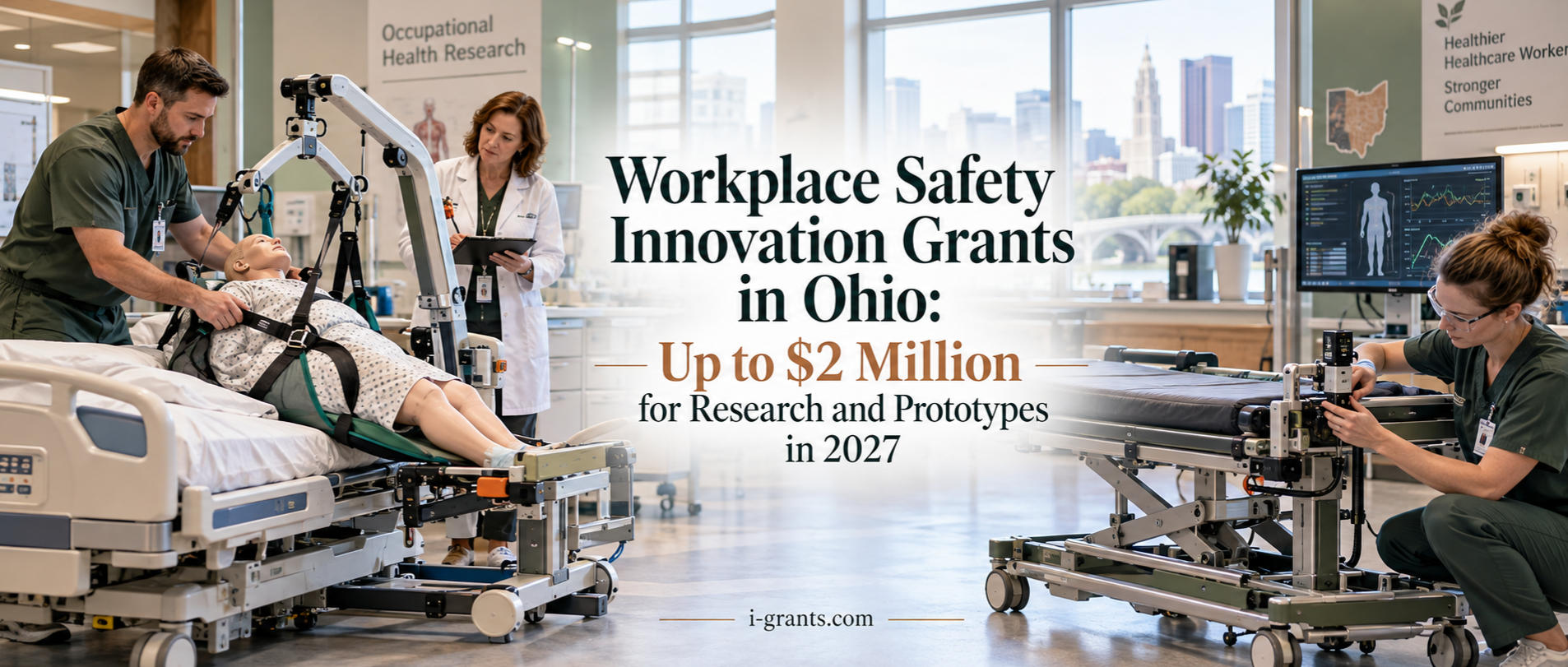
Industrial robots, advanced manufacturing equipment, intelligent sensors, and automated production systems are transforming workplaces across the United States. However, technological progress does not automatically eliminate occupational hazards. New machinery can introduce unfamiliar risks, workers may face substantial physical demands, and conventional protective equipment may not adequately address increasingly complex working environments. Developing new safety technologies therefore requires scientific research, engineering expertise, and collaboration between researchers and the industries that will ultimately use their innovations.
Ohio is investing heavily in this field through the Workforce Safety Innovation Grant, administered by the Ohio Bureau of Workers' Compensation (BWC) through its Workforce Safety Innovation Center (WSIC).
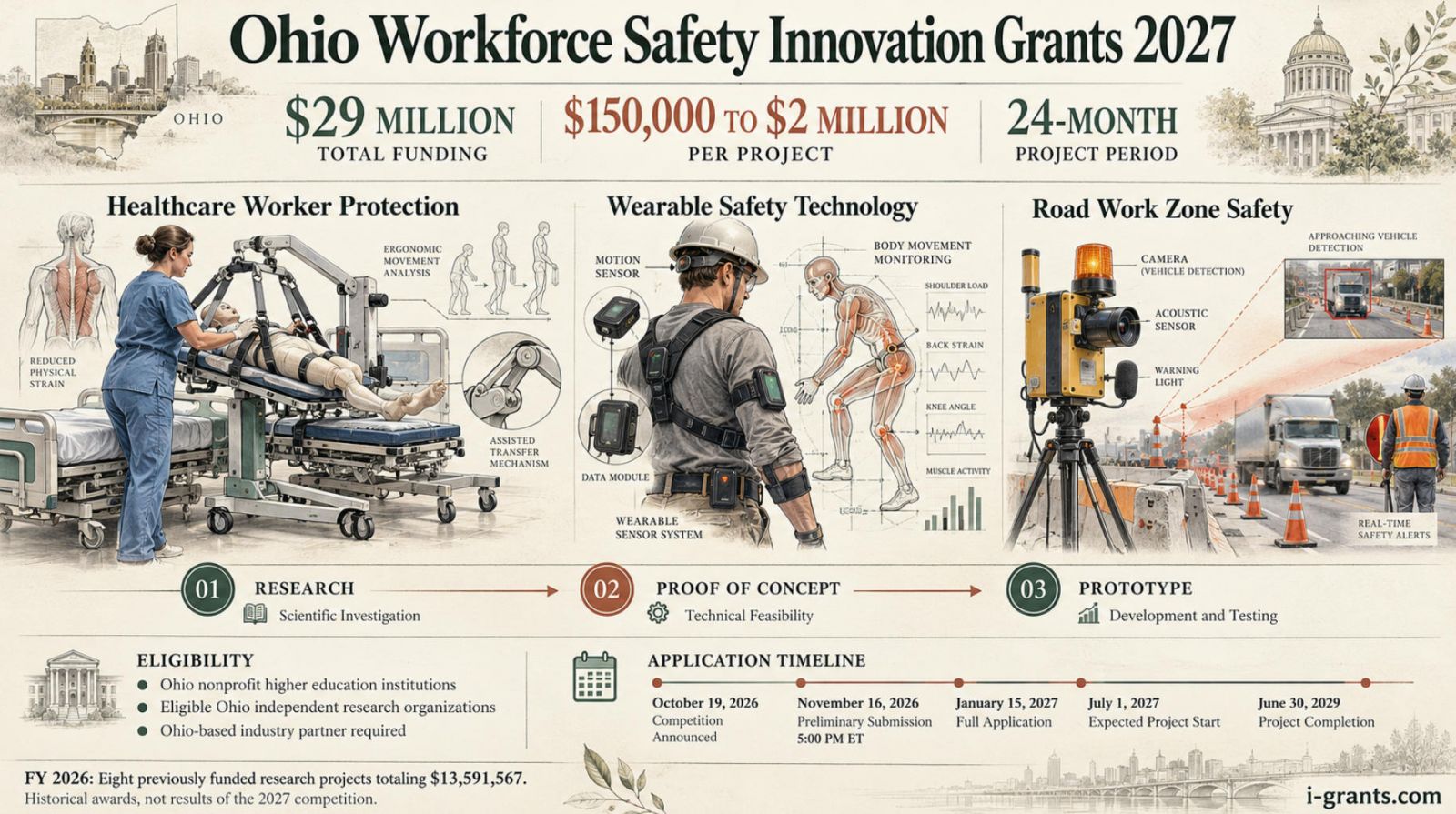
On October 19, 2026, BWC announced the fifth round of the program, making $29 million available for occupational safety research and technology development. Individual grants range from $150,000 to $2 million, supporting projects that investigate new protective technologies, demonstrate the feasibility of innovative solutions, and develop prototypes for potential commercial application.
The new competition covers the FY 2028–2029 funding cycle, with projects expected to operate from July 1, 2027, through June 30, 2029. However, the application process begins substantially earlier. Eligible institutions must submit preliminary documentation by November 16, 2026, at 5:00 p.m. Eastern Time, while complete applications are due by January 15, 2027.
The opportunity is substantial, but it is not a conventional business equipment grant. Primary applicants must be eligible nonprofit higher education institutions or independent research organizations based in Ohio. Each applicant must also have a confirmed industry partner located in the state.
This institutional partnership requirement makes the program particularly relevant to universities, research institutes, engineering laboratories, manufacturing companies, healthcare organizations, and specialists developing new occupational safety technologies.
The program also has a documented funding history. In its FY 2026 awards, WSIC supported eight research and development projects with a combined published value of approximately $13.59 million. These included wearable sensors for preventing back injuries, intelligent safety helmets, camera-based worker monitoring systems, technologies for safer patient handling, and advanced industrial safety training.
For applicants preparing the next generation of projects, these historical awards provide valuable insight into the types of research BWC has supported and the financial scale of actual grant decisions.
This guide examines the official 2027 application deadlines, eligibility requirements, research categories, funding rules, scientific evidence, previous grant recipients, and practical approaches to building a competitive university-industry proposal.
Ohio Workforce Safety Innovation Grants 2027: Program Overview
The Workforce Safety Innovation Center is an initiative of the Ohio Bureau of Workers' Compensation, the state agency responsible for administering Ohio's workers' compensation insurance system. BWC serves approximately 245,000 public and private employers and uses information from workplace injury claims to inform its prevention priorities.
The WSIC program focuses on developing personal protective equipment (PPE) and personal protective technology (PPT) capable of reducing occupational injuries, illnesses, and their long-term consequences. Its purpose is not simply to help employers purchase existing safety products. Instead, it finances research that may lead to new equipment, improved protective technologies, and practical methods for controlling workplace hazards.
This distinction is important because conventional workplace safety grants generally support the adoption of available interventions. WSIC addresses an earlier stage of innovation, when researchers must establish scientific evidence, demonstrate technical feasibility, and create solutions that can eventually be introduced into workplaces.
The fifth funding round continues the three-track model established in the preceding competition: Research, Proof of Concept, and Prototype. Each track corresponds to a different level of technological maturity, allowing applicants to seek funding appropriate to the development stage of their proposed solution.
Table 1. Ohio Workforce Safety Innovation Grant Requirements for FY 2028–2029
| Program feature | Confirmed information |
|---|---|
| Official program | Workforce Safety Innovation Grant |
| Administering agency | Ohio Bureau of Workers' Compensation (BWC) |
| Program administrator | Workforce Safety Innovation Center (WSIC) |
| Funding round | Fifth competition |
| Funding cycle | FY 2028–2029 |
| Total available funding | $29,000,000 |
| Minimum announced individual grant | $150,000 |
| Maximum announced individual grant | $2,000,000 |
| Eligible lead applicants | Ohio-based nonprofit higher education institutions and independent research organizations |
| Industry partner | Required, based in Ohio |
| Funding tracks | Research, Proof of Concept, Prototype |
| Application announcement | October 19, 2026 |
| Preliminary application deadline | November 16, 2026, at 5:00 p.m. ET |
| Complete application deadline | January 15, 2027 |
| Expected award notification | By July 1, 2027 |
| Project implementation period | July 1, 2027, through June 30, 2029 |
Source: Ohio Bureau of Workers' Compensation, fifth Workforce Safety Innovation Grant announcement, October 19, 2026, and official WSIC grant application page.
The program's $29 million allocation is intended to support a portfolio of projects rather than a single large research initiative. BWC may award funding across different research stages, depending on the applications received, the agency's priorities, the scientific quality of proposed projects, and the available budget.
The $2 million maximum should therefore not be interpreted as a standard award that every successful applicant will receive. A narrowly focused feasibility study may require substantially less funding than an advanced prototype project involving specialized manufacturing equipment, several research institutions, and extensive workplace testing.
Applicants should also distinguish the competition's funding cycle from its application dates. Although the program refers to FY 2028–2029, its first mandatory submission deadline falls in November 2026, while the full application deadline is in January 2027.
Who Can Apply for Ohio Workforce Safety Innovation Funding?
The most important eligibility restriction is that the Workforce Safety Innovation Grant is not designed for individual entrepreneurs or ordinary for-profit companies applying independently.
The program's primary applicants must be eligible nonprofit higher education institutions or independent research organizations operating in Ohio. These institutions are responsible for preparing the proposal, establishing project management arrangements, entering into the grant agreement, and ensuring that funding is used according to the applicable requirements.
Eligible university applicants may include engineering schools, scientific laboratories, occupational health research centers, and academic departments conducting relevant applied research. Independent nonprofit research institutions may also qualify if they satisfy the program's organizational, geographic, and administrative conditions.
In the previous cycle's administrative guidance, independent research organizations were subject to additional institutional requirements, including a minimum organizational operating history of five calendar years and appropriate legal and insurance documentation. Because that guidance predates the fifth competition, applicants should verify that the same conditions remain applicable under the FY 2028–2029 documents before relying on them.
Why an Ohio Industry Partner Is Mandatory
Each applicant must collaborate with an industry partner based in Ohio. This requirement reflects the practical purpose of the program: the funded innovation should address a real occupational safety problem and have a credible path toward application in an operating workplace.
An industrial company may provide access to manufacturing processes, workplace hazard information, technical facilities, equipment, or employees who can participate in appropriately approved research and testing. A healthcare institution may help researchers understand the difficulties faced by personnel moving patients or working in potentially violent environments. A transportation or logistics business may provide an operational setting for evaluating technologies designed to prevent collisions and improve worker awareness.
For example, a university engineering department could propose developing an intelligent protective helmet in partnership with a construction employer. The university would lead the scientific work, while the employer would contribute knowledge of actual workplace conditions, help identify performance requirements, and potentially provide a suitable environment for controlled testing.
The strength of the partnership should be demonstrated through practical commitments rather than a general statement of support. Reviewers need to understand what the industry partner will contribute, why its involvement matters to the research, and how the proposed technology could eventually be adopted by employers.
An applicant should therefore clarify access to facilities, equipment availability, personnel responsibilities, expected testing activities, information-sharing arrangements, and the intended use of research findings before submitting the full proposal.
Can a Manufacturing Company Receive the Grant Directly?
A conventional for-profit manufacturer does not qualify as the lead applicant simply because it has developed an innovative workplace safety concept.
However, the manufacturer may participate as the required industry partner alongside a qualifying Ohio research institution. This arrangement can benefit companies that understand a specific workplace hazard but lack the scientific personnel or laboratory infrastructure needed to develop and evaluate a new protective technology independently.
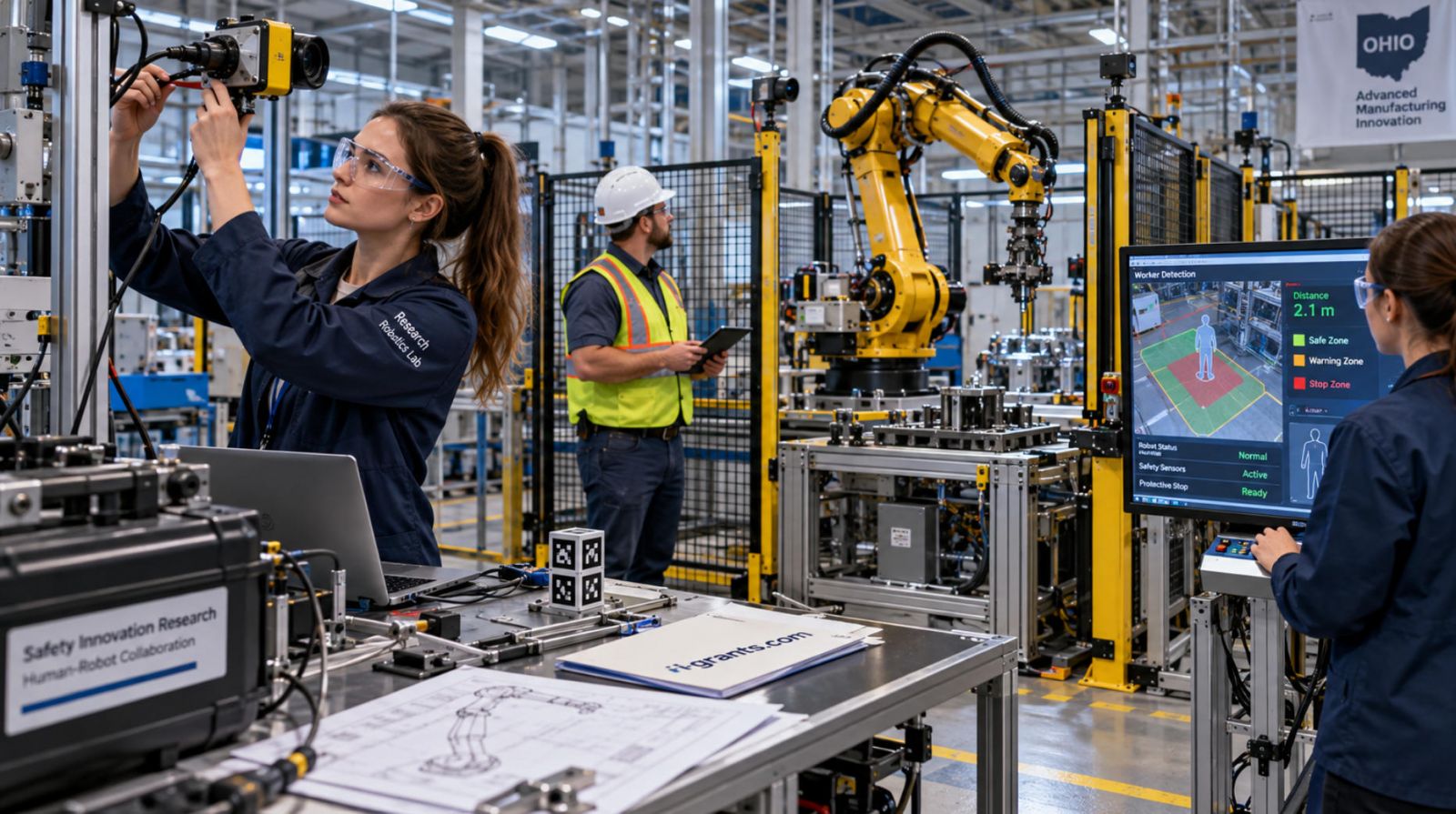
Consider a manufacturer seeking to prevent injuries caused by unexpected movements of industrial robotic equipment. The business may possess detailed knowledge of the production environment, near-miss incidents, maintenance procedures, and worker interactions with machines. A university partner may contribute expertise in machine vision, sensing technologies, robotics, and experimental evaluation.
Together, they could develop a research proposal grounded in both practical industrial needs and scientific methodology.
This model also creates opportunities for specialized grant writers who understand research proposals, scientific evaluation criteria, institutional budgeting, and the coordination of multiple project partners.
Research, Proof of Concept, and Prototype: Choosing the Right Funding Track
The WSIC program supports technologies at different stages of research and development. Selecting the appropriate track is one of the first strategic decisions applicants must make because the project's objectives, expected results, technical evidence, and financial requirements should correspond to its actual maturity.
A research proposal should not be presented as a nearly commercial product if the underlying scientific principles remain uncertain. Likewise, a team seeking advanced prototype funding should be prepared to demonstrate that the essential feasibility of its technology has already been established.
Research: Investigating New Approaches to Worker Protection
The Research track supports scientific and technical investigations intended to produce knowledge that can inform future protective equipment or safety technologies.
A project might investigate how workers respond to different types of hazard warnings, develop new protective materials, examine physiological indicators of fatigue, or evaluate technical approaches to detecting unsafe industrial conditions.
At this stage, the primary outcome may be scientific evidence rather than a commercially usable device.
Nevertheless, the research should maintain a clear connection to worker protection and identify how its findings could support subsequent development.
For example, researchers investigating new impact-absorbing materials should explain which workplace injuries the materials could help prevent, what limitations exist in current protective products, and how experimental findings could guide later prototype design.
Proof of Concept: Demonstrating Technical Feasibility
The Proof of Concept track is intended for projects that move beyond an initial scientific hypothesis and seek to demonstrate that a proposed technical approach can work.
A university may already have preliminary laboratory results suggesting that a combination of cameras and machine learning can identify dangerous worker movements near industrial equipment. The next stage may involve developing an experimental system, validating its performance, and determining whether it could function reliably in an actual manufacturing environment.
Successful proof-of-concept research should reduce important technical uncertainties and support a decision about further development.
Applicants should establish measurable success criteria before beginning the project, including the conditions under which the proposed technology will be tested and the evidence required to confirm that the central concept is feasible.
Prototype: Developing and Testing an Advanced Solution
The Prototype track supports more mature development, including the creation, improvement, and evaluation of functioning protective equipment or technology.
Projects may involve building physical devices, integrating sensors and software, conducting controlled performance tests, and examining how the technology behaves in relevant workplace conditions.
At this stage, technical reliability, usability, human factors, manufacturing considerations, and the potential for eventual commercialization become especially important.
A prototype project involving a wearable injury-prevention sensor, for example, might need to assess measurement accuracy, battery performance, comfort during long shifts, resistance to industrial conditions, and the possibility of integrating collected information into existing safety management practices.
The objective is not merely to construct a working device. Researchers should generate credible evidence that the technology can address the intended safety problem and identify the remaining steps required before broader implementation.
Table 2. WSIC Research Tracks and Historical Funding Limits
| Funding track | Minimum grant in the previous cycle | Maximum grant in the previous cycle | Principal development objective |
|---|---|---|---|
| Research | $150,000 | $300,000 | Generate scientific evidence and investigate new safety technologies |
| Proof of Concept | $500,000 | $1,500,000 | Demonstrate the technical feasibility of a proposed innovation |
| Prototype | $800,000 | $2,000,000 | Develop and evaluate a functional solution with a path toward practical use |
Source: WSIC Workforce Safety Innovation Grant Application for the preceding FY 2026–2027 funding cycle. These track-specific limits are historical reference values, not independently confirmed final limits for FY 2028–2029. The new competition officially confirms the overall individual award range of $150,000 to $2 million.
The preceding competition introduced the Research track alongside the existing Proof of Concept and Prototype tracks, creating a broader structure for supporting innovation from early investigation to advanced product development.
The earlier application guidance established different minimum and maximum amounts for each track. However, applicants should not automatically transfer those precise track-specific limits to the fifth competition without checking the updated application documents.
For the current funding round, the official October 2026 announcement confirms the total award range, the three tracks, and the two-year implementation period.
This distinction matters when preparing budgets. An applicant should use the current grant application rather than an older program guide to determine the amount that can be requested for its selected track.
The Two-Step Application Process and the 2026–2027 Deadlines
The fifth WSIC competition uses a two-stage application process.
This is one of the most consequential administrative requirements because applicants cannot assume that preparing a complete research proposal by January 2027 is sufficient.
The preliminary submission must be completed first.
Step One: Submit the Notice of Intent by November 16, 2026
Eligible institutions must email their preliminary materials to BWCWSIC@bwc.ohio.gov by 5:00 p.m. Eastern Time on November 16, 2026.
The submission includes the Notice of Intent to Apply for Funding, identified as Form WSIC-1, together with documentation establishing the institution's nonprofit status and appropriate liability coverage.
Applicants must also provide a project abstract limited to two pages.
The abstract should communicate the central research problem, the intended technological innovation, its relevance to occupational safety, and the proposed approach to investigation or development.
It should identify the practical problem that the technology addresses and explain why that problem matters to workers in Ohio.
A project abstract that merely states that the research will use artificial intelligence or advanced sensors is unlikely to communicate the substantive value of the work. The technical approach must be connected to a clearly defined workplace hazard and the expected improvements in employee protection.
The official process makes the preliminary submission a mandatory gateway to the full application stage.
Institutions that overlook this deadline may lose the opportunity to participate even if they have already prepared a detailed scientific proposal.
Step Two: Complete the Full Application by January 15, 2027
After reviewing preliminary materials, WSIC provides approved applicants with instructions for creating the required project accounts in the BWC Grant & Program Management Portal.
The complete application must be submitted electronically by January 15, 2027.
The official application page does not specify a closing hour for this second deadline. Applicants should therefore verify the applicable submission time in the current application instructions and avoid waiting until the final day.
The complete proposal is substantially more demanding than the preliminary abstract. It requires detailed scientific and organizational information, a project budget, information about key personnel, and supporting materials demonstrating the institution's ability to complete the proposed work.
The official application resources include a project budget template, a biographical sketch template, an application review form, a grant agreement template, and administrative guidance.
These documents should be treated as the authoritative basis for the application rather than relying on generic research proposal formats.
The preceding cycle's application guidance contained detailed formatting and page-limit requirements covering the project abstract, research facilities, key personnel, industry collaboration, scientific plan, budget, and implementation schedule. Applicants must check the current version to determine which requirements remain unchanged for FY 2028–2029.
Step Three: Award Decisions and Project Implementation
According to the published timeline, approved applicants are expected to receive their Notice of Award and WSIC Grant Agreement by July 1, 2027.
The grant agreement serves as the formal authorization to use the awarded funds according to the approved conditions.
Projects are expected to operate during the two-year period from July 1, 2027, through June 30, 2029.
The proposed research schedule should therefore account for laboratory work, equipment procurement, partner coordination, technical evaluation, preparation of reports, and the completion of agreed deliverables within that period.
An institution should not assume that expenses incurred before the grant agreement becomes effective will automatically qualify for reimbursement.
Eligible Project Costs and Reimbursement Requirements
The WSIC grant is intended to finance research and development activities associated with approved protective equipment and safety technologies.
The preceding cycle's program documentation identifies several important budget categories, including personnel, travel, equipment, contracts, other direct costs, and indirect costs.
However, the inclusion of an expense category in earlier guidance does not mean that every expense within it is automatically eligible under the new competition.
The current application, approved budget, and final grant agreement determine which expenditures can be reimbursed.
Personnel and Research Staff
Personnel expenses are often among the largest costs of an applied scientific project.
A university developing a new worker protection system may require engineers, research scientists, laboratory technicians, software developers, data analysts, and personnel responsible for coordinating practical testing.
The budget should connect these individuals' responsibilities to specific research activities.
For example, an engineer responsible for sensor integration may contribute to equipment development and performance testing, while a researcher specializing in ergonomics may evaluate physical workloads and employee movement.
Personnel costs should be supported by realistic workload assumptions and the institution's established compensation procedures.
Equipment, Materials, and Specialized Services
Applied safety research may require significant spending on instruments, specialized machinery, computing equipment, sensor components, protective materials, and testing facilities.
Such costs should be directly connected to the proposed scientific methodology.
An applicant seeking funding for expensive equipment should explain why the equipment is necessary, how it will be used, and whether existing institutional resources could satisfy the same requirement.
Specialized external services may also be necessary, particularly when the research institution lacks a particular testing capability or needs technical assistance in developing components.
Historical WSIC application guidance established detailed requirements for contracts and equipment purchases, including the documentation of prices and justification of supplier selection.
Applicants should verify the corresponding provisions in the FY 2028–2029 documents before entering agreements or committing grant-funded expenditures.
Why Reimbursement Rules Affect Cash Flow
A particularly important financial issue is the timing of grant payments.
The preceding WSIC administrative framework used reimbursement arrangements linked to documented project expenditures and completion of deliverables. Under that model, institutions needed sufficient financial capacity to cover operating costs before receiving the relevant reimbursement.
For example, a university may need to pay research personnel, purchase equipment, and complete an experimental milestone before an approved reimbursement request is processed.
This creates a working-capital requirement even where the grant covers the relevant approved costs.
A project worth $1.5 million should not automatically assume that the entire amount will be transferred to the institution at the beginning of the research period.
The institution's finance office should review the new grant agreement carefully to confirm how payments are authorized, which documents are required, and how delays in deliverable approval could affect the project.
Applicants should also confirm the current rules concerning matching contributions and indirect costs. The previous cycle included specific provisions for these matters, but they should not be presented as automatically applicable to FY 2028–2029 without checking the updated documentation.
A scientifically promising project can encounter serious implementation difficulties if the research team underestimates the institution's cash-flow obligations.
Why Ohio Needs New Workplace Safety Technologies
The scientific and economic case for workplace safety innovation can be examined using recent official injury statistics.
On February 10, 2026, the U.S. Bureau of Labor Statistics (BLS) released Ohio's employer-reported occupational injury and illness data for 2024.
Private industry employers reported 77,100 nonfatal workplace injuries and illnesses during that year.
The state's total recordable incidence rate was 2.0 cases per 100 full-time equivalent workers, compared with the national rate of 2.3.
Although Ohio's overall reported rate was below the national figure, the total number of incidents demonstrates that occupational hazards remain an important concern for employers and employees.
Of the reported cases, 40,600 involved days away from work, job transfer, or restricted duties. These incidents are particularly relevant because they can disrupt production, reduce workforce availability, and increase costs associated with injuries.
Table 3. Ohio Occupational Injury and Illness Statistics for 2024
| Indicator | Official reported value |
|---|---|
| Nonfatal injuries and illnesses in private industry | 77,100 |
| Ohio incidence rate per 100 full-time equivalent workers | 2.0 |
| National private industry incidence rate | 2.3 |
| Cases involving days away, job transfer, or restricted duties | 40,600 |
| Cases involving days away from work | 28,300 |
| Cases involving job transfer or restricted duties | 12,300 |
| Reported occupational injuries, excluding illnesses | 70,600 |
| Injuries as a share of all reported cases | 91.6 percent |
| Manufacturing incidence rate | 2.4 |
| Education and health services incidence rate | 2.8 |
| Nonfatal injuries and illnesses in state and local government | 12,700 |
| Fatal occupational injuries in Ohio | 165 |
Sources: U.S. Bureau of Labor Statistics, Employer-reported Workplace Injuries and Illnesses in Ohio, 2024, published February 10, 2026; and Fatal Work Injuries in Ohio, 2024, published March 27, 2026. Fatal injuries are measured through a separate statistical program and should not be added directly to the nonfatal case total.
The BLS data also reveal differences among industries.
Manufacturing recorded a nonfatal injury and illness incidence rate of 2.4 cases per 100 full-time equivalent workers, while education and health services recorded 2.8.
Three broad industry groups, trade, transportation and utilities; education and health services; and manufacturing, accounted for 72 percent of the reported injuries and illnesses while representing 56 percent of private industry employment.
These figures help explain why occupational safety innovation must address several distinct working environments rather than focusing only on traditional factory hazards.
Industrial workers may face risks associated with machinery, repetitive physical effort, moving equipment, and automated processes. Healthcare personnel may encounter injuries during patient handling or exposure to dangerous interactions. Transportation and logistics workers may face collision risks, physical strain, and hazards associated with moving goods.
The BLS also recorded 165 fatal occupational injuries in Ohio in 2024, compared with 164 in 2023. Transportation incidents were the most frequent fatal event category, accounting for 64 deaths.
These fatal injury statistics underline the importance of developing technologies capable of preventing severe incidents, particularly in environments where existing procedures and protective equipment may not eliminate all hazards.
For grant applicants, official state statistics provide a useful foundation for explaining the significance of a proposed research project. However, statewide data should be supplemented with information from the relevant industry partner, including the specific work tasks, exposures, near misses, injury patterns, or operational circumstances the proposed technology is intended to address.
Emerging Research: What a 2026 Study Reveals About Robot-Related Injuries
Robotics is increasingly used to perform hazardous, repetitive, and physically demanding tasks, but integrating machines into shared human workspaces also creates new safety challenges.
An important study published in 2026 in the American Journal of Industrial Medicine, titled Robot-Related Workers' Compensation Claims in Ohio, 2001–2020, analyzed occupational injury claims involving robots over a 20-year period.
The study was conducted by researchers associated with the National Institute for Occupational Safety and Health (NIOSH) and the Ohio Bureau of Workers' Compensation.
Researchers identified 1,076 robot-related workers' compensation claims from 2001 through 2020, resulting in total recorded costs exceeding $8.3 million.
Manufacturing accounted for 75.1 percent of the claims, demonstrating the substantial relevance of human-robot interaction safety to industrial workplaces.
The most frequently identified injury circumstances involved contact with objects or equipment, representing 57.9 percent of cases, followed by overexertion and bodily reactions at 20.6 percent.
A particularly important finding concerns the distribution of claim costs.
Most identified claims were classified as medical-only cases. However, the smaller number of claims involving lost work time accounted for a disproportionately large share of the financial consequences.
Of the 1,076 claims, 159 were classified as lost-time cases. They represented 14.8 percent of claims but approximately 91 percent of total costs, amounting to about $7.56 million.
This illustrates how a relatively small number of severe incidents can produce substantial financial and human consequences.
The study does not establish that the prevalence of robot-related injuries increased over the research period. Its findings instead identify the characteristics and costs of historical claims and highlight safety challenges that require continued investigation as industrial robotics evolves.
These data provide a useful scientific foundation for projects involving machine vision, worker movement detection, intelligent warning systems, and safer collaboration between humans and automated equipment.
However, the study is based on claims from 2001 through 2020 and should not be presented as a count of robot-related injuries occurring in 2026.
It is also independent of WSIC grant evaluations and does not demonstrate the effectiveness of specific WSIC-funded technologies.
Real WSIC Grant Recipients: Eight Projects Awarded Approximately $13.59 Million
One of the strongest sources of evidence about the Workforce Safety Innovation Grant is the official BWC database of funded projects.
For the FY 2026 award group, WSIC published eight projects involving Miami University, The Ohio State University, the University of Cincinnati, and the University of Dayton.
The awards cover multiple research areas, including immersive safety training, injury monitoring, head protection, patient handling, industrial robotics, and road construction safety.
Together, their published grant amounts total $13,591,567.
Table 4. Verified Ohio WSIC FY 2026 Grant Recipients and Award Amounts
| Research institution | Funded project | Track | Award |
|---|---|---|---|
| Miami University | SIGHT immersive manufacturing safety training | Proof of Concept | $1,499,912 |
| The Ohio State University | Wearable sensor for occupational exposure and lower-back injury risk | Prototype | $1,980,916 |
| The Ohio State University | Protective headgear for healthcare workers | Proof of Concept | $1,445,957 |
| The Ohio State University | Power-assisted patient transfer technology | Prototype | $1,839,055 |
| University of Cincinnati | Camera-based human digital twin for manufacturing and logistics safety | Prototype | $2,000,000 |
| University of Cincinnati | Smart safety helmets for preventing traumatic brain injury | Prototype | $1,966,457 |
| University of Cincinnati | Machine vision and learning for safer human-robot interaction | Proof of Concept | $1,441,361 |
| University of Dayton | Acoustic and visual warning system for road work zones | Proof of Concept | $1,417,909 |
| Total | Eight projects | $13,591,567 |
Sources: Ohio BWC, WSIC Grant-Funded Projects, FY 2026; University of Cincinnati research records. The total is calculated from individual published awards. The BWC listing contains an incorrectly formatted amount for the smart helmet project, while separate University of Cincinnati publications confirm the $1,966,457 figure.
Four of the projects were funded under the Proof of Concept track, and four under the Prototype track.
These grants demonstrate the financial scale of the program and the types of applied research that have attracted support. However, they should not be used to predict the exact number of awards, the allocation among tracks, or the projects that will succeed in the FY 2028–2029 competition.
The FY 2026 designation also does not mean that all eight projects had been completed by October 2026. Several awards support activities extending through June 2027.
Miami University: Artificial Intelligence and Immersive Safety Training
Miami University received $1,499,912 for the SIGHT project, formally known as Safety Immersion and Gamified Hazard Training for Industry 5.0 Workers.
The initiative addresses an important limitation of conventional industrial safety instruction: standardized training may not adequately reflect changing workplace hazards or the different experience levels of individual workers.
SIGHT combines artificial intelligence, immersive digital environments, and industrial sensing technologies to explore more personalized approaches to safety education.
The research involves faculty members from Miami University's business and manufacturing innovation communities, including principal investigator Dr. Fadel Megahed, alongside industry collaborators such as MaxByte Technologies and MeetKai.
The proposed system aims to help workers practice recognizing hazards and responding to unsafe situations in realistic simulated environments.
Rather than presenting safety training as a one-time activity completed when an employee joins a company, the project explores the possibility of providing ongoing instruction that responds to changing conditions.
An important development occurred in June 2026, when MaxByte Technologies reported conducting an industrial innovation workshop in collaboration with Miami University's Advanced Manufacturing Workforce and Innovation Hub.
The event included a live demonstration and interactive validation activities involving the SIGHT project.
This is evidence of practical research progress and stakeholder engagement. It does not, however, establish that the system has already reduced workplace injuries or achieved commercial deployment.
The distinction matters when discussing the outcomes of publicly funded innovation projects.
University of Cincinnati: Camera-Based Worker Safety Monitoring
The University of Cincinnati received $2 million for research into a real-time camera-based system that creates a digital representation of human movement to improve workplace safety in manufacturing and logistics.
The project is led by Dr. Manish Kumar and involves researchers from several technical disciplines.
Its central concept is to use camera data and computational modeling to understand worker movements and identify potential dangers associated with industrial environments.
Such technologies could eventually support risk detection near machines, vehicles, and automated production equipment.
However, practical use requires more than demonstrating that a camera can detect human movement.
Researchers must consider measurement accuracy, changing lighting conditions, industrial obstructions, system reliability, the interpretation of hazardous movements, and the potential consequences of false warnings.
Privacy and responsible handling of worker-related information are also important considerations when technologies collect or analyze movement data.
The project's maximum-level award demonstrates WSIC's willingness to finance technically demanding research involving sophisticated computational and engineering methods.
It does not mean the system is already commercially available or has demonstrated a measurable reduction in injury rates.
University of Cincinnati: Intelligent Safety Helmets
Another University of Cincinnati project received $1,966,457 for the development of smart protective helmets intended to reduce the risk of work-related traumatic brain injuries caused by falls and blunt impacts.
The project is led by Dr. Jing Shi and builds on related university research.
An earlier WSIC-funded project examined the development of smart safety helmets during the preceding funding period.
The newer award focuses on prototype development and further technical evaluation.
This sequence offers an example of how a research institution can move from earlier technological development toward a more advanced experimental stage through separate funded projects.
For a smart helmet to become useful in an industrial setting, researchers must address several questions. The protective structure must provide adequate impact performance, any electronic components must function reliably, and the finished product must remain comfortable and practical for workers.
A sophisticated electronic feature has limited value if employees cannot wear the equipment safely during their normal duties.
The example illustrates why WSIC applications should consider physical protection, technical functionality, and human factors together.
The Ohio State University: Wearable Sensors and Patient Handling
The Ohio State University received $1,980,916 for developing a wearable sensor prototype intended to measure occupational exposures and assess the risk of lower-back injuries.
The project, led by Dr. William Marras, addresses the problem of physical strain associated with demanding workplace tasks.
Wearable measurement systems may allow researchers to study worker movement and physical loads more precisely than methods based exclusively on observation or self-reported discomfort.
A separate Ohio State project received $1,839,055 to develop a power-assisted system for the lateral transfer of patients.
The project addresses occupational risks faced by healthcare personnel when moving patients between beds, stretchers, or other surfaces.
Patient handling can place significant physical demands on workers, particularly when transfers involve limited space, heavy loads, or patients unable to assist.
A successful technological solution would need to demonstrate not only mechanical functionality but also practical safety, ease of use, and compatibility with healthcare workflows.
Together, these two awards illustrate the breadth of occupational safety innovation. The program supports technologies for reducing musculoskeletal strain as well as protective equipment intended to prevent direct injuries.
University of Dayton: Early Warning Technology for Road Work Zones
The University of Dayton received $1,417,909 for a project integrating acoustic and visual sensing technologies to improve situational awareness and provide early warnings in roadway work zones.
Road maintenance and construction environments present distinctive risks because workers often operate close to moving vehicles, heavy machinery, and changing traffic conditions.
A warning system designed for these settings must function in noisy environments, distinguish relevant threats from ordinary activity, and provide information rapidly enough for workers to react.
It must also avoid excessive false alarms that could cause users to ignore warnings over time.
This project is a useful example of research in which technical performance, human behavior, and operational conditions are inseparable.
The protective value of a warning system ultimately depends on its ability to provide reliable information in time for an effective response.
From Laboratory Research to Real Workplace Safety: What Counts as Success?
Grant-funded innovation projects can produce several different types of results, and these should not be confused.
A research project may successfully identify a new scientific principle or provide evidence that a particular approach is feasible. A proof-of-concept project may demonstrate that a technology works under specified conditions. A prototype project may produce a functioning device that performs satisfactorily in controlled testing.
These achievements are meaningful, but they do not automatically prove that a technology has reduced workplace injuries in normal commercial use.
Demonstrating injury prevention generally requires further evidence, potentially including workplace evaluations, exposure measurements, comparisons of working conditions, operational performance data, or carefully designed studies of injury outcomes.
The appropriate evidence depends on the technology and the hazard being addressed.
For example, a wearable sensor might demonstrate strong measurement accuracy without yet proving that its use reduces injuries.
An intelligent warning system might reliably identify hazardous movements in laboratory testing but require additional evaluation before being deployed around operating industrial machinery.
A new protective helmet might show improved impact performance while still needing durability, usability, and manufacturing assessments.
What Research on Other Ohio Safety Grants Can Tell Us
Scientific evidence from a separate BWC program helps explain why engineering-based workplace safety interventions can have significant value.
In January 2023, NIOSH published a review of evidence concerning programs that help employers implement equipment and engineering changes to improve occupational safety.
The review discussed Ohio's Safety Intervention Grant program, which supports employers in purchasing and installing existing safety improvements.
A study of that separate program found that workers' compensation claim frequency among affected employees decreased by 66 percent after the supported interventions.
This result provides evidence that well-designed engineering controls can reduce occupational injury claims.
However, it must not be presented as a measured outcome of WSIC research grants.
The Safety Intervention Grant program finances the implementation of safety measures, while WSIC supports the earlier research and development of new protective technologies.
The distinction illustrates the broader pathway from scientific discovery to practical worker protection.
A new technology must first be developed and evaluated. It may then be adopted by employers, incorporated into safety practices, or supported by other implementation-focused financing mechanisms.
Only after appropriate use and evaluation can its actual contribution to injury prevention be established.
How to Build a Strong University-Industry Research Proposal
A competitive WSIC proposal needs to demonstrate more than scientific originality.
It must explain why the proposed research is necessary, how the innovation addresses a real occupational hazard, whether the institution has the expertise and resources to complete the work, and how the expected results could benefit Ohio workers.
The preceding WSIC administrative guidance identified research significance, workforce impact, innovation, scientific approach, key personnel, and available facilities as important review considerations.
These criteria provide a useful framework for proposal preparation, although applicants should use the updated FY 2028–2029 review form to confirm the current evaluation requirements.
Table 5. Important WSIC Proposal Evaluation Areas and Supporting Evidence
| Evaluation area | What applicants should demonstrate |
|---|---|
| Research significance | A clearly defined occupational hazard and evidence of its importance |
| Potential workforce impact | A credible explanation of how the innovation could reduce or control risks |
| Innovation | Meaningful technical differences from existing solutions |
| Scientific and technical approach | Appropriate methods, measurable objectives, and a realistic evaluation plan |
| Research personnel | Relevant qualifications, experience, and assigned responsibilities |
| Facilities and resources | Suitable laboratories, equipment, administrative capacity, and industry access |
| Practical application | A plausible route toward workplace adoption or further development |
Based on the principal evaluation themes in the WSIC administrative guidance available from the preceding funding cycle. The current official review form should be consulted for final requirements.
Define the Workplace Hazard Before Describing the Technology
A common weakness in technology-focused funding proposals is beginning with the proposed invention rather than the problem it is intended to solve.
An applicant may want to develop an artificial intelligence system, an advanced sensor, or a new protective material. However, the scientific importance of these technologies depends on the workplace conditions they are designed to improve.
A strong proposal should begin by identifying a particular hazard, the employees exposed to it, and the consequences associated with the risk.
For example, researchers developing a system for safer human-robot interaction might investigate situations involving unexpected robot movement, inadequate separation between workers and machinery, or difficulties recognizing hazardous positions during maintenance operations.
The proposal should establish why existing safety controls may be insufficient under the relevant conditions and how the proposed research could improve protection.
Official BLS statistics and scientific literature can support this argument, but data from an industry partner may be even more directly relevant.
Information about job tasks, exposure frequency, dangerous movements, near misses, and existing procedures can help demonstrate that the research addresses a practical problem rather than a hypothetical technical challenge.
Establish Measurable Research Objectives
The research plan should convert the central problem into objectives that can be tested.
A project developing a wearable sensor might establish requirements for measurement reliability, worker comfort, battery operation, or performance under different workplace conditions.
A camera-based warning system might define acceptable detection accuracy, response times, and performance in changing environments.
A protective device may require mechanical testing, materials evaluation, usability assessments, and verification that its design does not introduce new hazards.
These measures should be selected because they reflect the technology's intended protective function.
Applicants should avoid presenting arbitrary numerical performance targets as established industry requirements unless the figures are supported by applicable standards or scientific evidence.
The proposal should also explain how research results will be interpreted and what conditions would justify moving to a later development stage.
Demonstrate the Industry Partner's Practical Contribution
The industry partner should have a meaningful role in the research rather than merely appearing as a supporting organization.
Its contribution might involve identifying relevant hazards, providing access to workplaces, helping researchers understand operational constraints, participating in testing, or evaluating whether the proposed technology could be adopted in practice.
The partnership should also address the responsibilities associated with data collection, workplace access, confidentiality, intellectual property, and the protection of research participants where applicable.
For technologies involving human subjects, employee movement, biometric measurements, or potentially sensitive workplace information, applicants should determine the required ethical review and safeguards before implementing research activities.
A credible partnership agreement helps demonstrate that the proposed work is technically feasible and grounded in real operational conditions.
Explain the Path Toward Practical Use
The WSIC program is intended to support innovations that can eventually improve workplace safety, so applications should identify what will happen after the funded research period.
For early-stage research, the next step may be further experimentation or feasibility testing.
For proof-of-concept projects, it may involve advanced engineering and prototype development.
For prototype projects, the next stage may include product refinement, additional validation, regulatory or standards-related assessment, manufacturing preparation, or commercialization.
The application should be realistic about the resources and time required for these activities.
Promising that a new protective technology will become commercially available immediately after the grant period may be less persuasive than presenting an achievable development sequence supported by evidence.
The objective is to demonstrate a credible progression from research to workplace application.
Example: Building a $1.2 Million Occupational Safety Research Budget
Financial planning is an essential part of preparing a WSIC proposal because an advanced research project may require substantial spending across personnel, equipment, specialized services, and field testing.
Consider a hypothetical Ohio university developing a wearable monitoring system in partnership with an industrial manufacturer.
The proposed technology would measure physical workloads associated with repetitive manual handling and help researchers identify conditions that may increase the risk of lower-back injuries.
The university intends to develop working prototypes, validate the measurements, conduct controlled evaluations, and test the technology in a suitable industrial environment.
Assume the researchers estimate total project costs of $1.2 million over 24 months.
Table 6. Illustrative $1.2 Million Budget for an Ohio Workplace Safety Technology Project
| Budget category | Illustrative amount | Share of total budget |
|---|---|---|
| Research personnel and technical staff | $480,000 | 40 percent |
| Sensors, instruments, and specialized equipment | $300,000 | 25 percent |
| Specialized external technical services | $180,000 | 15 percent |
| Research materials and laboratory testing | $150,000 | 12.5 percent |
| Approved travel and workplace evaluation expenses | $30,000 | 2.5 percent |
| Illustrative institutional indirect costs | $60,000 | 5 percent |
| Total project budget | $1,200,000 | 100 percent |
Illustrative financial model prepared for explanatory purposes. This is not the budget of an actual WSIC recipient. Every category, rate, procurement arrangement, and indirect cost calculation must be verified against the FY 2028–2029 application rules and approved by BWC.
The personnel allocation reflects the continuing work of researchers, engineers, and technical staff throughout the two-year period. Equipment spending would support the development and validation of the wearable monitoring system, while specialized external services might address technical tasks that the university cannot complete using its own facilities.
Materials and laboratory testing would support prototype development, calibration, and controlled experiments. Travel and workplace evaluation costs would cover approved project-related activities, while institutional indirect expenses would need to comply with the applicable reimbursement rules.
The budget cannot be considered eligible merely because its total falls below the $2 million maximum.
Each expense must be justified, assigned to an appropriate category, and connected to the proposed research objectives.
The institution should also review current limitations on contract expenditures and indirect costs rather than automatically applying historical rates or procedures.
Why a Two-Year Budget Needs More Than a Total Figure
A useful project budget should be connected to the research schedule.
In the first six months, the team might concentrate on the technical design, equipment acquisition, and initial laboratory development.
The next stage could involve sensor integration, calibration, and controlled validation.
Later work could focus on more advanced prototypes, evaluation under realistic conditions, and adjustments based on research findings.
The final phase could involve additional workplace testing, analysis of results, preparation of technical reports, and documentation of the technology's next development steps.
These stages are illustrative, not mandatory WSIC milestones.
However, establishing clear relationships between expenses, activities, and expected results can strengthen both financial planning and the scientific credibility of a proposal.
An applicant should also identify which expenditures must be made before grant reimbursements are received.
A large approved award does not eliminate the need for institutional financial management, especially where payments depend on completed work and documentary verification.
Common Mistakes That Can Weaken a WSIC Grant Application
One of the most serious mistakes is misunderstanding applicant eligibility. A private company with an innovative safety technology may invest considerable effort preparing an application without recognizing that it must work through an eligible Ohio nonprofit higher education or research institution.
Another common problem is treating the required industry partner as a formality. A general letter of support may not convincingly demonstrate the practical collaboration needed to develop and evaluate a workplace safety technology. Stronger applications explain the partner's responsibilities, the resources it will provide, and the role it will play in assessing the proposed innovation.
Missing the preliminary deadline is an equally important risk. The November 16, 2026 submission is not merely an informal expression of interest. It is part of the official two-step application process, and applicants should not assume they can bypass it by submitting a complete proposal in January.
Projects can also suffer from an inappropriate choice of funding track. A team seeking prototype funding without adequate preliminary evidence may struggle to justify its development readiness, while a mature technology project may not fit the objectives of an early-stage research track.
Weak scientific justification is another concern. A proposal centered on sophisticated equipment or computational methods may fail to establish why the technology is needed, how it differs from existing solutions, or which occupational risks it is expected to address.
Insufficiently defined research objectives can also make evaluation difficult. Reviewers need to understand what the researchers intend to achieve, how they will assess the results, and which outcomes would demonstrate meaningful progress.
Financial weaknesses may include poorly justified equipment purchases, unsupported external service costs, incorrect indirect cost calculations, or insufficient consideration of reimbursement timing.
Finally, applicants should avoid overstating expected results. The development of a laboratory prototype does not automatically establish reduced injury rates, and an early-stage demonstration does not prove commercial readiness.
A credible application should distinguish between scientific objectives, technical performance, expected practical benefits, and evidence that can realistically be produced during the funded period.
Ohio Workforce Safety Innovation Grant vs. Employer Safety Equipment Grants
Research institutions and private employers should distinguish WSIC from other funding programs administered by BWC.
The Workforce Safety Innovation Grant is designed to support the development of new technologies. Its eligibility requirements therefore focus on qualifying research institutions and partnerships with Ohio industry.
The separate Safety Intervention Grant (SIG) supports eligible Ohio employers seeking to purchase and implement existing equipment that can reduce occupational injuries or illnesses.
As of October 2026, the SIG program offers a three-to-one matching structure, with BWC providing three dollars for every dollar contributed by the employer, subject to a maximum grant of $40,000 per three-year eligibility cycle.
For example, an eligible employer planning a qualifying safety equipment purchase worth $40,000 could potentially receive $30,000 from SIG and contribute $10,000, assuming the project is approved and satisfies the program's requirements.
This funding mechanism is fundamentally different from a WSIC research grant.
An employer that wants to purchase an already available lifting device or other established safety intervention may find the SIG program more relevant than a university-led research competition.
Conversely, a company seeking to develop a new wearable protection system or investigate an innovative approach to preventing injuries may benefit from collaborating with a qualified research institution under WSIC.
Understanding the distinction can prevent applicants from spending time preparing proposals for the wrong type of funding.
It also helps companies identify whether their current challenge involves purchasing an existing safety solution or developing technology that does not yet exist in a sufficiently mature form.
Final Application Considerations and Official Resources
The fifth Ohio Workforce Safety Innovation Grant competition represents a major opportunity for universities and research organizations working to improve employee protection through new technologies.
However, its eligibility conditions and two-stage submission process require early preparation.
The immediate priority for potential applicants is the November 16, 2026 deadline at 5:00 p.m. Eastern Time, when the Notice of Intent, institutional documentation, and two-page project abstract must be submitted.
Institutions that successfully complete the preliminary stage can then proceed to the full application, due January 15, 2027.
Before submitting, researchers should verify that their institution is eligible, that an appropriate Ohio industry partner has been confirmed, and that the proposed work falls within the program's intended research and development scope.
They should also select the appropriate research track, establish measurable objectives, prepare an evidence-based scientific plan, and ensure that the requested budget corresponds to actual project requirements.
The most persuasive proposals will connect these elements into a coherent explanation of the workplace problem, the proposed technological solution, the research methods, and the expected benefits for Ohio employees.
Applicants should consult the official WSIC application instructions and the database of previously funded projects.
The program administrator can be contacted at BWCWSIC@bwc.ohio.gov.
Frequently Asked Questions About Ohio Workplace Safety Innovation Grants
How much funding is available through the 2027 competition?
The fifth Workforce Safety Innovation Grant competition has a total announced funding allocation of $29 million. Individual grants range from $150,000 to $2 million, depending on the proposed project and its funding track.
Can a private manufacturer apply directly?
Ordinary for-profit manufacturers are not eligible lead applicants under the announced program structure. They may participate as industry partners alongside eligible Ohio nonprofit higher education institutions or independent research organizations.
Is an industry partner required?
Yes. Applicants must have a confirmed Ohio-based industry partner. The partnership is intended to connect scientific research with real occupational hazards and practical opportunities for workplace adoption.
What is the earliest application deadline?
The mandatory preliminary submission is due November 16, 2026, at 5:00 p.m. Eastern Time. The complete application deadline is January 15, 2027.
Can a project receive the full $2 million?
Yes, the current competition announces a maximum individual grant of $2 million. However, this amount is not guaranteed, and applicants must request funding appropriate to their project and the applicable track-specific rules.
Does the program only support conventional protective equipment?
No. The program also covers personal protective technologies and related innovations. Previous awards include wearable sensors, machine vision systems, industrial safety training technologies, intelligent helmets, and equipment designed to reduce physical strain.
Can grant funds be used to buy equipment?
Equipment that is necessary for an approved research project may be eligible under the applicable program rules and authorized budget. However, WSIC is not a general-purpose equipment purchasing grant for private employers.
Does every approved project need to demonstrate fewer workplace injuries?
Projects should have a credible potential to improve occupational safety, but the appropriate evidence depends on their development stage. Early research may establish scientific knowledge, proof-of-concept work may demonstrate feasibility, and prototype projects may provide technical validation. A grant award alone does not prove reduced injury rates.
Is matching funding required?
Applicants should verify the matching and reimbursement provisions in the current FY 2028–2029 application documents and grant agreement. Historical program arrangements should not be assumed to remain unchanged without confirmation.
When do funded projects begin?
The announced two-year project period runs from July 1, 2027, through June 30, 2029. The official schedule anticipates award notification and grant agreement execution by July 1, 2027.
Conclusion: Ohio's $29 Million Safety Innovation Program Connects Research With Real Workplace Needs
The fifth Workforce Safety Innovation Grant competition offers an important opportunity for Ohio's research institutions to develop technologies that could improve occupational safety in manufacturing, healthcare, transportation, construction, and other industries.
With $29 million in available funding and individual awards of up to $2 million, the program can support substantial scientific investigations, technical feasibility studies, and advanced prototype development.
Its distinctive feature is the combination of research funding and mandatory industrial collaboration. Universities and research institutions provide scientific expertise, while Ohio industry partners contribute knowledge of workplace hazards, operational requirements, and practical opportunities to evaluate new solutions.
Recent occupational injury statistics demonstrate the relevance of these efforts. Ohio's private industry employers reported 77,100 nonfatal workplace injuries and illnesses in 2024, while separate official records identified 165 fatal occupational injuries during the same year. Research published in 2026 also highlights the economic and human consequences associated with robot-related workplace incidents.
The program's previous awards demonstrate that its funding has already supported a diverse collection of technological approaches, including intelligent protective helmets, wearable injury monitoring devices, safer patient handling equipment, camera-based monitoring systems, and immersive industrial safety training.
These projects provide evidence of research investment and technical development, although their long-term impact on workplace injury rates must be established through further evaluation.
For applicants, the most important lesson is that a strong WSIC proposal must connect three elements: a clearly documented workplace safety problem, a scientifically credible technological approach, and a practical collaboration capable of moving the innovation toward real-world use.
A sophisticated invention is not enough without evidence of need, and a serious workplace problem is not enough without an appropriate research methodology and capable project team.
Institutions must also plan carefully for administrative compliance, equipment procurement, budgeting, reporting, and the timing of grant payments.
The next immediate milestone is November 16, 2026, when eligible applicants must submit their preliminary documents. The full proposal deadline follows on January 15, 2027, with funded projects expected to begin in July.
For universities, nonprofit research organizations, and industrial partners developing new workplace protection technologies, preparing a credible proposal may require expertise in scientific writing, collaborative project management, budgeting, and competitive grant evaluation.
i-grants.com connects organizations seeking funding with professional grant writers who can assist with research proposals, project documentation, financial planning, and the coordination of complex applications.
Ultimately, the value of Ohio's Workforce Safety Innovation Grant lies not only in the financial support available to researchers but also in its potential to advance technologies that protect workers. By linking scientific expertise with practical industrial needs, the program seeks to move promising ideas toward solutions that can make workplaces safer and improve the long-term well-being of employees.