

 Français
 Deutsch
 Українська

Launching an innovative business often requires entrepreneurs to make a difficult financial decision: maintain the security of regular employment or leave their jobs to develop a promising business idea. For individuals without substantial personal savings or access to private investors, replacing a stable salary can become one of the greatest obstacles to entrepreneurship. Even founders with valuable technical expertise, established professional networks, and commercially promising ideas may struggle to dedicate sufficient time to a new venture while meeting their personal financial obligations.
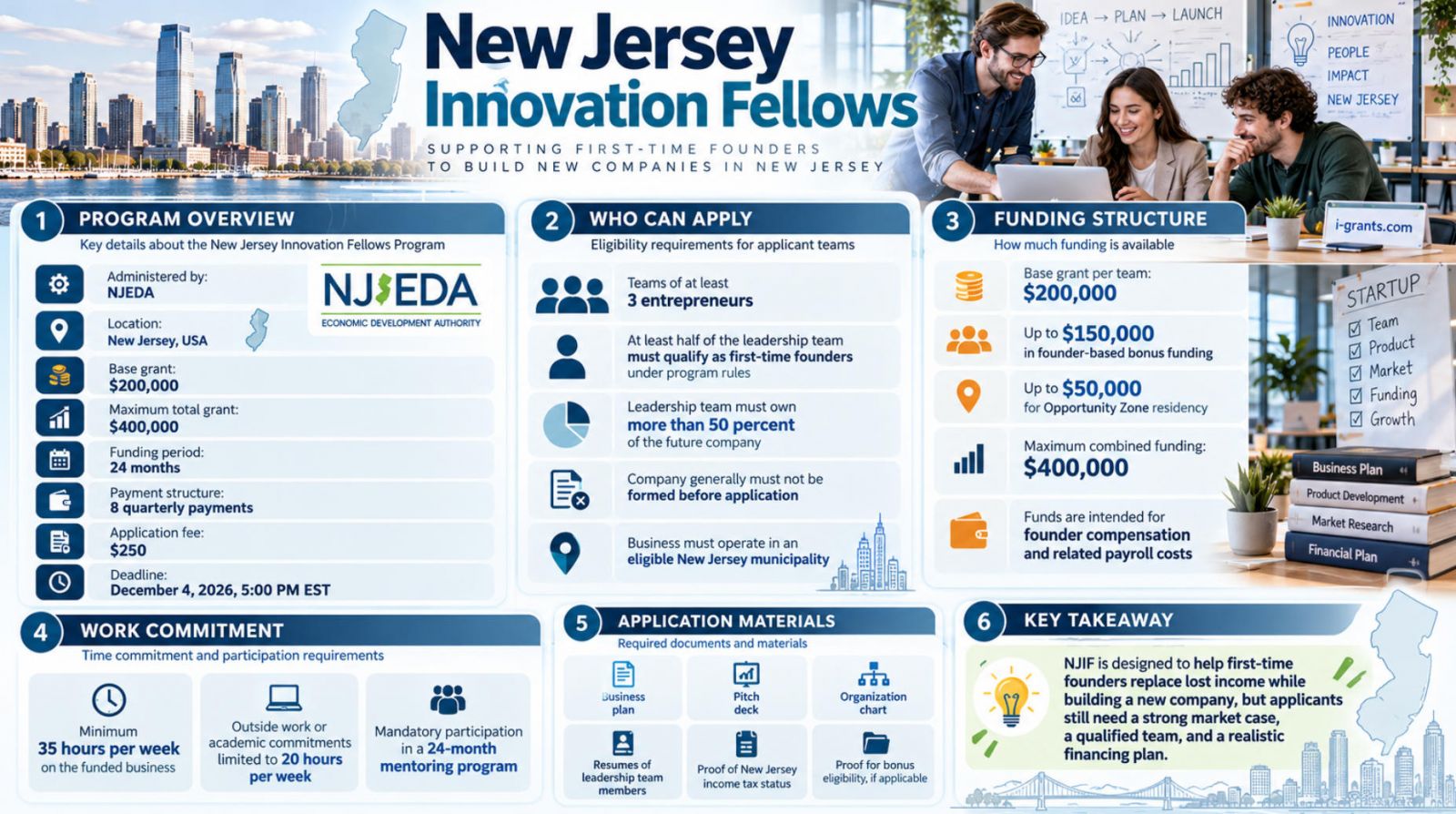
New Jersey has developed an unusual funding mechanism to address this challenge. The New Jersey Innovation Fellows (NJIF) Program, administered by the New Jersey Economic Development Authority (NJEDA), provides eligible entrepreneurial teams with grants ranging from $200,000 to $400,000 over two years. Unlike conventional startup grants that finance equipment, product development, marketing, or business expansion, NJIF primarily supports the people creating a company. Its funding is designed to replace employment income that entrepreneurs may give up when committing themselves to a new business venture.
The program also provides 24 months of structured mentorship, business development guidance, and access to New Jersey's innovation community. Its third funding round, known as NJIF Cohort III, opened on September 9, 2026, and applications must be submitted by December 4, 2026, at 5:00 p.m. Eastern Standard Time. The competition has a confirmed allocation of $2.5 million, with NJEDA expecting to recommend up to six entrepreneurial teams for financial support and potentially a seventh if sufficient funding remains.
However, the opportunity comes with important restrictions. Applicants must form teams of at least three entrepreneurs, satisfy specific requirements concerning previous business ownership and New Jersey income taxes, propose an eligible business idea, and commit to operating their future company in an approved municipality. Perhaps most importantly, the proposed company generally must not already be established or registered when the team applies. These conditions make NJIF substantially different from most startup funding opportunities, and entrepreneurs who misunderstand the program's structure may disqualify themselves before their business ideas are evaluated.
This guide examines the official NJIF Cohort III requirements, explains how teams can qualify for the maximum $400,000 award, analyzes the program's 29-point evaluation system, reviews previous grant recipients, and provides practical recommendations for preparing a competitive application.
New Jersey Innovation Fellows 2026: How the $400,000 Startup Grant Works
The New Jersey Innovation Fellows Program was established under the state's Economic Recovery Act and approved by the NJEDA Board in November 2022. Its central objective is to make entrepreneurship more accessible to individuals who have promising business ideas but cannot easily give up employment income to pursue them. Traditional startup financing generally focuses on the business itself: a manufacturer may seek funding to acquire machinery, a biotechnology company may need laboratory equipment, and a software developer may require investment to build and commercialize new technology. NJIF approaches the financing problem differently by recognizing that entrepreneurs must also support themselves while developing their businesses.
Without sufficient personal income, founders may be unable to dedicate the time necessary to transform an idea into a commercially viable enterprise. By providing income-replacement grants, NJIF allows approved entrepreneurial teams to devote substantial professional attention to their proposed ventures during the early development stage. Financial assistance is combined with compulsory entrepreneurship training and mentorship, creating a two-year support structure intended to help participants move from an initial concept toward an operating company.
Table 1. New Jersey Innovation Fellows Cohort III Funding and Application Requirements
| Program feature | Confirmed information |
|---|---|
| Official program name | New Jersey Innovation Fellows (NJIF) |
| Administering organization | New Jersey Economic Development Authority (NJEDA) |
| Funding round | Cohort III, 2026 |
| Geographic coverage | New Jersey, United States |
| Total Cohort III funding allocation | $2,500,000 |
| Base grant per team | $200,000 |
| Maximum additional bonuses | $200,000 |
| Maximum total grant per team | $400,000 |
| Minimum entrepreneurial team | Three individuals |
| First-time entrepreneur requirement | At least half of the leadership team |
| Ownership requirement | Entrepreneurial leadership must own more than 50 percent of the proposed venture |
| Minimum entrepreneurial commitment | 35 hours per week |
| Maximum outside work or study commitment | 20 hours per week |
| Grant duration | 24 months |
| Payment structure | Eight quarterly installments |
| Mentorship requirement | Mandatory two-year program |
| Application fee | $250, nonrefundable |
| Application opening date | September 9, 2026 |
| Application deadline | December 4, 2026, at 5:00 p.m. EST |
| Maximum application score | 29 points |
| Anticipated awards | Up to six teams, with a possible seventh award |
Source: NJEDA, New Jersey Innovation Fellows Cohort III Notice of Funding Availability, August 2026.
The $2.5 million allocation for Cohort III should not be confused with the $10 million originally appropriated for the wider NJIF program. The larger figure represents the program's initial legislative funding, while the smaller allocation applies specifically to the third cohort. NJEDA has indicated that the six highest-scoring eligible applications may be recommended to its Board for awards, with a possible seventh recommendation if sufficient money remains. Consequently, meeting the minimum eligibility requirements does not guarantee approval, because the competition evaluates both the proposed business and the ability of its entrepreneurial leadership team to implement the project.
Why Income-Replacement Funding Is Different
For entrepreneurs comparing funding opportunities, the most important feature of NJIF is the restricted purpose of the grant. The money is not intended to function as general working capital or unrestricted startup financing. According to the official Cohort III funding notice, grant awards must be used specifically for payroll and related payroll expenses associated with the approved entrepreneurial team, and a recipient company must establish an appropriate payroll management system before receiving grant payments.
Therefore, an award of $400,000 does not mean the team can immediately spend that amount on laboratory equipment, software development services, advertising, office rent, or other operating expenses. The funding provides income support to the founders while they work to establish the business, but the company must identify other financial resources for the activities necessary to develop and commercialize its products or services. This creates an important strategic question that every applicant should address: if NJIF finances the entrepreneurial team's compensation, how will the proposed company pay for everything else required to become operational?
A competitive application should answer that question directly. For example, a medical technology venture might need laboratory access, specialized testing, regulatory assistance, and prototype development, while an industrial software company may need computing infrastructure, technical contractors, and customer validation. NJIF can help the founders dedicate their working time to these activities, but it does not automatically provide the capital required to finance them.
Who Qualifies as a First-Time Entrepreneur Under NJIF?
One of the most frequently misunderstood aspects of NJIF is the definition of a first-time entrepreneur. The term does not simply mean someone who has never worked in business, managed a team, developed a product, or participated in commercial activity. In fact, NJEDA's evaluation system strongly rewards relevant professional experience, making it possible for highly experienced employees and industry specialists to participate in a program designed to support first-time company founders.
The first-time entrepreneur designation concerns specified previous business ownership and third-party investment circumstances. Under the Cohort III funding notice, individuals seeking to qualify must satisfy the program's restrictions concerning previous participation as founders, co-founders, or owners of businesses operating in New Jersey's targeted industries, including the relevant conditions associated with previous outside investment. These investment categories include professional angel investment, institutional venture capital, and private equity financing. The definition is therefore considerably more technical than its everyday meaning, and individual circumstances should be assessed against the official NJEDA documentation.
An experienced engineering manager who has spent 12 years developing medical devices but has never established a business falling within the program's restrictions may potentially qualify as a first-time entrepreneur. Similarly, a university researcher or senior software developer may bring extensive technical expertise without having previously founded a disqualifying company. By contrast, someone who established a venture-backed technology company in New Jersey should carefully examine the rules before claiming first-time entrepreneur status. Previous business ownership does not necessarily establish disqualification without considering the complete definition, but applicants should not rely on their own informal interpretation.
Team Composition, Ownership, and Previous Experience
NJIF does not accept applications from individuals acting alone. The entrepreneurial leadership team must include at least three people, and at least half of its members must qualify as first-time entrepreneurs. Because individual members cannot be divided into fractions, teams with an odd number of participants must round the required number of qualifying entrepreneurs upward. The leadership team must also collectively hold more than 50 percent of the future company's ownership, a condition that can influence negotiations with outside investors and other prospective shareholders.
Table 2. Minimum First-Time Entrepreneur Requirements by Team Size
| Leadership team size | Minimum first-time entrepreneurs | Required proportion of the team |
|---|---|---|
| Three entrepreneurs | 2 | 66.7 percent |
| Four entrepreneurs | 2 | 50 percent |
| Five entrepreneurs | 3 | 60 percent |
| Six entrepreneurs | 3 | 50 percent |
| Seven entrepreneurs | 4 | 57.1 percent |
Illustrative calculations based on NJIF's requirement that at least half of the entrepreneurial leadership team qualify as first-time entrepreneurs.
A three-person team consisting of two qualifying first-time entrepreneurs and one experienced business founder could potentially satisfy the composition requirement. However, all three participants must independently meet the other applicable conditions, including the New Jersey income tax requirement and the commitment to work on the proposed business. The team must also maintain the necessary ownership structure throughout the relevant period, so its founders should evaluate how future equity agreements might affect compliance.
Family members may participate on the same entrepreneurial team, according to NJEDA's official frequently asked questions, but family relationships do not create exceptions to the minimum team size, first-time entrepreneur conditions, ownership requirements, or individual eligibility rules. A team consisting of three relatives would still need at least two qualifying first-time entrepreneurs and would have to meet the remaining conditions.
The practical implication is that team formation should be treated as a strategic business decision rather than an administrative formality. Applicants need a combination of individuals who are eligible, capable of working together, professionally qualified, and willing to remain committed to the business for the required period. Selecting co-founders solely because they qualify for additional grant bonuses could weaken the application if their experience does not match the needs of the proposed company.
Why Applicants Should Not Register Their Startup Too Early
NJIF has an unusual restriction concerning the legal establishment of the proposed business: the program is designed for new business ideas rather than existing registered startups. The official guidance states that applicants generally must not have already formed or registered the company for which they are seeking support. A venture that has completed its legal formation, registered to conduct business in New Jersey, raised third-party capital, or undertaken equivalent formation activities may no longer satisfy the program's initial requirements.
This approach is fundamentally different from grant programs that require applicants to provide incorporation documents, business licenses, and operating histories before applying. For NJIF, the intended sequence begins with the entrepreneurial team developing its idea, checking eligibility, and submitting the application before formally establishing the proposed company. If the application is approved, the team proceeds with company formation and registration as part of the grant closing process.
Under the Cohort III funding notice, approved teams are generally required to form and register the new business within 30 business days after notification of the award and complete the grant agreement closing process within 60 business days. The program's general frequently asked questions use the shorter wording of 30 days without consistently specifying business days. Applicants should therefore follow the specific Cohort III notice and obtain clarification if the distinction could affect their implementation schedule.
Creating a subsidiary or branch of an existing company is not an automatic solution. NJIF is intended to support genuinely new entrepreneurial ventures rather than ordinary expansions of established businesses, and applicants cannot assume that forming a separate legal entity will satisfy the requirements if the proposed operation is effectively a continuation of an existing enterprise. At the same time, the rules distinguish between a founder's previous business experience and the establishment of the particular venture proposed for NJIF. Someone who previously participated in a different business may still warrant eligibility consideration, depending on the official definition and the circumstances involved.
For entrepreneurs who are accustomed to registering a company before seeking investment, this requirement deserves particular attention. Premature company formation can create a problem that is difficult or impossible to correct later. Prospective applicants should therefore review the official conditions before filing incorporation documents, entering binding investment arrangements, or taking other actions that could affect the venture's status as a newly proposed business.
New Jersey Income Tax Requirements, Residency, and Employment Commitments
NJIF's geographic requirements extend beyond the location of the future company. Every entrepreneurial leadership team member must demonstrate a qualifying connection to New Jersey's income tax system. Under the Cohort III funding notice, each entrepreneur must show that New Jersey gross income tax was withheld from wages or paid directly to the state at the time of application or within the preceding 60 calendar days.
Supporting evidence may include recent pay statements showing New Jersey tax withholding. Alternatively, eligible applicants may submit Form NJ-1040ES, the state's estimated income tax declaration, together with confirmation of the relevant payment. The requirement applies individually to every entrepreneurial leader, meaning that one founder's qualifying tax history cannot compensate for another member's missing documentation.
Do Entrepreneurs Have to Live in New Jersey?
Not necessarily. NJEDA's frequently asked questions indicate that New Jersey residency is not a universal prerequisite for participation, but every approved entrepreneur must satisfy the relevant New Jersey income tax requirements. A founder living in another state may potentially qualify if the applicable tax conditions are met, while someone living in New Jersey without the necessary recent tax documentation may face difficulties.
This distinction is particularly important for people living outside New Jersey who nevertheless earn income subject to the state's taxation. Residency and income tax eligibility are separate matters, and neither should be inferred automatically from the other. For international entrepreneurs, NJIF should not be understood as a general relocation grant or an unrestricted opportunity to move to the United States and establish a business. The relevant tax history, business location, ownership arrangements, and employment commitments must be considered before an application is submitted.
Can Applicants Keep Their Existing Jobs?
Applicants do not necessarily need to resign from their jobs before submitting an NJIF application. The official guidance allows entrepreneurs to maintain existing employment and other commitments before receiving an award notification, which reduces the risk of abandoning a stable income without knowing the competition's outcome. However, successful applicants must be prepared to satisfy the program's full-time entrepreneurial commitment within 60 days of approval.
Every entrepreneurial leader must dedicate at least 35 hours per week to the approved venture during the two-year commitment period. Outside employment, participation in other businesses, and educational obligations are limited to 20 hours per week. Students must consider not only classroom attendance but also the additional time required for academic work, while employed applicants must assess whether their existing jobs can realistically be reduced to the permitted level.
The practical implication is significant: NJIF offers a possible transition from regular employment to entrepreneurship without demanding that applicants give up their salaries before an award decision. Nevertheless, founders should prepare a personal financial plan that accounts for the eventual reduction in outside income, the quarterly payment schedule, applicable taxes, and the possibility that their grant-supported compensation may be lower than their previous earnings.
Eligible New Jersey Locations and Targeted Industries
The proposed NJIF-supported business must operate within an eligible municipality in New Jersey and belong to a qualifying targeted industry. Both conditions matter, because a promising technology company located outside an approved municipality may face eligibility problems even if its industry is otherwise appropriate. Likewise, a business established in an eligible municipality does not automatically qualify if its proposed activities fall outside the targeted sectors.
NJEDA identifies a broad range of industries connected to innovation and economic development. These include advanced manufacturing, advanced transportation and logistics, aviation, autonomous vehicles and zero-emission transportation research, clean energy, clean technology, life sciences, information technology, finance and insurance, professional services, film and digital media, and non-retail food and beverage innovation. Other specifically defined sectors may also qualify, including innovative activities that substantially change existing technologies or business models under the agency's interpretation of its rules.
The variety of eligible industries creates opportunities for different kinds of entrepreneurs, but applicants must explain how their particular products or services fit the official definitions. A team developing medical diagnostic technology could potentially qualify within life sciences, while a company creating software for industrial production might fit within information technology or advanced manufacturing. A business developing logistics optimization technology could fall within advanced transportation and logistics, and a venture designing new food-processing methods might be relevant to non-retail food innovation. These examples illustrate possible classifications rather than automatic eligibility determinations.
Opening a conventional retail store, restaurant, or local service business within an approved municipality does not establish eligibility simply because the business is new. The proposed venture must demonstrate the characteristics required by the relevant targeted industry or innovation category. Applicants should therefore avoid relying on broad statements about innovation and instead connect their business activities to specific definitions in NJEDA's official guidance.
Eligible Municipalities and Opportunity Zones Are Different
Two geographic concepts appear in the program rules, but they serve different purposes. An Eligible Municipality determines where the NJIF-supported business must operate, while an Opportunity Zone is a federally designated area that may create eligibility for an additional grant bonus if an approved entrepreneurial leader lives there. A company can therefore satisfy the business location requirement without qualifying for an Opportunity Zone bonus, and a founder's residence in such a zone does not automatically establish that the company's operating address is acceptable.
The official list of eligible municipalities includes locations such as Newark, Trenton, Camden, Jersey City, Princeton, and New Brunswick. Nevertheless, applicants should verify their intended business address against the relevant NJEDA documents rather than relying solely on the municipality's name or an informal geographic description. The difference between business location eligibility and bonus-related residence eligibility becomes particularly important when calculating the total amount of funding a team may request.
How to Qualify for the Full $400,000 NJIF Startup Grant
The maximum NJIF award consists of a $200,000 base grant and up to $200,000 in additional bonuses. The extra funding is not automatic, because each bonus depends on specific characteristics of the approved entrepreneurial team and must be supported by appropriate documentation. The published rules establish two principal bonus mechanisms: a residence-based bonus connected to a designated Opportunity Zone and individual bonuses associated with specified educational or diversity-related criteria.
An entrepreneurial team may qualify for an additional $50,000 if at least one approved leader resides in a designated Opportunity Zone in New Jersey when the application is submitted. The bonus is available once per qualifying team, regardless of how many founders live in such areas. For example, a three-person team with two founders living in qualifying Opportunity Zones would still receive only one $50,000 residence bonus. Applicants must provide acceptable address documentation, which may include a valid government-issued identification document, a lease agreement, or a recent utility bill identifying the relevant individual and residential address.
The program also allows bonuses of $50,000 for individual entrepreneurs who satisfy specified education or diversity-related requirements. A team may receive up to three of these bonuses, producing a maximum of $150,000 from this category. The education-related provision concerns qualifying graduates of colleges and universities located in New Jersey, including specified degrees or certificates from eligible institutions. A founder who graduated from an institution outside New Jersey should not assume that the same educational bonus is available.
The diversity-related provision follows definitions established under New Jersey law and includes specified minority business categories and women entrepreneurs. Eligibility depends on the applicable legal definitions and documentation requirements rather than a founder's informal description of their background. An individual who satisfies both an education criterion and a diversity-related criterion should not automatically expect two separate $50,000 bonuses, because the published structure provides one qualifying bonus per entrepreneurial leader, subject to the maximum of three leaders.
Table 3. NJIF Grant Amounts Under Different Bonus Scenarios
| Illustrative team circumstances | Base award | Additional bonuses | Total potential grant |
|---|---|---|---|
| Three eligible founders with no bonus qualifications | $200,000 | $0 | $200,000 |
| One qualifying entrepreneur graduate | $200,000 | $50,000 | $250,000 |
| Two entrepreneurs qualifying for education or diversity bonuses | $200,000 | $100,000 | $300,000 |
| Three entrepreneurs qualifying for education or diversity bonuses | $200,000 | $150,000 | $350,000 |
| Two qualifying entrepreneurs plus an Opportunity Zone resident | $200,000 | $150,000 | $350,000 |
| Three qualifying entrepreneurs plus an Opportunity Zone resident | $200,000 | $200,000 | $400,000 |
Illustrative calculations based on NJEDA's published bonus structure. All bonuses require eligibility verification and approval. The examples do not represent actual grant awards.
A Practical Example of a $400,000 Entrepreneurial Team
Consider a proposed medical technology venture formed by three entrepreneurs. The first founder is an experienced biomedical engineer who graduated from a university in New Jersey, the second is a software specialist who qualifies under the program's diversity-related bonus criteria, and the third is a product development professional who graduated from an eligible New Jersey college. Suppose the first founder also lives in a designated Opportunity Zone.
Assuming all three participants satisfy the remaining requirements, the team could potentially qualify for the $200,000 base grant, $150,000 in individual bonuses, and a further $50,000 Opportunity Zone bonus. Its maximum combined award would therefore be $400,000. The example demonstrates that the maximum amount depends not only on the strength of the business idea but also on the documented characteristics of the leadership team.
However, entrepreneurs should not choose co-founders solely to maximize bonus eligibility. The same program that offers additional money for qualifying team characteristics also gives exceptional weight to the founders' professional capabilities during competitive evaluation. A poorly balanced team may qualify for several bonuses but still receive a weaker score than experienced entrepreneurs who demonstrate a clear ability to build and operate a successful company.
Why the Possible Seventh Award Is Not Guaranteed
Cohort III has a confirmed funding allocation of $2.5 million. If six teams receive the maximum $400,000 award, those grants would total $2.4 million, leaving only $100,000. Since the base award for an eligible team is $200,000, the remaining amount would not be sufficient for a seventh standard award.
The possibility of supporting another team therefore depends on how much the selected applicants actually receive, whether additional resources become available, and NJEDA's final funding decisions. Applicants should regard the potential seventh award as a conditional possibility rather than a guaranteed place in the competition.
NJIF Payments: What Eight Quarterly Installments Mean for Founder Income
Approved NJIF recipients do not receive the full grant amount at the beginning of the program. Instead, the funding is divided into eight equal installments over 24 months, with the first installment released after the required grant agreement and closing conditions have been satisfied. The remaining seven payments depend on the recipients' continued compliance and NJEDA's review of the necessary documentation.
This structure makes the timing of payments as important as the headline award amount. A team that receives a grant of $400,000 still needs to plan how salaries will be paid, when funds will become available, and what happens if a compliance review delays a subsequent installment. Entrepreneurs should also distinguish the amount paid to the company from the net compensation ultimately received by each individual founder.
Table 4. NJIF Quarterly Payments and Illustrative Monthly Income Equivalents
| Total grant award | Quarterly payment to the team | Average monthly equivalent for the team | Average monthly equivalent per founder in a three-person team |
|---|---|---|---|
| $200,000 | $25,000 | $8,333.33 | $2,777.78 |
| $250,000 | $31,250 | $10,416.67 | $3,472.22 |
| $300,000 | $37,500 | $12,500 | $4,166.67 |
| $350,000 | $43,750 | $14,583.33 | $4,861.11 |
| $400,000 | $50,000 | $16,666.67 | $5,555.56 |
Illustrative calculations dividing the total award across eight quarters or 24 months. Individual amounts assume equal allocation among three founders. Actual compensation is subject to payroll arrangements, applicable taxes, related employment expenses, and NJEDA requirements. The program does not provide monthly grant installments.
For a three-person team receiving the maximum $400,000, an equal mathematical allocation over two years produces approximately $5,555.56 per founder per month. This is not a guaranteed take-home salary, because the amount does not account for taxes, related payroll expenses, or differences in the actual allocation of compensation among team members. NJEDA's guidance does not establish a single fixed maximum payment per person, but compensation must be reasonably equitable, and the relevant arrangements may be reviewed through payroll and individual tax documentation.
The financial implications become clearer when examining a company with substantial product development costs. Suppose an approved technology startup expects to spend $80,000 on specialized software services, $35,000 on equipment, and $25,000 on marketing and customer acquisition. Even if those expenses are essential to the business, they should not be assumed to qualify for payment from NJIF's income-replacement grant. The company must identify other appropriate financing sources and distinguish between the founders' personal income needs and the business's operating requirements.
The official guidance also makes clear that medical insurance and healthcare benefits are not covered by NJIF. Founders who are leaving employment may therefore need to make independent arrangements for health coverage, savings, personal taxes, and other expenses previously supported by their employers. Understanding these financial obligations before accepting an award is essential to avoiding cash shortages during the two-year commitment period.
How NJEDA Evaluates Applications: The 29-Point Scoring System
One of NJIF's most valuable features for serious applicants is the availability of an official competitive scoring rubric. Instead of relying entirely on broad advice about innovation or entrepreneurial motivation, candidates can examine the categories that NJEDA uses to evaluate proposals. The Cohort III framework provides a maximum score of 29 points, allocated among the quality of the business plan, operational readiness, and the experience of the entrepreneurial leadership team.
Table 5. Official NJIF Application Scoring Categories
| Evaluation category | Maximum points | Share of total possible score |
|---|---|---|
| Business plan quality | 5 | 17.24 percent |
| Operational readiness | 4 | 13.79 percent |
| Management team experience and expertise | 20 | 68.97 percent |
| Total | 29 | 100 percent |
Source: NJEDA, NJIF Competitive Scoring Rubric, updated May 13, 2025. Percentage shares are calculated from the official maximum point values and may differ slightly in total because of rounding.
Nearly 69 Percent of the Maximum Score Depends on the Founders
The most important strategic insight is that 20 of the maximum 29 points relate to the entrepreneurial leadership team. Although NJIF targets first-time entrepreneurs, it strongly rewards professional experience, industry expertise, complementary capabilities, and previous collaboration. The management category consists of four separate areas worth up to five points each: professional experience, expertise in the relevant industry, capabilities in sales and operations as well as product development and finance, and the length of the founders' previous working relationships.
This creates a substantial advantage for teams whose members bring different but complementary skills. An experienced engineer, a commercially knowledgeable industry specialist, and a professional with strong financial or operational expertise may be well positioned to demonstrate the capabilities NJEDA values. Nevertheless, the team must provide evidence of that experience rather than relying on general claims about its talent or motivation.
The length of previous collaboration also influences the score. Under the official rubric, teams that have worked together for more than three years may obtain the highest rating for that particular factor, while those with between one and three years of experience together fall into an intermediate category. Teams that have collaborated for less than one year receive fewer points. This does not automatically make a newly assembled team ineligible, but it does mean that founders should be realistic about the competitive effect of their working history.
A team that has only recently come together can still demonstrate complementary skills, clearly assigned responsibilities, and a credible process for managing decisions. However, it should not exaggerate the length of previous relationships or describe informal acquaintances as years of established professional cooperation. Accurate documentation and a convincing explanation of why the team is capable of operating the proposed venture are more valuable than unsupported claims.
Business Plan Quality and Operational Readiness
The business plan category offers a maximum of five points, with one point available for each of five elements: a clearly defined problem, a sufficiently meaningful potential market, competitor analysis, a market-entry strategy, and a convincing value proposition. A proposal describing an interesting technology without explaining who will purchase it may therefore lose points, even if the underlying invention is technically sophisticated.
For example, a medical technology team should describe not only the scientific advantages of its product but also the intended customers, available alternatives, purchasing decisions, and requirements for market entry. Similarly, an industrial software venture should explain how its technology improves a measurable production or business process and why customers might pay for the solution. In both cases, evidence of commercial relevance is more persuasive than broad statements about market disruption.
The remaining four points concern operational readiness. NJEDA evaluates proposed financial management arrangements, clearly assigned responsibilities, a diversity and inclusion plan, and identification of resources required in addition to the NJIF award. This final element is particularly important because the grant finances founder compensation rather than every cost of establishing the business. A team that recognizes its need for laboratory access, technical contractors, regulatory assistance, equipment, or development capital may demonstrate stronger preparation than one assuming that the grant alone can finance the entire venture.
Applicants can use the rubric as a practical self-assessment instrument by identifying supporting evidence for each criterion. Professional experience can be demonstrated through resumes and employment histories, industry knowledge through previous work and technical qualifications, and business feasibility through market research, customer discussions, and a logical financial model. Operational preparation should be reflected in clearly assigned management roles, accounting arrangements, and a realistic assessment of additional resources. This process can reveal weaknesses before submission, although calculating a high score internally does not guarantee the same result during NJEDA's official review.
NJIF Success Stories: Results From Previous Funding Rounds
Unlike many newly introduced startup funding initiatives, NJIF has an established record of awards and published information about participating businesses. The first cohort was announced in January 2024, when NJEDA selected 10 companies involving 30 entrepreneurs and awarded a combined $3.6 million in income-replacement grants. The recipients represented a variety of business concepts and municipalities, demonstrating that NJIF was not limited to a single technology sector or geographic location.
Among the first recipients were Klick Studios in Burlington City, My FitPlate in Jersey City, Quarks Advantage in Jersey City, and Thrivio Health in North Bergen, each of which received $400,000. Other businesses included AbilityHUB in West Windsor, AntaMed in East Orange, Fire Start Productions in Gloucester Township, Helloboss in Jersey City, Liv Again Wellness in Vineland, and Planthopper Corp in Asbury Park. The awards ranged from $250,000 to $400,000, providing documented examples of actual NJIF funding rather than hypothetical grant scenarios.
What the First Cohort Achieved
NJEDA's 2024 Annual Report provides measurable information about mentorship and business development activities during the first cohort. As of January 2025, the reported participant retention rate was 90 percent, and mentors had provided more than 1,100 hours of support, including approximately 220 hours of dedicated consultations. The program also organized more than 50 professional networking events and 12 structured learning sessions.
According to the same report, seven of the ten participating businesses received support through the National Science Foundation's I-Corps program, while 40 percent reported initial revenue. These figures indicate that some participating companies made measurable progress in developing their business activities, accessing additional entrepreneurship programs, and beginning commercial operations. They should not, however, be interpreted as proof that every company became profitable, obtained long-term financing, or established a sustainable market position. Initial revenue demonstrates commercial activity, while continued program participation does not necessarily establish long-term business survival.
The Second Cohort and the Importance of Updated Board Decisions
The historical record for NJIF's second cohort illustrates why grant research should not rely on a single annual report. NJEDA's 2024 Annual Report initially described eight supported businesses involving 26 entrepreneurs and stated that total awards amounted to $2.9 million. However, the eight individual grant amounts listed in that report add up to $2.8 million, creating a discrepancy between the stated aggregate figure and the detailed entries.
A later NJEDA Board memorandum dated May 13, 2025, clarified the initially approved amount as $2.8 million. Following appeals concerning the application scoring process, the NJEDA Board approved increasing the second cohort from eight awards to ten and expanding the total to $3.45 million. The additional recipients were Flo Good Technologies, awarded $350,000, and Uplift Media, awarded $300,000. The Board also approved changes to the scoring process, removing the Diversity Finance Advisory Board from the scoring of NJIF applications.
This subsequent decision provides a more complete historical account than the earlier annual report alone. It also demonstrates that the official review process and the handling of scoring disputes can materially affect funding outcomes, which makes careful attention to current rules and documented evaluation criteria especially important.
Table 6. Selected NJIF Award Recipients and Verified Funding Amounts
| Company | Cohort | Location | Published grant amount |
|---|---|---|---|
| Klick Studios | I | Burlington City | $400,000 |
| My FitPlate | I | Jersey City | $400,000 |
| Quarks Advantage | I | Jersey City | $400,000 |
| Thrivio Health | I | North Bergen | $400,000 |
| Recognition AI | II | Plainsboro Township | $300,000 |
| Cognimetry | II | Hackensack | $400,000 |
| Natural Sense | II | Princeton | $400,000 |
| Estate Ease | II | Jersey City | $350,000 |
| Flo Good Technologies | II, additional award approved in 2025 | New Jersey | $350,000 |
| Uplift Media | II, additional award approved in 2025 | New Jersey | $300,000 |
Sources: NJEDA Annual Report 2024; NJEDA May 13, 2025 Board memorandum and approved meeting minutes. The table presents selected recipients rather than every award. Receiving a grant does not establish subsequent profitability or commercial success.
What Previous Applications Reveal About Competition
The second cohort also provides useful evidence concerning application completeness. An NJEDA Board memorandum from March 2025 reported that 40 applications had been received in the second round, of which 27 were considered incomplete. Eight were initially recommended for approval, while five received a recommendation for discretionary declination. The incomplete applications represented 67.5 percent of the total submitted during that particular round.
This figure should not be presented as the expected rejection rate for Cohort III, because it reflects a specific earlier competition and its administrative review. Nevertheless, it demonstrates that document completeness is not a minor formality. Entrepreneurs may have promising ideas and suitable professional qualifications but still fail to advance if they do not submit the required materials or provide sufficient evidence of eligibility.
The later appeal decisions also illustrate the importance of accurate application evaluation. Applicants should therefore prepare complete submissions, retain supporting documentation, examine the current scoring criteria, and avoid relying on assumptions about how their proposals will be assessed.

Why New Jersey Is Investing in Early-Stage Entrepreneurship
NJIF operates within a broader state strategy to strengthen innovation, encourage business creation, and support the commercialization of new technologies. New Jersey has established capabilities in university research, pharmaceutical development, life sciences, financial services, advanced manufacturing, and technology entrepreneurship. However, moving from a promising idea to an operating company remains financially difficult, even in regions with strong research institutions and established industrial networks.
Scientists may possess valuable technical knowledge without the commercial experience needed to establish a business. Experienced professionals may identify market opportunities but be unwilling to abandon stable employment, while recent graduates may have promising ideas without sufficient financial resources to pursue them. NJIF addresses these barriers by supporting founders during the earliest stage of company creation and connecting them with mentors, universities, and other participants in the state's innovation community.
The wider economic context demonstrates why such initiatives are relevant. On July 21, 2026, NJEDA published results from an economic impact assessment of programs administered by the New Jersey Commission on Science, Innovation, and Technology (CSIT). According to the assessment, supported companies had received 548 grants since 2020, raised $524.5 million in additional capital, and created nearly 1,800 jobs. The 226 companies that provided relevant reporting data generated combined revenues of $99.4 million.
These figures should not be attributed to NJIF, because they concern a separate group of support programs. They nevertheless provide evidence of the broader innovation environment in which NJIF operates. They also demonstrate that early public funding can form one part of a longer financing pathway involving additional capital, commercialization, and employment growth.
Another example is the New Jersey Innovation Evergreen Fund. In an announcement dated October 16, 2026, NJEDA reported approving $16.5 million in investments across eight innovative companies since February. The investments supported businesses working in healthcare, biotechnology, life sciences, and other sectors, but the Evergreen Fund uses equity investment mechanisms rather than NJIF's income-replacement grant structure.
Together, these initiatives show how New Jersey employs different financial instruments to assist entrepreneurs at different stages of development. NJIF focuses on the people creating new companies, while other programs may become relevant when those companies need research financing, commercial development support, or capital for expansion.
How to Prepare a Competitive NJIF Application
A strong NJIF application must satisfy two distinct requirements. First, it must establish that the entrepreneurial team and proposed venture are eligible. Second, it must present a sufficiently credible business opportunity and capable management team to compete against other eligible applicants. Meeting only one of these conditions is not enough, because a technologically innovative idea cannot compensate for a fundamental eligibility problem, and a fully eligible team with a weak business plan may lose points during the competitive evaluation.
Before drafting extensive materials, entrepreneurs should examine the qualifications of every proposed leadership team member. This includes verifying previous business ownership, potential first-time entrepreneur status, recent New Jersey income tax payments, professional experience, ownership arrangements, and willingness to meet the full-time commitment. The team should also confirm that its proposed business has not been formed prematurely, that its intended activities fall within an eligible industry, and that the future operating address satisfies the geographic requirements.
Preparing the Business Plan and Presentation
NJIF requires a written business plan of no more than 3,000 words, so applicants must prioritize clear evidence and concise reasoning. A lengthy technical description is not necessarily more persuasive than a focused explanation of a real market problem, the proposed solution, the intended customer, and the reasons customers might adopt the product or service. The plan should also discuss the addressable market, existing competitors, the route to initial sales, potential revenue, and the resources needed to establish the company.
Competitor analysis deserves particular attention because applicants sometimes assume that describing a product as innovative is equivalent to demonstrating the absence of competition. In reality, competitors may include established products, alternative technologies, manual processes, or services that solve the same customer problem. A convincing business plan should explain why the proposed venture offers a meaningful advantage and how that advantage can be translated into commercial demand.
The application also requires a business presentation limited to 15 slides. This document should communicate the most important elements of the venture without simply reproducing the written business plan. It should explain the problem, proposed solution, market opportunity, competitive position, commercialization strategy, entrepreneurial team, financial assumptions, and development milestones. Effective visual design can improve clarity, but attractive graphics cannot compensate for unsupported revenue forecasts, missing customer evidence, or an unclear explanation of the company's business model.
Demonstrating Management Experience and Operational Readiness
Each entrepreneurial leader must provide a resume, and the application also requires an organizational chart showing the future company's structure and the responsibilities of individual team members. These documents matter particularly because the management category accounts for the largest share of the possible score. Resumes should establish relevant professional experience, technical knowledge, education, commercial responsibilities, and previous collaboration, while the organizational chart should show who will lead product development, operations, finance, and customer acquisition.
In a small entrepreneurial team, one individual may be responsible for several functions. That arrangement is not necessarily a weakness, provided the distribution of responsibilities is realistic and consistent with the founders' demonstrated skills. For example, a technically experienced founder may lead product development and supplier relationships, while another entrepreneur handles customer acquisition and commercial partnerships. A third member may oversee financial planning, administrative compliance, and the coordination of outside professional services.
Applicants should also identify the resources required beyond NJIF funding. A new company may need laboratory space, regulatory support, specialized equipment, software development services, research infrastructure, or private investment. The application should distinguish between resources already available and those still to be secured, explaining how the team intends to address any gaps. This does not necessarily mean every future financing arrangement must be completed before submission, but it does require a credible understanding of the costs and practical requirements associated with launching the business.
Avoiding Administrative Mistakes
The Cohort III notice requires the completed application and supporting documents to be submitted through the designated electronic system. Materials include the business plan, presentation, organizational chart, resumes, evidence of personal addresses, New Jersey income tax documentation, and any records needed to establish eligibility for additional bonuses. Applicants must also pay a nonrefundable $250 application fee.
NJEDA provides a five-business-day opportunity to correct certain identified deficiencies after notifying an applicant about incomplete or unclear documentation. However, this correction procedure does not extend the original application deadline. Late applications and submissions without the required fee cannot rely on the correction period to become eligible, so entrepreneurs should not postpone document preparation until the final hours of the competition.
The experience of earlier cohorts shows why this matters. A technically promising application may still fail because required documents are missing, tax eligibility is not adequately demonstrated, or important team information is inconsistent. The strongest submission is therefore not simply persuasive; it is complete, accurate, and supported by appropriate evidence.
The Mandatory Two-Year Mentorship Program and Compliance Requirements
Financial support is only one part of NJIF. Approved entrepreneurial teams must participate in a structured mentorship program lasting 24 months, with academic and innovation partners that have included the New Jersey Innovation Institute and the Rowan Center for Innovation & Entrepreneurship. Participants receive guidance in business planning, financial management, accounting, fundraising, product development, marketing, customer engagement, and other areas necessary for establishing a company.
The mentorship structure may include virtual learning, in-person sessions, individual consultations, professional networking activities, and meetings with experienced entrepreneurs and specialists. Participation is mandatory, and founders must allocate sufficient time not only to developing their businesses but also to completing the relevant program activities. The aim is to support their progression from an early concept toward a functioning enterprise with a credible path to commercialization.
The program also imposes continuing reporting obligations. Recipients must demonstrate that they remain eligible throughout the two-year grant period, and subsequent payments depend on NJEDA's review of the required documentation. Quarterly submissions include an updated organizational chart, management-prepared financial statements, confirmation of New Jersey income tax withholding and payment, mentorship participation records, and evidence that the company continues operating at an approved location. Teams must also submit the relevant disbursement request and required certifications.
Annual documentation includes individual New Jersey tax filings and company financial statements prepared by an accountant. The Cohort III funding notice states that quarterly compliance documentation is due within 45 business days after the end of each calendar quarter, while the general program FAQ uses slightly different wording. Approved applicants should rely on their final grant agreement and request clarification if necessary. These responsibilities make accounting procedures and timely recordkeeping essential from the beginning of the venture.
What Happens if a Founder Leaves the Company?
Maintaining the required leadership team is an ongoing condition of NJIF participation. If the number of entrepreneurial leaders falls below three, the company may be considered out of compliance, potentially affecting future payments and the status of its grant agreement. The official guidance provides a limited opportunity to correct certain violations, including a possible period of up to three months from notification of default to replace a departing team member and resolve the problem.
This does not mean that founders can freely change the company's leadership without consequences. Replacement arrangements must satisfy the applicable requirements, and the company should notify the program administrator promptly when a relevant change occurs. Failure to correct violations may lead to suspension of future payments, termination of the grant agreement, or recovery of previously distributed funds.
Other potential compliance problems include failing to maintain the required working hours, losing the necessary New Jersey tax eligibility, discontinuing mentorship participation, relocating the company to an ineligible location, or using grant funds for unauthorized expenses. NJIF should therefore be regarded as a two-year contractual commitment involving continuous financial and operational accountability rather than an unrestricted cash award.
Other New Jersey Funding Opportunities for Innovative Startups
Entrepreneurs often need different forms of capital as their businesses develop, and NJIF is not intended to satisfy every financing requirement. Its primary role is to support the founders' income during company formation, while other programs may be more suitable for research, product development, or subsequent commercial expansion. The appropriate financing strategy depends on the venture's stage of development, eligible activities, ownership structure, and ability to meet the conditions of each funding source.
The New Jersey Commission on Science, Innovation, and Technology operates programs supporting research and commercialization. Its SBIR/STTR Direct Financial Assistance initiatives, for example, provide targeted funding to companies participating in qualifying federal small business research programs. The fifth round includes assistance levels of $25,000 or $50,000 under different eligibility circumstances, but these are specialized grants connected to federal research funding activity rather than general-purpose assistance for every new business.
The New Jersey Innovation Evergreen Fund uses a different mechanism by supporting innovative companies through equity investments alongside qualified private investment partners. This form of financing may be suitable for companies seeking venture capital, but equity investment differs fundamentally from a grant because it involves ownership and investment arrangements. Tax incentive mechanisms, including the Angel Investor Tax Credit Program, may also help qualifying companies attract private investment, although those incentives should not be presented as equivalent to direct income-replacement funding.
Timing is particularly important for teams considering multiple programs. A venture that must remain unregistered when applying for NJIF may later need to complete its legal formation before becoming eligible for company-focused research or investment assistance. Applicants should therefore develop a financing strategy that reflects the different stages of business development and should verify whether any proposed combination of public grants, private investment, and overlapping expenses is permitted under the relevant rules.
Common Mistakes That Can Weaken an NJIF Application
One of the most serious mistakes is registering the proposed business before confirming the program's formation requirements. Many entrepreneurs assume that early registration demonstrates commitment and readiness, but NJIF is specifically designed to support new ventures before their legal establishment. Premature incorporation, inappropriate business registration, or certain outside financing arrangements can therefore create eligibility problems that are difficult to resolve.
Another common misunderstanding concerns the maximum award. The $400,000 grant applies to the entire team over two years, not to every founder individually, and the money is intended for approved compensation and related payroll expenses. Treating it as unrestricted business capital can result in unrealistic financial planning, particularly for companies that require substantial spending on research, equipment, regulatory approvals, or commercialization.
New Jersey income tax documentation is another critical area. Every entrepreneurial leader must satisfy the applicable requirements, and one participant's qualifying history cannot substitute for another person's missing evidence. Similarly, a proposed team may appear professionally impressive but fail to meet the minimum number of first-time entrepreneurs or the ownership restrictions. These matters should be resolved before the business plan is finalized.
Weak team composition can also reduce competitiveness even when all members meet the formal rules. Since nearly 69 percent of the possible points depend on management experience and expertise, founders should demonstrate that their skills complement one another and correspond to the actual needs of the business. A team assembled only to satisfy bonus conditions may be less convincing than one with strong professional experience, clearly allocated responsibilities, and a realistic record of collaboration.
Business planning weaknesses are equally important. An innovative idea without evidence of customer demand, a clear market-entry strategy, or a realistic explanation of future financing may perform poorly under the official rubric. Overly optimistic sales forecasts and unsupported claims about having no competitors cannot replace credible research and practical implementation plans.
Finally, applicants should not overlook what happens after the award. Failure to maintain the required leadership structure, working hours, tax status, mentorship participation, business location, or proper use of funds may affect later disbursements and expose the company to repayment obligations. The most effective approach is to treat eligibility, application quality, and post-award compliance as interconnected parts of the same business development strategy.
NJIF Cohort III Deadline, Application Process, and Practical Questions
Applications for New Jersey Innovation Fellows Cohort III opened on September 9, 2026, and the deadline is Friday, December 4, 2026, at 5:00 p.m. Eastern Standard Time. The official NJEDA website provides access to the application system, the detailed eligibility conditions, the list of eligible municipalities, relevant industry definitions, and the competitive scoring rubric. Entrepreneurs should use these official resources when making decisions that could affect business formation, employment, ownership, or tax compliance.
The program's September 2026 guidance indicates that Cohort III is currently expected to be the final funding round under the existing allocation. Additional competitions would depend on further funding, so applicants should not assume that an equivalent opportunity will automatically reopen in 2027. For prospective founders who meet the conditions, this makes the current application period particularly significant.
Several practical questions frequently arise when evaluating participation. Can a first-time entrepreneur receive $400,000 individually? No, the maximum award applies to an eligible team of at least three people. Does every eligible team receive the maximum? No, the base grant is $200,000, and the additional amount depends on qualifying bonuses that must be documented and approved. Even teams satisfying all eligibility requirements must compete for the limited funds available.
Can someone apply without having established a company? Yes, because supporting new entrepreneurial ideas before formal business creation is central to the program. In fact, an already registered startup seeking funding for its existing operations may not qualify. Previous involvement in other businesses must be considered separately under the first-time entrepreneur rules, and applicants should seek clarification where ownership or investment histories create uncertainty.
Do all founders need to live in New Jersey? Not necessarily, but every entrepreneurial leader must satisfy the relevant state income tax requirements, and the company must operate in an eligible municipality. Can students participate? They may be eligible if they meet the same tax, entrepreneurial commitment, and outside-activity conditions as other applicants. Can founders keep their existing jobs while waiting for a decision? Generally yes, but successful applicants must satisfy the full-time business commitment after approval within the specified transition period.
Can the grant pay for equipment, product development, or advertising? NJIF's published funding purpose is income replacement through payroll and related payroll expenses for the approved entrepreneurial team, so other business costs require separate financing unless NJEDA expressly confirms otherwise. Are the payments made all at once? No, they are divided into eight quarterly installments, with subsequent payments subject to compliance verification. Are grants automatically tax-free? No such assumption should be made, and recipients should consult an appropriate tax professional about the treatment of business income, payroll, and individual tax liabilities.
How many teams will win Cohort III? NJEDA expects to recommend up to six of the highest-scoring eligible applications, with a possible seventh if sufficient funding remains. Will another round follow in 2027? The current guidance does not guarantee one. Further competitions would depend on the availability of additional resources and official decisions.
For official program questions, NJEDA lists NJInnovationFellows@njeda.gov as a contact address. Applicants should note that the formal question-and-answer period specified for Cohort III ended on September 9, 2026, and program personnel may not be able to provide individualized application reviews during the open competition. The final application materials, deadlines, and official guidance should therefore remain the primary basis for preparing a submission.
A team planning to apply should verify the eligibility of every member, confirm its proposed industry and business location, and ensure that the venture has not been formally established in a manner that conflicts with the rules. It should then prepare the required business plan, presentation, organizational chart, resumes, tax documentation, and bonus eligibility records, while also developing a realistic financial strategy covering founder compensation and the costs of establishing the company. Reviewing the 29-point scoring rubric before submission can help ensure that the application demonstrates the team's experience, commercial opportunity, operational preparation, and ability to work together.
Conclusion: NJIF Offers More Than a Conventional Startup Grant
The New Jersey Innovation Fellows Program addresses a fundamental challenge facing early-stage entrepreneurs: the difficulty of giving up stable employment income to pursue a new business idea. By providing grants of up to $400,000 over two years, NJIF gives eligible entrepreneurial teams an opportunity to dedicate their professional time to company formation while receiving structured mentorship and financial assistance. Its distinctive design recognizes that supporting capable founders can be as important as financing the technology or product they intend to develop.
However, the value of NJIF should not be measured exclusively by the headline grant amount. The program combines income replacement, specific eligibility restrictions, competitive evaluation, business development guidance, and continuing financial accountability. Successful applicants must form an appropriate leadership team, demonstrate relevant experience, identify a credible market opportunity, and present a realistic plan for establishing a company within New Jersey's innovation economy.
The official scoring system makes the importance of management capabilities particularly clear. With 20 of the maximum 29 points assigned to entrepreneurial leadership, the founders' experience, complementary skills, and previous collaboration may strongly influence the outcome. A team with an excellent idea but insufficient evidence of professional readiness could therefore face substantial competition from applicants whose capabilities are better documented.
The financial structure requires equally careful consideration. The $400,000 maximum consists of a $200,000 base grant and additional bonuses available only under specified conditions, while the payments are distributed across eight quarters. Since the money is intended for founder compensation rather than unrestricted business expenditure, entrepreneurs must prepare a financing strategy that separates their personal income requirements from the costs of product development, operations, and commercialization.
The experience of previous cohorts demonstrates that NJIF has already supported numerous new businesses and provided significant mentorship activity. It also shows that application completeness, eligibility documentation, competitive scoring, and post-award compliance can materially affect funding outcomes. For potential applicants, the essential question is therefore not simply whether their business idea is innovative, but whether they have assembled the right team and established a credible path toward transforming that idea into a functioning enterprise.
Applications for NJIF Cohort III close on December 4, 2026, at 5:00 p.m. Eastern Standard Time. Entrepreneurs who meet the requirements should review the official NJEDA documentation before registering their proposed company or making irreversible employment and financing decisions. Preparing a complete application supported by evidence of market demand, professional capability, and operational readiness will be more valuable than relying on the size of the potential award alone.
For applicants seeking professional assistance with grant proposals, i-grants.com connects entrepreneurs and organizations with grant-writing specialists who can help develop structured applications, financial plans, and supporting documentation.
Ultimately, the New Jersey Innovation Fellows Program offers something that conventional startup financing often overlooks: the financial opportunity for capable entrepreneurs to dedicate their time, knowledge, and professional experience to building a new business. For a well-prepared team with a credible commercial idea, that support may be just as important as the capital eventually required to bring its product or service to market.