

 Français
  Deutsch
  Українська
KfW is one of the first names that founders and small businesses encounter when they search for public business financing in Germany. That is understandable. KfW promotional loans can offer long maturities, grace periods, interest advantages and, in selected products, risk sharing that makes banks more willing to finance a business case. But there is one point that every applicant should understand from the beginning: KfW loans are not grants.
A grant reduces the cost of a project without requiring repayment if the applicant follows the rules. A KfW loan is different. It is debt financing. The borrower must repay it through their bank, even when KfW refinances the programme or takes part of the credit risk. This makes the logic of KfW financing closer to bank finance than to classic grant funding. The application is not only about whether the project is eligible. It is also about whether the business can repay the loan.
This distinction matters for startups, freelancers, SMEs and grant writers. A founder may search for “small business grants in Germany” and find KfW, but the real question is not “How do I get free money?” The better question is: “How do I structure a credible, bankable financing case with the right KfW product?”
Why KfW Loans Matter in 2026
KfW promotional financing remains highly relevant because German SMEs are economically important but cautious about investment. According to the KfW SME Panel 2025, Germany had 3.87 million SMEs in 2024, with total SME turnover rising to EUR 5.2 trillion and employment reaching 33.01 million people. At the same time, investment appetite remained weak, with only 39 percent of SMEs implementing investment projects. This is exactly the environment in which promotional loans can matter: they do not replace demand, profitability or confidence, but they can reduce financing friction for companies that are ready to invest.
The startup context is also changing. KfW Research reported that entrepreneurial activity in Germany rose in 2025 to around 690,000 founders, up from 585,000 in the previous year. The increase was driven mainly by part-time business creation, with around 483,000 part-time founders and 206,000 full-time startups. The KfW Entrepreneurship Monitor also shows that founders are becoming younger, with 40 percent of business founders under the age of 30 in 2025.
For KfW, 2026 also started strongly. In the first quarter of 2026, KfW Group committed EUR 24.1 billion, up from EUR 17.7 billion in the same period of 2025. In the SME Bank and Private Clients business sector, promotional business volume reached EUR 14.8 billion, compared with EUR 10.9 billion one year earlier. Within the SME Bank, new commitments exceeded EUR 7.0 billion, and the priority area of startups and corporate investment reached EUR 2.1 billion.
For applicants, these figures do not mean that KfW funding is automatic. They show that KfW remains a central financing institution for German business investment, startup activity, innovation and transformation. The opportunity is real, but it depends on the right route, a convincing business case and a bank that is willing to finance the project.
KfW Loans Are Not Grants
The most common misunderstanding is to treat KfW as if it were a grant authority. In most business loan programmes, the company does not simply apply to KfW and receive funding directly. The applicant goes through a financing partner, usually a commercial bank, savings bank, cooperative bank or another approved financial institution. The bank reviews the business plan, repayment capacity, collateral, risk position and applicant profile. KfW then refinances the loan or, in some products, shares part of the credit risk with the financing partner.
This structure changes the whole application strategy. A grant application is often built around policy fit, eligible costs, impact and compliance. A KfW loan application also needs those elements, but the centre of gravity is different. The bank asks whether the borrower can repay. The financial plan, liquidity forecast, debt service capacity and quality of collateral are therefore not supporting documents. They are central evidence.
KfW’s own product pages make the bank route clear. For ERP-Gründerkredit StartGeld, KfW states that the applicant must request the promotional loan from the financing partner before starting the project, and only after KfW approval can the loan agreement be concluded and the project begin. The same logic applies to ERP-Förderkredit KMU.
Table 1. Main KfW Loan Routes for Startups and SMEs
| KfW product | Main target group | Maximum loan amount | Main use | Key financing feature |
|---|---|---|---|---|
| ERP-Gründerkredit StartGeld (067) | Founders, freelancers and young small companies within five years of starting activity | Up to EUR 200,000, including up to EUR 80,000 for working capital | Startup, business setup, investment, working capital, inventory, business purchase or participation | KfW assumes 80 percent of the credit risk for the financing partner |
| ERP-Förderkredit KMU (365) | SMEs and freelancers | Up to EUR 25 million | Investment, working capital, inventory, startup, succession and participation | No KfW risk assumption, bank assessment remains decisive |
| ERP-Förderkredit KMU (366) | SMEs that can present two annual financial statements | Up to EUR 25 million for investment, acquisition and participation, and up to EUR 7.5 million for working capital and inventory | Investment, working capital, inventory, succession and participation | Optional 50 percent KfW risk assumption |
| ERP-Förderkredit Gründung und Nachfolge (077) | Founders, business successors and young companies | Up to EUR 500,000 per applicant | Startup, succession, investment and working capital | 100 percent guarantee by a guarantee bank, loan limited to 35 percent of eligible costs |
How the KfW Bank Route Works
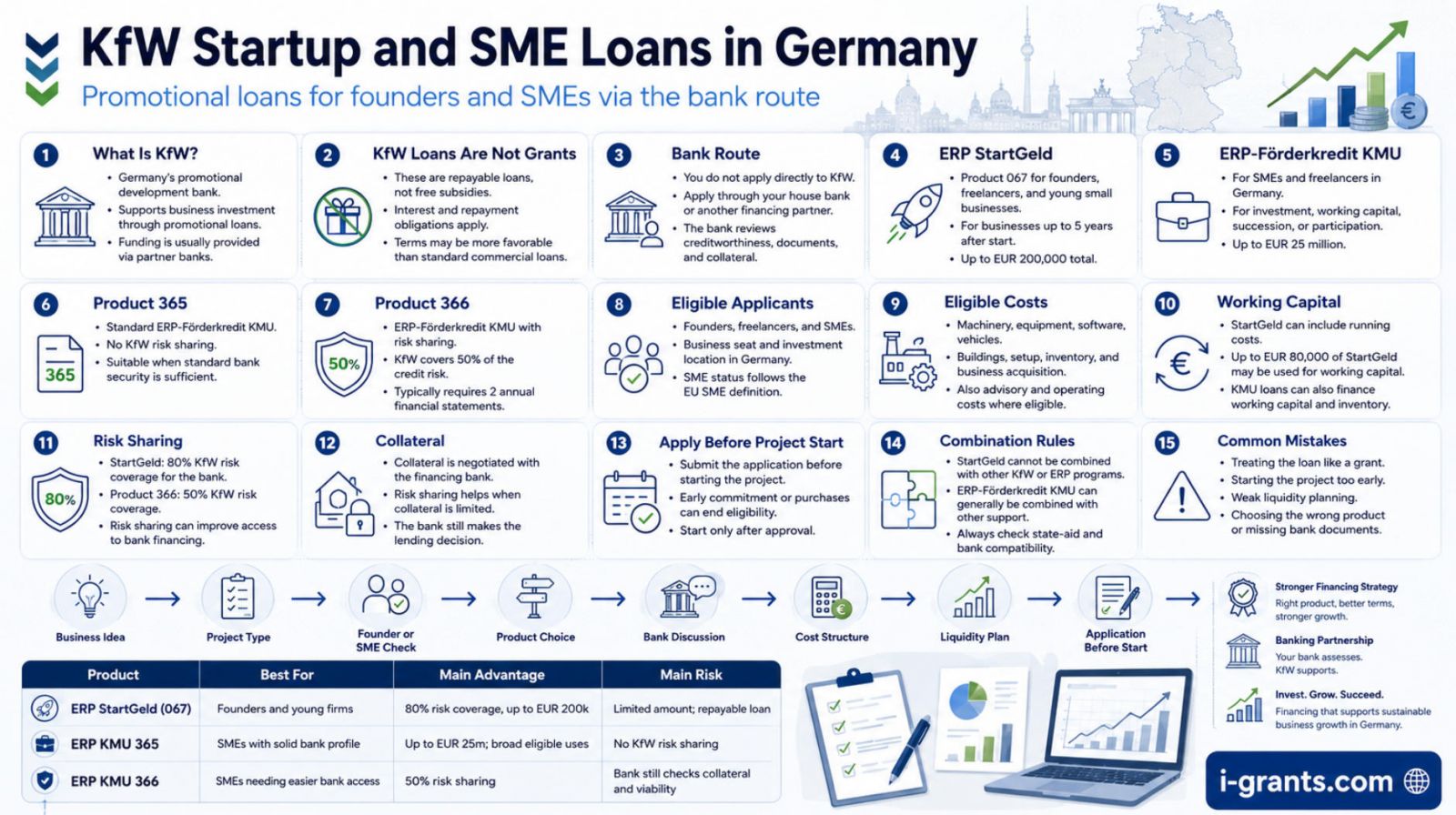
The practical route normally starts before the applicant signs binding contracts or starts spending. The company prepares a business plan, financing plan, investment budget, liquidity forecast and evidence of personal or business reliability. It then speaks to a financing partner. The financing partner checks whether the case is bankable and whether a KfW programme fits. If the bank supports the case, it forwards the application through the KfW process.
This is not a formality. The financing partner carries part of the risk and remains the borrower’s contractual counterpart. Even where KfW takes 80 percent or 50 percent of the credit risk, the bank still has to believe in the project. KfW explains this clearly for ERP-Förderkredit KMU: the individual interest rate is determined by the bank based on location, economic situation and the quality of collateral.
The bank route also means that a KfW loan can fail before it reaches KfW if the financing partner is not convinced. This is why applicants should not approach the bank with a vague idea and a wish for low-interest funding. They should approach it with a structured financing case.
A strong KfW loan case usually answers four questions at the same time: what the company wants to finance, why the project is commercially reasonable, how the loan will be repaid, and how the bank’s remaining risk is managed. If one of these parts is weak, the promotional nature of the loan may not be enough.
ERP-Gründerkredit StartGeld for Founders and Young Small Companies
ERP-Gründerkredit StartGeld is one of the most relevant KfW products for founders, freelancers and young small companies. KfW describes it as financing for business creation and consolidation in full-time or part-time self-employment. It can support investments and current costs, requires no equity capital and offers easier access to credit because KfW assumes 80 percent of the credit risk.
The loan amount can be up to EUR 200,000, with up to EUR 80,000 available for working capital. KfW pays out 100 percent of the loan amount, and the funds can be drawn within twelve months after approval. The product can be requested more than once until the maximum amount is reached.
The eligible uses are broad. KfW lists investments such as machinery, land, buildings, business equipment and company vehicles. It also lists working capital items such as personnel costs, rent, marketing expenses, trade fair participation, consulting costs, leasing instalments, material and inventory, and the purchase of a company or company share.
A major 2026 update is that nonprofit enterprises are again eligible for ERP-Gründerkredit StartGeld from 1 February 2026. KfW announced that, following the ERP Economic Planning Act 2026, the programme was reopened to nonprofit enterprises, including small social commercial enterprises and small nonprofit enterprises. This makes StartGeld more relevant not only for classic commercial founders, but also for social business models with a public-benefit orientation.
For applicants, the practical message is clear: StartGeld can help reduce the collateral barrier, but it does not remove the need for a credible business concept. A founder still needs to show market understanding, pricing, revenue logic, realistic costs, liquidity planning and repayment capacity. No equity capital is required by the product, but own funds can still improve the bank’s view of commitment and risk.
ERP-Förderkredit KMU for Growth, Working Capital and Succession
ERP-Förderkredit KMU is broader than StartGeld. KfW describes it as a loan for small and medium-sized enterprises and freelancers, covering investments, working capital, business formation, succession and participation. It can provide up to EUR 25 million for eligible projects, with maturities of up to 20 years and up to three repayment-free years depending on the financing case.
There are two main variants. Product 365 is the route without KfW risk assumption. Product 366 includes optional KfW risk assumption. Under the risk-assumption version, the loan can be up to EUR 25 million for investments, acquisition and participation, and up to EUR 7.5 million for working capital, material and inventory. KfW states that purchases, ongoing costs and material or inventory can be financed up to 100 percent.
The risk-assumption variant is especially important for SMEs that have a viable project but limited collateral. KfW explains that it can optionally assume 50 percent of the credit risk, which reduces the financing partner’s possible loss and can make banks more willing to finance a project even with limited collateral.
Still, risk sharing is not a free pass. The financing partner still reviews the company’s financial condition, collateral, management quality and repayment capacity. For the risk-assumption version, KfW states that the applicant must be able to present two annual financial statements. This makes it more suitable for established SMEs than for very early-stage founders.
ERP-Förderkredit Gründung und Nachfolge as a Special Route
ERP-Förderkredit Gründung und Nachfolge (077) should not be confused with StartGeld. It is a separate route for founders, business successors and young companies. KfW describes it as financing for business creation, succession and the expansion of young companies, with investment and working capital uses. Its distinctive feature is a 100 percent guarantee by a guarantee bank.
The maximum loan amount is EUR 500,000 per applicant, but the loan may not exceed 35 percent of eligible costs. The product therefore does not replace a full financing structure. It is part of a financing package, especially where guarantee-bank involvement is useful.
The route is more complex than a simple bank loan. KfW explains that the applicant requests the loan from a financing partner, not directly from KfW. After a positive risk assessment by the guarantee bank, KfW checks eligibility and sends the approval to the financing partner. Once the financing partner receives approval, the loan agreement can be concluded and the project can start.
For grant writers and financial advisers, the value of this product is diagnostic. A founder should not automatically assume that StartGeld is the only relevant KfW startup route. The right choice depends on project size, own funds, bank appetite, guarantee-bank route, eligible costs and whether the case is a new business, a succession or the growth of a young company.
Table 2. Which KfW Product Fits Which Financing Situation?
| Financing situation | Likely product to examine first | Why it may fit | Main caution |
|---|---|---|---|
| Solo founder starting a small service business | ERP-Gründerkredit StartGeld | Broad use, no equity capital required, risk relief for the bank | The bank still needs a credible income and liquidity plan |
| Young small company buying machinery and inventory | ERP-Gründerkredit StartGeld or ERP-Förderkredit KMU | StartGeld may fit if the company is within five years and loan size is modest, KMU loan may fit larger needs | StartGeld cannot be combined with other KfW or ERP programmes |
| Established SME expanding production | ERP-Förderkredit KMU | Larger loan amount, investment and working capital coverage | Collateral, profitability and repayment capacity remain central |
| SME with limited collateral but two annual financial statements | ERP-Förderkredit KMU with risk assumption (366) | KfW can assume 50 percent of credit risk | The bank still carries risk and must approve the case |
| Business succession or takeover | StartGeld, ERP-Förderkredit KMU or ERP-Förderkredit Gründung und Nachfolge | All may be relevant depending on amount, age of business and structure | Valuation, purchase price and post-takeover cash flow need careful analysis |
| Social enterprise or nonprofit business model | ERP-Gründerkredit StartGeld | KfW reopened StartGeld for nonprofit enterprises from 1 February 2026 | The business still needs a repayment model and bank acceptance |
| Digitalisation or innovation investment | ERP-Förderkredit KMU or dedicated ERP digitalisation and innovation loans | Dedicated KfW products may offer additional advantages | Product fit and documentation requirements must be checked separately |
Eligible Costs and the Difference Between Eligible and Bankable
KfW startup and SME loans can finance a wider set of costs than many grant programmes. StartGeld can support investments and working capital, including machinery, land, buildings, equipment, company vehicles, personnel costs, rent, marketing, trade fairs, consulting, leasing, material, inventory and business purchases. ERP-Förderkredit KMU also covers investments, working capital, inventory, business formation, succession and participation.
This does not mean that every cost is equally convincing to a bank. A machine that directly increases production capacity may be easier to justify than a large marketing budget with uncertain conversion. A building investment may create collateral but may also increase fixed costs. Working capital may be eligible, but it often requires a stronger liquidity explanation because it does not always create assets that the bank can secure.
The key distinction is between “eligible under the programme” and “bankable in the financing discussion”. Eligibility answers whether the KfW product can cover the cost category. Bankability answers whether a financing partner believes the project can repay the loan. Strong applications address both questions.
Table 3. Eligible Cost Categories and Bankability Questions
| Cost category | Typical KfW relevance | Bankability question |
|---|---|---|
| Machinery and equipment | Often eligible in StartGeld and ERP-Förderkredit KMU | Will the asset generate capacity, productivity or revenue that supports repayment? |
| Land, buildings and construction costs | Can be eligible depending on the product and project | Is the valuation realistic, and does the site support the business model? |
| Business equipment and vehicles | Can be eligible, especially when needed for operations | Is the asset essential or merely desirable? |
| Working capital | Can be eligible, including personnel, rent and operating costs | How long will the business need liquidity before revenues cover costs? |
| Marketing, trade fairs and consulting | Can be eligible in StartGeld and KMU loan logic | Is there a credible customer acquisition or implementation plan? |
| Material and inventory | Can be eligible | Are turnover assumptions, margins and stock levels realistic? |
| Business purchase or participation | Can be eligible in several products | Is the purchase price justified by cash flow, assets and succession strategy? |
| Software and digital investment | Can be relevant under KMU and dedicated digitalisation routes | Does the digital investment improve processes, data use, sales or productivity? |
Interest Rates, Collateral and Risk Sharing
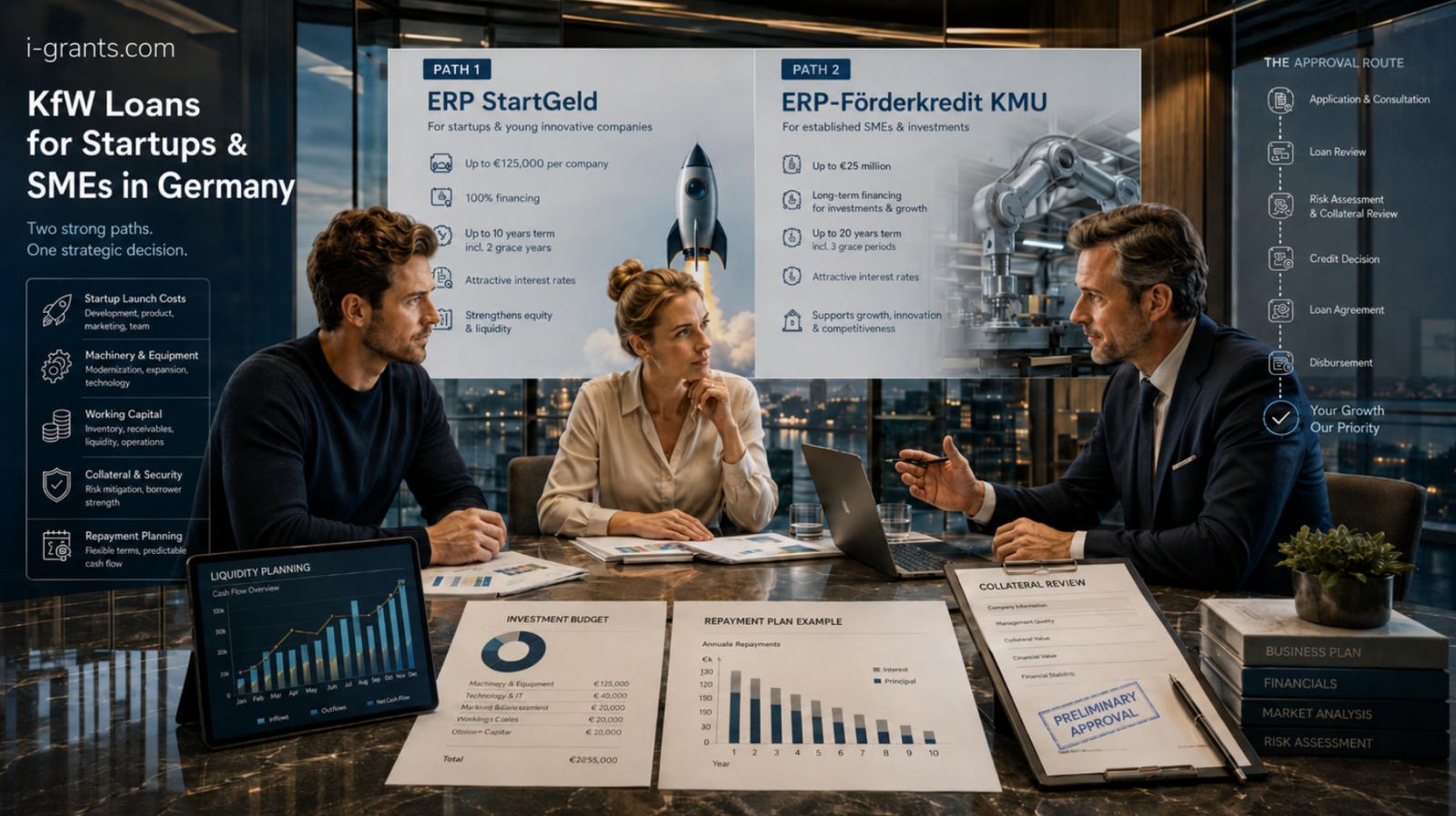
Applicants often focus on the interest advantage, but the actual credit decision depends on more than the programme rate. KfW states that in ERP-Förderkredit KMU, the individual price class is determined by the bank based on the applicant’s location, economic situation and collateral quality. This is a crucial point for SMEs because it shows that the promotional product does not remove bank risk assessment.
Collateral also remains important. For both StartGeld and ERP-Förderkredit KMU, KfW states that the type and amount of collateral are agreed with the bank. Risk assumption can improve the bank’s willingness to finance, but it does not mean that the applicant has no risk. The borrower remains responsible for repayment.
Own funds are not always mandatory. KfW states in its FAQ for ERP-Förderkredit KMU that the product can enable 100 percent financing and that own funds are not strictly required. However, KfW also notes that using own funds is recommended because the financing partner usually assesses creditworthiness more favourably when the applicant contributes at least part of the financing, which may have a positive effect on the interest rate.
For grant writers, this is one of the most important advisory points. The question is not only “Can the programme finance 100 percent?” It is “Will the bank consider this financing structure credible?” A project with some own contribution, realistic sales forecasts and clear collateral logic may be much stronger than a fully debt-financed project with optimistic assumptions.
Timing: Apply Before the Project Starts
Like many German funding instruments, KfW promotional loans follow a strict timing logic. The applicant should speak with the financing partner and submit the KfW loan request before starting the project. For StartGeld, KfW explicitly states that the promotional loan must be requested from the financing partner before the project begins. After KfW approval, the applicant can conclude the loan agreement with the financing partner and start the project.
ERP-Förderkredit KMU follows the same sequence. The loan must be requested from the financing partner before the project begins, and after KfW approval the borrower can conclude the loan agreement and start implementation.
This rule is often underestimated. A founder may think that signing a lease, ordering equipment or paying deposits is simply preparation. A bank or funding programme may treat these actions as project start or as risk-relevant commitments. The safest practical approach is to clarify the KfW route before entering binding obligations.
Combination With Other Funding
Combination rules differ by product. StartGeld cannot be combined with other KfW or ERP programmes. This is important for founders who want to mix several promotional routes. If StartGeld is used, the applicant should check whether it blocks other KfW or ERP financing for the same case.
ERP-Förderkredit KMU is more flexible. KfW states that it can generally be combined with other promotional funds, including loans, allowances and grants. However, flexibility does not mean that every combination is automatically safe. State aid rules, de minimis declarations, cumulation declarations and programme-specific ceilings may still apply. The KfW product page for ERP-Förderkredit KMU includes forms such as a de minimis declaration and a cumulation declaration, which shows that combination must be documented carefully.
This matters when KfW loans are used alongside GRW grants, BAFA energy-efficiency support, innovation funding, regional support or tax incentives. The financing plan should show which source finances which cost, whether aid ceilings are respected and whether the same eligible cost is being supported twice.
Digitalisation and Innovation as Adjacent Routes
This article focuses on StartGeld and ERP-Förderkredit KMU, but applicants should know that KfW also offers dedicated routes for digitalisation and innovation. ERP-Förderkredit Digitalisierung can finance digitalisation projects for companies and freelancers, with loan amounts up to EUR 7.5 million in stage 1 or up to EUR 25 million in stages 2 and 3. The risk-assumption version provides a 50 percent risk-sharing structure with the participating credit institution.
ERP-Förderkredit Innovation is aimed at innovation projects in the Mittelstand. KfW describes it as a loan for companies and freelancers, with interest advantages and a grant of up to 5 percent for demanding projects, as well as optional risk sharing with the house bank.
The need for such instruments is visible in KfW’s research. The KfW SME Innovation Report 2025 states that 41 percent of SMEs introduced at least one innovation in the previous three years, while innovation expenditure was rising even after adjustment for inflation. At the same time, innovation activity remains strongly concentrated among a few, primarily larger companies.
For applicants, the strategic lesson is that ERP-Förderkredit KMU is not always the only or best route. If the project is mainly a digitalisation or innovation project, a dedicated KfW route may offer a better fit. If the project is a broader investment, working-capital or succession case, StartGeld or ERP-Förderkredit KMU may be more relevant.
Table 4. KfW Application Strategy for Startups and SMEs
| Application step | What the applicant should prepare | What the financing partner will assess |
|---|---|---|
| Product selection | Compare StartGeld, ERP-Förderkredit KMU, 077 and possible digitalisation or innovation routes | Whether the applicant and project match the target group and product rules |
| Business plan | Explain market, customers, revenue model, pricing, team and implementation plan | Whether the business model is plausible and commercially viable |
| Investment and cost plan | Separate investment, working capital, inventory, consulting, marketing and acquisition costs | Whether costs are necessary, reasonable and connected to the business objective |
| Liquidity forecast | Show monthly liquidity, expected revenue, cost structure and repayment capacity | Whether the borrower can service the debt even in slower revenue scenarios |
| Collateral and own funds | Present available collateral, guarantees, private or business assets and own contribution | How much residual risk remains for the bank after any KfW risk assumption |
| Timing control | Avoid binding commitments before the KfW application route is clarified | Whether the project was requested before project start |
| Funding combination | Map other grants, loans, guarantees or tax incentives | Whether cumulation and state aid rules are respected |
| Post-approval use | Document use of funds and keep invoices, contracts and evidence | Whether loan funds are used in line with the approved purpose |
Common Mistakes in KfW Loan Applications
The first mistake is calling the loan a grant. This creates wrong expectations from the start. KfW may provide favourable conditions, but the borrower still carries repayment responsibility.
The second mistake is approaching the bank too late. If the applicant has already signed contracts, ordered equipment or started implementation, the financing route may become more difficult or even impossible. The timing rule should be part of the project plan from day one.
The third mistake is treating risk assumption as approval. KfW risk sharing can reduce the financing partner’s exposure, but it does not force a bank to lend. The bank still checks the borrower, the collateral and the repayment plan.
The fourth mistake is presenting a business plan that is descriptive rather than financial. A nice story about a market opportunity is not enough. The plan needs numbers, margins, liquidity, customer assumptions and repayment logic.
The fifth mistake is underestimating working capital. Many founders calculate equipment and setup costs but ignore the months before revenues stabilise. KfW can finance working capital in relevant products, but the need must be realistic and documented.
The sixth mistake is combining funding instruments without a clear state-aid and cost map. This is especially risky when a company uses KfW loans together with regional grants, energy support, innovation funding or de minimis aid.
How Grant Writers Can Add Value
For KfW loans, a grant writer’s role is not simply to write a narrative. The real value is in structuring the financing case before it reaches the bank. This includes choosing the correct product, separating eligible costs from total project costs, preparing a bank-ready business plan, building a liquidity model, checking the project-start rule, identifying collateral issues and mapping combination with other funding instruments.
The best KfW support also translates grant logic into bank language. A public funding argument might say that the project supports innovation, entrepreneurship or regional development. A bank argument must also show cash flow, repayment, risk control and financial resilience. The strongest applications combine both.
For startups, this may mean turning an idea into a credible first financing round. For SMEs, it may mean structuring investment, working capital and possible grants into one coherent package. For succession cases, it may mean explaining the acquisition price, transition plan, customer retention and post-takeover repayment capacity.
Final Takeaway
KfW startup and SME loans are among the most important public financing routes for business investment in Germany, but they should not be confused with grants. ERP-Gründerkredit StartGeld can help founders and young small companies finance setup, investment and working capital, with KfW assuming 80 percent of the bank’s credit risk. ERP-Förderkredit KMU can finance larger SME investments, working capital, succession and participation, with an optional 50 percent risk assumption in the 366 variant. ERP-Förderkredit Gründung und Nachfolge can be useful in selected startup and succession cases involving a guarantee bank.
The opportunity is significant, but the logic is disciplined. Applicants need a bankable project, realistic liquidity, credible repayment capacity, clean timing and a correct funding route. For i-grants.com users, the most important message is this: KfW is not about free money. It is about making a solid business project easier to finance through the right promotional loan structure.